By: A h s a n I r f a n S h a i k h
Define Olap (data ware house)?
Define Oltp?
Comparison between data ware house and
OLTP ?
“AGENDA”
 A data warehouse is a repository (collection of resources that
can be accessed to retrieve information)
 - OLAP (On-line Analytical Processing) is characterized by
relatively low volume of transactions. Queries are often very
complex and involve aggregations..
 OLAP applications are widely used by Data Mining
techniques.
 In OLAP database there is aggregated, historical data, stored
in multi-dimensional schemas (usually star schema).
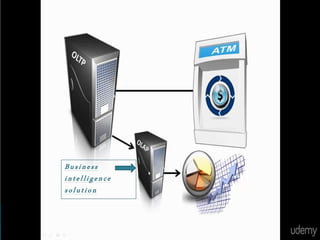
 OLTP (On-line Transaction Processing) is characterized by a
large number of short on-line transactions (INSERT, UPDATE,
DELETE).
 These system have detailed day to day transaction data which
keeps changing, on everyday basis.
 In OLTP database there is detailed and current data, and
schema used to store transactional databases is the entity
model (usually 3NF).
Business
intelligence
solution
 Both are related to information databases, which
provide the means and support for these two types
of functioning.
 Each one of the methods creates a different branch
on data management system, with it’s own ideas
and processes, but they complement themselves.
 To analyze and compare them we’ve built this
resource!
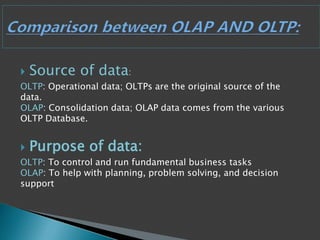
 Source of data:
OLTP: Operational data; OLTPs are the original source of the
data.
OLAP: Consolidation data; OLAP data comes from the various
OLTP Database.
 Purpose of data:
OLTP: To control and run fundamental business tasks
OLAP: To help with planning, problem solving, and decision
support
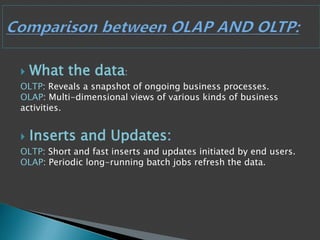
 What the data:
OLTP: Reveals a snapshot of ongoing business processes.
OLAP: Multi-dimensional views of various kinds of business
activities.
 Inserts and Updates:
OLTP: Short and fast inserts and updates initiated by end users.
OLAP: Periodic long-running batch jobs refresh the data.
 Queries:
OLTP: Relatively standardized and simple queries Returning
relatively few records.
OLAP: Often complex queries involving aggregations
 Processing Speed:
OLTP: Typically very fast.
OLAP: Depends on the amount of data involved; batch data
refreshes and complex queries may take many hours.
 Space Requirements:
 OLTP: Can be relatively small if historical data is archived.
OLAP: Larger due to the existence of aggregation structures
and history data.
 Database Design :
OLTP: Highly normalized with many tables.
OLAP: Typically de-normalized with fewer tables.
 OLTP systems is
absolutely critical, it
needs a complex
backup system.
 Full backups of the
data combined with
incremental backups
are required.
 OLAP only needs a
backup from time to
time
 since it’s data is not
critical and doesn’t
keep the system
running.
Backup and Recovery
THE END… 
THANKYOU!

OLAP v/s OLTP

  • 2.
    By: A hs a n I r f a n S h a i k h
  • 3.
    Define Olap (dataware house)? Define Oltp? Comparison between data ware house and OLTP ? “AGENDA”
  • 4.
     A datawarehouse is a repository (collection of resources that can be accessed to retrieve information)  - OLAP (On-line Analytical Processing) is characterized by relatively low volume of transactions. Queries are often very complex and involve aggregations..  OLAP applications are widely used by Data Mining techniques.  In OLAP database there is aggregated, historical data, stored in multi-dimensional schemas (usually star schema).
  • 5.
     OLTP (On-lineTransaction Processing) is characterized by a large number of short on-line transactions (INSERT, UPDATE, DELETE).  These system have detailed day to day transaction data which keeps changing, on everyday basis.  In OLTP database there is detailed and current data, and schema used to store transactional databases is the entity model (usually 3NF).
  • 6.
  • 7.
     Both arerelated to information databases, which provide the means and support for these two types of functioning.  Each one of the methods creates a different branch on data management system, with it’s own ideas and processes, but they complement themselves.  To analyze and compare them we’ve built this resource!
  • 8.
     Source ofdata: OLTP: Operational data; OLTPs are the original source of the data. OLAP: Consolidation data; OLAP data comes from the various OLTP Database.  Purpose of data: OLTP: To control and run fundamental business tasks OLAP: To help with planning, problem solving, and decision support
  • 9.
     What thedata: OLTP: Reveals a snapshot of ongoing business processes. OLAP: Multi-dimensional views of various kinds of business activities.  Inserts and Updates: OLTP: Short and fast inserts and updates initiated by end users. OLAP: Periodic long-running batch jobs refresh the data.
  • 10.
     Queries: OLTP: Relativelystandardized and simple queries Returning relatively few records. OLAP: Often complex queries involving aggregations  Processing Speed: OLTP: Typically very fast. OLAP: Depends on the amount of data involved; batch data refreshes and complex queries may take many hours.
  • 11.
     Space Requirements: OLTP: Can be relatively small if historical data is archived. OLAP: Larger due to the existence of aggregation structures and history data.  Database Design : OLTP: Highly normalized with many tables. OLAP: Typically de-normalized with fewer tables.
  • 12.
     OLTP systemsis absolutely critical, it needs a complex backup system.  Full backups of the data combined with incremental backups are required.  OLAP only needs a backup from time to time  since it’s data is not critical and doesn’t keep the system running. Backup and Recovery
  • 14.