Business
intelligence
and analytics.
OLAP
It is a multidimensional database where
the physical storage of the data is done in
a one-dimensional vector.
The creator of the OLAP idea was Edgar
Frank Codd, known forerunner of related
databases.
His initial proposal was to make a
disposition of the data in a vector to allow
a quick analysis.
Control elements:
● Decision variables: they represent a
measurement of the business.
● They are based on the concept of data
cube.
● Offer the user a multidimensional view of
the data.
● Do not impose restrictions.
● Offer symmetries for the dimensions.
● Allow flexible definition of dimensions,
restrictions, aggregations and hierarchy
between them.
● Offer intuitive operators.
● Be transparent to the type of technologies
supported by the ROLAP or MOLAP
warehouse.
OLAP Tools:
OLAP CUBES.
It is a database that has several
dimensions, expanding the
possibilities that until now offered
the known spreadsheets.
OLAP systems are usually composed
of three dimensions, but they can
have more, and the dimensions of
the cube correspond to a hierarchy
of data.
MOLAP
It is implemented in a
multidimensional database where
data is stored to provide analysis.
The data is organized in a cube-like
structure that the user can rotate.
It is very suitable for summaries and
financial reports.
ROLAP
It is implemented with a relational
database for handling, access and
data collection, but they have some
facilities to improve performance.
The system accesses directly the
data stored in a data warehouse to
provide the specific analyzes.
It handles the data warehouse
requirements and the ROLAP engine
provides the analytical function.
HOLAP (OLAP
hybridized
It stores some data in a relational
engine and others, in a
multidimensional dats database.
Try to combine the advantages of
MOLAP and ROLAP.
For example, when summary
information is needed, HOLAP
enhances cube technology for faster
performance.
When detailed information is
needed, HOLAP relies on rational
data.
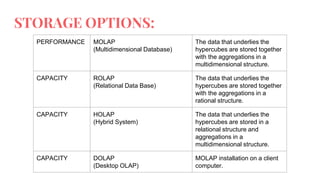
STORAGE OPTIONS:
PERFORMANCE MOLAP
(Multidimensional Database)
The data that underlies the
hypercubes are stored together
with the aggregations in a
multidimensional structure.
CAPACITY ROLAP
(Relational Data Base)
The data that underlies the
hypercubes are stored together
with the aggregations in a
rational structure.
CAPACITY HOLAP
(Hybrid System)
The data that underlies the
hypercubes are stored in a
relational structure and
aggregations in a
multidimensional structure.
CAPACITY DOLAP
(Desktop OLAP)
MOLAP installation on a client
computer.
OLAP providers:
❖ OLAP MICROSOFT.
❖ BUSINESS OBJECT.
❖ QLIKVIEW OF QLIKTECH.
❖ MICROSTRATEGY OLAP.
❖ COGNOS OLAP.
❖ IBM OLAP.
❖ INFORMATION BUILDER.
❖ ORACLE.
❖ SAS INSTITUTE.
❖ SPSS/IBM.
OLAP

OLAP

  • 1.
  • 2.
    OLAP It is amultidimensional database where the physical storage of the data is done in a one-dimensional vector. The creator of the OLAP idea was Edgar Frank Codd, known forerunner of related databases. His initial proposal was to make a disposition of the data in a vector to allow a quick analysis.
  • 3.
    Control elements: ● Decisionvariables: they represent a measurement of the business. ● They are based on the concept of data cube. ● Offer the user a multidimensional view of the data. ● Do not impose restrictions. ● Offer symmetries for the dimensions. ● Allow flexible definition of dimensions, restrictions, aggregations and hierarchy between them. ● Offer intuitive operators. ● Be transparent to the type of technologies supported by the ROLAP or MOLAP warehouse. OLAP Tools:
  • 4.
    OLAP CUBES. It isa database that has several dimensions, expanding the possibilities that until now offered the known spreadsheets. OLAP systems are usually composed of three dimensions, but they can have more, and the dimensions of the cube correspond to a hierarchy of data.
  • 5.
    MOLAP It is implementedin a multidimensional database where data is stored to provide analysis. The data is organized in a cube-like structure that the user can rotate. It is very suitable for summaries and financial reports.
  • 6.
    ROLAP It is implementedwith a relational database for handling, access and data collection, but they have some facilities to improve performance. The system accesses directly the data stored in a data warehouse to provide the specific analyzes. It handles the data warehouse requirements and the ROLAP engine provides the analytical function.
  • 7.
    HOLAP (OLAP hybridized It storessome data in a relational engine and others, in a multidimensional dats database. Try to combine the advantages of MOLAP and ROLAP. For example, when summary information is needed, HOLAP enhances cube technology for faster performance. When detailed information is needed, HOLAP relies on rational data.
  • 8.
    STORAGE OPTIONS: PERFORMANCE MOLAP (MultidimensionalDatabase) The data that underlies the hypercubes are stored together with the aggregations in a multidimensional structure. CAPACITY ROLAP (Relational Data Base) The data that underlies the hypercubes are stored together with the aggregations in a rational structure. CAPACITY HOLAP (Hybrid System) The data that underlies the hypercubes are stored in a relational structure and aggregations in a multidimensional structure. CAPACITY DOLAP (Desktop OLAP) MOLAP installation on a client computer.
  • 9.
    OLAP providers: ❖ OLAPMICROSOFT. ❖ BUSINESS OBJECT. ❖ QLIKVIEW OF QLIKTECH. ❖ MICROSTRATEGY OLAP. ❖ COGNOS OLAP. ❖ IBM OLAP. ❖ INFORMATION BUILDER. ❖ ORACLE. ❖ SAS INSTITUTE. ❖ SPSS/IBM.