What is OLAP?
•- OLAP = Online Analytical Processing
• - Technology for interactive, multidimensional
analysis of large data sets
• - Supports business decision-making with fast,
summarized data insights
• - Complementary to OLTP (Online Transaction
Processing)
3.
Why OLAP inBusiness Analytics?
• ✅ Helps uncover trends and patterns
• ✅ Enables strategic planning & forecasting
• ✅ Allows quick answers to complex queries
• ✅ Supports better decision-making through
data insights
4.
Key Features ofOLAP
• - Multidimensional view of data
• - Fast query and retrieval performance
• - Interactive analysis: slice, dice, drill down,
roll up
• - Supports aggregated and summarized data
5.
OLAP vs OLTP
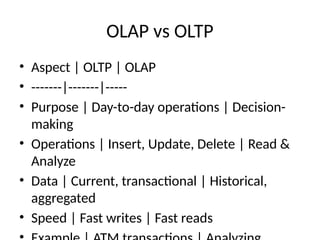
•Aspect | OLTP | OLAP
• -------|-------|-----
• Purpose | Day-to-day operations | Decision-
making
• Operations | Insert, Update, Delete | Read &
Analyze
• Data | Current, transactional | Historical,
aggregated
• Speed | Fast writes | Fast reads
6.
OLAP Operations
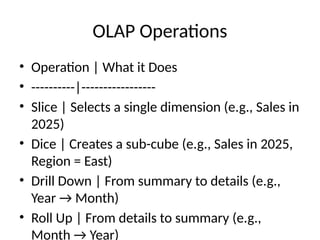
• Operation| What it Does
• ----------|-----------------
• Slice | Selects a single dimension (e.g., Sales in
2025)
• Dice | Creates a sub-cube (e.g., Sales in 2025,
Region = East)
• Drill Down | From summary to details (e.g.,
Year → Month)
• Roll Up | From details to summary (e.g.,
Month → Year)
7.
Types of OLAP
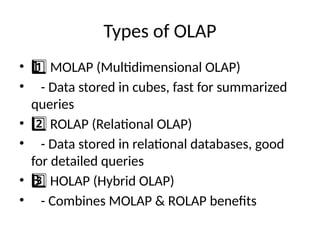
•MOLAP (Multidimensional OLAP)
1 ️
1️⃣
• - Data stored in cubes, fast for summarized
queries
• ROLAP (Relational OLAP)
2️⃣
• - Data stored in relational databases, good
for detailed queries
• HOLAP (Hybrid OLAP)
3 ️
3️⃣
• - Combines MOLAP & ROLAP benefits
8.
Business Applications ofOLAP
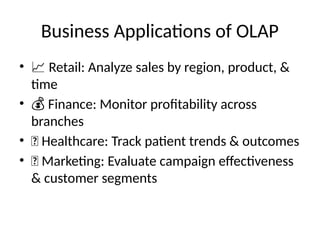
• 📈 Retail: Analyze sales by region, product, &
time
• 💰 Finance: Monitor profitability across
branches
• 🏥 Healthcare: Track patient trends & outcomes
• 📣 Marketing: Evaluate campaign effectiveness
& customer segments
9.
Advantages of OLAP
•🌟 Fast query response
• 🌟 Interactive & intuitive for business users
• 🌟 Supports complex calculations & forecasting
• 🌟 Helps discover hidden insights in big data
10.
Summary
• - OLAPenables fast, multidimensional analysis
of business data
• - Essential for business analytics & decision-
making
• - Complements transactional systems by
analyzing historical & aggregated data