CANCER
M.Prasad Naidu
MSc Medical
Biochemistry,
Ph.D.Research Scholar
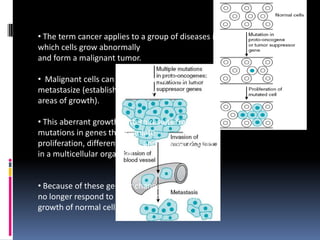
• The term cancer applies to a group of diseases in
which cells grow abnormally
and form a malignant tumor.
• Malignant cells can invade nearby tissues and
metastasize (establish secondary
areas of growth).
• This aberrant growth pattern results from
mutations in genes that regulate
proliferation, differentiation, and survival of cells
in a multicellular organism.
• Because of these genetic changes, cancer cells
no longer respond to the signals that govern
growth of normal cells
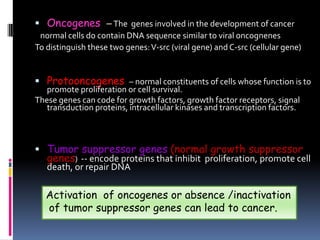
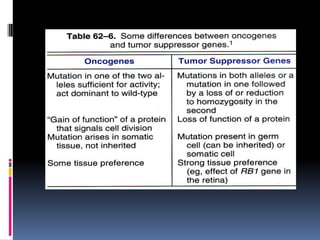
 Oncogenes – The genes involved in the development of cancer
normal cells do contain DNA sequence similar to viral oncognenes
To distinguish these two genes:V-src (viral gene) and C-src (cellular gene)
 Protooncogenes – normal constituents of cells whose function is to
promote proliferation or cell survival.
These genes can code for growth factors, growth factor receptors, signal
transduction proteins, intracellular kinases and transcription factors.
 Tumor suppressor genes (normal growth suppressor
genes) -- encode proteins that inhibit proliferation, promote cell
death, or repair DNA
Activation of oncogenes or absence /inactivation
of tumor suppressor genes can lead to cancer.
Protooncogenes are regulatory genes
 Products of many oncogene are polypeptide growth factor
ex: sis gene produce PDGF - normal wound healing.
 Product act as receptor for growth factor
ex: erb-B produces receptor for EGF
 Some act on key IC pathway involved in growth control
ex: Src Product receptor of EGF, insulin, PDGF.
 C-oncogenes are under the control of regulatory genes & expressed
only when required.
 When virus enters, an extra oncogene is inserted so as to produce
continuous expression of gene leading to uncontrolled cellular
activity & malignant transformation.
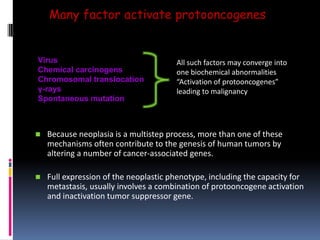
Many factor activate protooncogenes
 Because neoplasia is a multistep process, more than one of these
mechanisms often contribute to the genesis of human tumors by
altering a number of cancer-associated genes.
 Full expression of the neoplastic phenotype, including the capacity for
metastasis, usually involves a combination of protooncogene activation
and inactivation tumor suppressor gene.
Virus
Chemical carcinogens
Chromosomal translocation
γ-rays
Spontaneous mutation
All such factors may converge into
one biochemical abnormalities
“Activation of protooncogenes”
leading to malignancy
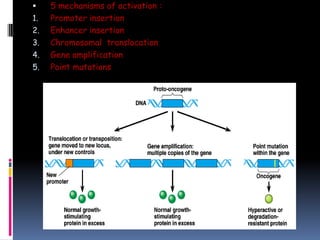
 5 mechanisms of activation :
1. Promoter insertion
2. Enhancer insertion
3. Chromosomal translocation
4. Gene amplification
5. Point mutations
1. Promoter Insertion
• Certain retro viruses lack oncogenes ( eg : avian leukemia
viruses ) but may cause cancer over a long period of time.
Viral insertion into chromosomes:
 In retrovirus, cDNA is made from their RNA by enzyme
reverse transcriptase.
 cDNA gets inserted into host genome
 Integrated dscDNA provirus
 This proviral DNA takes over the control of transcription of
cellular chromosomal DNA & transforms the cell.
eg: Avian leukemia
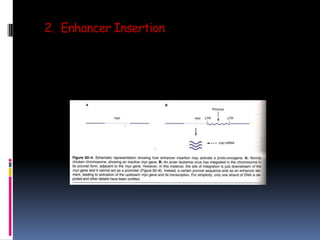
2. Enhancer Insertion
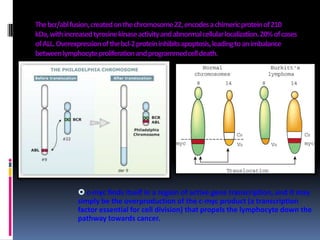
3. Chromosomal translocation
 Rearrangement of genetic material by splitting off a small
fragment of chromosome which is joined to another
chromosome.
 Over expression of proto oncogenes
eg: Burkitts lymphoma
Chronic myeloid leukemia
Thebcr/ablfusion,createdonthechromosome22,encodesachimericproteinof210
kDa,withincreasedtyrosinekinaseactivityandabnormalcellularlocalization.20%ofcases
ofALL.Overexpressionofthebcl-2proteininhibitsapoptosis,leadingtoanimbalance
betweenlymphocyteproliferationandprogrammedcelldeath.
 c-myc finds itself in a region of active gene transcription, and it may
simply be the overproduction of the c-myc product (a transcription
factor essential for cell division) that propels the lymphocyte down the
pathway towards cancer.
4. Gene amplification
• Certain DNA sequence is amplified several fold in some cancers.
•Gene amplification was first discovered as a mechanism by which some
tumor cell lines can acquire resistance to growth-inhibiting drugs.
Methotrexate becomes inactive due to gene amplification resulting in a
several fold increase in activity of DHR.
• Studies then demonstrated that three protooncogene families-myc, erb B,
and ras-are amplified in a significant number of human tumors.
•About 20% to 30% of breast and ovarian cancers and some types of SCC
show c-myc amplification.
•Amplification of N-myc correlates strongly with advanced tumor stage in
neuroblastoma
5. Mutations:
 Mutations activate protooncogenes through structural alterations.
These alterations, which usually involve critical protein regulatory
regions, often lead to the uncontrolled, continuous activity of the
mutated protein.
 Various types of mutations, such as base substitutions, deletions, and
insertions, are capable of activating protooncogenes.
 In human tumors the most characterized oncogene mutations are
base substitutions (point mutations) that change a single amino acid
within the protein.
 Mutations in DNA that give rise to cancer may be inherited or caused
by chemical carcinogens, radiation, viruses, and by replication errors
that are not repaired.
Point mutation
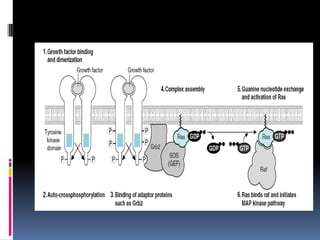
 Point mutations are frequently detected in the ras family of
protooncogenes (K-ras, H-ras, and N-ras).
 Single most dominant cause of many human tumor.
 Ras protein M.W 21000(P21)
 Inactive ras is in bound state with GDP.
 When cells are stimulated by GF, ras P21 get activated by
exchanging GDP for GTP.
 In normal cells, the activity of ras P21 is short lived because
of GTPase activity.
 Point mutation cause altered ras P21 lacking GTPase activity
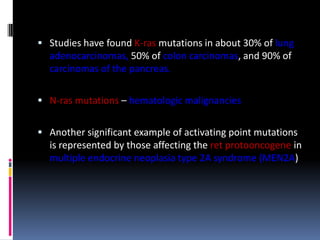
 Studies have found K-ras mutations in about 30% of lung
adenocarcinomas, 50% of colon carcinomas, and 90% of
carcinomas of the pancreas.
 N-ras mutations – hematologic malignancies
 Another significant example of activating point mutations
is represented by those affecting the ret protooncogene in
multiple endocrine neoplasia type 2A syndrome (MEN2A)
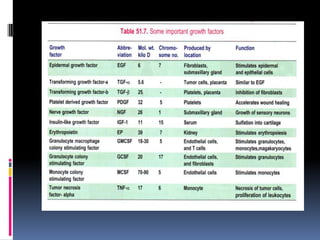
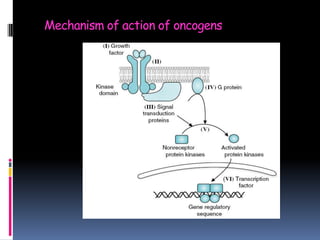
 The genes for both growth factors and growth factor receptors are oncogenes.
 Growth factors generally regulate growth by serving as ligands that bind to
cellular receptors located on the plasma membrane (cell-surface receptors) .
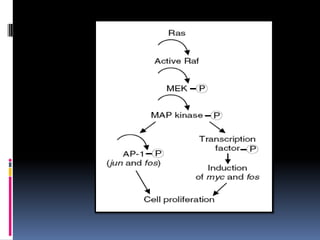
 Binding of ligands to these receptors stimulates a signal transduction pathway
in the cell activating the transcription of certain genes.
 If too much of a growth factor or a growth factor receptor is produced, the target
cells may respond by proliferating inappropriately.
 Growth factors receptors may also become oncogenic through translocation or
point mutations.
Growth factors
Mechanism of action of oncogens
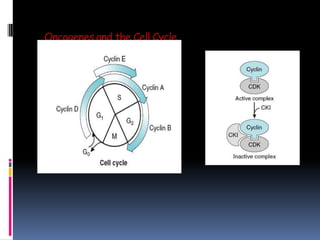
Oncogenes and the Cell Cycle
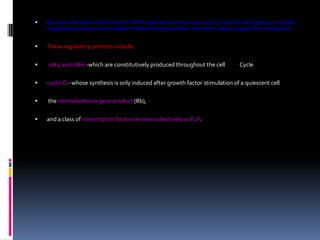
 Because the cell is committed to DNA replication and division once it enters the S phase, multiple
regulatory proteins are involved in determining whether the cell is ready to pass this checkpoint.
 These regulatory proteins include:
 cdk4 and cdk6 -which are constitutively produced throughout the cell Cycle
 cyclin D - whose synthesis is only induced after growth factor stimulation of a quiescent cell
 the retinoblastoma gene product (Rb),
 and a class of transcription factors known collectively as E2F.
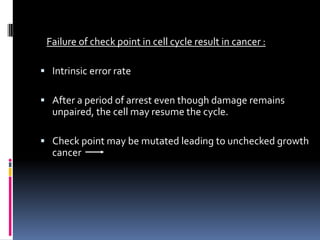
Failure of check point in cell cycle result in cancer :
 Intrinsic error rate
 After a period of arrest even though damage remains
unpaired, the cell may resume the cycle.
 Check point may be mutated leading to unchecked growth
cancer
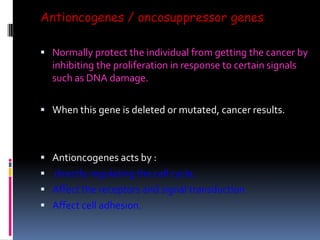
Antioncogenes / oncosuppressor genes
 Normally protect the individual from getting the cancer by
inhibiting the proliferation in response to certain signals
such as DNA damage.
 When this gene is deleted or mutated, cancer results.
 Antioncogenes acts by :
 directly regulating the cell cycle.
 Affect the receptors and signal transduction
 Affect cell adhesion.
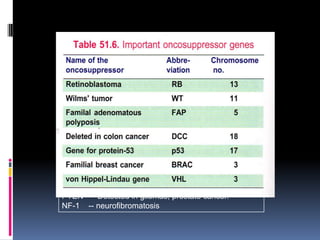
PTEN -- Detected in gliomas, prostate cancer.
NF-1 -- neurofibromatosis
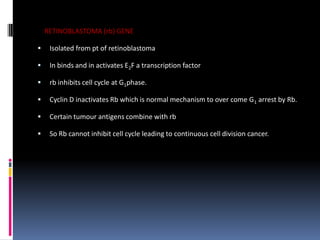
RETINOBLASTOMA (rb) GENE
 Isolated from pt of retinoblastoma
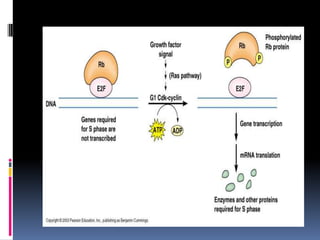
 In binds and in activates E2F a transcription factor
 rb inhibits cell cycle at G1phase.
 Cyclin D inactivates Rb which is normal mechanism to over come G1 arrest by Rb.
 Certain tumour antigens combine with rb
 So Rb cannot inhibit cell cycle leading to continuous cell division cancer.
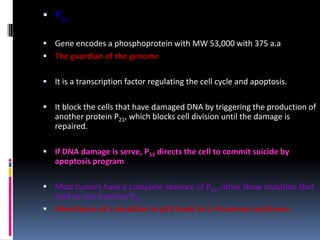
 P53
 Gene encodes a phosphoprotein with MW 53,000 with 375 a.a
 The guardian of the genome
 It is a transcription factor regulating the cell cycle and apoptosis.
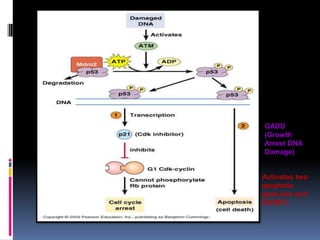
 It block the cells that have damaged DNA by triggering the production of
another protein P21, which blocks cell division until the damage is
repaired.
 If DNA damage is serve, P53 directs the cell to commit suicide by
apoptosis program
 Most tumors have a complete absence of P53 ,other show mutation that
lead to non function P53
 Inheritance of a mutation in p53 leads to Li-Fraumeni syndrome.
GADD
(Growth
Arrest DNA
Damage)
Activates two
apoptotic
gene bax and
IGFBP3
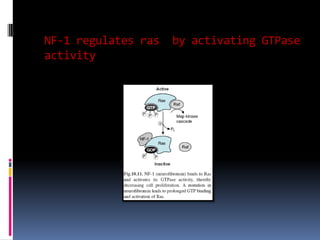
NF-1 regulates ras by activating GTPase
activity
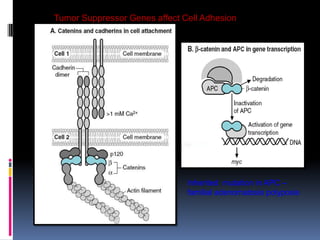
Tumor Suppressor Genes affect Cell Adhesion
Inherited mutation in APC –
familial adenomatosis polyposis
Apoptosis
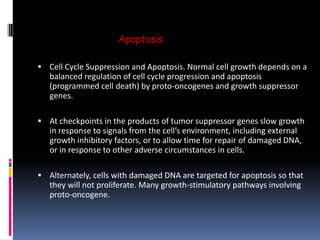
 Cell Cycle Suppression and Apoptosis. Normal cell growth depends on a
balanced regulation of cell cycle progression and apoptosis
(programmed cell death) by proto-oncogenes and growth suppressor
genes.
 At checkpoints in the products of tumor suppressor genes slow growth
in response to signals from the cell’s environment, including external
growth inhibitory factors, or to allow time for repair of damaged DNA,
or in response to other adverse circumstances in cells.
 Alternately, cells with damaged DNA are targeted for apoptosis so that
they will not proliferate. Many growth-stimulatory pathways involving
proto-oncogene.
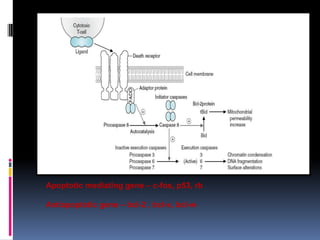
Apoptotic mediating gene – c-fos, p53, rb
Antiapoptotic gene – bcl-2 , bcl-x, bcl-w
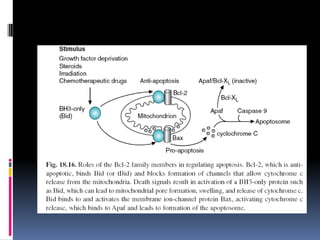
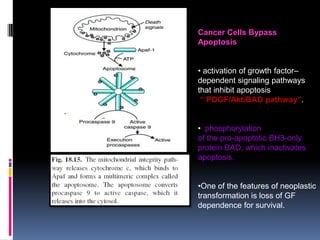
Cancer Cells Bypass
Apoptosis
• activation of growth factor–
dependent signaling pathways
that inhibit apoptosis
“ PDGF/Akt/BAD pathway”.
• phosphorylation
of the pro-apoptotic BH3-only
protein BAD, which inactivates
apoptosis.
•One of the features of neoplastic
transformation is loss of GF
dependence for survival.
Mutations in Repair Enzymes
 DNA repair enzymes are tumor suppressor genes in the sense that errors repaired
before replication do not become mutagenic.
 If DNA repair enzymes are absent, mutations accumulate much more rapidly
 once a mutation develops in a growth regulatory gene, a cancer may arise.
 Ex: inherited mutations in the tumor suppressor genes brca1 and brca2 predispose
women to the development of breast cancer.
 HNPCC (hereditary non-polyposis colon cancer) – due to inherited mutations in
enzymes involved in the DNA mismatch repair system.
 --
Telomerase
 DNA polymerase is unable to replicate the ends of chromosomes
, resulting in loss of DNA at specialized ends of chromosomes called
telomere.
 Telomeres composed of tandem repeats of six nucleotide sequences
( TTAGGG )
 Telomere binds with specialized telomere binding proteins to form a T
loop structure that prevents the ends of chromosomes from being
recognized as broken or damaged DNA.
 Loss of telomere repeats with each cell division cycle causes gradual
telomere shortening leading to growth arrest.
 Critically short telomere triggers a p53 regulated DNA damage check
point , this is called replicative senescence .
 Cells can bypass this growth arrest if rb or p53 are nonfunctional
 Cancer cells activate the enzyme telomerase thus telomere length is
maintained throughout multiple cell division.
 In certain cancer , telomerase activation caused cancer – Dyskeratosis
congenita
 Telomerase is an attractive target for cancer chemotherapy.
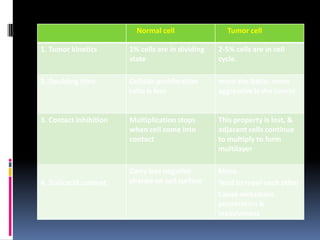
Normal cell Tumor cell
1. Tumor kinetics 1% cells are in dividing
state
2-5% cells are in cell
cycle.
2. Doubling time Cellular proliferation
ratio is less
more the Ratio, more
aggressive is the cancer
3. Contact inhibition Multiplication stops
when cell come into
contact
This property is lost, &
adjacent cells continue
to multiply to form
multilayer
4. Sialicacid content
Carry less negative
change on cell surface
More,
Tend to repel each other
Cause metastatic
penetration &
invasiveness
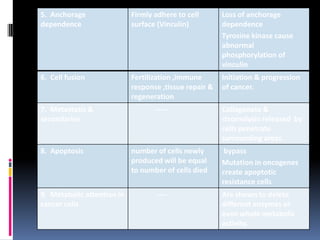
5. Anchorage
dependence
Firmly adhere to cell
surface (Vinculin)
Loss of anchorage
dependence
Tyrosine kinase cause
abnormal
phosphorylation of
vinculin
6. Cell fusion Fertilization ,immune
response ,tissue repair &
regeneration
Initiation & progression
of cancer.
7. Metastasis &
secondaries
----- Collagenase &
stromolysin released by
cells penetrate
surrounding areas.
8. Apoptosis number of cells newly
produced will be equal
to number of cells died
bypass
Mutation in oncogenes
create apoptotic
resistance cells
9. Metabolic attention in
cancer cells
---- Are shown to delete
different enzymes or
even whole metabolic
activity.
Oncogenes

Oncogenes

  • 1.
  • 2.
    • The termcancer applies to a group of diseases in which cells grow abnormally and form a malignant tumor. • Malignant cells can invade nearby tissues and metastasize (establish secondary areas of growth). • This aberrant growth pattern results from mutations in genes that regulate proliferation, differentiation, and survival of cells in a multicellular organism. • Because of these genetic changes, cancer cells no longer respond to the signals that govern growth of normal cells
  • 3.
     Oncogenes –The genes involved in the development of cancer normal cells do contain DNA sequence similar to viral oncognenes To distinguish these two genes:V-src (viral gene) and C-src (cellular gene)  Protooncogenes – normal constituents of cells whose function is to promote proliferation or cell survival. These genes can code for growth factors, growth factor receptors, signal transduction proteins, intracellular kinases and transcription factors.  Tumor suppressor genes (normal growth suppressor genes) -- encode proteins that inhibit proliferation, promote cell death, or repair DNA Activation of oncogenes or absence /inactivation of tumor suppressor genes can lead to cancer.
  • 4.
    Protooncogenes are regulatorygenes  Products of many oncogene are polypeptide growth factor ex: sis gene produce PDGF - normal wound healing.  Product act as receptor for growth factor ex: erb-B produces receptor for EGF  Some act on key IC pathway involved in growth control ex: Src Product receptor of EGF, insulin, PDGF.  C-oncogenes are under the control of regulatory genes & expressed only when required.  When virus enters, an extra oncogene is inserted so as to produce continuous expression of gene leading to uncontrolled cellular activity & malignant transformation.
  • 6.
    Many factor activateprotooncogenes  Because neoplasia is a multistep process, more than one of these mechanisms often contribute to the genesis of human tumors by altering a number of cancer-associated genes.  Full expression of the neoplastic phenotype, including the capacity for metastasis, usually involves a combination of protooncogene activation and inactivation tumor suppressor gene. Virus Chemical carcinogens Chromosomal translocation γ-rays Spontaneous mutation All such factors may converge into one biochemical abnormalities “Activation of protooncogenes” leading to malignancy
  • 7.
     5 mechanismsof activation : 1. Promoter insertion 2. Enhancer insertion 3. Chromosomal translocation 4. Gene amplification 5. Point mutations
  • 8.
    1. Promoter Insertion •Certain retro viruses lack oncogenes ( eg : avian leukemia viruses ) but may cause cancer over a long period of time.
  • 9.
    Viral insertion intochromosomes:  In retrovirus, cDNA is made from their RNA by enzyme reverse transcriptase.  cDNA gets inserted into host genome  Integrated dscDNA provirus  This proviral DNA takes over the control of transcription of cellular chromosomal DNA & transforms the cell. eg: Avian leukemia
  • 10.
  • 11.
    3. Chromosomal translocation Rearrangement of genetic material by splitting off a small fragment of chromosome which is joined to another chromosome.  Over expression of proto oncogenes eg: Burkitts lymphoma Chronic myeloid leukemia
  • 12.
    Thebcr/ablfusion,createdonthechromosome22,encodesachimericproteinof210 kDa,withincreasedtyrosinekinaseactivityandabnormalcellularlocalization.20%ofcases ofALL.Overexpressionofthebcl-2proteininhibitsapoptosis,leadingtoanimbalance betweenlymphocyteproliferationandprogrammedcelldeath.  c-myc findsitself in a region of active gene transcription, and it may simply be the overproduction of the c-myc product (a transcription factor essential for cell division) that propels the lymphocyte down the pathway towards cancer.
  • 13.
    4. Gene amplification •Certain DNA sequence is amplified several fold in some cancers. •Gene amplification was first discovered as a mechanism by which some tumor cell lines can acquire resistance to growth-inhibiting drugs. Methotrexate becomes inactive due to gene amplification resulting in a several fold increase in activity of DHR. • Studies then demonstrated that three protooncogene families-myc, erb B, and ras-are amplified in a significant number of human tumors. •About 20% to 30% of breast and ovarian cancers and some types of SCC show c-myc amplification. •Amplification of N-myc correlates strongly with advanced tumor stage in neuroblastoma
  • 14.
    5. Mutations:  Mutationsactivate protooncogenes through structural alterations. These alterations, which usually involve critical protein regulatory regions, often lead to the uncontrolled, continuous activity of the mutated protein.  Various types of mutations, such as base substitutions, deletions, and insertions, are capable of activating protooncogenes.  In human tumors the most characterized oncogene mutations are base substitutions (point mutations) that change a single amino acid within the protein.  Mutations in DNA that give rise to cancer may be inherited or caused by chemical carcinogens, radiation, viruses, and by replication errors that are not repaired.
  • 15.
    Point mutation  Pointmutations are frequently detected in the ras family of protooncogenes (K-ras, H-ras, and N-ras).  Single most dominant cause of many human tumor.  Ras protein M.W 21000(P21)  Inactive ras is in bound state with GDP.  When cells are stimulated by GF, ras P21 get activated by exchanging GDP for GTP.  In normal cells, the activity of ras P21 is short lived because of GTPase activity.  Point mutation cause altered ras P21 lacking GTPase activity
  • 18.
     Studies havefound K-ras mutations in about 30% of lung adenocarcinomas, 50% of colon carcinomas, and 90% of carcinomas of the pancreas.  N-ras mutations – hematologic malignancies  Another significant example of activating point mutations is represented by those affecting the ret protooncogene in multiple endocrine neoplasia type 2A syndrome (MEN2A)
  • 19.
     The genesfor both growth factors and growth factor receptors are oncogenes.  Growth factors generally regulate growth by serving as ligands that bind to cellular receptors located on the plasma membrane (cell-surface receptors) .  Binding of ligands to these receptors stimulates a signal transduction pathway in the cell activating the transcription of certain genes.  If too much of a growth factor or a growth factor receptor is produced, the target cells may respond by proliferating inappropriately.  Growth factors receptors may also become oncogenic through translocation or point mutations. Growth factors
  • 20.
  • 21.
  • 22.
     Because thecell is committed to DNA replication and division once it enters the S phase, multiple regulatory proteins are involved in determining whether the cell is ready to pass this checkpoint.  These regulatory proteins include:  cdk4 and cdk6 -which are constitutively produced throughout the cell Cycle  cyclin D - whose synthesis is only induced after growth factor stimulation of a quiescent cell  the retinoblastoma gene product (Rb),  and a class of transcription factors known collectively as E2F.
  • 23.
    Failure of checkpoint in cell cycle result in cancer :  Intrinsic error rate  After a period of arrest even though damage remains unpaired, the cell may resume the cycle.  Check point may be mutated leading to unchecked growth cancer
  • 24.
    Antioncogenes / oncosuppressorgenes  Normally protect the individual from getting the cancer by inhibiting the proliferation in response to certain signals such as DNA damage.  When this gene is deleted or mutated, cancer results.  Antioncogenes acts by :  directly regulating the cell cycle.  Affect the receptors and signal transduction  Affect cell adhesion.
  • 25.
    PTEN -- Detectedin gliomas, prostate cancer. NF-1 -- neurofibromatosis
  • 26.
    RETINOBLASTOMA (rb) GENE Isolated from pt of retinoblastoma  In binds and in activates E2F a transcription factor  rb inhibits cell cycle at G1phase.  Cyclin D inactivates Rb which is normal mechanism to over come G1 arrest by Rb.  Certain tumour antigens combine with rb  So Rb cannot inhibit cell cycle leading to continuous cell division cancer.
  • 28.
     P53  Geneencodes a phosphoprotein with MW 53,000 with 375 a.a  The guardian of the genome  It is a transcription factor regulating the cell cycle and apoptosis.  It block the cells that have damaged DNA by triggering the production of another protein P21, which blocks cell division until the damage is repaired.  If DNA damage is serve, P53 directs the cell to commit suicide by apoptosis program  Most tumors have a complete absence of P53 ,other show mutation that lead to non function P53  Inheritance of a mutation in p53 leads to Li-Fraumeni syndrome.
  • 29.
  • 30.
    NF-1 regulates rasby activating GTPase activity
  • 31.
    Tumor Suppressor Genesaffect Cell Adhesion Inherited mutation in APC – familial adenomatosis polyposis
  • 33.
    Apoptosis  Cell CycleSuppression and Apoptosis. Normal cell growth depends on a balanced regulation of cell cycle progression and apoptosis (programmed cell death) by proto-oncogenes and growth suppressor genes.  At checkpoints in the products of tumor suppressor genes slow growth in response to signals from the cell’s environment, including external growth inhibitory factors, or to allow time for repair of damaged DNA, or in response to other adverse circumstances in cells.  Alternately, cells with damaged DNA are targeted for apoptosis so that they will not proliferate. Many growth-stimulatory pathways involving proto-oncogene.
  • 34.
    Apoptotic mediating gene– c-fos, p53, rb Antiapoptotic gene – bcl-2 , bcl-x, bcl-w
  • 36.
    Cancer Cells Bypass Apoptosis •activation of growth factor– dependent signaling pathways that inhibit apoptosis “ PDGF/Akt/BAD pathway”. • phosphorylation of the pro-apoptotic BH3-only protein BAD, which inactivates apoptosis. •One of the features of neoplastic transformation is loss of GF dependence for survival.
  • 37.
    Mutations in RepairEnzymes  DNA repair enzymes are tumor suppressor genes in the sense that errors repaired before replication do not become mutagenic.  If DNA repair enzymes are absent, mutations accumulate much more rapidly  once a mutation develops in a growth regulatory gene, a cancer may arise.  Ex: inherited mutations in the tumor suppressor genes brca1 and brca2 predispose women to the development of breast cancer.  HNPCC (hereditary non-polyposis colon cancer) – due to inherited mutations in enzymes involved in the DNA mismatch repair system.  --
  • 38.
    Telomerase  DNA polymeraseis unable to replicate the ends of chromosomes , resulting in loss of DNA at specialized ends of chromosomes called telomere.  Telomeres composed of tandem repeats of six nucleotide sequences ( TTAGGG )  Telomere binds with specialized telomere binding proteins to form a T loop structure that prevents the ends of chromosomes from being recognized as broken or damaged DNA.  Loss of telomere repeats with each cell division cycle causes gradual telomere shortening leading to growth arrest.
  • 39.
     Critically shorttelomere triggers a p53 regulated DNA damage check point , this is called replicative senescence .  Cells can bypass this growth arrest if rb or p53 are nonfunctional  Cancer cells activate the enzyme telomerase thus telomere length is maintained throughout multiple cell division.  In certain cancer , telomerase activation caused cancer – Dyskeratosis congenita  Telomerase is an attractive target for cancer chemotherapy.
  • 40.
    Normal cell Tumorcell 1. Tumor kinetics 1% cells are in dividing state 2-5% cells are in cell cycle. 2. Doubling time Cellular proliferation ratio is less more the Ratio, more aggressive is the cancer 3. Contact inhibition Multiplication stops when cell come into contact This property is lost, & adjacent cells continue to multiply to form multilayer 4. Sialicacid content Carry less negative change on cell surface More, Tend to repel each other Cause metastatic penetration & invasiveness
  • 41.
    5. Anchorage dependence Firmly adhereto cell surface (Vinculin) Loss of anchorage dependence Tyrosine kinase cause abnormal phosphorylation of vinculin 6. Cell fusion Fertilization ,immune response ,tissue repair & regeneration Initiation & progression of cancer. 7. Metastasis & secondaries ----- Collagenase & stromolysin released by cells penetrate surrounding areas. 8. Apoptosis number of cells newly produced will be equal to number of cells died bypass Mutation in oncogenes create apoptotic resistance cells 9. Metabolic attention in cancer cells ---- Are shown to delete different enzymes or even whole metabolic activity.