TUMOR SUPPRESSOR GENES
p53 GENE
www.ilovepathology.com
Learning Outcomes
• What is p53 gene
• What are its functions
• How it regulates cell cycle
• What happens if p53 is inactivated
• How p53 is inactivated
• What are the cancers associated with p53 mutation
www.ilovepathology.com
P53 Gene
• This is a tumor suppressor gene ( its activity stops the
formation of tumors)
• Located on 17p13, first discovered in 1979
• The p53 protein is the product of p53 gene
• P-protein
• 53- weight of the protein, 53 kDa
• Located in almost all normal tissues
• Unstable and degrades very quickly
www.ilovepathology.com
• Is one of the most commonly mutated gene in cancer
www.ilovepathology.com
Function
• Regulation of Cell cycle
• DNA repair
• Apoptosis
• Prevents neoplastic transformation either by cell cycle arrest or by
triggering apoptosis.
www.ilovepathology.com
DNA Damage Increased p53 levels
Prevent Cell from entering S
phase of cell cycle
Allows time for the DNA repair to
take place
DNA Not Repaired
Apoptosis
GUARDIAN OF
THE GENOME
Conserves stability
Triggers expression of
p53 gene
Arrest of cell cycle at
G1 Phase
DNA Repaired
P53 degrades
Cell cycle continues
Permanent
arrest/senescence
P53 induces
DNA repair
genes
www.ilovepathology.com
P53 acts here
www.ilovepathology.com
• P53 is the transcriptional regulator of one of the genes named WAF
1
• Resulting in increased WAF proteins named as p 21
• P21 blocks CDK4/CyclinD complex ….. Cell cycle is halted in G1 stage
www.ilovepathology.com
p53 p21
www.ilovepathology.com
Regulation of p53 protein
www.ilovepathology.com
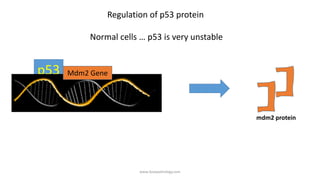
Regulation of p53 protein
Normal cells … p53 is very unstable
p53 Mdm2 Gene
mdm2 protein
www.ilovepathology.com
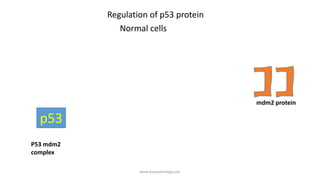
Regulation of p53 protein
Normal cells
p53
mdm2 protein
P53 mdm2
complex
www.ilovepathology.com
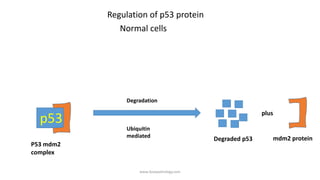
Regulation of p53 protein
Normal cells
p53
P53 mdm2
complex
Degradation
Ubiquitin
mediated mdm2 proteinDegraded p53
plus
www.ilovepathology.com
Regulation of p53 protein
Cells with damaged DNA
NO P53 mdm2
complex
No Degradation
p53 P
mdm2 protein
Increased p53 levels
www.ilovepathology.com
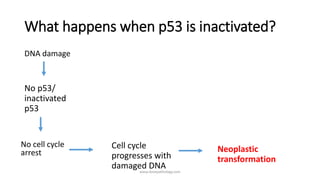
What happens when p53 is inactivated?
DNA damage
No p53/
inactivated
p53
Cell cycle
progresses with
damaged DNA
No cell cycle
arrest Neoplastic
transformation
www.ilovepathology.com
How p53 is inactivated??
• Mutations
• Heterozygous and homozygous loss of alleles
www.ilovepathology.com
What are the cancers associated with p53
mutations??
• Most human cancers!
• MC breast, colorectal, liver, lung, and ovarian cancers.
www.ilovepathology.com
Summary
• What is p53 gene
• What are its functions
• How it regulates cell cycle
• What happens if p53 is inactivated
• How p53 is inactivated
• What are the cancers associated with p53 mutation
www.ilovepathology.com
THANKS FOR WATCHING
www.ilovepathology.com

P53

  • 1.
    TUMOR SUPPRESSOR GENES p53GENE www.ilovepathology.com
  • 2.
    Learning Outcomes • Whatis p53 gene • What are its functions • How it regulates cell cycle • What happens if p53 is inactivated • How p53 is inactivated • What are the cancers associated with p53 mutation www.ilovepathology.com
  • 3.
    P53 Gene • Thisis a tumor suppressor gene ( its activity stops the formation of tumors) • Located on 17p13, first discovered in 1979 • The p53 protein is the product of p53 gene • P-protein • 53- weight of the protein, 53 kDa • Located in almost all normal tissues • Unstable and degrades very quickly www.ilovepathology.com
  • 4.
    • Is oneof the most commonly mutated gene in cancer www.ilovepathology.com
  • 5.
    Function • Regulation ofCell cycle • DNA repair • Apoptosis • Prevents neoplastic transformation either by cell cycle arrest or by triggering apoptosis. www.ilovepathology.com
  • 6.
  • 7.
    DNA Damage Increasedp53 levels Prevent Cell from entering S phase of cell cycle Allows time for the DNA repair to take place DNA Not Repaired Apoptosis GUARDIAN OF THE GENOME Conserves stability Triggers expression of p53 gene Arrest of cell cycle at G1 Phase DNA Repaired P53 degrades Cell cycle continues Permanent arrest/senescence P53 induces DNA repair genes www.ilovepathology.com
  • 8.
  • 9.
  • 10.
    • P53 isthe transcriptional regulator of one of the genes named WAF 1 • Resulting in increased WAF proteins named as p 21 • P21 blocks CDK4/CyclinD complex ….. Cell cycle is halted in G1 stage www.ilovepathology.com
  • 11.
  • 12.
    Regulation of p53protein www.ilovepathology.com
  • 13.
    Regulation of p53protein Normal cells … p53 is very unstable p53 Mdm2 Gene mdm2 protein www.ilovepathology.com
  • 14.
    Regulation of p53protein Normal cells p53 mdm2 protein P53 mdm2 complex www.ilovepathology.com
  • 15.
    Regulation of p53protein Normal cells p53 P53 mdm2 complex Degradation Ubiquitin mediated mdm2 proteinDegraded p53 plus www.ilovepathology.com
  • 16.
    Regulation of p53protein Cells with damaged DNA NO P53 mdm2 complex No Degradation p53 P mdm2 protein Increased p53 levels www.ilovepathology.com
  • 17.
    What happens whenp53 is inactivated? DNA damage No p53/ inactivated p53 Cell cycle progresses with damaged DNA No cell cycle arrest Neoplastic transformation www.ilovepathology.com
  • 18.
    How p53 isinactivated?? • Mutations • Heterozygous and homozygous loss of alleles www.ilovepathology.com
  • 19.
    What are thecancers associated with p53 mutations?? • Most human cancers! • MC breast, colorectal, liver, lung, and ovarian cancers. www.ilovepathology.com
  • 20.
    Summary • What isp53 gene • What are its functions • How it regulates cell cycle • What happens if p53 is inactivated • How p53 is inactivated • What are the cancers associated with p53 mutation www.ilovepathology.com
  • 21.