What Is Cancer?
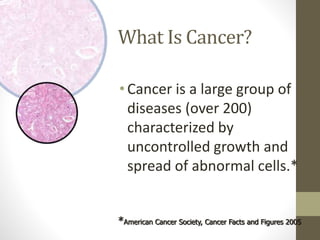
•Cancer is a large group of
diseases (over 200)
characterized by
uncontrolled growth and
spread of abnormal cells.*
*American Cancer Society, Cancer Facts and Figures 2005
•At cellular level
• Excessive cellular proliferation
• Uncoordinated growth
• Tissue infiltration
•At molecular level
• Disorder of growth regulatory genes
Carcino
genesis
Normal Cells Vs. Cancer Cells
• Cancer cells:
• Lose control over growth
and multiplication
• Do not self-destruct when
they become worn out or
damaged
• Crowd out healthy cells
NORMAL CELL
growth factor
growth factor receptor
signal transduction
activation of
transcription
cytoplasm
nucleus
DNA
RNA
Carcino
genesis
NEOPLASTIC (malignant) CELLS
Increase
in growth
factors
Increase
in growth
factor
receptors
Increase in
signal
transduction
Increase in
activation of
transcription
- Disturbed processes of mitosis and protein synthesis
Carcino
genesis
Properties of cancer cells
•1: self-sufficient in growth signals
•2: insensitive to anti-growth
signals
•3: stimulate local angiogenesis
•4: evade apoptosis
Classes of Genes Involved in
the Development of Tumour
• Non lethal genetic damage is the initiating
event in carcinogenesis.There are
principally four classes of genes which
when affected by such changes , can result
in the development of a tumour
1. Proto-oncogenes
2. Tumour suppressor gene
3. Genes involved in DNA repair
4. Genes involved in apoptosis
Oncogenes
• Oncogene: “onco” (cancer) gene
• 1989 Nobel Prize in Medicine or Physiology:
The Discovery of the Cellular Origin of
Retroviral Oncogenes
• J. Michael Bishop (UCSF)
• Harold Varmus (UCSF)
Oncogenes Cont’d
• Proto-oncogenes: normal cellular genes usually
involved in cell growth and/or cell division
• Oncogenes: a proto-oncogene that has been
activated by mutation or overexpression.
Results in a dominant gain of function
phenotype
• Growth Factors, Growth Factor Receptors,
G-proteins, Kinases, Gene Regulatory Proteins
Common Human Oncogenes
The Cell - A Molecular Approach. Cooper, Geoffrey M. Sunderland (MA): Sinauer Associates, Inc.; c2000
How are oncogenes activated?
• Point mutation-eg. K-ras,
• Amplification-eg. N-myc, MDM2,
Her2/neu/ErbB2
• Chromosome translocation-eg. c-myc, bcr-
abl
• Overexpression due to DNA demethylation
List of carcinogens
Chemical
• Asbestos
• Arsenic
• Chromium
• Polyaromatic hydocarbons
• dichlorodiphenyl-
trichloroethane (DDT)
Physical
• Gamma radiation
• UV light
• Radon
• X-rays
• Viruses*
Viruses and cancer
• Viruses account for 15% of all cancers
• DNA viruses
• Epstein-Barr virus
• Human papilloma virus
• Hepatitis B virus
• RNA viruses
• HIV-1
• HTLV-1
• HTLV-2
Tumor Suppressor Genes
• Genes that are normally involved in the inhibition
of cell growth and proliferation.
• Two Hit Hypothesis: Tumor suppressor genes act
in a recessive manner
• Need loss of both alleles to progress towards
cancer
Molecular Biology of the Cell. Alberts, Bruce; Johnson, Alexander; Lewis, Julian; Raff, Martin; Roberts, Keith; Walter, Peter. New York and London: Garland Science; c2002
Common Human Tumor Suppressor
Genes
The Cell - A Molecular Approach. Cooper, Geoffrey M. Sunderland (MA): Sinauer Associates, Inc.; c2000
Mechanisms of tumor suppressor
gene inactivation
• Deletion
• Point mutation
• Mutation followed by duplication
• Loss of heterozygosity
• DNA methylation
• Post-translational mechanism-binding to DNA
viral oncoproteins
Retinoblastoma (Rb) Tumor
Suppressor Gene
Rb prevents E2F transcription factor from transcribing genes
inappropriately
Loss of Rb allows for unregulated gene transcription
The Cell - A Molecular Approach. Cooper, Geoffrey M. Sunderland (MA): Sinauer Associates, Inc.; c2000
Genetics of Retinoblastoma
p53 Tumor Suppressor Gene
p53 is the single most
common target for genetic
insults leading to cancer
DNA damage stabilizes p53
and allows for p53 accumulation
p53 induces p21 (CDKN1A, CIP1, WAF1)
to cause cell cycle arrest
The state in which p53 is mutated is
referred to as Li Fraumani syndrome
Robbins & Cotran Basic Pathology 7th ed
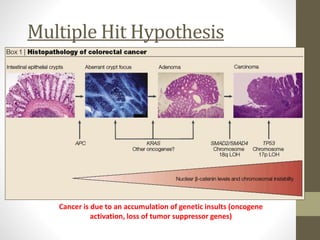
Multiple Hit Hypothesis
Cancer is due to an accumulation of genetic insults (oncogene
activation, loss of tumor suppressor genes)
Oncogene Addiction Hypothesis
• Cells become addicted to persistent
oncogene activity for proliferation
• Become unresponsive to any other
mitogenic (growth) stimuli
• Turn off MYC and cells can respond to other
stimuli
• Tumor cells begin to become more
normal
MYC Oncogene Addiction in
Hepatocellular Carcinoma
Felsher, et al.
MYC Inactivation Uncovers Pluripotent Differentiation and Tumor Dormancy in Hepatocellular Cancer
Shachaf CM, Kopelman AM, Arvanitis C, Karlsson A, Beer S, Mandi S, Bachman MH, Borowsky AD, Ruebner B, Cardiff RD, Yang Q, Bishop JM, Contag CH, Felsher DW.
Nature. Vol431, 2004.
The Concept of Gene Therapy

Oncogenes

  • 1.
    What Is Cancer? •Canceris a large group of diseases (over 200) characterized by uncontrolled growth and spread of abnormal cells.* *American Cancer Society, Cancer Facts and Figures 2005
  • 2.
    •At cellular level •Excessive cellular proliferation • Uncoordinated growth • Tissue infiltration •At molecular level • Disorder of growth regulatory genes Carcino genesis
  • 3.
    Normal Cells Vs.Cancer Cells • Cancer cells: • Lose control over growth and multiplication • Do not self-destruct when they become worn out or damaged • Crowd out healthy cells
  • 4.
    NORMAL CELL growth factor growthfactor receptor signal transduction activation of transcription cytoplasm nucleus DNA RNA Carcino genesis
  • 5.
    NEOPLASTIC (malignant) CELLS Increase ingrowth factors Increase in growth factor receptors Increase in signal transduction Increase in activation of transcription - Disturbed processes of mitosis and protein synthesis Carcino genesis
  • 6.
    Properties of cancercells •1: self-sufficient in growth signals •2: insensitive to anti-growth signals •3: stimulate local angiogenesis •4: evade apoptosis
  • 7.
    Classes of GenesInvolved in the Development of Tumour • Non lethal genetic damage is the initiating event in carcinogenesis.There are principally four classes of genes which when affected by such changes , can result in the development of a tumour 1. Proto-oncogenes 2. Tumour suppressor gene 3. Genes involved in DNA repair 4. Genes involved in apoptosis
  • 8.
    Oncogenes • Oncogene: “onco”(cancer) gene • 1989 Nobel Prize in Medicine or Physiology: The Discovery of the Cellular Origin of Retroviral Oncogenes • J. Michael Bishop (UCSF) • Harold Varmus (UCSF)
  • 9.
    Oncogenes Cont’d • Proto-oncogenes:normal cellular genes usually involved in cell growth and/or cell division • Oncogenes: a proto-oncogene that has been activated by mutation or overexpression. Results in a dominant gain of function phenotype • Growth Factors, Growth Factor Receptors, G-proteins, Kinases, Gene Regulatory Proteins
  • 10.
    Common Human Oncogenes TheCell - A Molecular Approach. Cooper, Geoffrey M. Sunderland (MA): Sinauer Associates, Inc.; c2000
  • 11.
    How are oncogenesactivated? • Point mutation-eg. K-ras, • Amplification-eg. N-myc, MDM2, Her2/neu/ErbB2 • Chromosome translocation-eg. c-myc, bcr- abl • Overexpression due to DNA demethylation
  • 13.
    List of carcinogens Chemical •Asbestos • Arsenic • Chromium • Polyaromatic hydocarbons • dichlorodiphenyl- trichloroethane (DDT) Physical • Gamma radiation • UV light • Radon • X-rays • Viruses*
  • 14.
    Viruses and cancer •Viruses account for 15% of all cancers • DNA viruses • Epstein-Barr virus • Human papilloma virus • Hepatitis B virus • RNA viruses • HIV-1 • HTLV-1 • HTLV-2
  • 15.
    Tumor Suppressor Genes •Genes that are normally involved in the inhibition of cell growth and proliferation. • Two Hit Hypothesis: Tumor suppressor genes act in a recessive manner • Need loss of both alleles to progress towards cancer Molecular Biology of the Cell. Alberts, Bruce; Johnson, Alexander; Lewis, Julian; Raff, Martin; Roberts, Keith; Walter, Peter. New York and London: Garland Science; c2002
  • 16.
    Common Human TumorSuppressor Genes The Cell - A Molecular Approach. Cooper, Geoffrey M. Sunderland (MA): Sinauer Associates, Inc.; c2000
  • 17.
    Mechanisms of tumorsuppressor gene inactivation • Deletion • Point mutation • Mutation followed by duplication • Loss of heterozygosity • DNA methylation • Post-translational mechanism-binding to DNA viral oncoproteins
  • 18.
    Retinoblastoma (Rb) Tumor SuppressorGene Rb prevents E2F transcription factor from transcribing genes inappropriately Loss of Rb allows for unregulated gene transcription The Cell - A Molecular Approach. Cooper, Geoffrey M. Sunderland (MA): Sinauer Associates, Inc.; c2000
  • 19.
  • 20.
    p53 Tumor SuppressorGene p53 is the single most common target for genetic insults leading to cancer DNA damage stabilizes p53 and allows for p53 accumulation p53 induces p21 (CDKN1A, CIP1, WAF1) to cause cell cycle arrest The state in which p53 is mutated is referred to as Li Fraumani syndrome Robbins & Cotran Basic Pathology 7th ed
  • 21.
    Multiple Hit Hypothesis Canceris due to an accumulation of genetic insults (oncogene activation, loss of tumor suppressor genes)
  • 22.
    Oncogene Addiction Hypothesis •Cells become addicted to persistent oncogene activity for proliferation • Become unresponsive to any other mitogenic (growth) stimuli • Turn off MYC and cells can respond to other stimuli • Tumor cells begin to become more normal
  • 23.
    MYC Oncogene Addictionin Hepatocellular Carcinoma Felsher, et al.
  • 24.
    MYC Inactivation UncoversPluripotent Differentiation and Tumor Dormancy in Hepatocellular Cancer Shachaf CM, Kopelman AM, Arvanitis C, Karlsson A, Beer S, Mandi S, Bachman MH, Borowsky AD, Ruebner B, Cardiff RD, Yang Q, Bishop JM, Contag CH, Felsher DW. Nature. Vol431, 2004.
  • 26.
    The Concept ofGene Therapy