Cancer: Reducing Your Risk Chapter 13
Agenda for Cancer Lecture Introduction (Etiology, Epidemiology, Oncologist) Basic Understanding of Biology (cells) Define Cancer (Autoimmune Disease) Risk Factors (profile of our exposures) Classifications of Cancer Location of Cancer Prevention, Detection and Treatment
Introduction The last 50 years has seen a better understanding of the causes and treatments of cancer.  Hence, the stigma, early detection and technology has improved the prognosis of cancer patients to an unprecedented level.
Cancer Statistics 553,400 Americans died of cancer 2001 1.3 million new cases diagnosed 1 in 4 deaths from cancer Early detection/improvements in technology have improved prognosis for many What do you think are the contributing factors to the incidence of cancer in the U.S. today?
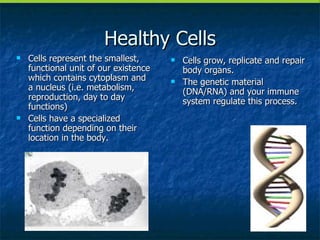
Healthy Cells Cells represent the smallest, functional unit of our existence which contains cytoplasm and a nucleus (i.e. metabolism, reproduction, day to day functions) Cells have a specialized function depending on their location in the body. Cells grow, replicate and repair body organs. The genetic material (DNA/RNA) and your immune system regulate this process.
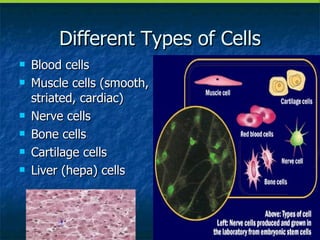
Different Types of Cells Blood cells Muscle cells (smooth, striated, cardiac) Nerve cells Bone cells Cartilage cells Liver (hepa) cells
Define Cancer Cancer is a term used to describe a large group of diseases that are characterized by a cellular malfunction.  Healthy cells are programmed to “know what to do and when to do it”.  Cancerous cells do not have this programming and therefore grow and replicate out of control.  They also serve no physiological function.  These cells are now termed a neoplasm.
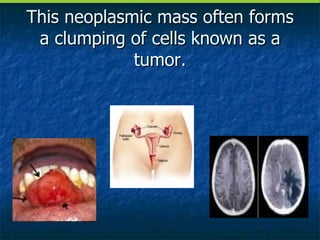
This neoplasmic mass often forms a clumping of cells known as a tumor.
Tumors Benign Tumors (noncancerous) Enclosed in a fibrous shell or capsule. Take up space Concerned if they interfere with surrounding tissues or vessels or impede the function of the body. Malignant Tumors (cancerous) Not usually contained – metastasis Invade and emit clawlike protrusions that disrupt the RNA and DNA of normal cells (these cancerous cells act like a virus).
Risk Factors (multi-factorial) Exposure to Cancer-causing agents Cellular Mutations (what agents cause this? Environment & Lifestyle agents) Genetics & Hormone exposure (i.e. breast cancer) Occupation and Environment Factors Social and Psychological Factors Chemicals in Food Viral (i.e. herpes, HPV, mononucleosis) create an opportunistic environment Medical Factors
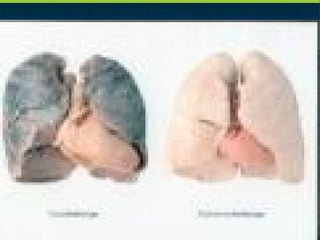
Types of Cancer Classifications of Cancer Carcinomas Sarcomas Lymphomas Leukemias Lung Cancer Killed 164,000 in 2000 Prevention-researchers theorize: 90% of all lung cancers could be avoided by not smoking
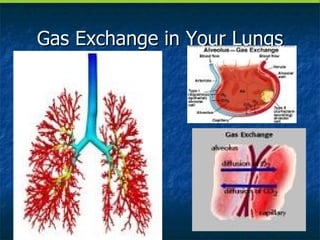
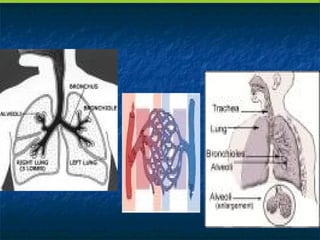
Gas Exchange in Your Lungs


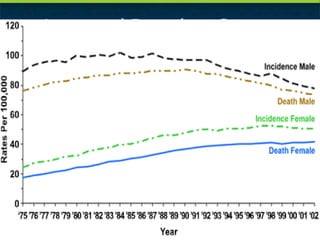
Lung and Bronchus Cancer (Invasive), 1975-2002 (CDC)
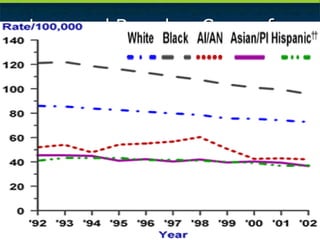
Lung and Bronchus Cancer for U.S. Males, 1992-2002
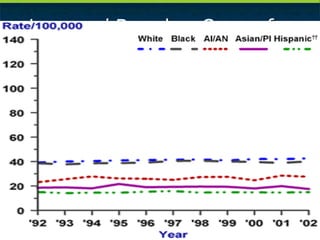
Lung and Bronchus Cancer for U.S. Females, 1992-2002
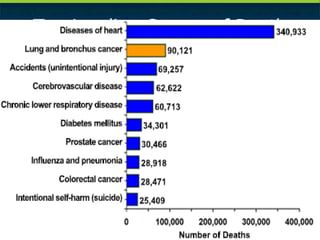
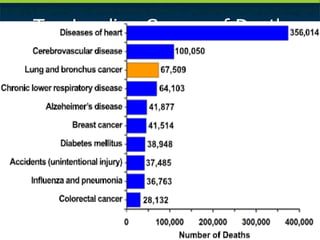
Ten Leading Causes of Death for Males, 2002 (CDC)
Ten Leading Causes of Death for Females, 2002 (CDC)
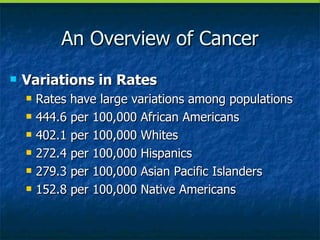
An Overview of Cancer Variations in Rates Rates have large variations among populations 444.6 per 100,000 African Americans 402.1 per 100,000 Whites 272.4 per 100,000 Hispanics 279.3 per 100,000 Asian Pacific Islanders 152.8 per 100,000 Native Americans
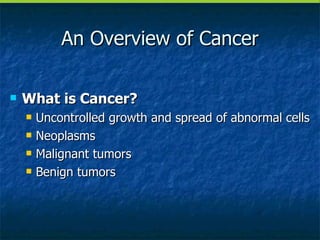
An Overview of Cancer What is Cancer? Uncontrolled growth and spread of abnormal cells Neoplasms Malignant tumors Benign tumors
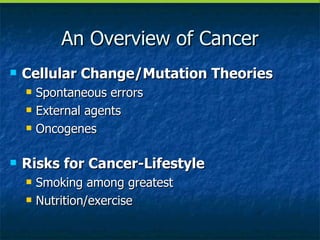
An Overview of Cancer Cellular Change/Mutation Theories Spontaneous errors External agents Oncogenes Risks for Cancer-Lifestyle Smoking among greatest Nutrition/exercise
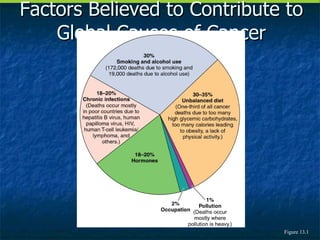
Factors Believed to Contribute to Global Causes of Cancer Figure 13.1
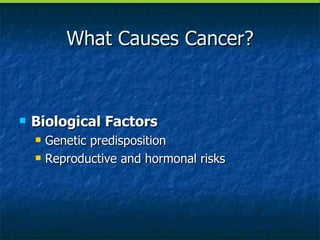
What Causes Cancer? Biological Factors Genetic predisposition Reproductive and hormonal risks
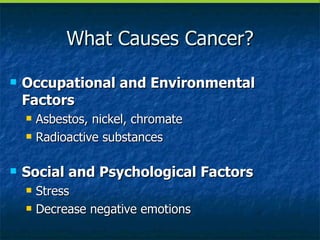
What Causes Cancer? Occupational and Environmental Factors Asbestos, nickel, chromate Radioactive substances Social and Psychological Factors Stress Decrease negative emotions
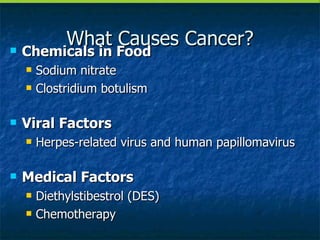
What Causes Cancer? Chemicals in Food Sodium nitrate Clostridium botulism Viral Factors Herpes-related virus and human papillomavirus Medical Factors Diethylstibestrol (DES) Chemotherapy
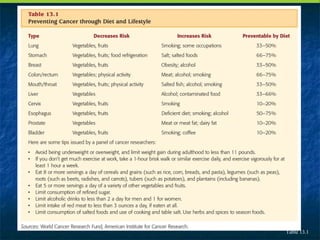
Table 13.1
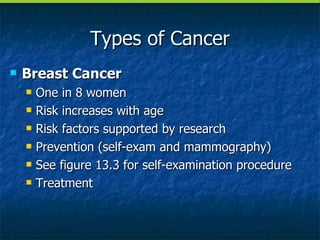
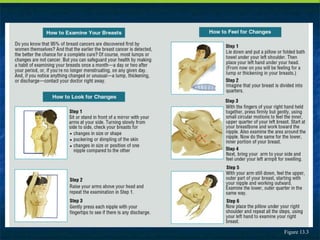
Types of Cancer Breast Cancer One in 8 women Risk increases with age Risk factors supported by research Prevention (self-exam and mammography) See figure 13.3 for self-examination procedure Treatment
Breast Self-Examination Figure 13.3
Types of Cancer Colon and Rectum Cancer 3 rd  most common in men and women 135,400 in 2001 diagnosed Warning signals, e.g. blood in the stool, rectal bleeding Prostate Cancer Most common in males today 189,000 new cases will be diagnosed in 2002 Estimated 30,200 men will die
Types of Cancer Skin Cancer: Sun Bathers Beware 1.3 million cases of skin cancer Treatable: basal or squamous Virulent: malignant melanoma ABCD rule about melanoma What are some ideas about the use of sunscreen?
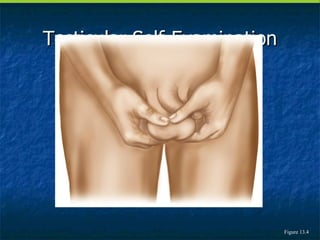
Types of Cancer Testicular Cancer Ages 17-34 at greatest risk Cause is unknown Undescended testicles present a great risk How and when should men examine their testicles? (see Figure 13.4)
Testicular Self-Examination Figure 13.4
Types of Cancer Ovarian Cancer 4 th  leading cause of death in young women Enlargement of abdomen common sign Prevention: annual pelvic exams Endometrium (Uterine) Cancer Pap test for early detection Risk: early onset of intercourse Warning: abnormal bleeding
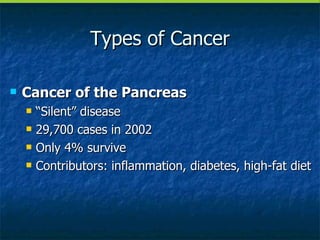
Types of Cancer Cancer of the Pancreas “Silent” disease 29,700 cases in 2002 Only 4% survive Contributors: inflammation, diabetes, high-fat diet
Types of Cancer Leukemia Cancer of blood-forming tissues Leads to the creation of immature white blood cells Symptoms: fatigue / paleness / weight loss Can be acute or chronic
Facing Cancer Detecting Cancer Magnetic Resonance Imaging (MRI) Computerized Axial Tomography scanning (CAT scan) Prostatic ultrasound (rectal probe) Self-exam and check-ups
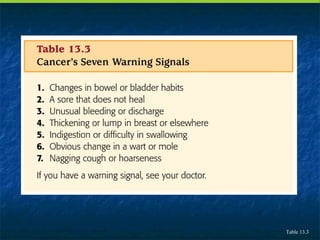
Table 13.3
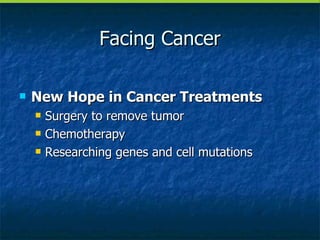
Facing Cancer New Hope in Cancer Treatments Surgery to remove tumor Chemotherapy Researching genes and cell mutations
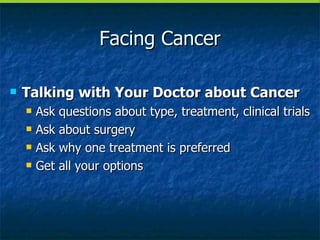
Facing Cancer Talking with Your Doctor about Cancer Ask questions about type, treatment, clinical trials Ask about surgery Ask why one treatment is preferred Get all your options
Facing Cancer Life After Cancer Laws reduce insurance discrimination Less isolation Assistance is available Support groups

Cancer Powerpoint

  • 1.
    Cancer: Reducing YourRisk Chapter 13
  • 2.
    Agenda for CancerLecture Introduction (Etiology, Epidemiology, Oncologist) Basic Understanding of Biology (cells) Define Cancer (Autoimmune Disease) Risk Factors (profile of our exposures) Classifications of Cancer Location of Cancer Prevention, Detection and Treatment
  • 3.
    Introduction The last50 years has seen a better understanding of the causes and treatments of cancer. Hence, the stigma, early detection and technology has improved the prognosis of cancer patients to an unprecedented level.
  • 4.
    Cancer Statistics 553,400Americans died of cancer 2001 1.3 million new cases diagnosed 1 in 4 deaths from cancer Early detection/improvements in technology have improved prognosis for many What do you think are the contributing factors to the incidence of cancer in the U.S. today?
  • 5.
    Healthy Cells Cellsrepresent the smallest, functional unit of our existence which contains cytoplasm and a nucleus (i.e. metabolism, reproduction, day to day functions) Cells have a specialized function depending on their location in the body. Cells grow, replicate and repair body organs. The genetic material (DNA/RNA) and your immune system regulate this process.
  • 6.
    Different Types ofCells Blood cells Muscle cells (smooth, striated, cardiac) Nerve cells Bone cells Cartilage cells Liver (hepa) cells
  • 7.
    Define Cancer Canceris a term used to describe a large group of diseases that are characterized by a cellular malfunction. Healthy cells are programmed to “know what to do and when to do it”. Cancerous cells do not have this programming and therefore grow and replicate out of control. They also serve no physiological function. These cells are now termed a neoplasm.
  • 8.
    This neoplasmic massoften forms a clumping of cells known as a tumor.
  • 9.
    Tumors Benign Tumors(noncancerous) Enclosed in a fibrous shell or capsule. Take up space Concerned if they interfere with surrounding tissues or vessels or impede the function of the body. Malignant Tumors (cancerous) Not usually contained – metastasis Invade and emit clawlike protrusions that disrupt the RNA and DNA of normal cells (these cancerous cells act like a virus).
  • 10.
    Risk Factors (multi-factorial)Exposure to Cancer-causing agents Cellular Mutations (what agents cause this? Environment & Lifestyle agents) Genetics & Hormone exposure (i.e. breast cancer) Occupation and Environment Factors Social and Psychological Factors Chemicals in Food Viral (i.e. herpes, HPV, mononucleosis) create an opportunistic environment Medical Factors
  • 11.
    Types of CancerClassifications of Cancer Carcinomas Sarcomas Lymphomas Leukemias Lung Cancer Killed 164,000 in 2000 Prevention-researchers theorize: 90% of all lung cancers could be avoided by not smoking
  • 12.
    Gas Exchange inYour Lungs
  • 13.
  • 14.
  • 15.
  • 16.
    Lung and BronchusCancer (Invasive), 1975-2002 (CDC)
  • 17.
    Lung and BronchusCancer for U.S. Males, 1992-2002
  • 18.
    Lung and BronchusCancer for U.S. Females, 1992-2002
  • 19.
    Ten Leading Causesof Death for Males, 2002 (CDC)
  • 20.
    Ten Leading Causesof Death for Females, 2002 (CDC)
  • 21.
    An Overview ofCancer Variations in Rates Rates have large variations among populations 444.6 per 100,000 African Americans 402.1 per 100,000 Whites 272.4 per 100,000 Hispanics 279.3 per 100,000 Asian Pacific Islanders 152.8 per 100,000 Native Americans
  • 22.
    An Overview ofCancer What is Cancer? Uncontrolled growth and spread of abnormal cells Neoplasms Malignant tumors Benign tumors
  • 23.
    An Overview ofCancer Cellular Change/Mutation Theories Spontaneous errors External agents Oncogenes Risks for Cancer-Lifestyle Smoking among greatest Nutrition/exercise
  • 24.
    Factors Believed toContribute to Global Causes of Cancer Figure 13.1
  • 25.
    What Causes Cancer?Biological Factors Genetic predisposition Reproductive and hormonal risks
  • 26.
    What Causes Cancer?Occupational and Environmental Factors Asbestos, nickel, chromate Radioactive substances Social and Psychological Factors Stress Decrease negative emotions
  • 27.
    What Causes Cancer?Chemicals in Food Sodium nitrate Clostridium botulism Viral Factors Herpes-related virus and human papillomavirus Medical Factors Diethylstibestrol (DES) Chemotherapy
  • 28.
  • 29.
    Types of CancerBreast Cancer One in 8 women Risk increases with age Risk factors supported by research Prevention (self-exam and mammography) See figure 13.3 for self-examination procedure Treatment
  • 30.
  • 31.
    Types of CancerColon and Rectum Cancer 3 rd most common in men and women 135,400 in 2001 diagnosed Warning signals, e.g. blood in the stool, rectal bleeding Prostate Cancer Most common in males today 189,000 new cases will be diagnosed in 2002 Estimated 30,200 men will die
  • 32.
    Types of CancerSkin Cancer: Sun Bathers Beware 1.3 million cases of skin cancer Treatable: basal or squamous Virulent: malignant melanoma ABCD rule about melanoma What are some ideas about the use of sunscreen?
  • 33.
    Types of CancerTesticular Cancer Ages 17-34 at greatest risk Cause is unknown Undescended testicles present a great risk How and when should men examine their testicles? (see Figure 13.4)
  • 34.
  • 35.
    Types of CancerOvarian Cancer 4 th leading cause of death in young women Enlargement of abdomen common sign Prevention: annual pelvic exams Endometrium (Uterine) Cancer Pap test for early detection Risk: early onset of intercourse Warning: abnormal bleeding
  • 36.
    Types of CancerCancer of the Pancreas “Silent” disease 29,700 cases in 2002 Only 4% survive Contributors: inflammation, diabetes, high-fat diet
  • 37.
    Types of CancerLeukemia Cancer of blood-forming tissues Leads to the creation of immature white blood cells Symptoms: fatigue / paleness / weight loss Can be acute or chronic
  • 38.
    Facing Cancer DetectingCancer Magnetic Resonance Imaging (MRI) Computerized Axial Tomography scanning (CAT scan) Prostatic ultrasound (rectal probe) Self-exam and check-ups
  • 39.
  • 40.
    Facing Cancer NewHope in Cancer Treatments Surgery to remove tumor Chemotherapy Researching genes and cell mutations
  • 41.
    Facing Cancer Talkingwith Your Doctor about Cancer Ask questions about type, treatment, clinical trials Ask about surgery Ask why one treatment is preferred Get all your options
  • 42.
    Facing Cancer LifeAfter Cancer Laws reduce insurance discrimination Less isolation Assistance is available Support groups