Molecular Biology of Cancer -Molecular Biology of Cancer -
Tumor suppressor genesTumor suppressor genes
Dr.CSBR.Prasad, M.D.,
Failure of growth inhibition is one of
the fundamental alterations in the
process of carcinogenesis
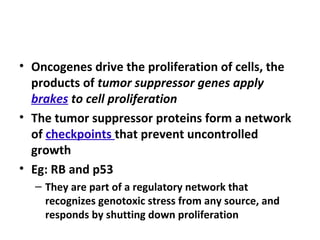
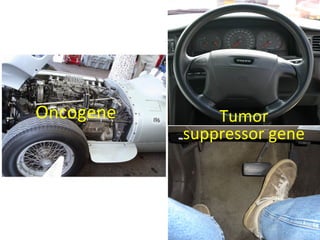
• Oncogenes drive the proliferation of cells, the
products of tumor suppressor genes apply
brakes to cell proliferation
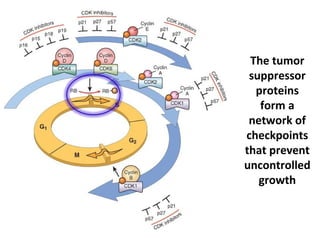
• The tumor suppressor proteins form a network
of checkpoints that prevent uncontrolled
growth
• Eg: RB and p53
– They are part of a regulatory network that
recognizes genotoxic stress from any source, and
responds by shutting down proliferation
Tumor
suppressor gene
Oncogene
The tumor
suppressor
proteins
form a
network of
checkpoints
that prevent
uncontrolled
growth
Oncogene expression in an otherwise
normal cell leads to …….
Expression of an oncogene in an otherwise
completely normal cell leads to quiescence, or
to permanent cell cycle arrest (oncogene-
induced senescence), rather than uncontrolled
proliferation
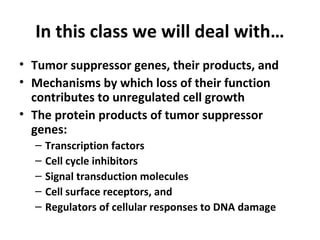
In this class we will deal with…
• Tumor suppressor genes, their products, and
• Mechanisms by which loss of their function
contributes to unregulated cell growth
• The protein products of tumor suppressor
genes:
– Transcription factors
– Cell cycle inhibitors
– Signal transduction molecules
– Cell surface receptors, and
– Regulators of cellular responses to DNA damage
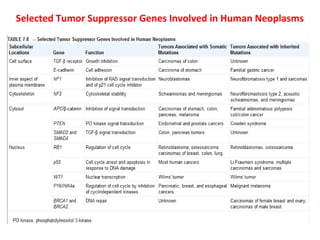
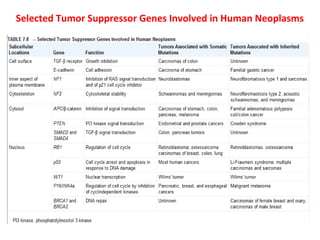
Selected Tumor Suppressor Genes Involved in Human Neoplasms
Tumor suppressor genes
• Physiologically they regulate cell growth
• It is a misnomer
• Failure of growth inhibition is key event in
carcinogenesis
• Loss of function of these genes - tumor
• The proteins that apply break to cell
proliferation are the products of these genes
Tumor suppressor genes
• Genes act by coding for growth controlling
molecules or growth factors
• Two pathways
– Control over mitosis
– Control over biochemical processes in the cell that
govern growth and differentiation i.e., gene
expression
Protein products of
tumor suppressor genes
• Cell cycle control
• Regulation of apoptosis
• Activities of cell survival and growth
Protein products of
tumor suppressor genes-function
• Transcription factors
• Cell cycle inhibitors
• Signal transduction factors
• Cell surface receptors
• Regulators of cellular response to DNA
damage
Tumor suppressor genes
• RB gene / retinoblastoma gene
• p53 gene
• APC gene/adenomatous polyposis coli gene
• B cell lymphoma gene/bcl 2 gene
• WT 1 gene/Wilms tumor gene
• NF1/NF2,Neurofibromatosis gene
Selected Tumor Suppressor Genes Involved in Human Neoplasms
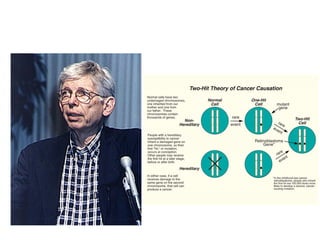
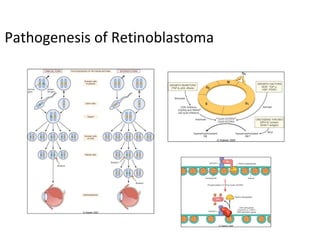
RB gene- two hit hypothesis
• Located on 13q14
• Both normal alleles must be inactivated (2- hits)
– First hit: Familial cases-born with one defective copy of
gene
– Second hit: The second intact copy undergoes somatic
mutation
• Sporadic cases-both normal RB alleles are lost by
somatic mutation in one of the retinoblasts
RB Gene
• Familial RB show increased risk for
osteosarcoma & soft tissue sarcomas
• RB locus is seen in adenocarcinomas of breast,
small cell ca lung & bladder ca
• Alterations in ā€œRB pathwayā€ involving INK4a,
CDK’s, RB proteins are present in cancer cells
LOH- Loss of heterozygosity
• Child carrying inheritent mutant RB allele in all
somatic cells is perfectly normal, except for
increased risk for RB
• Child is heterozygous for the RB gene, which
does not affect cell behavior
• Cancer develops when cell becomes
homozygous for mutant allele
LOH- Loss of heterozygosity
• The cell loses heterozygosity for normal RB
gene (i.e., loss of heterozygosity)
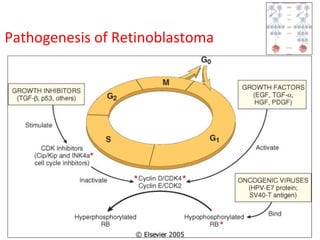
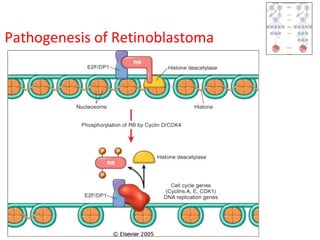
Pathogenesis of Retinoblastoma
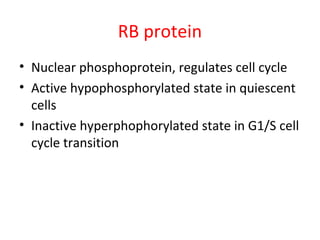
RB protein
• Nuclear phosphoprotein, regulates cell cycle
• Active hypophosphorylated state in quiescent
cells
• Inactive hyperphophorylated state in G1/S cell
cycle transition
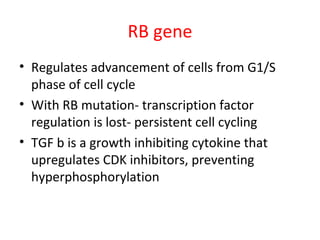
RB gene
• Regulates advancement of cells from G1/S
phase of cell cycle
• With RB mutation- transcription factor
regulation is lost- persistent cell cycling
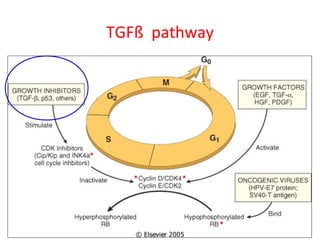
• TGF b is a growth inhibiting cytokine that
upregulates CDK inhibitors, preventing
hyperphosphorylation
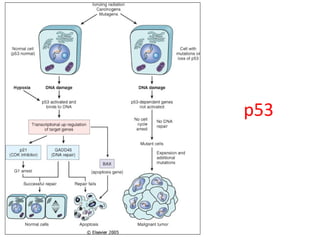
p53
p53 gene
• Normal function- prevent propogation of genetically
damaged cells
• When DNA is damaged-p53 upregulation-
transcription of genes that arrest cell cycle and repair
DNA
• Cell cycle arrest is mediated by p53 dependent
transcription CDK inhibitor p21
• If DNA cannot be repaired, p53 induces apoptosis
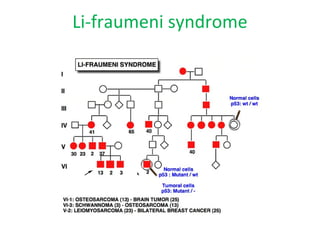
Li-fraumeni syndrome
• High risk of developing carcinoma by
inactivation of 2 nd normal allele of somatic
cells
• Leukemia, sarcoma, breast cancer, brain
tumor
• Homozygous loss of p53-DNA damage goes
Unrepaired-many mutant genes-cancer
Li-fraumeni syndrome
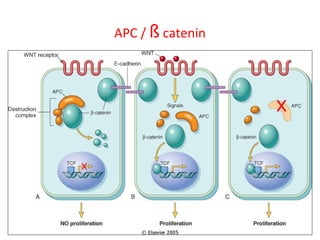
APC / ß catenin
APC gene/ ß catenine pathway
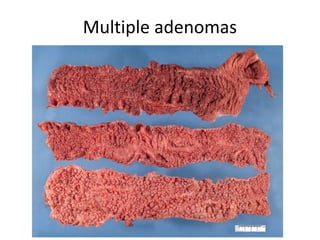
• Develop thousands of adenomatous polyps
• APC protein binds and regulates the
degradation of b catenine levels in cytoplasm
• Absence of APC protein-b catenine levels
increase- translocate to nucleus-up regulate
cell proliferation
• APC is a negative regulator of b catenine
Multiple adenomas
TGFß pathway
• Up regulate growth inhibitory genes
• Colon cancers, gastric ca in HNPCC
Mutated TGF ß
• receptors prevent growth restraining effects
TGFß pathway
NF1 gene
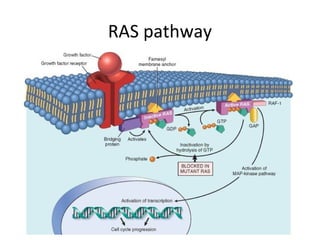
• Regulates signal transduction by RAS pathway
• Homozygous loss impairs conversion of active
RAS to inactive RAS
• Germ line inheritance of one mutant allele
predipose to multiple NF
• Loss of 2 nd NF gene - progression to
malignancy
RAS pathway
WT -1 gene
• WT-1 protein transcriptional activator of
genes involved in renal and gonadal
differentiation
• Tumorigenic function - role in differentiation
of genitourinary tissues
• Wilms’ tumor of kidney
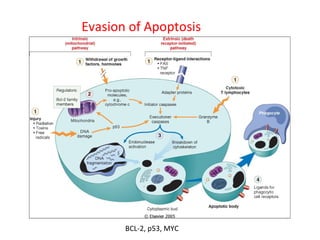
Evasion of Apoptosis
BCL-2, p53, MYC
• Genes inhibiting apoptosis –BCL2,BCL-XL
• Genes promoting apoptosis –BAD, BAX, BID
• t(14;18) in follicular lymphoma – over expression of
BCL2
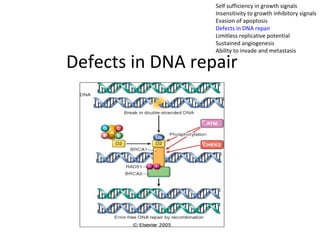
Defects in DNA repair
• Mismatch repair (HNPCC syndrome)
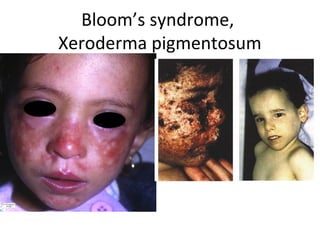
• Nucleotide excision repair (Xero. Pigmentosa)
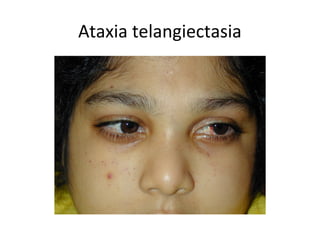
• Recombination repair (Ataxia telangiectasia,
Fanconi’s anemia & Bloom syndrome)
• Mutations not repaired in defects – Genomic
instability syndrome – Cancer
Self sufficiency in growth signals
Insensitivity to growth inhibitory signals
Evasion of apoptosis
Defects in DNA repair
Limitless replicative potential
Sustained angiogenesis
Ability to invade and metastasis
Bloom’s syndrome,
Xeroderma pigmentosum
Ataxia telangiectasia
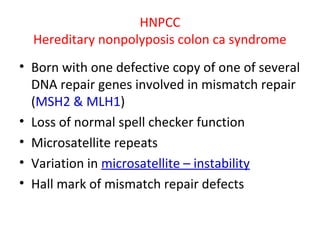
HNPCC
Hereditary nonpolyposis colon ca syndrome
• Born with one defective copy of one of several
DNA repair genes involved in mismatch repair
(MSH2 & MLH1)
• Loss of normal spell checker function
• Microsatellite repeats
• Variation in microsatellite – instability
• Hall mark of mismatch repair defects
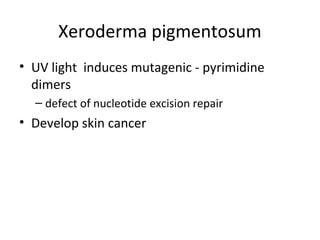
Xeroderma pigmentosum
• UV light induces mutagenic - pyrimidine
dimers
– defect of nucleotide excision repair
• Develop skin cancer
BRCA-1 and BRCA-2
• Involved in repair of double stranded DNA
breaks by homologous recombination
• Familial breast cancers, ovarian ca,
melanoma, pancreatic ca
Defects in DNA repair
Self sufficiency in growth signals
Insensitivity to growth inhibitory signals
Evasion of apoptosis
Defects in DNA repair
Limitless replicative potential
Sustained angiogenesis
Ability to invade and metastasis
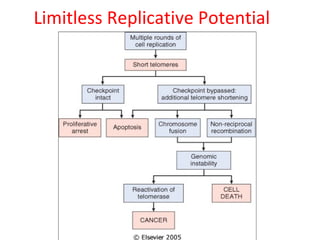
Limitless Replicative Potential
Limitless replicative potential
teleromerase
• Telomerase not active in somatic cells
• Cellular telomerase progressively shorten with
each cell cycle - replicative senescence
• Cancer cells reactivate telomerase
• 90 % of human tumors show telomerase
activity
E N D

Tumor suppressorgenes

  • 1.
    Molecular Biology ofCancer -Molecular Biology of Cancer - Tumor suppressor genesTumor suppressor genes Dr.CSBR.Prasad, M.D.,
  • 2.
    Failure of growthinhibition is one of the fundamental alterations in the process of carcinogenesis
  • 3.
    • Oncogenes drivethe proliferation of cells, the products of tumor suppressor genes apply brakes to cell proliferation • The tumor suppressor proteins form a network of checkpoints that prevent uncontrolled growth • Eg: RB and p53 – They are part of a regulatory network that recognizes genotoxic stress from any source, and responds by shutting down proliferation
  • 4.
  • 5.
    The tumor suppressor proteins form a networkof checkpoints that prevent uncontrolled growth
  • 6.
    Oncogene expression inan otherwise normal cell leads to ……. Expression of an oncogene in an otherwise completely normal cell leads to quiescence, or to permanent cell cycle arrest (oncogene- induced senescence), rather than uncontrolled proliferation
  • 7.
    In this classwe will deal with… • Tumor suppressor genes, their products, and • Mechanisms by which loss of their function contributes to unregulated cell growth • The protein products of tumor suppressor genes: – Transcription factors – Cell cycle inhibitors – Signal transduction molecules – Cell surface receptors, and – Regulators of cellular responses to DNA damage
  • 8.
    Selected Tumor SuppressorGenes Involved in Human Neoplasms
  • 9.
    Tumor suppressor genes •Physiologically they regulate cell growth • It is a misnomer • Failure of growth inhibition is key event in carcinogenesis • Loss of function of these genes - tumor • The proteins that apply break to cell proliferation are the products of these genes
  • 10.
    Tumor suppressor genes •Genes act by coding for growth controlling molecules or growth factors • Two pathways – Control over mitosis – Control over biochemical processes in the cell that govern growth and differentiation i.e., gene expression
  • 11.
    Protein products of tumorsuppressor genes • Cell cycle control • Regulation of apoptosis • Activities of cell survival and growth
  • 12.
    Protein products of tumorsuppressor genes-function • Transcription factors • Cell cycle inhibitors • Signal transduction factors • Cell surface receptors • Regulators of cellular response to DNA damage
  • 13.
    Tumor suppressor genes •RB gene / retinoblastoma gene • p53 gene • APC gene/adenomatous polyposis coli gene • B cell lymphoma gene/bcl 2 gene • WT 1 gene/Wilms tumor gene • NF1/NF2,Neurofibromatosis gene
  • 14.
    Selected Tumor SuppressorGenes Involved in Human Neoplasms
  • 15.
    RB gene- twohit hypothesis • Located on 13q14 • Both normal alleles must be inactivated (2- hits) – First hit: Familial cases-born with one defective copy of gene – Second hit: The second intact copy undergoes somatic mutation • Sporadic cases-both normal RB alleles are lost by somatic mutation in one of the retinoblasts
  • 17.
    RB Gene • FamilialRB show increased risk for osteosarcoma & soft tissue sarcomas • RB locus is seen in adenocarcinomas of breast, small cell ca lung & bladder ca • Alterations in ā€œRB pathwayā€ involving INK4a, CDK’s, RB proteins are present in cancer cells
  • 18.
    LOH- Loss ofheterozygosity • Child carrying inheritent mutant RB allele in all somatic cells is perfectly normal, except for increased risk for RB • Child is heterozygous for the RB gene, which does not affect cell behavior • Cancer develops when cell becomes homozygous for mutant allele
  • 19.
    LOH- Loss ofheterozygosity • The cell loses heterozygosity for normal RB gene (i.e., loss of heterozygosity)
  • 20.
  • 21.
  • 22.
  • 23.
    RB protein • Nuclearphosphoprotein, regulates cell cycle • Active hypophosphorylated state in quiescent cells • Inactive hyperphophorylated state in G1/S cell cycle transition
  • 24.
    RB gene • Regulatesadvancement of cells from G1/S phase of cell cycle • With RB mutation- transcription factor regulation is lost- persistent cell cycling • TGF b is a growth inhibiting cytokine that upregulates CDK inhibitors, preventing hyperphosphorylation
  • 25.
  • 26.
    p53 gene • Normalfunction- prevent propogation of genetically damaged cells • When DNA is damaged-p53 upregulation- transcription of genes that arrest cell cycle and repair DNA • Cell cycle arrest is mediated by p53 dependent transcription CDK inhibitor p21 • If DNA cannot be repaired, p53 induces apoptosis
  • 27.
    Li-fraumeni syndrome • Highrisk of developing carcinoma by inactivation of 2 nd normal allele of somatic cells • Leukemia, sarcoma, breast cancer, brain tumor • Homozygous loss of p53-DNA damage goes Unrepaired-many mutant genes-cancer
  • 28.
  • 29.
    APC / ßcatenin
  • 30.
    APC gene/ ßcatenine pathway • Develop thousands of adenomatous polyps • APC protein binds and regulates the degradation of b catenine levels in cytoplasm • Absence of APC protein-b catenine levels increase- translocate to nucleus-up regulate cell proliferation • APC is a negative regulator of b catenine
  • 31.
  • 32.
    TGFß pathway • Upregulate growth inhibitory genes • Colon cancers, gastric ca in HNPCC Mutated TGF ß • receptors prevent growth restraining effects
  • 33.
  • 34.
    NF1 gene • Regulatessignal transduction by RAS pathway • Homozygous loss impairs conversion of active RAS to inactive RAS • Germ line inheritance of one mutant allele predipose to multiple NF • Loss of 2 nd NF gene - progression to malignancy
  • 35.
  • 36.
    WT -1 gene •WT-1 protein transcriptional activator of genes involved in renal and gonadal differentiation • Tumorigenic function - role in differentiation of genitourinary tissues • Wilms’ tumor of kidney
  • 37.
  • 38.
    • Genes inhibitingapoptosis –BCL2,BCL-XL • Genes promoting apoptosis –BAD, BAX, BID • t(14;18) in follicular lymphoma – over expression of BCL2
  • 39.
    Defects in DNArepair • Mismatch repair (HNPCC syndrome) • Nucleotide excision repair (Xero. Pigmentosa) • Recombination repair (Ataxia telangiectasia, Fanconi’s anemia & Bloom syndrome) • Mutations not repaired in defects – Genomic instability syndrome – Cancer Self sufficiency in growth signals Insensitivity to growth inhibitory signals Evasion of apoptosis Defects in DNA repair Limitless replicative potential Sustained angiogenesis Ability to invade and metastasis
  • 40.
  • 41.
  • 42.
    HNPCC Hereditary nonpolyposis colonca syndrome • Born with one defective copy of one of several DNA repair genes involved in mismatch repair (MSH2 & MLH1) • Loss of normal spell checker function • Microsatellite repeats • Variation in microsatellite – instability • Hall mark of mismatch repair defects
  • 43.
    Xeroderma pigmentosum • UVlight induces mutagenic - pyrimidine dimers – defect of nucleotide excision repair • Develop skin cancer
  • 44.
    BRCA-1 and BRCA-2 •Involved in repair of double stranded DNA breaks by homologous recombination • Familial breast cancers, ovarian ca, melanoma, pancreatic ca
  • 45.
    Defects in DNArepair Self sufficiency in growth signals Insensitivity to growth inhibitory signals Evasion of apoptosis Defects in DNA repair Limitless replicative potential Sustained angiogenesis Ability to invade and metastasis
  • 46.
  • 47.
    Limitless replicative potential teleromerase •Telomerase not active in somatic cells • Cellular telomerase progressively shorten with each cell cycle - replicative senescence • Cancer cells reactivate telomerase • 90 % of human tumors show telomerase activity
  • 48.