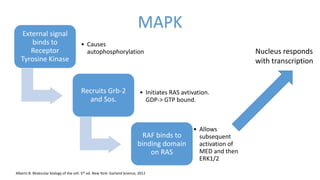
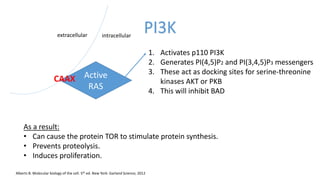
The Ras pathway allows cells to respond to external signals by controlling processes like proliferation, survival, and apoptosis. When growth factors bind to receptor tyrosine kinases, it activates Ras which can then activate the MAPK, PI3K, and other pathways to regulate gene expression and cell behavior. Mutations that cause Ras to be constantly active are implicated in many cancers. Inhibiting Ras function through drugs like farnesyltransferase inhibitors may block its ability to drive uncontrolled cell growth.
![About RAS…
By Irsalan Asif and Amy Bunch
Ras Pathway
GDP
GTP CD-GEGII
GA
P
GTP
Elk1
c-Fos
ATF2
c-Jun
P
P P
P
P
P
Stress Fibers and
Focal Adhesions
Gene
Expression
PLD
Pathway
PMA
Growth Factors
SO
S
p120-
GAP
p190-B
Rho
PI3KPLC-ε
Rap1
A
PLD RalBP1
PAKs
ERKs
ERKs
JNKK
JNK
JNK
MEKK1
CDC42
Rac
MEKs
Raf
RalGDS
Ral
GRB2
GE
F
Ras Ras
2009
ProteinLounge.com
C
Sabiosciences.com. Pathway Central: Ras Pathway [Internet]. 2014 [cited 7
December 2014]. Available from:
http://www.sabiosciences.com/pathway.php?sn=Ras_Pathway](https://image.slidesharecdn.com/raspresentationcomplete-150301124637-conversion-gate01/85/Ras-presentation-complete-1-320.jpg)

![Drug: Farnesyl transferase inhibitor
• Stops the function RAS’s post-
translational modification, (farnesyl
isoprenoid group).
• This means RAS cannot attach to
the cell membrane.
• Therefore cannot transduce signals.
Study: exposed mouse fibroblast cells to H-RAS
• Caused the cells to die.
• Reduces over expression of proteins.
• Reduces cell proliferation and division.
• Reduces risks of tumour and cancer.
Drug Therapies
Quazoo. Farnesyltransferase [Internet]. 2014 [cited 6 December 2014]. Available
from: http://www.quazoo.com/q/Farnesyltransferase](https://image.slidesharecdn.com/raspresentationcomplete-150301124637-conversion-gate01/85/Ras-presentation-complete-7-320.jpg)
![Ras Pathway
GDP
GTP CD-GEGII
GA
P
GTP
Elk1
c-Fos
ATF2
c-Jun
P
P P
P
P
P
Stress Fibers and
Focal Adhesions
Gene
Expression
PLD
Pathway
PMA
Growth Factors
SO
S
p120-
GAP
p190-B
Rho
PI3KPLC-ε
Rap1
A
PLD RalBP1
PAKs
ERKs
ERKs
JNKK
JNK
JNK
MEKK1
CDC42
Rac
MEKs
Raf
RalGDS
Ral
GRB2
GE
F
Ras Ras
2009
ProteinLounge.com
C
Thank You!
Any Questions?
Sabiosciences.com. Pathway Central: Ras Pathway [Internet]. 2014 [cited 7
December 2014]. Available from:
http://www.sabiosciences.com/pathway.php?sn=Ras_Pathway](https://image.slidesharecdn.com/raspresentationcomplete-150301124637-conversion-gate01/85/Ras-presentation-complete-8-320.jpg)


