OBSTRUCTIVE JAUNDICE
PATHOPHYSIOLOGY AND WORKUP
DR.KIRAN KUMAR.G
APOLLO BGS HOSPITALS
DEFINITION
Failure of normal amount of bile
to reach intestine
due to mechanical obstruction of the extra
hepatic biliary tree or within the porta hepatis
JAUNDICE
Jaundice (derived from French word ‘jaune’ for yellow) or icterus (Latin
word for Jaundice)
Yellowing of sclera at 3 mg%
Bilirubin has got high affinity for elastin and sclera has high elastin content
Yellowing of skin and mucous membrane at 6 mg%
D/D beta carotenemia,Quinacrine therapy malingering with picric acid
They doesn’t stain mucous membrane and sclera
Bilirubin level rise upto three weeks than stabilise
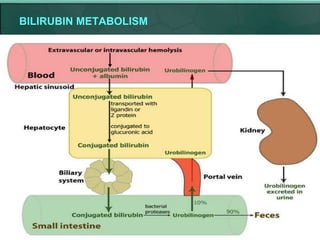
BILIRUBIN METABOLISM
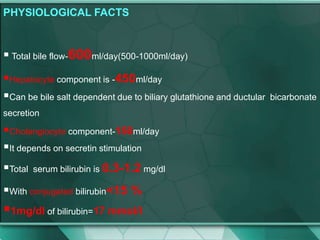
PHYSIOLOGICAL FACTS
 Total bile flow-600ml/day(500-1000ml/day)
Hepatocyte component is -450ml/day
Can be bile salt dependent due to biliary glutathione and ductular bicarbonate
secretion
Cholangiocyte component-150ml/day
It depends on secretin stimulation
Total serum bilirubin is 0.3-1.2 mg/dl
With conjugated bilirubin<15 %
1mg/dl of bilirubin=17 mmol/l
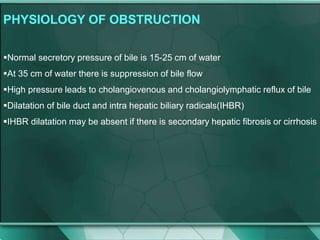
PHYSIOLOGY OF OBSTRUCTION
Normal secretory pressure of bile is 15-25 cm of water
At 35 cm of water there is suppression of bile flow
High pressure leads to cholangiovenous and cholangiolymphatic reflux of bile
Dilatation of bile duct and intra hepatic biliary radicals(IHBR)
IHBR dilatation may be absent if there is secondary hepatic fibrosis or cirrhosis
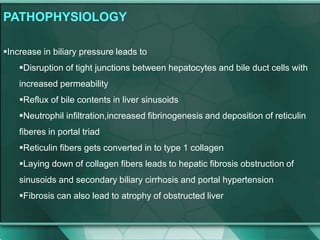
PATHOPHYSIOLOGY
Increase in biliary pressure leads to
Disruption of tight junctions between hepatocytes and bile duct cells with
increased permeability
Reflux of bile contents in liver sinusoids
Neutrophil infiltration,increased fibrinogenesis and deposition of reticulin
fiberes in portal triad
Reticulin fibers gets converted in to type 1 collagen
Laying down of collagen fibers leads to hepatic fibrosis obstruction of
sinusoids and secondary biliary cirrhosis and portal hypertension
Fibrosis can also lead to atrophy of obstructed liver
EFFECTS OF OBSTRUCTIVE
JAUNDICE ON VARIOUS
SYSTEMS
CHANGES IN LIVER BLOOD FLOW
Acute obstruction
 increase in hepatic arterial blood flow
No change in portal venous blood flow
Chronic obstruction
Decrease in total liver blood flow , dilatation of sinusoids and elevation of
portal pressure
CARDIOVASCULAR EFFECTS
Decreased cardiac contractability
Reduced left ventricular pressure
Impaired response to beta agonist drugs
Decreased peripheral vascular resistance
Bradycardia due to direct effect of bile salts on SA node.
Net result
Hypotensive patient
Exaggerated hypotensive response to bleeding
More prone to postoperative shock
RENAL FAILURE
10 % incidence with 70 % mortality
Factors responsible are
Decresed cardic function
Increased levels of ANP resulting in hypovolemia
Decreased effect of bile salts on kidney mediated by increased
prostaglandin E2
Endotoxemia
Resulting in
Renal vasoconstriction
Shunting of blood from cortex
Activation of complement system peritubular and glomerular fibrin
deposition leading to tubular and cortical necrosis
IMMUNE SYSTEM
Defects in cellular immunity
Impaired T cell proliferation
Decreased neutophil chemotaxis
Defective bacterial phagocytosis
Depressed function of RE system ie Kupffer cells
WOUND HEALING
Delayed wound healing
High incidence of wound dehiscence
Decresed activity of enzyme Propyl hydroxylase in the skin
This helps in incorporation of proline in collagen
Defective synthesis of collagen
COAGULATION FACTOR DEFECTS
Prolongation of Prothrombin time
Loss of calcium
Endotoxin induced damage to factor XI ,XII ,platelets
Low grade DIC with increased fibrin degradation
products
Thrombocytopenia from hyperspleenism
Decreased absroption of fat solube vitamins A,D,E,K
ITCHING
Retained bile salts
Levels does not correlete well
Itching disappears in terminal liver failure but bile salt
level still increased
Other theory
Due to endogenous opiate peptides
Inducing opiod receptor mediated scratching
activity of central origin
BIOCHEMICAL EFFECTS
Bilirubin
Rise by 25-43 micromol/litre/day
Mechanism of hyperbilirubinemia
Biliary venous & biliary regurgitation of conjugated bilirubin due to
disruption of tight intracellular junction
Trans hepatocytic regurgitation due to reversal of the secretory
polarity of hepatocytes
Rupture of dilated canaliculi in to sinusoids due to necrosis of
hepatocytes
ALKALINE PHOSPHATSE
Most sensitive indicator
Factor responsible are
Biliary component regurgitation
Increase in hepatic synthesis
Why Bilirubin levels plateau
Increased excretion of bile pigments by kidney by products other than bilirubin
not giving DIAZO reaction
With increasing levels of conjugated bilirubin
A portion get covalently bounded to serum albumin
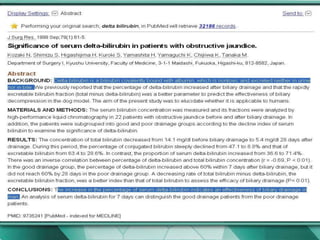
This protein bound bilirubin-Delta bilirubin,is not measurable by routine
technique
HISTORY AND CLINICAL EXAMINATION
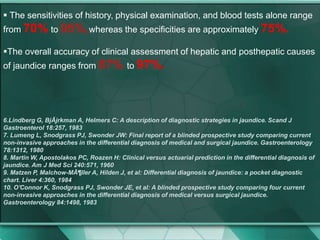
 The sensitivities of history, physical examination, and blood tests alone range
from 70% to 95%,whereas the specificities are approximately 75%.
The overall accuracy of clinical assessment of hepatic and posthepatic causes
of jaundice ranges from 87% to 97%.
6.Lindberg G, BjÃjrkman A, Helmers C: A description of diagnostic strategies in jaundice. Scand J
Gastroenterol 18:257, 1983
7. Lumeng L, Snodgrass PJ, Swonder JW: Final report of a blinded prospective study comparing current
non-invasive approaches in the differential diagnosis of medical and surgical jaundice. Gastroenterology
78:1312, 1980
8. Martin W, Apostolakos PC, Roazen H: Clinical versus actuarial prediction in the differential diagnosis of
jaundice. Am J Med Sci 240:571, 1960
9. Matzen P, Malchow-Möller A, Hilden J, et al: Differential diagnosis of jaundice: a pocket diagnostic
chart. Liver 4:360, 1984
10. O'Connor K, Snodgrass PJ, Swonder JE, et al: A blinded prospective study comparing four current
non-invasive approaches in the differential diagnosis of medical versus surgical jaundice.
Gastroenterology 84:1498, 1983
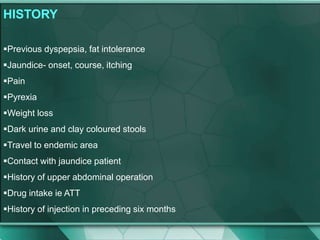
HISTORY
Previous dyspepsia, fat intolerance
Jaundice- onset, course, itching
Pain
Pyrexia
Weight loss
Dark urine and clay coloured stools
Travel to endemic area
Contact with jaundice patient
History of upper abdominal operation
Drug intake ie ATT
History of injection in preceding six months
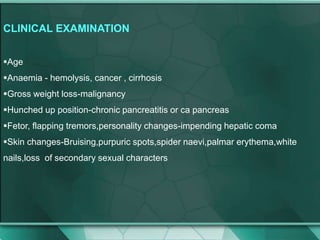
CLINICAL EXAMINATION
Age
Anaemia - hemolysis, cancer , cirrhosis
Gross weight loss-malignancy
Hunched up position-chronic pancreatitis or ca pancreas
Fetor, flapping tremors,personality changes-impending hepatic coma
Skin changes-Bruising,purpuric spots,spider naevi,palmar erythema,white
nails,loss of secondary sexual characters
ABDOMINAL EXAMINATION
 Dilated peri umbalical veins- cirrhosis & portal collateral
circulation
Ascitis-Cirrhosis or malignant disease
Nodular liver
Courvoisier’s Law-palpable non tender gall bladder in
jaundice patient-malignant biliary obstruction
Exceptions
Double impaction of stones
Impaction of pancreatic calculus at ampulla of vater
Mirizzi syndrome
BIOCHEMICAL INVESTIGATIONS
Routine investigations-Hb,TLC,DLC, Blood sugar, RFT ,Serum electrolytes
Urinary bilirubin,Urobilinogen
Serum Bilirubin-Total and Direct
SGOT,SGPT,ALP.GGTP and 5- Nucleotidase
PT and Serum Albumin
ALKALINE PHOSPHATSE(ALP)
ALP levels are elevated in nearly 100 % of patients with extra hepatic
obstruction except in some cases of intermittent obstruction.
Values usually greater than 3 times the upper limit of reference range,
and in most typical cases, they exceed 5 times the upper limit.
 An elevation less than 3 times the upper limit is evidence against
complete extra hepatic obstruction.
AST and ALT
Serum enzymes that provide evidence of hepato cellular damage.ALT found
primarily in the liver, where as AST also found in heart ,kidney, skeletal muscle
and brain
AST is less specific for liver function. The levels of AST and ALT should be
done simultaneously since ALT can confirm the hepatic origin of the less
specific but more sensitive AST.
In extra hepatic obstruction usually AST levels are not elevated(< 10 times the
upper reference limit)
GAMMA –GLUTAMYL TRANSPEPTIDASE(GGTP)
Correlates with ALP level
Most sensitive indicator of biliary tract disease
Better indicator of obstruction in children – levels are independent of age
Helpful in the diagnosis of acute biliary tract obstruction in contrast to ALP
because ALP requires synthesis of fresh ALP and hence lags behind the onset
of obstruction
5- NUCLEOTIDASE
The principal value is to confirm the hepatic origin of an elevated
ALP
This is particularly helpful in children, pregnant women and patients
who may have bone disease resulting in rise of ALP
It is more useful than ALP/GGTP in detecting hepatic metastasis
OTHER LAB INVESTIGATIONS
Prothrobin time
Serum albumin
Stool for occult blood
Presence of occult blood in the stools of a patient with jaundice must raise the
suspicion of malignancy.
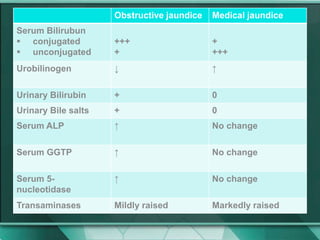
Obstructive jaundice Medical jaundice
Serum Bilirubun
 conjugated
 unconjugated
+++
+
+
+++
Urobilinogen ↓ ↑
Urinary Bilirubin + 0
Urinary Bile salts + 0
Serum ALP ↑ No change
Serum GGTP ↑ No change
Serum 5-
nucleotidase
↑ No change
Transaminases Mildly raised Markedly raised
ETIOLOGY
TYPES OF BILIARY OBSTRUCTION
Complete obstruction
Intermittent obstruction
Chronic incomplete obstruction
Segmental obstruction
INTERMITTENT OBSTRUCTION
 Symptoms and typical biochemical changes
Clinically jaundice may or may not be present
Causes
CBD stones
Periampullary tumours
Duodenal diverticulum
Choledochal cyst
Biliary parasites
hemobilia
CHRONIC INCOMPLETE OBSTRUCTION
With or without classical symptoms or biochemical changes
Pathological changes in bile ducts or liver
Causes
Strictures of CBD
Stenosis of biliary-enteric anastamosis
Chronic pancreatitis
Cystic fibrosis
Sphincter of oddi stenosis
SEGMENTAL OBSTRUCTION
 one or more segment of intrahepatic biliary tract obstructed
Causes
Traumatic
Intrahepatic stones
Sclerosing cholangitis
Cholangiocarcinoma
BILIARY OBSTRUCTION
INTRINSIC
 Ductal calculi
Primary - Develop de novo in bile ducts
Secondary - Migrate from gall bladder
 Acute Cholangitis
 Biliary Strictures
Idiopathic
Iatrogenic
 Sclerosing Cholangitis
 Parasites
 Haemobilia
 Benign Biliary Tumours
 Cholangiocarcinoma
 Carcinoma of ampulla of vater and Periampullary tumours
 Intraductal secondary tumour seeding
BILIARY OBSTRUCTION
EXTRINSIC
 Mirizzi syndrome
 Pancreatitis- acute and chronic
 Pancreatic pseudocyst
 Carcinoma of gall bladder
 Carcinoma of pancreas
 Cystic tumours of pancreas
 Metastatic carcinoma
 Hepatocellular carcinoma
BILIARY OBSTRUCTION
CONGENITAL AND GENETIC DISORDERS
 Biliary atresia
 Choledocal cyst
 Caroli’s disease
 Progressive familial intra hepatic cholestasis
 Primary biliary cirrhosis
 Alpha 1 antitrypsin defeciency
 Tyrosinemia
 Neonatal hepatitis
 Wilson disease
 Others - dyskinesia of sphincter of odi
IMAGING GOALS
To confirm the presence of an extrahepatic obstruction
To determine the level of the obstruction, to identify the specific cause of the
obstruction
To provide complementary information relating to the underlying diagnosis (eg.,
Staging information in cases of malignancy).
Ultrasonography
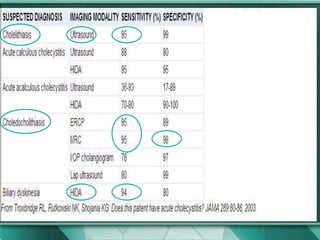
Ultrasound of the abdomen is an extremely useful and accurate method for
identifying gallstones and pathologic changes in the gallbladder consistent with
acute cholecystitis. Abdominal ultrasound, if performed by an experienced
operator, should be part of the routine evaluation of patients suspected of having
gallstone disease, given the high specificity (>98%) and sensitivity (>95%) of this
test for the diagnosis of cholelithiasis[1] ( Table 54-1 ). In addition to identifying
gallstones, ultrasound can also detail signs of cholecystitis such as thickening of
the gallbladder wall, pericholecystic fluid, and impacted stone in the neck of the
gallbladder. It is often the initial screening test for patients with suspected
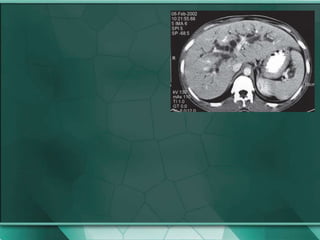
extrahepatic biliary obstruction ( Fig. 54-7 ). Dilation of the extrahepatic (>10 mm)
or intrahepatic (>4 mm) bile ducts suggests biliary obstruction. Intraoperative
ultrasound is now used frequently to further evaluate intrahepatic lesions, assess
resectability, and determine involvement of vascular structures
.
MAGNETIC RESONANCE CHOLANGIOPANCREATOGRAPHY (MRCP)
•Noninvasive test to visualize the hepato biliary tree
•No contrast
•Fluid found in the biliary tree is hyper intense on T2-weighted images. Surrounding
structures do not enhance and can be suppressed during image analysis.
•Sensitive in detecting biliary and pancreatic duct stones, strictures, or dilatations
within the biliary system.
•MRCP combined with conventional MR imaging of the abdomen can provide
information about surrounding structures (eg, pseudocysts, masses).
• ERCP and MRCP similarly effective in detecting malignant hilar and perihilar
obstruction
• MRCP is better able to determine the extent and type of tumor as compared to ERCP
Absolute contraindications
cardiac pacemaker
cerebral aneurysm clips
ocular or cochlear implants
Fluid stasis in the adjacent duodenum or ascitic fluid may produce image artifacts
on MRCP, making it difficult to clearly visualize the biliary tree.
ENDOSCOPIC ULTRASOUND (EUS)
Combines Endoscopy and US
Higher-frequency ultrasonic waves compared to traditional US (3.5 mhz vs 20
mhz) and allows diagnostic tissue sampling via EUS-guided fine-needle aspiration
(EUS-FNA).
EUS has been reported to have up to a 98% diagnostic accuracy in patients with
obstructive jaundice
The sensitivity of EUS for the identification of focal mass lesions in pancreas has
been reported to be superior to that of CT scanning, both traditional and spiral,
particularly for tumors smaller than 3 cm in diameter.
Compared to MRCP for the diagnosis of biliary stricture, EUS has been reported to
be more specific (100% vs 76%) and to have a much greater positive predictive
value (100% vs 25%), although the two have equal sensitivity (67%).
The positive yield of eus-fna for cytology in patients with malignant obstruction has
been reported to be as high as 96%.
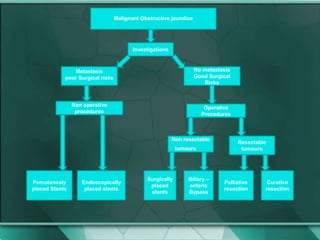
Investigations
Metastasis
poor Surgical risks
No metastasis
Good Surgical
Risks
Non operative
procedures
Operative
Procedures
Non resectable
tumours
Resectable
tumours
Biliary –
enteric
Bypass
Surgically
placed
stents
Percutanesly
placed Stents
Endoscopically
placed stents
Palliative
resection
Curative
resection
Malignant Obstructive jaundice
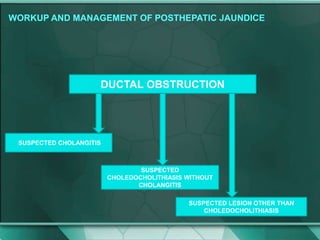
WORKUP AND MANAGEMENT OF POSTHEPATIC JAUNDICE
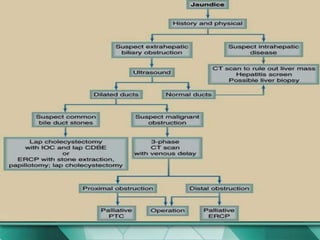
three possible clinical scenarios:DUCTAL OBSTRUCTION
SUSPECTED CHOLANGITIS
SUSPECTED
CHOLEDOCHOLITHIASIS WITHOUT
CHOLANGITIS
SUSPECTED LESION OTHER THAN
CHOLEDOCHOLITHIASIS
SUSPECTED CHOLANGITIS
A clinical picture compatible with acute suppurative cholangitis (charcot's triad or
raynaud's pentad) the most likely diagnosis is choledocholithiasis.
Appropriate resuscitation, correction of any coagulopathies if present, and
administration of antibiotics
ERCP is indicated for diagnosis and treatment
If ERCP is unavailable or is not feasible (e.g., Because of previous roux-en-y
reconstruction), transhepatic drainage or surgery may be necessary
Mainstay of treatment of severe cholangitis is not just the administration of
appropriate antibiotics but rather the establishment of adequate biliary drainage.
SUSPECTED CHOLEDOCHOLITHIASIS WITHOUT CHOLANGITIS
Choledocholithiasis is the most common cause of biliary obstruction.
Strongly suspected if the jaundice is episodic or painful or if usg has shown
presence of gallstones or bile duct stones.
Patients with suspected cbd stones should be referred for lap cholecystectomy with
either preoperative ERCP, intra operative cholangiography
Preoperative ERCP in this setting of jaundice is prefered
Diagnostic yield is high
 Therapeutic-clearing the CBD of stones in 95% of cases.
Many authors, however favor fully laparoscopic approach, in which CBD stone is
detected in the OR by means of intraoperative cholangiography and laparoscopic
biliary clearance is performed when choledocholithiasis is confirmed.
 The optimal approach in a particular setting should be dictated by local expertise.
SUSPECTED LESION OTHER THAN CHOLEDOCHOLITHIASIS
No gallstones are seen
Clinical presentation is less acute (e.g., constant abdominal or back pain)
Associated constitutional symptoms (e.g., weight loss, fatigue, and long-standing
anorexia)
Possible causes of may be classified into three categories depending on the location of
the obstructing lesion
the upper third of the biliary tree
the middle third
 the lower (distal) third
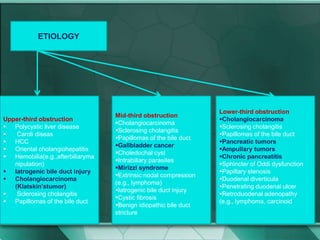
Upper-third obstruction
 Polycystic liver disease
 Caroli diseas
 HCC
 Oriental cholangiohepatitis
 Hemobilia(e.g.,afterbiliaryma
nipulation)
 Iatrogenic bile duct injury
 Cholangiocarcinoma
(Klatskin'stumor)
 Sclerosing cholangitis
 Papillomas of the bile duct
Mid-third obstruction
Cholangiocarcinoma
Sclerosing cholangitis
Papillomas of the bile duct
Gallbladder cancer
Choledochal cyst
Intrabiliary parasites
Mirizzi syndrome
Extrinsic nodal compression
(e.g., lymphoma)
Iatrogenic bile duct injury
Cystic fibrosis
Benign idiopathic bile duct
stricture
Lower-third obstruction
Cholangiocarcinoma
Sclerosing cholangitis
Papillomas of the bile duct
Pancreatic tumors
Ampullary tumors
Chronic pancreatitis
Sphincter of Oddi dysfunction
Papillary stenosis
Duodenal diverticula
Penetrating duodenal ulcer
Retroduodenal adenopathy
(e.g., lymphoma, carcinoid
ETIOLOGY
DIAGNOSIS AND ASSESSMENT OF RESECTABILITY
Involvement of the SUPERIOR MESENTERIC VEIN, THE PORTAL VEIN, THE
SUPERIOR MESENTERIC ARTERY, and the PORTA HEPATIS and on whether
there is evidence of significant LOCAL ADENOPATHY or EXTRAPANCREATIC
EXTENSION OF TUMOR indicates UNRESECTABILITY
The majority of lesions will be clearly unresectable, either because of tumor
extension or because of the presence of hepatic or peritoneal metastases
NON OPERATIVE MANAGEMENT
DRAINAGE PROCEDURES
In the majority of patients with malignant obstructions, treatment is palliative rather
than curative.
Cholangiography and decompression of obstructed biliary system
In the absence of preexisting or concomitant hepatocellular dysfunction, drainage of
one half of the liver is generally sufficient for resolution of jaundice
Routine preoperative drainage of an obstructed biliary system does not benefit
patients who will soon undergo resection.90,91
There is evidence suggesting that in patients with either pancreatic 92,93 or hepatic
malignancies, routine preoperative direct cholangiography with decompression is
associated with a higher incidence of postoperative complications when tumor resection
is ultimately carried out.
90. Pitt HA, Gomes AS, Lois JF: Does preoperative percutaneous biliary drainage reduce operative
risk or increase hospital cost? Ann Surg 201:545, 1985
91. McPherson GA, Benjamin IS, Hodgson HJ, et al: Preoperative percutaneous transhepatic biliary
drainage: results of a controlled trial. Br J Surg 71:371, 1984
92. Povoski SP, Karpeh MS Jr, Conlon KC, et al: Preoperative biliary drainage: impact on
intraoperative bile cultures and infectious morbidity and mortality after pancreaticoduodenectomy. J
Gastrointest Surg 3:496, 1999
93. Sohn TA, Yeo CJ, Cameron JL, et al: Do preoperative biliary stents increase
postpancreaticoduodenectomy complications? J Gastrointest Surg 4:258, 2000
OPERATIVE MANAGEMENT AT SPECIFIC SITES
BYPASS AND RESECTION
UPPER-THIRD OBSTRUCTION
PALLIATION.
Because the left hepatic duct has a long extrahepatic segment and is more
accessible, the preferred bypass -is a left hepaticojejunostomy
 Laparoscopic bypass techniques that make use of segment 3 have been
developed, but their performance has yet to be formally assessed
RESECTION FOR CURE
The hilar plate is taken down to lengthen the hepatic duct segment available for
subsequent anastomosis.
A formal hepatectomy or segmentectomy is required to ensure an adequate proximal
margin of resection
 If the resection is carried out proximal to the hepatic duct bifurcation, several
cholangiojejunostomies have to be done to anastomose individual hepatic biliary
branches.
The results of aggressive hilar tumor resections that included as much liver tissue as
was necessary to obtain a negative margin appear to justify this approach.
 In cases of left hepatic involvement, resection of the caudate lobe is indicated as well.
MIDDLE-THIRD OBSTRUCTION
Palliation.
Surgical bypass of middle-third lesions is technically simpler
 Hepaticojejunostomy is done distal to the hepatic duct bifurcation,
 Exposure of the hilar plate or the intrahepatic ducts is unnecessary.
Resection for cure.
Tumors in this part usually quite amenable to resection along with the lymphatic chains
in the porta hepatis.
Mirizzi syndrome -extrinsic obstruction of the CBD, either by causing inflammation of
the gallbladder wall or via direct impingement.
Treatment of this syndrome - Hepaticojejunostomy
Lower-third obstruction
Palliation
 The preferred bypass technique for lower-third lesions is a Roux-en-Y
choledochojejunostomy.
 Cholecystojejunostomy carries a higher risk of complications and subsequent
development of jaundice
Resection for cure.
 Resection of a lower-third lesion usually involves a pancreaticoduodenectomy though
transduodenal ampullary resection may be an acceptable alternative for a small
adenoma of the ampulla
For optimal results, pancreaticoduodenectomy is best performed in specialized centers.
postoperative adjuvant therapy may improve the prognosis after resection of a
pancreatic adenocarcinoma
PALLIATION IN PATIENTS WITH ADVANCED MALIGNANT DISEASE
When a patient has advanced malignant disease, drainage of the biliary system for
palliation is not routinely indicated, because the risk of complications related to the
procedure may outweigh the potential benefit
The best treatment for a patient with asymptomatic obstructive jaundice and liver
metastases may be supportive care alone.
Biliary decompression is indicated if cholangitis or severe pruritus interferes with quality
of life.
Stent placed with ercp to be the palliative modality of choice for advanced disease,
Upper-third lesions may be managed most easily through the initial placement of an
internal/external catheter at the time of ptc.
Metal expandable stents remain patent longer than large conventional plastic stents
RCTs suggest that surgical biliary bypass should be reserved for patients who are
expected to survive for 6 months or longer because bypass is associated with more
prolonged palliation at the cost of greater initial morbidity.
The role of prophylactic gastric drainage at the time of operative biliary drainage
remains controversial,101,102
 RCTs demonstrated a reduced incidence of subsequent clinical gastric outlet
obstruction when this measure was employed.
 When a pancreatic malignancy is present, intraoperative celiac ganglion injection
should be performed for either prophylactic or therapeutic pain
POSTOPERATIVE JAUNDICE
The development of jaundice in the postoperative setting is approximately 1% of all
surgical patients after operation.120
When jaundice occurs after a hepatobiliary procedure,
Attributable to specific biliary causes,
Retained cbd stones,
Postoperative biliary leakage (through reabsorption of bile leaking into the peritoneum)
 injury to the cbd
Development of biliary strictures
JAUNDICE WITHIN 48 HOURS OF THE OPERATION
Breakdown of rbc –due to multiple blood transfusions ,
The resorption of a large hematoma,
Transfusion reaction.
Known underlying hemolytic anemia and may be precipitated specific drugs (e.G.,
Sulfa drugs in a patient who has G6PD deficiency).
Gilbert syndrome may first manifest itself early in the postoperative period.
Intraoperative hypotension or hypoxemia or the early development of heart failure
can lead to hyperbilirubinemia within 5 to 10 days after operation.
The hyperbilirubinemia may be associated with other end-organ damage (e.G.,
Acute tubular necrosis).
Impairment of renal function causes a decrease in bilirubin excretion and can be
responsible for a mild hyperbilirubinemia.
Jaundice developing 7 to 10 days after operation
 In association with a medication-induced hepatitis attributable to an anesthetic agent.
Incidence of 1/10,000 after an initial exposure.
Administration of antibiotics or other medications used in the perioperative setting
Jaundice associated with intrahepatic cholestasis is often a manifestation of a sepsis,
particularly in patients with mods
 Jaundice may occur in as many as 30% of patients receiving total parenteral nutrition
(tpn).
It may be due to steatosis, particularly with formulas containing large amounts of
carbohydrates.
Decreased export of bilirubin from the hepatocytes may lead to cholestasis
Acalculous cholecystitis or even ductal obstruction may develop as a result of sludge in
the gallbladder and the cbd.
Unsuspected hepatic or post-hepatic causes (e.G., Occult cirrhosis,
choledocholithiasis, or cholecystitis)
A rare cause of postoperative jaundice is the development of thyrotoxicosis.
A diagnosis of exclusion- is so-called benign postoperative cholestasis, a
primarily cholestatic, self-limited process with no clearly demonstrable cause that
typically arises within 2 to 10 days after operation.
Mechanism-combination of an increased pigment load, impaired liver function,
and decreased renal bilirubin excretion caused by varying degrees of tubular
necrosis.
 The predominantly conjugated hyperbilirubinemia may reach 40 mg/dl and
remain elevated for as long as 3 weeks.
Obstructive jaundice.

Obstructive jaundice.

  • 1.
    OBSTRUCTIVE JAUNDICE PATHOPHYSIOLOGY ANDWORKUP DR.KIRAN KUMAR.G APOLLO BGS HOSPITALS
  • 2.
    DEFINITION Failure of normalamount of bile to reach intestine due to mechanical obstruction of the extra hepatic biliary tree or within the porta hepatis
  • 3.
    JAUNDICE Jaundice (derived fromFrench word ‘jaune’ for yellow) or icterus (Latin word for Jaundice) Yellowing of sclera at 3 mg% Bilirubin has got high affinity for elastin and sclera has high elastin content Yellowing of skin and mucous membrane at 6 mg% D/D beta carotenemia,Quinacrine therapy malingering with picric acid They doesn’t stain mucous membrane and sclera Bilirubin level rise upto three weeks than stabilise
  • 4.
  • 5.
    PHYSIOLOGICAL FACTS  Totalbile flow-600ml/day(500-1000ml/day) Hepatocyte component is -450ml/day Can be bile salt dependent due to biliary glutathione and ductular bicarbonate secretion Cholangiocyte component-150ml/day It depends on secretin stimulation Total serum bilirubin is 0.3-1.2 mg/dl With conjugated bilirubin<15 % 1mg/dl of bilirubin=17 mmol/l
  • 6.
    PHYSIOLOGY OF OBSTRUCTION Normalsecretory pressure of bile is 15-25 cm of water At 35 cm of water there is suppression of bile flow High pressure leads to cholangiovenous and cholangiolymphatic reflux of bile Dilatation of bile duct and intra hepatic biliary radicals(IHBR) IHBR dilatation may be absent if there is secondary hepatic fibrosis or cirrhosis
  • 7.
    PATHOPHYSIOLOGY Increase in biliarypressure leads to Disruption of tight junctions between hepatocytes and bile duct cells with increased permeability Reflux of bile contents in liver sinusoids Neutrophil infiltration,increased fibrinogenesis and deposition of reticulin fiberes in portal triad Reticulin fibers gets converted in to type 1 collagen Laying down of collagen fibers leads to hepatic fibrosis obstruction of sinusoids and secondary biliary cirrhosis and portal hypertension Fibrosis can also lead to atrophy of obstructed liver
  • 8.
  • 9.
    CHANGES IN LIVERBLOOD FLOW Acute obstruction  increase in hepatic arterial blood flow No change in portal venous blood flow Chronic obstruction Decrease in total liver blood flow , dilatation of sinusoids and elevation of portal pressure
  • 10.
    CARDIOVASCULAR EFFECTS Decreased cardiaccontractability Reduced left ventricular pressure Impaired response to beta agonist drugs Decreased peripheral vascular resistance Bradycardia due to direct effect of bile salts on SA node. Net result Hypotensive patient Exaggerated hypotensive response to bleeding More prone to postoperative shock
  • 11.
    RENAL FAILURE 10 %incidence with 70 % mortality Factors responsible are Decresed cardic function Increased levels of ANP resulting in hypovolemia Decreased effect of bile salts on kidney mediated by increased prostaglandin E2 Endotoxemia Resulting in Renal vasoconstriction Shunting of blood from cortex Activation of complement system peritubular and glomerular fibrin deposition leading to tubular and cortical necrosis
  • 12.
    IMMUNE SYSTEM Defects incellular immunity Impaired T cell proliferation Decreased neutophil chemotaxis Defective bacterial phagocytosis Depressed function of RE system ie Kupffer cells
  • 13.
    WOUND HEALING Delayed woundhealing High incidence of wound dehiscence Decresed activity of enzyme Propyl hydroxylase in the skin This helps in incorporation of proline in collagen Defective synthesis of collagen
  • 14.
    COAGULATION FACTOR DEFECTS Prolongationof Prothrombin time Loss of calcium Endotoxin induced damage to factor XI ,XII ,platelets Low grade DIC with increased fibrin degradation products Thrombocytopenia from hyperspleenism Decreased absroption of fat solube vitamins A,D,E,K
  • 15.
    ITCHING Retained bile salts Levelsdoes not correlete well Itching disappears in terminal liver failure but bile salt level still increased Other theory Due to endogenous opiate peptides Inducing opiod receptor mediated scratching activity of central origin
  • 16.
    BIOCHEMICAL EFFECTS Bilirubin Rise by25-43 micromol/litre/day Mechanism of hyperbilirubinemia Biliary venous & biliary regurgitation of conjugated bilirubin due to disruption of tight intracellular junction Trans hepatocytic regurgitation due to reversal of the secretory polarity of hepatocytes Rupture of dilated canaliculi in to sinusoids due to necrosis of hepatocytes
  • 17.
    ALKALINE PHOSPHATSE Most sensitiveindicator Factor responsible are Biliary component regurgitation Increase in hepatic synthesis
  • 18.
    Why Bilirubin levelsplateau Increased excretion of bile pigments by kidney by products other than bilirubin not giving DIAZO reaction With increasing levels of conjugated bilirubin A portion get covalently bounded to serum albumin This protein bound bilirubin-Delta bilirubin,is not measurable by routine technique
  • 20.
  • 21.
     The sensitivitiesof history, physical examination, and blood tests alone range from 70% to 95%,whereas the specificities are approximately 75%. The overall accuracy of clinical assessment of hepatic and posthepatic causes of jaundice ranges from 87% to 97%. 6.Lindberg G, BjÃjrkman A, Helmers C: A description of diagnostic strategies in jaundice. Scand J Gastroenterol 18:257, 1983 7. Lumeng L, Snodgrass PJ, Swonder JW: Final report of a blinded prospective study comparing current non-invasive approaches in the differential diagnosis of medical and surgical jaundice. Gastroenterology 78:1312, 1980 8. Martin W, Apostolakos PC, Roazen H: Clinical versus actuarial prediction in the differential diagnosis of jaundice. Am J Med Sci 240:571, 1960 9. Matzen P, Malchow-Möller A, Hilden J, et al: Differential diagnosis of jaundice: a pocket diagnostic chart. Liver 4:360, 1984 10. O'Connor K, Snodgrass PJ, Swonder JE, et al: A blinded prospective study comparing four current non-invasive approaches in the differential diagnosis of medical versus surgical jaundice. Gastroenterology 84:1498, 1983
  • 22.
    HISTORY Previous dyspepsia, fatintolerance Jaundice- onset, course, itching Pain Pyrexia Weight loss Dark urine and clay coloured stools Travel to endemic area Contact with jaundice patient History of upper abdominal operation Drug intake ie ATT History of injection in preceding six months
  • 23.
    CLINICAL EXAMINATION Age Anaemia -hemolysis, cancer , cirrhosis Gross weight loss-malignancy Hunched up position-chronic pancreatitis or ca pancreas Fetor, flapping tremors,personality changes-impending hepatic coma Skin changes-Bruising,purpuric spots,spider naevi,palmar erythema,white nails,loss of secondary sexual characters
  • 24.
    ABDOMINAL EXAMINATION  Dilatedperi umbalical veins- cirrhosis & portal collateral circulation Ascitis-Cirrhosis or malignant disease Nodular liver Courvoisier’s Law-palpable non tender gall bladder in jaundice patient-malignant biliary obstruction Exceptions Double impaction of stones Impaction of pancreatic calculus at ampulla of vater Mirizzi syndrome
  • 25.
    BIOCHEMICAL INVESTIGATIONS Routine investigations-Hb,TLC,DLC,Blood sugar, RFT ,Serum electrolytes Urinary bilirubin,Urobilinogen Serum Bilirubin-Total and Direct SGOT,SGPT,ALP.GGTP and 5- Nucleotidase PT and Serum Albumin
  • 26.
    ALKALINE PHOSPHATSE(ALP) ALP levelsare elevated in nearly 100 % of patients with extra hepatic obstruction except in some cases of intermittent obstruction. Values usually greater than 3 times the upper limit of reference range, and in most typical cases, they exceed 5 times the upper limit.  An elevation less than 3 times the upper limit is evidence against complete extra hepatic obstruction.
  • 27.
    AST and ALT Serumenzymes that provide evidence of hepato cellular damage.ALT found primarily in the liver, where as AST also found in heart ,kidney, skeletal muscle and brain AST is less specific for liver function. The levels of AST and ALT should be done simultaneously since ALT can confirm the hepatic origin of the less specific but more sensitive AST. In extra hepatic obstruction usually AST levels are not elevated(< 10 times the upper reference limit)
  • 28.
    GAMMA –GLUTAMYL TRANSPEPTIDASE(GGTP) Correlateswith ALP level Most sensitive indicator of biliary tract disease Better indicator of obstruction in children – levels are independent of age Helpful in the diagnosis of acute biliary tract obstruction in contrast to ALP because ALP requires synthesis of fresh ALP and hence lags behind the onset of obstruction
  • 29.
    5- NUCLEOTIDASE The principalvalue is to confirm the hepatic origin of an elevated ALP This is particularly helpful in children, pregnant women and patients who may have bone disease resulting in rise of ALP It is more useful than ALP/GGTP in detecting hepatic metastasis
  • 30.
    OTHER LAB INVESTIGATIONS Prothrobintime Serum albumin Stool for occult blood Presence of occult blood in the stools of a patient with jaundice must raise the suspicion of malignancy.
  • 31.
    Obstructive jaundice Medicaljaundice Serum Bilirubun  conjugated  unconjugated +++ + + +++ Urobilinogen ↓ ↑ Urinary Bilirubin + 0 Urinary Bile salts + 0 Serum ALP ↑ No change Serum GGTP ↑ No change Serum 5- nucleotidase ↑ No change Transaminases Mildly raised Markedly raised
  • 32.
  • 33.
    TYPES OF BILIARYOBSTRUCTION Complete obstruction Intermittent obstruction Chronic incomplete obstruction Segmental obstruction
  • 34.
    INTERMITTENT OBSTRUCTION  Symptomsand typical biochemical changes Clinically jaundice may or may not be present Causes CBD stones Periampullary tumours Duodenal diverticulum Choledochal cyst Biliary parasites hemobilia
  • 35.
    CHRONIC INCOMPLETE OBSTRUCTION Withor without classical symptoms or biochemical changes Pathological changes in bile ducts or liver Causes Strictures of CBD Stenosis of biliary-enteric anastamosis Chronic pancreatitis Cystic fibrosis Sphincter of oddi stenosis
  • 36.
    SEGMENTAL OBSTRUCTION  oneor more segment of intrahepatic biliary tract obstructed Causes Traumatic Intrahepatic stones Sclerosing cholangitis Cholangiocarcinoma
  • 37.
    BILIARY OBSTRUCTION INTRINSIC  Ductalcalculi Primary - Develop de novo in bile ducts Secondary - Migrate from gall bladder  Acute Cholangitis  Biliary Strictures Idiopathic Iatrogenic  Sclerosing Cholangitis  Parasites  Haemobilia  Benign Biliary Tumours  Cholangiocarcinoma  Carcinoma of ampulla of vater and Periampullary tumours  Intraductal secondary tumour seeding
  • 38.
    BILIARY OBSTRUCTION EXTRINSIC  Mirizzisyndrome  Pancreatitis- acute and chronic  Pancreatic pseudocyst  Carcinoma of gall bladder  Carcinoma of pancreas  Cystic tumours of pancreas  Metastatic carcinoma  Hepatocellular carcinoma
  • 39.
    BILIARY OBSTRUCTION CONGENITAL ANDGENETIC DISORDERS  Biliary atresia  Choledocal cyst  Caroli’s disease  Progressive familial intra hepatic cholestasis  Primary biliary cirrhosis  Alpha 1 antitrypsin defeciency  Tyrosinemia  Neonatal hepatitis  Wilson disease  Others - dyskinesia of sphincter of odi
  • 40.
    IMAGING GOALS To confirmthe presence of an extrahepatic obstruction To determine the level of the obstruction, to identify the specific cause of the obstruction To provide complementary information relating to the underlying diagnosis (eg., Staging information in cases of malignancy).
  • 41.
    Ultrasonography Ultrasound of theabdomen is an extremely useful and accurate method for identifying gallstones and pathologic changes in the gallbladder consistent with acute cholecystitis. Abdominal ultrasound, if performed by an experienced operator, should be part of the routine evaluation of patients suspected of having gallstone disease, given the high specificity (>98%) and sensitivity (>95%) of this test for the diagnosis of cholelithiasis[1] ( Table 54-1 ). In addition to identifying gallstones, ultrasound can also detail signs of cholecystitis such as thickening of the gallbladder wall, pericholecystic fluid, and impacted stone in the neck of the gallbladder. It is often the initial screening test for patients with suspected extrahepatic biliary obstruction ( Fig. 54-7 ). Dilation of the extrahepatic (>10 mm) or intrahepatic (>4 mm) bile ducts suggests biliary obstruction. Intraoperative ultrasound is now used frequently to further evaluate intrahepatic lesions, assess resectability, and determine involvement of vascular structures
  • 44.
    . MAGNETIC RESONANCE CHOLANGIOPANCREATOGRAPHY(MRCP) •Noninvasive test to visualize the hepato biliary tree •No contrast •Fluid found in the biliary tree is hyper intense on T2-weighted images. Surrounding structures do not enhance and can be suppressed during image analysis. •Sensitive in detecting biliary and pancreatic duct stones, strictures, or dilatations within the biliary system. •MRCP combined with conventional MR imaging of the abdomen can provide information about surrounding structures (eg, pseudocysts, masses). • ERCP and MRCP similarly effective in detecting malignant hilar and perihilar obstruction • MRCP is better able to determine the extent and type of tumor as compared to ERCP
  • 45.
    Absolute contraindications cardiac pacemaker cerebralaneurysm clips ocular or cochlear implants Fluid stasis in the adjacent duodenum or ascitic fluid may produce image artifacts on MRCP, making it difficult to clearly visualize the biliary tree.
  • 46.
    ENDOSCOPIC ULTRASOUND (EUS) CombinesEndoscopy and US Higher-frequency ultrasonic waves compared to traditional US (3.5 mhz vs 20 mhz) and allows diagnostic tissue sampling via EUS-guided fine-needle aspiration (EUS-FNA). EUS has been reported to have up to a 98% diagnostic accuracy in patients with obstructive jaundice The sensitivity of EUS for the identification of focal mass lesions in pancreas has been reported to be superior to that of CT scanning, both traditional and spiral, particularly for tumors smaller than 3 cm in diameter. Compared to MRCP for the diagnosis of biliary stricture, EUS has been reported to be more specific (100% vs 76%) and to have a much greater positive predictive value (100% vs 25%), although the two have equal sensitivity (67%). The positive yield of eus-fna for cytology in patients with malignant obstruction has been reported to be as high as 96%.
  • 49.
    Investigations Metastasis poor Surgical risks Nometastasis Good Surgical Risks Non operative procedures Operative Procedures Non resectable tumours Resectable tumours Biliary – enteric Bypass Surgically placed stents Percutanesly placed Stents Endoscopically placed stents Palliative resection Curative resection Malignant Obstructive jaundice
  • 50.
    WORKUP AND MANAGEMENTOF POSTHEPATIC JAUNDICE three possible clinical scenarios:DUCTAL OBSTRUCTION SUSPECTED CHOLANGITIS SUSPECTED CHOLEDOCHOLITHIASIS WITHOUT CHOLANGITIS SUSPECTED LESION OTHER THAN CHOLEDOCHOLITHIASIS
  • 51.
    SUSPECTED CHOLANGITIS A clinicalpicture compatible with acute suppurative cholangitis (charcot's triad or raynaud's pentad) the most likely diagnosis is choledocholithiasis. Appropriate resuscitation, correction of any coagulopathies if present, and administration of antibiotics ERCP is indicated for diagnosis and treatment If ERCP is unavailable or is not feasible (e.g., Because of previous roux-en-y reconstruction), transhepatic drainage or surgery may be necessary Mainstay of treatment of severe cholangitis is not just the administration of appropriate antibiotics but rather the establishment of adequate biliary drainage.
  • 52.
    SUSPECTED CHOLEDOCHOLITHIASIS WITHOUTCHOLANGITIS Choledocholithiasis is the most common cause of biliary obstruction. Strongly suspected if the jaundice is episodic or painful or if usg has shown presence of gallstones or bile duct stones. Patients with suspected cbd stones should be referred for lap cholecystectomy with either preoperative ERCP, intra operative cholangiography Preoperative ERCP in this setting of jaundice is prefered Diagnostic yield is high  Therapeutic-clearing the CBD of stones in 95% of cases. Many authors, however favor fully laparoscopic approach, in which CBD stone is detected in the OR by means of intraoperative cholangiography and laparoscopic biliary clearance is performed when choledocholithiasis is confirmed.  The optimal approach in a particular setting should be dictated by local expertise.
  • 53.
    SUSPECTED LESION OTHERTHAN CHOLEDOCHOLITHIASIS No gallstones are seen Clinical presentation is less acute (e.g., constant abdominal or back pain) Associated constitutional symptoms (e.g., weight loss, fatigue, and long-standing anorexia) Possible causes of may be classified into three categories depending on the location of the obstructing lesion the upper third of the biliary tree the middle third  the lower (distal) third
  • 54.
    Upper-third obstruction  Polycysticliver disease  Caroli diseas  HCC  Oriental cholangiohepatitis  Hemobilia(e.g.,afterbiliaryma nipulation)  Iatrogenic bile duct injury  Cholangiocarcinoma (Klatskin'stumor)  Sclerosing cholangitis  Papillomas of the bile duct Mid-third obstruction Cholangiocarcinoma Sclerosing cholangitis Papillomas of the bile duct Gallbladder cancer Choledochal cyst Intrabiliary parasites Mirizzi syndrome Extrinsic nodal compression (e.g., lymphoma) Iatrogenic bile duct injury Cystic fibrosis Benign idiopathic bile duct stricture Lower-third obstruction Cholangiocarcinoma Sclerosing cholangitis Papillomas of the bile duct Pancreatic tumors Ampullary tumors Chronic pancreatitis Sphincter of Oddi dysfunction Papillary stenosis Duodenal diverticula Penetrating duodenal ulcer Retroduodenal adenopathy (e.g., lymphoma, carcinoid ETIOLOGY
  • 55.
    DIAGNOSIS AND ASSESSMENTOF RESECTABILITY Involvement of the SUPERIOR MESENTERIC VEIN, THE PORTAL VEIN, THE SUPERIOR MESENTERIC ARTERY, and the PORTA HEPATIS and on whether there is evidence of significant LOCAL ADENOPATHY or EXTRAPANCREATIC EXTENSION OF TUMOR indicates UNRESECTABILITY The majority of lesions will be clearly unresectable, either because of tumor extension or because of the presence of hepatic or peritoneal metastases
  • 56.
  • 57.
    In the majorityof patients with malignant obstructions, treatment is palliative rather than curative. Cholangiography and decompression of obstructed biliary system In the absence of preexisting or concomitant hepatocellular dysfunction, drainage of one half of the liver is generally sufficient for resolution of jaundice
  • 58.
    Routine preoperative drainageof an obstructed biliary system does not benefit patients who will soon undergo resection.90,91 There is evidence suggesting that in patients with either pancreatic 92,93 or hepatic malignancies, routine preoperative direct cholangiography with decompression is associated with a higher incidence of postoperative complications when tumor resection is ultimately carried out. 90. Pitt HA, Gomes AS, Lois JF: Does preoperative percutaneous biliary drainage reduce operative risk or increase hospital cost? Ann Surg 201:545, 1985 91. McPherson GA, Benjamin IS, Hodgson HJ, et al: Preoperative percutaneous transhepatic biliary drainage: results of a controlled trial. Br J Surg 71:371, 1984 92. Povoski SP, Karpeh MS Jr, Conlon KC, et al: Preoperative biliary drainage: impact on intraoperative bile cultures and infectious morbidity and mortality after pancreaticoduodenectomy. J Gastrointest Surg 3:496, 1999 93. Sohn TA, Yeo CJ, Cameron JL, et al: Do preoperative biliary stents increase postpancreaticoduodenectomy complications? J Gastrointest Surg 4:258, 2000
  • 59.
    OPERATIVE MANAGEMENT ATSPECIFIC SITES BYPASS AND RESECTION
  • 60.
    UPPER-THIRD OBSTRUCTION PALLIATION. Because theleft hepatic duct has a long extrahepatic segment and is more accessible, the preferred bypass -is a left hepaticojejunostomy  Laparoscopic bypass techniques that make use of segment 3 have been developed, but their performance has yet to be formally assessed
  • 61.
    RESECTION FOR CURE Thehilar plate is taken down to lengthen the hepatic duct segment available for subsequent anastomosis. A formal hepatectomy or segmentectomy is required to ensure an adequate proximal margin of resection  If the resection is carried out proximal to the hepatic duct bifurcation, several cholangiojejunostomies have to be done to anastomose individual hepatic biliary branches. The results of aggressive hilar tumor resections that included as much liver tissue as was necessary to obtain a negative margin appear to justify this approach.  In cases of left hepatic involvement, resection of the caudate lobe is indicated as well.
  • 62.
    MIDDLE-THIRD OBSTRUCTION Palliation. Surgical bypassof middle-third lesions is technically simpler  Hepaticojejunostomy is done distal to the hepatic duct bifurcation,  Exposure of the hilar plate or the intrahepatic ducts is unnecessary. Resection for cure. Tumors in this part usually quite amenable to resection along with the lymphatic chains in the porta hepatis. Mirizzi syndrome -extrinsic obstruction of the CBD, either by causing inflammation of the gallbladder wall or via direct impingement. Treatment of this syndrome - Hepaticojejunostomy
  • 63.
    Lower-third obstruction Palliation  Thepreferred bypass technique for lower-third lesions is a Roux-en-Y choledochojejunostomy.  Cholecystojejunostomy carries a higher risk of complications and subsequent development of jaundice Resection for cure.  Resection of a lower-third lesion usually involves a pancreaticoduodenectomy though transduodenal ampullary resection may be an acceptable alternative for a small adenoma of the ampulla For optimal results, pancreaticoduodenectomy is best performed in specialized centers. postoperative adjuvant therapy may improve the prognosis after resection of a pancreatic adenocarcinoma
  • 64.
    PALLIATION IN PATIENTSWITH ADVANCED MALIGNANT DISEASE When a patient has advanced malignant disease, drainage of the biliary system for palliation is not routinely indicated, because the risk of complications related to the procedure may outweigh the potential benefit The best treatment for a patient with asymptomatic obstructive jaundice and liver metastases may be supportive care alone. Biliary decompression is indicated if cholangitis or severe pruritus interferes with quality of life. Stent placed with ercp to be the palliative modality of choice for advanced disease, Upper-third lesions may be managed most easily through the initial placement of an internal/external catheter at the time of ptc.
  • 65.
    Metal expandable stentsremain patent longer than large conventional plastic stents RCTs suggest that surgical biliary bypass should be reserved for patients who are expected to survive for 6 months or longer because bypass is associated with more prolonged palliation at the cost of greater initial morbidity. The role of prophylactic gastric drainage at the time of operative biliary drainage remains controversial,101,102  RCTs demonstrated a reduced incidence of subsequent clinical gastric outlet obstruction when this measure was employed.  When a pancreatic malignancy is present, intraoperative celiac ganglion injection should be performed for either prophylactic or therapeutic pain
  • 66.
    POSTOPERATIVE JAUNDICE The developmentof jaundice in the postoperative setting is approximately 1% of all surgical patients after operation.120 When jaundice occurs after a hepatobiliary procedure, Attributable to specific biliary causes, Retained cbd stones, Postoperative biliary leakage (through reabsorption of bile leaking into the peritoneum)  injury to the cbd Development of biliary strictures
  • 67.
    JAUNDICE WITHIN 48HOURS OF THE OPERATION Breakdown of rbc –due to multiple blood transfusions , The resorption of a large hematoma, Transfusion reaction. Known underlying hemolytic anemia and may be precipitated specific drugs (e.G., Sulfa drugs in a patient who has G6PD deficiency). Gilbert syndrome may first manifest itself early in the postoperative period. Intraoperative hypotension or hypoxemia or the early development of heart failure can lead to hyperbilirubinemia within 5 to 10 days after operation. The hyperbilirubinemia may be associated with other end-organ damage (e.G., Acute tubular necrosis). Impairment of renal function causes a decrease in bilirubin excretion and can be responsible for a mild hyperbilirubinemia.
  • 68.
    Jaundice developing 7to 10 days after operation  In association with a medication-induced hepatitis attributable to an anesthetic agent. Incidence of 1/10,000 after an initial exposure. Administration of antibiotics or other medications used in the perioperative setting Jaundice associated with intrahepatic cholestasis is often a manifestation of a sepsis, particularly in patients with mods  Jaundice may occur in as many as 30% of patients receiving total parenteral nutrition (tpn). It may be due to steatosis, particularly with formulas containing large amounts of carbohydrates. Decreased export of bilirubin from the hepatocytes may lead to cholestasis Acalculous cholecystitis or even ductal obstruction may develop as a result of sludge in the gallbladder and the cbd.
  • 69.
    Unsuspected hepatic orpost-hepatic causes (e.G., Occult cirrhosis, choledocholithiasis, or cholecystitis) A rare cause of postoperative jaundice is the development of thyrotoxicosis. A diagnosis of exclusion- is so-called benign postoperative cholestasis, a primarily cholestatic, self-limited process with no clearly demonstrable cause that typically arises within 2 to 10 days after operation. Mechanism-combination of an increased pigment load, impaired liver function, and decreased renal bilirubin excretion caused by varying degrees of tubular necrosis.  The predominantly conjugated hyperbilirubinemia may reach 40 mg/dl and remain elevated for as long as 3 weeks.