By
Yazhini.T
VARICOSE VEIN IS THE PENALTY FOR
VERTICALITY AGAINST GRAVITY
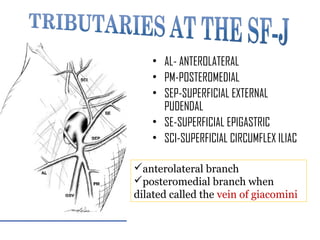
• AL- ANTEROLATERAL
• PM-POSTEROMEDIAL
• SEP-SUPERFICIAL EXTERNAL
PUDENDAL
• SE-SUPERFICIAL EPIGASTRIC
• SCI-SUPERFICIAL CIRCUMFLEX ILIAC
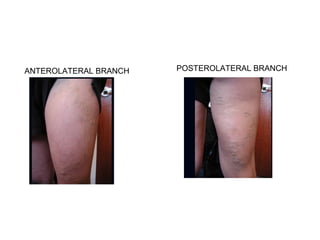
anterolateral branch
posteromedial branch when
dilated called the vein of giacomini
ANTEROLATERAL BRANCH POSTEROLATERAL BRANCH
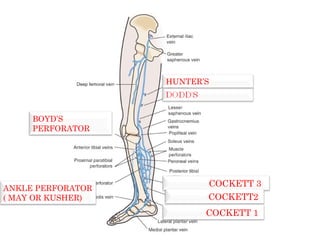
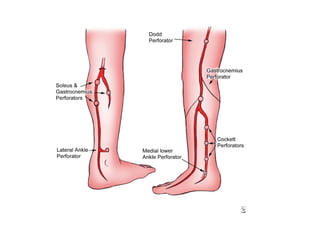
COCKETT 3
COCKETT2
COCKETT 1
BOYD’S
PERFORATOR
ANKLE PERFORATOR
( MAY OR KUSHER)
HUNTER’S
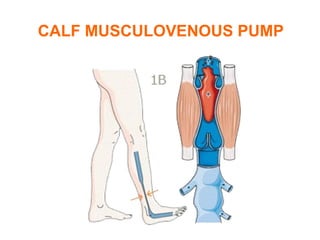
CALF MUSCULOVENOUS PUMP
PRESSURE INCREASES TO
200-300 MM Hg
PRESSURE FALLS AND SO IT
ALLOWS BLOOD TO FLOW FROM
SUPERFICIAL TO DEEP VEINS
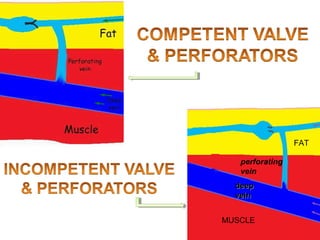
FAT
MUSCLE
perforating
vein
deepdeep
veinvein
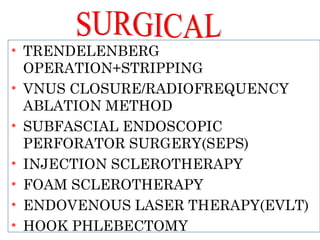
• TRENDELENBERG
OPERATION+STRIPPING
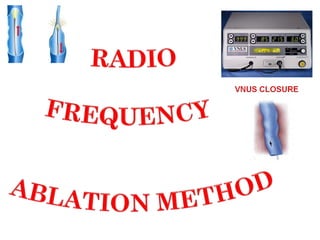
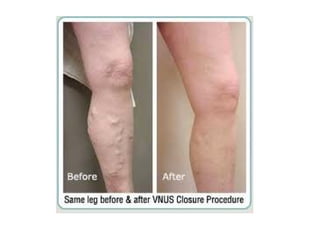
• VNUS CLOSURE/RADIOFREQUENCY
ABLATION METHOD
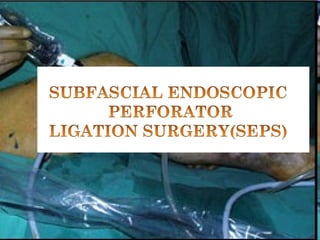
• SUBFASCIAL ENDOSCOPIC
PERFORATOR SURGERY(SEPS)
• INJECTION SCLEROTHERAPY
• FOAM SCLEROTHERAPY
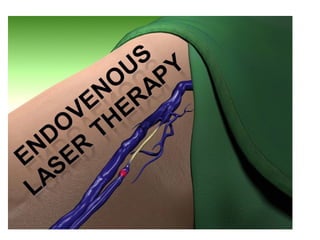
• ENDOVENOUS LASER THERAPY(EVLT)
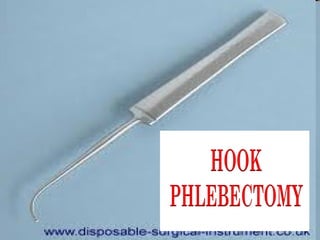
• HOOK PHLEBECTOMY
Indications for Surgery
* Better results with early treatment:
For operative treatment:-
1.Positive Trendelenburg Test
2.Particularily saphenofemoral
incompetence
3.Causing discomfort to the patient
4.Complications like venous ulcer
5.Cosmetic reasons

DVT- superficial varices developing after a venous
thrombosis, may be the only route of venous drainage
in lower limb and should not be removed until the
patency of deep veins of limb has been shown
*patient will depend on superficial veins for venous
drainage

Pregnancy

Woman on contraceptive pills

Thrombophlebitis
Pre-op
Operation postponed till
complications are rid of
Complete Local
examination : Perform all
Tests
Further investigations for
diagnosis:-
-Duplex USG imaging
-Doppler USG
-USG abdomen- rule out
abdominal pathology in
suspected cases
• Explain investigations
• Explain planned surgery
• Describe anaesthetic technique
• Risk of DVT
• Risk of superficial phlebitis
• Risk of bruising and swelling
• Risk of wound infection
• Damage to superficial nerves- sural,
saphenous,cutaneous
•Anaesthesia:
Operation is better
performed under GA
•Position: supine
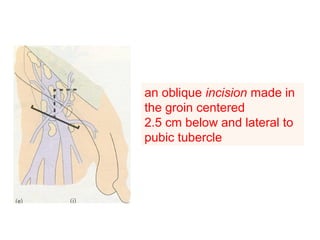
an oblique incision made in
the groin centered
2.5 cm below and lateral to
pubic tubercle
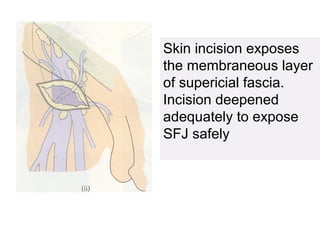
Skin incision exposes
the membraneous layer
of supericial fascia.
Incision deepened
adequately to expose
SFJ safely
Fat is brushed downwards .Long saphenous vein
found by blunt dissection & traced upto T-shaped
termination with femoral vein (must confirm the T
junction, before ligation)
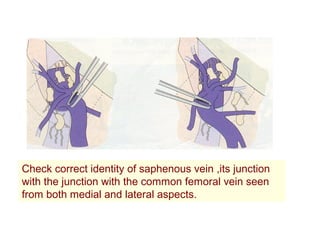
Check correct identity of saphenous vein ,its junction
with the junction with the common femoral vein seen
from both medial and lateral aspects.
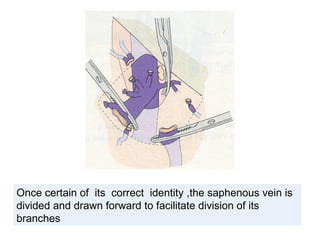
Once certain of its correct identity ,the saphenous vein is
divided and drawn forward to facilitate division of its
branches
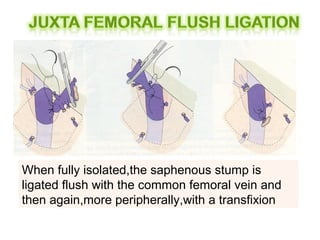
When fully isolated,the saphenous stump is
ligated flush with the common femoral vein and
then again,more peripherally,with a transfixion
• All the tributaries that join the
saphenous vein near its termination
( supericial inferior epigastric,superficial
circumflex iliac,superficial external
pudendal) must be dissected out ,ligated
with 2/0 polyglactin &divided.In
addition to this anterolateral and
posteromedial thigh veins terminate
close to s-f junction
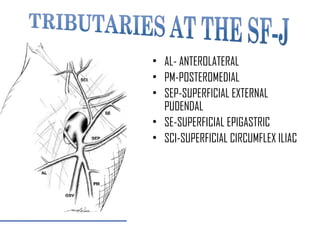
• AL- ANTEROLATERAL
• PM-POSTEROMEDIAL
• SEP-SUPERFICIAL EXTERNAL
PUDENDAL
• SE-SUPERFICIAL EPIGASTRIC
• SCI-SUPERFICIAL CIRCUMFLEX ILIAC
• Main principle of surgical treatement is to
ligate source of venous reflux and remove
incompetent saphenous trunk
• Done alone, there is a high chance of
recurrence
• To ensure elimination of as much as reflux
as possible, must remove LSV
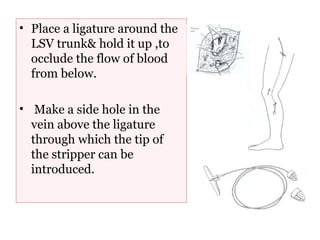
• Place a ligature around the
LSV trunk& hold it up ,to
occlude the flow of blood
from below.
• Make a side hole in the
vein above the ligature
through which the tip of
the stripper can be
introduced.
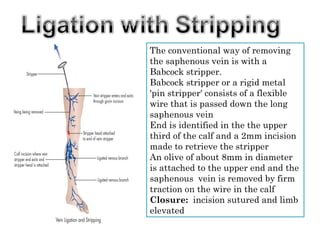
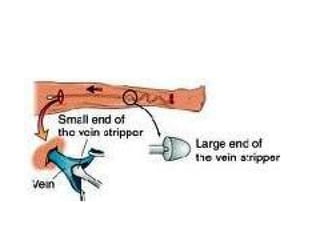
The conventional way of removing
the saphenous vein is with a
Babcock stripper.
Babcock stripper or a rigid metal
'pin stripper' consists of a flexible
wire that is passed down the long
saphenous vein
End is identified in the the upper
third of the calf and a 2mm incision
made to retrieve the stripper
An olive of about 8mm in diameter
is attached to the upper end and the
saphenous vein is removed by firm
traction on the wire in the calf
Closure: incision sutured and limb
elevated
Saphenopopliteal Junction
Ligation & Stripping
• Pre-op USG for localization of junction
• A transverse skin incision made in popliteal fossa
just below termination of vein
• Deep fasia incised to reveal short saphenous vein
beneath
• Vein followed to SPJ, where SSV enters the side of
popliteal vein
• Vein then ligated and divided close to popliteal vein
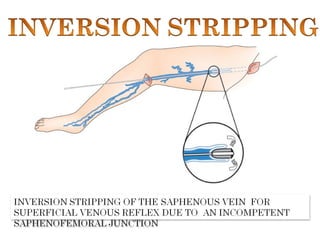
• Can strip SSV using inverting technique; stripper
passed upwards from the ankle, carefully dissecting
off the sural nerve to ensure that the whole of the
lesser saphenous vein is removed
What is inversion stripping?
Aim is to reduce damage to tissues around vein
Less pain and bleeding
Rigid metal pin stripper (Oesh) passed down
the inside of the saphenous vein and recovered
through a small incision in the upper part of calf
A strong suture attached to the end of the
stripper and firmly ligated to the proximal end of
the vein
During pulling of stripper, LSV will invert and
can be delivered through 2mm incision in midcalf
region
No olive used
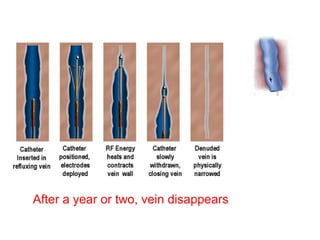
After a year or two, vein disappears
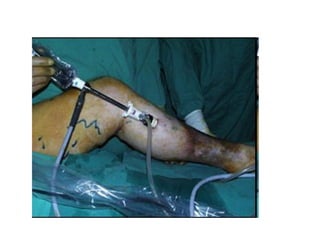
1. A tourniquet is placed above the knee and an
Esmarch band is placed tightly around the
lower extremity to empty the blood from the
surgical site.
2. The tourniquet is inflated to supra systolic
blood pressure (usually 300 mm Hg).
3. An incision is made one-hand’s width below
the tibial prominence and two-finger’s
breadth posterior to the anterior border of the
tibia. This provides access for the camera and
carbon dioxide insufflation.
4. A large balloon trocar is placed through
this incision into the subfascial plane
and filled with 180 cc of saline to
expand the space. The balloon is
emptied and removed. Carbon dioxide
insufflation is started through the
trocar, maintaining a pressure of 30
mm Hg to keep the subfascial space
expanded and to allow visualization of
the structures.
5. Frequently, a second incision is placed
inferior and posterior to the first,
allowing insertion of the instruments
that perform the vein ligation (either
cautery hook or clip applier and
scissors).
6. The camera follows the instruments in
a caudal direction and perforating
veins are identified traversing the
subfascial space. The veins are divided
and the instruments are removed. The
incisions then are closed in two layers
and a pressure dressing is applied
before the tourniquet is released
.7.The procedure is frequently performed
in an ambulatory care setting. The
pressure dressing is left in place for 2 to
5 days. Lower extremity activity is
limited for 5 to 7 days. Full recovery is
usually attained in 2 weeks.
• Haematoma (9%).
• Transient neuralgia (7%
• Paresthesia, hypesthesia
• Wound infections (6%)
COMPLICATIONS OF SEPS
   Involves a long incision along the
medial or posterior aspect of the calf
and blind division of the perforators.
Has a high chance of haematoma and
chronic skin changes and is rarely used
today.
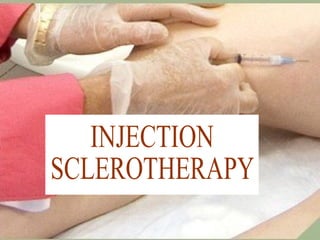
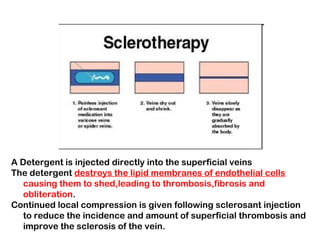
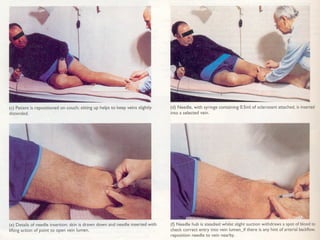
A Detergent is injected directly into the superficial veins
The detergent destroys the lipid membranes of endothelial cells
causing them to shed,leading to thrombosis,fibrosis and
obliteration.
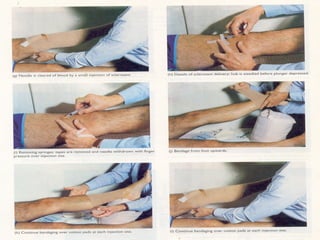
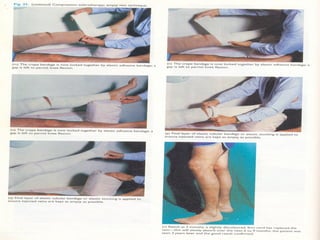
Continued local compression is given following sclerosant injection
to reduce the incidence and amount of superficial thrombosis and
improve the sclerosis of the vein.
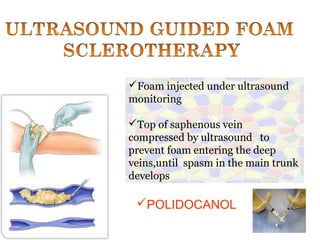
Foam injected under ultrasound
monitoring
Top of saphenous vein
compressed by ultrasound to
prevent foam entering the deep
veins,until spasm in the main trunk
develops
POLIDOCANOL
• CUTANEOUS ULCERATION
• DEEP VEIN THROMBOSIS
HEADACHE
TRANSIENT BLINDNESS
STROKE
•A laser probe is passed up inside a
catheter inserted ino the lower part o the
saphenous
vein under ultrasound guidance
•Crystalloid fluid - L.A& prevents burns
•Duplex ultrasound confirms LASER probe
is at SFJ and the LASER probe is then
withdrawn, administering a set number of
joules to the endothelial lining
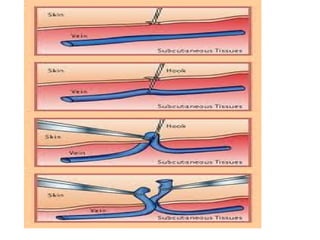
 Aim is to remove all the varicosities through incisions
that require no suture
 After stripping, residual veins and tributaries are left
behind.
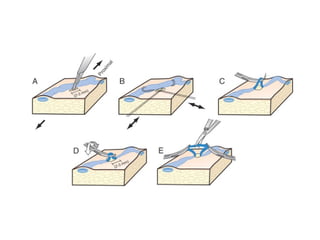
 Veins are taken care of by means of small hooks,
inserted through incisions of 1-2mm size
 Hook is used to capture a small section of a varicosity
and bring it to the surface, where it is grasped with large
artery forceps; remaining vein is then teased through
tiny incision.
 Closure of small incision achieved using adhesive
strips ;Very good cosmetic outcome
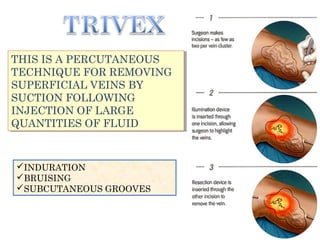
THIS IS A PERCUTANEOUS
TECHNIQUE FOR REMOVING
SUPERFICIAL VEINS BY
SUCTION FOLLOWING
INJECTION OF LARGE
QUANTITIES OF FLUID
THIS IS A PERCUTANEOUS
TECHNIQUE FOR REMOVING
SUPERFICIAL VEINS BY
SUCTION FOLLOWING
INJECTION OF LARGE
QUANTITIES OF FLUID
IINDURATION
BRUISING
SUBCUTANEOUS GROOVES
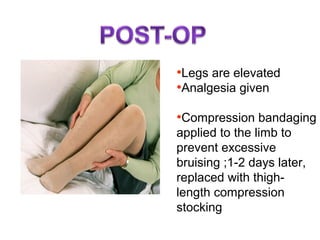
•Legs are elevated
•Analgesia given
•Compression bandaging
applied to the limb to
prevent excessive
bruising ;1-2 days later,
replaced with thigh-
length compression
stocking
Complications of surgery
• Pain, discomfort, bruising
• Nerve injury
saphenous -LSV
sural-short saphenous vein
• Venous thrombosis
• DVT
 varicose vein surgery
 varicose vein surgery

varicose vein surgery

  • 1.
    By Yazhini.T VARICOSE VEIN ISTHE PENALTY FOR VERTICALITY AGAINST GRAVITY
  • 4.
    • AL- ANTEROLATERAL •PM-POSTEROMEDIAL • SEP-SUPERFICIAL EXTERNAL PUDENDAL • SE-SUPERFICIAL EPIGASTRIC • SCI-SUPERFICIAL CIRCUMFLEX ILIAC anterolateral branch posteromedial branch when dilated called the vein of giacomini
  • 5.
  • 7.
    COCKETT 3 COCKETT2 COCKETT 1 BOYD’S PERFORATOR ANKLEPERFORATOR ( MAY OR KUSHER) HUNTER’S
  • 9.
  • 10.
    PRESSURE INCREASES TO 200-300MM Hg PRESSURE FALLS AND SO IT ALLOWS BLOOD TO FLOW FROM SUPERFICIAL TO DEEP VEINS
  • 12.
  • 14.
    • TRENDELENBERG OPERATION+STRIPPING • VNUSCLOSURE/RADIOFREQUENCY ABLATION METHOD • SUBFASCIAL ENDOSCOPIC PERFORATOR SURGERY(SEPS) • INJECTION SCLEROTHERAPY • FOAM SCLEROTHERAPY • ENDOVENOUS LASER THERAPY(EVLT) • HOOK PHLEBECTOMY
  • 15.
    Indications for Surgery *Better results with early treatment: For operative treatment:- 1.Positive Trendelenburg Test 2.Particularily saphenofemoral incompetence 3.Causing discomfort to the patient 4.Complications like venous ulcer 5.Cosmetic reasons
  • 16.
     DVT- superficial varicesdeveloping after a venous thrombosis, may be the only route of venous drainage in lower limb and should not be removed until the patency of deep veins of limb has been shown *patient will depend on superficial veins for venous drainage  Pregnancy  Woman on contraceptive pills  Thrombophlebitis
  • 17.
    Pre-op Operation postponed till complicationsare rid of Complete Local examination : Perform all Tests Further investigations for diagnosis:- -Duplex USG imaging -Doppler USG -USG abdomen- rule out abdominal pathology in suspected cases
  • 18.
    • Explain investigations •Explain planned surgery • Describe anaesthetic technique • Risk of DVT • Risk of superficial phlebitis • Risk of bruising and swelling • Risk of wound infection • Damage to superficial nerves- sural, saphenous,cutaneous
  • 19.
  • 21.
    an oblique incisionmade in the groin centered 2.5 cm below and lateral to pubic tubercle
  • 22.
    Skin incision exposes themembraneous layer of supericial fascia. Incision deepened adequately to expose SFJ safely
  • 23.
    Fat is brusheddownwards .Long saphenous vein found by blunt dissection & traced upto T-shaped termination with femoral vein (must confirm the T junction, before ligation)
  • 24.
    Check correct identityof saphenous vein ,its junction with the junction with the common femoral vein seen from both medial and lateral aspects.
  • 25.
    Once certain ofits correct identity ,the saphenous vein is divided and drawn forward to facilitate division of its branches
  • 26.
    When fully isolated,thesaphenous stump is ligated flush with the common femoral vein and then again,more peripherally,with a transfixion
  • 27.
    • All thetributaries that join the saphenous vein near its termination ( supericial inferior epigastric,superficial circumflex iliac,superficial external pudendal) must be dissected out ,ligated with 2/0 polyglactin &divided.In addition to this anterolateral and posteromedial thigh veins terminate close to s-f junction
  • 28.
    • AL- ANTEROLATERAL •PM-POSTEROMEDIAL • SEP-SUPERFICIAL EXTERNAL PUDENDAL • SE-SUPERFICIAL EPIGASTRIC • SCI-SUPERFICIAL CIRCUMFLEX ILIAC
  • 29.
    • Main principleof surgical treatement is to ligate source of venous reflux and remove incompetent saphenous trunk • Done alone, there is a high chance of recurrence • To ensure elimination of as much as reflux as possible, must remove LSV
  • 30.
    • Place aligature around the LSV trunk& hold it up ,to occlude the flow of blood from below. • Make a side hole in the vein above the ligature through which the tip of the stripper can be introduced.
  • 31.
    The conventional wayof removing the saphenous vein is with a Babcock stripper. Babcock stripper or a rigid metal 'pin stripper' consists of a flexible wire that is passed down the long saphenous vein End is identified in the the upper third of the calf and a 2mm incision made to retrieve the stripper An olive of about 8mm in diameter is attached to the upper end and the saphenous vein is removed by firm traction on the wire in the calf Closure: incision sutured and limb elevated
  • 33.
    Saphenopopliteal Junction Ligation &Stripping • Pre-op USG for localization of junction • A transverse skin incision made in popliteal fossa just below termination of vein • Deep fasia incised to reveal short saphenous vein beneath • Vein followed to SPJ, where SSV enters the side of popliteal vein • Vein then ligated and divided close to popliteal vein • Can strip SSV using inverting technique; stripper passed upwards from the ankle, carefully dissecting off the sural nerve to ensure that the whole of the lesser saphenous vein is removed
  • 35.
    What is inversionstripping? Aim is to reduce damage to tissues around vein Less pain and bleeding Rigid metal pin stripper (Oesh) passed down the inside of the saphenous vein and recovered through a small incision in the upper part of calf A strong suture attached to the end of the stripper and firmly ligated to the proximal end of the vein During pulling of stripper, LSV will invert and can be delivered through 2mm incision in midcalf region No olive used
  • 37.
    After a yearor two, vein disappears
  • 41.
    1. A tourniquetis placed above the knee and an Esmarch band is placed tightly around the lower extremity to empty the blood from the surgical site. 2. The tourniquet is inflated to supra systolic blood pressure (usually 300 mm Hg). 3. An incision is made one-hand’s width below the tibial prominence and two-finger’s breadth posterior to the anterior border of the tibia. This provides access for the camera and carbon dioxide insufflation.
  • 42.
    4. A largeballoon trocar is placed through this incision into the subfascial plane and filled with 180 cc of saline to expand the space. The balloon is emptied and removed. Carbon dioxide insufflation is started through the trocar, maintaining a pressure of 30 mm Hg to keep the subfascial space expanded and to allow visualization of the structures.
  • 43.
    5. Frequently, asecond incision is placed inferior and posterior to the first, allowing insertion of the instruments that perform the vein ligation (either cautery hook or clip applier and scissors). 6. The camera follows the instruments in a caudal direction and perforating veins are identified traversing the subfascial space. The veins are divided and the instruments are removed. The incisions then are closed in two layers and a pressure dressing is applied before the tourniquet is released
  • 44.
    .7.The procedure isfrequently performed in an ambulatory care setting. The pressure dressing is left in place for 2 to 5 days. Lower extremity activity is limited for 5 to 7 days. Full recovery is usually attained in 2 weeks.
  • 45.
    • Haematoma (9%). •Transient neuralgia (7% • Paresthesia, hypesthesia • Wound infections (6%) COMPLICATIONS OF SEPS
  • 46.
       Involves along incision along the medial or posterior aspect of the calf and blind division of the perforators. Has a high chance of haematoma and chronic skin changes and is rarely used today.
  • 48.
    A Detergent isinjected directly into the superficial veins The detergent destroys the lipid membranes of endothelial cells causing them to shed,leading to thrombosis,fibrosis and obliteration. Continued local compression is given following sclerosant injection to reduce the incidence and amount of superficial thrombosis and improve the sclerosis of the vein.
  • 53.
    Foam injected underultrasound monitoring Top of saphenous vein compressed by ultrasound to prevent foam entering the deep veins,until spasm in the main trunk develops POLIDOCANOL
  • 54.
    • CUTANEOUS ULCERATION •DEEP VEIN THROMBOSIS HEADACHE TRANSIENT BLINDNESS STROKE
  • 56.
    •A laser probeis passed up inside a catheter inserted ino the lower part o the saphenous vein under ultrasound guidance •Crystalloid fluid - L.A& prevents burns •Duplex ultrasound confirms LASER probe is at SFJ and the LASER probe is then withdrawn, administering a set number of joules to the endothelial lining
  • 58.
     Aim isto remove all the varicosities through incisions that require no suture  After stripping, residual veins and tributaries are left behind.  Veins are taken care of by means of small hooks, inserted through incisions of 1-2mm size  Hook is used to capture a small section of a varicosity and bring it to the surface, where it is grasped with large artery forceps; remaining vein is then teased through tiny incision.  Closure of small incision achieved using adhesive strips ;Very good cosmetic outcome
  • 61.
    THIS IS APERCUTANEOUS TECHNIQUE FOR REMOVING SUPERFICIAL VEINS BY SUCTION FOLLOWING INJECTION OF LARGE QUANTITIES OF FLUID THIS IS A PERCUTANEOUS TECHNIQUE FOR REMOVING SUPERFICIAL VEINS BY SUCTION FOLLOWING INJECTION OF LARGE QUANTITIES OF FLUID IINDURATION BRUISING SUBCUTANEOUS GROOVES
  • 62.
    •Legs are elevated •Analgesiagiven •Compression bandaging applied to the limb to prevent excessive bruising ;1-2 days later, replaced with thigh- length compression stocking
  • 63.
    Complications of surgery •Pain, discomfort, bruising • Nerve injury saphenous -LSV sural-short saphenous vein • Venous thrombosis • DVT