History Of Patient
Presentingthe case of 30 years old
female admitted in G2 ward of the New
Civil hospital on 20th
October 2016.
• Chief complains:
• Pain in abdomen fever since one
month.
4.
ODP- Origin durationprogress
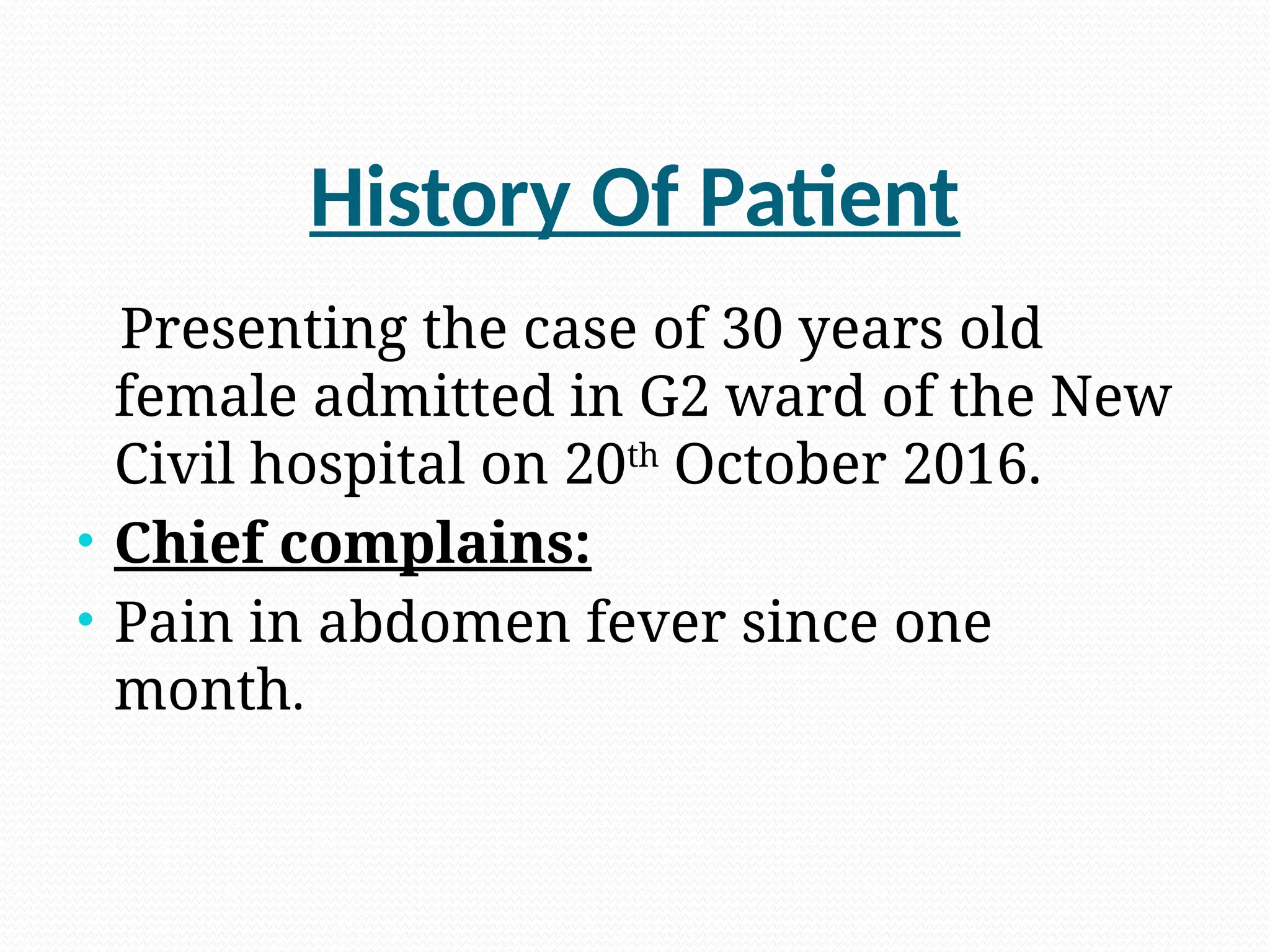
The patient had pain in abdomen with
fullness and indigestion before 2 days So she
went to Gurunanak hospital.
Ultra sonography was done and came to
know that there was calculi(stone) in Gall
Bladder and also in distal part of bile duct.
5.
.
After 2days, on 20th
october patient was shifted
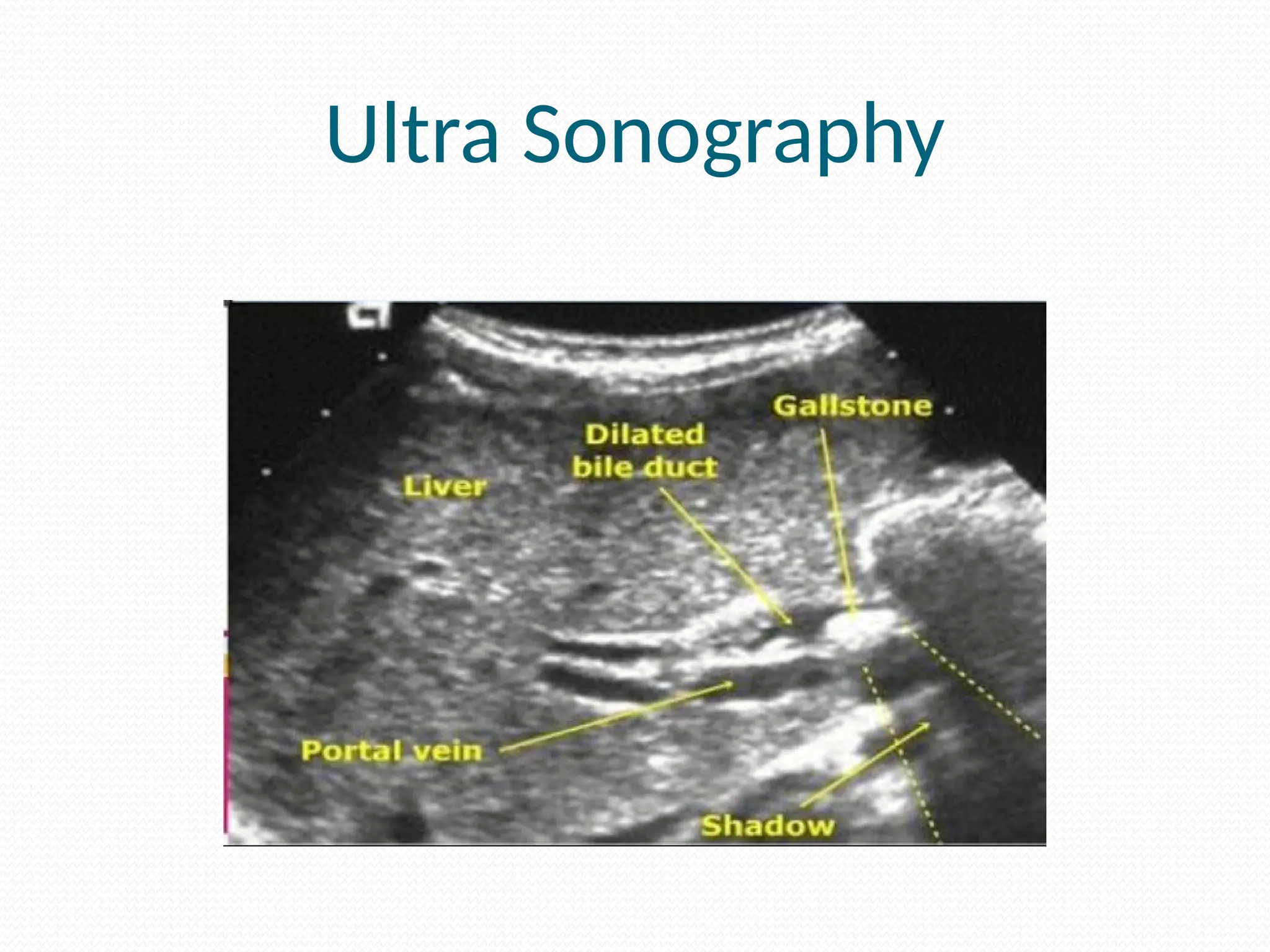
to civil hospital where they did ultra
sonography.
The Gall Bladder was over distended with
dialated cystic duct and sludge.
The distal part of common bile duct became
narrower and proximal to stricture there was
calculi (stone ).
Patient has complain of yellowish
discoloration of skin and sclera since one
month and also has decrease appetite since
one month.
6.
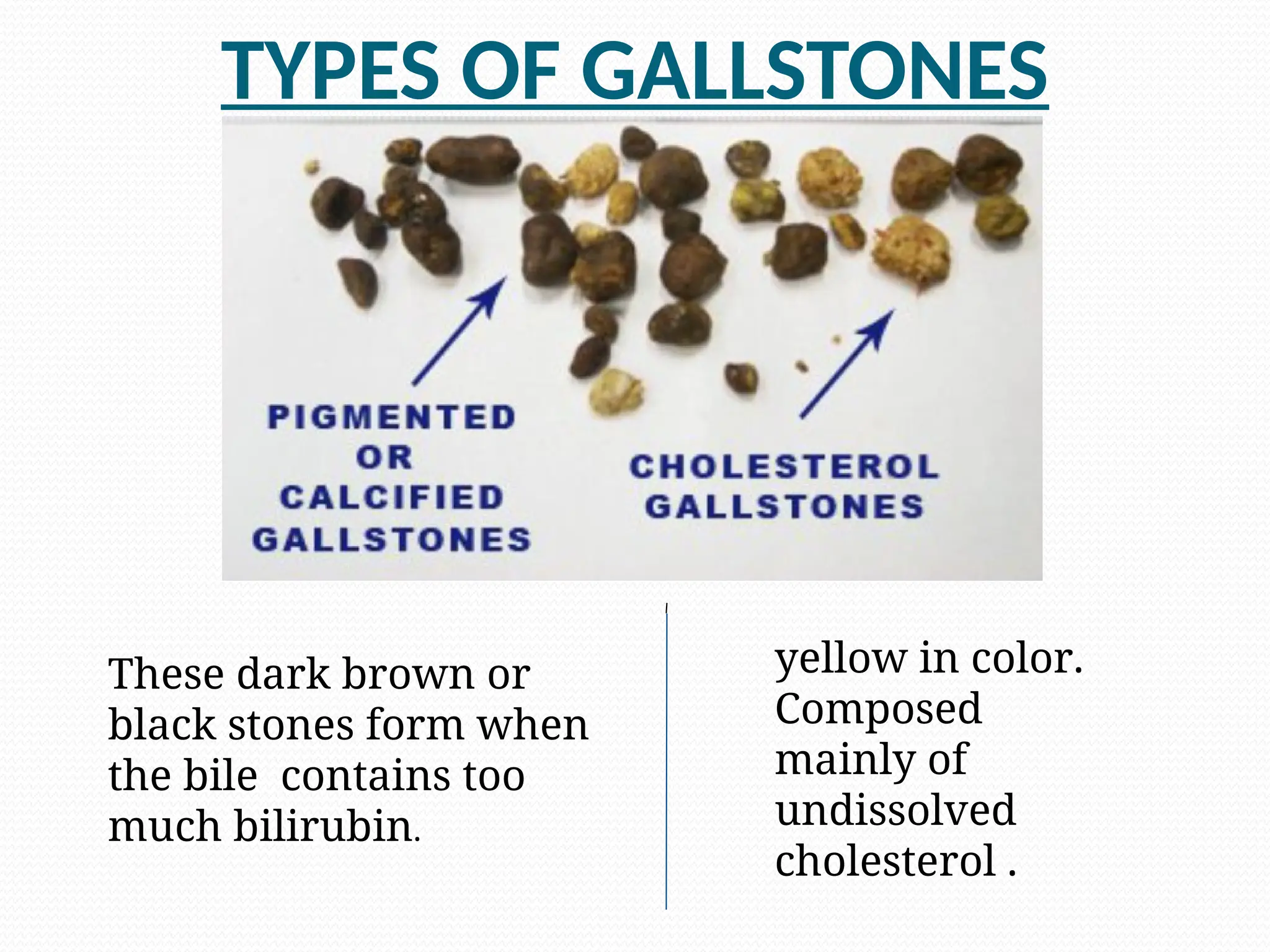
TYPES OF GALLSTONES
Thesedark brown or
black stones form when
the bile contains too
much bilirubin.
yellow in color.
Composed
mainly of
undissolved
cholesterol .
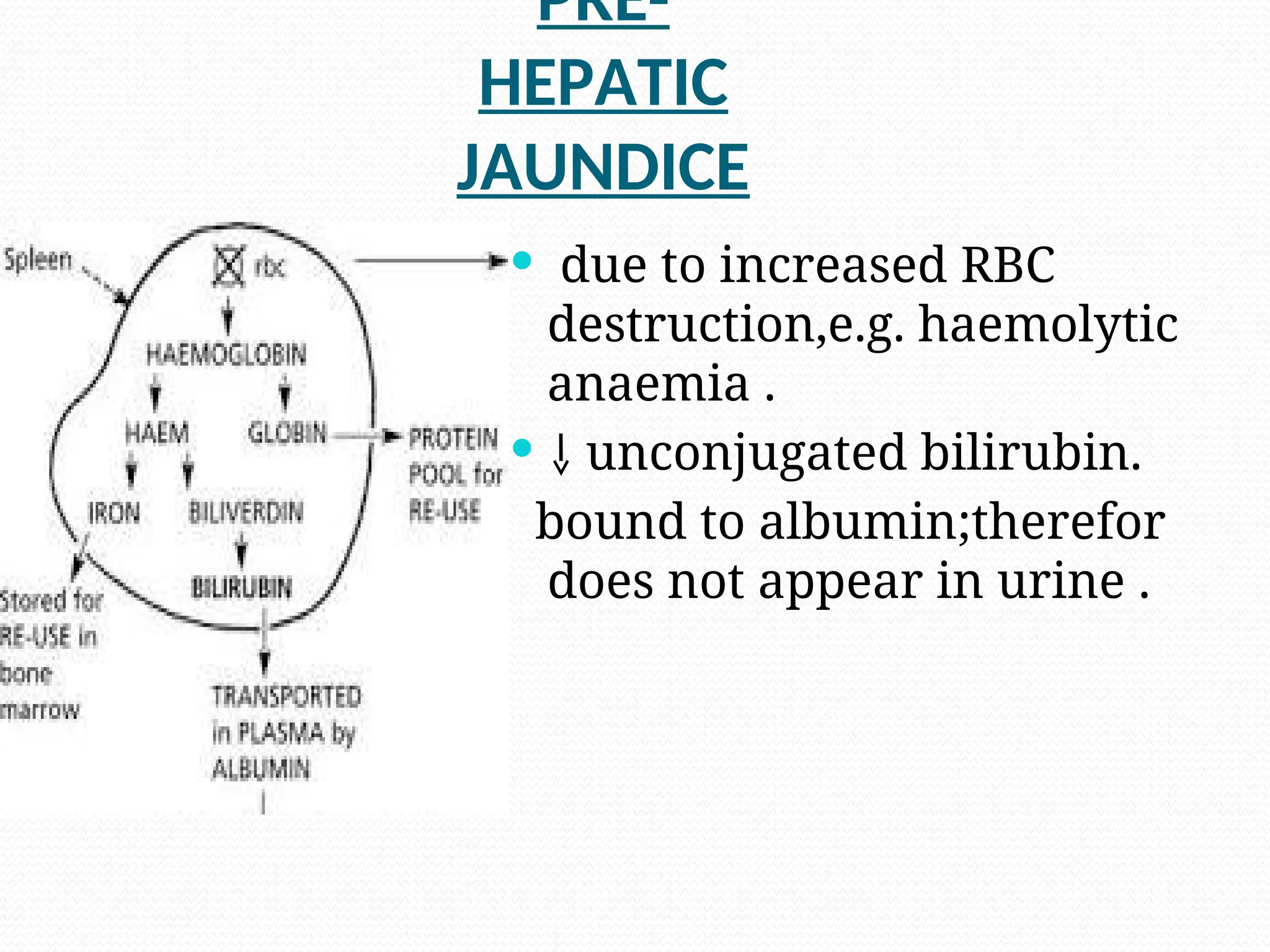
PRE-
HEPATIC
JAUNDICE
.
due toincreased RBC
destruction,e.g. haemolytic
anaemia .
unconjugated bilirubin.
bound to albumin;therefor
does not appear in urine .
Causes of pre-hepaticjaundice
Malaria : A blood borne infection spread by
mosquitoes.
Sickle cell anaemia : An inherited blood
disorder where the red blood cells develop
abnormally.
Thalassaemia : Similar to sickle cell.
Hereditary spherocytosis : A genetic condition
that causes red blood cells to have a much
shorter life span that normal.
13.
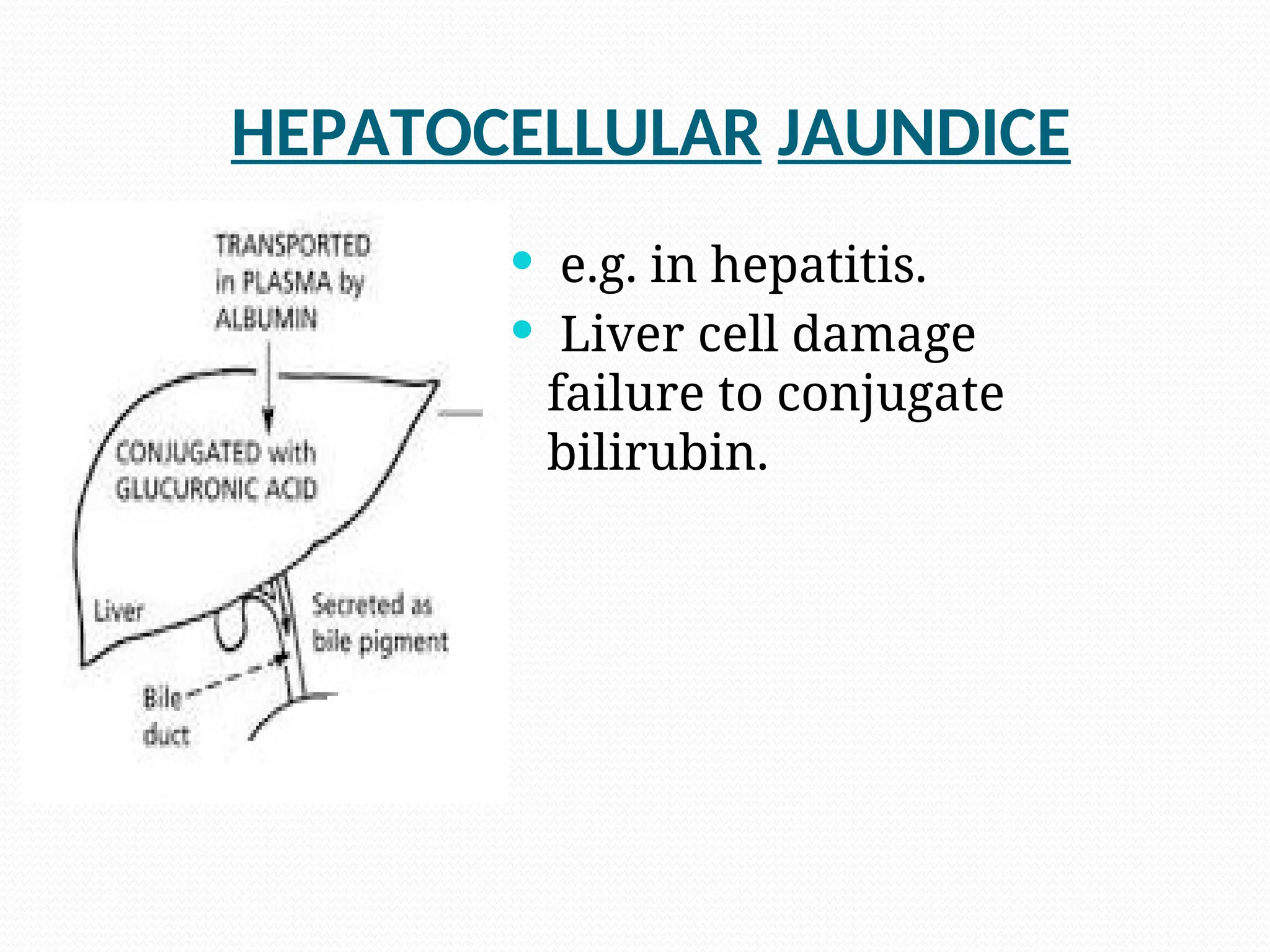
Causes of Hepatocellular
jaundice
The viral hepatitis group of infections :
hepatitis A, hepatitis B and hepatitis C
Alcoholic liver disease : Where the liver is
damaged as a result of drinking too much
alcohol.
Leptospirosis : A bacterial infection that’s
spread by animals , particularly rats.
Liver cancer : A rare and usually incurable
14.
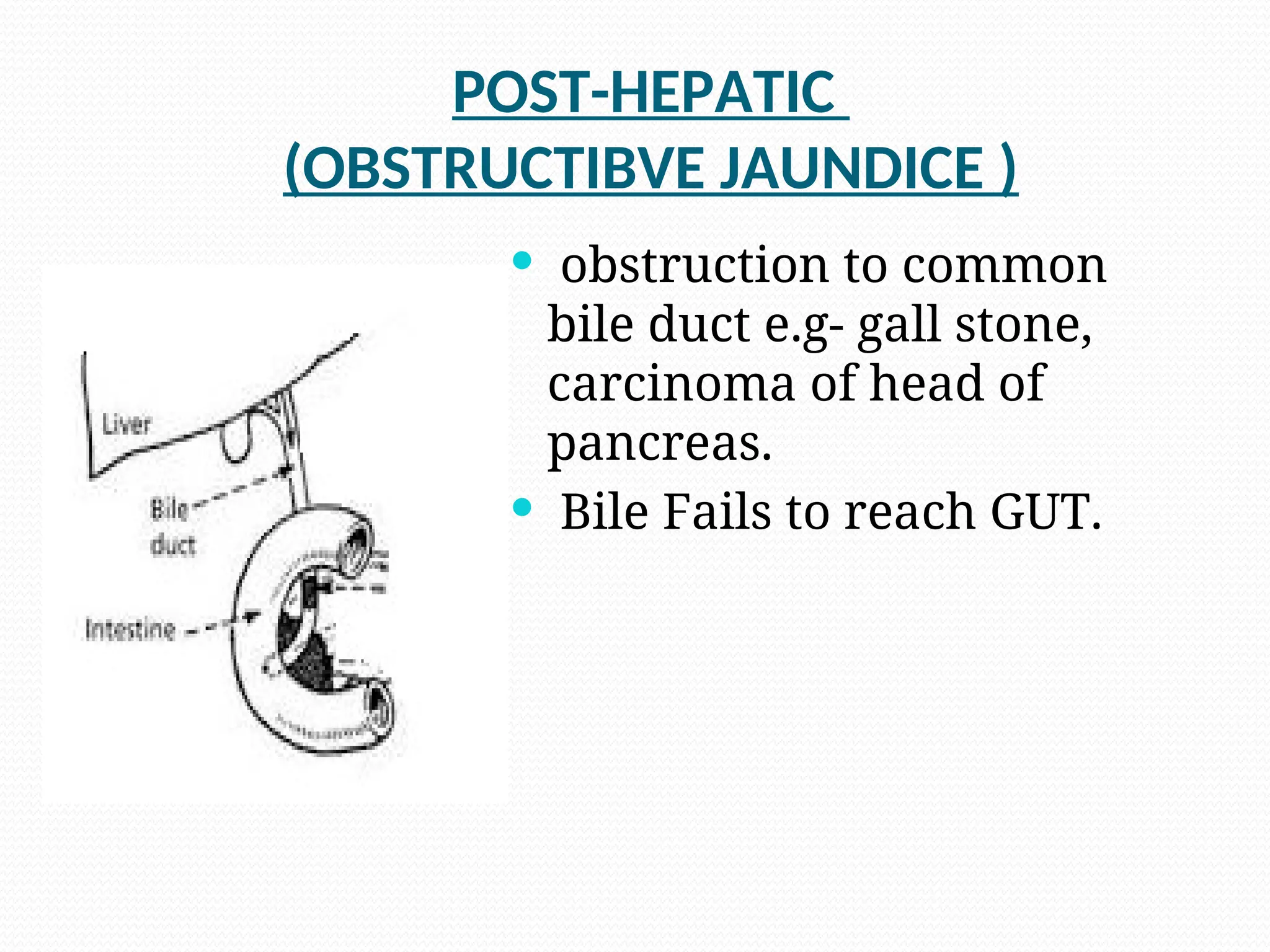
Causes of ObstructiveJaundice
Intrahepatic
• Hepatitis.
• Cirrhosis.
• Drugs
• Lymph node enlargement at porta hepatis .
15.
Causes of ObstructiveJaundice
Extrahepatic
• Carcinoma of head of pancreas.
• Stones in biliary track.
• Inflammation of common bile duct.
• Cysts of bile duct.
• Pancreatitis.
16.
SYMPTOMS
Pain.
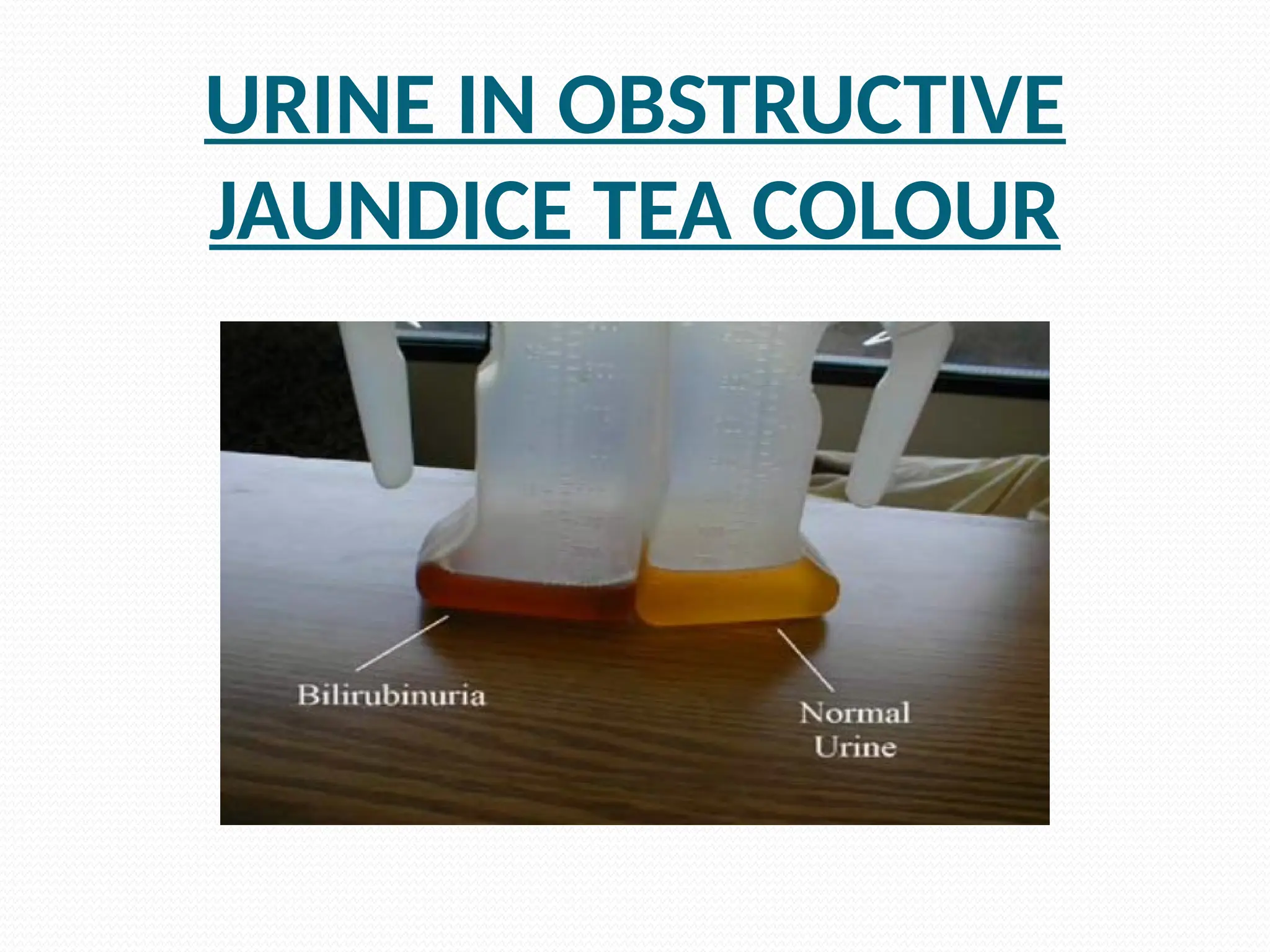
Yellowdiscolouration skin and sclera & dark
colour of urine [ tea colour ].
Itching.
Fever .
Loss of appetite.
Loss of weight.
17.
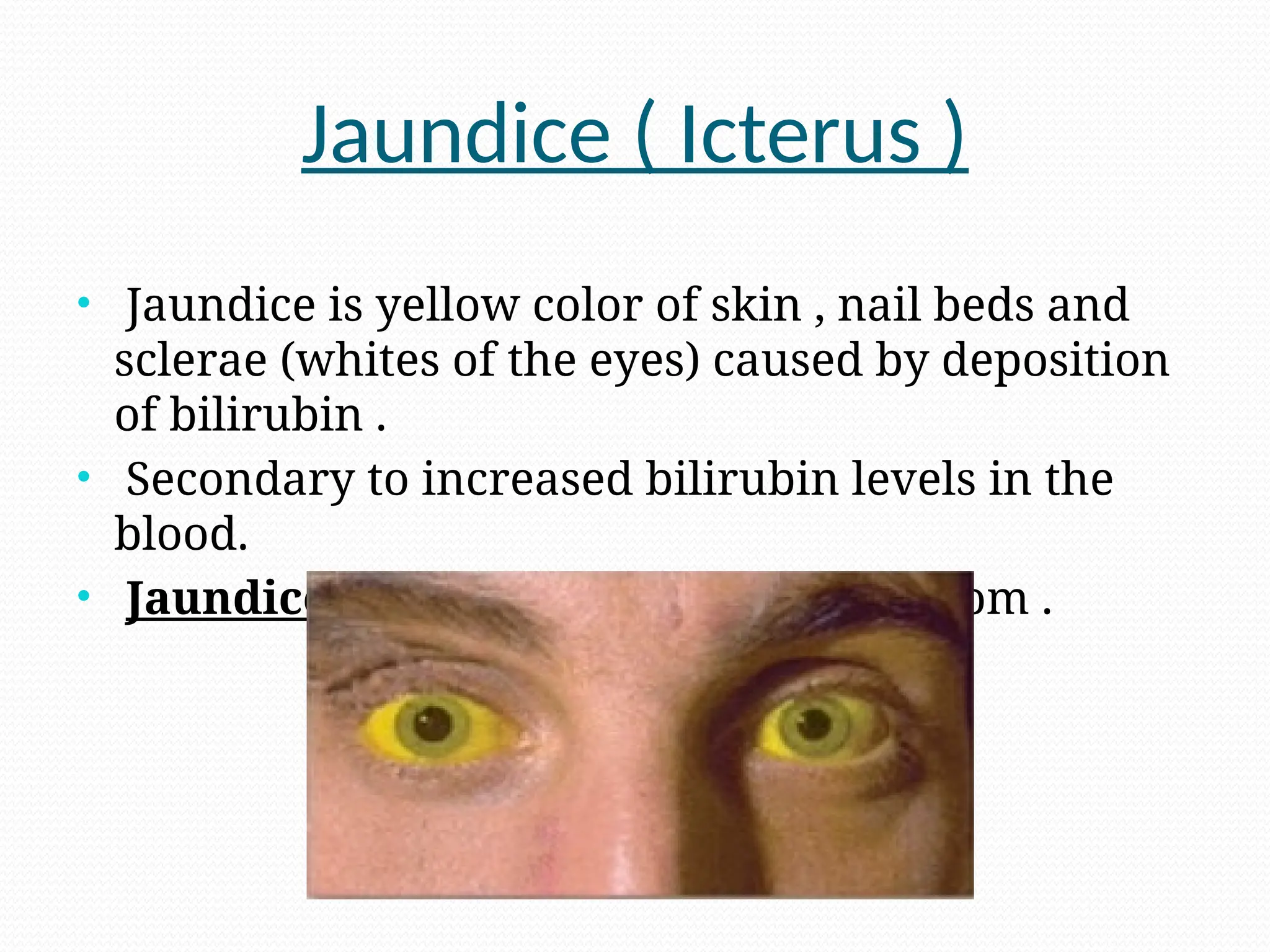
Jaundice ( Icterus)
• Jaundice is yellow color of skin , nail beds and
sclerae (whites of the eyes) caused by deposition
of bilirubin .
• Secondary to increased bilirubin levels in the
blood.
• Jaundice is not a disease but a symptom .
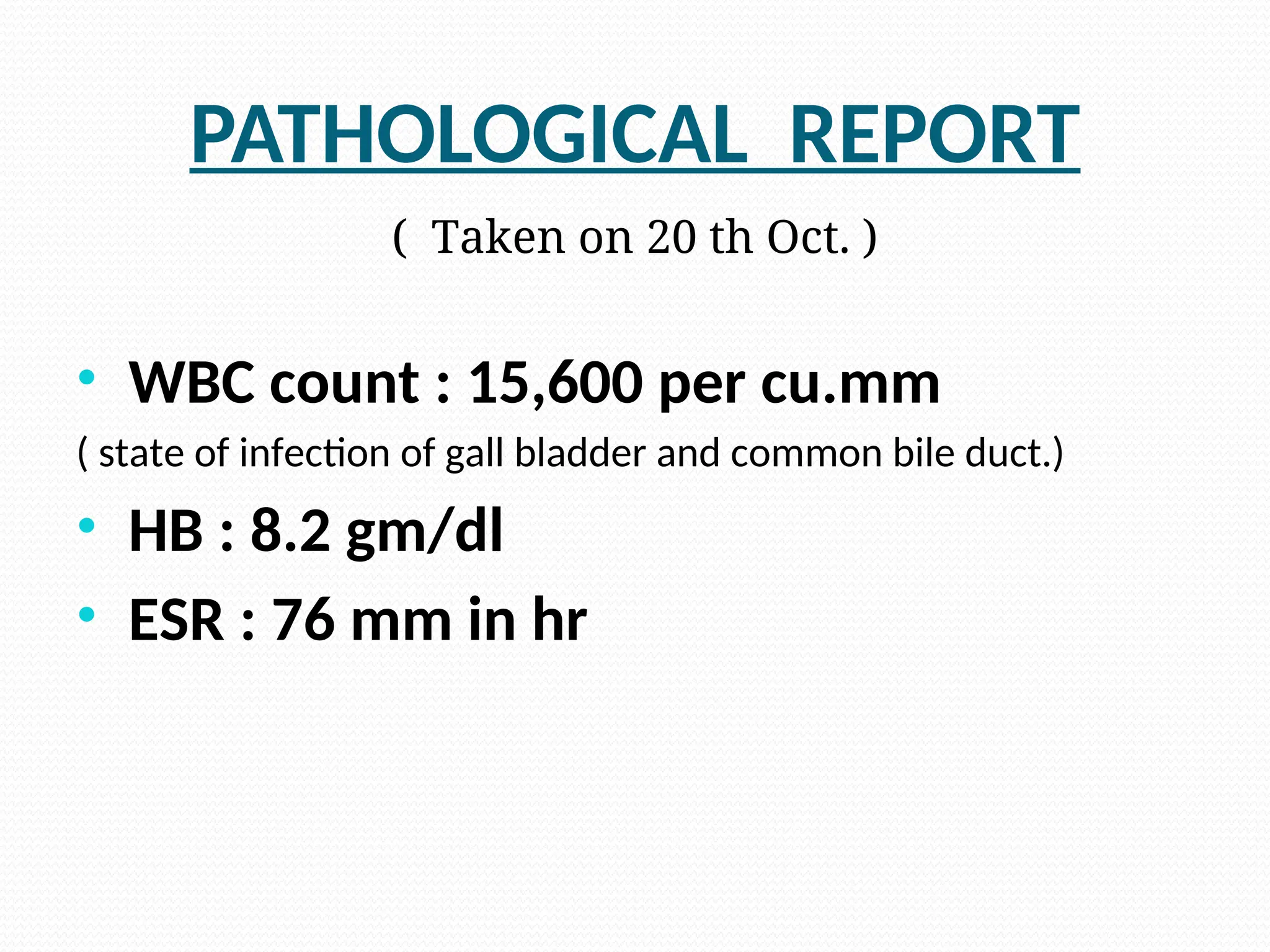
PATHOLOGICAL REPORT
( Takenon 20 th Oct. )
• WBC count : 15,600 per cu.mm
( state of infection of gall bladder and common bile duct.)
• HB : 8.2 gm/dl
• ESR : 76 mm in hr
20.
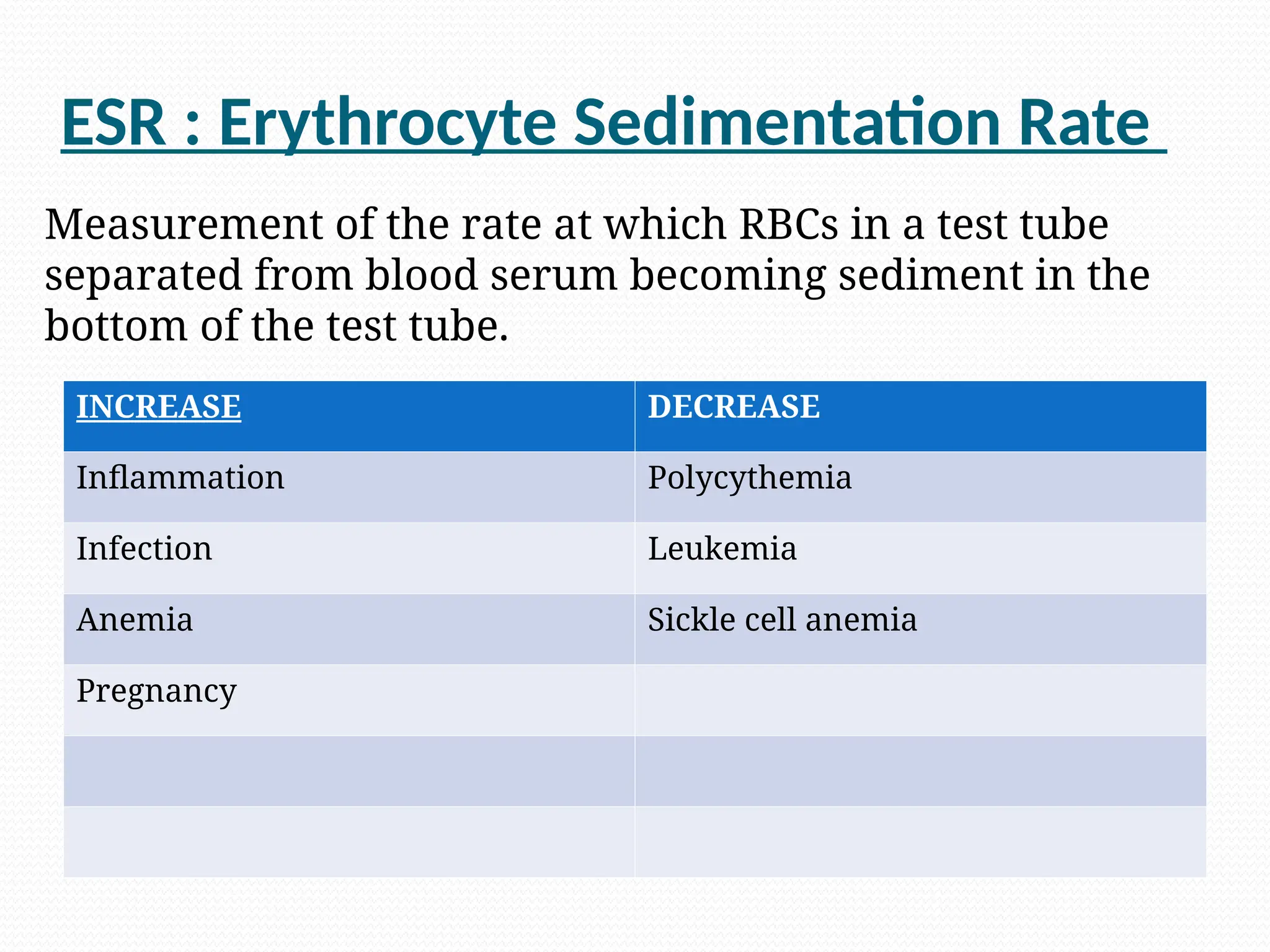
ESR : ErythrocyteSedimentation Rate
INCREASE DECREASE
Inflammation Polycythemia
Infection Leukemia
Anemia Sickle cell anemia
Pregnancy
Measurement of the rate at which RBCs in a test tube
separated from blood serum becoming sediment in the
bottom of the test tube.
21.
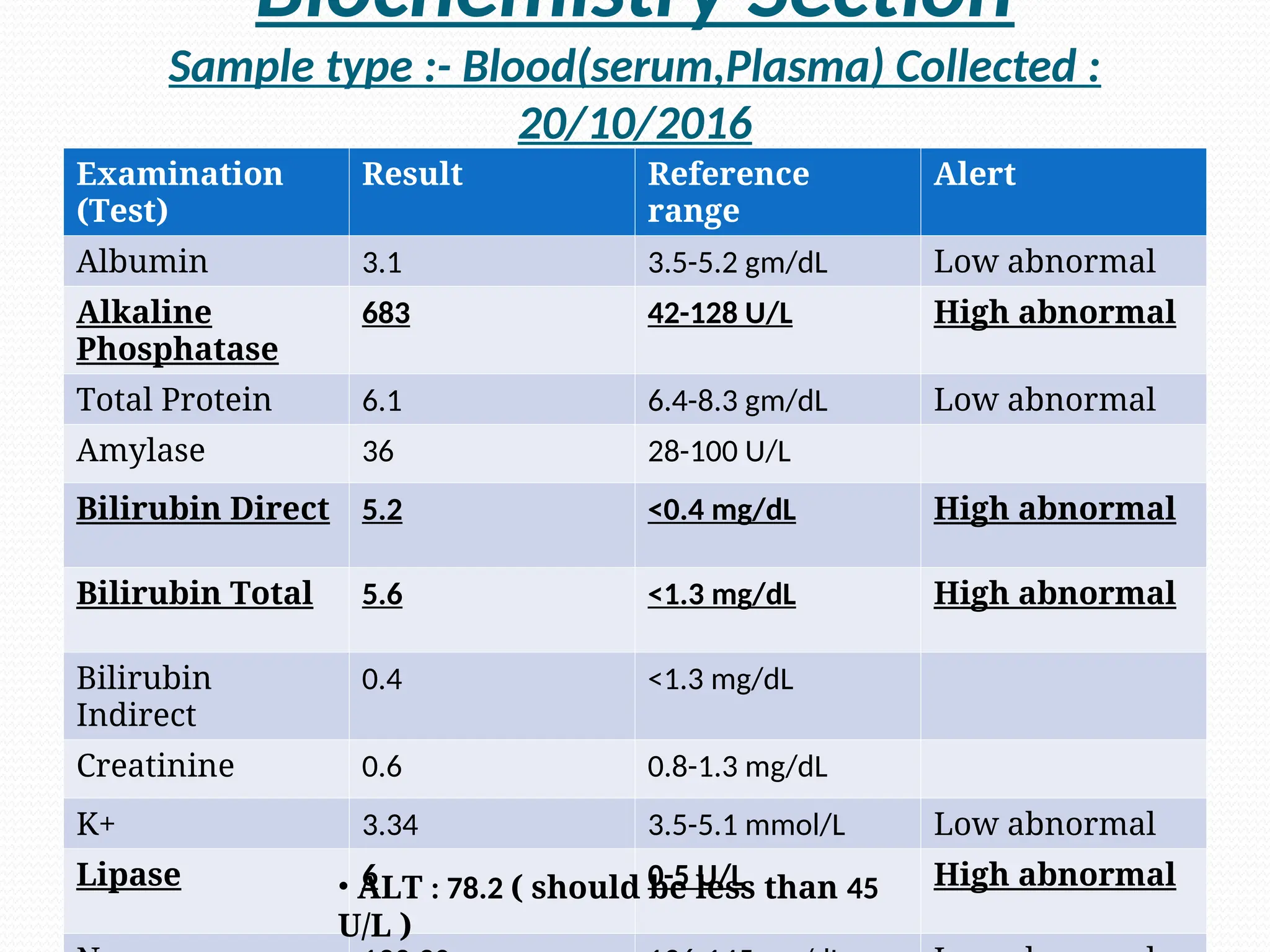
Biochemistry Section
Sample type:- Blood(serum,Plasma) Collected :
20/10/2016
Examination
(Test)
Result Reference
range
Alert
Albumin 3.1 3.5-5.2 gm/dL Low abnormal
Alkaline
Phosphatase
683 42-128 U/L High abnormal
Total Protein 6.1 6.4-8.3 gm/dL Low abnormal
Amylase 36 28-100 U/L
Bilirubin Direct 5.2 <0.4 mg/dL High abnormal
Bilirubin Total 5.6 <1.3 mg/dL High abnormal
Bilirubin
Indirect
0.4 <1.3 mg/dL
Creatinine 0.6 0.8-1.3 mg/dL
K+ 3.34 3.5-5.1 mmol/L Low abnormal
Lipase 6 0-5 U/L High abnormal
• ALT : 78.2 ( should be less than 45
U/L )
22.
.
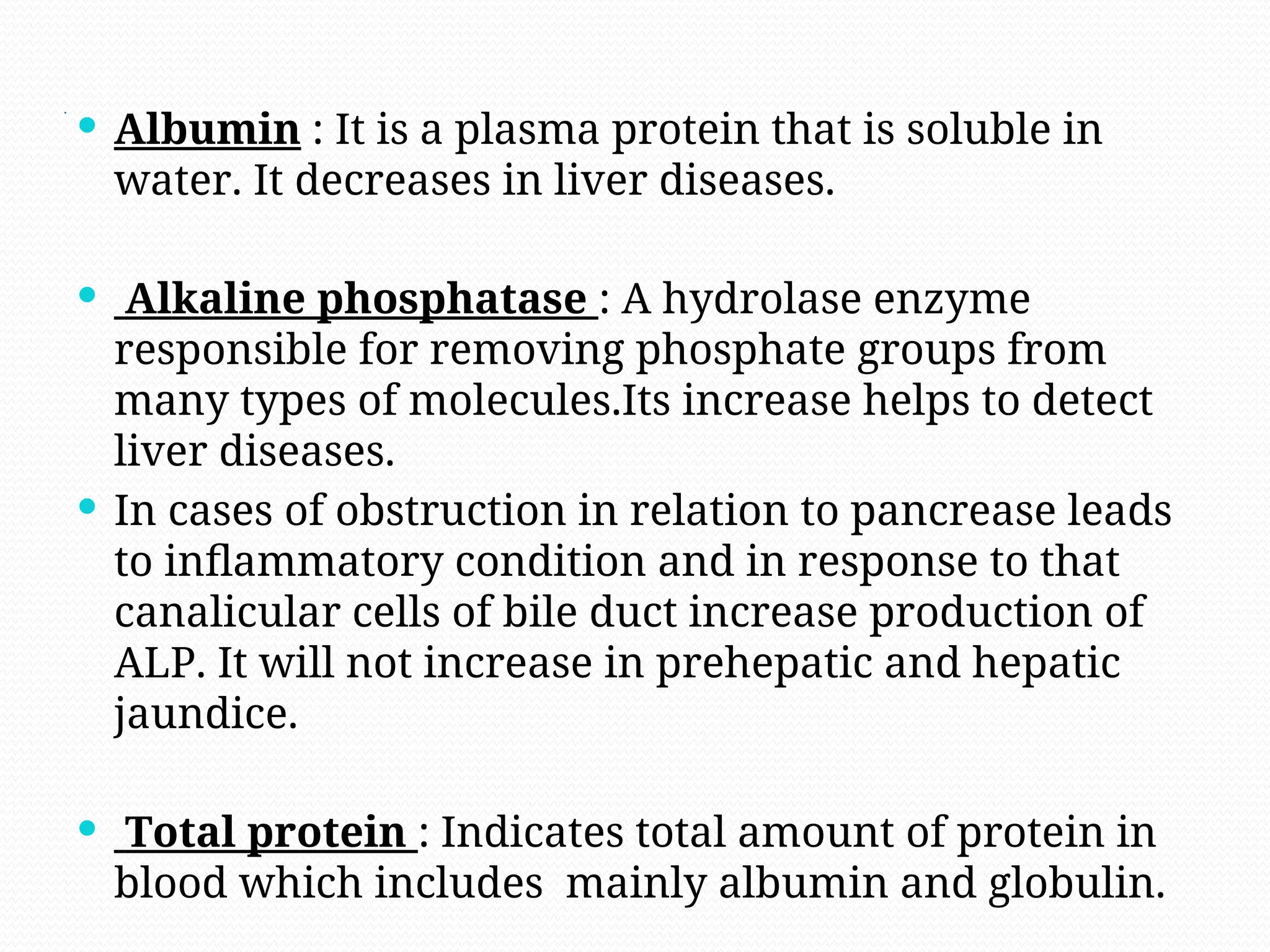
Albumin :It is a plasma protein that is soluble in
water. It decreases in liver diseases.
Alkaline phosphatase : A hydrolase enzyme
responsible for removing phosphate groups from
many types of molecules.Its increase helps to detect
liver diseases.
In cases of obstruction in relation to pancrease leads
to inflammatory condition and in response to that
canalicular cells of bile duct increase production of
ALP. It will not increase in prehepatic and hepatic
jaundice.
Total protein : Indicates total amount of protein in
blood which includes mainly albumin and globulin.
23.
.
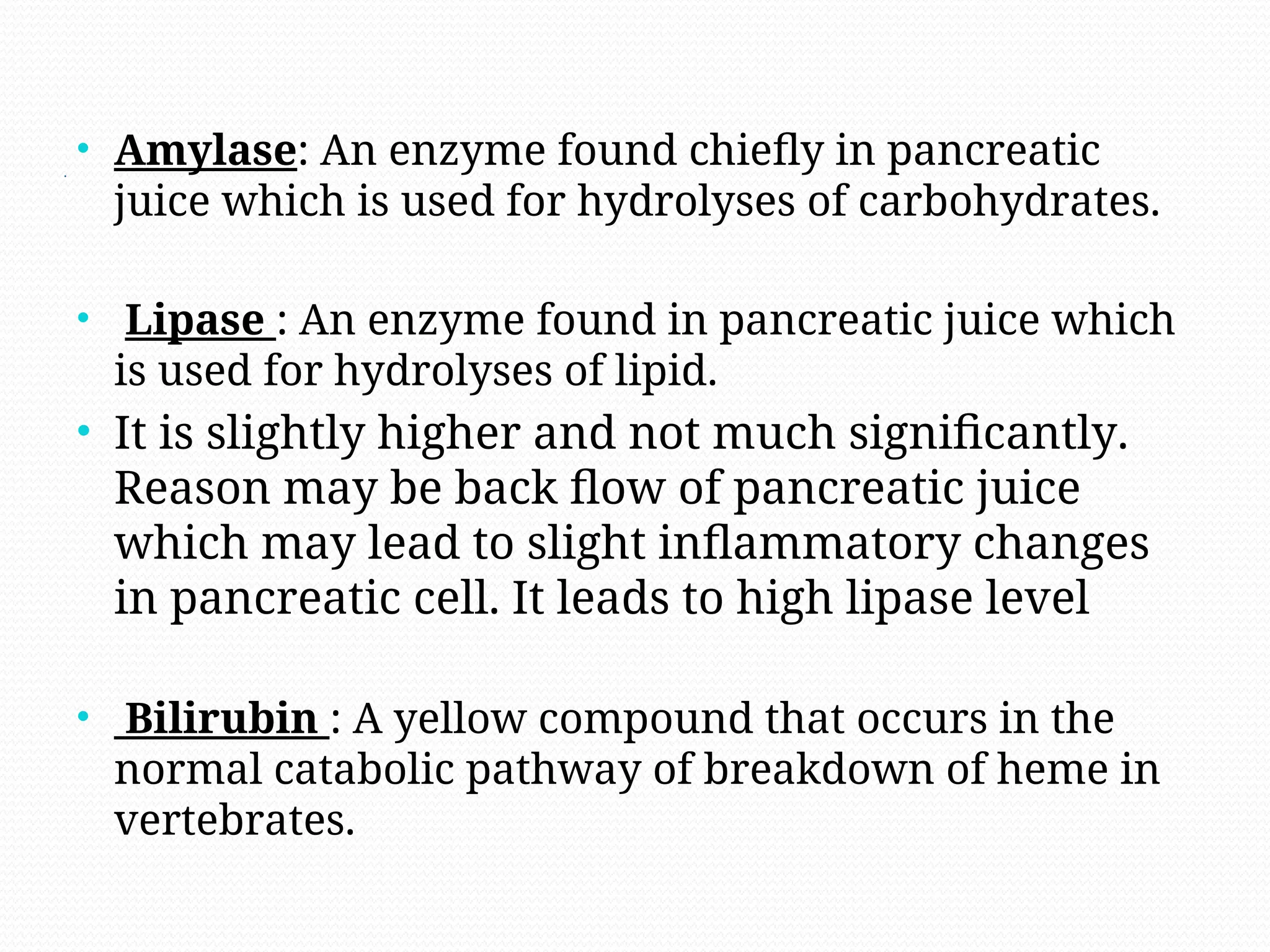
• Amylase: Anenzyme found chiefly in pancreatic
juice which is used for hydrolyses of carbohydrates.
• Lipase : An enzyme found in pancreatic juice which
is used for hydrolyses of lipid.
• It is slightly higher and not much significantly.
Reason may be back flow of pancreatic juice
which may lead to slight inflammatory changes
in pancreatic cell. It leads to high lipase level
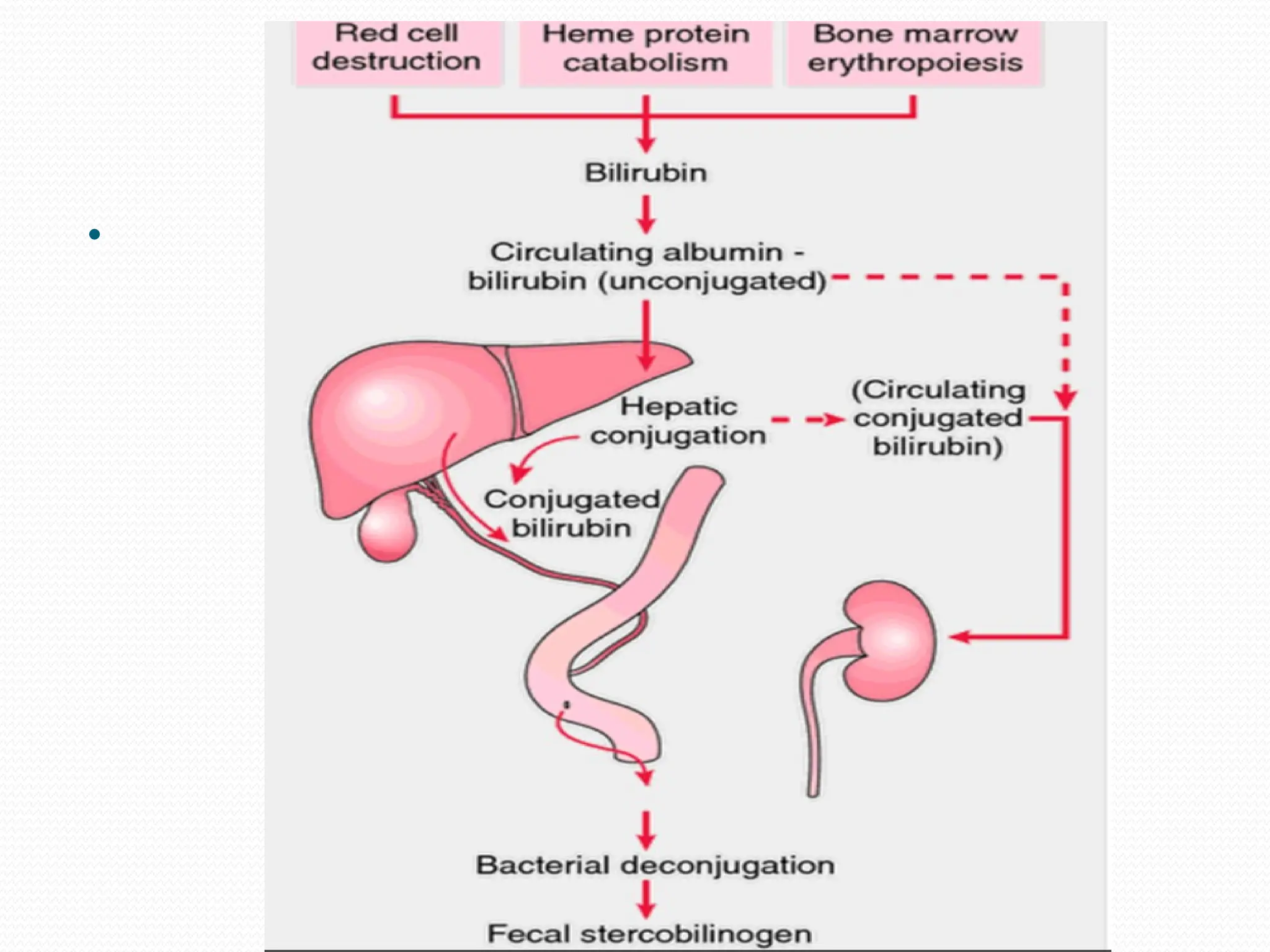
• Bilirubin : A yellow compound that occurs in the
normal catabolic pathway of breakdown of heme in
vertebrates.
24.
.
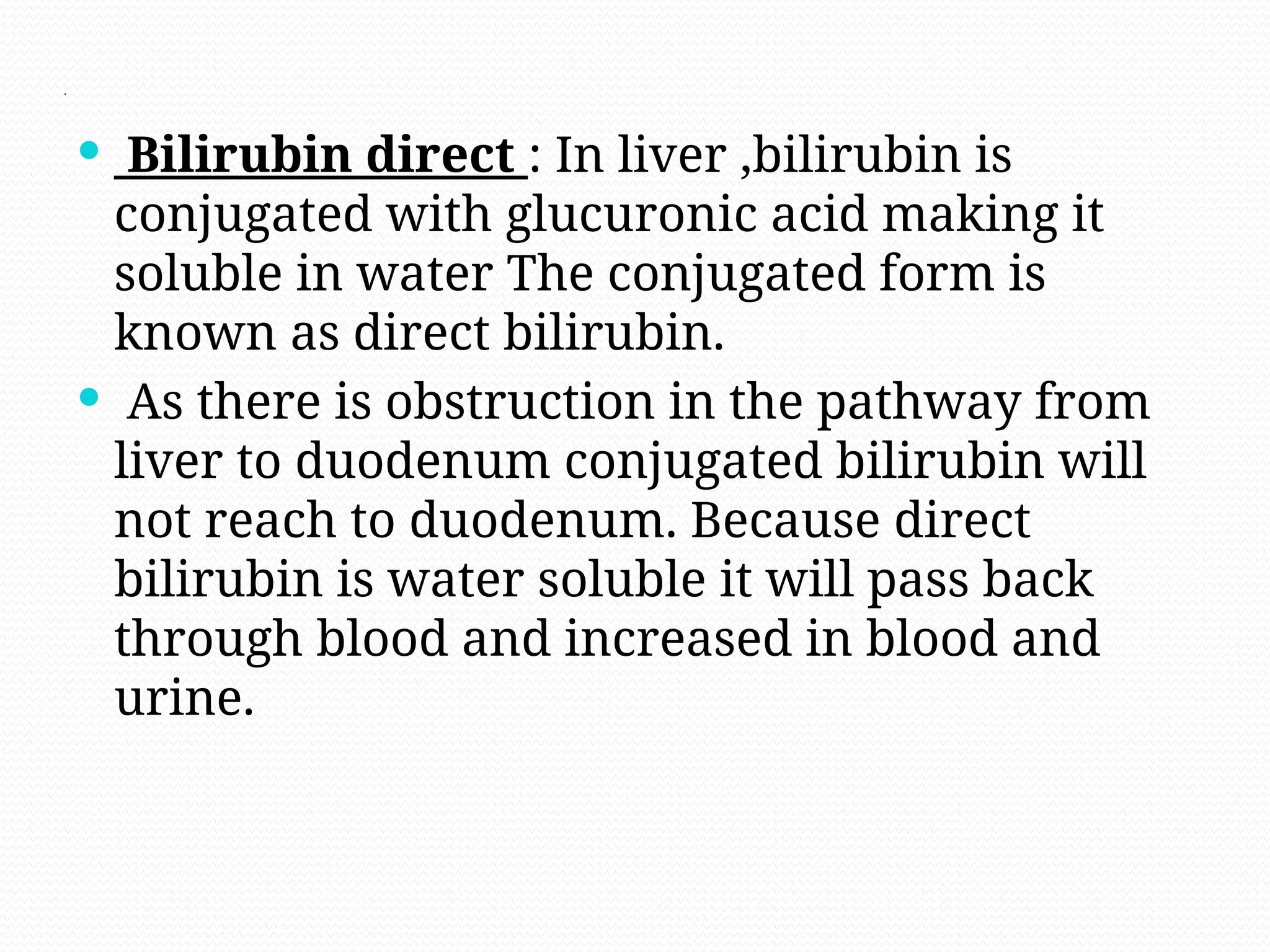
Bilirubin direct: In liver ,bilirubin is
conjugated with glucuronic acid making it
soluble in water The conjugated form is
known as direct bilirubin.
As there is obstruction in the pathway from
liver to duodenum conjugated bilirubin will
not reach to duodenum. Because direct
bilirubin is water soluble it will pass back
through blood and increased in blood and
urine.
25.
.
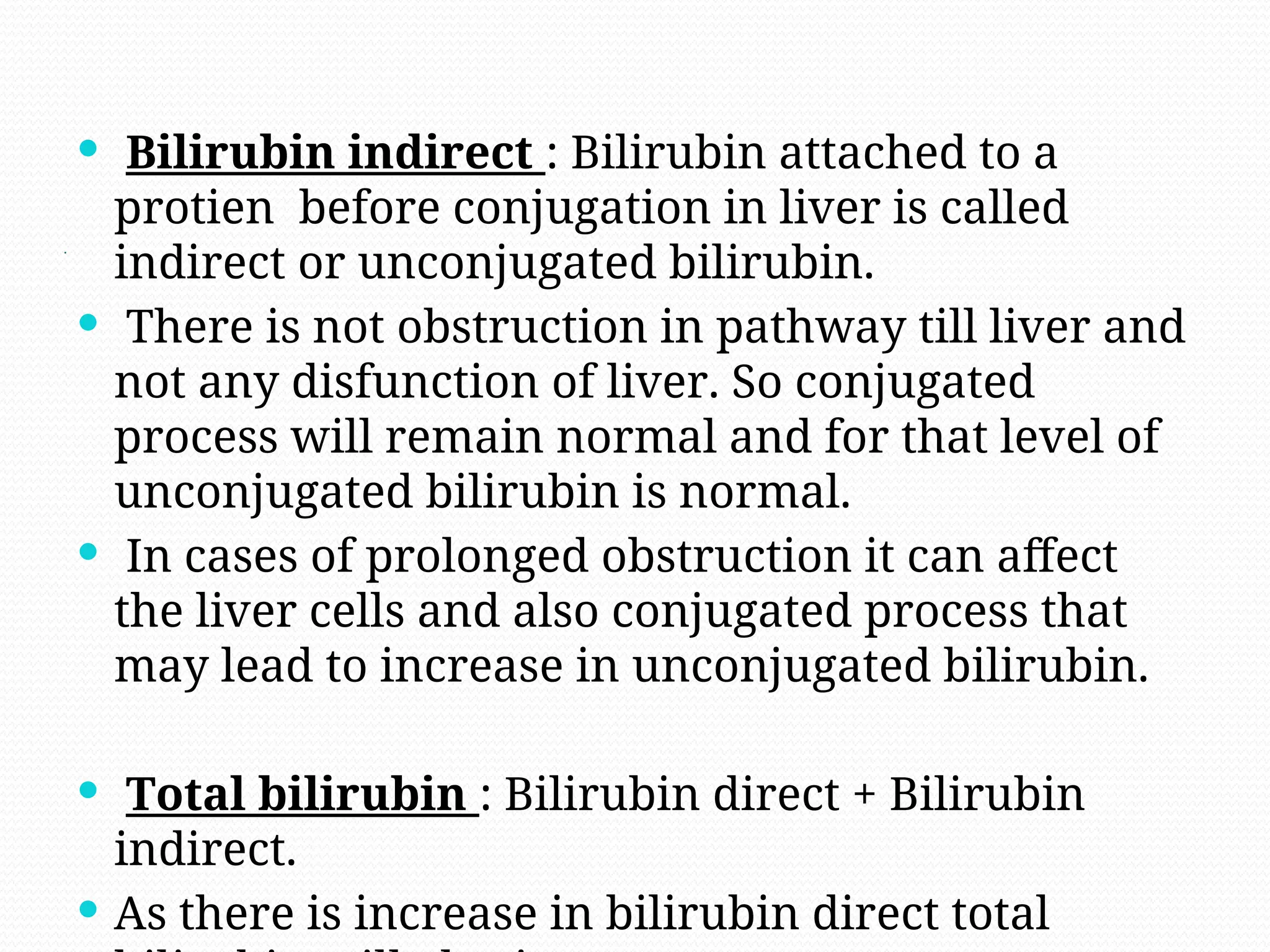
Bilirubin indirect: Bilirubin attached to a
protien before conjugation in liver is called
indirect or unconjugated bilirubin.
There is not obstruction in pathway till liver and
not any disfunction of liver. So conjugated
process will remain normal and for that level of
unconjugated bilirubin is normal.
In cases of prolonged obstruction it can affect
the liver cells and also conjugated process that
may lead to increase in unconjugated bilirubin.
Total bilirubin : Bilirubin direct + Bilirubin
indirect.
As there is increase in bilirubin direct total
26.
.
K+ andNa+ : They are free ionic minerals
present in body fluid.
They may be in less amount because of poor
nutrition and also because came out trough
vomiting in liver disease.
ALT : Alanine transaminase also known as
alanine amino transferase ( ALT ).It is mainly
found in liver and kidney. Its high level indicates
abnormal condition related to liver.
27.
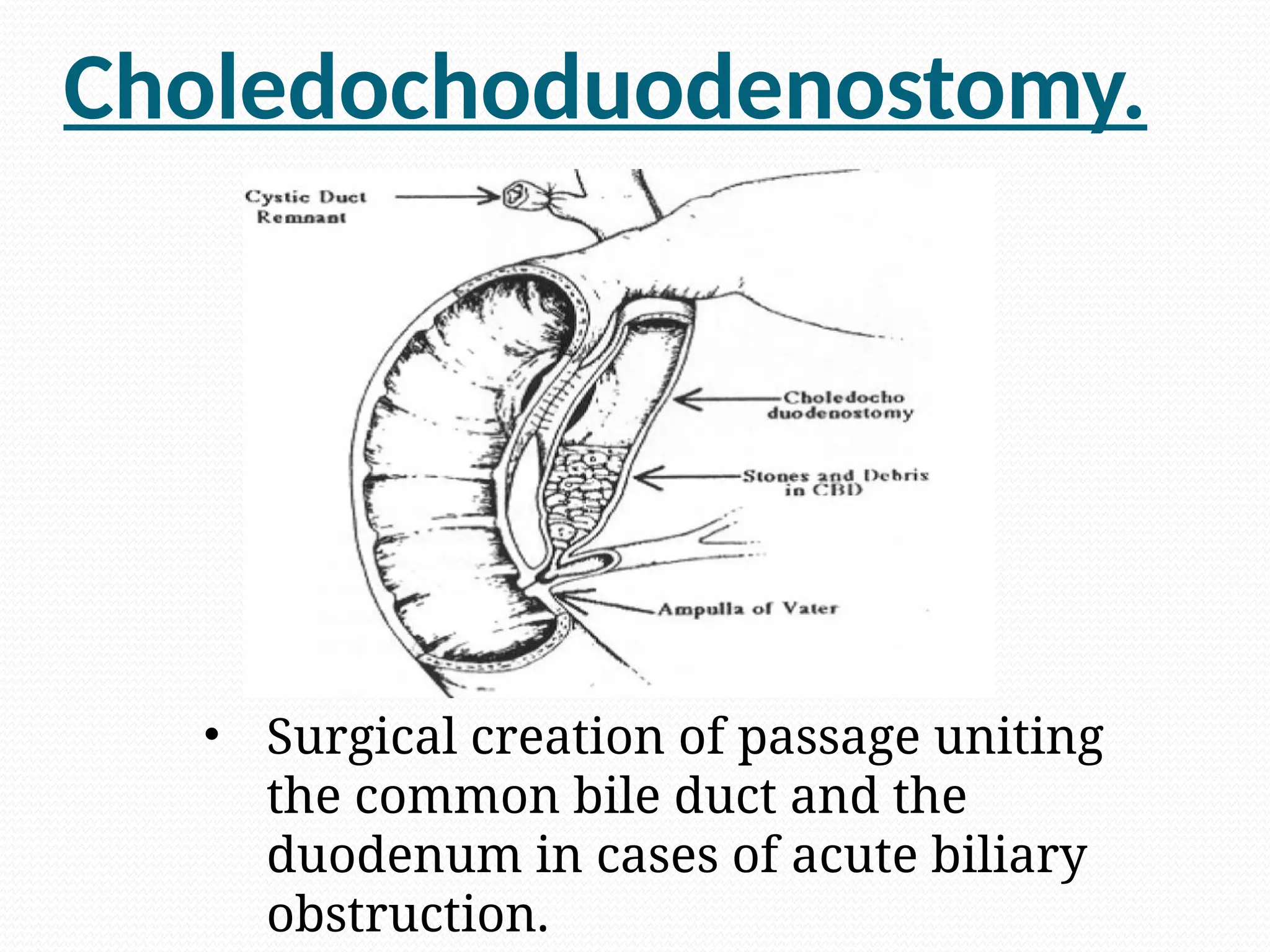
22 th October
The patient will be taken for the surgery known
as choledochoduodenostomy
associated with cholecystectomy.
She was given vitamin K injection before
surgery.
She was also given blood as she was anemic.
Vitamin k
VitaminK is a fat soluble Vitamin.
We need bile salts for digestion and absorption
of Vitamin K.
As there is obstruction in bile duct so bile will
not come to duodenum.
There may not be absorption of vitamin K so
patient may be deficient of Vitamin K.
Vitamin K is useful for blood clotting so patient
is given Vitamin K injection as there is surgery
and of course there will be bleeding.
30.
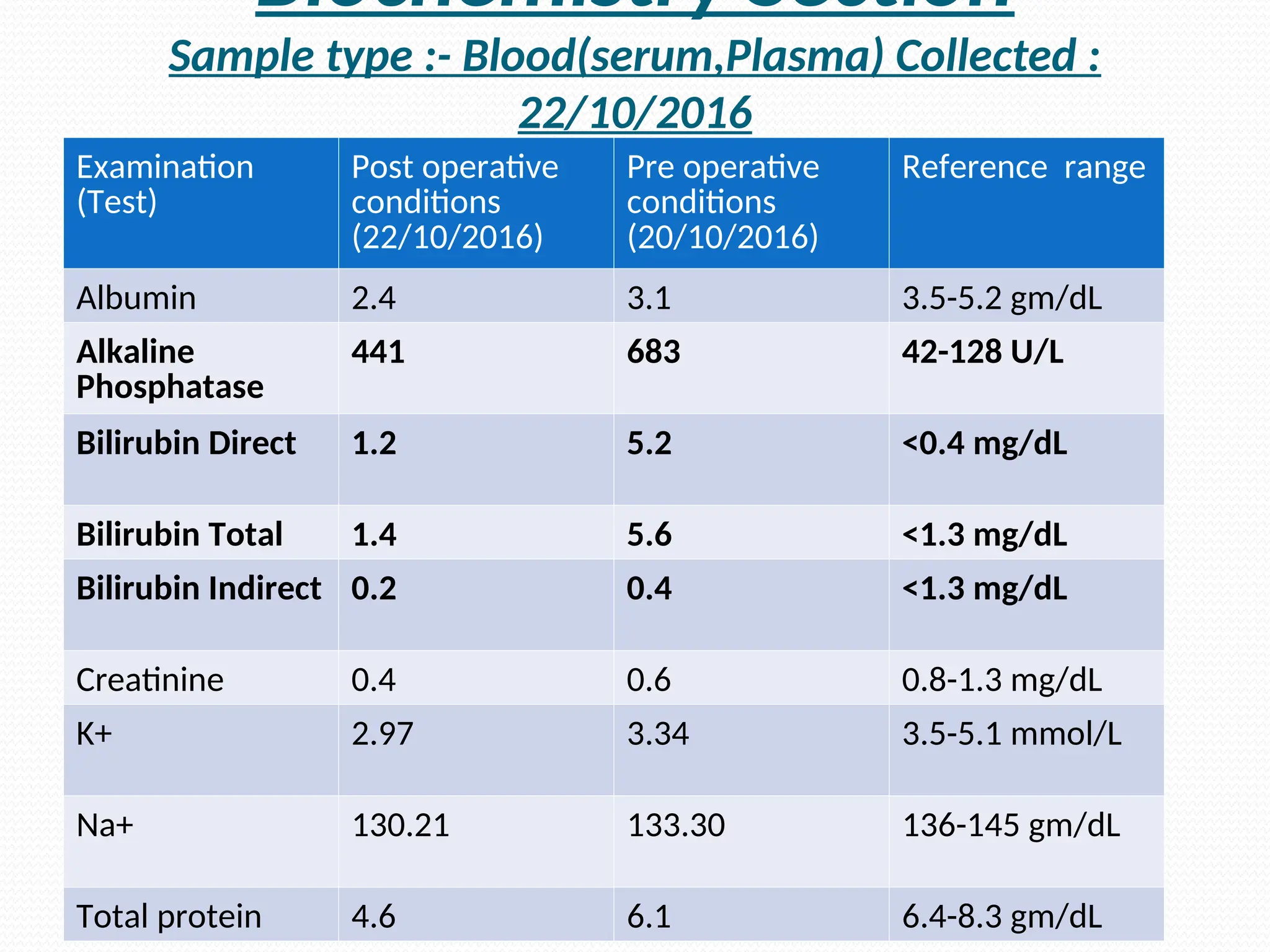
Biochemistry Section
Sample type:- Blood(serum,Plasma) Collected :
22/10/2016
Examination
(Test)
Post operative
conditions
(22/10/2016)
Pre operative
conditions
(20/10/2016)
Reference range
Albumin 2.4 3.1 3.5-5.2 gm/dL
Alkaline
Phosphatase
441 683 42-128 U/L
Bilirubin Direct 1.2 5.2 <0.4 mg/dL
Bilirubin Total 1.4 5.6 <1.3 mg/dL
Bilirubin Indirect 0.2 0.4 <1.3 mg/dL
Creatinine 0.4 0.6 0.8-1.3 mg/dL
K+ 2.97 3.34 3.5-5.1 mmol/L
Na+ 130.21 133.30 136-145 gm/dL
Total protein 4.6 6.1 6.4-8.3 gm/dL
31.
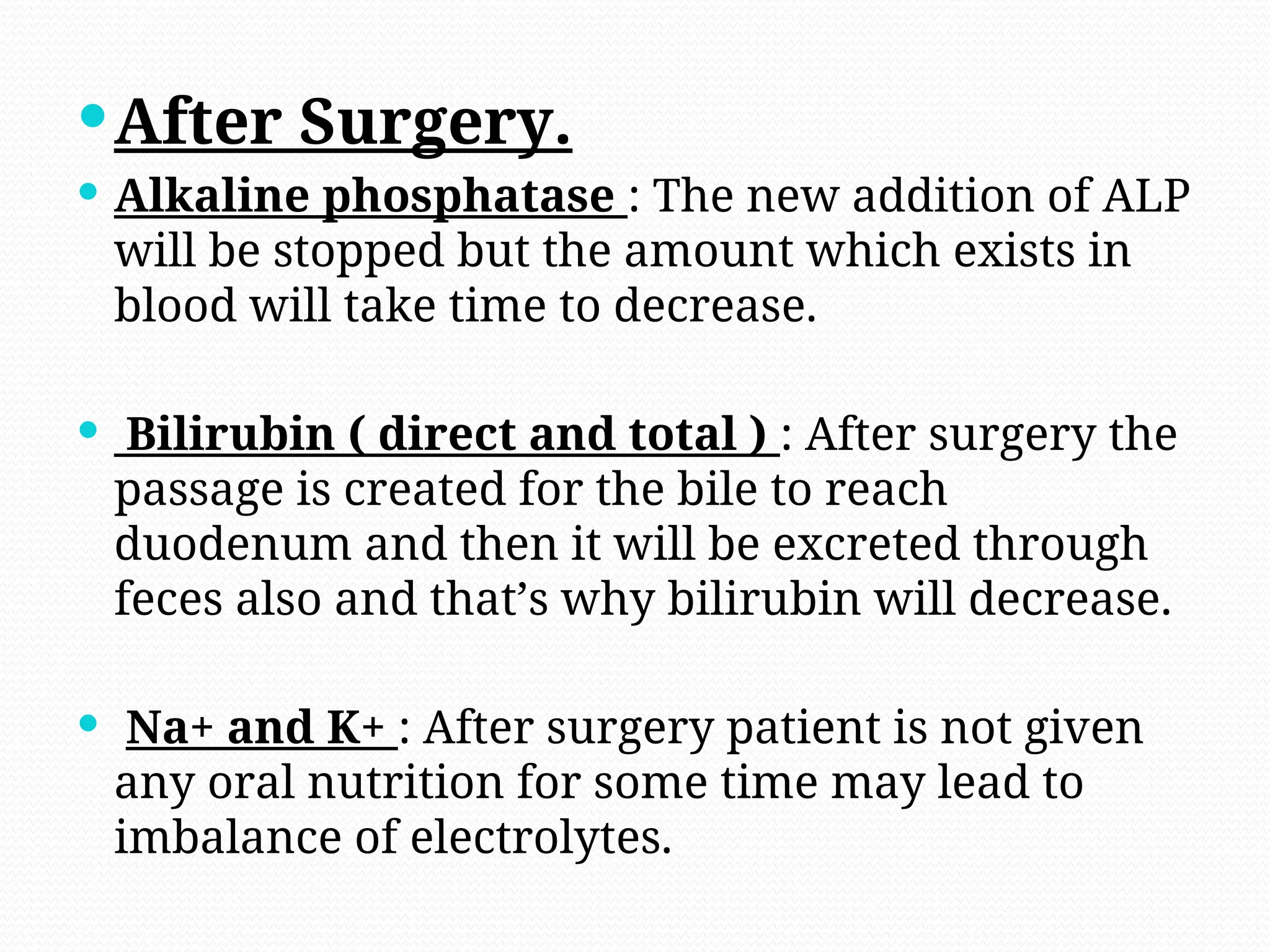
After Surgery.
Alkalinephosphatase : The new addition of ALP
will be stopped but the amount which exists in
blood will take time to decrease.
Bilirubin ( direct and total ) : After surgery the
passage is created for the bile to reach
duodenum and then it will be excreted through
feces also and that’s why bilirubin will decrease.
Na+ and K+ : After surgery patient is not given
any oral nutrition for some time may lead to
imbalance of electrolytes.
32.
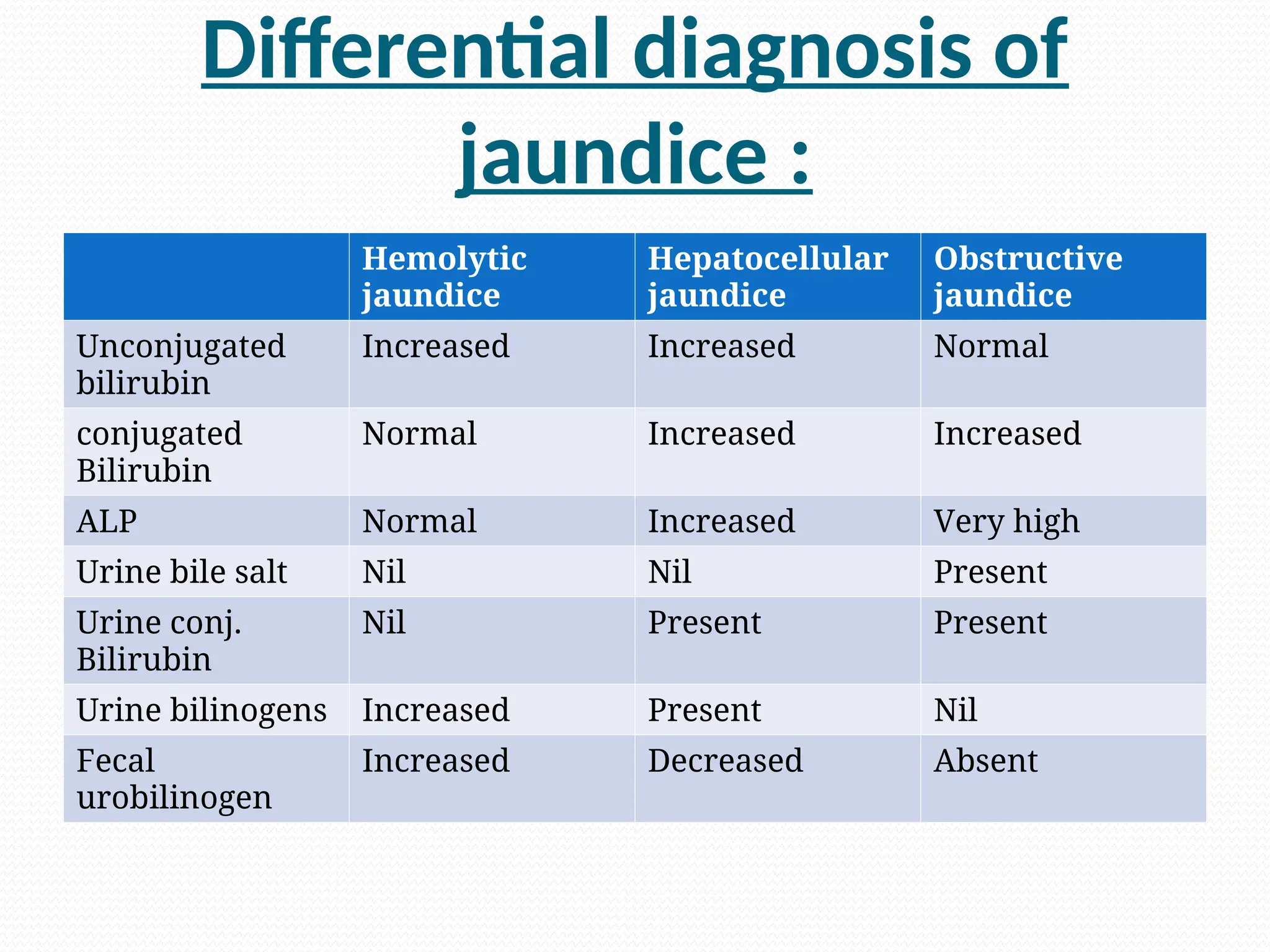
Differential diagnosis of
jaundice:
Hemolytic
jaundice
Hepatocellular
jaundice
Obstructive
jaundice
Unconjugated
bilirubin
Increased Increased Normal
conjugated
Bilirubin
Normal Increased Increased
ALP Normal Increased Very high
Urine bile salt Nil Nil Present
Urine conj.
Bilirubin
Nil Present Present
Urine bilinogens Increased Present Nil
Fecal
urobilinogen
Increased Decreased Absent
![SYMPTOMS
Pain.
Yellow discolouration skin and sclera & dark
colour of urine [ tea colour ].
Itching.
Fever .
Loss of appetite.
Loss of weight.](https://image.slidesharecdn.com/obstructivejaundicegroup6-250610153948-3a055ab6/75/obstructive_jaundice_group_6-ppt-pathology-16-2048.jpg)



![DOSH_VIKRITI_-_2[1].pptx ayurveda is great](https://cdn.slidesharecdn.com/ss_thumbnails/doshvikriti-21-250619143213-7b5df811-thumbnail.jpg?width=640&height=640&fit=bounds)
![jwaer_[Autosaved][1].pptx ayurveda for life](https://cdn.slidesharecdn.com/ss_thumbnails/jwaerautosaved1-250616174159-80eb4b4a-thumbnail.jpg?width=640&height=640&fit=bounds)


