MesentericCysts
Dr.V.Veeranadha reddy
Assistant professor,
GeneralSurgery
Introduction
A mesenteric cystis formed of fluid
collection between the 2 layers of
small bowel mesentery.
Incidence
• Mesenteric cyst is one of the rarest abdominal
masses.
• Theincidence varies from 1 per 100,000 to 1 per
250,000 admissions
• Approximately one third of casesare diagnosed
before the ageof 15.
Typesand Etiology
1.Chylolymphatic cyst
2.Enterogenous cyst.
3.Dermoid cyst.
4. Cysts of Urogenital remnant.
Chylolymphatic cyst:
1.Most common type of mesenteric cyst
2.It occurs due to congenitally misplaced lymphatic
tissue that has no efferent communication with the
lymphatic system.
3.Content is lymph/chyle,unilocular
4.It has independent blood supply.
5.Treatment is enucleation.
• Enterogenous cyst due to:
1.failure of the leaves of the mesentery to
fuse.Sequestrated intestinal epithelium or
fromduplicated intestine.
2.Thick wall lined by mucous membrane.
3.Content is mucinous,
4.It shares blood supply with adjacent intestine
wall,
5.Treatment is resection and anastomosis.
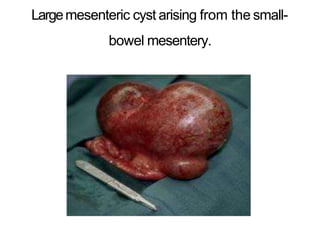
Largemesenteric cyst arising from the small-
bowel mesentery.
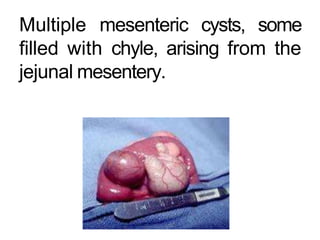
Multiple mesenteric cysts, some
filled with chyle, arising from the
jejunal mesentery.
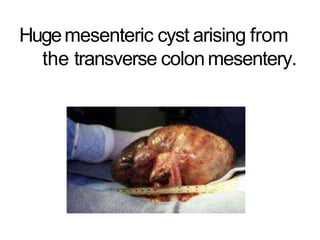
Hugemesenteric cyst arising from
the transverse colonmesentery.
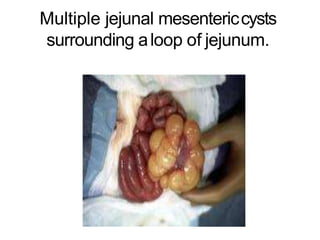
Multiple jejunal mesentericcysts
surrounding aloop of jejunum.
Presentation
• Mesenteric cysts mostly discoveredincidentally
• Symptoms
– Abdominal distention
– vague abdominal pain
– Massmay be palpable .
Presentation(conc.)
• Approximately 10% of patients with mesenteric
cysts present with an acute abdominal
emergency, the most common picture is small-
bowel obstruction, which may be associated with
intestinal volvulus orinfarction.
Investigations
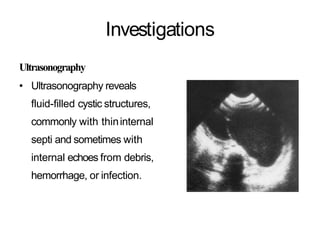
Ultrasonography
• Ultrasonography reveals
fluid-filled cystic structures,
commonly with thininternal
septi and sometimes with
internal echoes from debris,
hemorrhage, or infection.
Investigations (conc.)
CTscanning
• Abdominal
information,
CT scanning
onlt ti ensure
adds minimal
that cyst not
arising from another organ suchasthe kidney,
pancreas, or ovary.
Investigations (conc.)
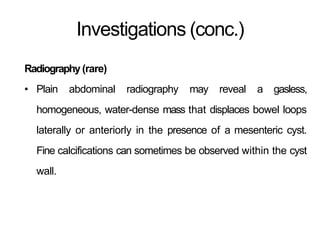
Radiography(rare)
• Plain abdominal radiography may reveal a gasless,
homogeneous, water-dense mass that displaces bowel loops
laterally or anteriorly in the presence of a mesenteric cyst.
Fine calcifications can sometimes be observed within the cyst
wall.
Treatment (conc.)
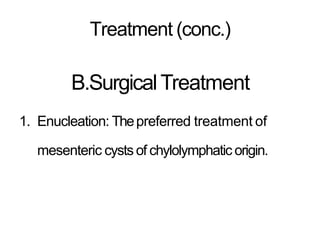
B.SurgicalTreatment
1. Enucleation: Thepreferred treatment of
mesenteric cysts of chylolymphatic origin.
Treatment (conc.)
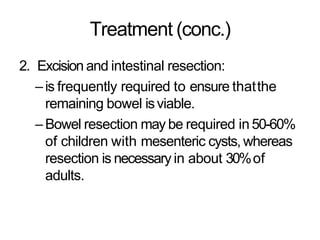
2. Excision and intestinal resection:
–is frequently required to ensure thatthe
remaining bowel isviable.
–Bowel resection may be required in 50-60%
of children with mesenteric cysts, whereas
resection is necessary in about 30%of
adults.
Treatment (conc.)
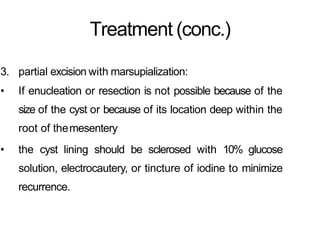
3. partial excision with marsupialization:
• If enucleation or resection is not possible because of the
size of the cyst or because of its location deep within the
root of themesentery
• the cyst lining should be sclerosed with 10% glucose
solution, electrocautery, or tincture of iodine to minimize
recurrence.
Treatment (conc.)
4. Current apporaches
• Laparoscopic management: could be used to
localize the cysts, and resection could be
performed through a small laparotomy or via
an extended umbilical incision.
Treatment (conc.)
• Ultrasound-guided drainage hasalso
reported to besuccessful.
Postoperative
• Depend on the intraoperativedecision
• If enculation done: the patient is maintained
nothing by mouth (NPO) with intravenous fluids
until bowel function returns(mostly 24hours).
• If intestinal resection done: follow up until
anastmosis is good.
Follow-up
• Routine postoperative follow-up care 2-3 weeks after
discharge from the hospital isindicated.
• Thechild's family should be warned about the potential for
intestinal obstruction fromadhesions.
• If the patient wastreated with marsupialization, closerfollow-
up for possible recurrence should beinstituted.
• Otherwise, long-term results for simple excision arefavorable.
Outcome and Prognosis
• Overall results are favorable. Therecurrence rate ranges
from 0-13.6%.
• Most recurrences occur in patients withretroperitoneal
cystsor those who had only apartialexcision.
• Essentially, no mortality is associated with mesenteric cyst;
only one pediatric death hasbeen reported since1950.
(WongSWet al,1998)
Future
• With the widespread use of ultrasonography,
mesenteric cysts are being diagnosed earlier, so
intervention during early infancy is indicated to
prevent potential complications such as intestinal
obstruction andvolvulus.

mesenteric cyst

  • 1.
  • 2.
    Introduction A mesenteric cystisformed of fluid collection between the 2 layers of small bowel mesentery.
  • 3.
    Incidence • Mesenteric cystis one of the rarest abdominal masses. • Theincidence varies from 1 per 100,000 to 1 per 250,000 admissions • Approximately one third of casesare diagnosed before the ageof 15.
  • 4.
    Typesand Etiology 1.Chylolymphatic cyst 2.Enterogenouscyst. 3.Dermoid cyst. 4. Cysts of Urogenital remnant.
  • 5.
    Chylolymphatic cyst: 1.Most commontype of mesenteric cyst 2.It occurs due to congenitally misplaced lymphatic tissue that has no efferent communication with the lymphatic system. 3.Content is lymph/chyle,unilocular 4.It has independent blood supply. 5.Treatment is enucleation.
  • 6.
    • Enterogenous cystdue to: 1.failure of the leaves of the mesentery to fuse.Sequestrated intestinal epithelium or fromduplicated intestine. 2.Thick wall lined by mucous membrane. 3.Content is mucinous, 4.It shares blood supply with adjacent intestine wall, 5.Treatment is resection and anastomosis.
  • 7.
    Largemesenteric cyst arisingfrom the small- bowel mesentery.
  • 8.
    Multiple mesenteric cysts,some filled with chyle, arising from the jejunal mesentery.
  • 9.
    Hugemesenteric cyst arisingfrom the transverse colonmesentery.
  • 10.
  • 11.
    Presentation • Mesenteric cystsmostly discoveredincidentally • Symptoms – Abdominal distention – vague abdominal pain – Massmay be palpable .
  • 12.
    Presentation(conc.) • Approximately 10%of patients with mesenteric cysts present with an acute abdominal emergency, the most common picture is small- bowel obstruction, which may be associated with intestinal volvulus orinfarction.
  • 13.
    Investigations Ultrasonography • Ultrasonography reveals fluid-filledcystic structures, commonly with thininternal septi and sometimes with internal echoes from debris, hemorrhage, or infection.
  • 14.
    Investigations (conc.) CTscanning • Abdominal information, CTscanning onlt ti ensure adds minimal that cyst not arising from another organ suchasthe kidney, pancreas, or ovary.
  • 15.
    Investigations (conc.) Radiography(rare) • Plainabdominal radiography may reveal a gasless, homogeneous, water-dense mass that displaces bowel loops laterally or anteriorly in the presence of a mesenteric cyst. Fine calcifications can sometimes be observed within the cyst wall.
  • 16.
    Treatment (conc.) B.SurgicalTreatment 1. Enucleation:Thepreferred treatment of mesenteric cysts of chylolymphatic origin.
  • 17.
    Treatment (conc.) 2. Excisionand intestinal resection: –is frequently required to ensure thatthe remaining bowel isviable. –Bowel resection may be required in 50-60% of children with mesenteric cysts, whereas resection is necessary in about 30%of adults.
  • 18.
    Treatment (conc.) 3. partialexcision with marsupialization: • If enucleation or resection is not possible because of the size of the cyst or because of its location deep within the root of themesentery • the cyst lining should be sclerosed with 10% glucose solution, electrocautery, or tincture of iodine to minimize recurrence.
  • 19.
    Treatment (conc.) 4. Currentapporaches • Laparoscopic management: could be used to localize the cysts, and resection could be performed through a small laparotomy or via an extended umbilical incision.
  • 20.
    Treatment (conc.) • Ultrasound-guideddrainage hasalso reported to besuccessful.
  • 21.
    Postoperative • Depend onthe intraoperativedecision • If enculation done: the patient is maintained nothing by mouth (NPO) with intravenous fluids until bowel function returns(mostly 24hours). • If intestinal resection done: follow up until anastmosis is good.
  • 22.
    Follow-up • Routine postoperativefollow-up care 2-3 weeks after discharge from the hospital isindicated. • Thechild's family should be warned about the potential for intestinal obstruction fromadhesions. • If the patient wastreated with marsupialization, closerfollow- up for possible recurrence should beinstituted. • Otherwise, long-term results for simple excision arefavorable.
  • 23.
    Outcome and Prognosis •Overall results are favorable. Therecurrence rate ranges from 0-13.6%. • Most recurrences occur in patients withretroperitoneal cystsor those who had only apartialexcision. • Essentially, no mortality is associated with mesenteric cyst; only one pediatric death hasbeen reported since1950. (WongSWet al,1998)
  • 24.
    Future • With thewidespread use of ultrasonography, mesenteric cysts are being diagnosed earlier, so intervention during early infancy is indicated to prevent potential complications such as intestinal obstruction andvolvulus.