MANAGEMENT OF HEAD
INJURY
PREPARED BY
Salman Habeeb
HEAD INJURY
• Any degree of injury to the head ranging
from scalp laceration to LOC to focal
neurological deficits
Traumatic brain injury (TBI)
Traumatic brain injury (TBI) is a
nondegenerative, noncongenital insult to the
brain from an external mechanical force,
possibly leading to permanent or temporary
impairment of cognitive, physical, and
psychosocial functions, with an associated
diminished or altered state of consciousness
ETIOLOGY
–Motor vehicle accidents
–Falls
–Assaults
–Sports-related injuries
–Firearm-related injuries
Highest among adolescents, young
adults, and those older than 75
Vehicle crashes are the leading
cause of brain injury. Falls are the
second leading cause
50% of major trauma deaths are
due to TBI
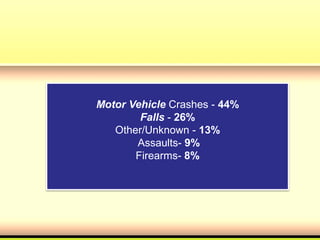
Motor Vehicle Crashes - 44%
Falls - 26%
Other/Unknown - 13%
Assaults- 9%
Firearms- 8%
• High potential for poor outcome
• Deaths occur at three points in time
after injury:
–Immediately after the injury
–Within 2 hours after injury
–3 weeks after injury
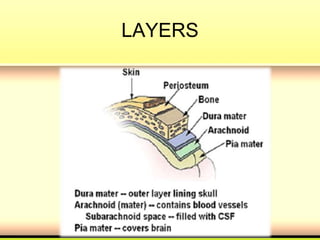
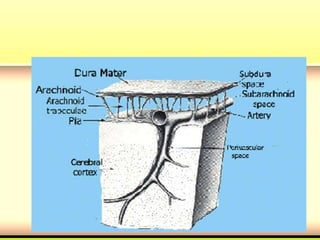
LAYERS
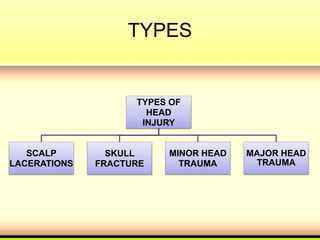
TYPES OF
HEAD
INJURY
SCALP
LACERATIONS
SKULL
FRACTURE
MINOR HEAD
TRAUMA
MAJOR HEAD
TRAUMA
TYPES
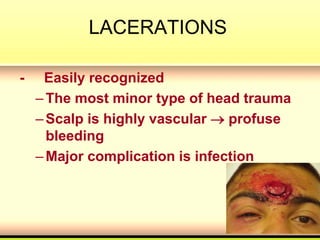
LACERATIONS
- Easily recognized
–The most minor type of head trauma
–Scalp is highly vascular  profuse
bleeding
–Major complication is infection
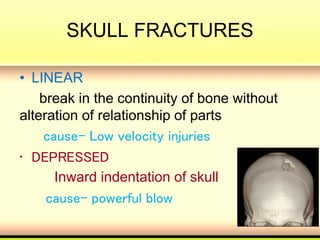
SKULL FRACTURES
• LINEAR
break in the continuity of bone without
alteration of relationship of parts
cause- Low velocity injuries
• DEPRESSED
Inward indentation of skull
cause- powerful blow
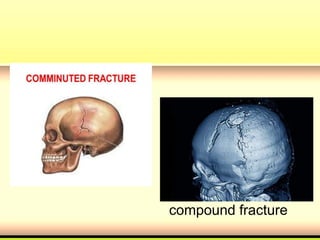
• Comminuted
multiple linear fractures with fragmentation
of bones into pieces
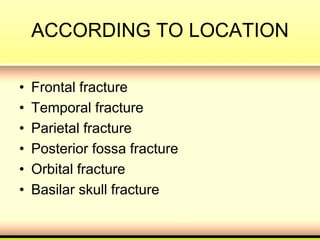
• Compound
Depressed skull fractures and scalp
laceration communicating intracranial cavity
compound fracture
ACCORDING TO LOCATION
• Frontal fracture
• Temporal fracture
• Parietal fracture
• Posterior fossa fracture
• Orbital fracture
• Basilar skull fracture
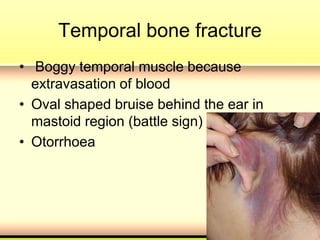
Temporal bone fracture
• Boggy temporal muscle because
extravasation of blood
• Oval shaped bruise behind the ear in
mastoid region (battle sign)
• Otorrhoea
Parietal bone fracture
• Deafness
• CSF otorrhoea
• Bulging of tympanic membrane by blood
or CSF
• Facial paralysis
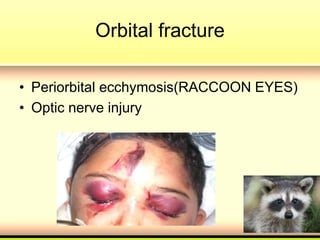
Orbital fracture
• Periorbital ecchymosis(RACCOON EYES)
• Optic nerve injury
Basilar skull fracture
• Otorrhoea, rhinorrhoea
• Bulging of tympanic membrane
• Battle’s sign
• Facial paralysis
• Tinnittis , vertigo
Test to determine CSF leakage
Method 1
• Check for presence of glucose
• Dextrostrip/ Tes-Tape strip
• If blood is present in the fluid
• The test become unreliable
• Go for 2nd method
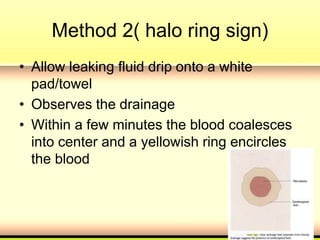
Method 2( halo ring sign)
• Allow leaking fluid drip onto a white
pad/towel
• Observes the drainage
• Within a few minutes the blood coalesces
into center and a yellowish ring encircles
the blood
MINOR HEAD TRAUMA
• CONCUSSION
A sudden transient mechanical head
injury with disruption of neuronal activity and
a change in the LOC
It occurs When the brain suddenly
shifts inside the skull and knocks against the
skulls bony surface
TYPICAL SIGNS
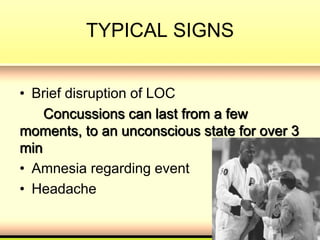
• Brief disruption of LOC
Concussions can last from a few
moments, to an unconscious state for over 3
min
• Amnesia regarding event
• Headache
MAJOR HEAD TRAUMA
CONTUSION
It is the bruising of the brain tissue within
a focal area
• It is usually associated with a closed head
injury
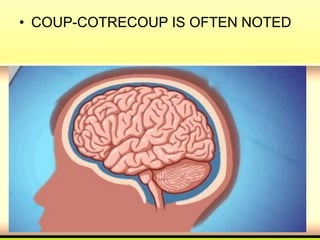
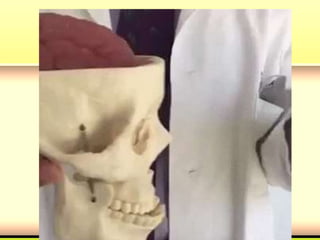
• COUP-COTRECOUP IS OFTEN NOTED
• In this type of injury contusion occur both
at the site of direct impact of the brain on
the skull( coup) and at the a secondary
area of damage on the opposite side away
from injury ( contrecoup) leading to
multiple contusion areas
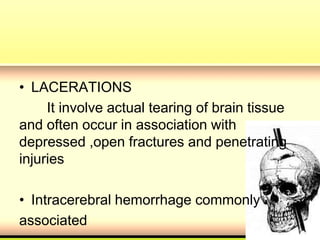
• LACERATIONS
It involve actual tearing of brain tissue
and often occur in association with
depressed ,open fractures and penetrating
injuries
• Intracerebral hemorrhage commonly
associated
COMPLICATIONS
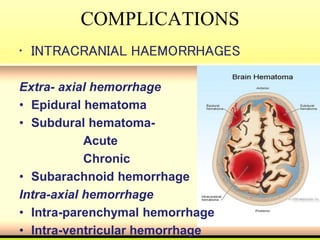
• INTRACRANIAL HAEMORRHAGES
Extra- axial hemorrhage
• Epidural hematoma
• Subdural hematoma-
Acute
Chronic
• Subarachnoid hemorrhage
Intra-axial hemorrhage
• Intra-parenchymal hemorrhage
• Intra-ventricular hemorrhage
EPIDURAL HEMORRHAGE
• A neurologic emergency
• Most common type of intracranial
hemorrhage
• Results from bleeding between the dura and
the inner surface of the skull
• Blow to the temporal, parietal bone
• Commonly bleeding by arterial origin-
breakage to middle meningeal artery
• Venous- dural venous sinus
Clinical manifestation- EDH
• The patient is initially unconscious after
the trauma
• The patient then awakens and has a lucid
interval followed by a decrease in LOC
• Headache
• Nausea and vomiting
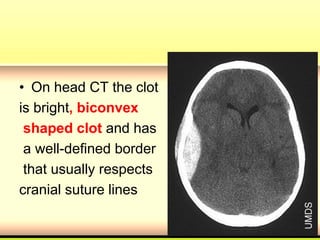
• On head CT the clot
is bright, biconvex
shaped clot and has
a well-defined border
that usually respects
cranial suture lines
• A rapid Open craniotomy for evacuation of
the congealed clot and hemostasis is
indicated for EDH
• Prevention of cerebral herniation can
dramatically improve outcome
SUB-DURAL HEMATOMA
• Subdural hematoma occurs from bleeding
between the dura matter and the
arachnoid layer of the meninges
• Types
1. acute subdural hematoma
2. subacute subdural hematoma
3. Chronic subdural hematoma
• SDH usually results from venous bleeding,
usually from tearing of a bridging vein
running from the cerebral cortex to the
dural sinuses.
• Hematoma may be slower to develop
Acute subdural hemorrhage
• It develop 24-48 hrs after the severe head
trauma
• Commonly related to acceleration-
deceleration injury
• Clinical manifestations as same as
elevated ICP
• The size of hematoma determines the
patient clinical presentation
• Decreasing LOC from drowsy and
confused to unconsciousness
• Headache
• Ipsilateral pupil dilation
• Motor signs
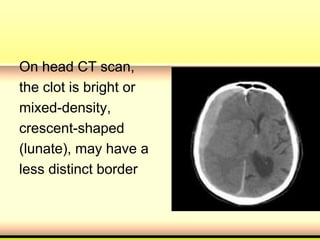
On head CT scan,
the clot is bright or
mixed-density,
crescent-shaped
(lunate), may have a
less distinct border
• Open craniotomy for evacuation of the clot
and decompression is indicated for any
acute SDH more than 1 cm in thickness,
or smaller hematomas that are
symptomatic
SUBACUTE SUBDURAL
HEMATOMA
• Usually occurs within 2-14 days of the
injury
• The alteration in mental status as
hematoma develops
• Progression depends on the size and
location of hematoma
CHRONIC SUBDURAL
HEMATOMA
• It develops over weeks or months after
seemingly minor head injury
• The peak incidence of chronic SDH is in
50-60 Years of age
• Clinical manifestations is progressive
alteration in LOC
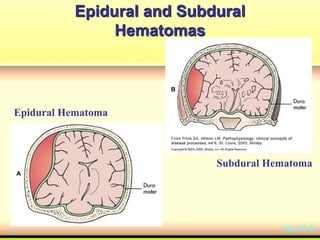
Epidural and Subdural
Hematomas
Fig. 55-15
Epidural Hematoma
Subdural Hematoma
Epidural and Subdural
Hematomas
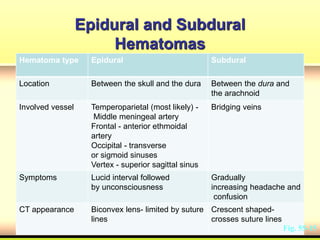
Hematoma type Epidural Subdural
Location Between the skull and the dura Between the dura and
the arachnoid
Involved vessel Temperoparietal (most likely) -
Middle meningeal artery
Frontal - anterior ethmoidal
artery
Occipital - transverse
or sigmoid sinuses
Vertex - superior sagittal sinus
Bridging veins
Symptoms Lucid interval followed
by unconsciousness
Gradually
increasing headache and
confusion
CT appearance Biconvex lens- limited by suture
lines
Crescent shaped-
crosses suture lines
Fig. 55-15
SUB ARACHNOID
HEMORRHAGE
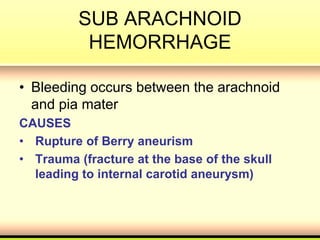
• Bleeding occurs between the arachnoid
and pia mater
CAUSES
• Rupture of Berry aneurism
• Trauma (fracture at the base of the skull
leading to internal carotid aneurysm)
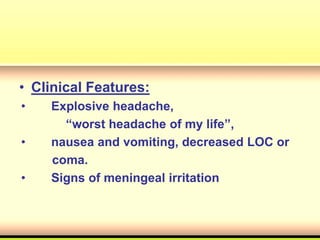
• Clinical Features:
• Explosive headache,
“worst headache of my life”,
• nausea and vomiting, decreased LOC or
coma.
• Signs of meningeal irritation
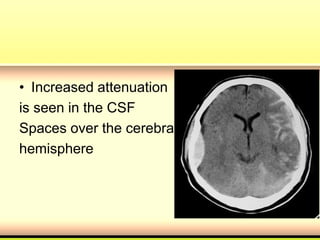
• Increased attenuation
is seen in the CSF
Spaces over the cerebral
hemisphere
Intracerebral Hemorrhage
(ICH)
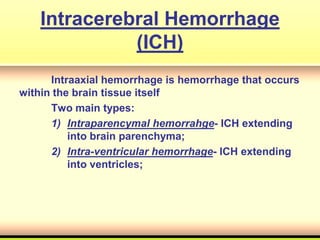
Intraaxial hemorrhage is hemorrhage that occurs
within the brain tissue itself
Two main types:
1) Intraparencymal hemorrahge- ICH extending
into brain parenchyma;
2) Intra-ventricular hemorrhage- ICH extending
into ventricles;
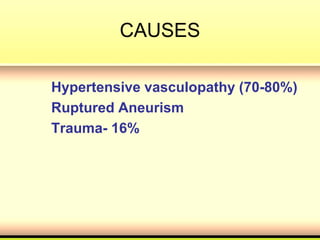
CAUSES
Hypertensive vasculopathy (70-80%)
Ruptured Aneurism
Trauma- 16%
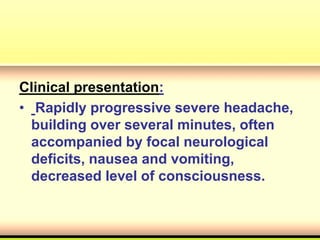
Clinical presentation:
• Rapidly progressive severe headache,
building over several minutes, often
accompanied by focal neurological
deficits, nausea and vomiting,
decreased level of consciousness.
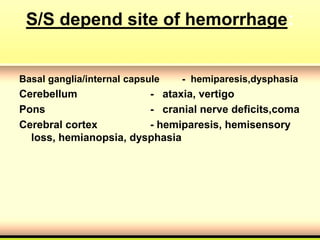
S/S depend site of hemorrhage:
Basal ganglia/internal capsule - hemiparesis,dysphasia
Cerebellum - ataxia, vertigo
Pons - cranial nerve deficits,coma
Cerebral cortex - hemiparesis, hemisensory
loss, hemianopsia, dysphasia
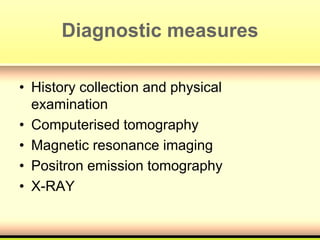
Diagnostic measures
• History collection and physical
examination
• Computerised tomography
• Magnetic resonance imaging
• Positron emission tomography
• X-RAY
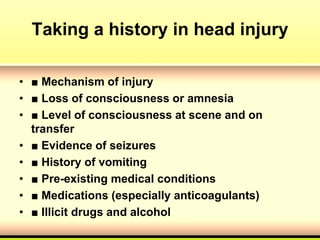
Taking a history in head injury
• ■ Mechanism of injury
• ■ Loss of consciousness or amnesia
• ■ Level of consciousness at scene and on
transfer
• ■ Evidence of seizures
• ■ History of vomiting
• ■ Pre-existing medical conditions
• ■ Medications (especially anticoagulants)
• ■ Illicit drugs and alcohol
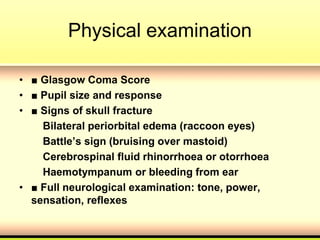
Physical examination
• ■ Glasgow Coma Score
• ■ Pupil size and response
• ■ Signs of skull fracture
Bilateral periorbital edema (raccoon eyes)
Battle’s sign (bruising over mastoid)
Cerebrospinal fluid rhinorrhoea or otorrhoea
Haemotympanum or bleeding from ear
• ■ Full neurological examination: tone, power,
sensation, reflexes
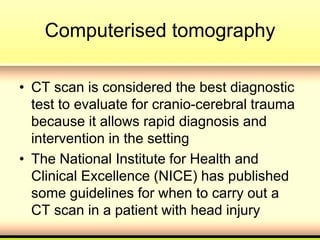
Computerised tomography
• CT scan is considered the best diagnostic
test to evaluate for cranio-cerebral trauma
because it allows rapid diagnosis and
intervention in the setting
• The National Institute for Health and
Clinical Excellence (NICE) has published
some guidelines for when to carry out a
CT scan in a patient with head injury
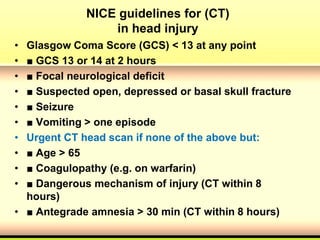
NICE guidelines for (CT)
in head injury
• Glasgow Coma Score (GCS) < 13 at any point
• ■ GCS 13 or 14 at 2 hours
• ■ Focal neurological deficit
• ■ Suspected open, depressed or basal skull fracture
• ■ Seizure
• ■ Vomiting > one episode
• Urgent CT head scan if none of the above but:
• ■ Age > 65
• ■ Coagulopathy (e.g. on warfarin)
• ■ Dangerous mechanism of injury (CT within 8
hours)
• ■ Antegrade amnesia > 30 min (CT within 8 hours)
• An MRI scan is more sensitive than CT
scan in detecting small lesions
• A cervical spine X-ray indicated to detect
any cervical injury
• Transcranial doppler allow the
mesurement of CBF
Management
• Severe head injury is best managed in a
neurointensive care setting
• The patient should be positioned with the
head up 30 degree
• It is important to ensure that the cervical
immobilisation collar does not obstruct
venous return from the head
Airway and ventilation
• patient in traumatic coma is unable to
protect their airway and is at risk for
aspiration
• Maintain a normocapnia
Circulation and cerebral
perfusion pressure
• Hypotension and hypoxia as a major
cause of secondary brain injury.
• A systolic BP < 90 mmHg worse outcome
in traumatic coma
• Cerebral perfusion pressure should be
maintained at > 65 mmHg in severely
head-injured patients.
Control of intracranial
pressure
• Position head up 30º
• Avoid obstruction of venous drainage from
head
• Sedation +/– muscle relaxant
• Normocapnia
• Diuretics: furosemide, mannitol
• Seizure control
• Normothermia
• Barbiturates
MEDICATIONS
• Osmotic diuretics
• Anticonvulsants
• Barbiturates
• Calcium Channel Blockers
OSMOTIC DIURETICS
• MANNITOL 25%
• 1.5-2 g/kg IV infused over 30-60 minutes
ANTICONVULSANTS
PHENYTOIN
where it may inhibit spread of seizure
activity in motor cortex
DOSAGE-
• Load 10-15 mg/kg THEN
• Maintenance: 100 mg IV/PO q6-8hr PRN
BARBITURATES
PENTOBARBITAL
• It will reduce the brain metabolic rate and
helps reduce ICP.
Dosage- 100 mg IV OR 150-200 mg IM
Surgical management
No surgical intervention if collection
<10ml
Indication of surgical decompression:
• The GCS score decreases by 2 or more points
between the time of injury and hospital
evaluation
• The patient presents with fixed and dilated
pupils
• The intracranial pressure (ICP) exceeds 20 mm
Hg
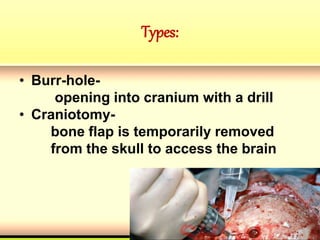
Types:
• Burr-hole-
opening into cranium with a drill
• Craniotomy-
bone flap is temporarily removed
from the skull to access the brain
• Craniectomy –
Excision into the cranium to cut
away a bone flap
• Cranioplasty -
surgical repair of a defect or
deformity of a skull
Nursing management
• Nursing assessment
ABC
GCS Score
Neurologic examination
Signs of elevated ICP
Signs of CSF leakage
Nursing diagnosis
• Ineffective tissue perfusion (cerebral)
related to interruption of CBF associated
with cerebral hemorrhage and edema
• Acute pain (headache) related to trauma
and cerebral edema
• Hyperthermia related to increased
metabolism, and loss of cerebral
integrative function secondary to possible
hypothalamus injury
• Impaired physical mobility related to
decreased LOC and treatment –imposed
bedrest
• Anxiety related to abrupt change in health
status, hospital environment and uncertain
future
• Risk for complication related cerebral
edema and hemorrhage
Preventive Measures
Health Promotion
• Prevent car and motorcycle
accidents
• To Wear safety helmets
Rehabilitation
Ambulatory and Home Care
• Nutrition
• Bowel and bladder management
• Seizure disorders
• Family participation and education
Unconscious stages
• Stupor is a state of partial or near
complete unconsciousness in which the
patient is lethargic, immobile, and has a
reduced response to stimuli.
• Coma is a state in which the patient is
totally unconscious and cannot be aroused
even with strong stimuli.
Persistent vegetative state
• It is a condition in which awake patients
are unconscious and unaware of their
surroundings and the cerebral cortex is not
functioning. A vegetative state can result
from diffuse injury to the cerebral
hemispheres of the brain without damage
to the lower brain and brainstem. The
vegetative state is considered permanent
if it persists for 12 months after TBI

Head injury.ppt

  • 1.
  • 2.
    HEAD INJURY • Anydegree of injury to the head ranging from scalp laceration to LOC to focal neurological deficits
  • 3.
    Traumatic brain injury(TBI) Traumatic brain injury (TBI) is a nondegenerative, noncongenital insult to the brain from an external mechanical force, possibly leading to permanent or temporary impairment of cognitive, physical, and psychosocial functions, with an associated diminished or altered state of consciousness
  • 4.
  • 5.
    Highest among adolescents,young adults, and those older than 75 Vehicle crashes are the leading cause of brain injury. Falls are the second leading cause 50% of major trauma deaths are due to TBI
  • 6.
    Motor Vehicle Crashes- 44% Falls - 26% Other/Unknown - 13% Assaults- 9% Firearms- 8%
  • 7.
    • High potentialfor poor outcome • Deaths occur at three points in time after injury: –Immediately after the injury –Within 2 hours after injury –3 weeks after injury
  • 8.
  • 10.
  • 11.
    LACERATIONS - Easily recognized –Themost minor type of head trauma –Scalp is highly vascular  profuse bleeding –Major complication is infection
  • 12.
    SKULL FRACTURES • LINEAR breakin the continuity of bone without alteration of relationship of parts cause- Low velocity injuries • DEPRESSED Inward indentation of skull cause- powerful blow
  • 13.
    • Comminuted multiple linearfractures with fragmentation of bones into pieces • Compound Depressed skull fractures and scalp laceration communicating intracranial cavity
  • 14.
  • 15.
    ACCORDING TO LOCATION •Frontal fracture • Temporal fracture • Parietal fracture • Posterior fossa fracture • Orbital fracture • Basilar skull fracture
  • 16.
    Temporal bone fracture •Boggy temporal muscle because extravasation of blood • Oval shaped bruise behind the ear in mastoid region (battle sign) • Otorrhoea
  • 17.
    Parietal bone fracture •Deafness • CSF otorrhoea • Bulging of tympanic membrane by blood or CSF • Facial paralysis
  • 18.
    Orbital fracture • Periorbitalecchymosis(RACCOON EYES) • Optic nerve injury
  • 19.
    Basilar skull fracture •Otorrhoea, rhinorrhoea • Bulging of tympanic membrane • Battle’s sign • Facial paralysis • Tinnittis , vertigo
  • 20.
    Test to determineCSF leakage Method 1 • Check for presence of glucose • Dextrostrip/ Tes-Tape strip • If blood is present in the fluid • The test become unreliable • Go for 2nd method
  • 21.
    Method 2( haloring sign) • Allow leaking fluid drip onto a white pad/towel • Observes the drainage • Within a few minutes the blood coalesces into center and a yellowish ring encircles the blood
  • 22.
    MINOR HEAD TRAUMA •CONCUSSION A sudden transient mechanical head injury with disruption of neuronal activity and a change in the LOC It occurs When the brain suddenly shifts inside the skull and knocks against the skulls bony surface
  • 23.
    TYPICAL SIGNS • Briefdisruption of LOC Concussions can last from a few moments, to an unconscious state for over 3 min • Amnesia regarding event • Headache
  • 24.
    MAJOR HEAD TRAUMA CONTUSION Itis the bruising of the brain tissue within a focal area • It is usually associated with a closed head injury
  • 25.
  • 27.
    • In thistype of injury contusion occur both at the site of direct impact of the brain on the skull( coup) and at the a secondary area of damage on the opposite side away from injury ( contrecoup) leading to multiple contusion areas
  • 28.
    • LACERATIONS It involveactual tearing of brain tissue and often occur in association with depressed ,open fractures and penetrating injuries • Intracerebral hemorrhage commonly associated
  • 29.
    COMPLICATIONS • INTRACRANIAL HAEMORRHAGES Extra-axial hemorrhage • Epidural hematoma • Subdural hematoma- Acute Chronic • Subarachnoid hemorrhage Intra-axial hemorrhage • Intra-parenchymal hemorrhage • Intra-ventricular hemorrhage
  • 30.
    EPIDURAL HEMORRHAGE • Aneurologic emergency • Most common type of intracranial hemorrhage • Results from bleeding between the dura and the inner surface of the skull • Blow to the temporal, parietal bone • Commonly bleeding by arterial origin- breakage to middle meningeal artery • Venous- dural venous sinus
  • 31.
    Clinical manifestation- EDH •The patient is initially unconscious after the trauma • The patient then awakens and has a lucid interval followed by a decrease in LOC • Headache • Nausea and vomiting
  • 32.
    • On headCT the clot is bright, biconvex shaped clot and has a well-defined border that usually respects cranial suture lines
  • 33.
    • A rapidOpen craniotomy for evacuation of the congealed clot and hemostasis is indicated for EDH • Prevention of cerebral herniation can dramatically improve outcome
  • 34.
    SUB-DURAL HEMATOMA • Subduralhematoma occurs from bleeding between the dura matter and the arachnoid layer of the meninges • Types 1. acute subdural hematoma 2. subacute subdural hematoma 3. Chronic subdural hematoma
  • 35.
    • SDH usuallyresults from venous bleeding, usually from tearing of a bridging vein running from the cerebral cortex to the dural sinuses. • Hematoma may be slower to develop
  • 36.
    Acute subdural hemorrhage •It develop 24-48 hrs after the severe head trauma • Commonly related to acceleration- deceleration injury • Clinical manifestations as same as elevated ICP
  • 37.
    • The sizeof hematoma determines the patient clinical presentation • Decreasing LOC from drowsy and confused to unconsciousness • Headache • Ipsilateral pupil dilation • Motor signs
  • 38.
    On head CTscan, the clot is bright or mixed-density, crescent-shaped (lunate), may have a less distinct border
  • 39.
    • Open craniotomyfor evacuation of the clot and decompression is indicated for any acute SDH more than 1 cm in thickness, or smaller hematomas that are symptomatic
  • 40.
    SUBACUTE SUBDURAL HEMATOMA • Usuallyoccurs within 2-14 days of the injury • The alteration in mental status as hematoma develops • Progression depends on the size and location of hematoma
  • 41.
    CHRONIC SUBDURAL HEMATOMA • Itdevelops over weeks or months after seemingly minor head injury • The peak incidence of chronic SDH is in 50-60 Years of age • Clinical manifestations is progressive alteration in LOC
  • 42.
    Epidural and Subdural Hematomas Fig.55-15 Epidural Hematoma Subdural Hematoma
  • 43.
    Epidural and Subdural Hematomas Hematomatype Epidural Subdural Location Between the skull and the dura Between the dura and the arachnoid Involved vessel Temperoparietal (most likely) - Middle meningeal artery Frontal - anterior ethmoidal artery Occipital - transverse or sigmoid sinuses Vertex - superior sagittal sinus Bridging veins Symptoms Lucid interval followed by unconsciousness Gradually increasing headache and confusion CT appearance Biconvex lens- limited by suture lines Crescent shaped- crosses suture lines Fig. 55-15
  • 44.
    SUB ARACHNOID HEMORRHAGE • Bleedingoccurs between the arachnoid and pia mater CAUSES • Rupture of Berry aneurism • Trauma (fracture at the base of the skull leading to internal carotid aneurysm)
  • 45.
    • Clinical Features: •Explosive headache, “worst headache of my life”, • nausea and vomiting, decreased LOC or coma. • Signs of meningeal irritation
  • 46.
    • Increased attenuation isseen in the CSF Spaces over the cerebral hemisphere
  • 47.
    Intracerebral Hemorrhage (ICH) Intraaxial hemorrhageis hemorrhage that occurs within the brain tissue itself Two main types: 1) Intraparencymal hemorrahge- ICH extending into brain parenchyma; 2) Intra-ventricular hemorrhage- ICH extending into ventricles;
  • 48.
  • 49.
    Clinical presentation: • Rapidlyprogressive severe headache, building over several minutes, often accompanied by focal neurological deficits, nausea and vomiting, decreased level of consciousness.
  • 50.
    S/S depend siteof hemorrhage: Basal ganglia/internal capsule - hemiparesis,dysphasia Cerebellum - ataxia, vertigo Pons - cranial nerve deficits,coma Cerebral cortex - hemiparesis, hemisensory loss, hemianopsia, dysphasia
  • 51.
    Diagnostic measures • Historycollection and physical examination • Computerised tomography • Magnetic resonance imaging • Positron emission tomography • X-RAY
  • 52.
    Taking a historyin head injury • ■ Mechanism of injury • ■ Loss of consciousness or amnesia • ■ Level of consciousness at scene and on transfer • ■ Evidence of seizures • ■ History of vomiting • ■ Pre-existing medical conditions • ■ Medications (especially anticoagulants) • ■ Illicit drugs and alcohol
  • 53.
    Physical examination • ■Glasgow Coma Score • ■ Pupil size and response • ■ Signs of skull fracture Bilateral periorbital edema (raccoon eyes) Battle’s sign (bruising over mastoid) Cerebrospinal fluid rhinorrhoea or otorrhoea Haemotympanum or bleeding from ear • ■ Full neurological examination: tone, power, sensation, reflexes
  • 54.
    Computerised tomography • CTscan is considered the best diagnostic test to evaluate for cranio-cerebral trauma because it allows rapid diagnosis and intervention in the setting • The National Institute for Health and Clinical Excellence (NICE) has published some guidelines for when to carry out a CT scan in a patient with head injury
  • 55.
    NICE guidelines for(CT) in head injury • Glasgow Coma Score (GCS) < 13 at any point • ■ GCS 13 or 14 at 2 hours • ■ Focal neurological deficit • ■ Suspected open, depressed or basal skull fracture • ■ Seizure • ■ Vomiting > one episode • Urgent CT head scan if none of the above but: • ■ Age > 65 • ■ Coagulopathy (e.g. on warfarin) • ■ Dangerous mechanism of injury (CT within 8 hours) • ■ Antegrade amnesia > 30 min (CT within 8 hours)
  • 56.
    • An MRIscan is more sensitive than CT scan in detecting small lesions • A cervical spine X-ray indicated to detect any cervical injury • Transcranial doppler allow the mesurement of CBF
  • 57.
    Management • Severe headinjury is best managed in a neurointensive care setting • The patient should be positioned with the head up 30 degree • It is important to ensure that the cervical immobilisation collar does not obstruct venous return from the head
  • 58.
    Airway and ventilation •patient in traumatic coma is unable to protect their airway and is at risk for aspiration • Maintain a normocapnia
  • 59.
    Circulation and cerebral perfusionpressure • Hypotension and hypoxia as a major cause of secondary brain injury. • A systolic BP < 90 mmHg worse outcome in traumatic coma • Cerebral perfusion pressure should be maintained at > 65 mmHg in severely head-injured patients.
  • 60.
    Control of intracranial pressure •Position head up 30º • Avoid obstruction of venous drainage from head • Sedation +/– muscle relaxant • Normocapnia • Diuretics: furosemide, mannitol • Seizure control • Normothermia • Barbiturates
  • 61.
    MEDICATIONS • Osmotic diuretics •Anticonvulsants • Barbiturates • Calcium Channel Blockers
  • 62.
    OSMOTIC DIURETICS • MANNITOL25% • 1.5-2 g/kg IV infused over 30-60 minutes
  • 63.
    ANTICONVULSANTS PHENYTOIN where it mayinhibit spread of seizure activity in motor cortex DOSAGE- • Load 10-15 mg/kg THEN • Maintenance: 100 mg IV/PO q6-8hr PRN
  • 64.
    BARBITURATES PENTOBARBITAL • It willreduce the brain metabolic rate and helps reduce ICP. Dosage- 100 mg IV OR 150-200 mg IM
  • 65.
    Surgical management No surgicalintervention if collection <10ml Indication of surgical decompression: • The GCS score decreases by 2 or more points between the time of injury and hospital evaluation • The patient presents with fixed and dilated pupils • The intracranial pressure (ICP) exceeds 20 mm Hg
  • 66.
    Types: • Burr-hole- opening intocranium with a drill • Craniotomy- bone flap is temporarily removed from the skull to access the brain
  • 67.
    • Craniectomy – Excisioninto the cranium to cut away a bone flap • Cranioplasty - surgical repair of a defect or deformity of a skull
  • 68.
    Nursing management • Nursingassessment ABC GCS Score Neurologic examination Signs of elevated ICP Signs of CSF leakage
  • 69.
    Nursing diagnosis • Ineffectivetissue perfusion (cerebral) related to interruption of CBF associated with cerebral hemorrhage and edema • Acute pain (headache) related to trauma and cerebral edema • Hyperthermia related to increased metabolism, and loss of cerebral integrative function secondary to possible hypothalamus injury
  • 70.
    • Impaired physicalmobility related to decreased LOC and treatment –imposed bedrest • Anxiety related to abrupt change in health status, hospital environment and uncertain future • Risk for complication related cerebral edema and hemorrhage
  • 71.
    Preventive Measures Health Promotion •Prevent car and motorcycle accidents • To Wear safety helmets
  • 72.
    Rehabilitation Ambulatory and HomeCare • Nutrition • Bowel and bladder management • Seizure disorders • Family participation and education
  • 73.
    Unconscious stages • Stuporis a state of partial or near complete unconsciousness in which the patient is lethargic, immobile, and has a reduced response to stimuli. • Coma is a state in which the patient is totally unconscious and cannot be aroused even with strong stimuli.
  • 74.
    Persistent vegetative state •It is a condition in which awake patients are unconscious and unaware of their surroundings and the cerebral cortex is not functioning. A vegetative state can result from diffuse injury to the cerebral hemispheres of the brain without damage to the lower brain and brainstem. The vegetative state is considered permanent if it persists for 12 months after TBI