TRENDS  in Lmphedema Management   Dr. Mansoor Khan MBBS, FCPS-I Surgical “D” unit,  Khyber Teaching Hospital,  Peshawar
 
 
“ Accumulation of abnormal amount of protein rich fluid in the interstitium due to compromised lymphatic system with (near) normal net capillary filtration ”
In United States   Highest incidence is observed following breast cancer surgery with radiotherapy (10 – 40%).
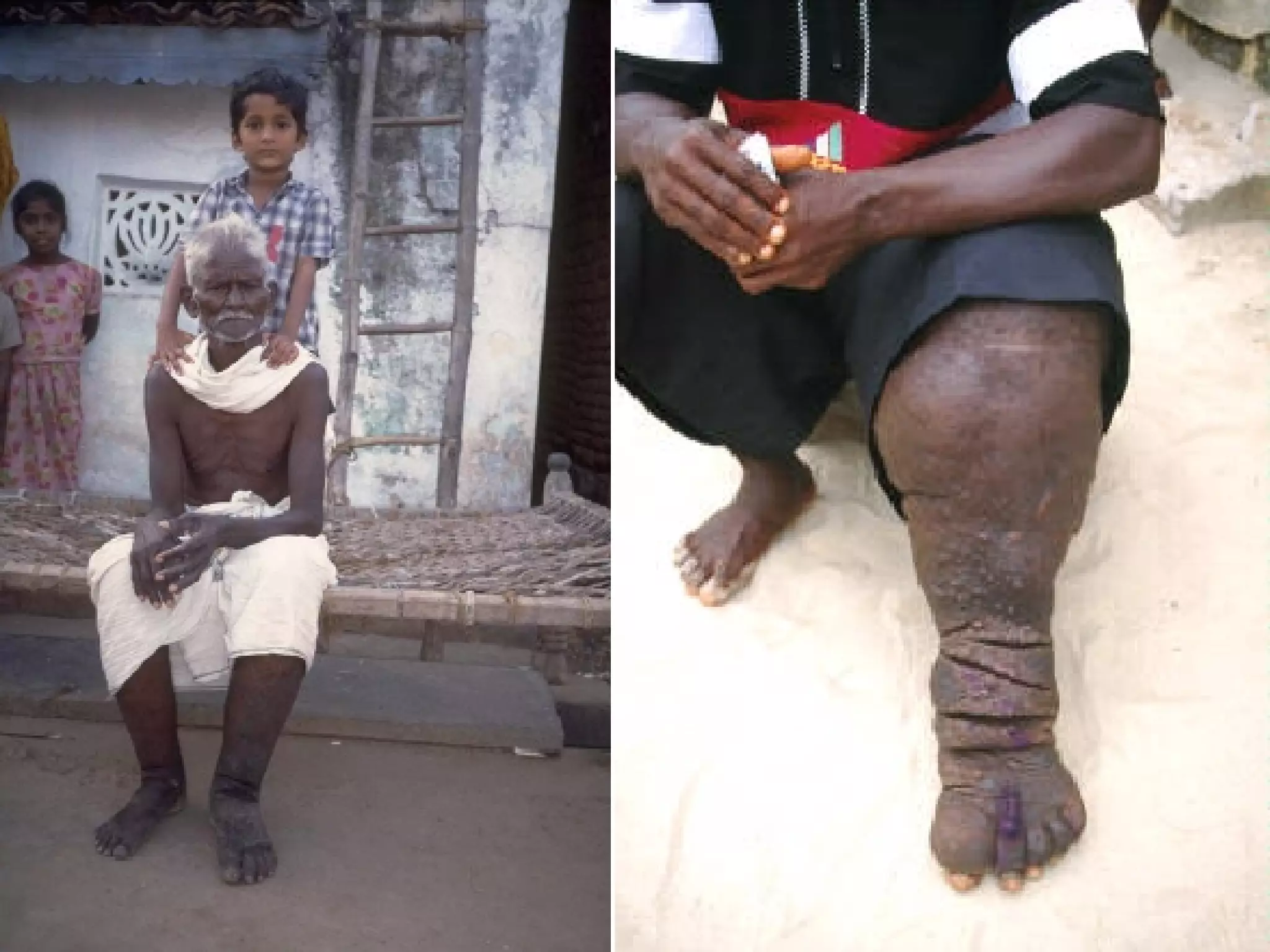
Worldwide   140-250 million  cases of lymphedema are estimated to exist with  filariasis  as the most common cause
Lymphatic  filariasis  affects more than 90 million people in the world
According to WHO Lymphatic Filariasis is the 2 nd  leading cause of permanent & long term disability in the world after leprosy
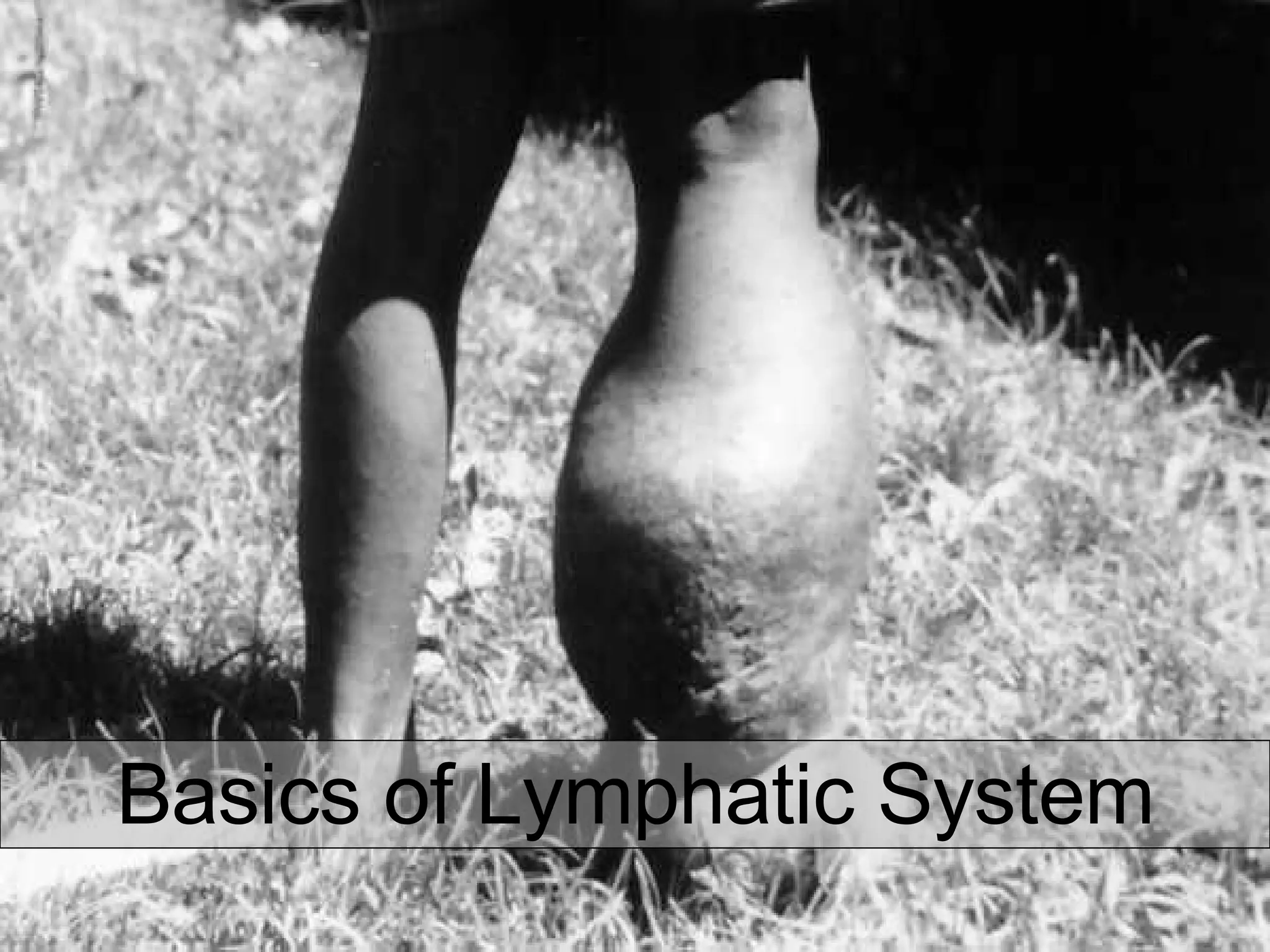
Basics of Lymphatic System
Develops from 4 primitive cystic spaces, 2 in the neck and 2 in the groin Cisterns elongate & develop communications Condensations along the connections are lymph nodes * Persistence of primitive cisterns are  cystic hygromas Embryology of lymphatic system
Embryology
Lymphatic capillaries Blind ended Large intercellular & intracellular fenestrations Allowing macromolecular influx (1000 kDa) Collagen fibers attachment on outer surface Dermal papillae Micronatomy of lymphatic system
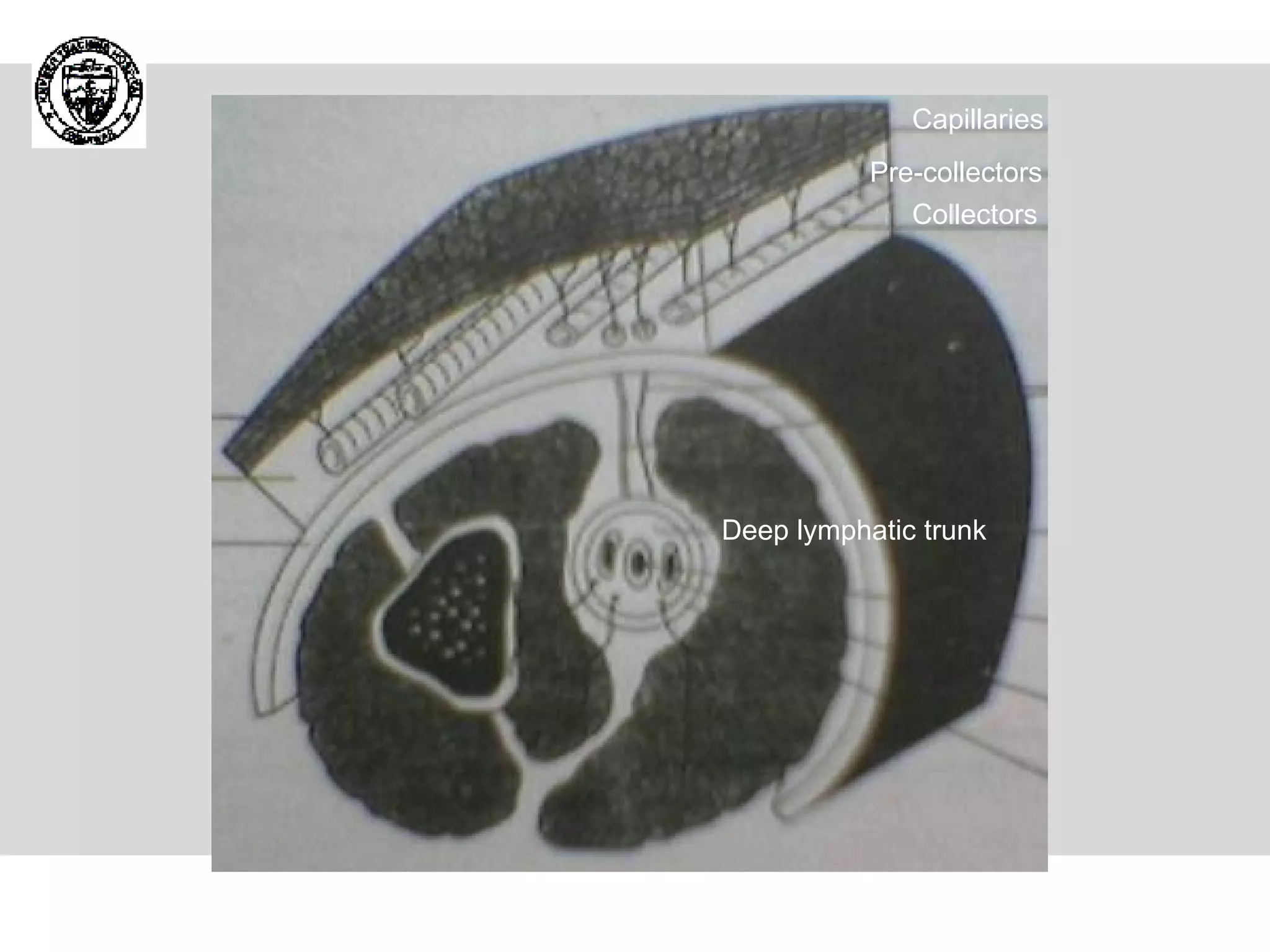
Sub papillary pre-collectors  Sub-dermal collector lymphatics Epifacial, valved, muscular lymphatics  with lymphangions Subfascial lymphatics  Interconnections at inguinal, anticubital,  axillary levels Microanatomy of lymphatic system
Capillaries   Pre-collectors  Collectors   Deep lymphatic trunk
Anatomy
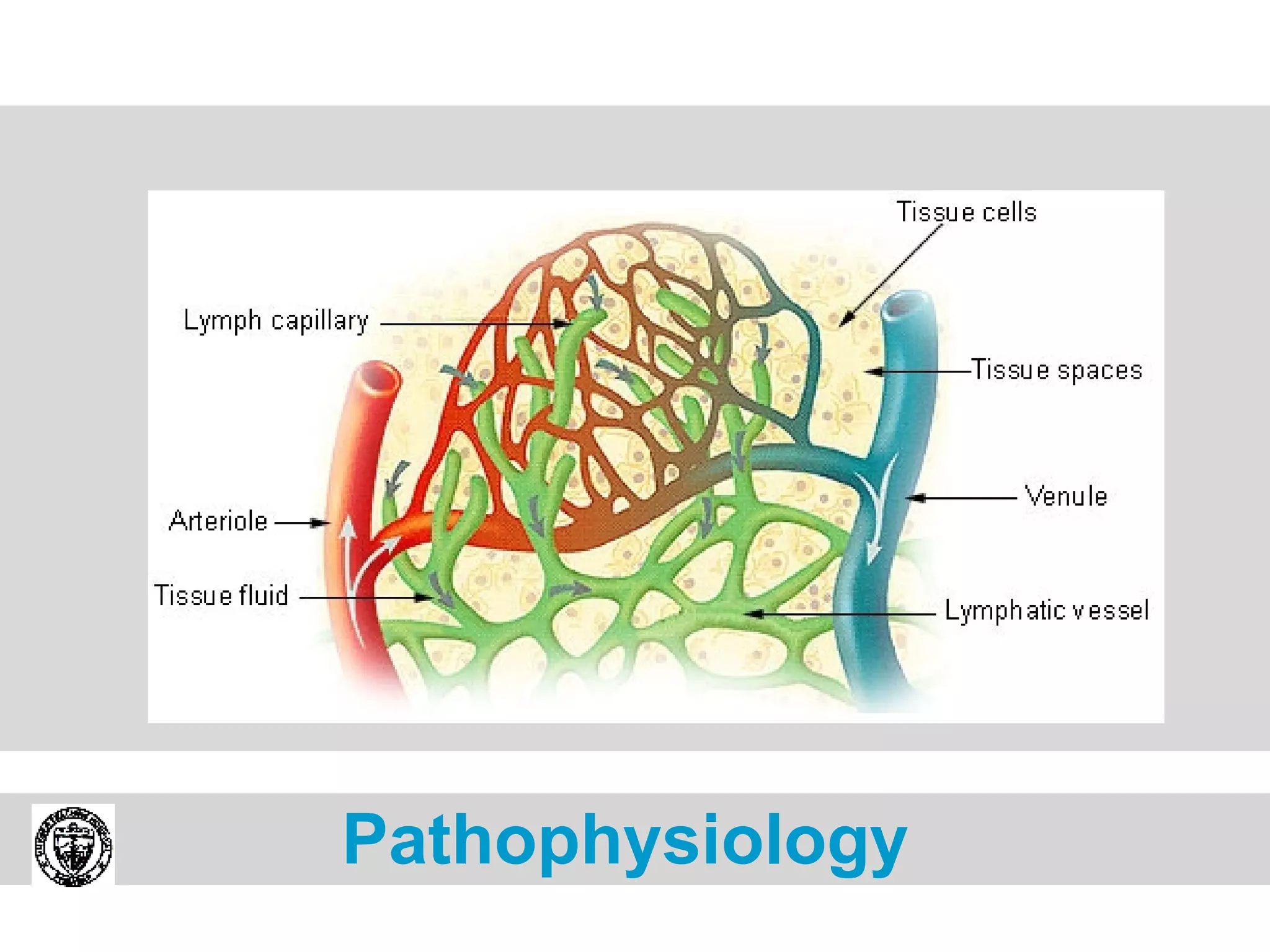
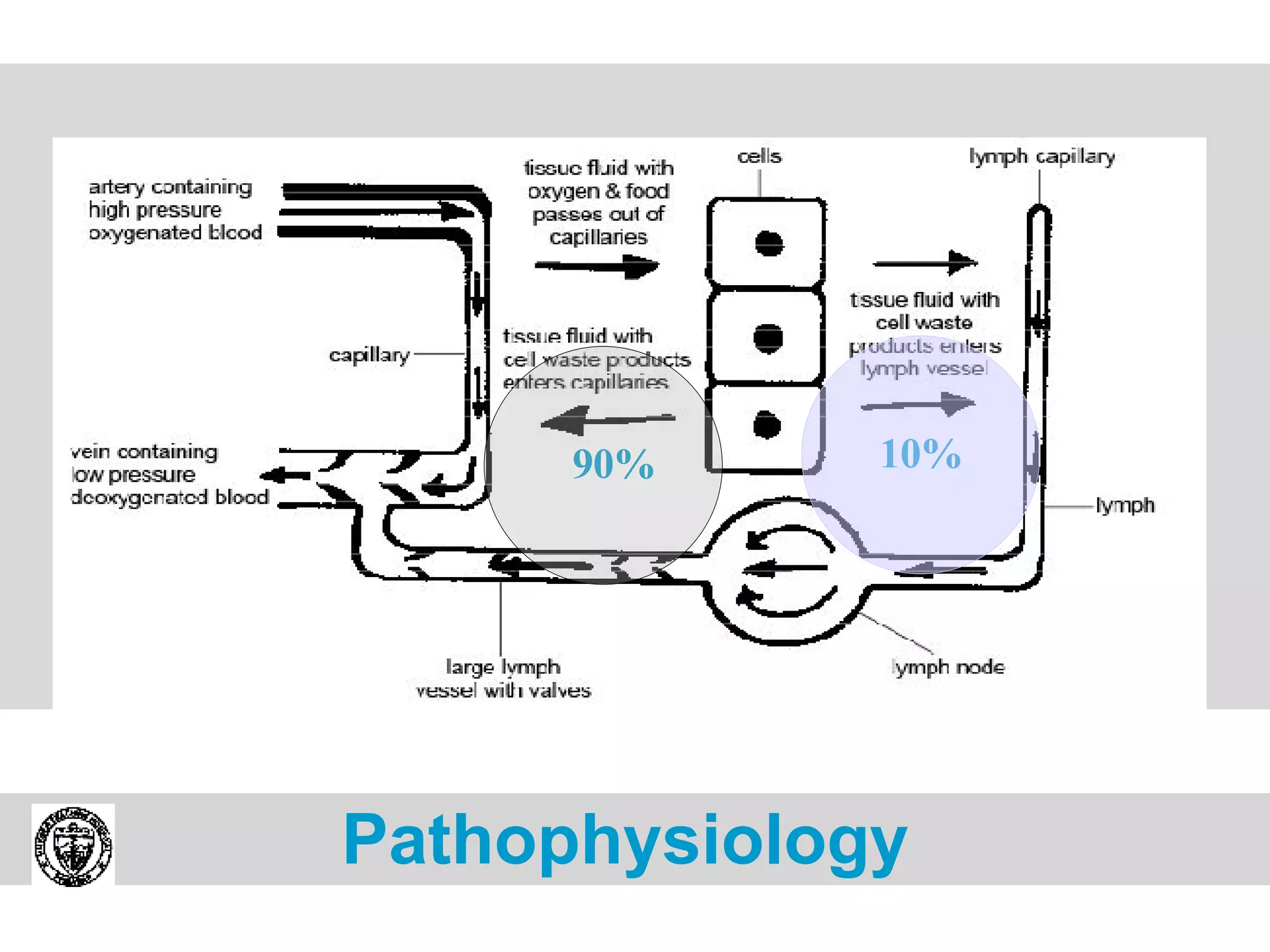
Pathophysiology
 
90% 10% Pathophysiology
Pathophysiology  Collagen  deposition lymphostasis Obstruction Aplasia hypoplasia Hypocon- tractility Valvular  incompetence  Dermal  thickening Sub dermal fibrosis LYMPH- EDEMA
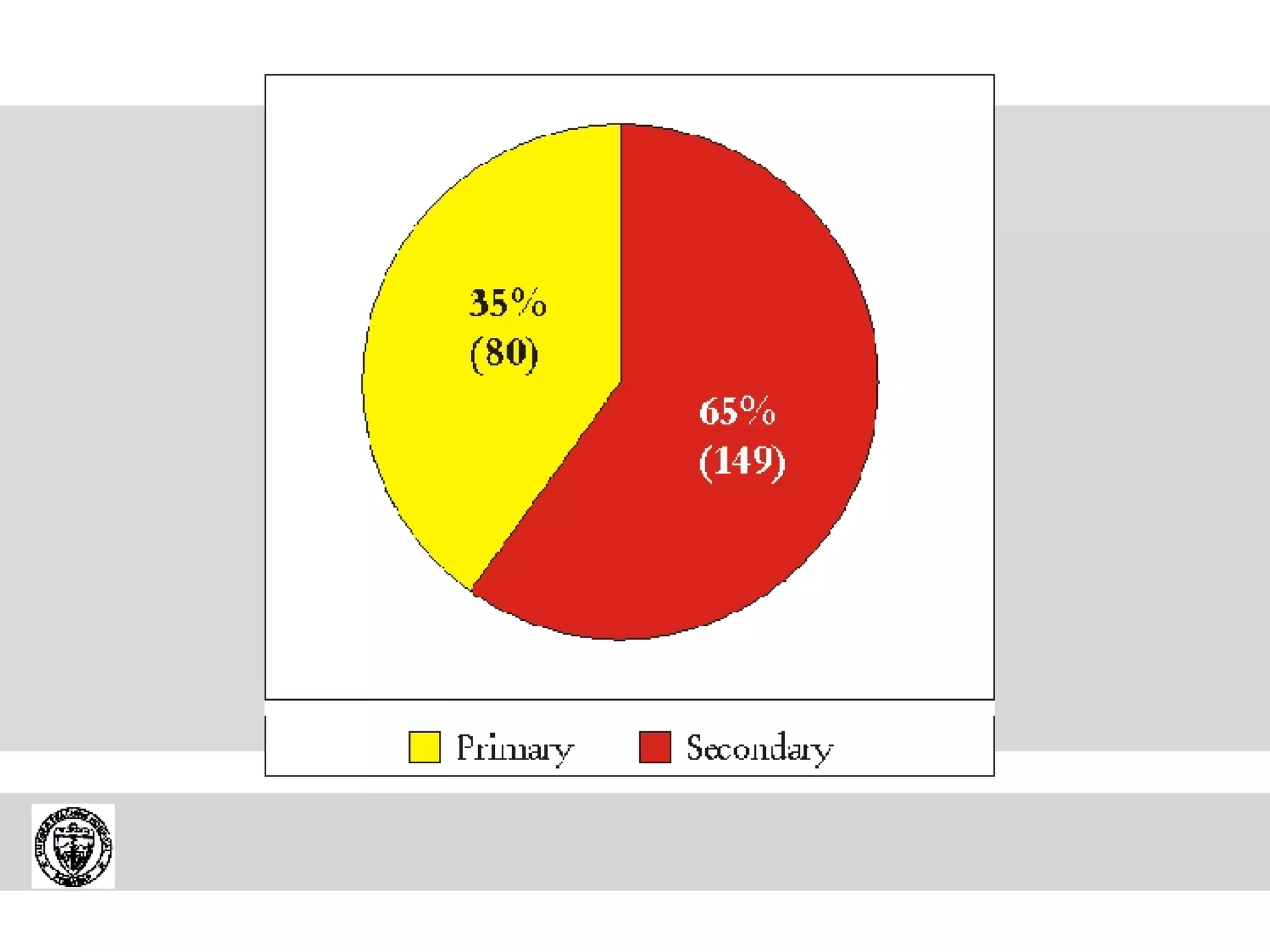
Etiology of lymphedema LYMPHEDEMA Primary lymphedema Secondary lymphedema Congenital   Praecox   Tarda
 
Congenital lymphedema < 1year  of age 10-25%  of all primary lymphedema  Sporadic  or familial  (Milroy's disease) More common in  males Lower extremity  is involved 3 times more frequently than the upper extremity  2/3 patients have  bilateral lymphedema   Aplasia pattern  without subcutaneous lymphatic  trunks involvement
Evident after birth and  before age 35 years Most often arises  during puberty   65-80%  of all primary lymphedema cases Females  are affected 4 times  70% of cases are  unilateral , with the  left lower  extremity being involved  Hypoplastic pattern , with the  lymphatics reduced in caliber and number   Lymphedema Precox
Clinically not evident until  35 years or older   Rarest  form of primary lymphedema  Only  10% of cases   Hyperplasic pattern , with  tortuous lymphatics  increased in caliber and number  Absent or incompetent valves   Lymphedema Tarda (Meige disease )
Secondary Lymphedema   Most common lymphedema having well recognized causes
Filariasis  Commonest cause worldwide Endemic in 72 countries  Affecting 5-10% population Africa, India, South America
Endemic areas of Filariasis
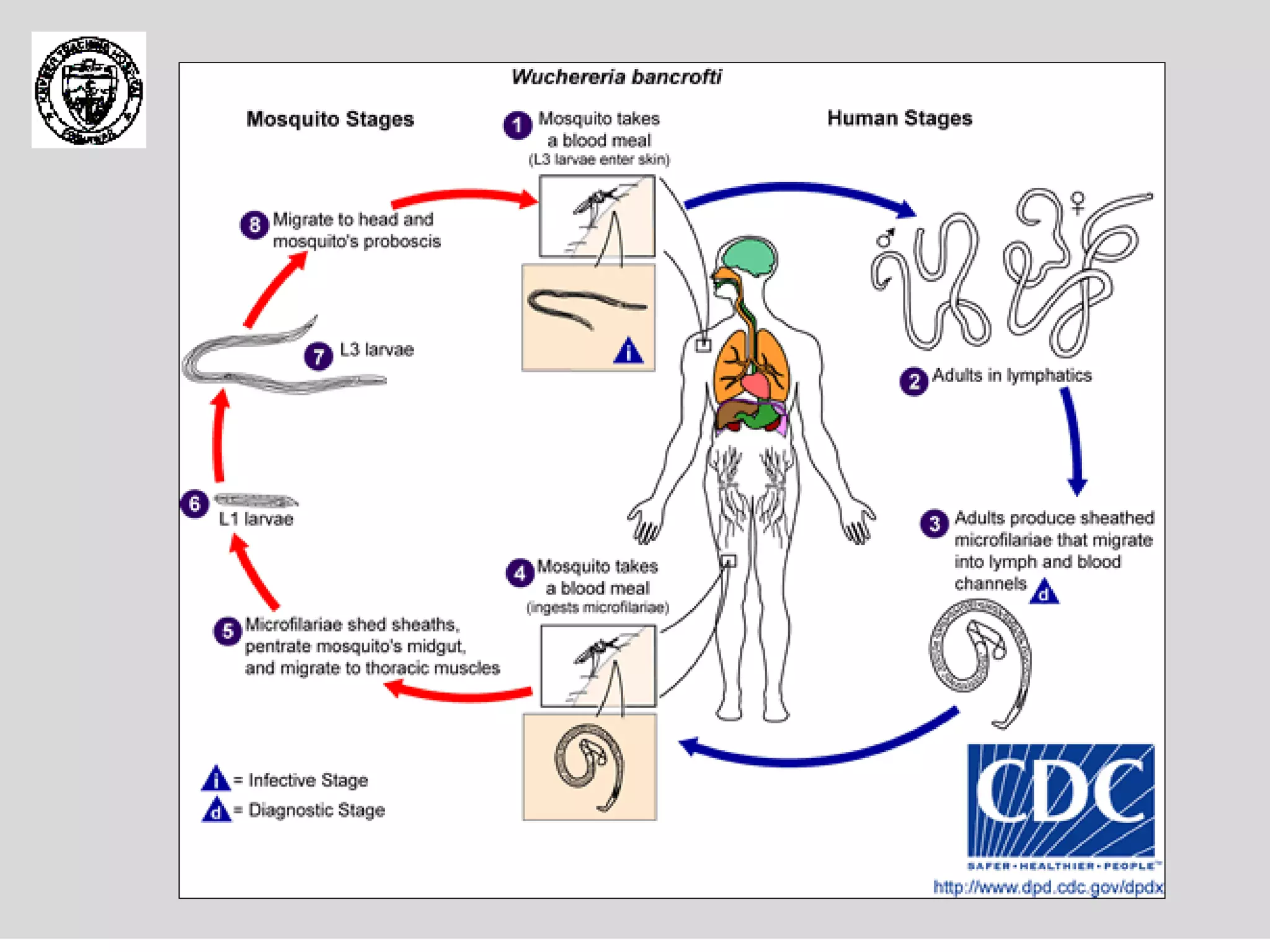
Filariasis Wuchereria  Bancrofti (90%)   Brugia malayi Brugia timori


Other causes of Secondary Lymphedema Breast surgery with radiotherapy Primary malignancy Prostate, cervical cancer, malignant melanoma  Trauma to lymphatics  Surgical excision of lymph nodes
Presentation of lymphedema Age  of onset Painless swelling Presence or absence of  family history Coexistent pathology
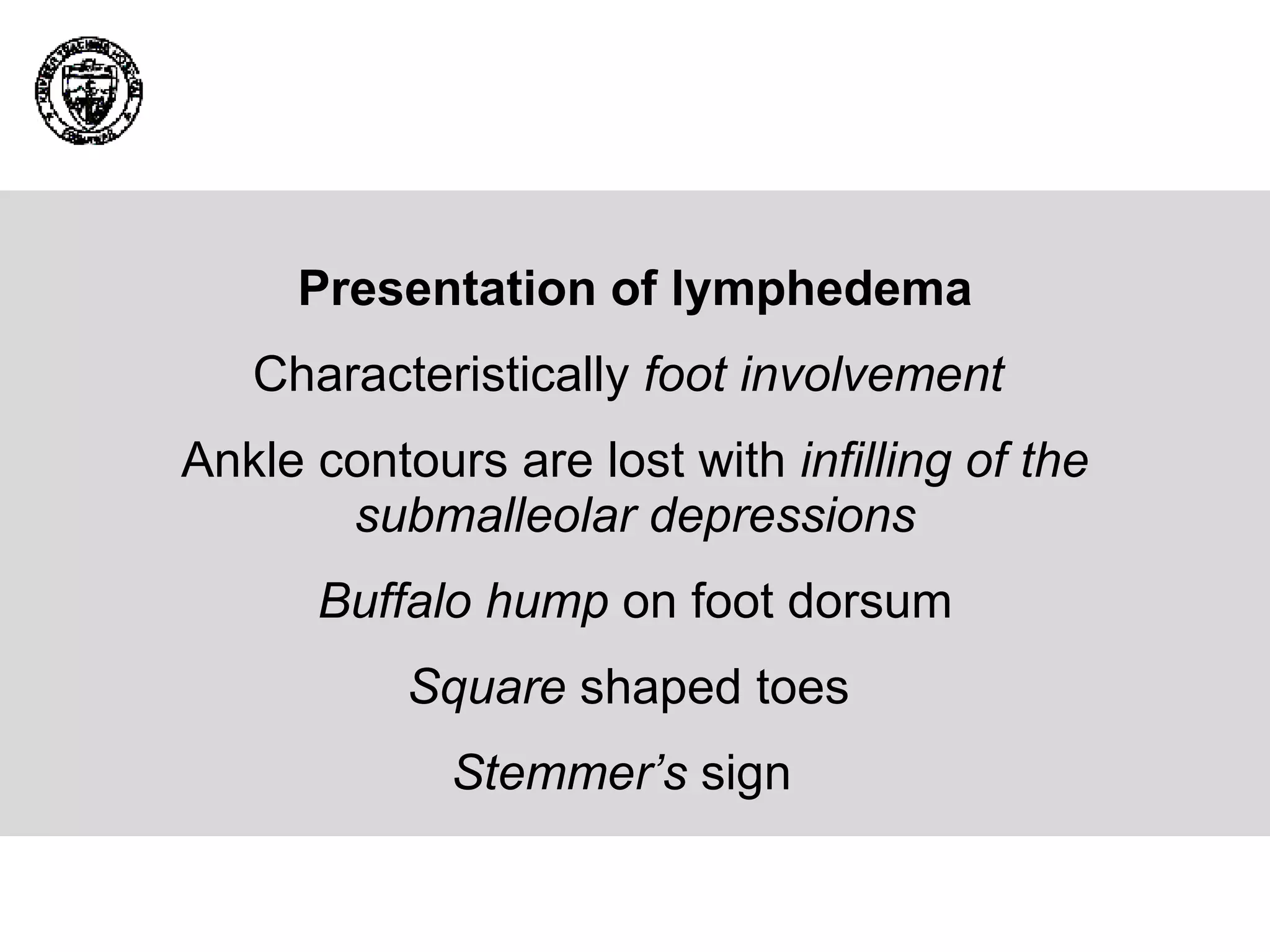
Presentation of lymphedema Characteristically  foot involvement   Ankle contours are lost with  infilling of the submalleolar depressions Buffalo hump  on foot dorsum Square  shaped toes  Stemmer’s  sign
Skin changes Chronic eczema Dermatophytosis Fissuring Verrucae Ulcerations Stewart Treves syndrome
Presentation of lymphedema Chyluria, chylous ascites, chylothorax, Lymphorrhoea  MEGALYMPHATICS
 
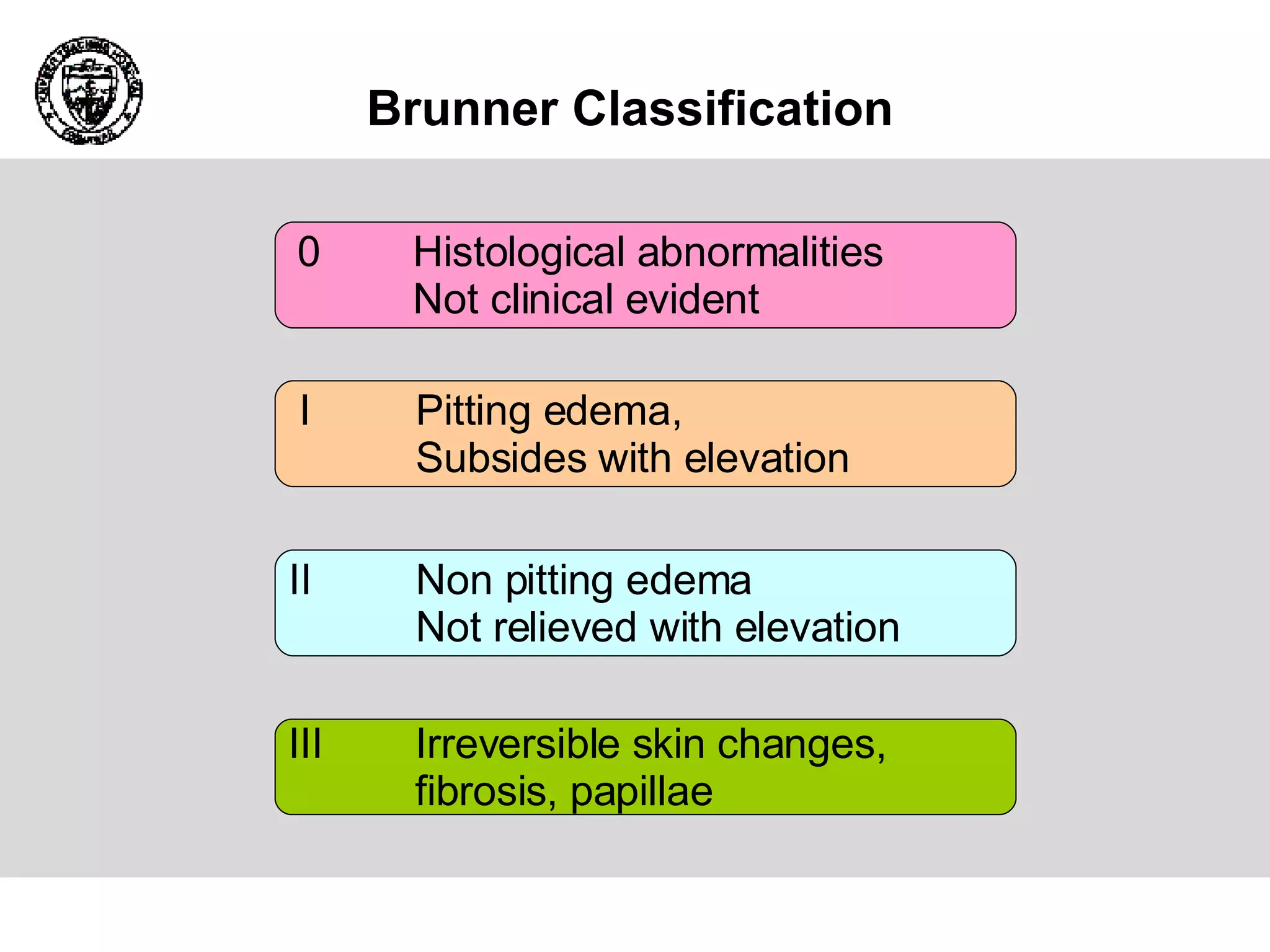
Brunner Classification   0 Histological abnormalities Not clinical evident  I Pitting edema,  Subsides with elevation II Non pitting edema Not relieved with elevation III Irreversible skin changes, fibrosis, papillae
Investigations
Investigations Infrequently required to establish the diagnosis To determine residual lymphatic function To establish treatment preferences To evaluate therapy
Contrast Lymphangiography Was gold standard for mapping Damages the normal lymphatic channels  due to inflammation Very painful procedure and needs GA
Lymphangiogram
Lymphangiogram
Isotope Lymphoscintigraphy Replaced the earlier Technetium labeled antimony sulphide
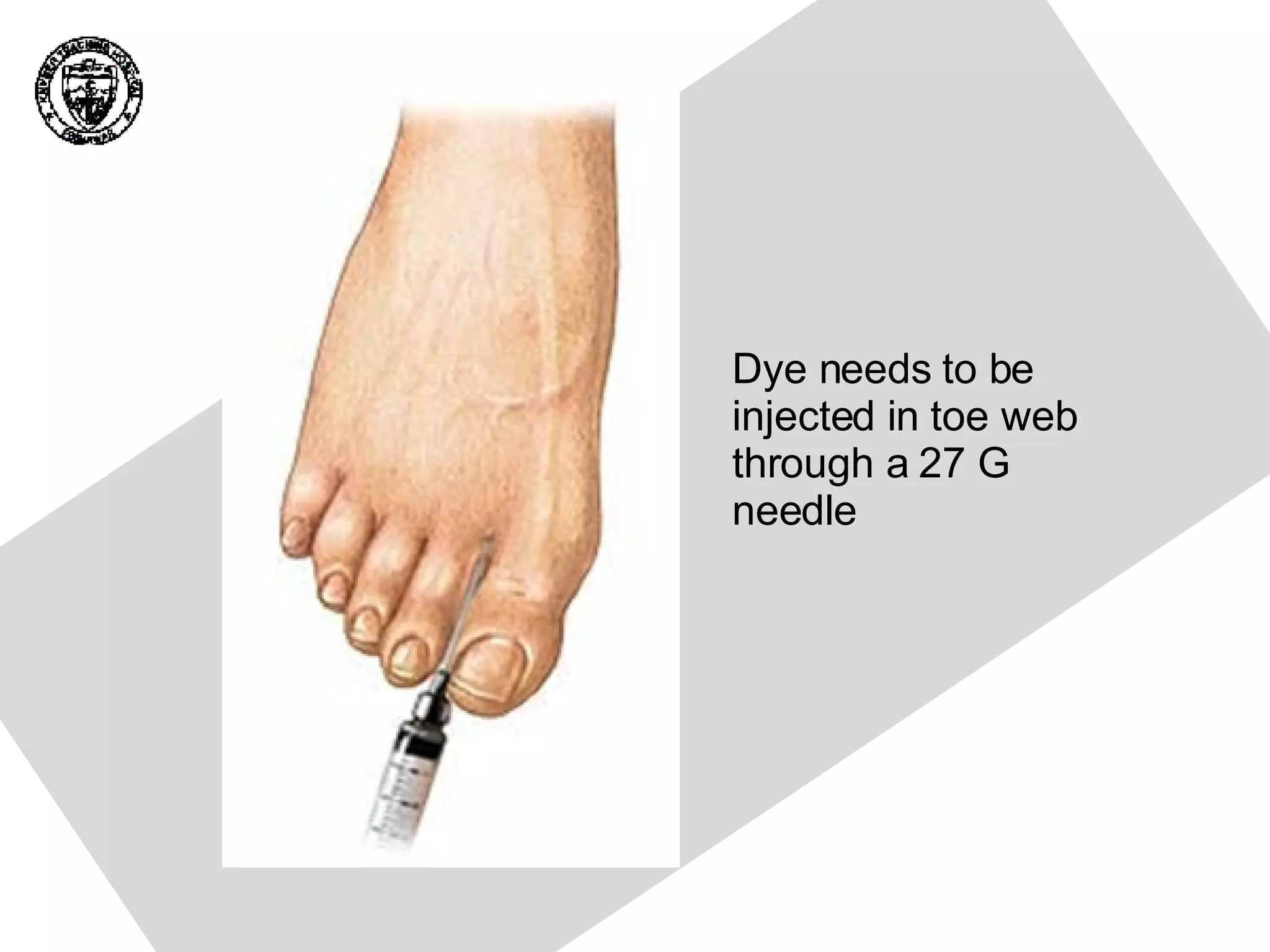
Dye needs to be injected in toe web through a 27 G needle
Lymphoscintigram
An indication for CT scan or MRI  is suspicion of malignancy,  for which these tests offer the most information   MRI Scan
Blood slide (Microfilaria)
Blood slide
Adult worms in lymph nodes
Others  Eosinophilia  Increased IgE levels Compliment fixation test Antigens of filaria
Treatment
TREATMENT Conservative  Surgical
Conservative  Physical  Medication
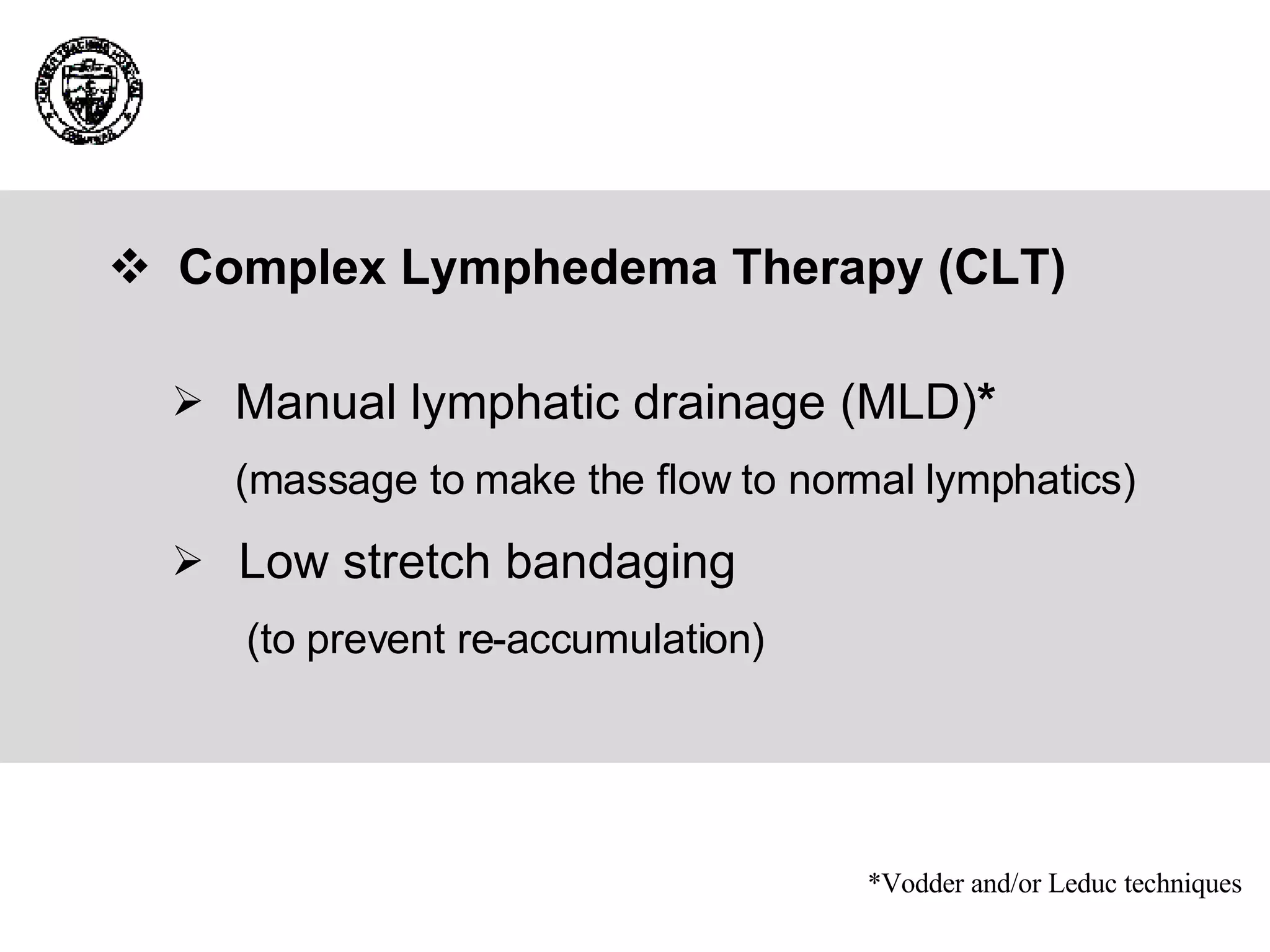
Complex Lymphedema Therapy (CLT) Manual lymphatic drainage (MLD) * (massage to make the flow to normal lymphatics) Low stretch bandaging    (to prevent re-accumulation)   *Vodder and/or Leduc techniques
CLT
Intermittent pneumatic pump compression therapy Effectively milking the lymph  from the extremity Compression garment  To help prevent return of fluid
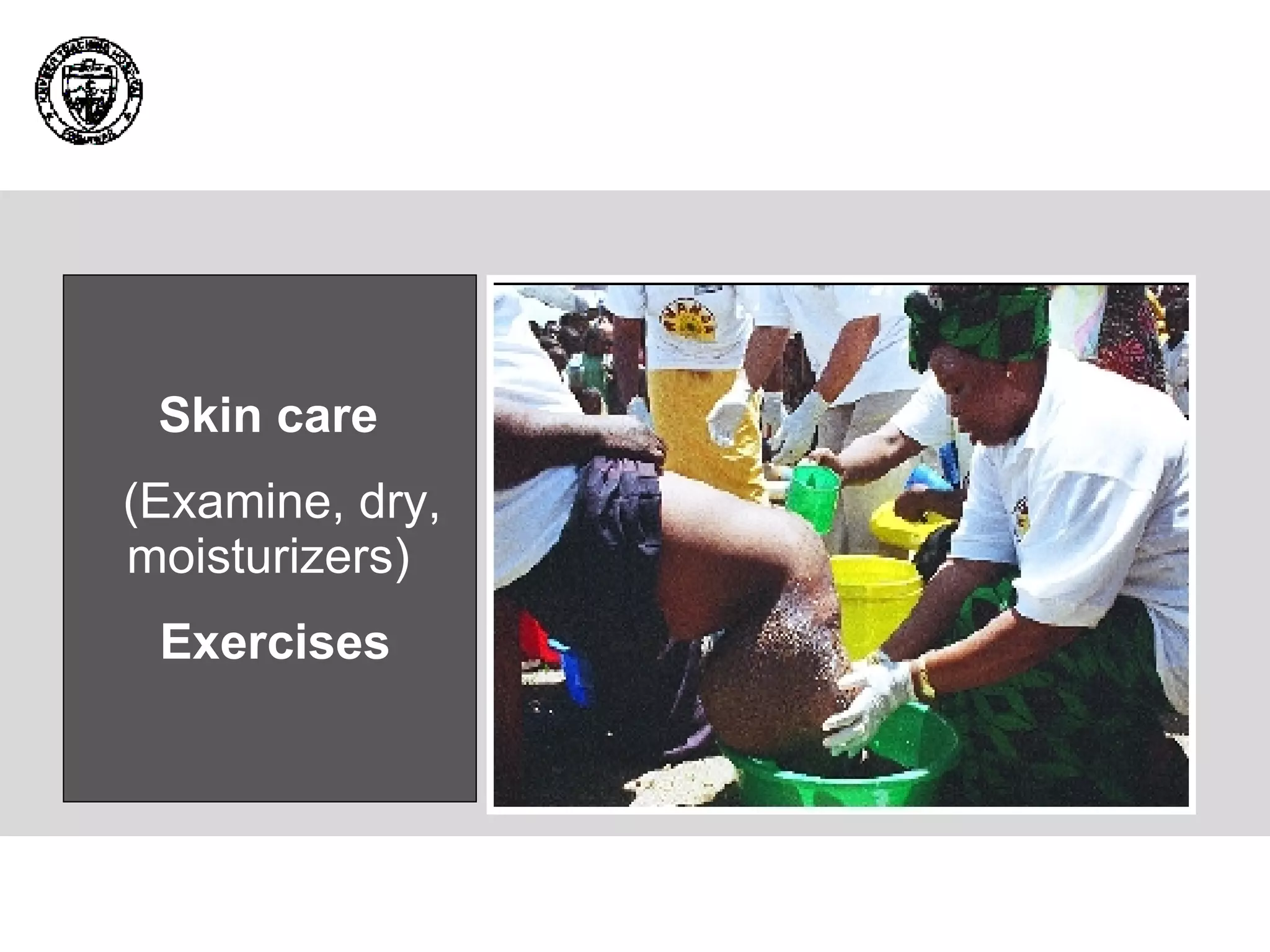
Skin care  (Examine, dry, moisturizers)  Exercises
Psychological support  & occupational therapy
Antiparasitic agents   Diethylecarbimazole 6mg/kg single dose or 1-3wk (Don’t use in pregnancy, infants, elderly) Ivermectin (400mcg/kg/d) Tetracycline  Doxycycline (100mg/day for 6-8 wks)
Antibiotic  For skin infections Penicillin V 500mg tds for streptococcal Flucloxacilline 250mg qid for staphylococcal Infections Miconazole 1% skin ointment Or systemic antifungal
Hydroxyrutosides/ coumadins   Binds wit proteins, engulfed by macrophages leading to proteolysis
Surgical Procedures for Lymphedema
Surgical Ablative/reduction Bypass surgeries
Ablative surgeries Sistrunk procedure Homan procedure Thompson procedure Charles procedure
Sistrunk Procedure (1918) Wedge of skin & subcutaneous tissue excised & wound closed primarily  Most commonly used to reduce girth of thigh
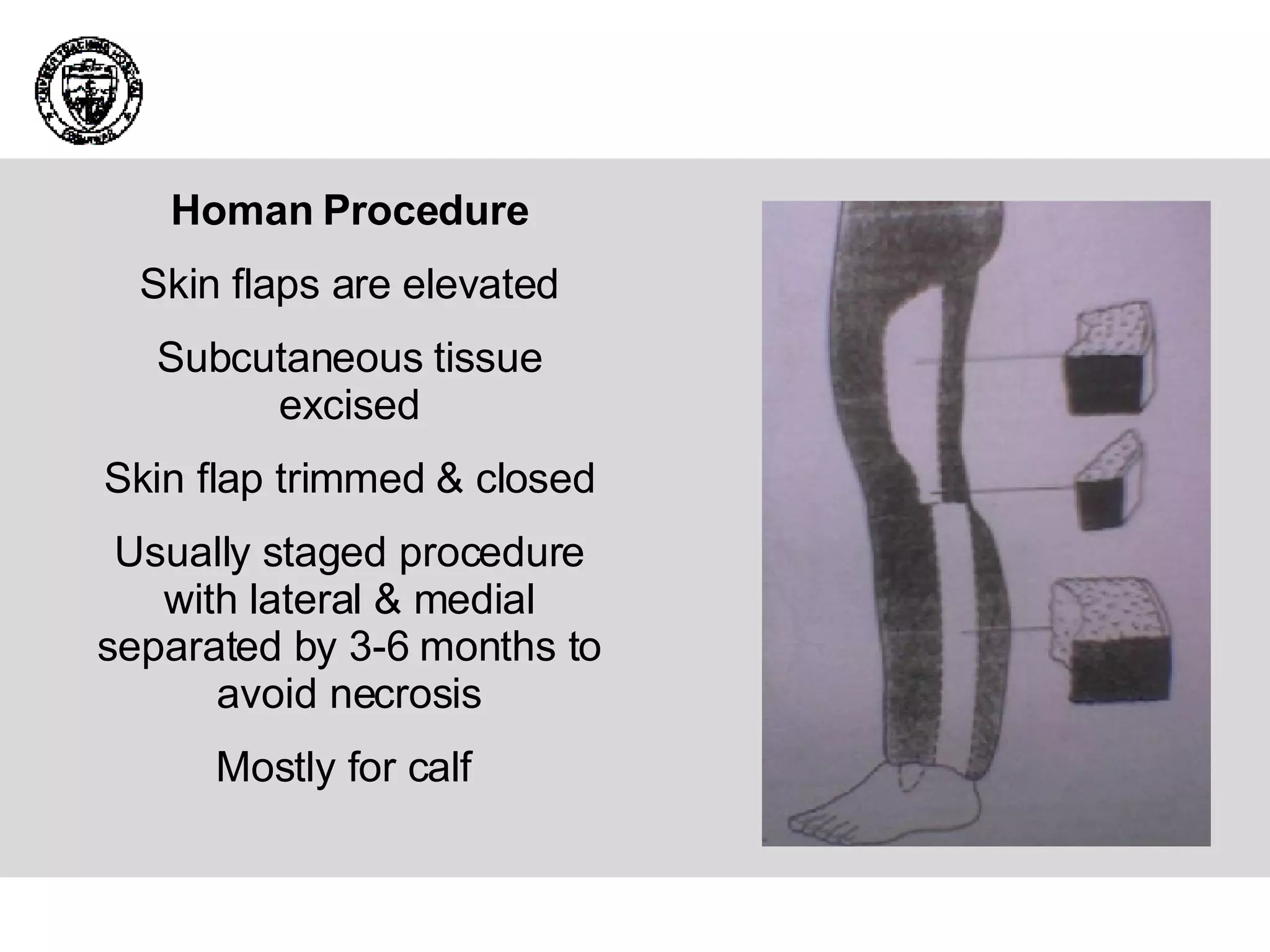
Homan Procedure Skin flaps are elevated Subcutaneous tissue excised Skin flap trimmed & closed Usually staged procedure with lateral & medial separated by 3-6 months to avoid necrosis Mostly for calf
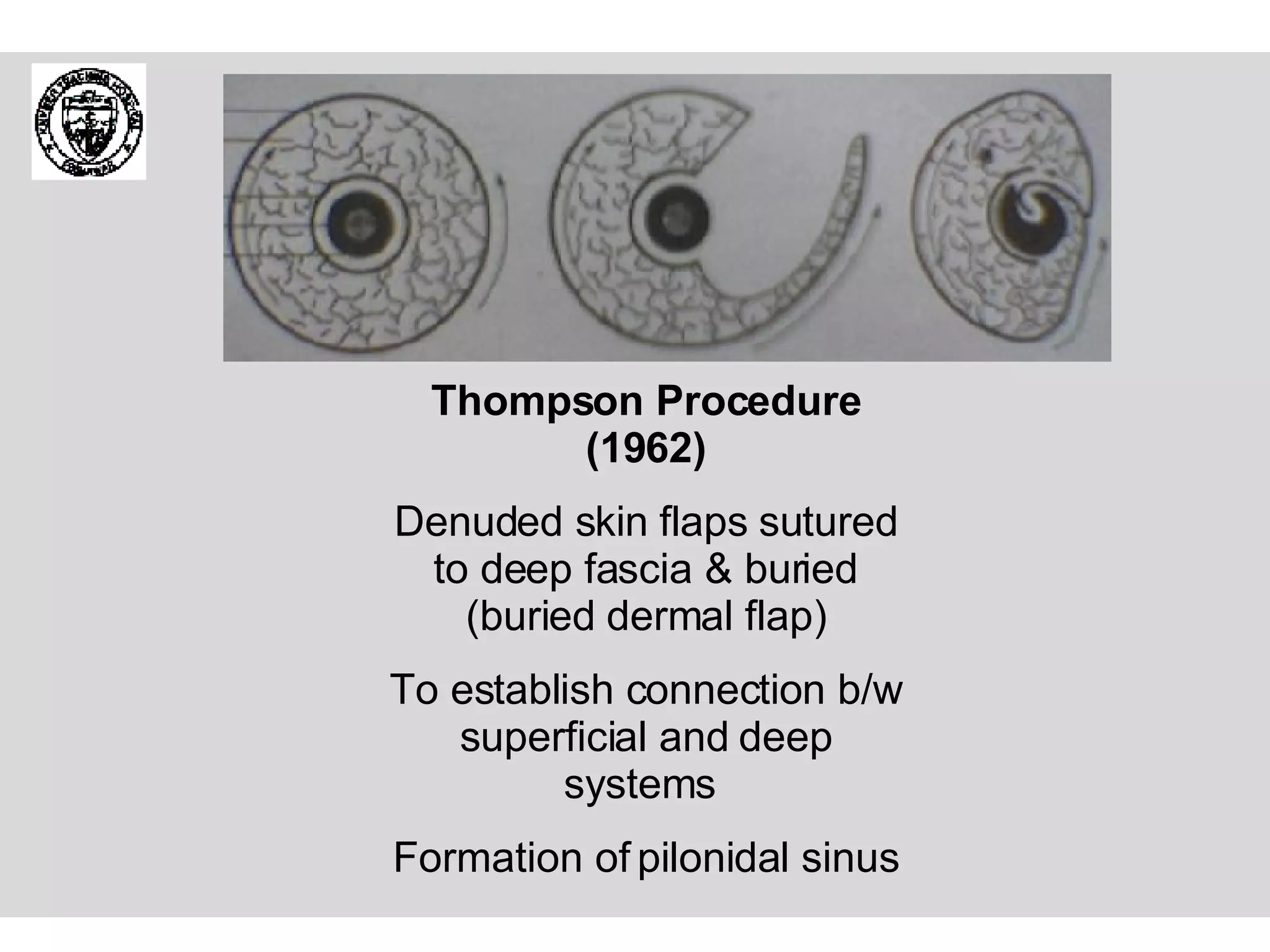
Thompson Procedure (1962) Denuded skin flaps sutured to deep fascia & buried (buried dermal flap) To establish connection b/w superficial and deep systems  Formation of pilonidal sinus
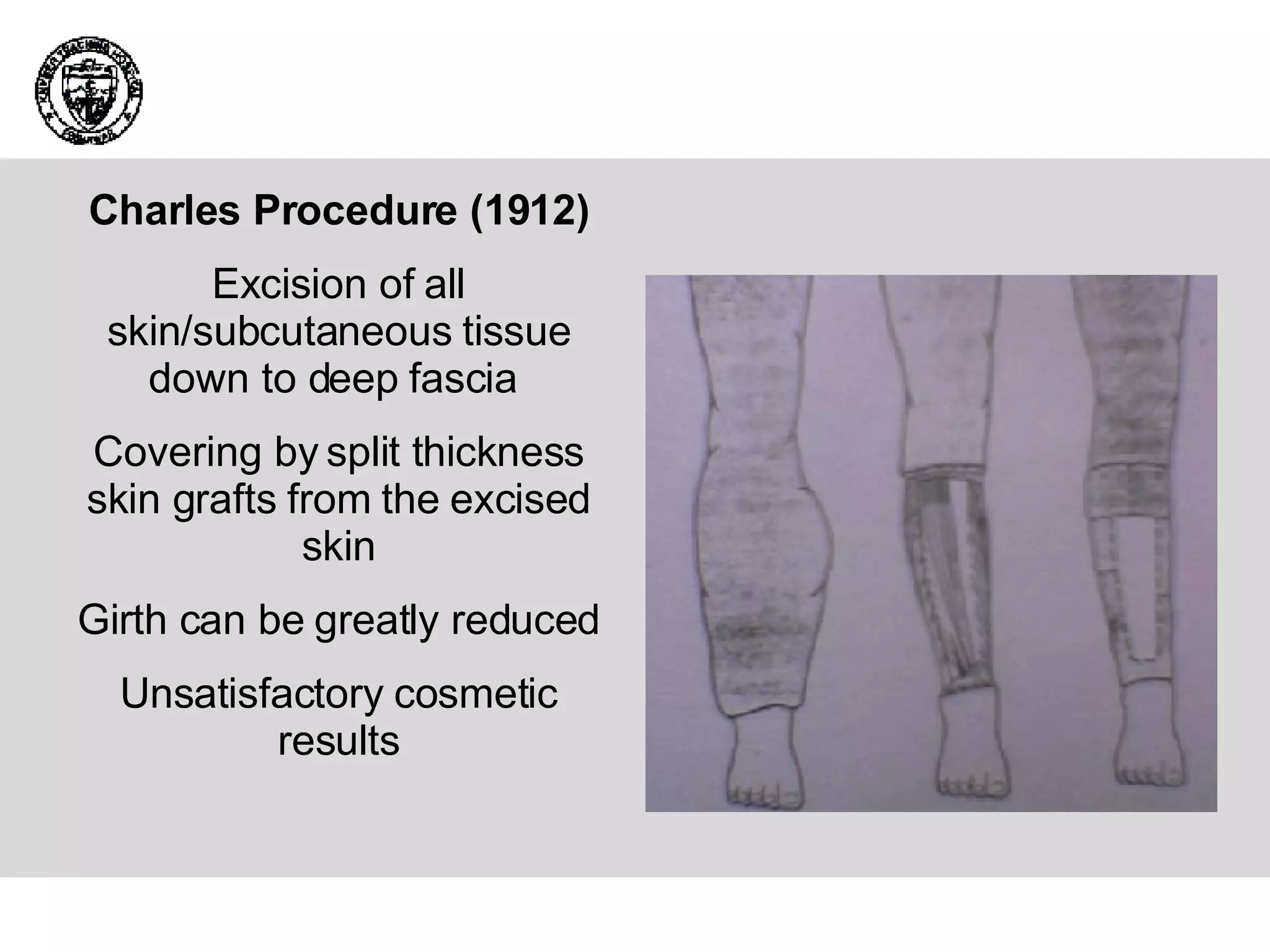
Charles Procedure (1912) Excision of all skin/subcutaneous tissue down to deep fascia  Covering by split thickness skin grafts from the excised skin Girth can be greatly reduced Unsatisfactory cosmetic results
Bypass surgeries Lymph node anastamosis with veins Lymphovenous anastamosis
 
 
Lymphedema
Thanks

Trends in the management of Lymphedema

  • 1.
    TRENDS inLmphedema Management Dr. Mansoor Khan MBBS, FCPS-I Surgical “D” unit, Khyber Teaching Hospital, Peshawar
  • 2.
  • 3.
  • 4.
    “ Accumulation ofabnormal amount of protein rich fluid in the interstitium due to compromised lymphatic system with (near) normal net capillary filtration ”
  • 5.
    In United States Highest incidence is observed following breast cancer surgery with radiotherapy (10 – 40%).
  • 6.
    Worldwide 140-250 million cases of lymphedema are estimated to exist with filariasis as the most common cause
  • 7.
    Lymphatic filariasis affects more than 90 million people in the world
  • 8.
    According to WHOLymphatic Filariasis is the 2 nd leading cause of permanent & long term disability in the world after leprosy
  • 9.
  • 10.
    Develops from 4primitive cystic spaces, 2 in the neck and 2 in the groin Cisterns elongate & develop communications Condensations along the connections are lymph nodes * Persistence of primitive cisterns are cystic hygromas Embryology of lymphatic system
  • 11.
  • 12.
    Lymphatic capillaries Blindended Large intercellular & intracellular fenestrations Allowing macromolecular influx (1000 kDa) Collagen fibers attachment on outer surface Dermal papillae Micronatomy of lymphatic system
  • 13.
    Sub papillary pre-collectors Sub-dermal collector lymphatics Epifacial, valved, muscular lymphatics with lymphangions Subfascial lymphatics Interconnections at inguinal, anticubital, axillary levels Microanatomy of lymphatic system
  • 14.
    Capillaries Pre-collectors Collectors Deep lymphatic trunk
  • 15.
  • 16.
  • 17.
  • 18.
  • 19.
    Pathophysiology Collagen deposition lymphostasis Obstruction Aplasia hypoplasia Hypocon- tractility Valvular incompetence Dermal thickening Sub dermal fibrosis LYMPH- EDEMA
  • 20.
    Etiology of lymphedemaLYMPHEDEMA Primary lymphedema Secondary lymphedema Congenital Praecox Tarda
  • 21.
  • 22.
    Congenital lymphedema <1year of age 10-25% of all primary lymphedema Sporadic or familial (Milroy's disease) More common in males Lower extremity is involved 3 times more frequently than the upper extremity 2/3 patients have bilateral lymphedema Aplasia pattern without subcutaneous lymphatic trunks involvement
  • 23.
    Evident after birthand before age 35 years Most often arises during puberty 65-80% of all primary lymphedema cases Females are affected 4 times 70% of cases are unilateral , with the left lower extremity being involved Hypoplastic pattern , with the lymphatics reduced in caliber and number Lymphedema Precox
  • 24.
    Clinically not evidentuntil 35 years or older Rarest form of primary lymphedema Only 10% of cases Hyperplasic pattern , with tortuous lymphatics increased in caliber and number Absent or incompetent valves Lymphedema Tarda (Meige disease )
  • 25.
    Secondary Lymphedema Most common lymphedema having well recognized causes
  • 26.
    Filariasis Commonestcause worldwide Endemic in 72 countries Affecting 5-10% population Africa, India, South America
  • 27.
    Endemic areas ofFilariasis
  • 28.
    Filariasis Wuchereria Bancrofti (90%) Brugia malayi Brugia timori
  • 29.
  • 30.
  • 31.
  • 32.
    Other causes ofSecondary Lymphedema Breast surgery with radiotherapy Primary malignancy Prostate, cervical cancer, malignant melanoma Trauma to lymphatics Surgical excision of lymph nodes
  • 33.
    Presentation of lymphedemaAge of onset Painless swelling Presence or absence of family history Coexistent pathology
  • 34.
    Presentation of lymphedemaCharacteristically foot involvement Ankle contours are lost with infilling of the submalleolar depressions Buffalo hump on foot dorsum Square shaped toes Stemmer’s sign
  • 35.
    Skin changes Chroniceczema Dermatophytosis Fissuring Verrucae Ulcerations Stewart Treves syndrome
  • 36.
    Presentation of lymphedemaChyluria, chylous ascites, chylothorax, Lymphorrhoea MEGALYMPHATICS
  • 37.
  • 38.
    Brunner Classification 0 Histological abnormalities Not clinical evident I Pitting edema, Subsides with elevation II Non pitting edema Not relieved with elevation III Irreversible skin changes, fibrosis, papillae
  • 39.
  • 40.
    Investigations Infrequently requiredto establish the diagnosis To determine residual lymphatic function To establish treatment preferences To evaluate therapy
  • 41.
    Contrast Lymphangiography Wasgold standard for mapping Damages the normal lymphatic channels due to inflammation Very painful procedure and needs GA
  • 42.
  • 43.
  • 44.
    Isotope Lymphoscintigraphy Replacedthe earlier Technetium labeled antimony sulphide
  • 45.
    Dye needs tobe injected in toe web through a 27 G needle
  • 46.
  • 47.
    An indication forCT scan or MRI is suspicion of malignancy, for which these tests offer the most information MRI Scan
  • 48.
  • 49.
  • 50.
    Adult worms inlymph nodes
  • 51.
    Others Eosinophilia Increased IgE levels Compliment fixation test Antigens of filaria
  • 52.
  • 53.
  • 54.
  • 55.
    Complex Lymphedema Therapy(CLT) Manual lymphatic drainage (MLD) * (massage to make the flow to normal lymphatics) Low stretch bandaging (to prevent re-accumulation) *Vodder and/or Leduc techniques
  • 56.
  • 57.
    Intermittent pneumatic pumpcompression therapy Effectively milking the lymph from the extremity Compression garment To help prevent return of fluid
  • 58.
    Skin care (Examine, dry, moisturizers) Exercises
  • 59.
    Psychological support & occupational therapy
  • 60.
    Antiparasitic agents Diethylecarbimazole 6mg/kg single dose or 1-3wk (Don’t use in pregnancy, infants, elderly) Ivermectin (400mcg/kg/d) Tetracycline Doxycycline (100mg/day for 6-8 wks)
  • 61.
    Antibiotic Forskin infections Penicillin V 500mg tds for streptococcal Flucloxacilline 250mg qid for staphylococcal Infections Miconazole 1% skin ointment Or systemic antifungal
  • 62.
    Hydroxyrutosides/ coumadins Binds wit proteins, engulfed by macrophages leading to proteolysis
  • 63.
  • 64.
  • 65.
    Ablative surgeries Sistrunkprocedure Homan procedure Thompson procedure Charles procedure
  • 66.
    Sistrunk Procedure (1918)Wedge of skin & subcutaneous tissue excised & wound closed primarily Most commonly used to reduce girth of thigh
  • 67.
    Homan Procedure Skinflaps are elevated Subcutaneous tissue excised Skin flap trimmed & closed Usually staged procedure with lateral & medial separated by 3-6 months to avoid necrosis Mostly for calf
  • 68.
    Thompson Procedure (1962)Denuded skin flaps sutured to deep fascia & buried (buried dermal flap) To establish connection b/w superficial and deep systems Formation of pilonidal sinus
  • 69.
    Charles Procedure (1912)Excision of all skin/subcutaneous tissue down to deep fascia Covering by split thickness skin grafts from the excised skin Girth can be greatly reduced Unsatisfactory cosmetic results
  • 70.
    Bypass surgeries Lymphnode anastamosis with veins Lymphovenous anastamosis
  • 71.
  • 72.
  • 73.
  • 74.