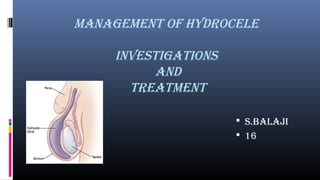
ManageMent of hydrocele 
investigations 
and 
treatMent 
 s.balaji 
 16
• Blood-examination : 
- general investigations like Hb, TLC ,DLC 
- eosinophilia and microfilaria- filariasis 
- lymphocytosis and increased ESR- epididymo - orchitis 
• Urine examination : 
- routine : urea ,uric acid ,creatinine 
-passage of infected urine and presence of E.coli, streptococcus, 
staphylococcus-acute epididymitis 
- tuberculosis bacilli may be seen in urine in tuberculous epididymitis 
• Chest X ray : 
-is an important part of investigation in tuberculous epididymo orchitis to 
exclude presence of pulmonary tuberculosis 
-secondary deposits may be seen un testicular tumors particularly teratomas
• Ultrasonography: 
- helpful to know the position of the testis, also to know whether 
they are normal or not. this investigation is helpful in hydrocele, haematocele, 
secondary hydrocele, torsion of testis. 
• Aspiration : 
- Milky fluid- spermatocele 
- Clear fluid- cyst of epididymis 
- In hydrocele an amber colour fluid may be obtained whose specific 
gravity remains in the range of 1.022 to 1.024 ,it may contain water, inorganic 
salts, cholesterol, fibrinogen, 6% of albumin 
In secondary hydrocele from testicular tumour the fluid will be blood 
stained.To facilitate better palpation of testis and epididymis fluid should be 
aspirated out in case of secondary hydrocele
Surgical procedure : 
 Indication for surgery : 
Vaginal hydrocele 
Infantile and funicular hydrocele are also treated 
surgically in the same manner 
 Contraindication : 
Secondary hydrocele due to testicular tumors 
 Position of the patient : supine 
 Anaesthesia : general anaesthesia, surface anaesthesia 
 Preparation of parts : savlon and spirit
procedure of the Surgery : 
• Incision :Hydrocele is held tense by an assistant and 5-6 cm 
incision <depending upon size > is made over the most prominent 
part of the swelling parallel to the median raphe of the scrotum 
• Layers opened :skin, dartos, external spermatic fascia , 
cremasteric fascia , internal spermatic fascia 
• at this stage hydrocele sac is visible and is delivered outside the 
incision 
• Hydrocele fluid is drained by using trocar and cannula 
• An opening is made in the tunica vaginalis sac and it is enlarged ,all 
fluid is drained out. Testis and epididymis are inspected for any 
pathology
typeS of Surgery : 
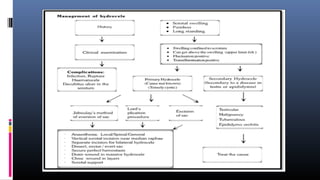
• Depending on the size of the hydrocele and thickness of the wall of the 
sac ,two types of surgery can be done , 
a)Small tunica vaginaliS Sac (tv) : 
The sac is opened and the cut edge of sac is plicated to tunica 
albuginea .The redundant tunica vaginalis is plicated by interrupted 
sutures 
The sac gets crumpled up and surrounds the testis .This is called 
lord’s plication. The secretions get absorbed by lymphatics and 
venous system 
B) Sac iS large and thick : 
Partial excision and eversion of sac is ideal treatment .In this 
operation ,after excision of the sac ,cut edge of the sac is everted and 
sutured behind the testis .this is called jaboulay’s operation
• By eversion of the sac ,the secreting surface of the testis 
becomes anterior and secretions are absorbed by 
subcutaneous lymphatics. 
Closure : 
-a corrugated plastic drain is kept in the scrotum and brought out 
separately by making a stab incision and is anchored to the 
scrotal skin by white thread 
- Subcutaneous layer by using 2-0 chromic catgut 
- Skin –interrupted thread(white)/catgut .absorbable sutures 
such as catgut or vicryl can also be used 
- Scrotal support is given to reduce oedema
PostoPerative 
management • Npo for 6 hours followed by soft diet 
• Antibiotics and analgesics 
• Suture removal after 7-8 days 
PostoPerative comPlications : 
-- haematoma : if large and increasing in size ,wound should be reopened 
urgently and bleeders have to be ligated . It may be due to injury of 
testicular artery ,vein or pampiniform plexus of veins 
-- wound infection can result in pyelocele 
--Injury to the spermatic cord 
Advice at discharge : rest for about a week
comPlications of hydrocele : 
 Haematoma : due to minor trauma 
 Pyelocele :infected haematocele 
 Calcification of the sac wall 
 Rupture of hydrocele sac : traumatic or spontaneous 
 Hernia of the hydrocele sac : in long standing cases when 
tension of the fluid within tubica causes herniation through 
dartos muscle
Differential diagnosis 
• acute epididymo orchitis 
• Tuberculosis epididymo orchitis 
• Syphilitic orchitis 
• Subacute epididymo orchitis(filarial) 
• Lymph varix 
• Lymph scrotum 
• Chylocele 
• Elephantiasis of the scotum 
• Extravasation of urine
• Torsion of the testis 
• Tumors of testis 
- seminoma 
- teratoma 
• Cysts 
- cysts of epididymitis 
- spermatocele 
- cysts of an appendage of the testis 
• Fournier’s gangrene
Hydrocele management

Hydrocele management

  • 1.
    ManageMent of hydrocele investigations and treatMent  s.balaji  16
  • 2.
    • Blood-examination : - general investigations like Hb, TLC ,DLC - eosinophilia and microfilaria- filariasis - lymphocytosis and increased ESR- epididymo - orchitis • Urine examination : - routine : urea ,uric acid ,creatinine -passage of infected urine and presence of E.coli, streptococcus, staphylococcus-acute epididymitis - tuberculosis bacilli may be seen in urine in tuberculous epididymitis • Chest X ray : -is an important part of investigation in tuberculous epididymo orchitis to exclude presence of pulmonary tuberculosis -secondary deposits may be seen un testicular tumors particularly teratomas
  • 3.
    • Ultrasonography: -helpful to know the position of the testis, also to know whether they are normal or not. this investigation is helpful in hydrocele, haematocele, secondary hydrocele, torsion of testis. • Aspiration : - Milky fluid- spermatocele - Clear fluid- cyst of epididymis - In hydrocele an amber colour fluid may be obtained whose specific gravity remains in the range of 1.022 to 1.024 ,it may contain water, inorganic salts, cholesterol, fibrinogen, 6% of albumin In secondary hydrocele from testicular tumour the fluid will be blood stained.To facilitate better palpation of testis and epididymis fluid should be aspirated out in case of secondary hydrocele
  • 5.
    Surgical procedure :  Indication for surgery : Vaginal hydrocele Infantile and funicular hydrocele are also treated surgically in the same manner  Contraindication : Secondary hydrocele due to testicular tumors  Position of the patient : supine  Anaesthesia : general anaesthesia, surface anaesthesia  Preparation of parts : savlon and spirit
  • 6.
    procedure of theSurgery : • Incision :Hydrocele is held tense by an assistant and 5-6 cm incision <depending upon size > is made over the most prominent part of the swelling parallel to the median raphe of the scrotum • Layers opened :skin, dartos, external spermatic fascia , cremasteric fascia , internal spermatic fascia • at this stage hydrocele sac is visible and is delivered outside the incision • Hydrocele fluid is drained by using trocar and cannula • An opening is made in the tunica vaginalis sac and it is enlarged ,all fluid is drained out. Testis and epididymis are inspected for any pathology
  • 7.
    typeS of Surgery: • Depending on the size of the hydrocele and thickness of the wall of the sac ,two types of surgery can be done , a)Small tunica vaginaliS Sac (tv) : The sac is opened and the cut edge of sac is plicated to tunica albuginea .The redundant tunica vaginalis is plicated by interrupted sutures The sac gets crumpled up and surrounds the testis .This is called lord’s plication. The secretions get absorbed by lymphatics and venous system B) Sac iS large and thick : Partial excision and eversion of sac is ideal treatment .In this operation ,after excision of the sac ,cut edge of the sac is everted and sutured behind the testis .this is called jaboulay’s operation
  • 8.
    • By eversionof the sac ,the secreting surface of the testis becomes anterior and secretions are absorbed by subcutaneous lymphatics. Closure : -a corrugated plastic drain is kept in the scrotum and brought out separately by making a stab incision and is anchored to the scrotal skin by white thread - Subcutaneous layer by using 2-0 chromic catgut - Skin –interrupted thread(white)/catgut .absorbable sutures such as catgut or vicryl can also be used - Scrotal support is given to reduce oedema
  • 9.
    PostoPerative management •Npo for 6 hours followed by soft diet • Antibiotics and analgesics • Suture removal after 7-8 days PostoPerative comPlications : -- haematoma : if large and increasing in size ,wound should be reopened urgently and bleeders have to be ligated . It may be due to injury of testicular artery ,vein or pampiniform plexus of veins -- wound infection can result in pyelocele --Injury to the spermatic cord Advice at discharge : rest for about a week
  • 11.
    comPlications of hydrocele:  Haematoma : due to minor trauma  Pyelocele :infected haematocele  Calcification of the sac wall  Rupture of hydrocele sac : traumatic or spontaneous  Hernia of the hydrocele sac : in long standing cases when tension of the fluid within tubica causes herniation through dartos muscle
  • 12.
    Differential diagnosis •acute epididymo orchitis • Tuberculosis epididymo orchitis • Syphilitic orchitis • Subacute epididymo orchitis(filarial) • Lymph varix • Lymph scrotum • Chylocele • Elephantiasis of the scotum • Extravasation of urine
  • 13.
    • Torsion ofthe testis • Tumors of testis - seminoma - teratoma • Cysts - cysts of epididymitis - spermatocele - cysts of an appendage of the testis • Fournier’s gangrene