Examining The Acute
Abdomen
in the Adult
Guy R. Nicastri, MD, FACS
Associate Professor of Surgery and Family Medicine
Warren Alpert Medical School of Brown University
Overview
 Definition
 Pathophysiology
 Review Abdominal Exam
 Organize a “work-up”
 Specific diseases
Definition of
Acute Abdomen
 Sudden onset, usually <24 hours
 Severe pain
 Requires urgent decision/diagnosis
 Treatment often surgical
Abdominal Pain
 10% of ER visits or admitted patients
 40% discharged from ER with “pain of
unknown etiology”
 60% discharged from ER have wrong
diagnosis
 The older the patient, the less accurate the
diagnosis
Pathophysiology of Abdominal Pain
 Somatic pain
 Nociceptors in skin, ligaments, deep tissues, muscles,
bones, or joints (body wall)
 Well localized
 Visceral pain
 Nociceptors in internal organs
 Poorly localized
 Referred pain
 Pain sensed at a considerable distance from source
What’s Needed?
What’s NOT?
A Good History is Essential!!
 When
 Where
 How
 Associated symptoms
 Recurring
 Previous surgery
 Other medical conditions
History
 Description of pain
 Associated symptoms
 Gynecologic/GU history
 Past medical history
 Family, social history
Description of Pain
The abdominal pain checklist
Onset and duration
Character and severity
Location and radiation
What makes it better
What makes it worse
Progression of pain
Associated symptoms
Associated Symptoms
 Nausea, vomiting
 Fever, chills
 Anorexia, weight loss
 Food intolerance
 Pulmonary symptoms
 Change in bowel habits
 GU complaints
Gynecologic / GU History
 Last menses
 Contraception
 Sexual history
 Obstetric history
 Vaginal discharge, bleeding
 Previous STDs
 Urinary symptoms
Past Medical History
 Cardiac or pulmonary disorders
 GI, vascular diseases
 Diabetes, HIV
 Medications
 Recent invasive procedures
 Trauma
 Recent URI or strep throat
Family & Social History
 Inflammatory bowel disease
 Connective tissue disorders
 Bleeding diatheses
 Cancer
 Recent travel
 Environmental hazards
 Drugs, alcohol
Physical Examination
 General appearance
 Chest
 Abdomen
 Rectal
 Pelvic
 GU
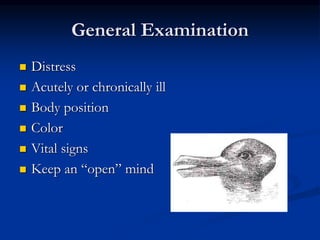
General Examination
 Distress
 Acutely or chronically ill
 Body position
 Color
 Vital signs
 Keep an “open” mind
General Impression Matters
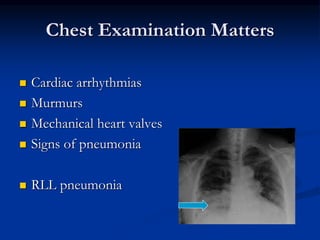
Chest Examination Matters
 Cardiac arrhythmias
 Murmurs
 Mechanical heart valves
 Signs of pneumonia
 RLL pneumonia
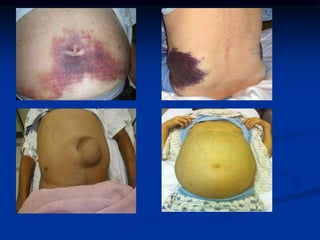
Abdominal Exam - LOOK
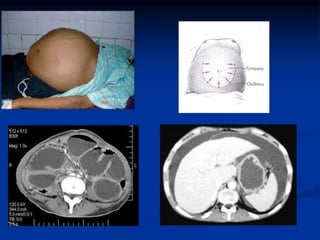
 Distention
 Breathing pattern, patient movement
 Discoloration
 Cullen’s sign
 Grey Turner’s sign
 Scars, hernia
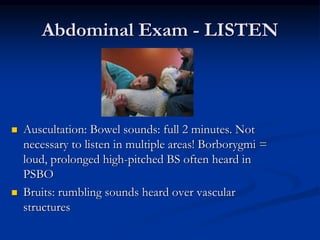
Abdominal Exam - LISTEN
 Auscultation: Bowel sounds: full 2 minutes. Not
necessary to listen in multiple areas! Borborygmi =
loud, prolonged high-pitched BS often heard in
PSBO
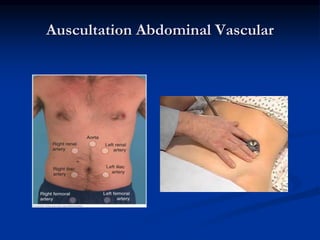
 Bruits: rumbling sounds heard over vascular
structures
Auscultation Abdominal Vascular
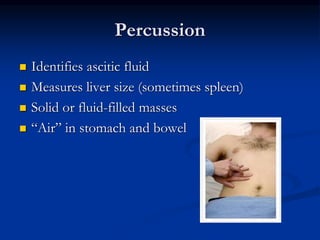
Percussion
 Identifies ascitic fluid
 Measures liver size (sometimes spleen)
 Solid or fluid-filled masses
 “Air” in stomach and bowel
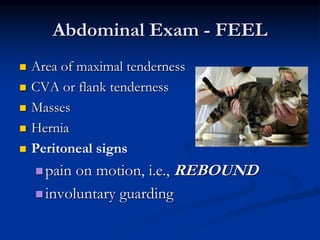
Abdominal Exam - FEEL
 Area of maximal tenderness
 CVA or flank tenderness
 Masses
 Hernia
 Peritoneal signs
pain on motion, i.e., REBOUND
involuntary guarding
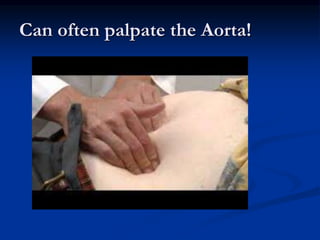
Can often palpate the Aorta!
Peritoneal Signs
 Very worrisome finding
 “rebound” tenderness local vs diffuse
 Often will mean surgery
 …but not always
 Pancreatitis, localized diverticulitis,
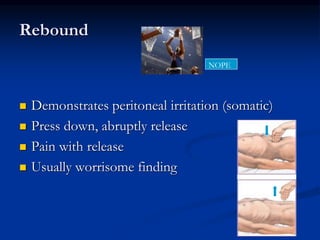
Rebound
 Demonstrates peritoneal irritation (somatic)
 Press down, abruptly release
 Pain with release
 Usually worrisome finding
NOPE
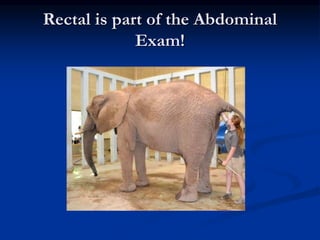
Rectal is part of the Abdominal
Exam!
Digital Rectal Exam
 Only rarely should be omitted, integral part of
abdominal exam
 Valuable information:
 Perianal lesions, fistulas, abscesses, hemorrhoids
 Anal canal masses, fissures, tenderness,
induration, sphincter tone
 Presence of stool, occult/frank blood
 Males, evaluate prostate
Pelvic Exam
 Extremely important
 Have a female chaperone present
 Assess external anatomy
 Speculum and bimanual exam
 Can perform swabbing if indicated
 Note position of uterus, cervical motion
tenderness, adnexal masses or tenderness
Ancillary Tests: Basic
 CBC
 Amylase, lipase
 Urine Analysis
 Pregnancy test
 Liver tests (AST, ALT, Alk Phos, T Bili)
 EKG
 Chest x-ray, abdominal films
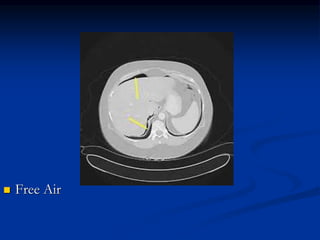
 Free Air
Ancillary Tests: Complex
 Ultrasound (US)
 Computed tomography (CT)
 Angiography (rare)
 Nuclear Medicine (HIDA)
 Laparoscopy, especially in young women
 Barium enema or endoscopy never with
peritonitis
Common Causes
of Acute Abdomen
 Appendicitis
 Cholecystitis
 Perforated bowel
 Perforated ulcer
 Ectopic pregnancy
 PID / TOA
 Mesenteric ischemia
 IBD
 Gastroenteritis
 Nephrolithiasis
 Pancreatitis
 Diverticulitis
 Bowel obstruction
Putting it all together…
 See the patient: Get a general impression
 Take a detailed history: likely will steer you in
the ‘right” direction
 Exam: should further define your differential
 Ancillary testing: even more data
 Diagnosis
 Treatment
Appendicitis
 Most common cause of abd pain requiring
surgery
 300,000 appendectomies annually in U.S.
 History: usually less then 48 hours
 Remains a clinical diagnosis
 Dangerous in the very young and very old
Appendicitis
 History: periumbilical cramping pain migrating to
RLQ; anorexia, nausea,+/- vomiting
 Exam: tenderness in RLQ and on rectal/pelvic exam
 Often note “low-grade” fevers (<102)
 Slight leukocytosis (WBC in “teens”)
 US helpful in infants and females
 CT in many cases confirms clinical diagnosis
 Laparoscopy a reasonable option in equivacal cases
Abdominal Exam
 McBurney’s point tenderness
 Rovsing’s sign
 Psoas sign
 Obturator sign
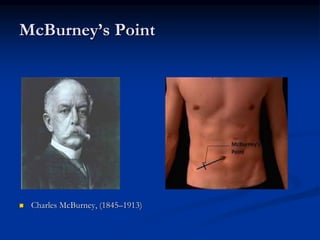
McBurney’s Point
 Charles McBurney, (1845–1913)
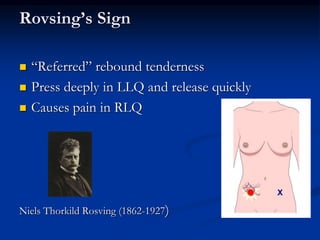
Rovsing’s Sign
 “Referred” rebound tenderness
 Press deeply in LLQ and release quickly
 Causes pain in RLQ
Niels Thorkild Rosving (1862-1927)
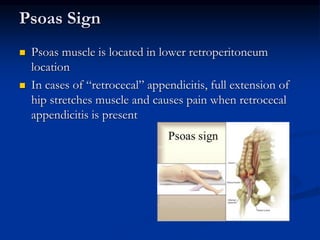
Psoas Sign
 Psoas muscle is located in lower retroperitoneum
location
 In cases of “retrocecal” appendicitis, full extension of
hip stretches muscle and causes pain when retrocecal
appendicitis is present
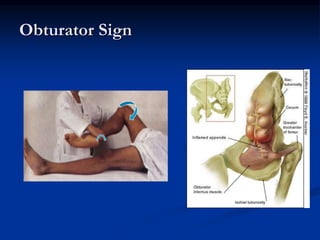
Obturator Sign
 Flex knee and hip to ninety degrees
 Rotate hip by moving ankle away from the
body while allowing the knee to move only
inward
 Inflamed appendix in contact with the obturator
internus muscle ‘stretches” with this maneuver
causing pain
Obturator Sign
Cholecystitis vs Biliary Colic
 History: severe epigastric/RUQ pain, typically
2-4 hours after eating
 Exam: RUQ tenderness, + Murphy’s sign
 Elevated WBC vs normal
 Elevated LFT’s vs normal
 US: thickened GB wall, pericholecystic fluid,
gallstones vs gallstones only
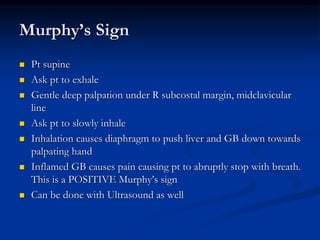
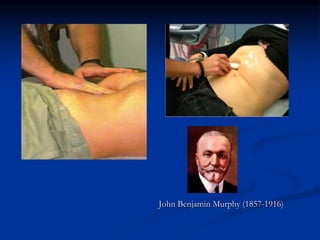
Murphy’s Sign
 Pt supine
 Ask pt to exhale
 Gentle deep palpation under R subcostal margin, midclavicular
line
 Ask pt to slowly inhale
 Inhalation causes diaphragm to push liver and GB down towards
palpating hand
 Inflamed GB causes pain causing pt to abruptly stop with breath.
This is a POSITIVE Murphy’s sign
 Can be done with Ultrasound as well
John Benjamin Murphy (1857-1916)
inflamed
Small Bowel Obstruction
 History of previous abdominal operation most
common cause. Adhesions etiology in these
cases.
 Hernia: Abdominal wall vs internal
 Triad of diagnostic symptoms
 cramping abdominal pain
 vomiting
 obstipation
Bowel Obstruction
 Determining ‘partial” from complete very
important
 Peritoneal signs, high WBC (usually >20,000),
fevers, “toxic” appearance all worrisome
 75% of PSBO pts with adhesions from prior
surgery as etiology will resolve without need for
surgery
Small Bowel Obstruction
 Radiographic findings
 Air-fluid levels with “J” loops
 Absence of air in colon
 Quartet of physical findings
 Distention
 Early: little or no tenderness
 Late: tenderness and guarding
 Borborygmi
SBO: Upright and “flat-plate” x-rays
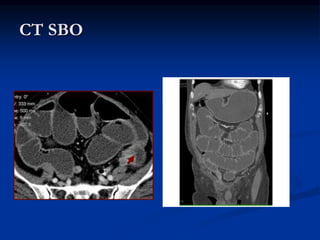
CT SBO
Perforated Peptic Ulcer
 History: PUD, NSAIDS, steroids, critical illness
 Exam: Severe tenderness, generalized rebound
 Tympanic on percussion
 Free air seen on plain radiographs or CT
 Mostly treated surgically
Diverticulitis
 History: constipation, LLQ pain, fever, diarrhea
 Exam: LLQ tenderness, local rebound not
uncommon, mass sometimes palpable
 Laboratory tests
Pyuria, WBC elevated
CT - up to 93% sensitivity
Pancreatitis
 History: gallstones, alcohol, medications
 Severe epigastric pain radiating to the back, +/-
nausea, vomiting
 Exam: generalized upper abdominal tenderness,
most marked in epigastrium, +/- rebound
 Increased amylase and lipase values common
 Elevated WBC and fever common
CT Pancreas
Normal Acute pancreatitis
Ureterolithiasis
 History: flank pain, hematuria, radiation to
groin, previous attacks
 Exam: restless; no abdominal tenderness, flank
tenderness
 Urinalysis: RBCs, crystals
 CT, IVP and US useful
Inflammatory Bowel Disease
 History: intermittent cramping abdominal pain,
diarrhea, low grade fever, weight loss
 Exam: localized abdominal tenderness, + stool
for blood
 CT and Barium studies helpful
 Endoscopy
Ectopic Pregnancy
 History: menstrual irregularities, + sexual
history, symptoms of early pregnancy
 Exam: adnexal mass on pelvic; may have
hypotension and tachycardia
 Pregnancy test +
 US and laparoscopy diagnostic
PID / TOA
 History: premenopausal woman, midcycle,
previous STD, vaginal discharge, dysuria, Kehr’s
sign
 Exam: cervical motion tenderness, adnexal
mass
 Pyuria
 US useful to diagnose
Gastroenteritis
 History: diarrhea, vomiting, crampy pain
 Exam: no localizing peritoneal signs
 Normal WBC common
Mesenteric Ischemia / Infarction
 History: intestinal angina, arrhythmias, low
flow, hypercoagulable state
 Exam: pain out of proportion to findings!!!
 WBC and amylase elevated
 Acidosis, stool + for blood
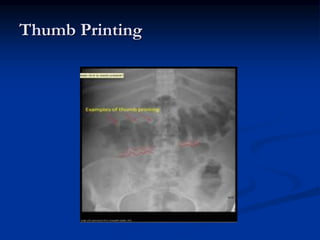
 “Thumb printing” on plain film
 CT replacing angiography
 High Index Of Suspicion a Must!
Thumb Printing
Other Causes of Acute Abdomen
 Volvulus
 Cholangitis
 Pneumonia
 Acute M I
 Ovarian torsion / cyst
 Hepatitis
 Sickle cell disease
 Diabetic ketoacidosis
 Uremia
 Porphyria
 Intussusception
 Lupus
 HIV intestinal disease
Pitfalls
 Old age, infants
 Spinal cord injury
 HIV
 Steroids
“Very young? Very old? Very odd?
Be very careful.”
F.T. de Dombal, MA, MD
Summary
 Abrupt onset of severe abdominal pain is
of unclear etiology in many cases is a
medical emergency, requiring urgent and
specific diagnosis.
Summary
 History and physical examination much more
important than laboratory tests
 Making the management decision is more
important than making the diagnosis
 Treatment is often surgical
Examining the Acute Abdomen

Examining the Acute Abdomen

  • 1.
    Examining The Acute Abdomen inthe Adult Guy R. Nicastri, MD, FACS Associate Professor of Surgery and Family Medicine Warren Alpert Medical School of Brown University
  • 2.
    Overview  Definition  Pathophysiology Review Abdominal Exam  Organize a “work-up”  Specific diseases
  • 3.
    Definition of Acute Abdomen Sudden onset, usually <24 hours  Severe pain  Requires urgent decision/diagnosis  Treatment often surgical
  • 4.
    Abdominal Pain  10%of ER visits or admitted patients  40% discharged from ER with “pain of unknown etiology”  60% discharged from ER have wrong diagnosis  The older the patient, the less accurate the diagnosis
  • 5.
    Pathophysiology of AbdominalPain  Somatic pain  Nociceptors in skin, ligaments, deep tissues, muscles, bones, or joints (body wall)  Well localized  Visceral pain  Nociceptors in internal organs  Poorly localized  Referred pain  Pain sensed at a considerable distance from source
  • 6.
  • 7.
  • 8.
    A Good Historyis Essential!!  When  Where  How  Associated symptoms  Recurring  Previous surgery  Other medical conditions
  • 9.
    History  Description ofpain  Associated symptoms  Gynecologic/GU history  Past medical history  Family, social history
  • 10.
    Description of Pain Theabdominal pain checklist Onset and duration Character and severity Location and radiation What makes it better What makes it worse Progression of pain Associated symptoms
  • 11.
    Associated Symptoms  Nausea,vomiting  Fever, chills  Anorexia, weight loss  Food intolerance  Pulmonary symptoms  Change in bowel habits  GU complaints
  • 12.
    Gynecologic / GUHistory  Last menses  Contraception  Sexual history  Obstetric history  Vaginal discharge, bleeding  Previous STDs  Urinary symptoms
  • 13.
    Past Medical History Cardiac or pulmonary disorders  GI, vascular diseases  Diabetes, HIV  Medications  Recent invasive procedures  Trauma  Recent URI or strep throat
  • 14.
    Family & SocialHistory  Inflammatory bowel disease  Connective tissue disorders  Bleeding diatheses  Cancer  Recent travel  Environmental hazards  Drugs, alcohol
  • 15.
    Physical Examination  Generalappearance  Chest  Abdomen  Rectal  Pelvic  GU
  • 16.
    General Examination  Distress Acutely or chronically ill  Body position  Color  Vital signs  Keep an “open” mind
  • 17.
  • 18.
    Chest Examination Matters Cardiac arrhythmias  Murmurs  Mechanical heart valves  Signs of pneumonia  RLL pneumonia
  • 19.
    Abdominal Exam -LOOK  Distention  Breathing pattern, patient movement  Discoloration  Cullen’s sign  Grey Turner’s sign  Scars, hernia
  • 21.
    Abdominal Exam -LISTEN  Auscultation: Bowel sounds: full 2 minutes. Not necessary to listen in multiple areas! Borborygmi = loud, prolonged high-pitched BS often heard in PSBO  Bruits: rumbling sounds heard over vascular structures
  • 22.
  • 23.
    Percussion  Identifies asciticfluid  Measures liver size (sometimes spleen)  Solid or fluid-filled masses  “Air” in stomach and bowel
  • 25.
    Abdominal Exam -FEEL  Area of maximal tenderness  CVA or flank tenderness  Masses  Hernia  Peritoneal signs pain on motion, i.e., REBOUND involuntary guarding
  • 26.
  • 27.
    Peritoneal Signs  Veryworrisome finding  “rebound” tenderness local vs diffuse  Often will mean surgery  …but not always  Pancreatitis, localized diverticulitis,
  • 28.
    Rebound  Demonstrates peritonealirritation (somatic)  Press down, abruptly release  Pain with release  Usually worrisome finding NOPE
  • 29.
    Rectal is partof the Abdominal Exam!
  • 30.
    Digital Rectal Exam Only rarely should be omitted, integral part of abdominal exam  Valuable information:  Perianal lesions, fistulas, abscesses, hemorrhoids  Anal canal masses, fissures, tenderness, induration, sphincter tone  Presence of stool, occult/frank blood  Males, evaluate prostate
  • 31.
    Pelvic Exam  Extremelyimportant  Have a female chaperone present  Assess external anatomy  Speculum and bimanual exam  Can perform swabbing if indicated  Note position of uterus, cervical motion tenderness, adnexal masses or tenderness
  • 32.
    Ancillary Tests: Basic CBC  Amylase, lipase  Urine Analysis  Pregnancy test  Liver tests (AST, ALT, Alk Phos, T Bili)  EKG  Chest x-ray, abdominal films
  • 34.
  • 35.
    Ancillary Tests: Complex Ultrasound (US)  Computed tomography (CT)  Angiography (rare)  Nuclear Medicine (HIDA)  Laparoscopy, especially in young women  Barium enema or endoscopy never with peritonitis
  • 36.
    Common Causes of AcuteAbdomen  Appendicitis  Cholecystitis  Perforated bowel  Perforated ulcer  Ectopic pregnancy  PID / TOA  Mesenteric ischemia  IBD  Gastroenteritis  Nephrolithiasis  Pancreatitis  Diverticulitis  Bowel obstruction
  • 37.
    Putting it alltogether…  See the patient: Get a general impression  Take a detailed history: likely will steer you in the ‘right” direction  Exam: should further define your differential  Ancillary testing: even more data  Diagnosis  Treatment
  • 38.
    Appendicitis  Most commoncause of abd pain requiring surgery  300,000 appendectomies annually in U.S.  History: usually less then 48 hours  Remains a clinical diagnosis  Dangerous in the very young and very old
  • 39.
    Appendicitis  History: periumbilicalcramping pain migrating to RLQ; anorexia, nausea,+/- vomiting  Exam: tenderness in RLQ and on rectal/pelvic exam  Often note “low-grade” fevers (<102)  Slight leukocytosis (WBC in “teens”)  US helpful in infants and females  CT in many cases confirms clinical diagnosis  Laparoscopy a reasonable option in equivacal cases
  • 40.
    Abdominal Exam  McBurney’spoint tenderness  Rovsing’s sign  Psoas sign  Obturator sign
  • 41.
    McBurney’s Point  CharlesMcBurney, (1845–1913)
  • 42.
    Rovsing’s Sign  “Referred”rebound tenderness  Press deeply in LLQ and release quickly  Causes pain in RLQ Niels Thorkild Rosving (1862-1927)
  • 43.
    Psoas Sign  Psoasmuscle is located in lower retroperitoneum location  In cases of “retrocecal” appendicitis, full extension of hip stretches muscle and causes pain when retrocecal appendicitis is present
  • 44.
    Obturator Sign  Flexknee and hip to ninety degrees  Rotate hip by moving ankle away from the body while allowing the knee to move only inward  Inflamed appendix in contact with the obturator internus muscle ‘stretches” with this maneuver causing pain
  • 45.
  • 46.
    Cholecystitis vs BiliaryColic  History: severe epigastric/RUQ pain, typically 2-4 hours after eating  Exam: RUQ tenderness, + Murphy’s sign  Elevated WBC vs normal  Elevated LFT’s vs normal  US: thickened GB wall, pericholecystic fluid, gallstones vs gallstones only
  • 47.
    Murphy’s Sign  Ptsupine  Ask pt to exhale  Gentle deep palpation under R subcostal margin, midclavicular line  Ask pt to slowly inhale  Inhalation causes diaphragm to push liver and GB down towards palpating hand  Inflamed GB causes pain causing pt to abruptly stop with breath. This is a POSITIVE Murphy’s sign  Can be done with Ultrasound as well
  • 48.
  • 49.
  • 50.
    Small Bowel Obstruction History of previous abdominal operation most common cause. Adhesions etiology in these cases.  Hernia: Abdominal wall vs internal  Triad of diagnostic symptoms  cramping abdominal pain  vomiting  obstipation
  • 51.
    Bowel Obstruction  Determining‘partial” from complete very important  Peritoneal signs, high WBC (usually >20,000), fevers, “toxic” appearance all worrisome  75% of PSBO pts with adhesions from prior surgery as etiology will resolve without need for surgery
  • 52.
    Small Bowel Obstruction Radiographic findings  Air-fluid levels with “J” loops  Absence of air in colon  Quartet of physical findings  Distention  Early: little or no tenderness  Late: tenderness and guarding  Borborygmi
  • 53.
    SBO: Upright and“flat-plate” x-rays
  • 54.
  • 56.
    Perforated Peptic Ulcer History: PUD, NSAIDS, steroids, critical illness  Exam: Severe tenderness, generalized rebound  Tympanic on percussion  Free air seen on plain radiographs or CT  Mostly treated surgically
  • 58.
    Diverticulitis  History: constipation,LLQ pain, fever, diarrhea  Exam: LLQ tenderness, local rebound not uncommon, mass sometimes palpable  Laboratory tests Pyuria, WBC elevated CT - up to 93% sensitivity
  • 59.
    Pancreatitis  History: gallstones,alcohol, medications  Severe epigastric pain radiating to the back, +/- nausea, vomiting  Exam: generalized upper abdominal tenderness, most marked in epigastrium, +/- rebound  Increased amylase and lipase values common  Elevated WBC and fever common
  • 60.
  • 61.
    Ureterolithiasis  History: flankpain, hematuria, radiation to groin, previous attacks  Exam: restless; no abdominal tenderness, flank tenderness  Urinalysis: RBCs, crystals  CT, IVP and US useful
  • 62.
    Inflammatory Bowel Disease History: intermittent cramping abdominal pain, diarrhea, low grade fever, weight loss  Exam: localized abdominal tenderness, + stool for blood  CT and Barium studies helpful  Endoscopy
  • 63.
    Ectopic Pregnancy  History:menstrual irregularities, + sexual history, symptoms of early pregnancy  Exam: adnexal mass on pelvic; may have hypotension and tachycardia  Pregnancy test +  US and laparoscopy diagnostic
  • 64.
    PID / TOA History: premenopausal woman, midcycle, previous STD, vaginal discharge, dysuria, Kehr’s sign  Exam: cervical motion tenderness, adnexal mass  Pyuria  US useful to diagnose
  • 65.
    Gastroenteritis  History: diarrhea,vomiting, crampy pain  Exam: no localizing peritoneal signs  Normal WBC common
  • 66.
    Mesenteric Ischemia /Infarction  History: intestinal angina, arrhythmias, low flow, hypercoagulable state  Exam: pain out of proportion to findings!!!  WBC and amylase elevated  Acidosis, stool + for blood  “Thumb printing” on plain film  CT replacing angiography  High Index Of Suspicion a Must!
  • 67.
  • 68.
    Other Causes ofAcute Abdomen  Volvulus  Cholangitis  Pneumonia  Acute M I  Ovarian torsion / cyst  Hepatitis  Sickle cell disease  Diabetic ketoacidosis  Uremia  Porphyria  Intussusception  Lupus  HIV intestinal disease
  • 69.
    Pitfalls  Old age,infants  Spinal cord injury  HIV  Steroids “Very young? Very old? Very odd? Be very careful.” F.T. de Dombal, MA, MD
  • 70.
    Summary  Abrupt onsetof severe abdominal pain is of unclear etiology in many cases is a medical emergency, requiring urgent and specific diagnosis.
  • 71.
    Summary  History andphysical examination much more important than laboratory tests  Making the management decision is more important than making the diagnosis  Treatment is often surgical