OPEN INGUINAL
HERNIA REPAIR
DR.B.Selvaraj MS; Mch; FICS;
“ Surgical Educator”
Malaysia
OPERATIVE SURGERY
OPEN INGUINAL HERNIA REPAIR
ANATOMY
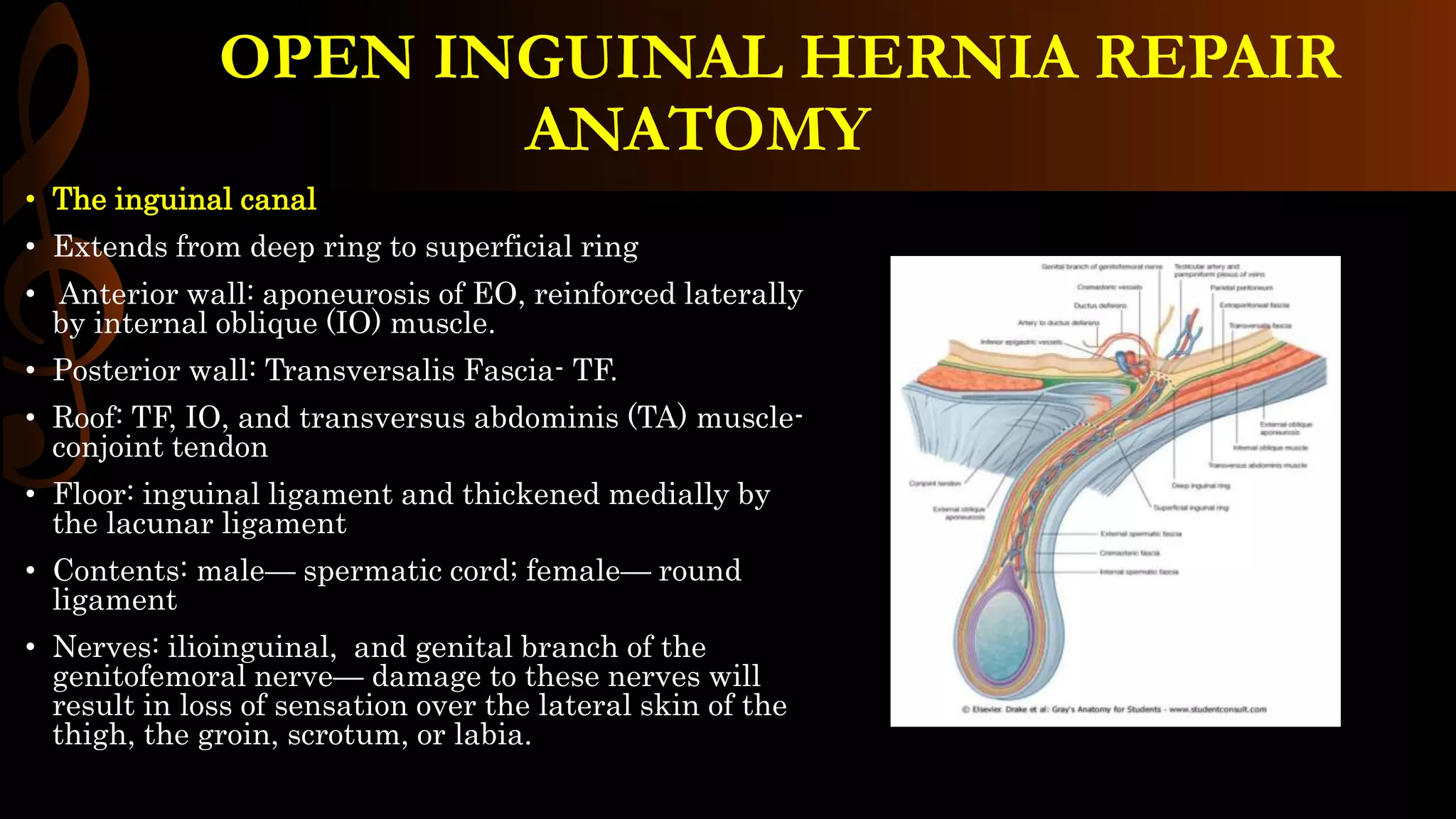
• The inguinal canal
• Extends from deep ring to superficial ring
• Anterior wall: aponeurosis of EO, reinforced laterally
by internal oblique (IO) muscle.
• Posterior wall: Transversalis Fascia- TF.
• Roof: TF, IO, and transversus abdominis (TA) muscle-
conjoint tendon
• Floor: inguinal ligament and thickened medially by
the lacunar ligament
• Contents: male— spermatic cord; female— round
ligament
• Nerves: ilioinguinal, and genital branch of the
genitofemoral nerve— damage to these nerves will
result in loss of sensation over the lateral skin of the
thigh, the groin, scrotum, or labia.
OPEN INGUINAL HERNIA REPAIR
• INDICATIONS:
 Asymptomatic hernia- since majority
will develop pain better to operate
 Symptomatic hernia elective repair.
 Irreducible hernia emergency
repair.
• ANESTHESIA:
 GA/ LA/ regional— spinal or epidural
• Informed consent- risks of surgery:
Recurrence.
Bleeding, infection, scar
Chronic pain – nerve injury or nerve
entrapment neuropathy
Testicular artery injury- Testicular atrophy
Emergency: bowel resection +/ – anastomosis
+/ – stoma
Cardiovascular/ respiratory complications
VTE- Venous Thromboembolism
OPEN INGUINAL HERNIA REPAIR
• :Pre-0p Preparation
Elective: smoking cessation, weight
optimized, medical optimization for
respiratory/ cardiovascular complaints.
Emergency: preoperative resuscitation and
stabilisation
Consent and mark the side of the hernia.
Group and save blood in emergency
Preoperative antibiotic if using mesh and
thrombo-prophylaxis.
• Position and theatre set-up:
Supine; knees slightly flexed to reduce tension on
the groin.
Hair removal
Patient warmer.
Skin preparation to include abdomen, groins, and
scrotum
OPEN INGUINAL HERNIA REPAIR
• Incision: Access
 Transverse or slightly oblique incision
above the inguinal crease lateral to the
deep ring to just above pubic tubercle.
• Exposure
 Incise fat and Scarpa’s fascia, ligating the
superficial epigastric veins which cross the line
of incision.
 Expose external oblique aponeurosis
OPEN INGUINAL HERNIA REPAIR
• Division of External oblique
aponeurosis:
 Divide external oblique aponeurosis
cranio caudally towards external ring
• Protection of nerves:
 Identify internal oblique and cremastric
muscles
 Safe-guard ilioinguinal and genital branch of
genitofemoral nerves
OPEN INGUINAL HERNIA REPAIR
• Longitudinal division of cremastric
muscle:
 Divide cremastric muscle with scissors
Then blunt dissection to avoid injury to the
spermatic cord
• Separation of cremaster muscle:
 During this dissection protect genital branch of
genitofemoral nerve
OPEN INGUINAL HERNIA REPAIR
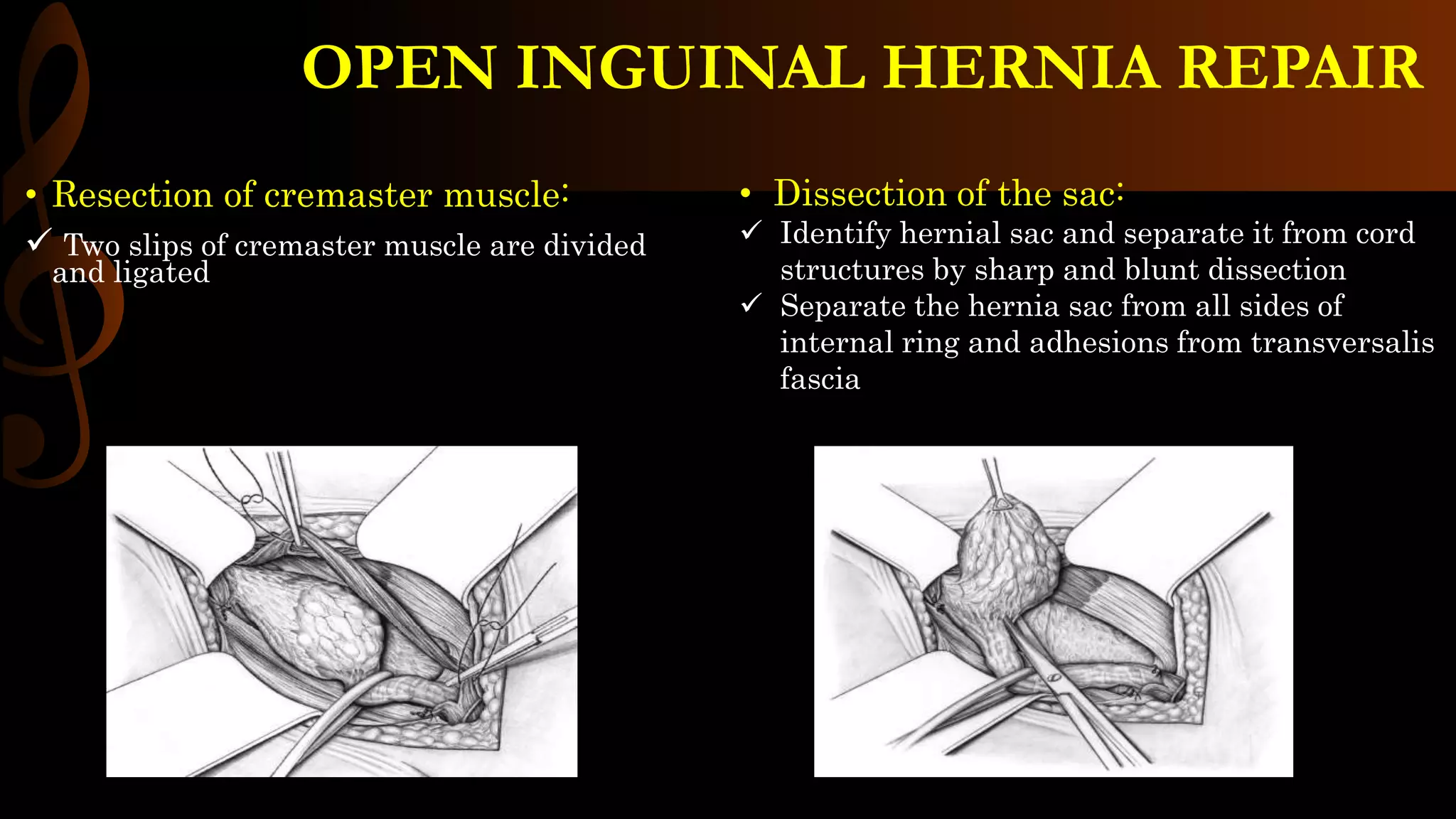
• Resection of cremaster muscle:
 Two slips of cremaster muscle are divided
and ligated
• Dissection of the sac:
 Identify hernial sac and separate it from cord
structures by sharp and blunt dissection
 Separate the hernia sac from all sides of
internal ring and adhesions from transversalis
fascia
OPEN INGUINAL HERNIA REPAIR
• For indirect inguinal hernia:
Closed method:
Twist & suture ligate sac at internal ring
Redundant part excised
• For indirect inguinal hernia:
 Open method:
 Open the sac & separate adhesions
 Suture ligate at internal ring
OPEN INGUINAL HERNIA REPAIR
• For direct inguinal hernia:
Need not open the sac
Purse string suture at base of the sac
• For direct inguinal hernia:
 Invaginate the sac and the tighten the purse
string suture
OPEN INGUINAL HERNIA REPAIR
• Different types of hernia repairs
Bassini’s repair
Shouldice repair
Stoppa’s preperitoneal repair
Desarda’s repair
Litchtenstein’s tension free mesh repair
Gilbert’s Prolene Hernia System
LITCHTENSTEIN’S MESH REPAIR
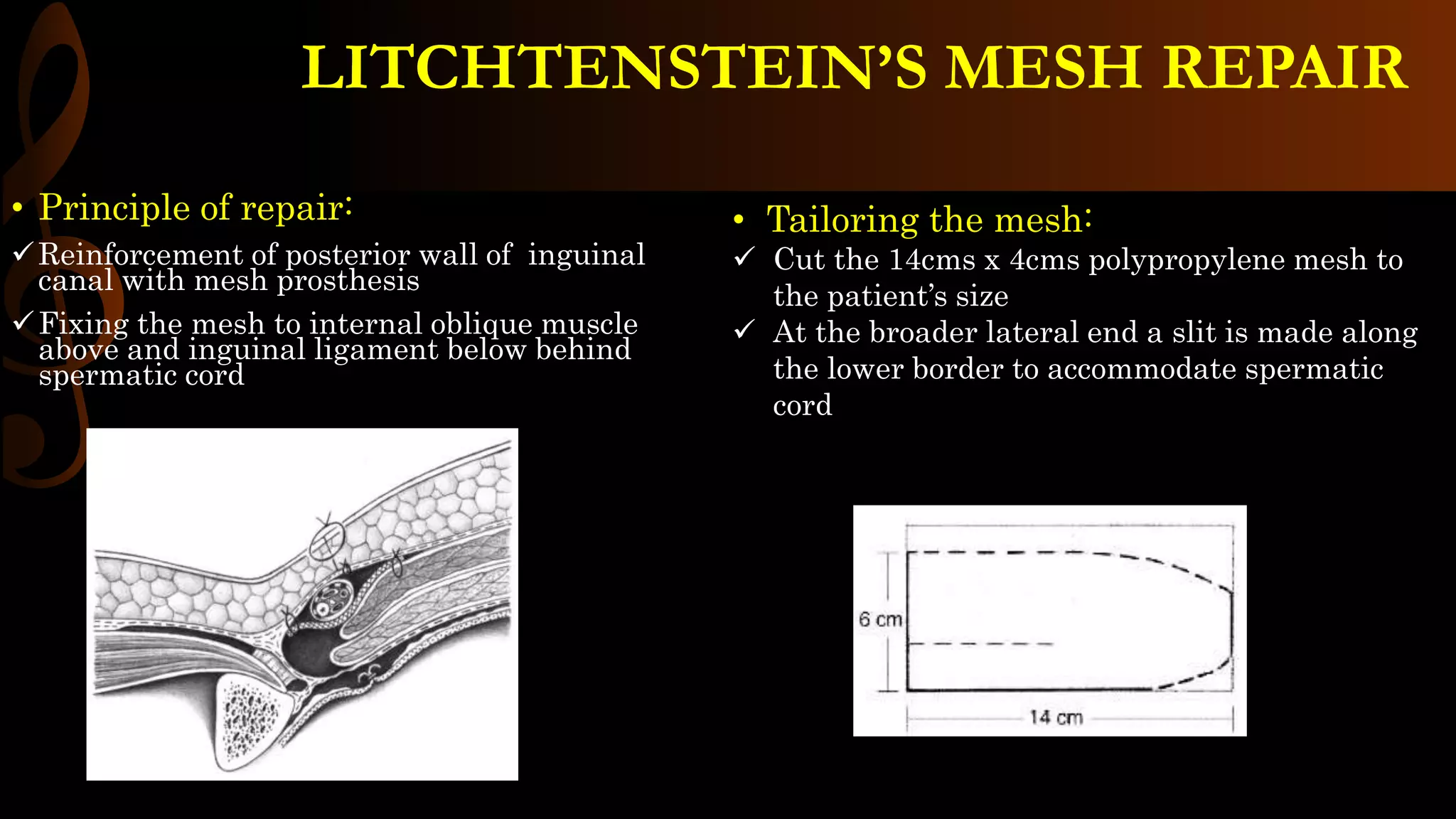
• Principle of repair:
Reinforcement of posterior wall of inguinal
canal with mesh prosthesis
Fixing the mesh to internal oblique muscle
above and inguinal ligament below behind
spermatic cord
• Tailoring the mesh:
 Cut the 14cms x 4cms polypropylene mesh to
the patient’s size
 At the broader lateral end a slit is made along
the lower border to accommodate spermatic
cord
LITCHTENSTEIN’S MESH REPAIR
• Fixing the mesh to inguinal
ligament:
Fix the mesh to pubic tubercle with a U
stitch
Continue running suture upto the internal
ring with non absorbable suture
• Fixing the mesh to internal oblique
muscle:
 With interrupted non absorbable suture
 Accommodate the spermatic cord in the slit in
the mesh
LITCHTENSTEIN’S MESH REPAIR
• Reconstruction of internal inguinal
ring:
The upper tail in the mesh should be
stitched to the lower tail and inguinal
ligament with a single stitch
• Closure of the wound:
 External oblique- continuous absorbable (#1).
 Scarpa’s fascia: interrupted absorbable sutures
(2.0).
 Skin: continuous subcuticular absorbable
sutures (3.0).
GILBERT’S PROLENE HERNIA SYSTEM- PHS
• What is this?:
A bilayered polypropylene mesh device
with a flat underlay and overlay joined by
a central connector.
This helps in anterior and posterior hernia
repair
• Sutureles mesh deployment:
 Create preperitoneal space by blunt finger
dissection- actualised space
 Deploy the circular part of the mesh inside as
underlay
 Spread the rectangular part above the muscle
as overlay
OPEN INGUINAL HERNIA REPAIR
• Post-op Care:
Most of these repairs are day-care procedures, and patients can be
discharged with a prescription for a mild analgesic agent.
Activity instructions will vary with the type of repair-- advise
patients to advance their level of activity as tolerated.
Patients can safely ambulate on the evening of the operation.
Usually no heavy lifting/ straining for 6– 8 weeks.
If mesh is used for repair prophylactic antibiotics should be given
to avoid infection of the mesh
THANK YOU

Open inguinal hernia repair / operative surgery

  • 1.
    OPEN INGUINAL HERNIA REPAIR DR.B.SelvarajMS; Mch; FICS; “ Surgical Educator” Malaysia OPERATIVE SURGERY
  • 2.
    OPEN INGUINAL HERNIAREPAIR ANATOMY • The inguinal canal • Extends from deep ring to superficial ring • Anterior wall: aponeurosis of EO, reinforced laterally by internal oblique (IO) muscle. • Posterior wall: Transversalis Fascia- TF. • Roof: TF, IO, and transversus abdominis (TA) muscle- conjoint tendon • Floor: inguinal ligament and thickened medially by the lacunar ligament • Contents: male— spermatic cord; female— round ligament • Nerves: ilioinguinal, and genital branch of the genitofemoral nerve— damage to these nerves will result in loss of sensation over the lateral skin of the thigh, the groin, scrotum, or labia.
  • 3.
    OPEN INGUINAL HERNIAREPAIR • INDICATIONS:  Asymptomatic hernia- since majority will develop pain better to operate  Symptomatic hernia elective repair.  Irreducible hernia emergency repair. • ANESTHESIA:  GA/ LA/ regional— spinal or epidural • Informed consent- risks of surgery: Recurrence. Bleeding, infection, scar Chronic pain – nerve injury or nerve entrapment neuropathy Testicular artery injury- Testicular atrophy Emergency: bowel resection +/ – anastomosis +/ – stoma Cardiovascular/ respiratory complications VTE- Venous Thromboembolism
  • 4.
    OPEN INGUINAL HERNIAREPAIR • :Pre-0p Preparation Elective: smoking cessation, weight optimized, medical optimization for respiratory/ cardiovascular complaints. Emergency: preoperative resuscitation and stabilisation Consent and mark the side of the hernia. Group and save blood in emergency Preoperative antibiotic if using mesh and thrombo-prophylaxis. • Position and theatre set-up: Supine; knees slightly flexed to reduce tension on the groin. Hair removal Patient warmer. Skin preparation to include abdomen, groins, and scrotum
  • 5.
    OPEN INGUINAL HERNIAREPAIR • Incision: Access  Transverse or slightly oblique incision above the inguinal crease lateral to the deep ring to just above pubic tubercle. • Exposure  Incise fat and Scarpa’s fascia, ligating the superficial epigastric veins which cross the line of incision.  Expose external oblique aponeurosis
  • 6.
    OPEN INGUINAL HERNIAREPAIR • Division of External oblique aponeurosis:  Divide external oblique aponeurosis cranio caudally towards external ring • Protection of nerves:  Identify internal oblique and cremastric muscles  Safe-guard ilioinguinal and genital branch of genitofemoral nerves
  • 7.
    OPEN INGUINAL HERNIAREPAIR • Longitudinal division of cremastric muscle:  Divide cremastric muscle with scissors Then blunt dissection to avoid injury to the spermatic cord • Separation of cremaster muscle:  During this dissection protect genital branch of genitofemoral nerve
  • 8.
    OPEN INGUINAL HERNIAREPAIR • Resection of cremaster muscle:  Two slips of cremaster muscle are divided and ligated • Dissection of the sac:  Identify hernial sac and separate it from cord structures by sharp and blunt dissection  Separate the hernia sac from all sides of internal ring and adhesions from transversalis fascia
  • 9.
    OPEN INGUINAL HERNIAREPAIR • For indirect inguinal hernia: Closed method: Twist & suture ligate sac at internal ring Redundant part excised • For indirect inguinal hernia:  Open method:  Open the sac & separate adhesions  Suture ligate at internal ring
  • 10.
    OPEN INGUINAL HERNIAREPAIR • For direct inguinal hernia: Need not open the sac Purse string suture at base of the sac • For direct inguinal hernia:  Invaginate the sac and the tighten the purse string suture
  • 11.
    OPEN INGUINAL HERNIAREPAIR • Different types of hernia repairs Bassini’s repair Shouldice repair Stoppa’s preperitoneal repair Desarda’s repair Litchtenstein’s tension free mesh repair Gilbert’s Prolene Hernia System
  • 12.
    LITCHTENSTEIN’S MESH REPAIR •Principle of repair: Reinforcement of posterior wall of inguinal canal with mesh prosthesis Fixing the mesh to internal oblique muscle above and inguinal ligament below behind spermatic cord • Tailoring the mesh:  Cut the 14cms x 4cms polypropylene mesh to the patient’s size  At the broader lateral end a slit is made along the lower border to accommodate spermatic cord
  • 13.
    LITCHTENSTEIN’S MESH REPAIR •Fixing the mesh to inguinal ligament: Fix the mesh to pubic tubercle with a U stitch Continue running suture upto the internal ring with non absorbable suture • Fixing the mesh to internal oblique muscle:  With interrupted non absorbable suture  Accommodate the spermatic cord in the slit in the mesh
  • 14.
    LITCHTENSTEIN’S MESH REPAIR •Reconstruction of internal inguinal ring: The upper tail in the mesh should be stitched to the lower tail and inguinal ligament with a single stitch • Closure of the wound:  External oblique- continuous absorbable (#1).  Scarpa’s fascia: interrupted absorbable sutures (2.0).  Skin: continuous subcuticular absorbable sutures (3.0).
  • 15.
    GILBERT’S PROLENE HERNIASYSTEM- PHS • What is this?: A bilayered polypropylene mesh device with a flat underlay and overlay joined by a central connector. This helps in anterior and posterior hernia repair • Sutureles mesh deployment:  Create preperitoneal space by blunt finger dissection- actualised space  Deploy the circular part of the mesh inside as underlay  Spread the rectangular part above the muscle as overlay
  • 16.
    OPEN INGUINAL HERNIAREPAIR • Post-op Care: Most of these repairs are day-care procedures, and patients can be discharged with a prescription for a mild analgesic agent. Activity instructions will vary with the type of repair-- advise patients to advance their level of activity as tolerated. Patients can safely ambulate on the evening of the operation. Usually no heavy lifting/ straining for 6– 8 weeks. If mesh is used for repair prophylactic antibiotics should be given to avoid infection of the mesh
  • 17.