Name: MD. Zahirul Islam
Roll:333
Batch:12th
World University of Bangladesh
Presentation
of
Antiperspirant & Deodorant
Welcome
To
My presentation
Antiperspirant & Deodorant
A deodorant is a substance applied to the body to
prevent body odor caused by the bacterial breakdown
of perspiration in armpits, feet, and other areas of the body.
A subgroup of deodorants, antiperspirants, affect odor as
well as prevent sweating by affecting sweat glands.
Antiperspirants
Antiperspirants are typically applied to the under arms,
while deodorants may also be used on feet and other areas
in the form of body sprays. In the United States, the food
and drug administration classifies and regulates most
deodorants as cosmetics but classifies antiperspirants
as over-the-counter drugs.
Perspiration physiology
When the body temperature rises, the sympathetic nervous
system stimulates the sweat glands to secrete water to the
skin surface, where it cools the body by evaporation. Thus,
sweat is an important mechanism for temperature control.
Mechanism perspiration control
Sweating allows the body to regulate its
temperature. Sweating is controlled from a center in the
periotic and anterior regions of the brain's hypothalamus,
where thermo sensitive neurons are located. The heat-
regulatory function of the hypothalamus is also affected by
inputs from temperature receptors in the skin.
Active ingredient for antiperspirant formulation
 Aluminum cholohydrate
 Aluminum chloride
 Basic aluminum bromide
 Basic aluminum nitrate
 Basic aluminum iodide
 Magnesium aluminum chloride
Types of antiperspirant
1.Aerosol
2.Sticks
3. Cream
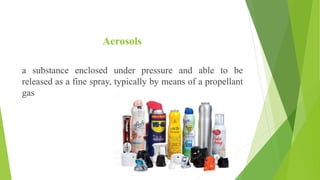
Aerosols
a substance enclosed under pressure and able to be
released as a fine spray, typically by means of a propellant
gas
Types of aerosol
Primary aerosols contain particles introduced directly into
the gas; secondary aerosols form through gas-to-particle
conversion. Various types of aerosol, classified according
to physical form and how they were generated,
include dust, fume, mist, smoke and fog. There are several
measures of aerosol concentration.
Formulation of typical aerosols antiperspirant:
An aerosol formulation consists of two components: the
product concentrate and the propellant. The product
concentrate is the active drug combined with additional
ingredients or co-solvents required to make a stable and
efficacious product. The concentrate can be a solution,
suspension, emulsion, semisolid, or powder.
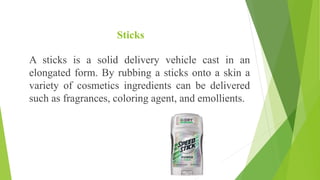
Sticks
A sticks is a solid delivery vehicle cast in an
elongated form. By rubbing a sticks onto a skin a
variety of cosmetics ingredients can be delivered
such as fragrances, coloring agent, and emollients.
Formulation of dry antiperspirant sticks:
Powder phase ingredients:
 Avicel
 Italian talc
 Ultra-fine AlCl2
 Dry-Flo starch
 Zn-Stearate
Formulation of dry antiperspirant sticks:
Liquid Phase ingredients:
 Volatile silicon
 Isopropylan 33
 Perfume
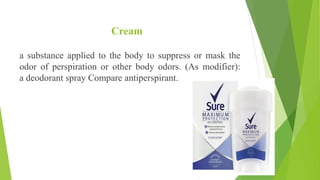
Cream
a substance applied to the body to suppress or mask the
odor of perspiration or other body odors. (As modifier):
a deodorant spray Compare antiperspirant.
Formulation antiperspirant cream
Ingredients:
 Isopropyl myristate
 Benton 38
 Ethyl alcohol
 Zirconium complex
 Silicon
 Perfume
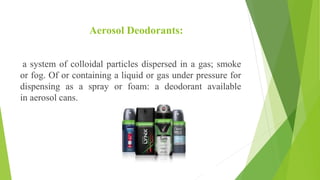
Aerosol Deodorants:
a system of colloidal particles dispersed in a gas; smoke
or fog. Of or containing a liquid or gas under pressure for
dispensing as a spray or foam: a deodorant available
in aerosol cans.
General mechanism of deodorants
Most antiperspirants contain ingredients called aluminum
salts. The main way in which they work is to dissolve in
sweat and create a thin coating of gel to cover over the
sweat glands. This coating reduces the amount of sweat
released onto the surface of the skin for a number of hours
after the antiperspirant is applied.
Formulation of typical aerosol deodorants
 Triclosan
 PG
 Alcohol
 Water
Thanks
to
All

Antiperspirant &Deodorant

  • 1.
    Name: MD. ZahirulIslam Roll:333 Batch:12th World University of Bangladesh Presentation of Antiperspirant & Deodorant
  • 2.
  • 3.
    Antiperspirant & Deodorant Adeodorant is a substance applied to the body to prevent body odor caused by the bacterial breakdown of perspiration in armpits, feet, and other areas of the body. A subgroup of deodorants, antiperspirants, affect odor as well as prevent sweating by affecting sweat glands.
  • 4.
    Antiperspirants Antiperspirants are typicallyapplied to the under arms, while deodorants may also be used on feet and other areas in the form of body sprays. In the United States, the food and drug administration classifies and regulates most deodorants as cosmetics but classifies antiperspirants as over-the-counter drugs.
  • 5.
    Perspiration physiology When thebody temperature rises, the sympathetic nervous system stimulates the sweat glands to secrete water to the skin surface, where it cools the body by evaporation. Thus, sweat is an important mechanism for temperature control.
  • 6.
    Mechanism perspiration control Sweatingallows the body to regulate its temperature. Sweating is controlled from a center in the periotic and anterior regions of the brain's hypothalamus, where thermo sensitive neurons are located. The heat- regulatory function of the hypothalamus is also affected by inputs from temperature receptors in the skin.
  • 7.
    Active ingredient forantiperspirant formulation  Aluminum cholohydrate  Aluminum chloride  Basic aluminum bromide  Basic aluminum nitrate  Basic aluminum iodide  Magnesium aluminum chloride
  • 8.
  • 9.
    Aerosols a substance enclosedunder pressure and able to be released as a fine spray, typically by means of a propellant gas
  • 10.
    Types of aerosol Primaryaerosols contain particles introduced directly into the gas; secondary aerosols form through gas-to-particle conversion. Various types of aerosol, classified according to physical form and how they were generated, include dust, fume, mist, smoke and fog. There are several measures of aerosol concentration.
  • 11.
    Formulation of typicalaerosols antiperspirant: An aerosol formulation consists of two components: the product concentrate and the propellant. The product concentrate is the active drug combined with additional ingredients or co-solvents required to make a stable and efficacious product. The concentrate can be a solution, suspension, emulsion, semisolid, or powder.
  • 12.
    Sticks A sticks isa solid delivery vehicle cast in an elongated form. By rubbing a sticks onto a skin a variety of cosmetics ingredients can be delivered such as fragrances, coloring agent, and emollients.
  • 13.
    Formulation of dryantiperspirant sticks: Powder phase ingredients:  Avicel  Italian talc  Ultra-fine AlCl2  Dry-Flo starch  Zn-Stearate
  • 14.
    Formulation of dryantiperspirant sticks: Liquid Phase ingredients:  Volatile silicon  Isopropylan 33  Perfume
  • 15.
    Cream a substance appliedto the body to suppress or mask the odor of perspiration or other body odors. (As modifier): a deodorant spray Compare antiperspirant.
  • 16.
    Formulation antiperspirant cream Ingredients: Isopropyl myristate  Benton 38  Ethyl alcohol  Zirconium complex  Silicon  Perfume
  • 17.
    Aerosol Deodorants: a systemof colloidal particles dispersed in a gas; smoke or fog. Of or containing a liquid or gas under pressure for dispensing as a spray or foam: a deodorant available in aerosol cans.
  • 18.
    General mechanism ofdeodorants Most antiperspirants contain ingredients called aluminum salts. The main way in which they work is to dissolve in sweat and create a thin coating of gel to cover over the sweat glands. This coating reduces the amount of sweat released onto the surface of the skin for a number of hours after the antiperspirant is applied.
  • 19.
    Formulation of typicalaerosol deodorants  Triclosan  PG  Alcohol  Water
  • 20.