Non-aqueous Titrations
 Non aqueous titration is the titration of substances dissolved in solvents other than
water.
 It is the most common titrimetric procedure used in pharmacopoeial assays and
serves a double purpose.
 it is suitable for the titration of very weak acids and very weak bases, and it
provides a solvent in which organic compound are soluble.
Non-aqueous Titrations
Titration in water solutions is limited by factors:
▶ It is impossible to titrate for a mix of acids or the bases
▶ It is impossible to titrate for a mix of strong and weak acids (bases)
▶ It is impossible to titrate separately for a mix of acids (bases) with near constants of
dissociation
▶ It is impossible to define substances which are insoluble in water.
3
Non-aqueous Titrations
• Solvent which are used in non aqueous titration are called
non aqueous solvent.
They are following types:-
1. Aprotic Solvent
2. Protogenic Solvent
3. Protophillic Solvent
4. Amphiprotic Solvent
4
Non-aqueous Solvents
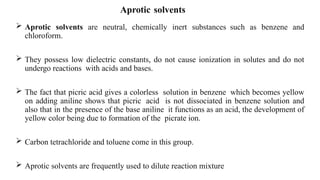
Aprotic solvents
 Aprotic solvents are neutral, chemically inert substances such as benzene and
chloroform.
 They possess low dielectric constants, do not cause ionization in solutes and do not
undergo reactions with acids and bases.
 The fact that picric acid gives a colorless solution in benzene which becomes yellow
on adding aniline shows that picric acid is not dissociated in benzene solution and
also that in the presence of the base aniline it functions as an acid, the development of
yellow color being due to formation of the picrate ion.
 Carbon tetrachloride and toluene come in this group.
 Aprotic solvents are frequently used to dilute reaction mixture
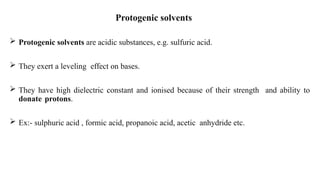
Protogenic solvents
 Protogenic solvents are acidic substances, e.g. sulfuric acid.
 They exert a leveling effect on bases.
 They have high dielectric constant and ionised because of their strength and ability to
donate protons.
 Ex:- sulphuric acid , formic acid, propanoic acid, acetic anhydride etc.
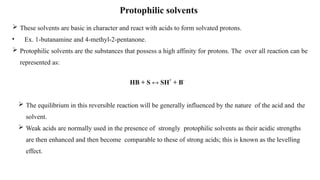
Protophilic solvents
 These solvents are basic in character and react with acids to form solvated protons.
• Ex. 1-butanamine and 4-methyl-2-pentanone.
 Protophilic solvents are the substances that possess a high affinity for protons. The over all reaction can be
represented as:
HB + S ↔ SH+
+ B-
 The equilibrium in this reversible reaction will be generally influenced by the nature of the acid and the
solvent.
 Weak acids are normally used in the presence of strongly protophilic solvents as their acidic strengths
are then enhanced and then become comparable to these of strong acids; this is known as the levelling
effect.
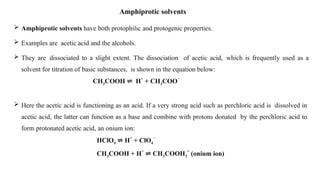
Amphiprotic solvents
 Amphiprotic solvents have both protophilic and protogenic properties.
 Examples are acetic acid and the alcohols.
 They are dissociated to a slight extent. The dissociation of acetic acid, which is frequently used as a
solvent for titration of basic substances, is shown in the equation below:
CH3COOH ⇌ H+
+ CH3COO−
 Here the acetic acid is functioning as an acid. If a very strong acid such as perchloric acid is dissolved in
acetic acid, the latter can function as a base and combine with protons donated by the perchloric acid to
form protonated acetic acid, an onium ion:
HClO4 ⇌ H+
+ ClO4
−
CH3COOH + H+
⇌ CH3COOH2
+
(onium ion)
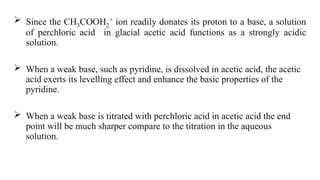
 Since the CH3COOH2
+
ion readily donates its proton to a base, a solution
of perchloric acid in glacial acetic acid functions as a strongly acidic
solution.
 When a weak base, such as pyridine, is dissolved in acetic acid, the acetic
acid exerts its levelling effect and enhance the basic properties of the
pyridine.
 When a weak base is titrated with perchloric acid in acetic acid the end
point will be much sharper compare to the titration in the aqueous
solution.
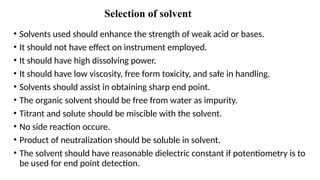
Selection of solvent
• Solvents used should enhance the strength of weak acid or bases.
• It should not have effect on instrument employed.
• It should have high dissolving power.
• It should have low viscosity, free form toxicity, and safe in handling.
• Solvents should assist in obtaining sharp end point.
• The organic solvent should be free from water as impurity.
• Titrant and solute should be miscible with the solvent.
• No side reaction occure.
• Product of neutralization should be soluble in solvent.
• The solvent should have reasonable dielectric constant if potentiometry is to
be used for end point detection.
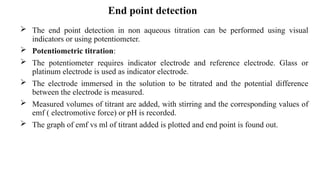
 The end point detection in non aqueous titration can be performed using visual
indicators or using potentiometer.
 Potentiometric titration:
 The potentiometer requires indicator electrode and reference electrode. Glass or
platinum electrode is used as indicator electrode.
 The electrode immersed in the solution to be titrated and the potential difference
between the electrode is measured.
 Measured volumes of titrant are added, with stirring and the corresponding values of
emf ( electromotive force) or pH is recorded.
 The graph of emf vs ml of titrant added is plotted and end point is found out.
End point detection
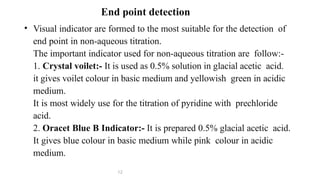
• Visual indicator are formed to the most suitable for the detection of
end point in non-aqueous titration.
The important indicator used for non-aqueous titration are follow:-
1. Crystal voilet:- It is used as 0.5% solution in glacial acetic acid.
it gives voilet colour in basic medium and yellowish green in acidic
medium.
It is most widely use for the titration of pyridine with prechloride
acid.
2. Oracet Blue B Indicator:- It is prepared 0.5% glacial acetic acid.
It gives blue colour in basic medium while pink colour in acidic
medium.
12
End point detection
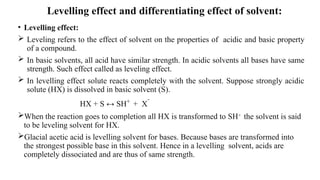
Levelling effect and differentiating effect of solvent:
• Levelling effect:
 Leveling refers to the effect of solvent on the properties of acidic and basic property
of a compound.
 In basic solvents, all acid have similar strength. In acidic solvents all bases have same
strength. Such effect called as leveling effect.
 In levelling effect solute reacts completely with the solvent. Suppose strongly acidic
solute (HX) is dissolved in basic solvent (S).
HX + S ↔ SH+
+ X
-
When the reaction goes to completion all HX is transformed to SH+
the solvent is said
to be leveling solvent for HX.
Glacial acetic acid is levelling solvent for bases. Because bases are transformed into
the strongest possible base in this solvent. Hence in a levelling solvent, acids are
completely dissociated and are thus of same strength.
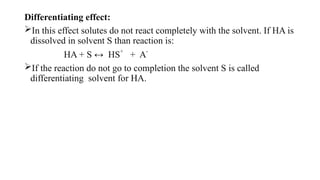
Differentiating effect:
In this effect solutes do not react completely with the solvent. If HA is
dissolved in solvent S than reaction is:
HA + S ↔ HS+
+ A-
If the reaction do not go to completion the solvent S is called
differentiating solvent for HA.
Titrants in non-aqueous titration
• Acidic titrant : Perchloric acid
• Basic Titrant : sodium methoxide, tetrautyl ammonium hydroxide
Perchloric acid ( HClO4)as titrant
The titrant selected should be strongest acid or base, in non aqueous solvents perchloric
acid is stronger than hydrochloric acid thus, HClO4 is used as titrant in non aqueous
titration.
HClO4 may contain small amount of water. The water present in HClO4 may cause
problem in the titration. Water is removed by addition of acetic anhydride which reacts
with water to yield ethanolic acid.
Materials Required :8.5 ml of perchloric acid (70.0 to 72.0%), 1 Litre of glacial
acetic acid, 30ml of acetic anhydride.
Preparation of 0.1M Perchloric acid
 Procedure : Gradually mix 8.5 ml of perchloric acid to 500 ml of glacial acetic acid
with vigorous and continuous stirring. Now add 30 ml acetic anhydride and make up the
volume to 1 litre with glacial acetic acid and allow to stand for 24 hours before use.
H2O + (CH3CO)2O → 2CH3COOH
Acetic acid
Acetic anhydride
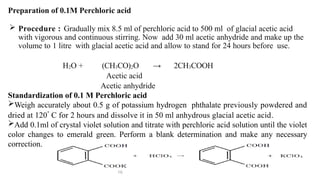
Standardization of 0.1 M Perchloric acid
Weigh accurately about 0.5 g of potassium hydrogen phthalate previously powdered and
dried at 120
⸰
C for 2 hours and dissolve it in 50 ml anhydrous glacial acetic acid.
Add 0.1ml of crystal violet solution and titrate with perchloric acid solution until the violet
color changes to emerald green. Perform a blank determination and make any necessary
correction.
16
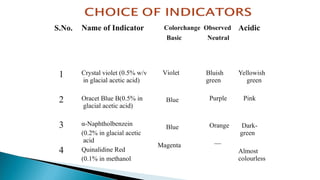
S.No. Name of Indicator Colorchange Observed
Basic Neutral
Acidic
1
2
3
4
Crystal violet (0.5% w/v
in glacial acetic acid)
Oracet Blue B(0.5% in
glacial acetic acid)
α-Naphtholbenzein
(0.2% in glacial acetic
acid
Quinalidine Red
(0.1% in methanol
Violet
Blue
Blue
Magenta
Bluish
green
Purple
Orange
—
Almost
colourless
Yellowish
green
Pink
Dark-
green
• ESTIMATION OF SODIUM BENZOATE
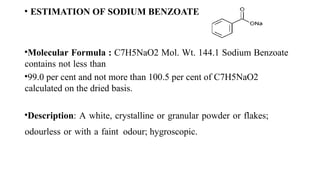
•Molecular Formula : C7H5NaO2 Mol. Wt. 144.1 Sodium Benzoate
contains not less than
•99.0 per cent and not more than 100.5 per cent of C7H5NaO2
calculated on the dried basis.
•Description: A white, crystalline or granular powder or flakes;
odourless or with a faint odour; hygroscopic.
•Preparation of 0.1N solution of HClO4 and its standardization: Dissolve 8.5 ml of 72% HClO4 in about
900 ml glacial acetic acid with constant stirring, add about 30 ml acetic anhydride and make up the volume
(1000 ml) with glacial acetic acid and keep the mixture for 24 hour. Acetic anhydride absorbed all the water
from HClO4 and glacial acetic acid and renders the solution virtually anhydrous. HClO4 must be well diluted
with glacial acetic acid before adding acetic anhydride because reaction between HClO4 and acetic anhydride is
explosive.
Standardisation of HClO4: To 0.5gm of potassium acid phthalate add 25 ml of glacial acetic acid and add few
drops of 5% w/v crystal violet in glacial acetic acid as indicator. This solution is titrated with 0.1 HClO4. The
colour changes from blue to blue green.
1 ml of 0.1N HClO4 = 0.020414 gms of potassium acid Phthalate
Assay Procedure: Weigh accurately about 0.25 g of Sodium Benzoate, dissolve in 20 ml of anhydrous glacial
acetic acid, warming to 50º if necessary, cool. Titrate with 0.1 M perchloric acid, using 0.05 ml of 1
naphtholbenzein solution as indicator. Carry out a blank titration.
Equivalent factor or I.P factor : 1 ml of 0.1 M perchloric acid is equivalent to 0.01441 g of sodium benzoate.
ESTIMATION OF EPHEDRINE HYDROCHLORIDE
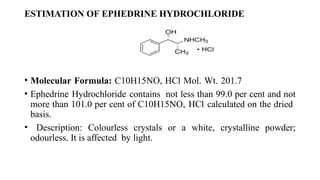
• Molecular Formula: C10H15NO, HCl Mol. Wt. 201.7
• Ephedrine Hydrochloride contains not less than 99.0 per cent and not
more than 101.0 per cent of C10H15NO, HCl calculated on the dried
basis.
• Description: Colourless crystals or a white, crystalline powder;
odourless. It is affected by light.
•Preparation of 0.1N solution of HClO4 and its standardization: Dissolve 8.5 ml of 72% HClO4 in about
900 ml glacial acetic acid with constant stirring, add about 30 ml acetic anhydride and make up the volume
(1000 ml) with glacial acetic acid and keep the mixture for 24 hour. Acetic anhydride absorbed all the water
from HClO4 and glacial acetic acid and renders the solution virtually anhydrous. HClO4 must be well diluted
with glacial acetic acid before adding acetic anhydride because reaction between HClO4 and acetic anhydride
is explosive.
Standardisation of HClO4: To 500 mg of potassium acid phthalate add 25 ml of glacial acetic acid and add
few drops of 5% w/v crystal violet in glacial acetic acid as indicator. This solution is titrated with 0.1 HClO4.
The colour changes from blue to blue green.
1 ml of 0.1N HClO4 = 0.020414 gms of potassium acid Phthalate
Assay Procedure: Weigh accurately about 0.17 g of Ephedrine Hydrochloride, dissolve in 10 ml of mercuric
acetate solution, warming gently, add 50 ml of acetone and mix. Titrate with 0.1 M perchloric acid, using 1 ml
of a saturated solution of methyl orange in acetone as indicator, until a red colour is obtained. Carry out a
blank titration
Equivalent or I.P factor : 1 ml of 0.1 M perchloric acid is equivalent to 0.02017 g of C10H15NO,HCl
Non- aqueous titrations have the following
advantages
22
 Organic acids and bases that are insoluble in water are soluble in non- aqueous solvent.
 A non-aqueous solvent may help two are more acids in mixture. The individual acid can
give separate end point in different solvent.
 Enlargement of solubility range: many substances that are not soluble in water can be
easily titrated in water-free media (e.g. fats and oils)
 Enlargement of application range: weak bases and acids can be easily
titrated
 Substance compositions that cannot be separately determined in aqueous media can
often be titrated in non-aqueous media
 Non-aqueous solvents are useful for the titration of very weak acids or bases that cannot
be titrated in water
 Non aqueous titrations are simple and accurate, examples of non aqueous titration are
 EX. - Ephedrine preparations, codeine phosphate in APC, tetracycline, teramycin,
Anti- histamines and various piprazine preparations.

Non aqueous titration...............pptx

  • 1.
  • 2.
     Non aqueoustitration is the titration of substances dissolved in solvents other than water.  It is the most common titrimetric procedure used in pharmacopoeial assays and serves a double purpose.  it is suitable for the titration of very weak acids and very weak bases, and it provides a solvent in which organic compound are soluble. Non-aqueous Titrations
  • 3.
    Titration in watersolutions is limited by factors: ▶ It is impossible to titrate for a mix of acids or the bases ▶ It is impossible to titrate for a mix of strong and weak acids (bases) ▶ It is impossible to titrate separately for a mix of acids (bases) with near constants of dissociation ▶ It is impossible to define substances which are insoluble in water. 3 Non-aqueous Titrations
  • 4.
    • Solvent whichare used in non aqueous titration are called non aqueous solvent. They are following types:- 1. Aprotic Solvent 2. Protogenic Solvent 3. Protophillic Solvent 4. Amphiprotic Solvent 4 Non-aqueous Solvents
  • 5.
    Aprotic solvents  Aproticsolvents are neutral, chemically inert substances such as benzene and chloroform.  They possess low dielectric constants, do not cause ionization in solutes and do not undergo reactions with acids and bases.  The fact that picric acid gives a colorless solution in benzene which becomes yellow on adding aniline shows that picric acid is not dissociated in benzene solution and also that in the presence of the base aniline it functions as an acid, the development of yellow color being due to formation of the picrate ion.  Carbon tetrachloride and toluene come in this group.  Aprotic solvents are frequently used to dilute reaction mixture
  • 6.
    Protogenic solvents  Protogenicsolvents are acidic substances, e.g. sulfuric acid.  They exert a leveling effect on bases.  They have high dielectric constant and ionised because of their strength and ability to donate protons.  Ex:- sulphuric acid , formic acid, propanoic acid, acetic anhydride etc.
  • 7.
    Protophilic solvents  Thesesolvents are basic in character and react with acids to form solvated protons. • Ex. 1-butanamine and 4-methyl-2-pentanone.  Protophilic solvents are the substances that possess a high affinity for protons. The over all reaction can be represented as: HB + S ↔ SH+ + B-  The equilibrium in this reversible reaction will be generally influenced by the nature of the acid and the solvent.  Weak acids are normally used in the presence of strongly protophilic solvents as their acidic strengths are then enhanced and then become comparable to these of strong acids; this is known as the levelling effect.
  • 8.
    Amphiprotic solvents  Amphiproticsolvents have both protophilic and protogenic properties.  Examples are acetic acid and the alcohols.  They are dissociated to a slight extent. The dissociation of acetic acid, which is frequently used as a solvent for titration of basic substances, is shown in the equation below: CH3COOH ⇌ H+ + CH3COO−  Here the acetic acid is functioning as an acid. If a very strong acid such as perchloric acid is dissolved in acetic acid, the latter can function as a base and combine with protons donated by the perchloric acid to form protonated acetic acid, an onium ion: HClO4 ⇌ H+ + ClO4 − CH3COOH + H+ ⇌ CH3COOH2 + (onium ion)
  • 9.
     Since theCH3COOH2 + ion readily donates its proton to a base, a solution of perchloric acid in glacial acetic acid functions as a strongly acidic solution.  When a weak base, such as pyridine, is dissolved in acetic acid, the acetic acid exerts its levelling effect and enhance the basic properties of the pyridine.  When a weak base is titrated with perchloric acid in acetic acid the end point will be much sharper compare to the titration in the aqueous solution.
  • 10.
    Selection of solvent •Solvents used should enhance the strength of weak acid or bases. • It should not have effect on instrument employed. • It should have high dissolving power. • It should have low viscosity, free form toxicity, and safe in handling. • Solvents should assist in obtaining sharp end point. • The organic solvent should be free from water as impurity. • Titrant and solute should be miscible with the solvent. • No side reaction occure. • Product of neutralization should be soluble in solvent. • The solvent should have reasonable dielectric constant if potentiometry is to be used for end point detection.
  • 11.
     The endpoint detection in non aqueous titration can be performed using visual indicators or using potentiometer.  Potentiometric titration:  The potentiometer requires indicator electrode and reference electrode. Glass or platinum electrode is used as indicator electrode.  The electrode immersed in the solution to be titrated and the potential difference between the electrode is measured.  Measured volumes of titrant are added, with stirring and the corresponding values of emf ( electromotive force) or pH is recorded.  The graph of emf vs ml of titrant added is plotted and end point is found out. End point detection
  • 12.
    • Visual indicatorare formed to the most suitable for the detection of end point in non-aqueous titration. The important indicator used for non-aqueous titration are follow:- 1. Crystal voilet:- It is used as 0.5% solution in glacial acetic acid. it gives voilet colour in basic medium and yellowish green in acidic medium. It is most widely use for the titration of pyridine with prechloride acid. 2. Oracet Blue B Indicator:- It is prepared 0.5% glacial acetic acid. It gives blue colour in basic medium while pink colour in acidic medium. 12 End point detection
  • 13.
    Levelling effect anddifferentiating effect of solvent: • Levelling effect:  Leveling refers to the effect of solvent on the properties of acidic and basic property of a compound.  In basic solvents, all acid have similar strength. In acidic solvents all bases have same strength. Such effect called as leveling effect.  In levelling effect solute reacts completely with the solvent. Suppose strongly acidic solute (HX) is dissolved in basic solvent (S). HX + S ↔ SH+ + X - When the reaction goes to completion all HX is transformed to SH+ the solvent is said to be leveling solvent for HX. Glacial acetic acid is levelling solvent for bases. Because bases are transformed into the strongest possible base in this solvent. Hence in a levelling solvent, acids are completely dissociated and are thus of same strength.
  • 14.
    Differentiating effect: In thiseffect solutes do not react completely with the solvent. If HA is dissolved in solvent S than reaction is: HA + S ↔ HS+ + A- If the reaction do not go to completion the solvent S is called differentiating solvent for HA.
  • 15.
    Titrants in non-aqueoustitration • Acidic titrant : Perchloric acid • Basic Titrant : sodium methoxide, tetrautyl ammonium hydroxide Perchloric acid ( HClO4)as titrant The titrant selected should be strongest acid or base, in non aqueous solvents perchloric acid is stronger than hydrochloric acid thus, HClO4 is used as titrant in non aqueous titration. HClO4 may contain small amount of water. The water present in HClO4 may cause problem in the titration. Water is removed by addition of acetic anhydride which reacts with water to yield ethanolic acid. Materials Required :8.5 ml of perchloric acid (70.0 to 72.0%), 1 Litre of glacial acetic acid, 30ml of acetic anhydride.
  • 16.
    Preparation of 0.1MPerchloric acid  Procedure : Gradually mix 8.5 ml of perchloric acid to 500 ml of glacial acetic acid with vigorous and continuous stirring. Now add 30 ml acetic anhydride and make up the volume to 1 litre with glacial acetic acid and allow to stand for 24 hours before use. H2O + (CH3CO)2O → 2CH3COOH Acetic acid Acetic anhydride Standardization of 0.1 M Perchloric acid Weigh accurately about 0.5 g of potassium hydrogen phthalate previously powdered and dried at 120 ⸰ C for 2 hours and dissolve it in 50 ml anhydrous glacial acetic acid. Add 0.1ml of crystal violet solution and titrate with perchloric acid solution until the violet color changes to emerald green. Perform a blank determination and make any necessary correction. 16
  • 17.
    S.No. Name ofIndicator Colorchange Observed Basic Neutral Acidic 1 2 3 4 Crystal violet (0.5% w/v in glacial acetic acid) Oracet Blue B(0.5% in glacial acetic acid) α-Naphtholbenzein (0.2% in glacial acetic acid Quinalidine Red (0.1% in methanol Violet Blue Blue Magenta Bluish green Purple Orange — Almost colourless Yellowish green Pink Dark- green
  • 18.
    • ESTIMATION OFSODIUM BENZOATE •Molecular Formula : C7H5NaO2 Mol. Wt. 144.1 Sodium Benzoate contains not less than •99.0 per cent and not more than 100.5 per cent of C7H5NaO2 calculated on the dried basis. •Description: A white, crystalline or granular powder or flakes; odourless or with a faint odour; hygroscopic.
  • 19.
    •Preparation of 0.1Nsolution of HClO4 and its standardization: Dissolve 8.5 ml of 72% HClO4 in about 900 ml glacial acetic acid with constant stirring, add about 30 ml acetic anhydride and make up the volume (1000 ml) with glacial acetic acid and keep the mixture for 24 hour. Acetic anhydride absorbed all the water from HClO4 and glacial acetic acid and renders the solution virtually anhydrous. HClO4 must be well diluted with glacial acetic acid before adding acetic anhydride because reaction between HClO4 and acetic anhydride is explosive. Standardisation of HClO4: To 0.5gm of potassium acid phthalate add 25 ml of glacial acetic acid and add few drops of 5% w/v crystal violet in glacial acetic acid as indicator. This solution is titrated with 0.1 HClO4. The colour changes from blue to blue green. 1 ml of 0.1N HClO4 = 0.020414 gms of potassium acid Phthalate Assay Procedure: Weigh accurately about 0.25 g of Sodium Benzoate, dissolve in 20 ml of anhydrous glacial acetic acid, warming to 50º if necessary, cool. Titrate with 0.1 M perchloric acid, using 0.05 ml of 1 naphtholbenzein solution as indicator. Carry out a blank titration. Equivalent factor or I.P factor : 1 ml of 0.1 M perchloric acid is equivalent to 0.01441 g of sodium benzoate.
  • 20.
    ESTIMATION OF EPHEDRINEHYDROCHLORIDE • Molecular Formula: C10H15NO, HCl Mol. Wt. 201.7 • Ephedrine Hydrochloride contains not less than 99.0 per cent and not more than 101.0 per cent of C10H15NO, HCl calculated on the dried basis. • Description: Colourless crystals or a white, crystalline powder; odourless. It is affected by light.
  • 21.
    •Preparation of 0.1Nsolution of HClO4 and its standardization: Dissolve 8.5 ml of 72% HClO4 in about 900 ml glacial acetic acid with constant stirring, add about 30 ml acetic anhydride and make up the volume (1000 ml) with glacial acetic acid and keep the mixture for 24 hour. Acetic anhydride absorbed all the water from HClO4 and glacial acetic acid and renders the solution virtually anhydrous. HClO4 must be well diluted with glacial acetic acid before adding acetic anhydride because reaction between HClO4 and acetic anhydride is explosive. Standardisation of HClO4: To 500 mg of potassium acid phthalate add 25 ml of glacial acetic acid and add few drops of 5% w/v crystal violet in glacial acetic acid as indicator. This solution is titrated with 0.1 HClO4. The colour changes from blue to blue green. 1 ml of 0.1N HClO4 = 0.020414 gms of potassium acid Phthalate Assay Procedure: Weigh accurately about 0.17 g of Ephedrine Hydrochloride, dissolve in 10 ml of mercuric acetate solution, warming gently, add 50 ml of acetone and mix. Titrate with 0.1 M perchloric acid, using 1 ml of a saturated solution of methyl orange in acetone as indicator, until a red colour is obtained. Carry out a blank titration Equivalent or I.P factor : 1 ml of 0.1 M perchloric acid is equivalent to 0.02017 g of C10H15NO,HCl
  • 22.
    Non- aqueous titrationshave the following advantages 22  Organic acids and bases that are insoluble in water are soluble in non- aqueous solvent.  A non-aqueous solvent may help two are more acids in mixture. The individual acid can give separate end point in different solvent.  Enlargement of solubility range: many substances that are not soluble in water can be easily titrated in water-free media (e.g. fats and oils)  Enlargement of application range: weak bases and acids can be easily titrated  Substance compositions that cannot be separately determined in aqueous media can often be titrated in non-aqueous media  Non-aqueous solvents are useful for the titration of very weak acids or bases that cannot be titrated in water  Non aqueous titrations are simple and accurate, examples of non aqueous titration are  EX. - Ephedrine preparations, codeine phosphate in APC, tetracycline, teramycin, Anti- histamines and various piprazine preparations.