NOE 
•Transferring magnetization through scalar coupling is a 
“coherent” process. This means that all of the spins are doing 
the same thing at the same time. 
•Relaxation is an “incoherent” process, because it is caused by 
random fluxuations that are not coordinated. 
•The nuclear Overhauser effect (NOE) is in incoherent process 
in which two nuclear spins “cross-relax”. Recall that a single 
spin can relax by T1 (longitudinal or spin-latice) or T2 
(transverse or spin-spin) mechanisms. Nuclear spins can also 
cross-relax through dipole-dipole interactions and other 
mechanisms. This cross relaxation causes changes in one spin 
through perturbations of the other spin. 
•The NOE is dependent on many factors. The major factors 
are molecular tumbling frequency and internuclear distance. 
The intensity of the NOE is proportional to r-6 where r is the 
distance between the 2 spins.
Qualitative Description 
Two nuclear spins within about 5 Å will 
interact with each other through 
space. This interaction is called 
cross-relaxation, and it gives rise to 
the nuclear Overhauser effect 
(NOE). 
Two spins have 4 energy levels, and the 
transitions along the edges 
correspond to transitions of one or 
the other spin alone. W2 and W0 are 
the cross-relaxation pathways, 
which depend on the tumbling of 
the molecule. 
2 spins I and S 
aa n1(***) 
(***) n2 ab 
bb n4(*) 
WS 
(1) 
WS 
(2) 
WI 
(1) 
WI 
(2) 
ba n3(*) 
W2 
W0
dn1/dt = -WS 
(1)n1-WI 
(1)n1–W2n1 + WS 
(1)n2+WI 
(1)n3+W2n4 
… etc for n2,3,4 
using: Iz= n1-n3+n2-n4 Sz= n1-n2+n3-n4 2IzSz= n1-n3-n2+n4 
One gets the ‘master equation’ or Solomon equation 
dIz/dt = -(WI 
(1)+WI 
(2)+W2+W0)Iz – (W2-W0)Sz –(WI 
(1)-WI 
(2))2IzSz 
dSz/dt = -(WS 
(1)+WS 
(2)+W2+W0)Sz – (W2-W0)Iz – (WS 
(1)-WS 
(2))2IzSz 
d2IzSz/dt = -(WI 
(1)+WI 
(2)+ WS 
(1)+WS 
(2))2IzSz - (WS 
(1)-WS 
(2))Sz - (WI 
(1)-WI 
(2))Iz 
(WI 
(2)+W2+W0) auto relaxation rate of Iz or rI 
(1)+WI 
(WS 
(1)+WS 
(2)+W2+W0) auto relaxation rate of Rz or rR 
(W-W) cross relaxation rate s20IS 
Terms with 2IzSz can be neglected in many circumstances 
unless (W(1)-WI/S 
I/S 
(2)) (D-CSA ‘cross correlated relaxation’ etc …)
Spectral densities J(w) 
W0 µ gI 
2 gS 
2 rIS 
-6 tc / [ 1 + (wI - wS)2tc 
2] 
W2 µ gI 
2 gS 
-6 tc / [ 1 + (wI + wS)2tc 
2 rIS 
2] 
WS µ gI 
2 rIS 
2 gS 
-6 tc / [ 1 + wS 
2tc 
2] 
WI µ gI 
2 rIS 
2 gS 
-6 tc / [ 1 + wI 
2] 
2tc 
• Since the probability of a transition depends on the different 
frequencies that the system has (the spectral density), the 
W terms are proportional the J(w). 
• Also, since we need two magnetic dipoles to have dipolar 
coupling, the NOE depends on the strength of the two 
dipoles involved. The strength of a dipole is proportional to 
rIS 
-3, and the Ws will depend on rIS 
-6: 
for proteins only W0 is of importance W I,S,2 << 
• The relationship is to the inverse sixth power of rIS, which 
means that the NOE decays very fast as we pull the two 
nuclei away from each other. 
• For protons, this means that we can see things which are at 
most 5 to 6 Å apart in the molecule (under ideal conditions…).
d(Iz – Iz0)/dt = - rI (Iz–Iz0) - sIS (Sz–Sz0) 
d(Sz – Sz0)/dt = - sIS (Iz–Iz0) - rS (Sz–Sz0) 
Note that in general there is no simple 
mono-exponential T1 behaviour !!
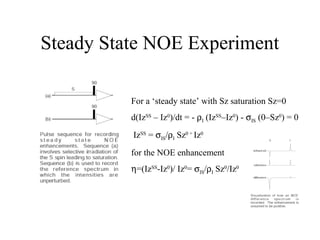
Steady State NOE Experiment 
For a ‘steady state’ with Sz saturation Sz=0 
d(IzSS – Iz0)/dt = - rI (IzSS–Iz0) - sIS (0–Sz0) = 0 
IzSS = sIS/rI Sz0 + Iz0 
for the NOE enhancement 
h=(IzSS-Iz0)/ Iz0= sIS/rI Sz0/Iz0
NOE difference 
Ultrahigh quality NOE spectra: The upper spectrum shows the NOE enhancements observed when 
H 5 is irradiated. The NOE spectrum has been recorded using a new technique in which pulsed 
field gradients are used; the result is a spectrum of exceptional quality. In the example shown here, 
it is possible to detect the enhancement of H10 which comes from a three step transfer via H6 and 
H9. 
One-dimensional NOE experiments using pulsed field gradients, J. Magn. Reson., 1997, 125, 302.
Transient NOE experiment 
Solve the Solomon equation 
With the initial condition 
Iz(0)=Iz0 Sz(0)=-Sz0 
For small mixing times tm 
the ‘linear approximation’ applies: 
d(Iz(t)– Iz0)/dt = -r(Iz(t)–Iz0) - s(Sz–Sz0) ~ 2 sSz0 
IISISValid for trand ts<< 1 
mS mIS (i.e. S is still inverted and very little transfer from S) 
h(t) = (Iz(t) - Iz0)/ Iz0 = 2stmm IS 
m 
The NOE enhancement is proportional to sIS !
Longer mixing times 
a system of coupled differential equations can be solved 
by diagonalization or by numerical integration 
Multi-exponential solution: the exponentials are the 
Eigenvalues of the relaxation matrix
NOESY 
The selective S inversion is replaced 
with a t1evolution period 
Sz(0)=cosWSt1Sz0, Iz(0)=cosWIt1Iz0 
(using the initial rate appx.) 
Sz(tm)=sIStmIz0 + rStmSz0 (a) 
+cosWIt1[sIStm]Iz0 (b) 
+cosWSt1[rStm-1]Sz0 (c)
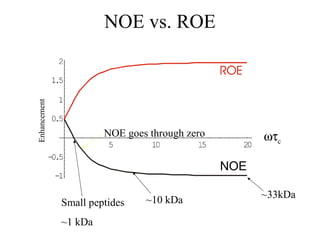
NOE vs. ROE 
Enhancement 
NOE goes through zero wtc 
NOE 
~10 kDa ~33kDa Small peptides 
~1 kDa
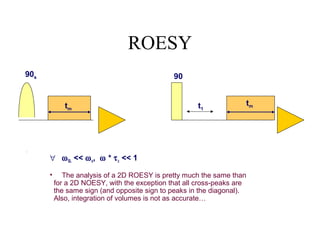
ROESY 
90 
t1 
tm 
" wSL << wo, w * tc << 1 
• The analysis of a 2D ROESY is pretty much the same than 
for a 2D NOESY, with the exception that all cross-peaks are 
the same sign (and opposite sign to peaks in the diagonal). 
Also, integration of volumes is not as accurate… 
90s 
tm
t Approaches to Identifying NOEs 
• 15N- or 13C-dispersed 
(heteronuclear) 
3D 
1H 
13C 
1H 
1H 
15N 
1H 
1H 
15N 
1H 
13C 
1H 
13C 
1H 
13C 
1H 
15N 
1H 
15N 
4D 
2D 1H 1H 
3D 1H 1H 1H 
• 1H-1H (homonuclear)
2D - 3D NOE 
3D- NOESY-HSQC
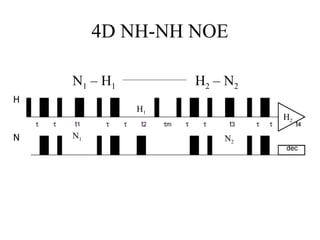
4D NH-NH NOE 
N1 – H1 H2 – N2 
N1 
H1 
N2 
H2

Noe

  • 1.
    NOE •Transferring magnetizationthrough scalar coupling is a “coherent” process. This means that all of the spins are doing the same thing at the same time. •Relaxation is an “incoherent” process, because it is caused by random fluxuations that are not coordinated. •The nuclear Overhauser effect (NOE) is in incoherent process in which two nuclear spins “cross-relax”. Recall that a single spin can relax by T1 (longitudinal or spin-latice) or T2 (transverse or spin-spin) mechanisms. Nuclear spins can also cross-relax through dipole-dipole interactions and other mechanisms. This cross relaxation causes changes in one spin through perturbations of the other spin. •The NOE is dependent on many factors. The major factors are molecular tumbling frequency and internuclear distance. The intensity of the NOE is proportional to r-6 where r is the distance between the 2 spins.
  • 2.
    Qualitative Description Twonuclear spins within about 5 Å will interact with each other through space. This interaction is called cross-relaxation, and it gives rise to the nuclear Overhauser effect (NOE). Two spins have 4 energy levels, and the transitions along the edges correspond to transitions of one or the other spin alone. W2 and W0 are the cross-relaxation pathways, which depend on the tumbling of the molecule. 2 spins I and S aa n1(***) (***) n2 ab bb n4(*) WS (1) WS (2) WI (1) WI (2) ba n3(*) W2 W0
  • 3.
    dn1/dt = -WS (1)n1-WI (1)n1–W2n1 + WS (1)n2+WI (1)n3+W2n4 … etc for n2,3,4 using: Iz= n1-n3+n2-n4 Sz= n1-n2+n3-n4 2IzSz= n1-n3-n2+n4 One gets the ‘master equation’ or Solomon equation dIz/dt = -(WI (1)+WI (2)+W2+W0)Iz – (W2-W0)Sz –(WI (1)-WI (2))2IzSz dSz/dt = -(WS (1)+WS (2)+W2+W0)Sz – (W2-W0)Iz – (WS (1)-WS (2))2IzSz d2IzSz/dt = -(WI (1)+WI (2)+ WS (1)+WS (2))2IzSz - (WS (1)-WS (2))Sz - (WI (1)-WI (2))Iz (WI (2)+W2+W0) auto relaxation rate of Iz or rI (1)+WI (WS (1)+WS (2)+W2+W0) auto relaxation rate of Rz or rR (W-W) cross relaxation rate s20IS Terms with 2IzSz can be neglected in many circumstances unless (W(1)-WI/S I/S (2)) (D-CSA ‘cross correlated relaxation’ etc …)
  • 4.
    Spectral densities J(w) W0 µ gI 2 gS 2 rIS -6 tc / [ 1 + (wI - wS)2tc 2] W2 µ gI 2 gS -6 tc / [ 1 + (wI + wS)2tc 2 rIS 2] WS µ gI 2 rIS 2 gS -6 tc / [ 1 + wS 2tc 2] WI µ gI 2 rIS 2 gS -6 tc / [ 1 + wI 2] 2tc • Since the probability of a transition depends on the different frequencies that the system has (the spectral density), the W terms are proportional the J(w). • Also, since we need two magnetic dipoles to have dipolar coupling, the NOE depends on the strength of the two dipoles involved. The strength of a dipole is proportional to rIS -3, and the Ws will depend on rIS -6: for proteins only W0 is of importance W I,S,2 << • The relationship is to the inverse sixth power of rIS, which means that the NOE decays very fast as we pull the two nuclei away from each other. • For protons, this means that we can see things which are at most 5 to 6 Å apart in the molecule (under ideal conditions…).
  • 5.
    d(Iz – Iz0)/dt= - rI (Iz–Iz0) - sIS (Sz–Sz0) d(Sz – Sz0)/dt = - sIS (Iz–Iz0) - rS (Sz–Sz0) Note that in general there is no simple mono-exponential T1 behaviour !!
  • 6.
    Steady State NOEExperiment For a ‘steady state’ with Sz saturation Sz=0 d(IzSS – Iz0)/dt = - rI (IzSS–Iz0) - sIS (0–Sz0) = 0 IzSS = sIS/rI Sz0 + Iz0 for the NOE enhancement h=(IzSS-Iz0)/ Iz0= sIS/rI Sz0/Iz0
  • 7.
    NOE difference Ultrahighquality NOE spectra: The upper spectrum shows the NOE enhancements observed when H 5 is irradiated. The NOE spectrum has been recorded using a new technique in which pulsed field gradients are used; the result is a spectrum of exceptional quality. In the example shown here, it is possible to detect the enhancement of H10 which comes from a three step transfer via H6 and H9. One-dimensional NOE experiments using pulsed field gradients, J. Magn. Reson., 1997, 125, 302.
  • 8.
    Transient NOE experiment Solve the Solomon equation With the initial condition Iz(0)=Iz0 Sz(0)=-Sz0 For small mixing times tm the ‘linear approximation’ applies: d(Iz(t)– Iz0)/dt = -r(Iz(t)–Iz0) - s(Sz–Sz0) ~ 2 sSz0 IISISValid for trand ts<< 1 mS mIS (i.e. S is still inverted and very little transfer from S) h(t) = (Iz(t) - Iz0)/ Iz0 = 2stmm IS m The NOE enhancement is proportional to sIS !
  • 9.
    Longer mixing times a system of coupled differential equations can be solved by diagonalization or by numerical integration Multi-exponential solution: the exponentials are the Eigenvalues of the relaxation matrix
  • 10.
    NOESY The selectiveS inversion is replaced with a t1evolution period Sz(0)=cosWSt1Sz0, Iz(0)=cosWIt1Iz0 (using the initial rate appx.) Sz(tm)=sIStmIz0 + rStmSz0 (a) +cosWIt1[sIStm]Iz0 (b) +cosWSt1[rStm-1]Sz0 (c)
  • 11.
    NOE vs. ROE Enhancement NOE goes through zero wtc NOE ~10 kDa ~33kDa Small peptides ~1 kDa
  • 12.
    ROESY 90 t1 tm " wSL << wo, w * tc << 1 • The analysis of a 2D ROESY is pretty much the same than for a 2D NOESY, with the exception that all cross-peaks are the same sign (and opposite sign to peaks in the diagonal). Also, integration of volumes is not as accurate… 90s tm
  • 13.
    t Approaches toIdentifying NOEs • 15N- or 13C-dispersed (heteronuclear) 3D 1H 13C 1H 1H 15N 1H 1H 15N 1H 13C 1H 13C 1H 13C 1H 15N 1H 15N 4D 2D 1H 1H 3D 1H 1H 1H • 1H-1H (homonuclear)
  • 14.
    2D - 3DNOE 3D- NOESY-HSQC
  • 15.
    4D NH-NH NOE N1 – H1 H2 – N2 N1 H1 N2 H2