1
Dr. MishuSingh
Department of Chemistry
Maharana Paratap Govt. P.G College
Hardoi.MISHU SINGH
Conformations
The infinite number of arrangements of the atoms or groups of a
molecule in three dimentional space which are interconvertible into
each other by rotation about single bond are called Conformations or
Rotational Isomers or simply Rotamers.
These conformers have different internal dimensions (atom-to-atom
distances, dihedral angles, dipole moment etc.)
.
The energy barrier for rotation of carbon-carbon single bonds
(conversion of different spatial arrangements) is normally small, < 0.6
kcal/mol and >16 kcal/mol.
2MISHU SINGH
3
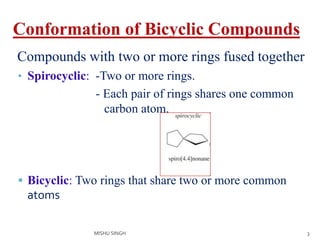
Compounds with two or more rings fused together
• Spirocyclic: -Two or more rings.
- Each pair of rings shares one common
carbon atom.
 Bicyclic: Two rings that share two or more common
atoms
MISHU SINGH
4
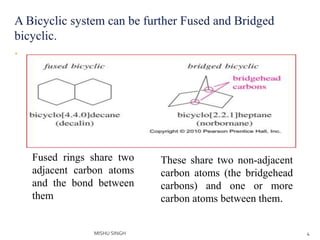
These share two non-adjacent
carbon atoms (the bridgehead
carbons) and one or more
carbon atoms between them.
Fused rings share two
adjacent carbon atoms
and the bond between
them
MISHU SINGH
5
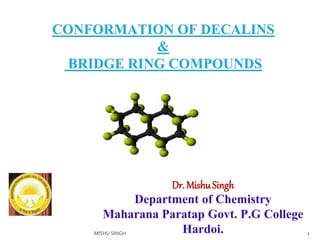
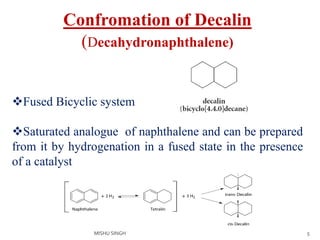
Confromation of Decalin
(Decahydronaphthalene)
Fused Bicyclic system
Saturated analogue of naphthalene and can be prepared
from it by hydrogenation in a fused state in the presence
of a catalyst
MISHU SINGH
6MISHU SINGH
7
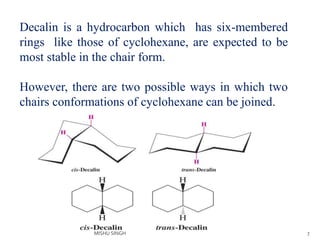
Decalin is a hydrocarbon which has six-membered
rings like those of cyclohexane, are expected to be
most stable in the chair form.
However, there are two possible ways in which two
chairs conformations of cyclohexane can be joined.
MISHU SINGH
8
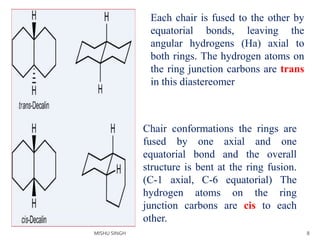
Chair conformations the rings are
fused by one axial and one
equatorial bond and the overall
structure is bent at the ring fusion.
(C-1 axial, C-6 equatorial) The
hydrogen atoms on the ring
junction carbons are cis to each
other.
Each chair is fused to the other by
equatorial bonds, leaving the
angular hydrogens (Ha) axial to
both rings. The hydrogen atoms on
the ring junction carbons are trans
in this diastereomer
MISHU SINGH
Symmetry
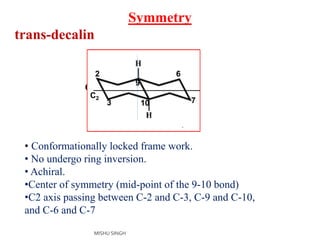
trans-decalin
• Conformationally locked frame work.
• No undergo ring inversion.
• Achiral.
•Center of symmetry (mid-point of the 9-10 bond)
•C2 axis passing between C-2 and C-3, C-9 and C-10,
and C-6 and C-7
6
7
C2
9
103
2 6
7
MISHU SINGH
10
.
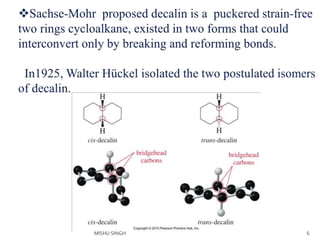
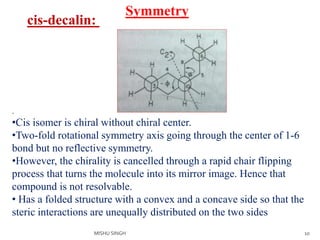
•Cis isomer is chiral without chiral center.
•Two-fold rotational symmetry axis going through the center of 1-6
bond but no reflective symmetry.
•However, the chirality is cancelled through a rapid chair flipping
process that turns the molecule into its mirror image. Hence that
compound is not resolvable.
• Has a folded structure with a convex and a concave side so that the
steric interactions are unequally distributed on the two sides
cis-decalin:
Symmetry
MISHU SINGH
11
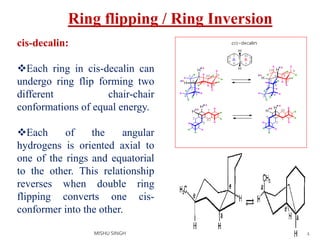
cis-decalin:
Each ring in cis-decalin can
undergo ring flip forming two
different chair-chair
conformations of equal energy.
Each of the angular
hydrogens is oriented axial to
one of the rings and equatorial
to the other. This relationship
reverses when double ring
flipping converts one cis-
conformer into the other.
Ring flipping / Ring Inversion
MISHU SINGH
12
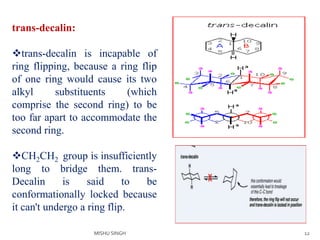
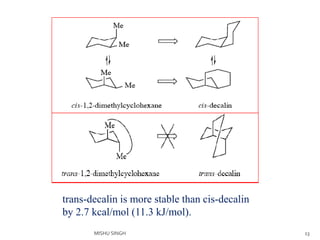
trans-decalin:
trans-decalin is incapable of
ring flipping, because a ring flip
of one ring would cause its two
alkyl substituents (which
comprise the second ring) to be
too far apart to accommodate the
second ring.
CH2CH2 group is insufficiently
long to bridge them. trans-
Decalin is said to be
conformationally locked because
it can't undergo a ring flip.
MISHU SINGH
13
trans-decalin is more stable than cis-decalin
by 2.7 kcal/mol (11.3 kJ/mol).
MISHU SINGH
14
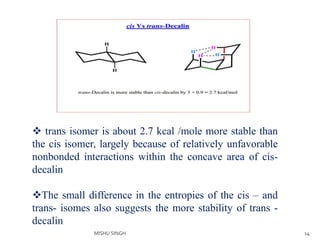
 trans isomer is about 2.7 kcal /mole more stable than
the cis isomer, largely because of relatively unfavorable
nonbonded interactions within the concave area of cis-
decalin
The small difference in the entropies of the cis – and
trans- isomes also suggests the more stability of trans -
decalin
MISHU SINGH
15
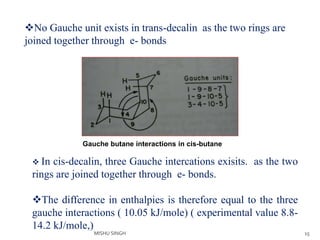
No Gauche unit exists in trans-decalin as the two rings are
joined together through e- bonds
 In cis-decalin, three Gauche intercations exisits. as the two
rings are joined together through e- bonds.
The difference in enthalpies is therefore equal to the three
gauche interactions ( 10.05 kJ/mole) ( experimental value 8.8-
14.2 kJ/mole,)
Gauche butane interactions in cis-butane
MISHU SINGH
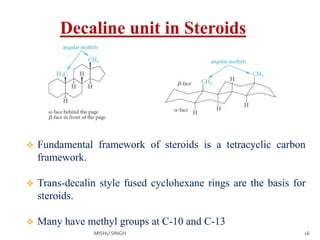
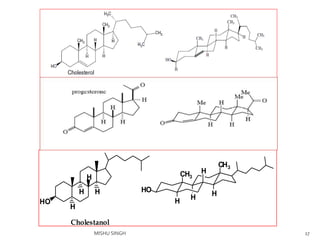
 Fundamental framework of steroids is a tetracyclic carbon
framework.
 Trans-decalin style fused cyclohexane rings are the basis for
steroids.
 Many have methyl groups at C-10 and C-13
16MISHU SINGH
HO
Cholestanol
H
H H
H CH3
CH3
H
H
HO
H
H
17MISHU SINGH
18
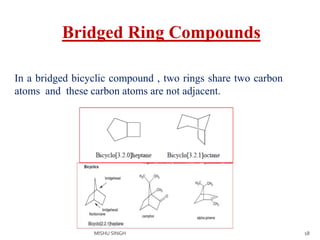
Bridged Ring Compounds
In a bridged bicyclic compound , two rings share two carbon
atoms and these carbon atoms are not adjacent.
MISHU SINGH
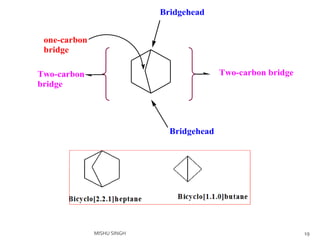
Two-carbon bridgeTwo-carbon
bridge
Bridgehead
Bridgehead
one-carbon
bridge
19MISHU SINGH
Bicyclo [ 1.1.1] pentane
 Smallest bridge ring system
 Bridged head C are very close due to very small endocyclic
valency angle i.e..72.5 0
 Unstable and converts to 1,4 pentadiene on heating.
1,4-pentadiene
3000 C
Endocyclic valency angle 72.5
MISHU SINGH
21
Bicyclo [ 2.2.1] heptane ( Norborane)
(B)
(E)(D)(C)
(A)
C-1 & C-4 are joined by methylene bridge to give boat conformation.
System is strained because of two eclipsed butane units in boat.
 Out of the 6 H’s at C-2, C-3, C-5, C-6
HA, HA` - boat – equatorial orientation
HB, HB`- boat –axial orientation
MISHU SINGH
22
Bicyclo [ 2.2.2] octane
C-1 & C-4 are joined by ethylene bridge.
 In its idealized form the system has all the adjacent positions
eclipsed.
MISHU SINGH
23
Other Bridge Ring Systems
Bicylo[ 3.1.1] heptane 3-Methyl Bicylo[ 3.1.1] heptane Bicylo[ 3.2.1] octane
Bicylo[ 3.3.1] nonane
Chair-chair
conformation
Bicylo[ 3.3.1] nonane
Boat –chair
conformation
Bicylo[ 3.3.1] nonane
Boat-boat conformation
MISHU SINGH
Propellanes & Admantane
When the two bridgehead atoms are joined by a single bond, a
tricyclic system is formed where the three rings share two
bridgehead atoms, these are called Propellanes.
A tricyclic compound may be formed by 4 bridgehead carbon
atoms as in case of Admentane.( C-3,C-5,C-7,C-10)
Tricyclo[1.1.1.0]pentane Tricyclo[3.2.1.0] octane
MISHU SINGH
25MISHU SINGH

Decalins

  • 1.
    1 Dr. MishuSingh Department ofChemistry Maharana Paratap Govt. P.G College Hardoi.MISHU SINGH
  • 2.
    Conformations The infinite numberof arrangements of the atoms or groups of a molecule in three dimentional space which are interconvertible into each other by rotation about single bond are called Conformations or Rotational Isomers or simply Rotamers. These conformers have different internal dimensions (atom-to-atom distances, dihedral angles, dipole moment etc.) . The energy barrier for rotation of carbon-carbon single bonds (conversion of different spatial arrangements) is normally small, < 0.6 kcal/mol and >16 kcal/mol. 2MISHU SINGH
  • 3.
    3 Compounds with twoor more rings fused together • Spirocyclic: -Two or more rings. - Each pair of rings shares one common carbon atom.  Bicyclic: Two rings that share two or more common atoms MISHU SINGH
  • 4.
    4 These share twonon-adjacent carbon atoms (the bridgehead carbons) and one or more carbon atoms between them. Fused rings share two adjacent carbon atoms and the bond between them MISHU SINGH
  • 5.
    5 Confromation of Decalin (Decahydronaphthalene) FusedBicyclic system Saturated analogue of naphthalene and can be prepared from it by hydrogenation in a fused state in the presence of a catalyst MISHU SINGH
  • 6.
  • 7.
    7 Decalin is ahydrocarbon which has six-membered rings like those of cyclohexane, are expected to be most stable in the chair form. However, there are two possible ways in which two chairs conformations of cyclohexane can be joined. MISHU SINGH
  • 8.
    8 Chair conformations therings are fused by one axial and one equatorial bond and the overall structure is bent at the ring fusion. (C-1 axial, C-6 equatorial) The hydrogen atoms on the ring junction carbons are cis to each other. Each chair is fused to the other by equatorial bonds, leaving the angular hydrogens (Ha) axial to both rings. The hydrogen atoms on the ring junction carbons are trans in this diastereomer MISHU SINGH
  • 9.
    Symmetry trans-decalin • Conformationally lockedframe work. • No undergo ring inversion. • Achiral. •Center of symmetry (mid-point of the 9-10 bond) •C2 axis passing between C-2 and C-3, C-9 and C-10, and C-6 and C-7 6 7 C2 9 103 2 6 7 MISHU SINGH
  • 10.
    10 . •Cis isomer ischiral without chiral center. •Two-fold rotational symmetry axis going through the center of 1-6 bond but no reflective symmetry. •However, the chirality is cancelled through a rapid chair flipping process that turns the molecule into its mirror image. Hence that compound is not resolvable. • Has a folded structure with a convex and a concave side so that the steric interactions are unequally distributed on the two sides cis-decalin: Symmetry MISHU SINGH
  • 11.
    11 cis-decalin: Each ring incis-decalin can undergo ring flip forming two different chair-chair conformations of equal energy. Each of the angular hydrogens is oriented axial to one of the rings and equatorial to the other. This relationship reverses when double ring flipping converts one cis- conformer into the other. Ring flipping / Ring Inversion MISHU SINGH
  • 12.
    12 trans-decalin: trans-decalin is incapableof ring flipping, because a ring flip of one ring would cause its two alkyl substituents (which comprise the second ring) to be too far apart to accommodate the second ring. CH2CH2 group is insufficiently long to bridge them. trans- Decalin is said to be conformationally locked because it can't undergo a ring flip. MISHU SINGH
  • 13.
    13 trans-decalin is morestable than cis-decalin by 2.7 kcal/mol (11.3 kJ/mol). MISHU SINGH
  • 14.
    14  trans isomeris about 2.7 kcal /mole more stable than the cis isomer, largely because of relatively unfavorable nonbonded interactions within the concave area of cis- decalin The small difference in the entropies of the cis – and trans- isomes also suggests the more stability of trans - decalin MISHU SINGH
  • 15.
    15 No Gauche unitexists in trans-decalin as the two rings are joined together through e- bonds  In cis-decalin, three Gauche intercations exisits. as the two rings are joined together through e- bonds. The difference in enthalpies is therefore equal to the three gauche interactions ( 10.05 kJ/mole) ( experimental value 8.8- 14.2 kJ/mole,) Gauche butane interactions in cis-butane MISHU SINGH
  • 16.
     Fundamental frameworkof steroids is a tetracyclic carbon framework.  Trans-decalin style fused cyclohexane rings are the basis for steroids.  Many have methyl groups at C-10 and C-13 16MISHU SINGH
  • 17.
  • 18.
    18 Bridged Ring Compounds Ina bridged bicyclic compound , two rings share two carbon atoms and these carbon atoms are not adjacent. MISHU SINGH
  • 19.
  • 20.
    Bicyclo [ 1.1.1]pentane  Smallest bridge ring system  Bridged head C are very close due to very small endocyclic valency angle i.e..72.5 0  Unstable and converts to 1,4 pentadiene on heating. 1,4-pentadiene 3000 C Endocyclic valency angle 72.5 MISHU SINGH
  • 21.
    21 Bicyclo [ 2.2.1]heptane ( Norborane) (B) (E)(D)(C) (A) C-1 & C-4 are joined by methylene bridge to give boat conformation. System is strained because of two eclipsed butane units in boat.  Out of the 6 H’s at C-2, C-3, C-5, C-6 HA, HA` - boat – equatorial orientation HB, HB`- boat –axial orientation MISHU SINGH
  • 22.
    22 Bicyclo [ 2.2.2]octane C-1 & C-4 are joined by ethylene bridge.  In its idealized form the system has all the adjacent positions eclipsed. MISHU SINGH
  • 23.
    23 Other Bridge RingSystems Bicylo[ 3.1.1] heptane 3-Methyl Bicylo[ 3.1.1] heptane Bicylo[ 3.2.1] octane Bicylo[ 3.3.1] nonane Chair-chair conformation Bicylo[ 3.3.1] nonane Boat –chair conformation Bicylo[ 3.3.1] nonane Boat-boat conformation MISHU SINGH
  • 24.
    Propellanes & Admantane Whenthe two bridgehead atoms are joined by a single bond, a tricyclic system is formed where the three rings share two bridgehead atoms, these are called Propellanes. A tricyclic compound may be formed by 4 bridgehead carbon atoms as in case of Admentane.( C-3,C-5,C-7,C-10) Tricyclo[1.1.1.0]pentane Tricyclo[3.2.1.0] octane MISHU SINGH
  • 25.