Electronic spectra of metals
and their complexes.
Supervided by:
Prof. Issa M. El-Nahhal.
Prepared by:
Nehal S. Tabassi.
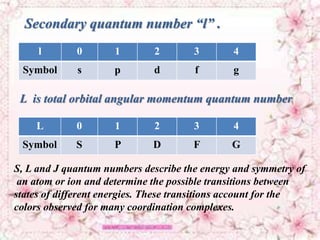
Secondary quantum number “l” .
L is total orbital angular momentum quantum number
l 0 1 2 3 4
Symbol s p d f g
L 0 1 2 3 4
Symbol S P D F G
S, L and J quantum numbers describe the energy and symmetry of
an atom or ion and determine the possible transitions between
states of different energies. These transitions account for the
colors observed for many coordination complexes.
Electronic spectra
There is tow types of transition in coordination
compounds :
d-d transition in metals.
Charge-Transfer Transition in complexes.
d-d transition in metals.
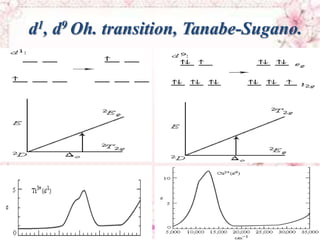
d1, d9 Oh. transition, Tanabe-Sugano.
d2, d8Oh. transition, Tanabe-Sugano.
d3, d7 Oh. transition, Tanabe-Sugano.
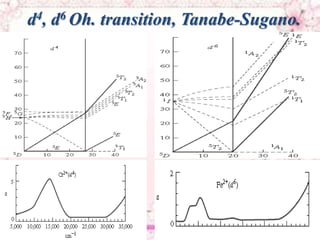
d4, d6 Oh. transition, Tanabe-Sugano.
d5 Oh. transition, Tanabe-Sugano.
Charge-Transfer transition
• Charge-transfer band arise from the movement of
electrons between orbitals that are predominantly
ligand in character and orbitals that are
predominantly metal in character.
• These transitions are identified by their high
intensity and the sensitivity of their energies to
solvent polarity.
•Absorption for charge transfer transition is more
intense than d–d transitions. (Ɛd-d =20 L mol-1 cm-1 or less,
Ɛcharge-transfer =50,000 L mol-1 cm-1 or greater)
Charge-Transfer transition
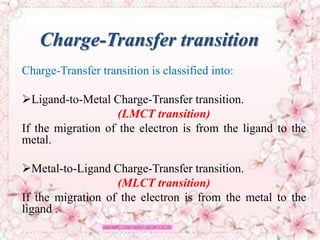
Charge-Transfer transition is classified into:
Ligand-to-Metal Charge-Transfer transition.
(LMCT transition)
If the migration of the electron is from the ligand to the
metal.
Metal-to-Ligand Charge-Transfer transition.
(MLCT transition)
If the migration of the electron is from the metal to the
ligand .
Ligand-to-Metal Charge-Transfer
transition.
•Ligands possess σ, σ*, π, π*, and nonbonding (n) molecular orbitals.
• If the ligand molecular orbitals are full, charge transfer may occur
from the ligand molecular orbitals to the empty or partially filled metal
d-orbitals.
•LMCT transitions result in intense bands. Forbidden d-d transitions
may also take place giving rise to weak absorptions.
• Ligand to metal charge transfer results in the reduction of the metal.
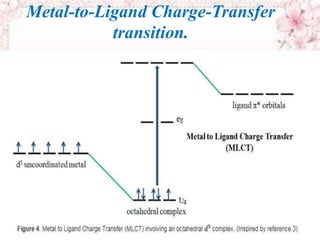
Metal-to-Ligand Charge-Transfer
transition.
•If the metal is in a low oxidation state (electron rich) and
the ligand possesses low-lying empty orbitals (e.g., CO or
CN − ).
•LMCT transitions are common for coordination
compounds having π-acceptor ligands.
• Upon the absorption of light, electrons in the metal
orbitals are excited to the ligand π* orbitals.
•MLCT transitions result in intense bands. Forbidden d – d
transitions may also occur.
• This transition results in the oxidation of the metal.
Metal-to-Ligand Charge-Transfer
transition.
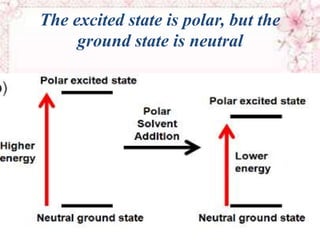
Effect of Solvent Polarity on CT Spectra
You are preparing a sample for a UV/Vis experiment and you decide
to use a polar solvent. Is a shift in wavelength observed when:
 Both the ground state and the excited state are neutral .
 The excited state is polar, but the ground state is neutral
 The ground state and excited state is polar
 The ground state is polar and the excited state is neutral
The excited state is polar, but the
ground state is neutral
The ground state and excited state is
polar
The ground state is polar and the
excited state is neutral
Electronic spectra

Electronic spectra

  • 1.
    Electronic spectra ofmetals and their complexes. Supervided by: Prof. Issa M. El-Nahhal. Prepared by: Nehal S. Tabassi.
  • 2.
    Secondary quantum number“l” . L is total orbital angular momentum quantum number l 0 1 2 3 4 Symbol s p d f g L 0 1 2 3 4 Symbol S P D F G S, L and J quantum numbers describe the energy and symmetry of an atom or ion and determine the possible transitions between states of different energies. These transitions account for the colors observed for many coordination complexes.
  • 5.
    Electronic spectra There istow types of transition in coordination compounds : d-d transition in metals. Charge-Transfer Transition in complexes.
  • 6.
  • 8.
    d1, d9 Oh.transition, Tanabe-Sugano.
  • 9.
    d2, d8Oh. transition,Tanabe-Sugano.
  • 10.
    d3, d7 Oh.transition, Tanabe-Sugano.
  • 11.
    d4, d6 Oh.transition, Tanabe-Sugano.
  • 12.
    d5 Oh. transition,Tanabe-Sugano.
  • 13.
    Charge-Transfer transition • Charge-transferband arise from the movement of electrons between orbitals that are predominantly ligand in character and orbitals that are predominantly metal in character. • These transitions are identified by their high intensity and the sensitivity of their energies to solvent polarity. •Absorption for charge transfer transition is more intense than d–d transitions. (Ɛd-d =20 L mol-1 cm-1 or less, Ɛcharge-transfer =50,000 L mol-1 cm-1 or greater)
  • 14.
    Charge-Transfer transition Charge-Transfer transitionis classified into: Ligand-to-Metal Charge-Transfer transition. (LMCT transition) If the migration of the electron is from the ligand to the metal. Metal-to-Ligand Charge-Transfer transition. (MLCT transition) If the migration of the electron is from the metal to the ligand .
  • 15.
    Ligand-to-Metal Charge-Transfer transition. •Ligands possessσ, σ*, π, π*, and nonbonding (n) molecular orbitals. • If the ligand molecular orbitals are full, charge transfer may occur from the ligand molecular orbitals to the empty or partially filled metal d-orbitals. •LMCT transitions result in intense bands. Forbidden d-d transitions may also take place giving rise to weak absorptions. • Ligand to metal charge transfer results in the reduction of the metal.
  • 16.
    Metal-to-Ligand Charge-Transfer transition. •If themetal is in a low oxidation state (electron rich) and the ligand possesses low-lying empty orbitals (e.g., CO or CN − ). •LMCT transitions are common for coordination compounds having π-acceptor ligands. • Upon the absorption of light, electrons in the metal orbitals are excited to the ligand π* orbitals. •MLCT transitions result in intense bands. Forbidden d – d transitions may also occur. • This transition results in the oxidation of the metal.
  • 17.
  • 19.
    Effect of SolventPolarity on CT Spectra You are preparing a sample for a UV/Vis experiment and you decide to use a polar solvent. Is a shift in wavelength observed when:  Both the ground state and the excited state are neutral .  The excited state is polar, but the ground state is neutral  The ground state and excited state is polar  The ground state is polar and the excited state is neutral
  • 20.
    The excited stateis polar, but the ground state is neutral
  • 21.
    The ground stateand excited state is polar
  • 22.
    The ground stateis polar and the excited state is neutral