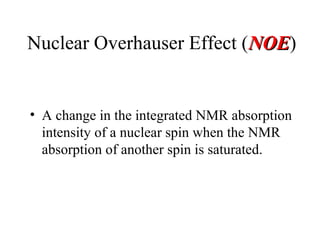
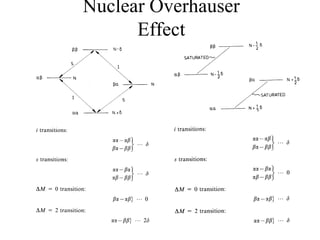
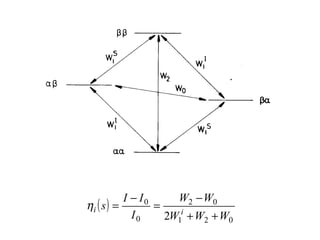
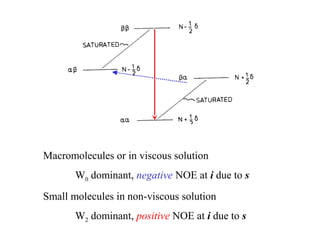
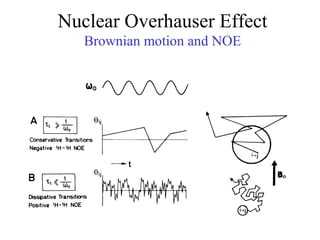
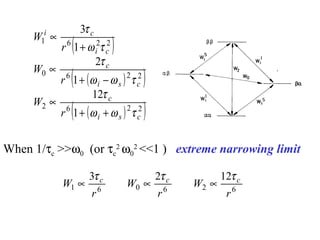
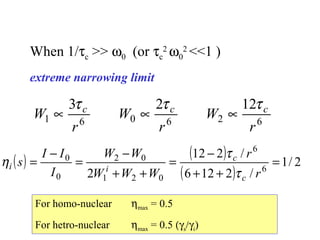
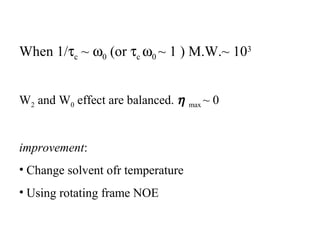
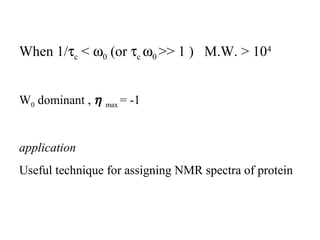
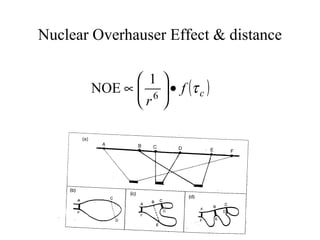
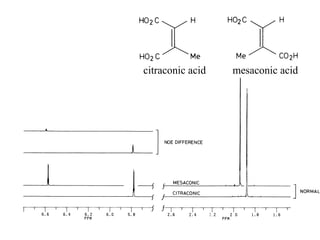
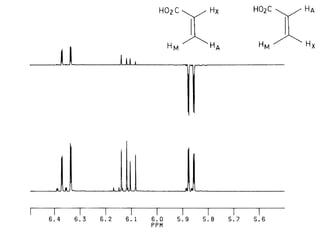
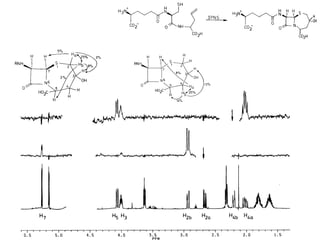
The Nuclear Overhauser Effect (NOE) describes a change in the NMR signal intensity of one nuclear spin when a nearby spin is saturated. There are two main relaxation mechanisms, W0 and W2, that determine whether the NOE will be positive or negative. W0 typically leads to a negative NOE for macromolecules or in viscous solutions, while W2 usually gives a positive NOE for small molecules in non-viscous solutions. The magnitude of the NOE depends on factors like molecular weight, temperature, and solvent and can provide information about internuclear distances that is useful for assigning protein NMR spectra.


![UV SPECTROSCOPY [ULTRA-VIOLET SPECTROSCOPY]](https://cdn.slidesharecdn.com/ss_thumbnails/40-191218142647-thumbnail.jpg?width=640&height=640&fit=bounds)


