Stereochemistry of cyclohexane
• Name of students - 1.Dalvi Shraddha kishor -----
2.Sontakke Pratibha Tanaji
• Class - SY B.Sc B.Ed
• College – Department of Education and Extension
,SPPU , Pune
• Subject – Chemistry
Introduction
• Cyclic Compounds :-
organic compounds in which
the carbon atoms are
arranged in ring structures
are called as cyclic
compounds.
• General molecular formula is
CnH2n
• The first two members cyclopropane and cyclobutane show mark differences in
their chemical behaviour as compared to the others both of them have the
tendency of undergoing edition reaction and the ring brakes to form stable open
chain compound.
Baeyer strain theory
• Cycloalkanes contain sp3 hybrid carbons, the normal tetrahedral bond angle would be 109.5°.
• In the formation of ring structures, this angle will have to be deformed.
• Baeyer thought that cyclopropane, cyclobutane ring systems are unstable due to presence of angles
train in the molecule. Because of these angle strain these ring system have tendency to open the ring
so that these angles strain is relieved.
• How does the angle strain arise in these molecules?
• Baeyer has assumed that these rings are planar geometrical polygons and calculated the angles strain
for various alkane. In order to maintain the planarity , in cyclopropane, the deformation required is
from109.5° to 60° while in case of cyclobutane it is from 109.5° to 90° such De formation in bond
angle leads to the angle strain.
• Angle Strain :- Tetrahedral angle – Internal angle
=109.5° - Internal angle
• Baeyer proposed that as the angles strain increases the stability of the ring
decreases.
Heat of combustion and stabilities of cyclo alkanes
• Heat of Combustion :- It is defined as the amount of heat evolved when
one mole of the compound is completilly oxidised the general equation for
heat of combustion for cycloalkanes is,
(CH2)n + 3/2nO2 nCO2 + n H2O + Heat
Cycloalkane
(where, n=size of the ring i.e. no. of carbon atoms in the ring)
Relative Ring Strain = 157.4 – (Heat of combustion per -CH2 group.)
• Observations :-
1. If heat of combustion per –CH2– is 157.4 kcal/mole then the cycloalkane is as stable as open chain alkane e.g. cyclohexane.
2. If heat of combustion per–CH2– is less than 157.4 kcal/mole then the cycloalkane is more stable than the open chain alkane.
3. If heat of combustion per –CH2– is more than 157.4 kcal/mole then the cycloalkane is less stable than open chain alkane. e.g.
Cyclopropane, cyclobutane.
• As the heat of combustion per CH2 becomes more and more than that of open chain alkanes, stability of cycloalkane decreases.
4. Heat of combustion per –CH2– group in cyclohexane is nearly the same as that in open chain alkane. Therefore, cyclohexane is a stable
as open chain compound. As open chain compounds are free from angle strain; cyclohexane should also be free from any angles strain.
5. The relative angle strain in 7,8 and higher membered rings is very small and compounds with ring size greater than 15 are in fact more
stable then cyclohexane and are completely free from strain.
Why baeyer’s Strain theory failed ?
1. Baeyer’s Strain theory cannot be applied to rings larger than four members, because the
first false assumption he made was that ,all the ring compounds were planar .
2. If large rings are stable why are the difficult to synthesize? Here we come across Baeyer’s
second falls assumption. A compound is difficult to synthesize does not necessary means
that, it is unstable.
• For ring closing ,the two ends of the chain should be brought closer enough to each other
for bond formation.
• For synthesizing large ring compounds, as the length of carbon chain increases, the
probability of ring closing decreases and that of chain lengthening increases.
Conformation of cyclic compounds
• In 1980, Sachse suggested that cyclohexane is a non-planar molecule and
exists in two conformations that are free of angle strain,
1. Chaiye conformation
2. Boat conformation
• Sachse-Mohr Theory :- Provided a very strong support for the existence of
chair and boat conformation of cyclohexane and since then the study of
conformation of cyclohexane is known as Sachse Mohr theory .
+91 78897 94962
Factors affecting the stability of conformations
• Angle strain :- Any deviation from the normal
tetrahedral bond angle (109.5°) causes the angle
strain in the molecule and hence decreases the
stability of the molecules due to poor overlap of
atomic orbital in the formation of C-C bonds.
In cyclopropane,even though all the carbon atom are
sp3 hybridised,the internal bond angle compressed
from 109.5°to 60°. This introduces an angle strain
2. Torsional Strain
• Staggered configuration is more stable than eclipsed
conformation. Therefore, any deviation from the
staggered conformation is responsible for torsional
strain due to which the internal energy increase in
and the stability of confirmation decreases.
• If non-bonded interactions are repulsive, they
destabilize the conformation and if attractive,they
stabilize the conformation.
Dipole – dipole interaction
• It is the attraction of the positive end of the polar molecule for the negative end of
the another polar molecule(e.g.HF).
• Polar molecules are generally held to each other most strongly then non polar
molecule of comparable molecular weight the special kind of dipole dipole
interaction is hydrogen bonding in which hydrogen sulphur is a bridge between two
electro negative atom holding one by covalent bond and the other by purely
electrostatic force.
• Hydrogen Bonding is generally indicated by dashed lines.
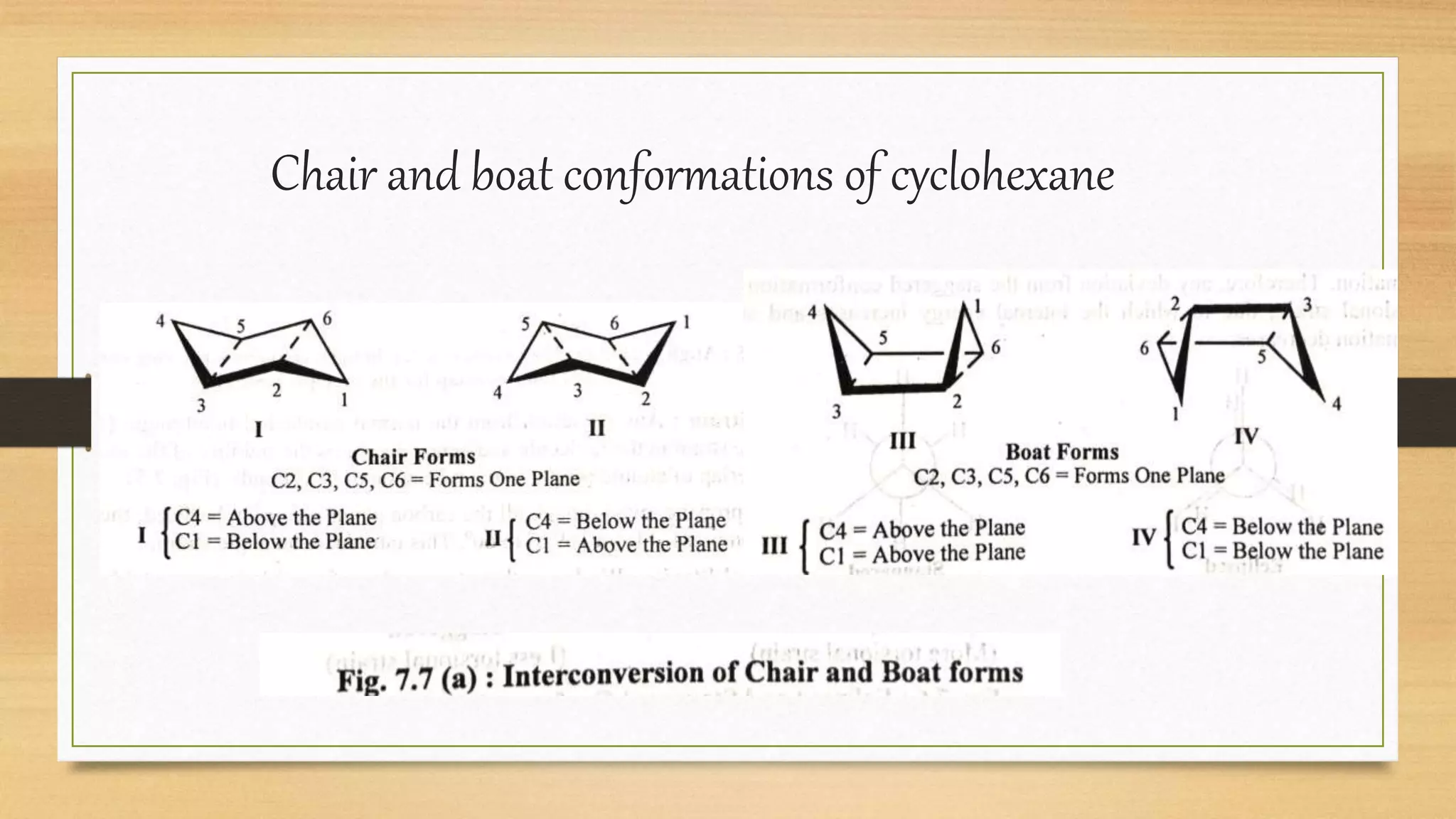
Chair and boat conformations of cyclohexane
Equatorial and Axial ‘H’ atoms in Cyclohexane
• Axial hydrogen :- in the chair confirmation there are 6 hydrogen atom which are perpendicular to the
average plane and parallel to the axis passing through the centre are known as axial hydrogens.
• Equatorial hydrogen:- In the chair form there are 6 hydrogen atoms at which are projecting outward
and are in the average plane of the ring are known as equatorial hydrogen ,the bond holding these
hydrogens are the equatorial bond.
Ring Flipping
• When one form of the chair is converted into another chair, it is known as ring
Flipping.
• After ring Flipping the axial 'H’ atoms becomes equatorial 'H’atoms and equatorial ‘H’
atoms become Axial ‘H’ atoms.
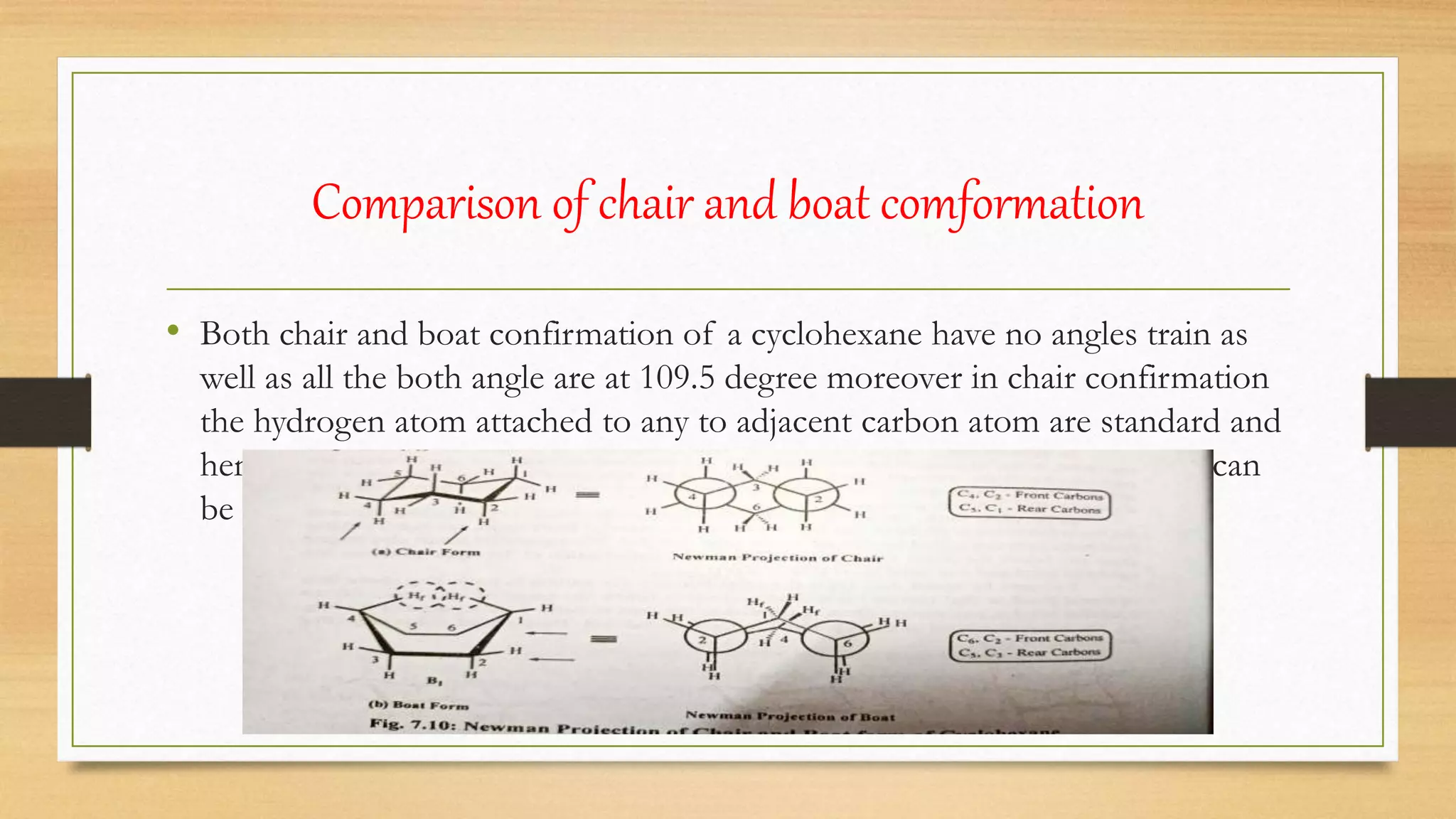
Comparison of chair and boat comformation
• Both chair and boat confirmation of a cyclohexane have no angles train as
well as all the both angle are at 109.5 degree moreover in chair confirmation
the hydrogen atom attached to any to adjacent carbon atom are standard and
hence the torsional strain is minimum the strainfree share confirmation can
be verified by drawing the newman projection formula
Skew boat or Twist boat
Skew boat or Twist boatA modified boat conformation has been suggested in
which the flag pole hydrogens are moved away and therefore van der Waals
strain or steric strain decreases. Similarly the torsional interactions due to
eclipsing hydrogens are also decreased to some extent. Such a boat is known as
skew boat or twist boat conformation. (
Half chair conformation
When bottom carbon of chair conformation is lifted upwards, so that, five
carbons are in the same plane (Fig. 7.12) and only one carbon is above the
plane, such a conformation is called as half chair conformation.
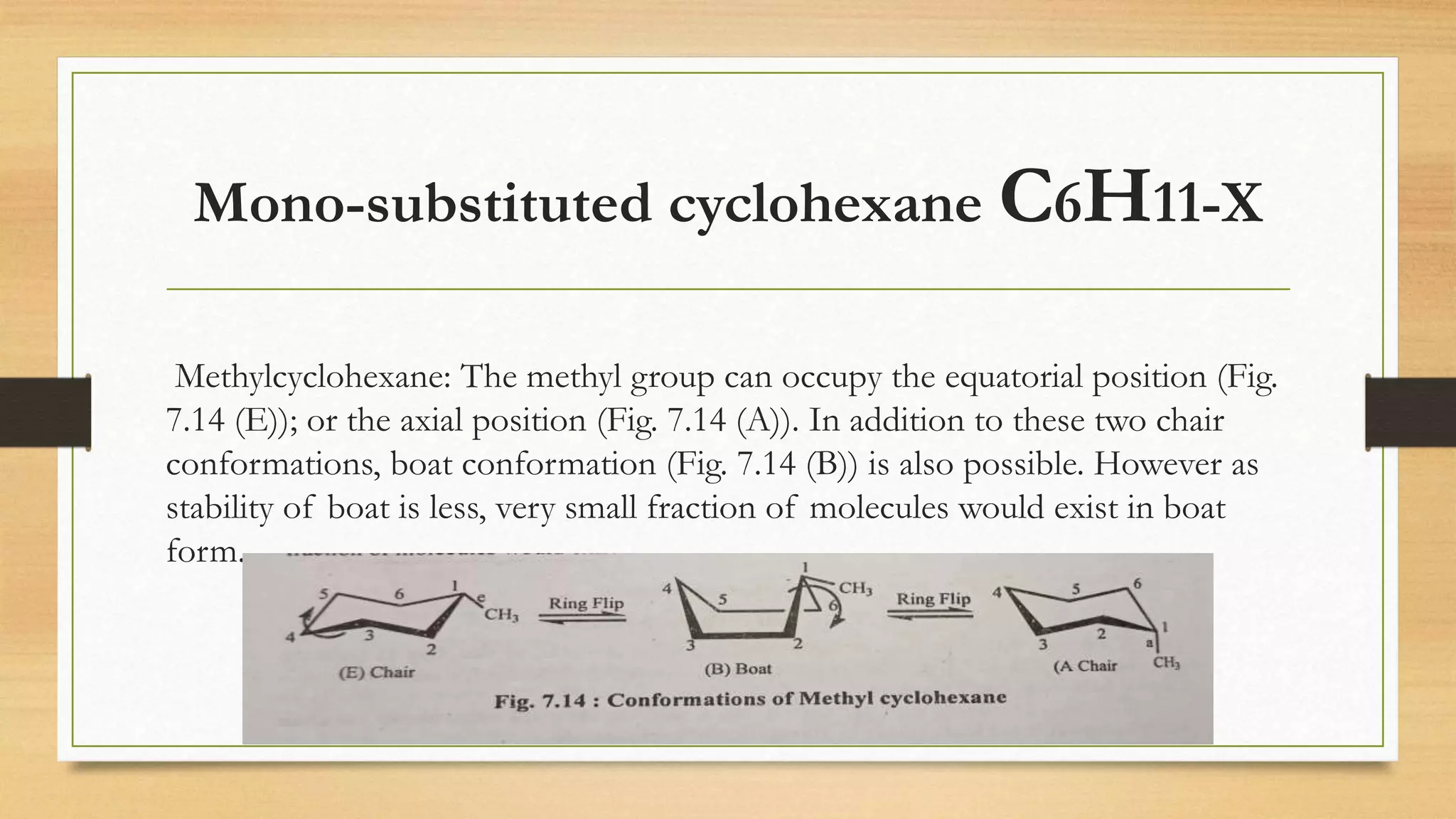
Mono-substituted cyclohexane C6H11-X
Methylcyclohexane: The methyl group can occupy the equatorial position (Fig.
7.14 (E)); or the axial position (Fig. 7.14 (A)). In addition to these two chair
conformations, boat conformation (Fig. 7.14 (B)) is also possible. However as
stability of boat is less, very small fraction of molecules would exist in boat
form.
Effect of Size of the substituent
As the effect of the size (or bulk) of the substituent increases, the 1,3-diaxial
interactions become more prominent. As the energy difference between the
axial and equatorial conformation increases, the equatorial conformer becomes
more and predominant. Table 7.3 indicates differences in the energy for the
axial and equatorial isomers for the monosubstituted cyclohexane.
t-butyl cyclohexane (Locking of Conformation)
When we have a heavily crowded substituent such as tertiary butyl group, the
1,3diaxial interactions in the axial conformation ) are so severe that this
molecule almost exclusively exists in the equatorial conformation Only . In
other words, the t-butyl group is locked (blocked) at equatorial position. This
phenomenon is called as 'Locking of Conformation".
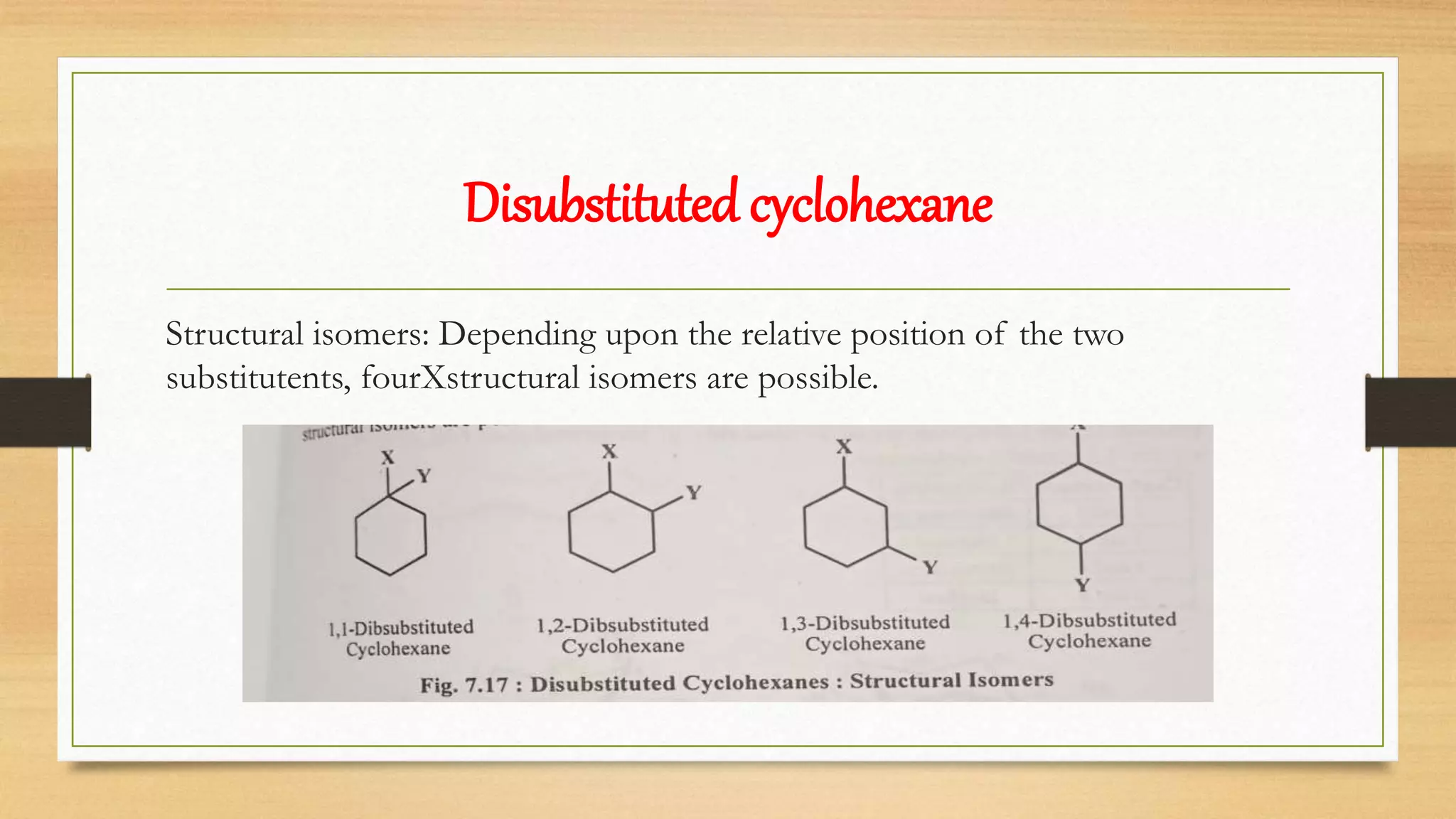
Disubstituted cyclohexane
Structural isomers: Depending upon the relative position of the two
substitutents, fourXstructural isomers are possible.
Type 1: 1,1-Disubstituted Cyclohexane
When both substituents are present on the same carbon atom, such
compounds are called as 1,1-disubstituted cyclohexane derivatives.
1)Geometrical Isomerism: Since both substituents are
present on the same carbon atom, such compounds
do not show geometrical isomerism
2).2) Optical Isomerism: The molecule possesses a
plane of symmetry (plane that includes both X and Y
and divides the molecule into two equal parts and
hence optical isomerism is not possible.
3) Conformational isomers: 1,1 disubstituted cyclohexane will exist in two
distinct chair conformation boat and skew boat conformations are also
possible however, we will consider only chair conformations as they are most
stable and most of the molecules prefer to exist in chair conformation. In :A^
prime the substituent X is occupying the axial position while Y is at the
equatorial position. If the ring A flips, we get B in which the positions of the
two groups have beeninverted.
4) Relative Stabilities: Whether the conformation ' `^ prime A^ prime is
more stable or B is more that will depend upon the relative sizes of the
groups X and Y. That conformation will be more stable in which the bulkier
substituent will occupy the equatorial position. Thus, if `X is bulkier that Y,
then conformation 'B' is more stable than A. On the other hand if y is bulkier
than X, then conformation 'A' is more stable than "B".In case both
substituents are alike i.e. X = Y , then both conformation will be identical.
Type 2: 1,2-Disubstituted
Cyclohexane
(A) Cis - isomer (a,e form):
One substituent is in axial and
the other in the equatorial
position, i.e. the substituents
are on the same side of the
general plane ()e.g. cis-1,2
dimethyl cyclohexane.
Optical Isomers: we see that cis 1,2-dimethyl cyclohexane has no element of
symmetry and therefore is expected to be optically active. However, it is
found that the
compound is optically inactive.
Relative stability : In cis 1,2-dimethyl cyclohexane there is one axial methyl
group produce 2-butane gauche type interaction (axial group is gauche with
respect to C_{3} and C_{5} of the ring) (Fig 7.19). On the basis 0.9
Kcal/mole for each 1,3-diaxial C*H_{3} - H interaction or butane gauche
interaction, we calculate a total of 2.7 kcal of van der Waal strain for the cis
1,2 dimethyl cyclohexane.(
(B) Trans-Isomer (e,e or a,a form): The isomer in which
both the substituents are in theequatorial position (e, e) or axial position
(a, a) ie. the substituents are on the opposite side ofthe plane.
Optical isomers: Both (5) and (6) have no elements of symmetry and
therefore expected to be optically active. As expected, trans 1,2-dimethyl
cyclohexane exists as a pair of enantiomers (5) and (7) or (6) and (8). Ring
flipping would produce the less stable diaxial conformations (6) and (8).
Notice that (5) and (7) or (6) and (8) are enantiomers while (5) and (8) or
(6) and (7) are diastereo isomers. Conformation (5) is more stable than (6)
Trans 1,2-dimethyl cyclohexane exsists as a pair of
resolvable enantiomerscontaining higher proportions of (5)
and (7) rather than that of (6) and (8).
Relative Stability: In the 1,2-diaxial trans forms (6) and (8),
there are two axial substituents giving rise to a total of four
butane-gauch interactions, increasing the energy of the
molecule by 0.9 x 4 3.6 kcal/mole. In the 1,2-diequitorial
trans forms (5) and (7) non of the substituent is in axial
position but both the methyl groups are gauch themselves
(use models). This gives rise to an energy of 0.9 k.cal/mole
for this isomer.
Comparison between Cis and Trans
Isomerstrans-
Comparison between Cis and Trans Isomerstrans-1,2 (In trans 1,2-dimethyl
cyclohexane (diequatorial, 5 and 7) there is 1,3-diaxial CH H interactions but there is
one butane gauche interaction between two CH₁ groups. Therefore, trans 1,2-dimethyl
cycloexane (diequatorial) has 0.9 kcal of van-der Waals strain.In cis 1,2-dimethyl
cyclohexane there are two 1,3-diaxial CH3-H interactions and one butane gauche
interaction, hence there is a total of 2.7 kcal/mole of van-der Waalsstrain.If we
substract 0.9 kcal/mole from 2.7 kcal, we conclude that the trans 1.2 (c.e) isomer
should be more stable than, cis isomer by 1.8 kcal/mole, which is in agreement with
the measured value of 1.87 kcal/mole.
Stereochemistry of cyclohexane.pptx

Stereochemistry of cyclohexane.pptx

  • 1.
  • 2.
    Stereochemistry of cyclohexane •Name of students - 1.Dalvi Shraddha kishor ----- 2.Sontakke Pratibha Tanaji • Class - SY B.Sc B.Ed • College – Department of Education and Extension ,SPPU , Pune • Subject – Chemistry
  • 3.
    Introduction • Cyclic Compounds:- organic compounds in which the carbon atoms are arranged in ring structures are called as cyclic compounds. • General molecular formula is CnH2n
  • 4.
    • The firsttwo members cyclopropane and cyclobutane show mark differences in their chemical behaviour as compared to the others both of them have the tendency of undergoing edition reaction and the ring brakes to form stable open chain compound.
  • 5.
    Baeyer strain theory •Cycloalkanes contain sp3 hybrid carbons, the normal tetrahedral bond angle would be 109.5°. • In the formation of ring structures, this angle will have to be deformed. • Baeyer thought that cyclopropane, cyclobutane ring systems are unstable due to presence of angles train in the molecule. Because of these angle strain these ring system have tendency to open the ring so that these angles strain is relieved. • How does the angle strain arise in these molecules? • Baeyer has assumed that these rings are planar geometrical polygons and calculated the angles strain for various alkane. In order to maintain the planarity , in cyclopropane, the deformation required is from109.5° to 60° while in case of cyclobutane it is from 109.5° to 90° such De formation in bond angle leads to the angle strain. • Angle Strain :- Tetrahedral angle – Internal angle =109.5° - Internal angle
  • 6.
    • Baeyer proposedthat as the angles strain increases the stability of the ring decreases.
  • 7.
    Heat of combustionand stabilities of cyclo alkanes • Heat of Combustion :- It is defined as the amount of heat evolved when one mole of the compound is completilly oxidised the general equation for heat of combustion for cycloalkanes is, (CH2)n + 3/2nO2 nCO2 + n H2O + Heat Cycloalkane (where, n=size of the ring i.e. no. of carbon atoms in the ring) Relative Ring Strain = 157.4 – (Heat of combustion per -CH2 group.)
  • 8.
    • Observations :- 1.If heat of combustion per –CH2– is 157.4 kcal/mole then the cycloalkane is as stable as open chain alkane e.g. cyclohexane. 2. If heat of combustion per–CH2– is less than 157.4 kcal/mole then the cycloalkane is more stable than the open chain alkane. 3. If heat of combustion per –CH2– is more than 157.4 kcal/mole then the cycloalkane is less stable than open chain alkane. e.g. Cyclopropane, cyclobutane. • As the heat of combustion per CH2 becomes more and more than that of open chain alkanes, stability of cycloalkane decreases. 4. Heat of combustion per –CH2– group in cyclohexane is nearly the same as that in open chain alkane. Therefore, cyclohexane is a stable as open chain compound. As open chain compounds are free from angle strain; cyclohexane should also be free from any angles strain. 5. The relative angle strain in 7,8 and higher membered rings is very small and compounds with ring size greater than 15 are in fact more stable then cyclohexane and are completely free from strain.
  • 9.
    Why baeyer’s Straintheory failed ? 1. Baeyer’s Strain theory cannot be applied to rings larger than four members, because the first false assumption he made was that ,all the ring compounds were planar . 2. If large rings are stable why are the difficult to synthesize? Here we come across Baeyer’s second falls assumption. A compound is difficult to synthesize does not necessary means that, it is unstable. • For ring closing ,the two ends of the chain should be brought closer enough to each other for bond formation. • For synthesizing large ring compounds, as the length of carbon chain increases, the probability of ring closing decreases and that of chain lengthening increases.
  • 11.
    Conformation of cycliccompounds • In 1980, Sachse suggested that cyclohexane is a non-planar molecule and exists in two conformations that are free of angle strain, 1. Chaiye conformation 2. Boat conformation • Sachse-Mohr Theory :- Provided a very strong support for the existence of chair and boat conformation of cyclohexane and since then the study of conformation of cyclohexane is known as Sachse Mohr theory . +91 78897 94962
  • 12.
    Factors affecting thestability of conformations • Angle strain :- Any deviation from the normal tetrahedral bond angle (109.5°) causes the angle strain in the molecule and hence decreases the stability of the molecules due to poor overlap of atomic orbital in the formation of C-C bonds. In cyclopropane,even though all the carbon atom are sp3 hybridised,the internal bond angle compressed from 109.5°to 60°. This introduces an angle strain
  • 13.
    2. Torsional Strain •Staggered configuration is more stable than eclipsed conformation. Therefore, any deviation from the staggered conformation is responsible for torsional strain due to which the internal energy increase in and the stability of confirmation decreases. • If non-bonded interactions are repulsive, they destabilize the conformation and if attractive,they stabilize the conformation.
  • 14.
    Dipole – dipoleinteraction • It is the attraction of the positive end of the polar molecule for the negative end of the another polar molecule(e.g.HF). • Polar molecules are generally held to each other most strongly then non polar molecule of comparable molecular weight the special kind of dipole dipole interaction is hydrogen bonding in which hydrogen sulphur is a bridge between two electro negative atom holding one by covalent bond and the other by purely electrostatic force. • Hydrogen Bonding is generally indicated by dashed lines.
  • 15.
    Chair and boatconformations of cyclohexane
  • 16.
    Equatorial and Axial‘H’ atoms in Cyclohexane • Axial hydrogen :- in the chair confirmation there are 6 hydrogen atom which are perpendicular to the average plane and parallel to the axis passing through the centre are known as axial hydrogens. • Equatorial hydrogen:- In the chair form there are 6 hydrogen atoms at which are projecting outward and are in the average plane of the ring are known as equatorial hydrogen ,the bond holding these hydrogens are the equatorial bond.
  • 17.
    Ring Flipping • Whenone form of the chair is converted into another chair, it is known as ring Flipping. • After ring Flipping the axial 'H’ atoms becomes equatorial 'H’atoms and equatorial ‘H’ atoms become Axial ‘H’ atoms.
  • 18.
    Comparison of chairand boat comformation • Both chair and boat confirmation of a cyclohexane have no angles train as well as all the both angle are at 109.5 degree moreover in chair confirmation the hydrogen atom attached to any to adjacent carbon atom are standard and hence the torsional strain is minimum the strainfree share confirmation can be verified by drawing the newman projection formula
  • 19.
    Skew boat orTwist boat Skew boat or Twist boatA modified boat conformation has been suggested in which the flag pole hydrogens are moved away and therefore van der Waals strain or steric strain decreases. Similarly the torsional interactions due to eclipsing hydrogens are also decreased to some extent. Such a boat is known as skew boat or twist boat conformation. (
  • 20.
    Half chair conformation Whenbottom carbon of chair conformation is lifted upwards, so that, five carbons are in the same plane (Fig. 7.12) and only one carbon is above the plane, such a conformation is called as half chair conformation.
  • 21.
    Mono-substituted cyclohexane C6H11-X Methylcyclohexane:The methyl group can occupy the equatorial position (Fig. 7.14 (E)); or the axial position (Fig. 7.14 (A)). In addition to these two chair conformations, boat conformation (Fig. 7.14 (B)) is also possible. However as stability of boat is less, very small fraction of molecules would exist in boat form.
  • 22.
    Effect of Sizeof the substituent As the effect of the size (or bulk) of the substituent increases, the 1,3-diaxial interactions become more prominent. As the energy difference between the axial and equatorial conformation increases, the equatorial conformer becomes more and predominant. Table 7.3 indicates differences in the energy for the axial and equatorial isomers for the monosubstituted cyclohexane.
  • 23.
    t-butyl cyclohexane (Lockingof Conformation) When we have a heavily crowded substituent such as tertiary butyl group, the 1,3diaxial interactions in the axial conformation ) are so severe that this molecule almost exclusively exists in the equatorial conformation Only . In other words, the t-butyl group is locked (blocked) at equatorial position. This phenomenon is called as 'Locking of Conformation".
  • 24.
    Disubstituted cyclohexane Structural isomers:Depending upon the relative position of the two substitutents, fourXstructural isomers are possible.
  • 25.
    Type 1: 1,1-DisubstitutedCyclohexane When both substituents are present on the same carbon atom, such compounds are called as 1,1-disubstituted cyclohexane derivatives.
  • 26.
    1)Geometrical Isomerism: Sinceboth substituents are present on the same carbon atom, such compounds do not show geometrical isomerism 2).2) Optical Isomerism: The molecule possesses a plane of symmetry (plane that includes both X and Y and divides the molecule into two equal parts and hence optical isomerism is not possible.
  • 27.
    3) Conformational isomers:1,1 disubstituted cyclohexane will exist in two distinct chair conformation boat and skew boat conformations are also possible however, we will consider only chair conformations as they are most stable and most of the molecules prefer to exist in chair conformation. In :A^ prime the substituent X is occupying the axial position while Y is at the equatorial position. If the ring A flips, we get B in which the positions of the two groups have beeninverted. 4) Relative Stabilities: Whether the conformation ' `^ prime A^ prime is more stable or B is more that will depend upon the relative sizes of the groups X and Y. That conformation will be more stable in which the bulkier substituent will occupy the equatorial position. Thus, if `X is bulkier that Y, then conformation 'B' is more stable than A. On the other hand if y is bulkier than X, then conformation 'A' is more stable than "B".In case both substituents are alike i.e. X = Y , then both conformation will be identical.
  • 28.
    Type 2: 1,2-Disubstituted Cyclohexane (A)Cis - isomer (a,e form): One substituent is in axial and the other in the equatorial position, i.e. the substituents are on the same side of the general plane ()e.g. cis-1,2 dimethyl cyclohexane.
  • 29.
    Optical Isomers: wesee that cis 1,2-dimethyl cyclohexane has no element of symmetry and therefore is expected to be optically active. However, it is found that the compound is optically inactive. Relative stability : In cis 1,2-dimethyl cyclohexane there is one axial methyl group produce 2-butane gauche type interaction (axial group is gauche with respect to C_{3} and C_{5} of the ring) (Fig 7.19). On the basis 0.9 Kcal/mole for each 1,3-diaxial C*H_{3} - H interaction or butane gauche interaction, we calculate a total of 2.7 kcal of van der Waal strain for the cis 1,2 dimethyl cyclohexane.(
  • 31.
    (B) Trans-Isomer (e,eor a,a form): The isomer in which both the substituents are in theequatorial position (e, e) or axial position (a, a) ie. the substituents are on the opposite side ofthe plane. Optical isomers: Both (5) and (6) have no elements of symmetry and therefore expected to be optically active. As expected, trans 1,2-dimethyl cyclohexane exists as a pair of enantiomers (5) and (7) or (6) and (8). Ring flipping would produce the less stable diaxial conformations (6) and (8). Notice that (5) and (7) or (6) and (8) are enantiomers while (5) and (8) or (6) and (7) are diastereo isomers. Conformation (5) is more stable than (6)
  • 32.
    Trans 1,2-dimethyl cyclohexaneexsists as a pair of resolvable enantiomerscontaining higher proportions of (5) and (7) rather than that of (6) and (8). Relative Stability: In the 1,2-diaxial trans forms (6) and (8), there are two axial substituents giving rise to a total of four butane-gauch interactions, increasing the energy of the molecule by 0.9 x 4 3.6 kcal/mole. In the 1,2-diequitorial trans forms (5) and (7) non of the substituent is in axial position but both the methyl groups are gauch themselves (use models). This gives rise to an energy of 0.9 k.cal/mole for this isomer.
  • 34.
    Comparison between Cisand Trans Isomerstrans- Comparison between Cis and Trans Isomerstrans-1,2 (In trans 1,2-dimethyl cyclohexane (diequatorial, 5 and 7) there is 1,3-diaxial CH H interactions but there is one butane gauche interaction between two CH₁ groups. Therefore, trans 1,2-dimethyl cycloexane (diequatorial) has 0.9 kcal of van-der Waals strain.In cis 1,2-dimethyl cyclohexane there are two 1,3-diaxial CH3-H interactions and one butane gauche interaction, hence there is a total of 2.7 kcal/mole of van-der Waalsstrain.If we substract 0.9 kcal/mole from 2.7 kcal, we conclude that the trans 1.2 (c.e) isomer should be more stable than, cis isomer by 1.8 kcal/mole, which is in agreement with the measured value of 1.87 kcal/mole.