PT. J.N.M. MEDICAL COLLEGE
RAIPUR
PRESENTATION ON:- NMR SPECTROSCOPY
PRESENTED BY : TUSHAR
CHANDRAKAR
M.Sc. MBT (PREV)
CONTEXT:-
 History
 Introduction & Theory
 Principle
 Instrumentation
 Graph Interpretation
• Chemical Shift
• Splitting
• Peak Integration
 Application
 References
 NMR was first accurately measured and described in 1938 by Isidor
Rabi. He won the Nobel Prize in Physics for his work in 1944.
 In 1946, Felix Bloch and Edward Mills Purcell were able to expand on
Rabi's technique. Together, they were able to demonstrate NMR for the
first time on liquids and solids. The two shared the Nobel Prize in
Physics in 1952.
 NMR has also been adapted for the medical field in the form of MRI
machines. Physicists Peter Mansfield and Paul Lauterbur first developed
MRI-related techniques in the late 1970s. The two were later awarded
the Nobel Prize in Physiology or Medicine in 2003.
History:-
 NMR is a spectroscopy technique which based on the absorption of
electromagnetic radiation in the radio frequency region 40 to 900 MHz by
nuclei of the atom.
 Proton NMR spectroscopy is one of the most powerful tools for elucidating
the no. of Hydrogen or Proton in compound
 It is used to study a wide variety of nuclei.
1H 13C 15N 19F 31P
Introduction:-
Theory:-
Spin quantum number (I) is related to the atomic number & atomic
mass of the nucleus.
Atomic No. (Z) Atomic Mass (A) Example Status
Odd Odd 1H
NMR Active
Nuclei
Odd Even 15N
Even Odd 13C
Even Even 16O
NMR Inactive
Nuclei
Nucleus have electrically
charged and spin & generating a
magnetic field.
Without external magnetic field
nucleus spin are random in
direction.
If applied external magnetic field
, nuclei align themselves either
with or against field of external
magnetic field.
If external magnetic field is
applied no. Of possible orientation
calculated by (2I + 1) rule.
PRINCIPLE
:-
 Eg:- Hydrogen has spin quantum
number I=1/2 & possible orientation
is two.
Ie. +1/2 and -1/2
The transfer of energy occurs at a
wavelength that coincides with the
radio frequency.
Also, energy is emitted at the same
frequency when the spin comes back
to its base level.
 Therefore, by measuring the signal which matches this transfer
the processing of the NMR spectrum for the concerned nucleus is
yield.
 The emitted radio frequency is directly proportional to the
strength of the applied magnetic field.
Instrumentation:-
Sample holder – It is a glass tube
which is 8.5 cm long and 0.3 cm
in diameter.
Magnetic coils – Magnetic coil
generates magnetic field whenever
current flows through it
Permanent magnet – It helps in
providing a homogenous magnetic
field.
Sweep generator – Modifies the
strength of the magnetic field
which is already applied.
Radiofrequency transmitter – It produces a powerful but short pulse of the radio
waves.
Radiofrequency – It helps in detecting receiver radio frequencies.
RF detector – It helps in determining unabsorbed radio frequencies.
Recorder – It records the NMR signals which are received by the RF detector.
Readout system – A computer that records the data.
Graph Interpretation:-
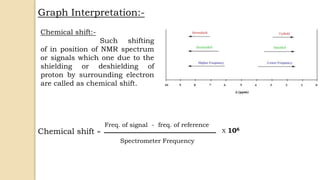
Chemical shift:-
Such shifting
of in position of NMR spectrum
or signals which one due to the
shielding or deshielding of
proton by surrounding electron
are called as chemical shift.
Chemical shift =
Freq. of signal - freq. of reference
Spectrometer Frequency
X 106
Spin-Spin Interactions:-
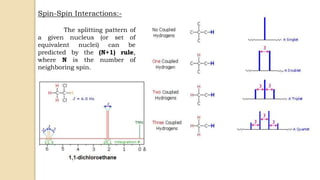
The splitting pattern of
a given nucleus (or set of
equivalent nuclei) can be
predicted by the (N+1) rule,
where N is the number of
neighboring spin.
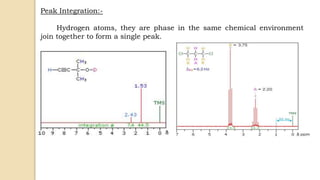
Peak Integration:-
Hydrogen atoms, they are phase in the same chemical environment
join together to form a single peak.
Application of NMR:-
 Study the physical, chemical, and biological properties of matter.
Chemists use it to determine molecular identity and structure.
Bacterial identification and metabolic studies
 Medical practitioners employ magnetic resonance imaging (MRI), a
multidimensional NMR imaging technique, for diagnostic purposes.
Development of vaccines & treatments for a range of diseases,
including HIV, influenza, tuberculosis and cancer.
Reference:-
 Cavanagh, J., Fairbrother, W.J., Palmer III, A.G. and Skelton, N.J., 1995. Protein NMR
spectroscopy: principles and practice. Academic Press.
 Günther, H., 2013. NMR spectroscopy: basic principles, concepts and applications in
chemistry. John Wiley & Sons.
 Duer, M.J. ed., 2008. Solid state NMR spectroscopy: principles and applications. John
Wiley & Sons.
 https://www.slideshare.net/solairajananant/nmr-spectroscopy-13887430
 https://www2.chemistry.msu.edu/faculty/reusch/virttxtjml/spectrpy/nmr/nmr1.htm
THANK YOU

NMR Spectroscopy

  • 1.
    PT. J.N.M. MEDICALCOLLEGE RAIPUR PRESENTATION ON:- NMR SPECTROSCOPY PRESENTED BY : TUSHAR CHANDRAKAR M.Sc. MBT (PREV)
  • 2.
    CONTEXT:-  History  Introduction& Theory  Principle  Instrumentation  Graph Interpretation • Chemical Shift • Splitting • Peak Integration  Application  References
  • 3.
     NMR wasfirst accurately measured and described in 1938 by Isidor Rabi. He won the Nobel Prize in Physics for his work in 1944.  In 1946, Felix Bloch and Edward Mills Purcell were able to expand on Rabi's technique. Together, they were able to demonstrate NMR for the first time on liquids and solids. The two shared the Nobel Prize in Physics in 1952.  NMR has also been adapted for the medical field in the form of MRI machines. Physicists Peter Mansfield and Paul Lauterbur first developed MRI-related techniques in the late 1970s. The two were later awarded the Nobel Prize in Physiology or Medicine in 2003. History:-
  • 4.
     NMR isa spectroscopy technique which based on the absorption of electromagnetic radiation in the radio frequency region 40 to 900 MHz by nuclei of the atom.  Proton NMR spectroscopy is one of the most powerful tools for elucidating the no. of Hydrogen or Proton in compound  It is used to study a wide variety of nuclei. 1H 13C 15N 19F 31P Introduction:-
  • 5.
    Theory:- Spin quantum number(I) is related to the atomic number & atomic mass of the nucleus. Atomic No. (Z) Atomic Mass (A) Example Status Odd Odd 1H NMR Active Nuclei Odd Even 15N Even Odd 13C Even Even 16O NMR Inactive Nuclei
  • 6.
    Nucleus have electrically chargedand spin & generating a magnetic field. Without external magnetic field nucleus spin are random in direction. If applied external magnetic field , nuclei align themselves either with or against field of external magnetic field. If external magnetic field is applied no. Of possible orientation calculated by (2I + 1) rule. PRINCIPLE :-
  • 7.
     Eg:- Hydrogenhas spin quantum number I=1/2 & possible orientation is two. Ie. +1/2 and -1/2 The transfer of energy occurs at a wavelength that coincides with the radio frequency. Also, energy is emitted at the same frequency when the spin comes back to its base level.
  • 8.
     Therefore, bymeasuring the signal which matches this transfer the processing of the NMR spectrum for the concerned nucleus is yield.  The emitted radio frequency is directly proportional to the strength of the applied magnetic field.
  • 9.
    Instrumentation:- Sample holder –It is a glass tube which is 8.5 cm long and 0.3 cm in diameter. Magnetic coils – Magnetic coil generates magnetic field whenever current flows through it Permanent magnet – It helps in providing a homogenous magnetic field. Sweep generator – Modifies the strength of the magnetic field which is already applied. Radiofrequency transmitter – It produces a powerful but short pulse of the radio waves. Radiofrequency – It helps in detecting receiver radio frequencies. RF detector – It helps in determining unabsorbed radio frequencies. Recorder – It records the NMR signals which are received by the RF detector. Readout system – A computer that records the data.
  • 10.
    Graph Interpretation:- Chemical shift:- Suchshifting of in position of NMR spectrum or signals which one due to the shielding or deshielding of proton by surrounding electron are called as chemical shift. Chemical shift = Freq. of signal - freq. of reference Spectrometer Frequency X 106
  • 11.
    Spin-Spin Interactions:- The splittingpattern of a given nucleus (or set of equivalent nuclei) can be predicted by the (N+1) rule, where N is the number of neighboring spin.
  • 12.
    Peak Integration:- Hydrogen atoms,they are phase in the same chemical environment join together to form a single peak.
  • 14.
    Application of NMR:- Study the physical, chemical, and biological properties of matter. Chemists use it to determine molecular identity and structure. Bacterial identification and metabolic studies  Medical practitioners employ magnetic resonance imaging (MRI), a multidimensional NMR imaging technique, for diagnostic purposes. Development of vaccines & treatments for a range of diseases, including HIV, influenza, tuberculosis and cancer.
  • 15.
    Reference:-  Cavanagh, J.,Fairbrother, W.J., Palmer III, A.G. and Skelton, N.J., 1995. Protein NMR spectroscopy: principles and practice. Academic Press.  Günther, H., 2013. NMR spectroscopy: basic principles, concepts and applications in chemistry. John Wiley & Sons.  Duer, M.J. ed., 2008. Solid state NMR spectroscopy: principles and applications. John Wiley & Sons.  https://www.slideshare.net/solairajananant/nmr-spectroscopy-13887430  https://www2.chemistry.msu.edu/faculty/reusch/virttxtjml/spectrpy/nmr/nmr1.htm
  • 16.