NMR
Spectroscopy
Presented to:
Dr. Muhammad Irfan
Presented by:
Aqsa Ayoub
FORMAN CHRISTIAN COLLEGE
A CHARTERED UNIVERSITY
NMR SPECTROSCOPY
NMR spectroscopy, is a technique that exploits
the magnetic properties of certain atomic nuclei.
Nuclear magnetic resonance (NMR) is a
physical phenomenon in which nuclei in a magnetic
field absorb and re-emit electromagnetic radiation.
This energy is at a specific resonance frequency which
depends on the strength of the magnetic field and the
magnetic properties of the isotope of the atoms.
Nuclear spin
• Subatomic particles (electrons, protons and neutrons)
can be imagined as spinning on their axes.
• atoms (such as 12C) has no overall spin.
• atoms (such as 1H and 13C) has an overall spin.
Rules
– If the number of neutrons and the number of protons
are both even, then the nucleus has NO spin.
– If the number of neutrons plus the number of protons
is odd, then the nucleus has a half-integer spin (i.e.
1/2, 3/2, 5/2)
– If the number of neutrons and the number of protons
are both odd, then the nucleus has an integer spin
(i.e. 1, 2, 3)
In the presence of an applied magnetic field the spin
states have different energy and the magnetic moment
can align with or against the applied field.
∆𝐸 = 𝐸 𝛽 − 𝐸 𝛼 = 2𝜇 𝛽 𝐵𝑜
Irradiation of a sample with radio frequency energy
corresponding to the spin state separation (DE) will
Excite nuclei in the +½ state to the higher energy –½
state afterwards it will loose energy and goes down to
ground state and release photon of specific frequency
which will be monitored.
The radio frequency wave must osscilate with frequency to
cause protons to resonate and this frequency is called
resonance frequency
𝐸 = ℎ𝑓 = 2𝜇 𝛽 𝐵𝑜
𝑓 =
2𝜇 𝛽 𝐵𝑜
ℎ
Not all protons give resonance signals at the same field
frequency. Electrons move in response to the applied
field and generate a secondary magnetic field which
opposes the applied field. The secondary field shields
the nucleus from the applied field
Nuclei in different environments resonate at
different frequencies.
The Chemical Shift
The difference in resonance frequency is
measured as a chemical shift
The NMR Spectrometer
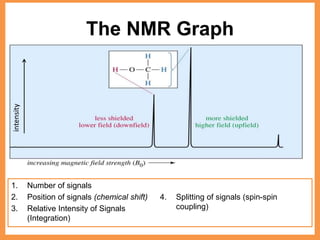
1. Number of signals
2. Position of signals (chemical shift)
3. Relative Intensity of Signals
(Integration)
4. Splitting of signals (spin-spin
coupling)
The NMR Graph
intensity
Spin-Spin coupling
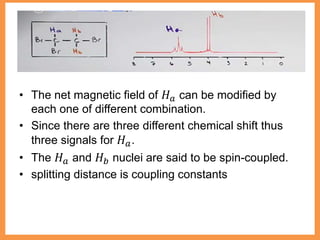
Chemical shift of 𝐻 𝑎 is not only affected by its own electron
density but also by neighbouring hydrogen nuclei.
Each one of 𝐻 𝑏 nuclei can spin in either one or two ways:
spin up (+1/2) or (-1/2) since there are 2 𝐻 𝑏 nuclei there
are four possible spin combination that can around the 𝐻 𝑎
atom
(+1/2,+1/2) ,(-1/2,+1/2) ,(+1/2,-1/2) ,(-1/2,-1/2)
1,2 tri bromo ethane
same
• The net magnetic field of 𝐻 𝑎 can be modified by
each one of different combination.
• Since there are three different chemical shift thus
three signals for 𝐻 𝑎.
• The 𝐻 𝑎 and 𝐻 𝑏 nuclei are said to be spin-coupled.
• splitting distance is coupling constants
n + 1 rule
• Protons in the same environment are said to be
equivalent and as such behave as one proton.
• This follows the n + 1 rule.
– n is the number of hydrogen atoms attached to
the next-door carbon
– n + 1 is how many peaks will be seen in the
cluster.
Summary
• Nuclei spin(-1/2, +1/2)
• Magnetic field (two energy states)
• Chemical shift (Nuclei in different environments resonate
at different frequencies.)
• Photon emittance (detected)
• NMR spectra (integration)
• Spin spin coupling (n+1 rule)
Applications of NMR spectroscopy
• Solution structure
• Molecular dynamics
• Protein folding
• Ionization state
• Weak intermolecular interactions
• Protein hydration
• Hydrogen bonding
• Drug screening and design
• Metabolite analysis
• Chemical analysis

Nmr spectroscopy

  • 1.
    NMR Spectroscopy Presented to: Dr. MuhammadIrfan Presented by: Aqsa Ayoub FORMAN CHRISTIAN COLLEGE A CHARTERED UNIVERSITY
  • 2.
    NMR SPECTROSCOPY NMR spectroscopy,is a technique that exploits the magnetic properties of certain atomic nuclei. Nuclear magnetic resonance (NMR) is a physical phenomenon in which nuclei in a magnetic field absorb and re-emit electromagnetic radiation. This energy is at a specific resonance frequency which depends on the strength of the magnetic field and the magnetic properties of the isotope of the atoms.
  • 3.
    Nuclear spin • Subatomicparticles (electrons, protons and neutrons) can be imagined as spinning on their axes. • atoms (such as 12C) has no overall spin. • atoms (such as 1H and 13C) has an overall spin. Rules – If the number of neutrons and the number of protons are both even, then the nucleus has NO spin. – If the number of neutrons plus the number of protons is odd, then the nucleus has a half-integer spin (i.e. 1/2, 3/2, 5/2) – If the number of neutrons and the number of protons are both odd, then the nucleus has an integer spin (i.e. 1, 2, 3)
  • 5.
    In the presenceof an applied magnetic field the spin states have different energy and the magnetic moment can align with or against the applied field. ∆𝐸 = 𝐸 𝛽 − 𝐸 𝛼 = 2𝜇 𝛽 𝐵𝑜
  • 6.
    Irradiation of asample with radio frequency energy corresponding to the spin state separation (DE) will Excite nuclei in the +½ state to the higher energy –½ state afterwards it will loose energy and goes down to ground state and release photon of specific frequency which will be monitored.
  • 7.
    The radio frequencywave must osscilate with frequency to cause protons to resonate and this frequency is called resonance frequency 𝐸 = ℎ𝑓 = 2𝜇 𝛽 𝐵𝑜 𝑓 = 2𝜇 𝛽 𝐵𝑜 ℎ
  • 8.
    Not all protonsgive resonance signals at the same field frequency. Electrons move in response to the applied field and generate a secondary magnetic field which opposes the applied field. The secondary field shields the nucleus from the applied field Nuclei in different environments resonate at different frequencies. The Chemical Shift The difference in resonance frequency is measured as a chemical shift
  • 9.
  • 10.
    1. Number ofsignals 2. Position of signals (chemical shift) 3. Relative Intensity of Signals (Integration) 4. Splitting of signals (spin-spin coupling) The NMR Graph intensity
  • 11.
    Spin-Spin coupling Chemical shiftof 𝐻 𝑎 is not only affected by its own electron density but also by neighbouring hydrogen nuclei. Each one of 𝐻 𝑏 nuclei can spin in either one or two ways: spin up (+1/2) or (-1/2) since there are 2 𝐻 𝑏 nuclei there are four possible spin combination that can around the 𝐻 𝑎 atom (+1/2,+1/2) ,(-1/2,+1/2) ,(+1/2,-1/2) ,(-1/2,-1/2) 1,2 tri bromo ethane same
  • 12.
    • The netmagnetic field of 𝐻 𝑎 can be modified by each one of different combination. • Since there are three different chemical shift thus three signals for 𝐻 𝑎. • The 𝐻 𝑎 and 𝐻 𝑏 nuclei are said to be spin-coupled. • splitting distance is coupling constants
  • 13.
    n + 1rule • Protons in the same environment are said to be equivalent and as such behave as one proton. • This follows the n + 1 rule. – n is the number of hydrogen atoms attached to the next-door carbon – n + 1 is how many peaks will be seen in the cluster.
  • 14.
    Summary • Nuclei spin(-1/2,+1/2) • Magnetic field (two energy states) • Chemical shift (Nuclei in different environments resonate at different frequencies.) • Photon emittance (detected) • NMR spectra (integration) • Spin spin coupling (n+1 rule)
  • 15.
    Applications of NMRspectroscopy • Solution structure • Molecular dynamics • Protein folding • Ionization state • Weak intermolecular interactions • Protein hydration • Hydrogen bonding • Drug screening and design • Metabolite analysis • Chemical analysis