Light sources for Atomic Absorption Spectroscopy (AAS)
And
Background corrections
Prepared by-
Dr. Mallikarjunaswamy C
Assistant Professor
Postgraduate Department of Chemistry
JSS College of Arts, Commerce and Science
Ooty Road, Mysuru-570025
Radiation Sources
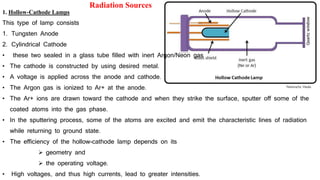
1. Hollow-Cathode Lamps
This type of lamp consists
1. Tungsten Anode
2. Cylindrical Cathode
• these two sealed in a glass tube filled with inert Argon/Neon gas
• The cathode is constructed by using desired metal.
• A voltage is applied across the anode and cathode.
• The Argon gas is ionized to Ar+ at the anode.
• The Ar+ ions are drawn toward the cathode and when they strike the surface, sputter off some of the
coated atoms into the gas phase.
• In the sputtering process, some of the atoms are excited and emit the characteristic lines of radiation
while returning to ground state.
• The efficiency of the hollow-cathode lamp depends on its
 geometry and
 the operating voltage.
• High voltages, and thus high currents, lead to greater intensities.
Limitations
• The greater voltage and current is increase in Doppler broadening of the emission lines from the lamp.
• The greater currents produce an increased number of unexcited atoms in the cloud.
• The unexcited atoms, in turn, are capable of absorbing the radiation emitted by the excited ones.
• This self-absorption leads to lowered intensities, particularly at the center of the emission band.
• HCL has high precision and low detection limit.
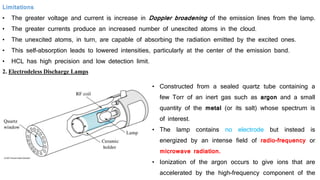
2. Electrodeless Discharge Lamps
• Constructed from a sealed quartz tube containing a
few Torr of an inert gas such as argon and a small
quantity of the metal (or its salt) whose spectrum is
of interest.
• The lamp contains no electrode but instead is
energized by an intense field of radio-frequency or
microwave radiation.
• Ionization of the argon occurs to give ions that are
accelerated by the high-frequency component of the
Source Modulation / Interferences of Flame Noise
• It is necessary to eliminate interferences caused by
emission of radiation by the flame.
• Of course, interferences removed by the bandpass
monochromators.
• However, emitted radiation equal to monochromator setting is inevitably present in the flame because of
excitation and emission of analyte atoms and flame gas species.
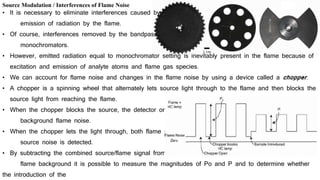
• We can account for flame noise and changes in the flame noise by using a device called a chopper.
• A chopper is a spinning wheel that alternately lets source light through to the flame and then blocks the
source light from reaching the flame.
• When the chopper blocks the source, the detector only reads the
background flame noise.
• When the chopper lets the light through, both flame noise and
source noise is detected.
• By subtracting the combined source/flame signal from only the
flame background it is possible to measure the magnitudes of Po and P and to determine whether
the introduction of the
Correction of Spectral Interferences
1. Continuum-source correction method
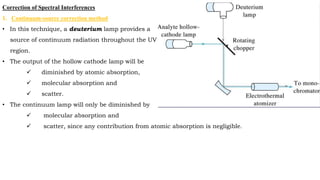
• In this technique, a deuterium lamp provides a
source of continuum radiation throughout the UV
region.
• The output of the hollow cathode lamp will be
 diminished by atomic absorption,
 molecular absorption and
 scatter.
• The continuum lamp will only be diminished by
 molecular absorption and
 scatter, since any contribution from atomic absorption is negligible.
2. Background Correction Based on the Zeeman Effect
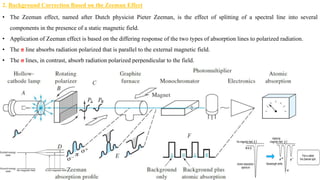
• The Zeeman effect, named after Dutch physicist Pieter Zeeman, is the effect of splitting of a spectral line into several
components in the presence of a static magnetic field.
• Application of Zeeman effect is based on the differing response of the two types of absorption lines to polarized radiation.
• The π line absorbs radiation polarized that is parallel to the external magnetic field.
• The σ lines, in contrast, absorb radiation polarized perpendicular to the field.
3. Background Correction Based on Source Self-Reversal/ Smith-Hieftje method
• It is based on the self-reversal or self-absorption behavior of radiation emitted from hollow-cathode lamps when they are
operated at high currents.
• High currents produce large concentrations of nonexcited atoms, which are capable of absorbing the radiation produced from
the excited species.
• To obtain corrected absorbances, the lamp is programmed to run alternately at low and high currents.
• The total absorbance is obtained during the low-current operation.
• At High Current absorbance by the analyte is at a minimum, (due to insufficient energy for atom excitation) absorbance due to
background interference is measured.

Light sources for atomic absorption spectroscopy (aas)

  • 1.
    Light sources forAtomic Absorption Spectroscopy (AAS) And Background corrections Prepared by- Dr. Mallikarjunaswamy C Assistant Professor Postgraduate Department of Chemistry JSS College of Arts, Commerce and Science Ooty Road, Mysuru-570025
  • 2.
    Radiation Sources 1. Hollow-CathodeLamps This type of lamp consists 1. Tungsten Anode 2. Cylindrical Cathode • these two sealed in a glass tube filled with inert Argon/Neon gas • The cathode is constructed by using desired metal. • A voltage is applied across the anode and cathode. • The Argon gas is ionized to Ar+ at the anode. • The Ar+ ions are drawn toward the cathode and when they strike the surface, sputter off some of the coated atoms into the gas phase. • In the sputtering process, some of the atoms are excited and emit the characteristic lines of radiation while returning to ground state. • The efficiency of the hollow-cathode lamp depends on its  geometry and  the operating voltage. • High voltages, and thus high currents, lead to greater intensities.
  • 3.
    Limitations • The greatervoltage and current is increase in Doppler broadening of the emission lines from the lamp. • The greater currents produce an increased number of unexcited atoms in the cloud. • The unexcited atoms, in turn, are capable of absorbing the radiation emitted by the excited ones. • This self-absorption leads to lowered intensities, particularly at the center of the emission band. • HCL has high precision and low detection limit. 2. Electrodeless Discharge Lamps • Constructed from a sealed quartz tube containing a few Torr of an inert gas such as argon and a small quantity of the metal (or its salt) whose spectrum is of interest. • The lamp contains no electrode but instead is energized by an intense field of radio-frequency or microwave radiation. • Ionization of the argon occurs to give ions that are accelerated by the high-frequency component of the
  • 4.
    Source Modulation /Interferences of Flame Noise • It is necessary to eliminate interferences caused by emission of radiation by the flame. • Of course, interferences removed by the bandpass monochromators. • However, emitted radiation equal to monochromator setting is inevitably present in the flame because of excitation and emission of analyte atoms and flame gas species. • We can account for flame noise and changes in the flame noise by using a device called a chopper. • A chopper is a spinning wheel that alternately lets source light through to the flame and then blocks the source light from reaching the flame. • When the chopper blocks the source, the detector only reads the background flame noise. • When the chopper lets the light through, both flame noise and source noise is detected. • By subtracting the combined source/flame signal from only the flame background it is possible to measure the magnitudes of Po and P and to determine whether the introduction of the
  • 5.
    Correction of SpectralInterferences 1. Continuum-source correction method • In this technique, a deuterium lamp provides a source of continuum radiation throughout the UV region. • The output of the hollow cathode lamp will be  diminished by atomic absorption,  molecular absorption and  scatter. • The continuum lamp will only be diminished by  molecular absorption and  scatter, since any contribution from atomic absorption is negligible.
  • 6.
    2. Background CorrectionBased on the Zeeman Effect • The Zeeman effect, named after Dutch physicist Pieter Zeeman, is the effect of splitting of a spectral line into several components in the presence of a static magnetic field. • Application of Zeeman effect is based on the differing response of the two types of absorption lines to polarized radiation. • The π line absorbs radiation polarized that is parallel to the external magnetic field. • The σ lines, in contrast, absorb radiation polarized perpendicular to the field.
  • 7.
    3. Background CorrectionBased on Source Self-Reversal/ Smith-Hieftje method • It is based on the self-reversal or self-absorption behavior of radiation emitted from hollow-cathode lamps when they are operated at high currents. • High currents produce large concentrations of nonexcited atoms, which are capable of absorbing the radiation produced from the excited species. • To obtain corrected absorbances, the lamp is programmed to run alternately at low and high currents. • The total absorbance is obtained during the low-current operation. • At High Current absorbance by the analyte is at a minimum, (due to insufficient energy for atom excitation) absorbance due to background interference is measured.