Nuclear Magnetic Resonance
Spectroscopy
(1H NMR or PMR)
For M. Sc. I Chemistry
Shaikh Siraj Babulal
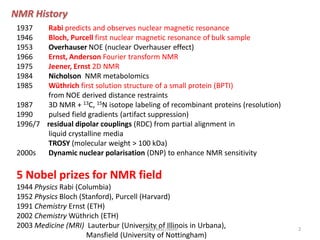
1937 Rabi predicts and observes nuclear magnetic resonance
1946 Bloch, Purcell first nuclear magnetic resonance of bulk sample
1953 Overhauser NOE (nuclear Overhauser effect)
1966 Ernst, Anderson Fourier transform NMR
1975 Jeener, Ernst 2D NMR
1984 Nicholson NMR metabolomics
1985 Wüthrich first solution structure of a small protein (BPTI)
from NOE derived distance restraints
1987 3D NMR + 13C, 15N isotope labeling of recombinant proteins (resolution)
1990 pulsed field gradients (artifact suppression)
1996/7 residual dipolar couplings (RDC) from partial alignment in
liquid crystalline media
TROSY (molecular weight > 100 kDa)
2000s Dynamic nuclear polarisation (DNP) to enhance NMR sensitivity
5 Nobel prizes for NMR field
1944 Physics Rabi (Columbia)
1952 Physics Bloch (Stanford), Purcell (Harvard)
1991 Chemistry Ernst (ETH)
2002 Chemistry Wüthrich (ETH)
2003 Medicine (MRI) Lauterbur (University of Illinois in Urbana),
Mansfield (University of Nottingham)
NMR History
2SIRaJ/MSc/NMR
NMR
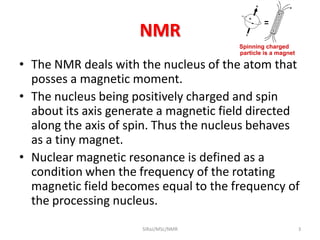
• The NMR deals with the nucleus of the atom that
posses a magnetic moment.
• The nucleus being positively charged and spin
about its axis generate a magnetic field directed
along the axis of spin. Thus the nucleus behaves
as a tiny magnet.
• Nuclear magnetic resonance is defined as a
condition when the frequency of the rotating
magnetic field becomes equal to the frequency of
the processing nucleus.
Spinning charged
particle is a magnet
Spinning charged
particle is a magnet
3SIRaJ/MSc/NMR
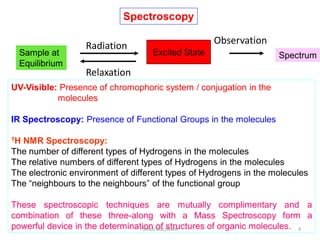
Sample at
Equilibrium
Radiation
Excited State Spectrum
Relaxation
Observation
Spectroscopy
UV-Visible: Presence of chromophoric system / conjugation in the
molecules
IR Spectroscopy: Presence of Functional Groups in the molecules
1H NMR Spectroscopy:
The number of different types of Hydrogens in the molecules
The relative numbers of different types of Hydrogens in the molecules
The electronic environment of different types of Hydrogens in the molecules
The “neighbours to the neighbours” of the functional group
These spectroscopic techniques are mutually complimentary and a
combination of these three-along with a Mass Spectroscopy form a
powerful device in the determination of structures of organic molecules. 4SIRaJ/MSc/NMR
NMR Spectroscopy
• NMR uses energy in the radio frequency range.
• This energy is too low to cause changes in electron energy levels or
in the vibrations of molecules.
• NMR can cause changes in the spin of particles in the nucleus of
some atoms.
• Nuclear magnetic resonance (NMR) is a physical phenomenon in
which nuclei in a magnetic field absorb and re-emit electromagnetic
radiation.
• This energy is at a specific resonance frequency which depends on
the strength of the magnetic field and the magnetic properties of
the isotope of the atoms; in practical applications, the frequency is
similar to VHF and UHF television broadcasts (60–1000 MHz).
• NMR allows the observation of specific quantum mechanical
magnetic properties of the atomic nucleus.
5SIRaJ/MSc/NMR
Nucleus
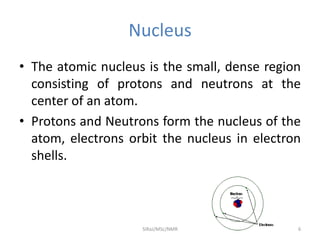
• The atomic nucleus is the small, dense region
consisting of protons and neutrons at the
center of an atom.
• Protons and Neutrons form the nucleus of the
atom, electrons orbit the nucleus in electron
shells.
6SIRaJ/MSc/NMR
• All nucleons, that is neutrons and protons,
composing any atomic nucleus, have the
intrinsic quantum property of spin.
• The overall spin of the nucleus is determined
by the spin quantum number S / I.
• The spinning charged nucleus generates a
magnetic field.
7SIRaJ/MSc/NMR
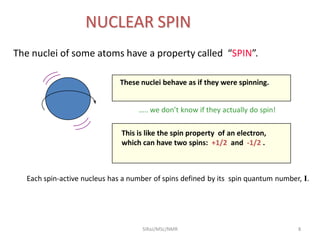
The nuclei of some atoms have a property called “SPIN”.
NUCLEAR SPIN
These nuclei behave as if they were spinning.
This is like the spin property of an electron,
which can have two spins: +1/2 and -1/2 .
Each spin-active nucleus has a number of spins defined by its spin quantum number, I.
….. we don’t know if they actually do spin!
8SIRaJ/MSc/NMR
l
Nucleii
spin + charge
l
Nucleii
spin + charge
ll
Nucleii
spin + charge
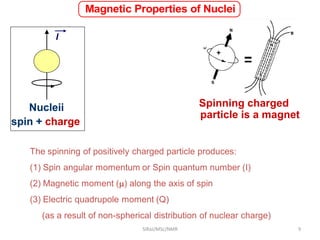
Spinning charged
particle is a magnet
Spinning charged
particle is a magnet
Magnetic Properties of Nuclei
The spinning of positively charged particle produces:
(1) Spin angular momentum or Spin quantum number (I)
(2) Magnetic moment (m) along the axis of spin
(3) Electric quadrupole moment (Q)
(as a result of non-spherical distribution of nuclear charge)
9SIRaJ/MSc/NMR
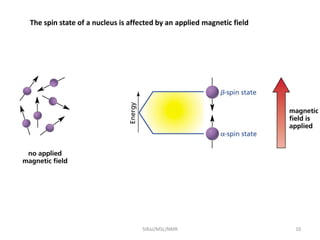
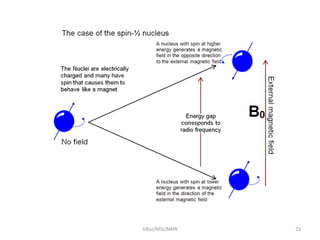
The spin state of a nucleus is affected by an applied magnetic field
10SIRaJ/MSc/NMR
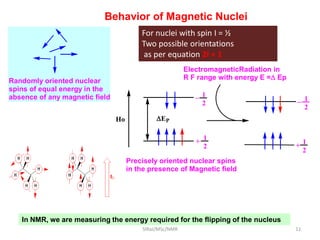
Behavior of Magnetic Nuclei
Randomly oriented nuclear
spins of equal energy in the
absence of any magnetic field 1
2
_
1
2
+
EP
1
2
_
1
2
+
ElectromagneticRadiation in
R F range with energy E = Ep
Ho
Precisely oriented nuclear spins
in the presence of Magnetic field
For nuclei with spin I = ½
Two possible orientations
as per equation 2I + 1
In NMR, we are measuring the energy required for the flipping of the nucleus
11SIRaJ/MSc/NMR
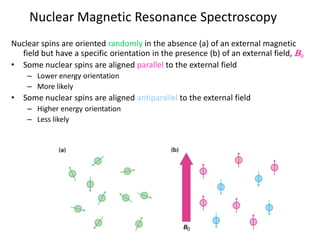
Nuclear spins are oriented randomly in the absence (a) of an external magnetic
field but have a specific orientation in the presence (b) of an external field, B0
• Some nuclear spins are aligned parallel to the external field
– Lower energy orientation
– More likely
• Some nuclear spins are aligned antiparallel to the external field
– Higher energy orientation
– Less likely
Nuclear Magnetic Resonance Spectroscopy
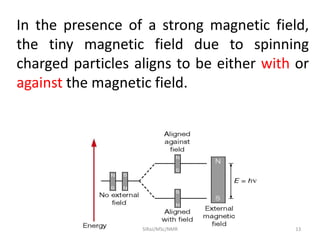
In the presence of a strong magnetic field,
the tiny magnetic field due to spinning
charged particles aligns to be either with or
against the magnetic field.
13SIRaJ/MSc/NMR
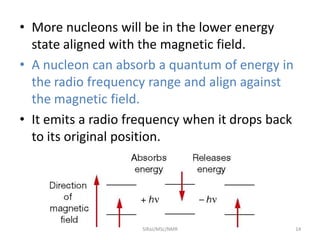
• More nucleons will be in the lower energy
state aligned with the magnetic field.
• A nucleon can absorb a quantum of energy in
the radio frequency range and align against
the magnetic field.
• It emits a radio frequency when it drops back
to its original position.
14SIRaJ/MSc/NMR
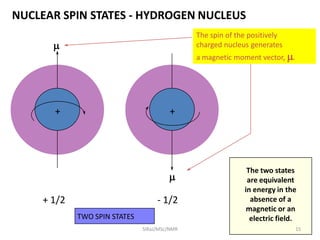
NUCLEAR SPIN STATES - HYDROGEN NUCLEUS
+ 1/2 - 1/2
The two states
are equivalent
in energy in the
absence of a
magnetic or an
electric field.
+ +
The spin of the positively
charged nucleus generates
a magnetic moment vector, m.
m
m
TWO SPIN STATES
15SIRaJ/MSc/NMR
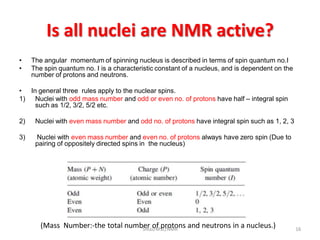
Is all nuclei are NMR active?
• The angular momentum of spinning nucleus is described in terms of spin quantum no.I
• The spin quantum no. I is a characteristic constant of a nucleus, and is dependent on the
number of protons and neutrons.
• In general three rules apply to the nuclear spins.
1) Nuclei with odd mass number and odd or even no. of protons have half – integral spin
such as 1/2, 3/2, 5/2 etc.
2) Nuclei with even mass number and odd no. of protons have integral spin such as 1, 2, 3
3) Nuclei with even mass number and even no. of protons always have zero spin (Due to
pairing of oppositely directed spins in the nucleus)
(Mass Number:-the total number of protons and neutrons in a nucleus.) 16SIRaJ/MSc/NMR
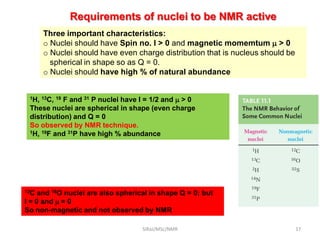
Requirements of nuclei to be NMR active
Three important characteristics:
o Nuclei should have Spin no. I > 0 and magnetic momemtum m > 0
o Nuclei should have even charge distribution that is nucleus should be
spherical in shape so as Q = 0.
o Nuclei should have high % of natural abundance
1H, 13C, 19 F and 31 P nuclei have I = 1/2 and m > 0
These nuclei are spherical in shape (even charge
distribution) and Q = 0
So observed by NMR technique.
1H, 19F and 31P have high % abundance
12C and 16O nuclei are also spherical in shape Q = 0; but
I = 0 and m = 0
So non-magnetic and not observed by NMR
17SIRaJ/MSc/NMR
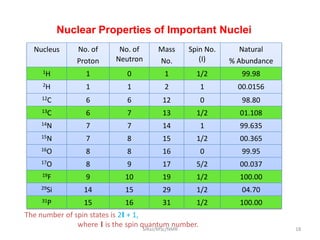
Nucleus No. of
Proton
No. of
Neutron
Mass
No.
Spin No.
(I)
Natural
% Abundance
1H 1 0 1 1/2 99.98
2H 1 1 2 1 00.0156
12C 6 6 12 0 98.80
13C 6 7 13 1/2 01.108
14N 7 7 14 1 99.635
15N 7 8 15 1/2 00.365
16O 8 8 16 0 99.95
17O 8 9 17 5/2 00.037
19F 9 10 19 1/2 100.00
29Si 14 15 29 1/2 04.70
31P 15 16 31 1/2 100.00
Nuclear Properties of Important Nuclei
The number of spin states is 2I + 1,
where I is the spin quantum number. 18SIRaJ/MSc/NMR
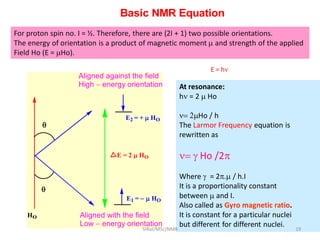
Basic NMR Equation
For proton spin no. I = ½. Therefore, there are (2I + 1) two possible orientations.
The energy of orientation is a product of magnetic moment m and strength of the applied
Field Ho (E = mHo).
At resonance:
h = 2 m Ho
= 2mHo / h
The Larmor Frequency equation is
rewritten as
=  Ho /2
Where  = 2.m / h.I
It is a proportionality constant
between m and I.
Also called as Gyro magnetic ratio.
It is constant for a particular nuclei
but different for different nuclei.


HO
E2 = + m HO
E1 =  m HO
Aligned with the field
Low  energy orientation
Aligned against the field
High  energy orientation
E = 2 m HO
E = h
19SIRaJ/MSc/NMR
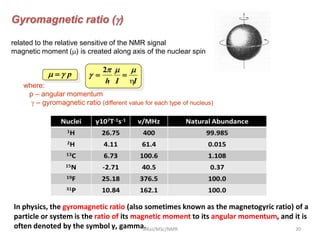
Gyromagnetic ratio ()
related to the relative sensitive of the NMR signal
magnetic moment (m) is created along axis of the nuclear spin
where:
p – angular momentum
 – gyromagnetic ratio (different value for each type of nucleus)
IIh 
mm
 ==
2
pm =
In physics, the gyromagnetic ratio (also sometimes known as the magnetogyric ratio) of a
particle or system is the ratio of its magnetic moment to its angular momentum, and it is
often denoted by the symbol γ, gamma. 20SIRaJ/MSc/NMR
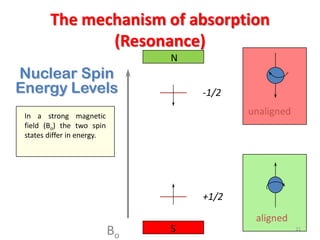
The mechanism of absorption
(Resonance)
Nuclear Spin
Energy Levels
Bo
+1/2
-1/2
In a strong magnetic
field (Bo) the two spin
states differ in energy.
aligned
unaligned
N
S 21
THE “RESONANCE” PHENOMENON
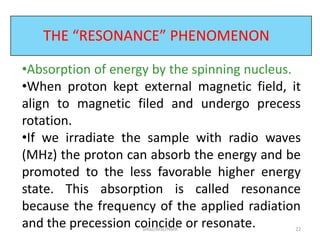
•Absorption of energy by the spinning nucleus.
•When proton kept external magnetic field, it
align to magnetic filed and undergo precess
rotation.
•If we irradiate the sample with radio waves
(MHz) the proton can absorb the energy and be
promoted to the less favorable higher energy
state. This absorption is called resonance
because the frequency of the applied radiation
and the precession coincide or resonate. 22SIRaJ/MSc/NMR
23SIRaJ/MSc/NMR
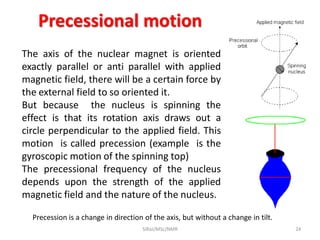
Precessional motion
Precession is a change in direction of the axis, but without a change in tilt.
The axis of the nuclear magnet is oriented
exactly parallel or anti parallel with applied
magnetic field, there will be a certain force by
the external field to so oriented it.
But because the nucleus is spinning the
effect is that its rotation axis draws out a
circle perpendicular to the applied field. This
motion is called precession (example is the
gyroscopic motion of the spinning top)
The precessional frequency of the nucleus
depends upon the strength of the applied
magnetic field and the nature of the nucleus.
24SIRaJ/MSc/NMR
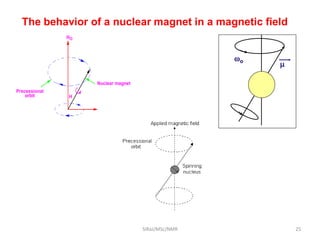
Precessional
orbit
Nuclear magnet
HO
H
The behavior of a nuclear magnet in a magnetic field
wo
m
25SIRaJ/MSc/NMR
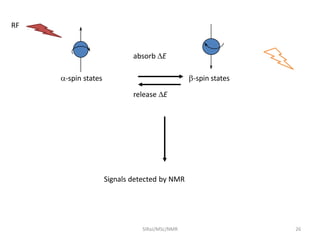
a-spin states b-spin states
absorb E
release E
Signals detected by NMR
RF
26SIRaJ/MSc/NMR
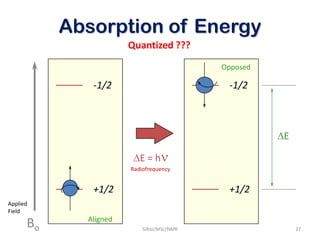
Absorption of Energy
Bo
+1/2
-1/2
+1/2
-1/2
E = h
E
Quantized ???
Radiofrequency
Applied
Field
Aligned
Opposed
27SIRaJ/MSc/NMR
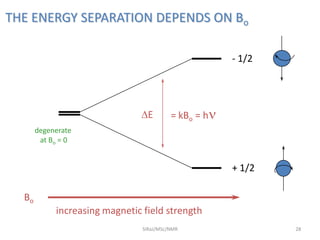
Bo
E
+ 1/2
- 1/2
= kBo = h
degenerate
at Bo = 0
increasing magnetic field strength
THE ENERGY SEPARATION DEPENDS ON Bo
28SIRaJ/MSc/NMR
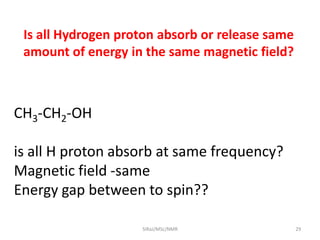
Is all Hydrogen proton absorb or release same
amount of energy in the same magnetic field?
CH3-CH2-OH
is all H proton absorb at same frequency?
Magnetic field -same
Energy gap between to spin??
29SIRaJ/MSc/NMR
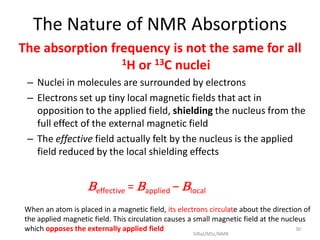
The absorption frequency is not the same for all
1H or 13C nuclei
– Nuclei in molecules are surrounded by electrons
– Electrons set up tiny local magnetic fields that act in
opposition to the applied field, shielding the nucleus from the
full effect of the external magnetic field
– The effective field actually felt by the nucleus is the applied
field reduced by the local shielding effects
Beffective = Bapplied – Blocal
The Nature of NMR Absorptions
When an atom is placed in a magnetic field, its electrons circulate about the direction of
the applied magnetic field. This circulation causes a small magnetic field at the nucleus
which opposes the externally applied field 30
SIRaJ/MSc/NMR
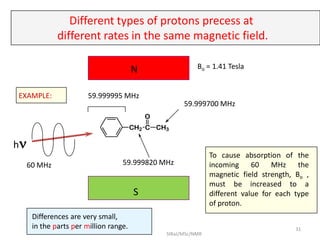
Different types of protons precess at
different rates in the same magnetic field.
N
S
CH2 C
O
CH3
59.999995 MHz
59.999820 MHz
59.999700 MHz
h
60 MHz
To cause absorption of the
incoming 60 MHz the
magnetic field strength, Bo ,
must be increased to a
different value for each type
of proton.
Bo = 1.41 Tesla
Differences are very small,
in the parts per million range.
EXAMPLE:
31
SIRaJ/MSc/NMR
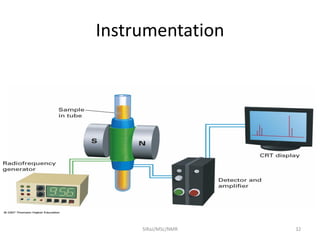
Instrumentation
32SIRaJ/MSc/NMR
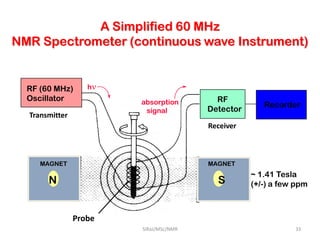
A Simplified 60 MHz
NMR Spectrometer (continuous wave Instrument)
Transmitter
Receiver
Probe
h
SN
RF
Detector
Recorder
RF (60 MHz)
Oscillator
~ 1.41 Tesla
(+/-) a few ppm
absorption
signal
MAGNETMAGNET
33SIRaJ/MSc/NMR
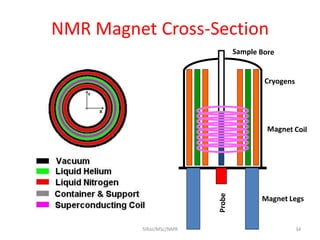
Magnet Legs
NMR Magnet Cross-Section
34SIRaJ/MSc/NMR
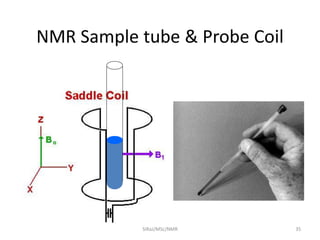
NMR Sample tube & Probe Coil
35SIRaJ/MSc/NMR
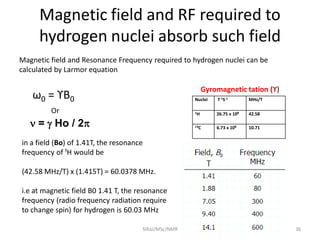
Magnetic field and RF required to
hydrogen nuclei absorb such field
Magnetic field and Resonance Frequency required to hydrogen nuclei can be
calculated by Larmor equation
Nuclei T-1S-1 MHz/T
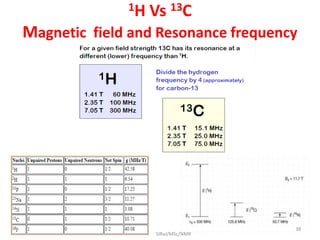
1H 26.75 x 10⁸ 42.58
13C 6.73 x 10⁸ 10.71
ω0 = ϒB0
in a field (Bo) of 1.41T, the resonance
frequency of ¹H would be
(42.58 MHz/T) x (1.415T) = 60.0378 MHz.
i.e at magnetic field B0 1.41 T, the resonance
frequency (radio frequency radiation require
to change spin) for hydrogen is 60.03 MHz
Gyromagnetic tation (ϒ)
Or
 =  Ho / 2
36SIRaJ/MSc/NMR
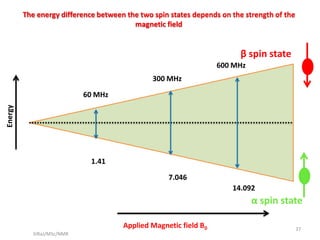
The energy difference between the two spin states depends on the strength of the
magnetic field
Energy
Applied Magnetic field B0
14.092
7.046
1.41
β spin state
α spin state
60 MHz
300 MHz
600 MHz
37
SIRaJ/MSc/NMR
1H Vs 13C
Magnetic field and Resonance frequency
38
SIRaJ/MSc/NMR
c. The 1H NMR spectrum of toluene shows that it has two peaks because of methyl and
aromatic protons recorded at 60 MHz and 1.41 T. Given this information, what would be
the magnetic field at 400 MHz? 39SIRaJ/MSc/NMR
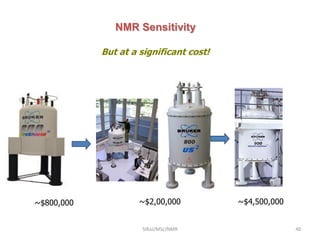
NMR Sensitivity
But at a significant cost!
~$800,000 ~$2,00,000 ~$4,500,000
40SIRaJ/MSc/NMR
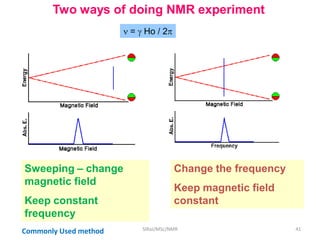
Two ways of doing NMR experiment
Sweeping – change
magnetic field
Keep constant
frequency
Change the frequency
Keep magnetic field
constant
 =  Ho / 2
Commonly Used method 41SIRaJ/MSc/NMR
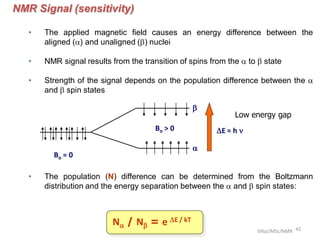
NMR Signal (sensitivity)
• The applied magnetic field causes an energy difference between the
aligned (a) and unaligned (b) nuclei
• NMR signal results from the transition of spins from the a to b state
• Strength of the signal depends on the population difference between the a
and b spin states
• The population (N) difference can be determined from the Boltzmann
distribution and the energy separation between the a and b spin states:
Na / Nb = e E / kT
Bo = 0
Bo > 0 E = h 
a
b
Low energy gap
42SIRaJ/MSc/NMR
Information from 1H-NMR spectra:
1. Number of signals: How many different types of hydrogens in the
molecule.
2. Position of signals (chemical shift): What types of hydrogens.
3. The chemical shift (δ, in ppm) gives a clue as to the type of hydrogen
generating the peak (alkane, alkene, benzene, aldehyde, etc.)
4. Relative areas under signals (integration): How many hydrogens of
each type. (number of Hydrogens)
5. Splitting pattern: How many neighboring hydrogens.
43SIRaJ/MSc/NMR
Chemical equivalent and non-
equivalent protons
• 1H NMR spectroscopy determines how many
kinds of electronically nonequivalent
hydrogens are present in a molecule
• Chemically equivalent proton resonance at
same frequency and gives one signal peak.
• Numbers of peaks in NMR gives different sets
of protons
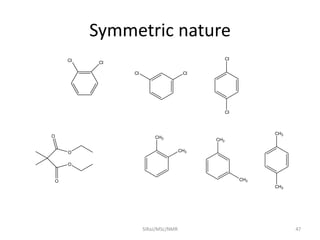
• Symmetric molecules have equivalent protons
on each side of symmetry
44SIRaJ/MSc/NMR
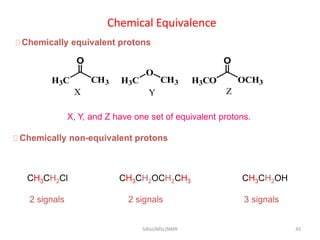
Chemical Equivalence
 Chemically equivalent protons
H3C CH3
O
O
H3C CH3 H3CO OCH3
O
X Y Z
X, Y, and Z have one set of equivalent protons.
 Chemically non-equivalent protons
CH3CH2Cl CH3CH2OCH2CH3 CH3CH2OH
2 signals 2 signals 3 signals
45SIRaJ/MSc/NMR
Examples on
Types of protons / sets of protons
46SIRaJ/MSc/NMR
Symmetric nature
47SIRaJ/MSc/NMR
Cl
Cl
Cl Cl
Cl Cl
CH3
CH3
CH3
CH3
CH3
CH3O
O
O
O
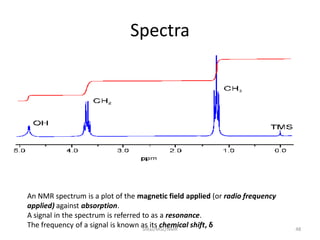
Spectra
An NMR spectrum is a plot of the magnetic field applied (or radio frequency
applied) against absorption.
A signal in the spectrum is referred to as a resonance.
The frequency of a signal is known as its chemical shift, δ 48SIRaJ/MSc/NMR
Integration
• The process of excitation in NMR involves the flipping of
the nucleus. This process of transition and the probability of
the transition is same for all the protons, irrespective of the
electronic environment. As a result, the area under the NMR
resonance is proportional to the number of hydrogens which
that resonance represents.
• In this way, by integrating the different NMR resonance,
information regarding the relative numbers of chemically
distinct hydrogens can be found.
• The integrals will appear as a line over the NMR spectrum.
Integration only gives information on the relative number of
different hydrogens, not the absolute number.
49SIRaJ/MSc/NMR
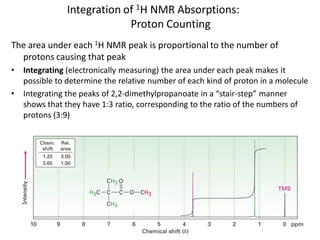
The area under each 1H NMR peak is proportional to the number of
protons causing that peak
• Integrating (electronically measuring) the area under each peak makes it
possible to determine the relative number of each kind of proton in a molecule
• Integrating the peaks of 2,2-dimethylpropanoate in a “stair-step” manner
shows that they have 1:3 ratio, corresponding to the ratio of the numbers of
protons (3:9)
Integration of 1H NMR Absorptions:
Proton Counting
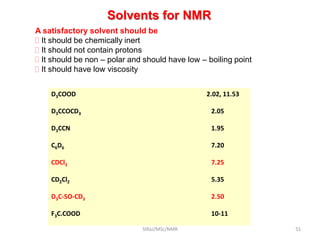
Solvents for NMR
D3COOD 2.02, 11.53
D3CCOCD3 2.05
D3CCN 1.95
C6D6 7.20
CDCl3 7.25
CD2Cl2 5.35
D3C-SO-CD3 2.50
F3C.COOD 10-11
A satisfactory solvent should be
 It should be chemically inert
 It should not contain protons
 It should be non – polar and should have low – boiling point
 It should have low viscosity
51SIRaJ/MSc/NMR
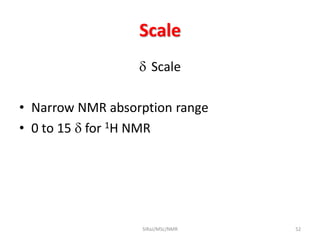
Scale
 Scale
• Narrow NMR absorption range
• 0 to 15  for 1H NMR
52SIRaJ/MSc/NMR
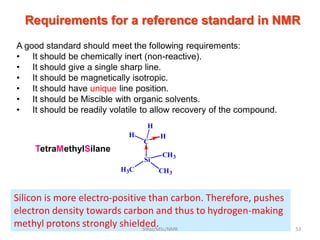
Requirements for a reference standard in NMR
A good standard should meet the following requirements:
• It should be chemically inert (non-reactive).
• It should give a single sharp line.
• It should be magnetically isotropic.
• It should have unique line position.
• It should be Miscible with organic solvents.
• It should be readily volatile to allow recovery of the compound.
TetraMethylSilane
Silicon is more electro-positive than carbon. Therefore, pushes
electron density towards carbon and thus to hydrogen-making
methyl protons strongly shielded.
H3C
Si
CH3
C
CH3
H
H
H
53SIRaJ/MSc/NMR
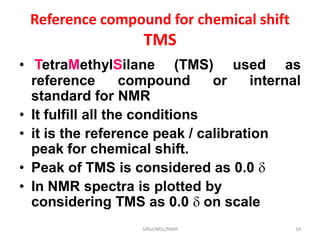
Reference compound for chemical shift
TMS
• TetraMethylSilane (TMS) used as
reference compound or internal
standard for NMR
• It fulfill all the conditions
• it is the reference peak / calibration
peak for chemical shift.
• Peak of TMS is considered as 0.0 
• In NMR spectra is plotted by
considering TMS as 0.0  on scale
54SIRaJ/MSc/NMR
Chemical Shift
• The chemical shift in absolute terms is defined by
the frequency / magnetic field of the resonance
expressed with reference to a standard
compound which is defined to be at 0 ppm.
• The change in resonance frequency (or field) is
very very low for proton i.e. ppm,
• The scale is made more manageable by
expressing it in parts per million (ppm) and
is independent of the spectrometer frequency.
55SIRaJ/MSc/NMR
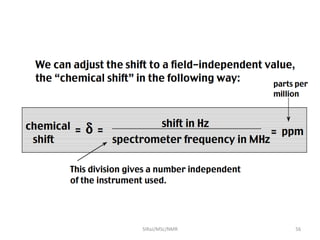
SIRaJ/MSc/NMR 56
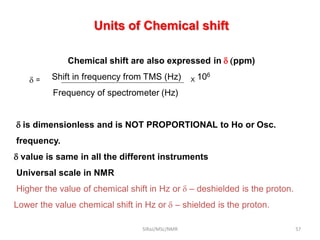
Chemical shift are also expressed in  (ppm)
 = Shift in frequency from TMS (Hz) X 106
Frequency of spectrometer (Hz)
 is dimensionless and is NOT PROPORTIONAL to Ho or Osc.
frequency.
 value is same in all the different instruments
Universal scale in NMR
Higher the value of chemical shift in Hz or   deshielded is the proton.
Lower the value chemical shift in Hz or   shielded is the proton.
Units of Chemical shift
57SIRaJ/MSc/NMR
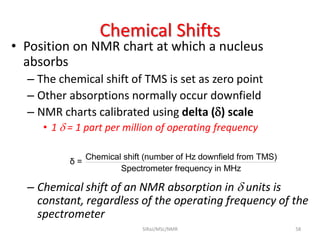
• Position on NMR chart at which a nucleus
absorbs
– The chemical shift of TMS is set as zero point
– Other absorptions normally occur downfield
– NMR charts calibrated using delta () scale
• 1  = 1 part per million of operating frequency
– Chemical shift of an NMR absorption in  units is
constant, regardless of the operating frequency of the
spectrometer
Chemical shift (number of Hz downfield from TMS)
δ =
Spectrometer frequency in MHz
Chemical Shifts
58SIRaJ/MSc/NMR
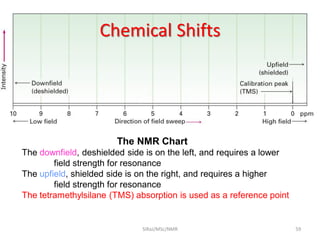
The NMR Chart
The downfield, deshielded side is on the left, and requires a lower
field strength for resonance
The upfield, shielded side is on the right, and requires a higher
field strength for resonance
The tetramethylsilane (TMS) absorption is used as a reference point
Chemical Shifts
59SIRaJ/MSc/NMR
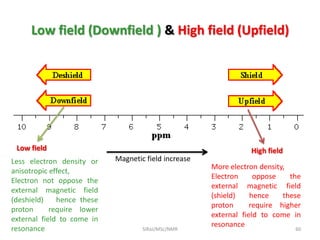
Low field (Downfield ) & High field (Upfield)
60SIRaJ/MSc/NMR
Magnetic field increase
High fieldLow field
More electron density,
Electron oppose the
external magnetic field
(shield) hence these
proton require higher
external field to come in
resonance
Less electron density or
anisotropic effect,
Electron not oppose the
external magnetic field
(deshield) hence these
proton require lower
external field to come in
resonance
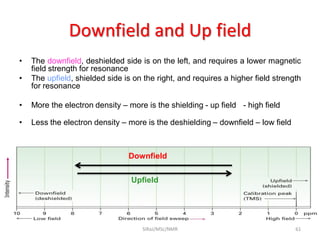
Downfield and Up field
• The downfield, deshielded side is on the left, and requires a lower magnetic
field strength for resonance
• The upfield, shielded side is on the right, and requires a higher field strength
for resonance
• More the electron density – more is the shielding - up field - high field
• Less the electron density – more is the deshielding – downfield – low field
61SIRaJ/MSc/NMR
Downfield
Upfield
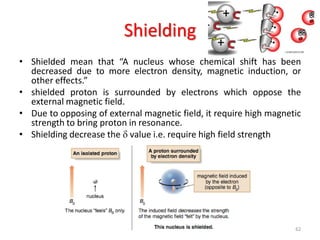
Shielding
• Shielded mean that “A nucleus whose chemical shift has been
decreased due to more electron density, magnetic induction, or
other effects.”
• shielded proton is surrounded by electrons which oppose the
external magnetic field.
• Due to opposing of external magnetic field, it require high magnetic
strength to bring proton in resonance.
• Shielding decrease the  value i.e. require high field strength
SIRaJ/MSc/NMR 62
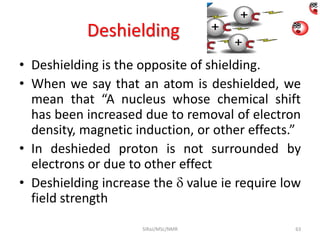
Deshielding
• Deshielding is the opposite of shielding.
• When we say that an atom is deshielded, we
mean that “A nucleus whose chemical shift
has been increased due to removal of electron
density, magnetic induction, or other effects.”
• In deshieded proton is not surrounded by
electrons or due to other effect
• Deshielding increase the  value ie require low
field strength
63SIRaJ/MSc/NMR
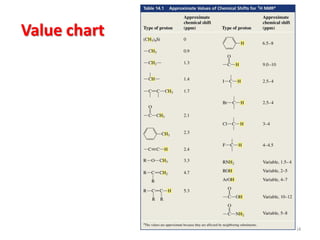
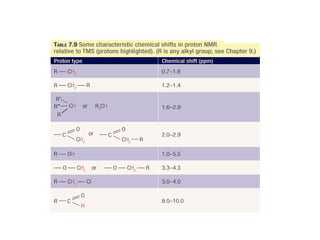
Value chart
64SIRaJ/MSc/NMR
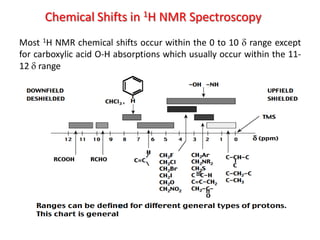
Most 1H NMR chemical shifts occur within the 0 to 10  range except
for carboxylic acid O-H absorptions which usually occur within the 11-
12  range
Chemical Shifts in 1H NMR Spectroscopy
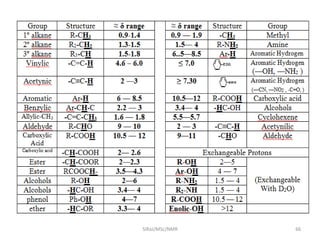
SIRaJ/MSc/NMR 66
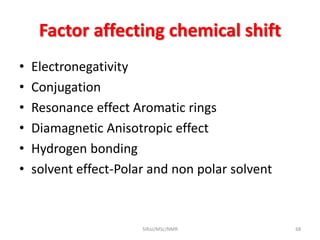
Factor affecting chemical shift
• Electronegativity
• Conjugation
• Resonance effect Aromatic rings
• Diamagnetic Anisotropic effect
• Hydrogen bonding
• solvent effect-Polar and non polar solvent
68SIRaJ/MSc/NMR
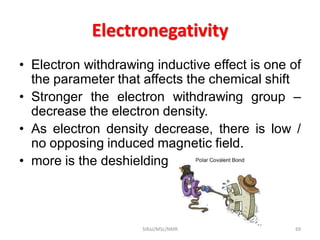
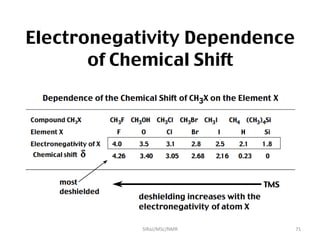
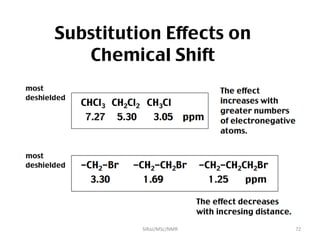
Electronegativity
• Electron withdrawing inductive effect is one of
the parameter that affects the chemical shift
• Stronger the electron withdrawing group –
decrease the electron density.
• As electron density decrease, there is low /
no opposing induced magnetic field.
• more is the deshielding
69SIRaJ/MSc/NMR
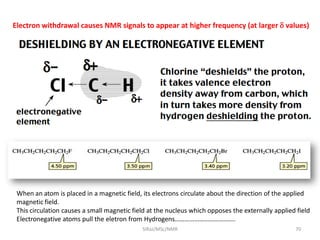
Electron withdrawal causes NMR signals to appear at higher frequency (at larger  values)
When an atom is placed in a magnetic field, its electrons circulate about the direction of the applied
magnetic field.
This circulation causes a small magnetic field at the nucleus which opposes the externally applied field
Electronegative atoms pull the eletron from Hydrogens……………………………….
70SIRaJ/MSc/NMR
SIRaJ/MSc/NMR 71
SIRaJ/MSc/NMR 72
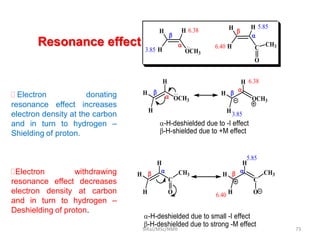
Resonance effect
 Electron donating
resonance effect increases
electron density at the carbon
and in turn to hydrogen –
Shielding of proton.
Electron withdrawing
resonance effect decreases
electron density at carbon
and in turn to hydrogen –
Deshielding of proton.
OCH3
H
H
H
a
b
a-H-deshielded due to -I effect
b-H-shielded due to +M effect
OCH3
H
H
H
ab
C
H
H
H
ab
O
CH3
C
H
H
H
ab
O
CH3
a-H-deshielded due to small -I effect
b-H-deshielded due to strong -M effect
6.38
3.85
5.85
6.40
OCH3
H
H
H
a
b
6.38
3.85 C
H
H
H
a
b
O
CH3
5.85
6.40
73SIRaJ/MSc/NMR
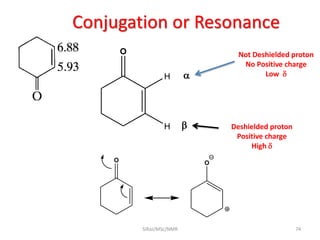
Conjugation or Resonance
74SIRaJ/MSc/NMR
O
a
b
H
H Deshielded proton
Positive charge
High 
Not Deshielded proton
No Positive charge
Low 
O O
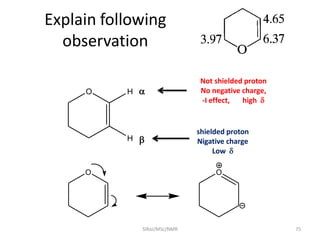
Explain following
observation
SIRaJ/MSc/NMR 75
a
b
O
H
H
shielded proton
Nigative charge
Low 
Not shielded proton
No negative charge,
-I effect, high 
O O
SIRaJ/MSc/NMR 76
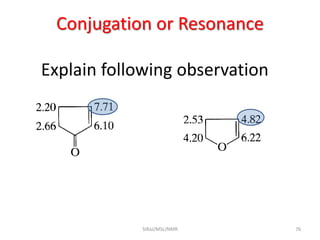
Conjugation or Resonance
Explain following observation
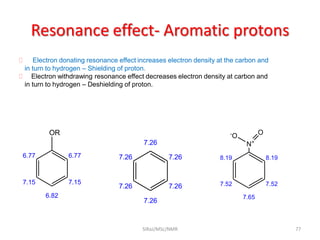
Resonance effect- Aromatic protons
 Electron donating resonance effect increases electron density at the carbon and
in turn to hydrogen – Shielding of proton.
 Electron withdrawing resonance effect decreases electron density at carbon and
in turn to hydrogen – Deshielding of proton.
77SIRaJ/MSc/NMR
OR
6.77
7.15
6.82
7.15
6.77 7.26
7.26
7.26
7.26
7.26
7.26 N+
O-
O
8.19
7.52
7.65
7.52
8.19
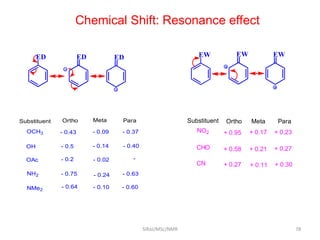
ED ED ED EW EW EW
OCH3 - 0.43 - 0.09 - 0.37
OH - 0.5 - 0.14 - 0.40
OAc - 0.2 - 0.02 -
NH2 - 0.75 - 0.24 - 0.63
NMe2
- 0.64 - 0.10 - 0.60
Substituent Ortho Meta Para Substituent Ortho Meta Para
NO2 + 0.95 + 0.17 + 0.23
CHO + 0.58 + 0.21 + 0.27
CN + 0.27 + 0.11 + 0.30
Chemical Shift: Resonance effect
78SIRaJ/MSc/NMR
Diamagnetic anisotropic effect
• Anisotropic induced magnetic field effects are
the result of a local induced magnetic field
experienced by a nucleus resulting from
circulating π electrons that can either be
paramagnetic when it is parallel to the applied
field or diamagnetic when it is opposed to it.
79SIRaJ/MSc/NMR
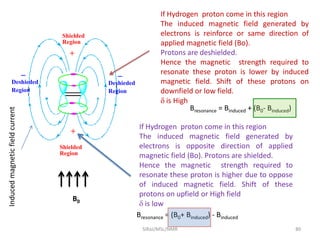
SIRaJ/MSc/NMR 80
Shielded
Region
Shielded
Region
Deshieded
Region

+
+
Deshieded
Region

B0
If Hydrogen proton come in this region
The induced magnetic field generated by
electrons is reinforce or same direction of
applied magnetic field (Bo).
Protons are deshielded.
Hence the magnetic strength required to
resonate these proton is lower by induced
magnetic field. Shift of these protons on
downfield or low field.
 is High
Bresonance = Binduced + (B0- Binduced)
If Hydrogen proton come in this region
The induced magnetic field generated by
electrons is opposite direction of applied
magnetic field (Bo). Protons are shielded.
Hence the magnetic strength required to
resonate these proton is higher due to oppose
of induced magnetic field. Shift of these
protons on upfield or High field
 is low
Bresonance = (B0+ Binduced) - Binduced
Inducedmagneticfieldcurrent
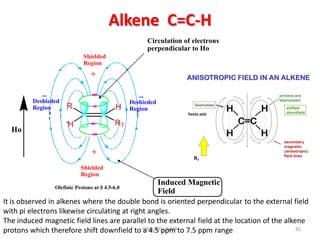
Alkene C=C-H
81SIRaJ/MSc/NMR
H
R1
R
H
Shielded
Region
Shielded
Region
Deshieded
Region

+
+
Deshieded
Region

Olefinic Protons at  4.5-6.0
Circulation of electrons
perpendicular to Ho
Induced Magnetic
Field
Ho
It is observed in alkenes where the double bond is oriented perpendicular to the external field
with pi electrons likewise circulating at right angles.
The induced magnetic field lines are parallel to the external field at the location of the alkene
protons which therefore shift downfield to a 4.5 ppm to 7.5 ppm range
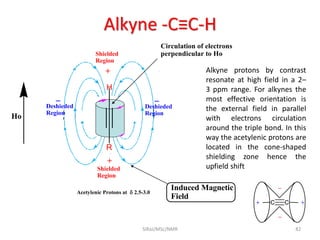
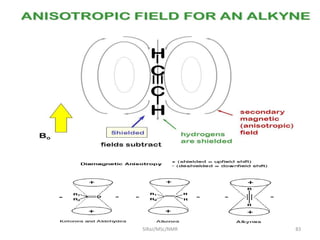
Alkyne -C≡C-H
82SIRaJ/MSc/NMR
H
R
Shielded
Region
Shielded
Region
+
+
Deshieded
Region

Deshieded
Region

Acetylenic Protons at  2.5-3.0
Ho
Circulation of electrons
perpendicular to Ho
Induced Magnetic
Field
Alkyne protons by contrast
resonate at high field in a 2–
3 ppm range. For alkynes the
most effective orientation is
the external field in parallel
with electrons circulation
around the triple bond. In this
way the acetylenic protons are
located in the cone-shaped
shielding zone hence the
upfield shift
SIRaJ/MSc/NMR 83
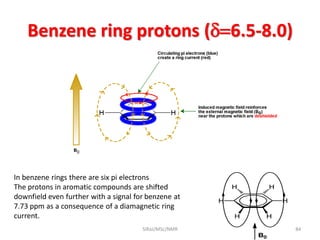
Benzene ring protons (=6.5-8.0)
84SIRaJ/MSc/NMR
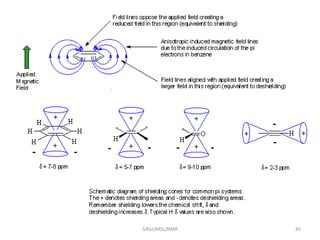
In benzene rings there are six pi electrons
The protons in aromatic compounds are shifted
downfield even further with a signal for benzene at
7.73 ppm as a consequence of a diamagnetic ring
current.
SIRaJ/MSc/NMR 85
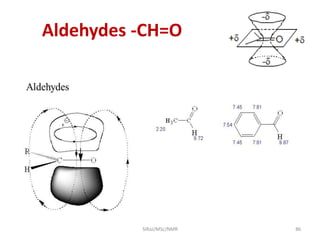
Aldehydes -CH=O
86SIRaJ/MSc/NMR
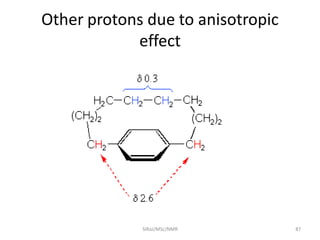
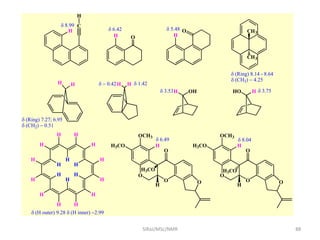
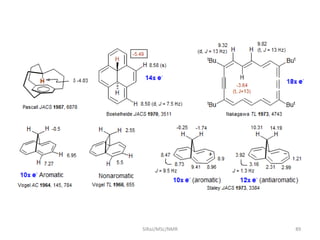
Other protons due to anisotropic
effect
87SIRaJ/MSc/NMR
H
C
H
OH
O
H
H H
CH3
CH3
H
H
H
H
H
H
H H
H
H
H
H
HH
H
H
H
H
H OH HO H
H H
O
O O
O
OCH3
H3CO H
H3CO
H
O
O O
O
OCH3
H3CO H
H
H3CO
 8.99
 6.42  5.48
 (Ring) 8.14 - 8.64
 (CH)  4.25
 3.53  3.75
 (Ring) 7.27; 6.95
 (CH2)  0.51
  0.42  .42
 (H outer) 9.28  (H inner) 2.99
   0
88SIRaJ/MSc/NMR
SIRaJ/MSc/NMR 89
Hydrogen bonding
SIRaJ/MSc/NMR 90
Spin Spin splitting
• The 1H-NMR spectra, each set of protons generates a
single NMR signal. In fact, the 1H-NMR spectra of most
organic molecules contain proton signals that are 'split'
into two or more sub-peaks. Rather than being a
complication, however, this splitting behavior actually
provides us with more information about our sample
molecule.
• The source of signal splitting is a phenomenon
called spin-spin coupling, a term that describes the
magnetic interactions between neighboring, non-
equivalent NMR-active nuclei.
91SIRaJ/MSc/NMR
92
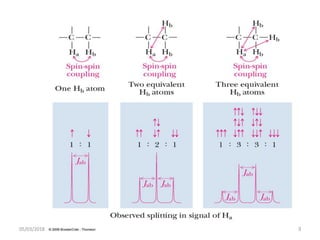
Spin-Spin Splitting in 1H NMR Spectra
 Peaks are often split into multiple peaks due to magnetic interactions between
nonequivalent protons on adjacent carbons, The process is called spin-spin splitting.
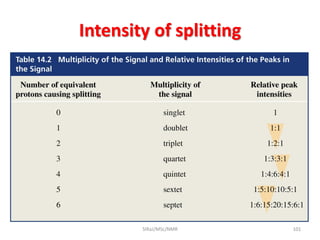
 The splitting is into one more peak than the number of H’s on the adjacent carbon(s), This
is the “n+1 rule”
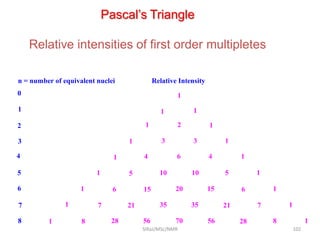
 The relative intensities are in proportion of a binomial distribution given by Pascal’s
Triangle
 The set of peaks is a multiplet (2 = doublet, 3 = triplet, 4 = quartet, 5=pentet, 6=sextet,
7=heptet…..)
SIRaJ/MSc/NMR 93
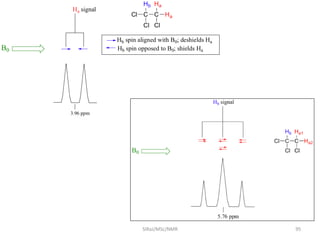
Spin Spin Coupling / splitting
• In the simplest case we expect to see a single peak for each type of
proton in a molecule. But consider what happens if a proton that
we are looking at (HA) is near another nonequivalent proton (HB).
In half of the molecules the HA proton will be adjacent to an HB
aligned with the field and in the other half the HA proton will be
adjacent to an HB aligned against the field. Thus, half the HA's in
the sample will feel a slightly larger magnetic field than they would
in the absence of HB and half will feel a slightly smaller magnetic
field. Thus, we will observe two absorptions for the HA proton. (Of
course we would also observe the same thing for HB.) This splitting
of the HA resonance into two peaks is termed "spin-spin coupling"
or "spin-spin splitting" and the distance between the two peaks (in
Hz) is called the "coupling constant" (usually represented by the
symbol J). The spin-spin coupling is transmitted through the
electrons in the bonds and so depends on the bonding relationship
between the two hydrogens.
SIRaJ/MSc/NMR 94
SIRaJ/MSc/NMR 95
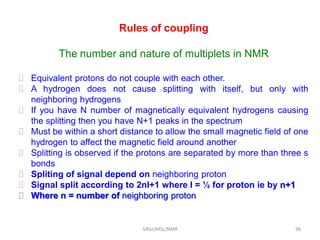
Rules of coupling
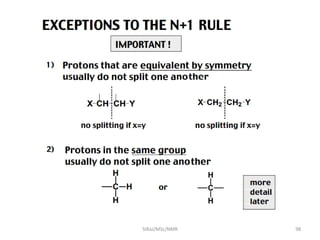
The number and nature of multiplets in NMR
 Equivalent protons do not couple with each other.
 A hydrogen does not cause splitting with itself, but only with
neighboring hydrogens
 If you have N number of magnetically equivalent hydrogens causing
the splitting then you have N+1 peaks in the spectrum
 Must be within a short distance to allow the small magnetic field of one
hydrogen to affect the magnetic field around another
 Splitting is observed if the protons are separated by more than three s
bonds
 Spliting of signal depend on neighboring proton
 Signal split according to 2nI+1 where I = ½ for proton ie by n+1
 Where n = number of neighboring proton
96SIRaJ/MSc/NMR
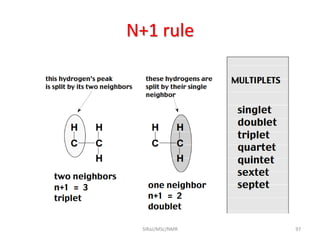
N+1 rule
SIRaJ/MSc/NMR 97
SIRaJ/MSc/NMR 98
05/03/2018 Chapter 19 99
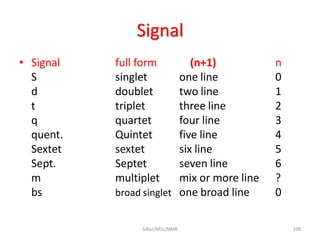
Signal
• Signal full form (n+1) n
S singlet one line 0
d doublet two line 1
t triplet three line 2
q quartet four line 3
quent. Quintet five line 4
Sextet sextet six line 5
Sept. Septet seven line 6
m multiplet mix or more line ?
bs broad singlet one broad line 0
100SIRaJ/MSc/NMR
Intensity of splitting
101SIRaJ/MSc/NMR
Pascal’s Triangle
Relative intensities of first order multipletes
1
1 1
1 2 1
1 3 3 1
1 4 6 4 1
1 5 10 10 5
1 6 15 20 15 6 1
1 7 21 35 35 21 7 1
1 8 28 56 70 56 28 8 1
1
n = number of equivalent nuclei Relative Intensity
0
1
2
3
4
5
6
7
8
102SIRaJ/MSc/NMR
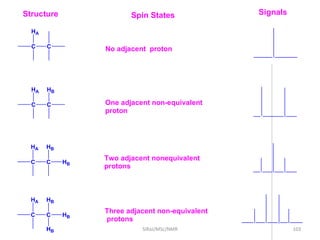
C C
HA
No adjacent proton
C C
HA HB
One adjacent non-equivalent
proton
C C
HA HB
HB
Two adjacent nonequivalent
protons
C C
HA HB
HB
HB
Three adjacent non-equivalent
protons
Structure Spin States Signals
103SIRaJ/MSc/NMR
Broad peak in NMR (bs-broad singlet)
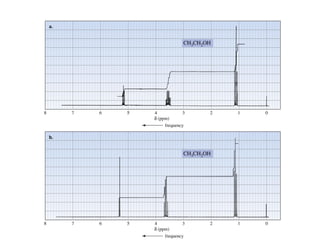
• In NMR spectra, we get a sharp peak line for
splitting as s,d,t etc
• But some peaks are not sharp
• They show as broad peak
• Protons which are exchangble shows such
peaks or protons which attached to –OH, -NH2
104SIRaJ/MSc/NMR
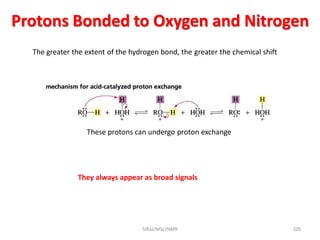
Protons Bonded to Oxygen and Nitrogen
These protons can undergo proton exchange
They always appear as broad signals
The greater the extent of the hydrogen bond, the greater the chemical shift
105SIRaJ/MSc/NMR
SIRaJ/MSc/NMR 106
Protons Bonded to Oxygen and Nitrogen will
not spilt even they have neighboring proton
SIRaJ/MSc/NMR 107
05/03/2018 Chapter 19 108
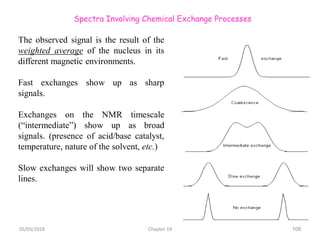
Spectra Involving Chemical Exchange Processes
The observed signal is the result of the
weighted average of the nucleus in its
different magnetic environments.
Fast exchanges show up as sharp
signals.
Exchanges on the NMR timescale
(“intermediate”) show up as broad
signals. (presence of acid/base catalyst,
temperature, nature of the solvent, etc.)
Slow exchanges will show two separate
lines.
D2O exchangeable protons
•Protons attached to O, N, S are resonating anywhere between 1 to 15 .
•The position depends on a) substrate b) solvent c) concentration d)
temperature.
•The best method to detect these protons is to re-run the spectra on
addition of drop of D2O, wherein these protons will change their position.
109SIRaJ/MSc/NMR
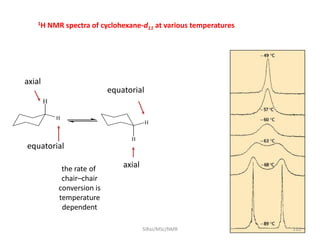
1H NMR spectra of cyclohexane-d11 at various temperatures
H
H
H
H
axial
equatorial
axial
equatorial
the rate of
chair–chair
conversion is
temperature
dependent
110SIRaJ/MSc/NMR
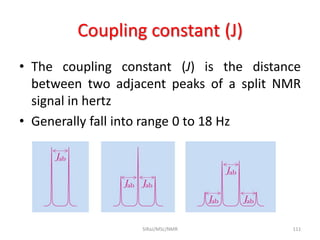
Coupling constant (J)
• The coupling constant (J) is the distance
between two adjacent peaks of a split NMR
signal in hertz
• Generally fall into range 0 to 18 Hz
111SIRaJ/MSc/NMR
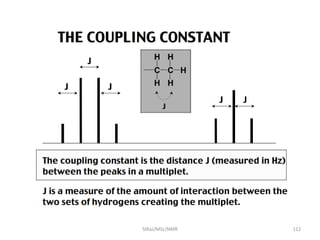
SIRaJ/MSc/NMR 112
Types of coupling
SIRaJ/MSc/NMR 113
114
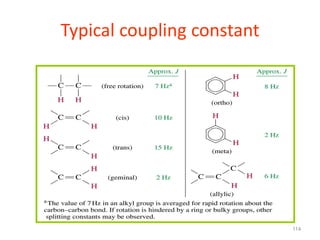
Typical coupling constant
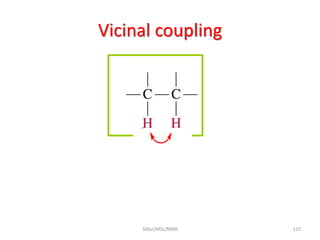
Vicinal coupling
115SIRaJ/MSc/NMR
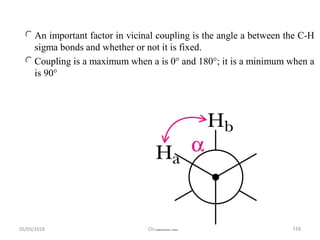
05/03/2018 Chapter 19 116
An important factor in vicinal coupling is the angle a between the C-H
sigma bonds and whether or not it is fixed.
Coupling is a maximum when a is 0° and 180°; it is a minimum when a
is 90°
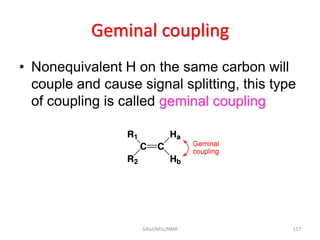
Geminal coupling
• Nonequivalent H on the same carbon will
couple and cause signal splitting, this type
of coupling is called geminal coupling
117SIRaJ/MSc/NMR
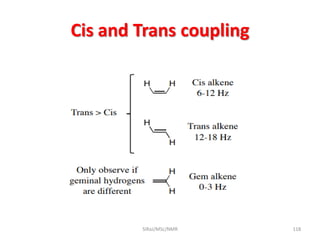
Cis and Trans coupling
118SIRaJ/MSc/NMR
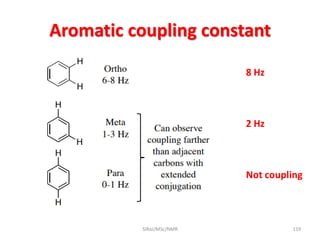
Aromatic coupling constant
119SIRaJ/MSc/NMR
8 Hz
2 Hz
Not coupling
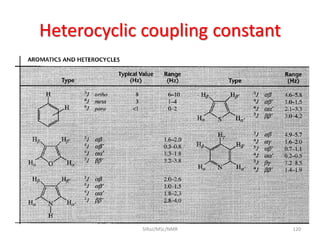
Heterocyclic coupling constant
120SIRaJ/MSc/NMR
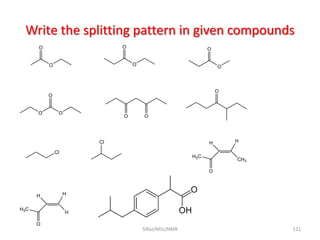
Write the splitting pattern in given compounds
121SIRaJ/MSc/NMR
O
O
O
O
O
O
O O
O
O O
O
Cl
Cl H
CH3
H
H3C
O
H
H
H
H3C
O
How will differentiate following pair by PMR
SIRaJ/MSc/NMR 122
Assign the signals for following compounds
SIRaJ/MSc/NMR 123
Deduce the structure from following data
SIRaJ/MSc/NMR 124

NMR Spectroscopy Lecture

  • 1.
    Nuclear Magnetic Resonance Spectroscopy (1HNMR or PMR) For M. Sc. I Chemistry Shaikh Siraj Babulal
  • 2.
    1937 Rabi predictsand observes nuclear magnetic resonance 1946 Bloch, Purcell first nuclear magnetic resonance of bulk sample 1953 Overhauser NOE (nuclear Overhauser effect) 1966 Ernst, Anderson Fourier transform NMR 1975 Jeener, Ernst 2D NMR 1984 Nicholson NMR metabolomics 1985 Wüthrich first solution structure of a small protein (BPTI) from NOE derived distance restraints 1987 3D NMR + 13C, 15N isotope labeling of recombinant proteins (resolution) 1990 pulsed field gradients (artifact suppression) 1996/7 residual dipolar couplings (RDC) from partial alignment in liquid crystalline media TROSY (molecular weight > 100 kDa) 2000s Dynamic nuclear polarisation (DNP) to enhance NMR sensitivity 5 Nobel prizes for NMR field 1944 Physics Rabi (Columbia) 1952 Physics Bloch (Stanford), Purcell (Harvard) 1991 Chemistry Ernst (ETH) 2002 Chemistry Wüthrich (ETH) 2003 Medicine (MRI) Lauterbur (University of Illinois in Urbana), Mansfield (University of Nottingham) NMR History 2SIRaJ/MSc/NMR
  • 3.
    NMR • The NMRdeals with the nucleus of the atom that posses a magnetic moment. • The nucleus being positively charged and spin about its axis generate a magnetic field directed along the axis of spin. Thus the nucleus behaves as a tiny magnet. • Nuclear magnetic resonance is defined as a condition when the frequency of the rotating magnetic field becomes equal to the frequency of the processing nucleus. Spinning charged particle is a magnet Spinning charged particle is a magnet 3SIRaJ/MSc/NMR
  • 4.
    Sample at Equilibrium Radiation Excited StateSpectrum Relaxation Observation Spectroscopy UV-Visible: Presence of chromophoric system / conjugation in the molecules IR Spectroscopy: Presence of Functional Groups in the molecules 1H NMR Spectroscopy: The number of different types of Hydrogens in the molecules The relative numbers of different types of Hydrogens in the molecules The electronic environment of different types of Hydrogens in the molecules The “neighbours to the neighbours” of the functional group These spectroscopic techniques are mutually complimentary and a combination of these three-along with a Mass Spectroscopy form a powerful device in the determination of structures of organic molecules. 4SIRaJ/MSc/NMR
  • 5.
    NMR Spectroscopy • NMRuses energy in the radio frequency range. • This energy is too low to cause changes in electron energy levels or in the vibrations of molecules. • NMR can cause changes in the spin of particles in the nucleus of some atoms. • Nuclear magnetic resonance (NMR) is a physical phenomenon in which nuclei in a magnetic field absorb and re-emit electromagnetic radiation. • This energy is at a specific resonance frequency which depends on the strength of the magnetic field and the magnetic properties of the isotope of the atoms; in practical applications, the frequency is similar to VHF and UHF television broadcasts (60–1000 MHz). • NMR allows the observation of specific quantum mechanical magnetic properties of the atomic nucleus. 5SIRaJ/MSc/NMR
  • 6.
    Nucleus • The atomicnucleus is the small, dense region consisting of protons and neutrons at the center of an atom. • Protons and Neutrons form the nucleus of the atom, electrons orbit the nucleus in electron shells. 6SIRaJ/MSc/NMR
  • 7.
    • All nucleons,that is neutrons and protons, composing any atomic nucleus, have the intrinsic quantum property of spin. • The overall spin of the nucleus is determined by the spin quantum number S / I. • The spinning charged nucleus generates a magnetic field. 7SIRaJ/MSc/NMR
  • 8.
    The nuclei ofsome atoms have a property called “SPIN”. NUCLEAR SPIN These nuclei behave as if they were spinning. This is like the spin property of an electron, which can have two spins: +1/2 and -1/2 . Each spin-active nucleus has a number of spins defined by its spin quantum number, I. ….. we don’t know if they actually do spin! 8SIRaJ/MSc/NMR
  • 9.
    l Nucleii spin + charge l Nucleii spin+ charge ll Nucleii spin + charge Spinning charged particle is a magnet Spinning charged particle is a magnet Magnetic Properties of Nuclei The spinning of positively charged particle produces: (1) Spin angular momentum or Spin quantum number (I) (2) Magnetic moment (m) along the axis of spin (3) Electric quadrupole moment (Q) (as a result of non-spherical distribution of nuclear charge) 9SIRaJ/MSc/NMR
  • 10.
    The spin stateof a nucleus is affected by an applied magnetic field 10SIRaJ/MSc/NMR
  • 11.
    Behavior of MagneticNuclei Randomly oriented nuclear spins of equal energy in the absence of any magnetic field 1 2 _ 1 2 + EP 1 2 _ 1 2 + ElectromagneticRadiation in R F range with energy E = Ep Ho Precisely oriented nuclear spins in the presence of Magnetic field For nuclei with spin I = ½ Two possible orientations as per equation 2I + 1 In NMR, we are measuring the energy required for the flipping of the nucleus 11SIRaJ/MSc/NMR
  • 12.
    Nuclear spins areoriented randomly in the absence (a) of an external magnetic field but have a specific orientation in the presence (b) of an external field, B0 • Some nuclear spins are aligned parallel to the external field – Lower energy orientation – More likely • Some nuclear spins are aligned antiparallel to the external field – Higher energy orientation – Less likely Nuclear Magnetic Resonance Spectroscopy
  • 13.
    In the presenceof a strong magnetic field, the tiny magnetic field due to spinning charged particles aligns to be either with or against the magnetic field. 13SIRaJ/MSc/NMR
  • 14.
    • More nucleonswill be in the lower energy state aligned with the magnetic field. • A nucleon can absorb a quantum of energy in the radio frequency range and align against the magnetic field. • It emits a radio frequency when it drops back to its original position. 14SIRaJ/MSc/NMR
  • 15.
    NUCLEAR SPIN STATES- HYDROGEN NUCLEUS + 1/2 - 1/2 The two states are equivalent in energy in the absence of a magnetic or an electric field. + + The spin of the positively charged nucleus generates a magnetic moment vector, m. m m TWO SPIN STATES 15SIRaJ/MSc/NMR
  • 16.
    Is all nucleiare NMR active? • The angular momentum of spinning nucleus is described in terms of spin quantum no.I • The spin quantum no. I is a characteristic constant of a nucleus, and is dependent on the number of protons and neutrons. • In general three rules apply to the nuclear spins. 1) Nuclei with odd mass number and odd or even no. of protons have half – integral spin such as 1/2, 3/2, 5/2 etc. 2) Nuclei with even mass number and odd no. of protons have integral spin such as 1, 2, 3 3) Nuclei with even mass number and even no. of protons always have zero spin (Due to pairing of oppositely directed spins in the nucleus) (Mass Number:-the total number of protons and neutrons in a nucleus.) 16SIRaJ/MSc/NMR
  • 17.
    Requirements of nucleito be NMR active Three important characteristics: o Nuclei should have Spin no. I > 0 and magnetic momemtum m > 0 o Nuclei should have even charge distribution that is nucleus should be spherical in shape so as Q = 0. o Nuclei should have high % of natural abundance 1H, 13C, 19 F and 31 P nuclei have I = 1/2 and m > 0 These nuclei are spherical in shape (even charge distribution) and Q = 0 So observed by NMR technique. 1H, 19F and 31P have high % abundance 12C and 16O nuclei are also spherical in shape Q = 0; but I = 0 and m = 0 So non-magnetic and not observed by NMR 17SIRaJ/MSc/NMR
  • 18.
    Nucleus No. of Proton No.of Neutron Mass No. Spin No. (I) Natural % Abundance 1H 1 0 1 1/2 99.98 2H 1 1 2 1 00.0156 12C 6 6 12 0 98.80 13C 6 7 13 1/2 01.108 14N 7 7 14 1 99.635 15N 7 8 15 1/2 00.365 16O 8 8 16 0 99.95 17O 8 9 17 5/2 00.037 19F 9 10 19 1/2 100.00 29Si 14 15 29 1/2 04.70 31P 15 16 31 1/2 100.00 Nuclear Properties of Important Nuclei The number of spin states is 2I + 1, where I is the spin quantum number. 18SIRaJ/MSc/NMR
  • 19.
    Basic NMR Equation Forproton spin no. I = ½. Therefore, there are (2I + 1) two possible orientations. The energy of orientation is a product of magnetic moment m and strength of the applied Field Ho (E = mHo). At resonance: h = 2 m Ho = 2mHo / h The Larmor Frequency equation is rewritten as =  Ho /2 Where  = 2.m / h.I It is a proportionality constant between m and I. Also called as Gyro magnetic ratio. It is constant for a particular nuclei but different for different nuclei.   HO E2 = + m HO E1 =  m HO Aligned with the field Low  energy orientation Aligned against the field High  energy orientation E = 2 m HO E = h 19SIRaJ/MSc/NMR
  • 20.
    Gyromagnetic ratio () relatedto the relative sensitive of the NMR signal magnetic moment (m) is created along axis of the nuclear spin where: p – angular momentum  – gyromagnetic ratio (different value for each type of nucleus) IIh  mm  == 2 pm = In physics, the gyromagnetic ratio (also sometimes known as the magnetogyric ratio) of a particle or system is the ratio of its magnetic moment to its angular momentum, and it is often denoted by the symbol γ, gamma. 20SIRaJ/MSc/NMR
  • 21.
    The mechanism ofabsorption (Resonance) Nuclear Spin Energy Levels Bo +1/2 -1/2 In a strong magnetic field (Bo) the two spin states differ in energy. aligned unaligned N S 21
  • 22.
    THE “RESONANCE” PHENOMENON •Absorptionof energy by the spinning nucleus. •When proton kept external magnetic field, it align to magnetic filed and undergo precess rotation. •If we irradiate the sample with radio waves (MHz) the proton can absorb the energy and be promoted to the less favorable higher energy state. This absorption is called resonance because the frequency of the applied radiation and the precession coincide or resonate. 22SIRaJ/MSc/NMR
  • 23.
  • 24.
    Precessional motion Precession isa change in direction of the axis, but without a change in tilt. The axis of the nuclear magnet is oriented exactly parallel or anti parallel with applied magnetic field, there will be a certain force by the external field to so oriented it. But because the nucleus is spinning the effect is that its rotation axis draws out a circle perpendicular to the applied field. This motion is called precession (example is the gyroscopic motion of the spinning top) The precessional frequency of the nucleus depends upon the strength of the applied magnetic field and the nature of the nucleus. 24SIRaJ/MSc/NMR
  • 25.
    Precessional orbit Nuclear magnet HO H The behaviorof a nuclear magnet in a magnetic field wo m 25SIRaJ/MSc/NMR
  • 26.
    a-spin states b-spinstates absorb E release E Signals detected by NMR RF 26SIRaJ/MSc/NMR
  • 27.
    Absorption of Energy Bo +1/2 -1/2 +1/2 -1/2 E= h E Quantized ??? Radiofrequency Applied Field Aligned Opposed 27SIRaJ/MSc/NMR
  • 28.
    Bo E + 1/2 - 1/2 =kBo = h degenerate at Bo = 0 increasing magnetic field strength THE ENERGY SEPARATION DEPENDS ON Bo 28SIRaJ/MSc/NMR
  • 29.
    Is all Hydrogenproton absorb or release same amount of energy in the same magnetic field? CH3-CH2-OH is all H proton absorb at same frequency? Magnetic field -same Energy gap between to spin?? 29SIRaJ/MSc/NMR
  • 30.
    The absorption frequencyis not the same for all 1H or 13C nuclei – Nuclei in molecules are surrounded by electrons – Electrons set up tiny local magnetic fields that act in opposition to the applied field, shielding the nucleus from the full effect of the external magnetic field – The effective field actually felt by the nucleus is the applied field reduced by the local shielding effects Beffective = Bapplied – Blocal The Nature of NMR Absorptions When an atom is placed in a magnetic field, its electrons circulate about the direction of the applied magnetic field. This circulation causes a small magnetic field at the nucleus which opposes the externally applied field 30 SIRaJ/MSc/NMR
  • 31.
    Different types ofprotons precess at different rates in the same magnetic field. N S CH2 C O CH3 59.999995 MHz 59.999820 MHz 59.999700 MHz h 60 MHz To cause absorption of the incoming 60 MHz the magnetic field strength, Bo , must be increased to a different value for each type of proton. Bo = 1.41 Tesla Differences are very small, in the parts per million range. EXAMPLE: 31 SIRaJ/MSc/NMR
  • 32.
  • 33.
    A Simplified 60MHz NMR Spectrometer (continuous wave Instrument) Transmitter Receiver Probe h SN RF Detector Recorder RF (60 MHz) Oscillator ~ 1.41 Tesla (+/-) a few ppm absorption signal MAGNETMAGNET 33SIRaJ/MSc/NMR
  • 34.
    Magnet Legs NMR MagnetCross-Section 34SIRaJ/MSc/NMR
  • 35.
    NMR Sample tube& Probe Coil 35SIRaJ/MSc/NMR
  • 36.
    Magnetic field andRF required to hydrogen nuclei absorb such field Magnetic field and Resonance Frequency required to hydrogen nuclei can be calculated by Larmor equation Nuclei T-1S-1 MHz/T 1H 26.75 x 10⁸ 42.58 13C 6.73 x 10⁸ 10.71 ω0 = ϒB0 in a field (Bo) of 1.41T, the resonance frequency of ¹H would be (42.58 MHz/T) x (1.415T) = 60.0378 MHz. i.e at magnetic field B0 1.41 T, the resonance frequency (radio frequency radiation require to change spin) for hydrogen is 60.03 MHz Gyromagnetic tation (ϒ) Or  =  Ho / 2 36SIRaJ/MSc/NMR
  • 37.
    The energy differencebetween the two spin states depends on the strength of the magnetic field Energy Applied Magnetic field B0 14.092 7.046 1.41 β spin state α spin state 60 MHz 300 MHz 600 MHz 37 SIRaJ/MSc/NMR
  • 38.
    1H Vs 13C Magneticfield and Resonance frequency 38 SIRaJ/MSc/NMR
  • 39.
    c. The 1HNMR spectrum of toluene shows that it has two peaks because of methyl and aromatic protons recorded at 60 MHz and 1.41 T. Given this information, what would be the magnetic field at 400 MHz? 39SIRaJ/MSc/NMR
  • 40.
    NMR Sensitivity But ata significant cost! ~$800,000 ~$2,00,000 ~$4,500,000 40SIRaJ/MSc/NMR
  • 41.
    Two ways ofdoing NMR experiment Sweeping – change magnetic field Keep constant frequency Change the frequency Keep magnetic field constant  =  Ho / 2 Commonly Used method 41SIRaJ/MSc/NMR
  • 42.
    NMR Signal (sensitivity) •The applied magnetic field causes an energy difference between the aligned (a) and unaligned (b) nuclei • NMR signal results from the transition of spins from the a to b state • Strength of the signal depends on the population difference between the a and b spin states • The population (N) difference can be determined from the Boltzmann distribution and the energy separation between the a and b spin states: Na / Nb = e E / kT Bo = 0 Bo > 0 E = h  a b Low energy gap 42SIRaJ/MSc/NMR
  • 43.
    Information from 1H-NMRspectra: 1. Number of signals: How many different types of hydrogens in the molecule. 2. Position of signals (chemical shift): What types of hydrogens. 3. The chemical shift (δ, in ppm) gives a clue as to the type of hydrogen generating the peak (alkane, alkene, benzene, aldehyde, etc.) 4. Relative areas under signals (integration): How many hydrogens of each type. (number of Hydrogens) 5. Splitting pattern: How many neighboring hydrogens. 43SIRaJ/MSc/NMR
  • 44.
    Chemical equivalent andnon- equivalent protons • 1H NMR spectroscopy determines how many kinds of electronically nonequivalent hydrogens are present in a molecule • Chemically equivalent proton resonance at same frequency and gives one signal peak. • Numbers of peaks in NMR gives different sets of protons • Symmetric molecules have equivalent protons on each side of symmetry 44SIRaJ/MSc/NMR
  • 45.
    Chemical Equivalence  Chemicallyequivalent protons H3C CH3 O O H3C CH3 H3CO OCH3 O X Y Z X, Y, and Z have one set of equivalent protons.  Chemically non-equivalent protons CH3CH2Cl CH3CH2OCH2CH3 CH3CH2OH 2 signals 2 signals 3 signals 45SIRaJ/MSc/NMR
  • 46.
    Examples on Types ofprotons / sets of protons 46SIRaJ/MSc/NMR
  • 47.
    Symmetric nature 47SIRaJ/MSc/NMR Cl Cl Cl Cl ClCl CH3 CH3 CH3 CH3 CH3 CH3O O O O
  • 48.
    Spectra An NMR spectrumis a plot of the magnetic field applied (or radio frequency applied) against absorption. A signal in the spectrum is referred to as a resonance. The frequency of a signal is known as its chemical shift, δ 48SIRaJ/MSc/NMR
  • 49.
    Integration • The processof excitation in NMR involves the flipping of the nucleus. This process of transition and the probability of the transition is same for all the protons, irrespective of the electronic environment. As a result, the area under the NMR resonance is proportional to the number of hydrogens which that resonance represents. • In this way, by integrating the different NMR resonance, information regarding the relative numbers of chemically distinct hydrogens can be found. • The integrals will appear as a line over the NMR spectrum. Integration only gives information on the relative number of different hydrogens, not the absolute number. 49SIRaJ/MSc/NMR
  • 50.
    The area undereach 1H NMR peak is proportional to the number of protons causing that peak • Integrating (electronically measuring) the area under each peak makes it possible to determine the relative number of each kind of proton in a molecule • Integrating the peaks of 2,2-dimethylpropanoate in a “stair-step” manner shows that they have 1:3 ratio, corresponding to the ratio of the numbers of protons (3:9) Integration of 1H NMR Absorptions: Proton Counting
  • 51.
    Solvents for NMR D3COOD2.02, 11.53 D3CCOCD3 2.05 D3CCN 1.95 C6D6 7.20 CDCl3 7.25 CD2Cl2 5.35 D3C-SO-CD3 2.50 F3C.COOD 10-11 A satisfactory solvent should be  It should be chemically inert  It should not contain protons  It should be non – polar and should have low – boiling point  It should have low viscosity 51SIRaJ/MSc/NMR
  • 52.
    Scale  Scale • NarrowNMR absorption range • 0 to 15  for 1H NMR 52SIRaJ/MSc/NMR
  • 53.
    Requirements for areference standard in NMR A good standard should meet the following requirements: • It should be chemically inert (non-reactive). • It should give a single sharp line. • It should be magnetically isotropic. • It should have unique line position. • It should be Miscible with organic solvents. • It should be readily volatile to allow recovery of the compound. TetraMethylSilane Silicon is more electro-positive than carbon. Therefore, pushes electron density towards carbon and thus to hydrogen-making methyl protons strongly shielded. H3C Si CH3 C CH3 H H H 53SIRaJ/MSc/NMR
  • 54.
    Reference compound forchemical shift TMS • TetraMethylSilane (TMS) used as reference compound or internal standard for NMR • It fulfill all the conditions • it is the reference peak / calibration peak for chemical shift. • Peak of TMS is considered as 0.0  • In NMR spectra is plotted by considering TMS as 0.0  on scale 54SIRaJ/MSc/NMR
  • 55.
    Chemical Shift • Thechemical shift in absolute terms is defined by the frequency / magnetic field of the resonance expressed with reference to a standard compound which is defined to be at 0 ppm. • The change in resonance frequency (or field) is very very low for proton i.e. ppm, • The scale is made more manageable by expressing it in parts per million (ppm) and is independent of the spectrometer frequency. 55SIRaJ/MSc/NMR
  • 56.
  • 57.
    Chemical shift arealso expressed in  (ppm)  = Shift in frequency from TMS (Hz) X 106 Frequency of spectrometer (Hz)  is dimensionless and is NOT PROPORTIONAL to Ho or Osc. frequency.  value is same in all the different instruments Universal scale in NMR Higher the value of chemical shift in Hz or   deshielded is the proton. Lower the value chemical shift in Hz or   shielded is the proton. Units of Chemical shift 57SIRaJ/MSc/NMR
  • 58.
    • Position onNMR chart at which a nucleus absorbs – The chemical shift of TMS is set as zero point – Other absorptions normally occur downfield – NMR charts calibrated using delta () scale • 1  = 1 part per million of operating frequency – Chemical shift of an NMR absorption in  units is constant, regardless of the operating frequency of the spectrometer Chemical shift (number of Hz downfield from TMS) δ = Spectrometer frequency in MHz Chemical Shifts 58SIRaJ/MSc/NMR
  • 59.
    The NMR Chart Thedownfield, deshielded side is on the left, and requires a lower field strength for resonance The upfield, shielded side is on the right, and requires a higher field strength for resonance The tetramethylsilane (TMS) absorption is used as a reference point Chemical Shifts 59SIRaJ/MSc/NMR
  • 60.
    Low field (Downfield) & High field (Upfield) 60SIRaJ/MSc/NMR Magnetic field increase High fieldLow field More electron density, Electron oppose the external magnetic field (shield) hence these proton require higher external field to come in resonance Less electron density or anisotropic effect, Electron not oppose the external magnetic field (deshield) hence these proton require lower external field to come in resonance
  • 61.
    Downfield and Upfield • The downfield, deshielded side is on the left, and requires a lower magnetic field strength for resonance • The upfield, shielded side is on the right, and requires a higher field strength for resonance • More the electron density – more is the shielding - up field - high field • Less the electron density – more is the deshielding – downfield – low field 61SIRaJ/MSc/NMR Downfield Upfield
  • 62.
    Shielding • Shielded meanthat “A nucleus whose chemical shift has been decreased due to more electron density, magnetic induction, or other effects.” • shielded proton is surrounded by electrons which oppose the external magnetic field. • Due to opposing of external magnetic field, it require high magnetic strength to bring proton in resonance. • Shielding decrease the  value i.e. require high field strength SIRaJ/MSc/NMR 62
  • 63.
    Deshielding • Deshielding isthe opposite of shielding. • When we say that an atom is deshielded, we mean that “A nucleus whose chemical shift has been increased due to removal of electron density, magnetic induction, or other effects.” • In deshieded proton is not surrounded by electrons or due to other effect • Deshielding increase the  value ie require low field strength 63SIRaJ/MSc/NMR
  • 64.
  • 65.
    Most 1H NMRchemical shifts occur within the 0 to 10  range except for carboxylic acid O-H absorptions which usually occur within the 11- 12  range Chemical Shifts in 1H NMR Spectroscopy
  • 66.
  • 68.
    Factor affecting chemicalshift • Electronegativity • Conjugation • Resonance effect Aromatic rings • Diamagnetic Anisotropic effect • Hydrogen bonding • solvent effect-Polar and non polar solvent 68SIRaJ/MSc/NMR
  • 69.
    Electronegativity • Electron withdrawinginductive effect is one of the parameter that affects the chemical shift • Stronger the electron withdrawing group – decrease the electron density. • As electron density decrease, there is low / no opposing induced magnetic field. • more is the deshielding 69SIRaJ/MSc/NMR
  • 70.
    Electron withdrawal causesNMR signals to appear at higher frequency (at larger  values) When an atom is placed in a magnetic field, its electrons circulate about the direction of the applied magnetic field. This circulation causes a small magnetic field at the nucleus which opposes the externally applied field Electronegative atoms pull the eletron from Hydrogens………………………………. 70SIRaJ/MSc/NMR
  • 71.
  • 72.
  • 73.
    Resonance effect  Electrondonating resonance effect increases electron density at the carbon and in turn to hydrogen – Shielding of proton. Electron withdrawing resonance effect decreases electron density at carbon and in turn to hydrogen – Deshielding of proton. OCH3 H H H a b a-H-deshielded due to -I effect b-H-shielded due to +M effect OCH3 H H H ab C H H H ab O CH3 C H H H ab O CH3 a-H-deshielded due to small -I effect b-H-deshielded due to strong -M effect 6.38 3.85 5.85 6.40 OCH3 H H H a b 6.38 3.85 C H H H a b O CH3 5.85 6.40 73SIRaJ/MSc/NMR
  • 74.
    Conjugation or Resonance 74SIRaJ/MSc/NMR O a b H HDeshielded proton Positive charge High  Not Deshielded proton No Positive charge Low  O O
  • 75.
    Explain following observation SIRaJ/MSc/NMR 75 a b O H H shieldedproton Nigative charge Low  Not shielded proton No negative charge, -I effect, high  O O
  • 76.
    SIRaJ/MSc/NMR 76 Conjugation orResonance Explain following observation
  • 77.
    Resonance effect- Aromaticprotons  Electron donating resonance effect increases electron density at the carbon and in turn to hydrogen – Shielding of proton.  Electron withdrawing resonance effect decreases electron density at carbon and in turn to hydrogen – Deshielding of proton. 77SIRaJ/MSc/NMR OR 6.77 7.15 6.82 7.15 6.77 7.26 7.26 7.26 7.26 7.26 7.26 N+ O- O 8.19 7.52 7.65 7.52 8.19
  • 78.
    ED ED EDEW EW EW OCH3 - 0.43 - 0.09 - 0.37 OH - 0.5 - 0.14 - 0.40 OAc - 0.2 - 0.02 - NH2 - 0.75 - 0.24 - 0.63 NMe2 - 0.64 - 0.10 - 0.60 Substituent Ortho Meta Para Substituent Ortho Meta Para NO2 + 0.95 + 0.17 + 0.23 CHO + 0.58 + 0.21 + 0.27 CN + 0.27 + 0.11 + 0.30 Chemical Shift: Resonance effect 78SIRaJ/MSc/NMR
  • 79.
    Diamagnetic anisotropic effect •Anisotropic induced magnetic field effects are the result of a local induced magnetic field experienced by a nucleus resulting from circulating π electrons that can either be paramagnetic when it is parallel to the applied field or diamagnetic when it is opposed to it. 79SIRaJ/MSc/NMR
  • 80.
    SIRaJ/MSc/NMR 80 Shielded Region Shielded Region Deshieded Region  + + Deshieded Region  B0 If Hydrogenproton come in this region The induced magnetic field generated by electrons is reinforce or same direction of applied magnetic field (Bo). Protons are deshielded. Hence the magnetic strength required to resonate these proton is lower by induced magnetic field. Shift of these protons on downfield or low field.  is High Bresonance = Binduced + (B0- Binduced) If Hydrogen proton come in this region The induced magnetic field generated by electrons is opposite direction of applied magnetic field (Bo). Protons are shielded. Hence the magnetic strength required to resonate these proton is higher due to oppose of induced magnetic field. Shift of these protons on upfield or High field  is low Bresonance = (B0+ Binduced) - Binduced Inducedmagneticfieldcurrent
  • 81.
    Alkene C=C-H 81SIRaJ/MSc/NMR H R1 R H Shielded Region Shielded Region Deshieded Region  + + Deshieded Region  Olefinic Protonsat  4.5-6.0 Circulation of electrons perpendicular to Ho Induced Magnetic Field Ho It is observed in alkenes where the double bond is oriented perpendicular to the external field with pi electrons likewise circulating at right angles. The induced magnetic field lines are parallel to the external field at the location of the alkene protons which therefore shift downfield to a 4.5 ppm to 7.5 ppm range
  • 82.
    Alkyne -C≡C-H 82SIRaJ/MSc/NMR H R Shielded Region Shielded Region + + Deshieded Region  Deshieded Region  Acetylenic Protonsat  2.5-3.0 Ho Circulation of electrons perpendicular to Ho Induced Magnetic Field Alkyne protons by contrast resonate at high field in a 2– 3 ppm range. For alkynes the most effective orientation is the external field in parallel with electrons circulation around the triple bond. In this way the acetylenic protons are located in the cone-shaped shielding zone hence the upfield shift
  • 83.
  • 84.
    Benzene ring protons(=6.5-8.0) 84SIRaJ/MSc/NMR In benzene rings there are six pi electrons The protons in aromatic compounds are shifted downfield even further with a signal for benzene at 7.73 ppm as a consequence of a diamagnetic ring current.
  • 85.
  • 86.
  • 87.
    Other protons dueto anisotropic effect 87SIRaJ/MSc/NMR
  • 88.
    H C H OH O H H H CH3 CH3 H H H H H H H H H H H H HH H H H H HOH HO H H H O O O O OCH3 H3CO H H3CO H O O O O OCH3 H3CO H H H3CO  8.99  6.42  5.48  (Ring) 8.14 - 8.64  (CH)  4.25  3.53  3.75  (Ring) 7.27; 6.95  (CH2)  0.51   0.42  .42  (H outer) 9.28  (H inner) 2.99    0 88SIRaJ/MSc/NMR
  • 89.
  • 90.
  • 91.
    Spin Spin splitting •The 1H-NMR spectra, each set of protons generates a single NMR signal. In fact, the 1H-NMR spectra of most organic molecules contain proton signals that are 'split' into two or more sub-peaks. Rather than being a complication, however, this splitting behavior actually provides us with more information about our sample molecule. • The source of signal splitting is a phenomenon called spin-spin coupling, a term that describes the magnetic interactions between neighboring, non- equivalent NMR-active nuclei. 91SIRaJ/MSc/NMR
  • 92.
    92 Spin-Spin Splitting in1H NMR Spectra  Peaks are often split into multiple peaks due to magnetic interactions between nonequivalent protons on adjacent carbons, The process is called spin-spin splitting.  The splitting is into one more peak than the number of H’s on the adjacent carbon(s), This is the “n+1 rule”  The relative intensities are in proportion of a binomial distribution given by Pascal’s Triangle  The set of peaks is a multiplet (2 = doublet, 3 = triplet, 4 = quartet, 5=pentet, 6=sextet, 7=heptet…..)
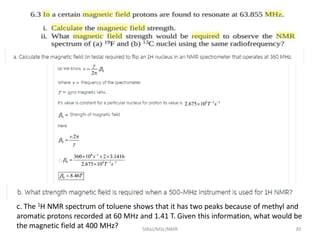
  • 93.
  • 94.
    Spin Spin Coupling/ splitting • In the simplest case we expect to see a single peak for each type of proton in a molecule. But consider what happens if a proton that we are looking at (HA) is near another nonequivalent proton (HB). In half of the molecules the HA proton will be adjacent to an HB aligned with the field and in the other half the HA proton will be adjacent to an HB aligned against the field. Thus, half the HA's in the sample will feel a slightly larger magnetic field than they would in the absence of HB and half will feel a slightly smaller magnetic field. Thus, we will observe two absorptions for the HA proton. (Of course we would also observe the same thing for HB.) This splitting of the HA resonance into two peaks is termed "spin-spin coupling" or "spin-spin splitting" and the distance between the two peaks (in Hz) is called the "coupling constant" (usually represented by the symbol J). The spin-spin coupling is transmitted through the electrons in the bonds and so depends on the bonding relationship between the two hydrogens. SIRaJ/MSc/NMR 94
  • 95.
  • 96.
    Rules of coupling Thenumber and nature of multiplets in NMR  Equivalent protons do not couple with each other.  A hydrogen does not cause splitting with itself, but only with neighboring hydrogens  If you have N number of magnetically equivalent hydrogens causing the splitting then you have N+1 peaks in the spectrum  Must be within a short distance to allow the small magnetic field of one hydrogen to affect the magnetic field around another  Splitting is observed if the protons are separated by more than three s bonds  Spliting of signal depend on neighboring proton  Signal split according to 2nI+1 where I = ½ for proton ie by n+1  Where n = number of neighboring proton 96SIRaJ/MSc/NMR
  • 97.
  • 98.
  • 99.
  • 100.
    Signal • Signal fullform (n+1) n S singlet one line 0 d doublet two line 1 t triplet three line 2 q quartet four line 3 quent. Quintet five line 4 Sextet sextet six line 5 Sept. Septet seven line 6 m multiplet mix or more line ? bs broad singlet one broad line 0 100SIRaJ/MSc/NMR
  • 101.
  • 102.
    Pascal’s Triangle Relative intensitiesof first order multipletes 1 1 1 1 2 1 1 3 3 1 1 4 6 4 1 1 5 10 10 5 1 6 15 20 15 6 1 1 7 21 35 35 21 7 1 1 8 28 56 70 56 28 8 1 1 n = number of equivalent nuclei Relative Intensity 0 1 2 3 4 5 6 7 8 102SIRaJ/MSc/NMR
  • 103.
    C C HA No adjacentproton C C HA HB One adjacent non-equivalent proton C C HA HB HB Two adjacent nonequivalent protons C C HA HB HB HB Three adjacent non-equivalent protons Structure Spin States Signals 103SIRaJ/MSc/NMR
  • 104.
    Broad peak inNMR (bs-broad singlet) • In NMR spectra, we get a sharp peak line for splitting as s,d,t etc • But some peaks are not sharp • They show as broad peak • Protons which are exchangble shows such peaks or protons which attached to –OH, -NH2 104SIRaJ/MSc/NMR
  • 105.
    Protons Bonded toOxygen and Nitrogen These protons can undergo proton exchange They always appear as broad signals The greater the extent of the hydrogen bond, the greater the chemical shift 105SIRaJ/MSc/NMR
  • 106.
    SIRaJ/MSc/NMR 106 Protons Bondedto Oxygen and Nitrogen will not spilt even they have neighboring proton
  • 107.
  • 108.
    05/03/2018 Chapter 19108 Spectra Involving Chemical Exchange Processes The observed signal is the result of the weighted average of the nucleus in its different magnetic environments. Fast exchanges show up as sharp signals. Exchanges on the NMR timescale (“intermediate”) show up as broad signals. (presence of acid/base catalyst, temperature, nature of the solvent, etc.) Slow exchanges will show two separate lines.
  • 109.
    D2O exchangeable protons •Protonsattached to O, N, S are resonating anywhere between 1 to 15 . •The position depends on a) substrate b) solvent c) concentration d) temperature. •The best method to detect these protons is to re-run the spectra on addition of drop of D2O, wherein these protons will change their position. 109SIRaJ/MSc/NMR
  • 110.
    1H NMR spectraof cyclohexane-d11 at various temperatures H H H H axial equatorial axial equatorial the rate of chair–chair conversion is temperature dependent 110SIRaJ/MSc/NMR
  • 111.
    Coupling constant (J) •The coupling constant (J) is the distance between two adjacent peaks of a split NMR signal in hertz • Generally fall into range 0 to 18 Hz 111SIRaJ/MSc/NMR
  • 112.
  • 113.
  • 114.
  • 115.
  • 116.
    05/03/2018 Chapter 19116 An important factor in vicinal coupling is the angle a between the C-H sigma bonds and whether or not it is fixed. Coupling is a maximum when a is 0° and 180°; it is a minimum when a is 90°
  • 117.
    Geminal coupling • NonequivalentH on the same carbon will couple and cause signal splitting, this type of coupling is called geminal coupling 117SIRaJ/MSc/NMR
  • 118.
    Cis and Transcoupling 118SIRaJ/MSc/NMR
  • 119.
  • 120.
  • 121.
    Write the splittingpattern in given compounds 121SIRaJ/MSc/NMR O O O O O O O O O O O O Cl Cl H CH3 H H3C O H H H H3C O
  • 122.
    How will differentiatefollowing pair by PMR SIRaJ/MSc/NMR 122
  • 123.
    Assign the signalsfor following compounds SIRaJ/MSc/NMR 123
  • 124.
    Deduce the structurefrom following data SIRaJ/MSc/NMR 124