12/6/2021 © R R INSTITUTIONS , BANGALORE
1
DEPARTMENT OF PHARMACEUTICS
MECHANICAL & pH ACTIVATED DRUG DELIVERY SYSTEM
R R COLLEGE OF PHARMACY
BY
MS PYNSKHEMLIN SYIEMLIEH
M.PHARM 1ST SEM
SUBMITTED TO
Dr A GEETHA LAKSHMI
HOD & PROFESSOR
DEPARTMENT OF PHARMACEUTICS
02-05-2022 © R R INSTITUTIONS , BANGALORE
2
CONTENTS
INTRODUCTION
MECHANICAL ACTIVATED DRUG DELIVERY SYSTEM
• CLASSIFICATION
• ADVANTAGES & DISADVANTAGES
pH ACTIVATED DRUG DELIVERY SYSTEM
• CLASSIFICATION
• ADVANTAGES & DISADVANTAGES
REFERENCE
02-05-2022 © R R INSTITUTIONS , BANGALORE
3
INTRODUCTION
Mechanical and pH activated drug delivery systems are
classified under the activation modulated drug delivery system
of rate controlling drug delivery system.
Drug delivery is activated and controlled by physical,
chemical or bio-chemical processes or facilitated by the
energy supplied externally.
The rate of drug release is then controlled , based on the
nature of the process applied or the type of energy used i.e,
• Physical means
• Chemical means
• Biological means
02-05-2022 © R R INSTITUTIONS , BANGALORE
4
MECHANICALLYACTIVATED DRUG DELIVERY SYSTEM
• A solution formulation retained in a container equipped with a mechanically
activated pumping system.
• A measured dose of drug formulation is reproducibly delivered into a body cavity.
• The volume of solution delivered is controllable, as small as 10-100 μl .
• Independent of the force and duration of activation applied as well as the solution
volume in the container.
• For example, the nose , through the nasal head upon manual activation of the drug
delivery pumping system.
• Example is the development of metered dose nebulizer for the intranasal
administration of a precision dose of buserelin ( synthetic analog of luteinizing
hormone releasing hormone (LHRH)).
• Through nasal absorption the hepatic first-pass elimination is avoided.
02-05-2022 © R R INSTITUTIONS , BANGALORE
5
CLASSIFICATION:
1.Metered dose inhalers
2.Dry powder inhalers
3.Nebulizers
02-05-2022 © R R INSTITUTIONS , BANGALORE
6
1. METERED DOSE INHALERS
 Developed in 1955 by Riker Laboratory.
 Delivers a specific amount of medication to the lungs in the form of short burst of aerosolized medicine that is
usually self administered by the patient via inhalation.
 Used to treat asthma, chronic obstructive pulmonary disease (COPD) and other respiratory diseases.
 Drugs commonly used are bronchodilators or corticosteroids or combination.
 Example: Salbutamol Pressrized Inhalation BP ( Asthalin).
02-05-2022 © R R INSTITUTIONS , BANGALORE
7
Advantages
• It reduces dose lose
• Allow pressurized metered dose
• It deliver specific amount of medication to patients
• No drug preparation is needed
• Small in size and convenience to patients
• Inexpensive compared to Dry Powder Inhaler (DPI) & Nebulizer.
• Quick to use
• It has multi-dose capability, more than hundred dose are available.
Disadvantages
• Possible of dosing error
• Potential source of contamination or infection
• No information about the number of dose left in the MDI.
• Difficult to deliver high dose.
02-05-2022 © R R INSTITUTIONS , BANGALORE
8
2. DRY POWDER INHALER
 Device that delivers medications in the form of dry powders.
 Once loaded or actuated , the operator puts the mouthpiece of the inhaler into the mouth and take a deep
inhalation.
 This inhaler is breath activated.
 Marketed examples are Advair, Diskus, Asmanex, etc.
02-05-2022 © R R INSTITUTIONS , BANGALORE
9
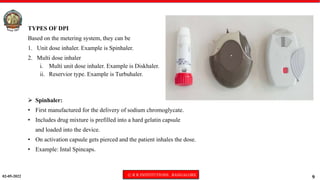
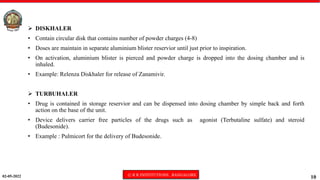
TYPES OF DPI
Based on the metering system, they can be
1. Unit dose inhaler. Example is Spinhaler.
2. Multi dose inhaler
i. Multi unit dose inhaler. Example is Diskhaler.
ii. Reservior type. Example is Turbuhaler.
 Spinhaler:
• First manufactured for the delivery of sodium chromoglycate.
• Includes drug mixture is prefilled into a hard gelatin capsule
and loaded into the device.
• On activation capsule gets pierced and the patient inhales the dose.
• Example: Intal Spincaps.
02-05-2022 © R R INSTITUTIONS , BANGALORE
10
 DISKHALER
• Contain circular disk that contains number of powder charges (4-8)
• Doses are maintain in separate aluminium blister reservior until just prior to inspiration.
• On activation, aluminium blister is pierced and powder charge is dropped into the dosing chamber and is
inhaled.
• Example: Relenza Diskhaler for release of Zanamivir.
 TURBUHALER
• Drug is contained in storage reservior and can be dispensed into dosing chamber by simple back and forth
action on the base of the unit.
• Device delivers carrier free particles of the drugs such as agonist (Terbutaline sulfate) and steroid
(Budesonide).
• Example : Pulmicort for the delivery of Budesonide.
02-05-2022 © R R INSTITUTIONS , BANGALORE
11
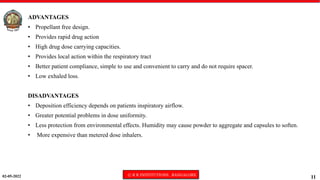
ADVANTAGES
• Propellant free design.
• Provides rapid drug action
• High drug dose carrying capacities.
• Provides local action within the respiratory tract
• Better patient compliance, simple to use and convenient to carry and do not require spacer.
• Low exhaled loss.
DISADVANTAGES
• Deposition efficiency depends on patients inspiratory airflow.
• Greater potential problems in dose uniformity.
• Less protection from environmental effects. Humidity may cause powder to aggregate and capsules to soften.
• More expensive than metered dose inhalers.
02-05-2022 © R R INSTITUTIONS , BANGALORE
12
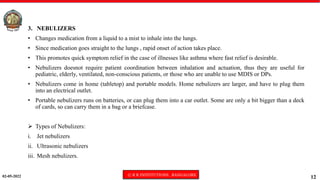
3. NEBULIZERS
• Changes medication from a liquid to a mist to inhale into the lungs.
• Since medication goes straight to the lungs , rapid onset of action takes place.
• This promotes quick symptom relief in the case of illnesses like asthma where fast relief is desirable.
• Nebulizers doesnot require patient coordination between inhalation and actuation, thus they are useful for
pediatric, elderly, ventilated, non-conscious patients, or those who are unable to use MDIS or DPs.
• Nebulizers come in home (tabletop) and portable models. Home nebulizers are larger, and have to plug them
into an electrical outlet.
• Portable nebulizers runs on batteries, or can plug them into a car outlet. Some are only a bit bigger than a deck
of cards, so can carry them in a bag or a briefcase.
 Types of Nebulizers:
i. Jet nebulizers
ii. Ultrasonic nebulizers
iii. Mesh nebulizers.
02-05-2022 © R R INSTITUTIONS , BANGALORE
13
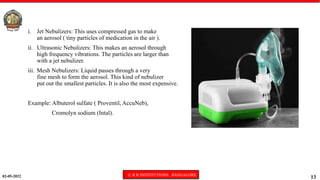
i. Jet Nebulizers: This uses compressed gas to make
an aerosol ( tiny particles of medication in the air ).
ii. Ultrasonic Nebulizers: This makes an aerosol through
high frequency vibrations. The particles are larger than
with a jet nebulizer.
iii. Mesh Nebulizers: Liquid passes through a very
fine mesh to form the aerosol. This kind of nebulizer
put out the smallest particles. It is also the most expensive.
Example: Albuterol sulfate ( Proventil, AccuNeb),
Cromolyn sodium (Intal).
02-05-2022 © R R INSTITUTIONS , BANGALORE
14
ADVANTAGES
 High output.
 Higher dose than MDIs.
 Multiple one-way valve reduce waste.
 Dishwasher safe, may be boiled or autoclaved.
 Cost effective for long term.
DISADVANTAGES
 Less portable than inhalers.
 Delivery may take 5-10 mins or longer.
 Require power sources,maintainance and cleaning.
 Noisy.
02-05-2022 © R R INSTITUTIONS , BANGALORE
15
pH ACTIVATED DRUG DELVERY SYSTEM
• This type of drug delivery system permits targeting the delivery of a drug only in the region with a selected pH
range.
• Drugs administer orally would encounter a spectrum of pH ranging from 7 in mouth, 1-4 in the stomach, and
5-7 in the small intestine.
• Since most drugs are either weak acids or weak bases, their release from formulation is pH dependent.
02-05-2022 © R R INSTITUTIONS , BANGALORE
16
Intestinal pH activated DDS
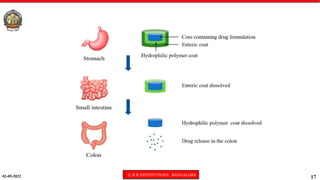
• It is fabricated by coating the drug- containing core with a pH sensitive polymer combination.
• A gastric fluid labile drug is protected by encapsulating it inside a polymer membrane that resist the
degradation action of gastric pH such as the combination of ethyl cellulose and HMC phthalate.
• The drug is released by drug dissolution and pore channel diffusion mechanism.
• In the stomach, coating membrane resists the action of gastric fluid (pH< 3) & and the drug molecule thus
protected from acid degradation.
• After gastric emptying the DDS travels to the small intestine and intestinal fluid (pH >7.5) activates the erosion
of the intestinal fluid soluble polymer from the coating membrane.
• This leaves a micro porous membrane constructed from the intestinal insoluble polymer ,which controls the
release of drug from the core tablet.
• The drug solute is thus delivered at a controlled manner in the intestine by a combination of drug dissolution
and pore channel diffusion.
02-05-2022 © R R INSTITUTIONS , BANGALORE
17
02-05-2022 © R R INSTITUTIONS , BANGALORE
18
CLASSIFICATION
1. Hydrogels.
2. Nanoparticles.
3. Microspheres.
4. Microgels.
02-05-2022 © R R INSTITUTIONS , BANGALORE
19
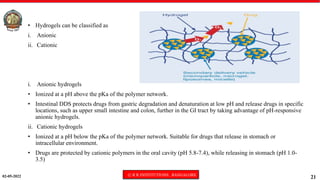
1. Hydrogels:
• Hydrogels are three-dimensional (3D) cross-linked polymer networks, which can absorb and retain large
amount of water.
• Hydrogels possess a diversity of tunable features of the bulk structure that can be tailored for a specific
therapeutic.
• Cross-linked hydrogels network enable to protect drugs from hostile environment, such as low pH and
enzymes in the stomach.
• Drugs release from pH-responsive hydrogels after the material swelling at specific pH.
• Mesh size of hydrogels in swollen state may range from 5-100 nm and can be optimized for sustained release of
macro molecules based on their hydrodynamic radii.
02-05-2022 © R R INSTITUTIONS , BANGALORE
20
• Two basic strategies for imparting pH-responsive behaviour-
i. Ionizable groups with suitability and/ or conformational changes in response to environmental pH.
ii. Acid sensitivity bonds that cleave to release molecules anchored into the backbone.
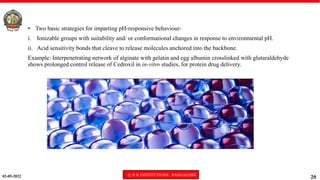
Example: Interpenetrating network of alginate with gelatin and egg albumin crosslinked with glutaraldehyde
shows prolonged control release of Cedroxil in in-vitro studies, for protein drug delivery.
02-05-2022 © R R INSTITUTIONS , BANGALORE
21
• Hydrogels can be classified as
i. Anionic
ii. Cationic
i. Anionic hydrogels
• Ionized at a pH above the pKa of the polymer network.
• Intestinal DDS protects drugs from gastric degradation and denaturation at low pH and release drugs in specific
locations, such as upper small intestine and colon, further in the GI tract by taking advantage of pH-responsive
anionic hydrogels.
ii. Cationic hydrogels
• Ionized at a pH below the pKa of the polymer network. Suitable for drugs that release in stomach or
intracellular environment.
• Drugs are protected by cationic polymers in the oral cavity (pH 5.8-7.4), while releasing in stomach (pH 1.0-
3.5)
02-05-2022 © R R INSTITUTIONS , BANGALORE
22
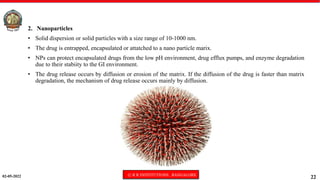
2. Nanoparticles
• Solid dispersion or solid particles with a size range of 10-1000 nm.
• The drug is entrapped, encapsulated or attatched to a nano particle marix.
• NPs can protect encapsulated drugs from the low pH environment, drug efflux pumps, and enzyme degradation
due to their stabiity to the GI environment.
• The drug release occurs by diffusion or erosion of the matrix. If the diffusion of the drug is faster than matrix
degradation, the mechanism of drug release occurs mainly by diffusion.
02-05-2022 © R R INSTITUTIONS , BANGALORE
23
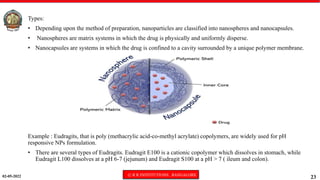
Types:
• Depending upon the method of preparation, nanoparticles are classified into nanospheres and nanocapsules.
• Nanospheres are matrix systems in which the drug is physically and uniformly disperse.
• Nanocapsules are systems in which the drug is confined to a cavity surrounded by a unique polymer membrane.
Example : Eudragits, that is poly (methacrylic acid-co-methyl acrylate) copolymers, are widely used for pH
responsive NPs formulation.
• There are several types of Eudragits. Eudragit E100 is a cationic copolymer which dissolves in stomach, while
Eudragit L100 dissolves at a pH 6-7 (jejunum) and Eudragit S100 at a pH > 7 ( ileum and colon).
02-05-2022 © R R INSTITUTIONS , BANGALORE
24
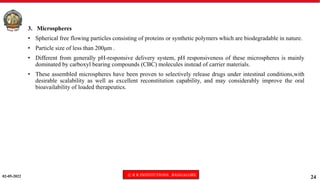
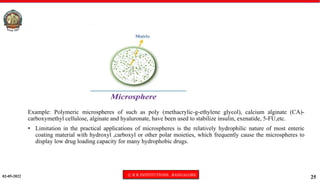
3. Microspheres
• Spherical free flowing particles consisting of proteins or synthetic polymers which are biodegradable in nature.
• Particle size of less than 200μm .
• Different from generally pH-responsive delivery system, pH responsiveness of these microspheres is mainly
dominated by carboxyl bearing compounds (CBC) molecules instead of carrier materials.
• These assembled microspheres have been proven to selectively release drugs under intestinal conditions,with
desirable scalability as well as excellent reconstitution capability, and may considerably improve the oral
bioavailability of loaded therapeutics.
02-05-2022 © R R INSTITUTIONS , BANGALORE
25
Example: Polymeric microspheres of such as poly (methacrylic-g-ethylene glycol), calcium alginate (CA)-
carboxymethyl cellulose, alginate and hyaluronate, have been used to stabilize insulin, exenatide, 5-FU,etc.
• Limitation in the practical applications of microspheres is the relatively hydrophilic nature of most enteric
coating material with hydroxyl ,carboxyl or other polar moieties, which frequently cause the microspheres to
display low drug loading capacity for many hydrophobic drugs.
02-05-2022 © R R INSTITUTIONS , BANGALORE
26
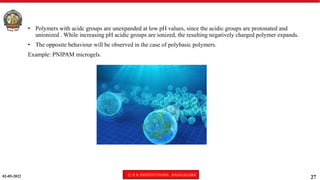
4. Microgels:
• MGs are the mcroscopic hydrogels.
• Stimuli responsive MGs are smart drug delivery carriers and have the capability to incorporate and release their
host molecule in response to stimuli ( pH), for targeted drug delivery.
• pH responsive polymers are generally fabricated by inserting pendant acidic or basic functional groups to the
backbone of the polymer.
• These functional groups either accept or release protons in response to appropriate pH and changes in the ionic
strength of surrounding aqueous media.
02-05-2022 © R R INSTITUTIONS , BANGALORE
27
• Polymers with acidc groups are unexpanded at low pH values, since the acidic groups are protonated and
unionized . While increasing pH acidic groups are ionized, the resulting negatively charged polymer expands.
• The opposite behaviour will be observed in the case of polybasic polymers.
Example: PNIPAM microgels.
02-05-2022 © R R INSTITUTIONS , BANGALORE
28
ADVANTAGES OF pH ACTIVATED DDS
• Decreased side effect.
• Improved drug utilization.
• Improved patients compliance.
• Lower daily cost to patient due to fewer dosage units are required by the patient in therapy.
• Protection of mucosa from irritating drugs.
• Drug loss is prevented by extensive first pass metabolism.
02-05-2022 © R R INSTITUTIONS , BANGALORE
29
DISADVANTAGES
• Non-biodegradability of the synthetic pH sensitive polymers.
• pH levels in the small intestine and colon vary between and within individuals.
• pH levels in the end of small intestine and caecum are similar.
• Poor site specificity.
02-05-2022 © R R INSTITUTIONS , BANGALORE
30
REFERENCES
• Novel Drug Delivery Systems, Y W Chien, 2nd Edition, revised and expanded.
• Drug delivery systems, Prafull P Patil, Dr Surajj Sarode, Bhushan P Gayakwad, Dr Md Rageeb Md Usman.
• Novel drug delivery systems, Gautam D Mehetre, Raju R Thenge, Rameshwar S Cheke, Sachin D Shinde.
• Novel drug delivery systems, Dr Md Rageeb Md Usman, Dr Aijaz A Sheikh, Dr Subhash V Deshmane, Dr
Kailash R Biyani.
• pH Sensitive Drug Delivery Systems: A Review, American Journal Of Drug Discovery and Developmnt,
V Balamuralidhara, TM Pramodkumar, N Srujana, MP Venkatesh, N Vishal Gupta, KL Krishna and
HV Gangadharappa.
• Novel drug delivery systems, Aruna Rastogi, PHARMATUTOR-ART-1652.
• https://www.slideshare.net/chandrikay14/ph-activated-and-ion-activated-cdds .
• https://www.slideshare.net/MehakAggarwAl18/p-h-activated-drug-delivery-systems.
• https://www.slideshare.net/BharatSain/mechanically-activated-drug-delivery.
02-05-2022 © R R INSTITUTIONS , BANGALORE
31
THANK YOU