Presented By
Bindiya Patel
M.PHARM
(PHARMACEUTICS)
Definition
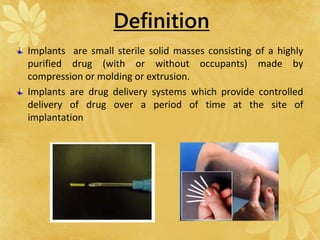
Implants are small sterile solid masses consisting of a highly
purified drug (with or without occupants) made by
compression or molding or extrusion.
Implants are drug delivery systems which provide controlled
delivery of drug over a period of time at the site of
implantation
Introduction
Implants are intended for implantation in the body (usually
subcutaneously) for the purpose of providing continuous
release of the drug over long periods of time.
Implants are administered by means of a suitable special
injector or surgical incision.
These are developed with a view to transmit drugs and fluids
into the blood stream without the repeated insertion of
needles
These systems are particularly suited for delivery requirements
of drugs such as insulin, steroids, antibiotics, analgesics,
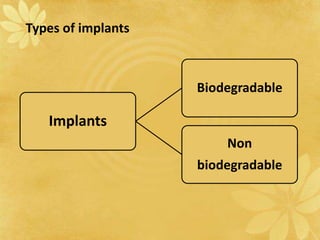
Implants
Biodegradable
Non
biodegradable
Types of implants
Advantages
Unattended continuous delivery within the therapeutic window
Avoids the highly variable peak and trough concentrations
Enhanced drug efficacy
Minimized side effects
Termination of therapy as and when required
Patient compliance is also a benefit of continuous dosing with
these implants as they operate for a long period of time once
implanted
Disadvantages
The reaction between host and implant.
Implantation procedure is difficult in the case of larger
implants.
Inadequate release.
Requires small surgery for large implantation & painful.
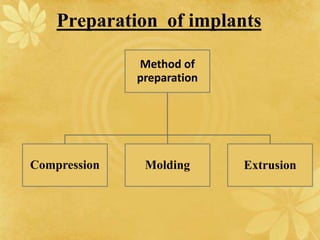
Preparation of implants
Method of
preparation
Compression Molding Extrusion
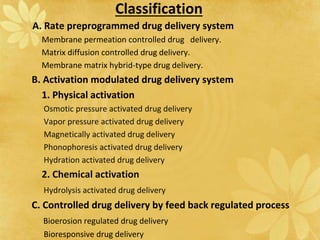
Classification
A. Rate preprogrammed drug delivery system
Membrane permeation controlled drug delivery.
Matrix diffusion controlled drug delivery.
Membrane matrix hybrid-type drug delivery.
B. Activation modulated drug delivery system
1. Physical activation
Osmotic pressure activated drug delivery
Vapor pressure activated drug delivery
Magnetically activated drug delivery
Phonophoresis activated drug delivery
Hydration activated drug delivery
2. Chemical activation
Hydrolysis activated drug delivery
C. Controlled drug delivery by feed back regulated process
Bioerosion regulated drug delivery
Bioresponsive drug delivery
Polymer membrane permeation
controlled drug delivery
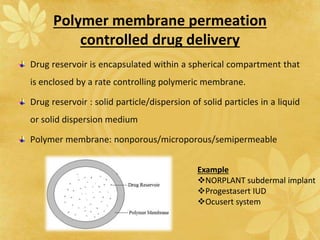
Drug reservoir is encapsulated within a spherical compartment that
is enclosed by a rate controlling polymeric membrane.
Drug reservoir : solid particle/dispersion of solid particles in a liquid
or solid dispersion medium
Polymer membrane: nonporous/microporous/semipermeable
Example
NORPLANT subdermal implant
Progestasert IUD
Ocusert system
Polymer matrix diffusion controlled drug
delivery systems
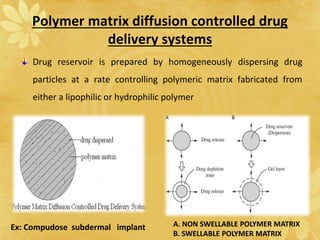
Drug reservoir is prepared by homogeneously dispersing drug
particles at a rate controlling polymeric matrix fabricated from
either a lipophilic or hydrophilic polymer
A. NON SWELLABLE POLYMER MATRIX
B. SWELLABLE POLYMER MATRIX
Ex: Compudose subdermal implant
Membrane Matrix Hybrid Type Drug Delivery
System
It is a hybrid of Membrane permeation controlled DDS and Matrix
diffusion controlled DDS.
Advantage:
It achieves controlled release kinetics maintained by matrix controlled
DDS.
It minimizes the risk of dose dumping associated with membrane
permeation controlled DDS
Example:
NORPLANT 2 Subdermal Implant
(Levonorgestrol releasing implant)
Activation modulated DDS
The release of drug molecules from the delivery system is activated
by some physical, chemical or biochemical process facilitated by an
external energy supplier
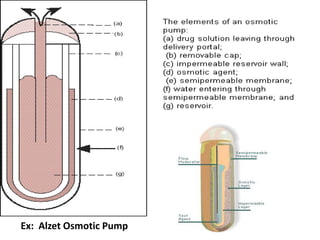
In this type of DDS, the drug in solution is released through a
specialized laser drilled delivery orifice at a constant rate under a
controlled gradient of osmotic pressure
External component: Rigid semipermeable housing made up of
substituted cellulosic polymers containing an osmotically active salt.
Internal compartment: Drug reservoir enclosed by a flexible partition
layer and osmotic agent impermeable polyester bag.
Osmotic Pressure Activated Drug Delivery Device
Ex: Alzet Osmotic Pump
Vapor Pressure Activated Drug
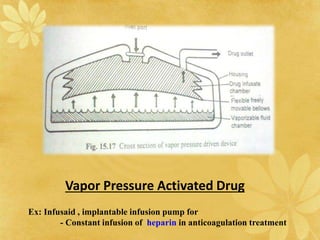
In this system, the drug reservoir in a solution formulation, is contained
inside an infusate chamber.
It is physically separated from the vapor pressure chamber by a freely
movable bellows
The vapor chamber contains a vaporizable fluid, which vaporizes at
body temp. & creates a vapor pressure.
Under the vapor pressure created, the bellows move upward & forces
the drug solution in the infusate chamber to release, through a series
of flow regulators & the delivery cannula into the blood circulation at a
constant flow rate.
Vapor Pressure Activated Drug
Ex: Infusaid , implantable infusion pump for
- Constant infusion of heparin in anticoagulation treatment
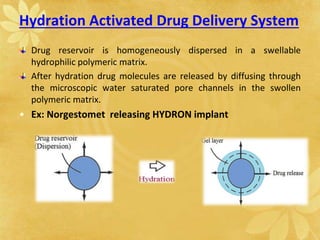
Hydration Activated Drug Delivery System
Drug reservoir is homogeneously dispersed in a swellable
hydrophilic polymeric matrix.
After hydration drug molecules are released by diffusing through
the microscopic water saturated pore channels in the swollen
polymeric matrix.
• Ex: Norgestomet releasing HYDRON implant
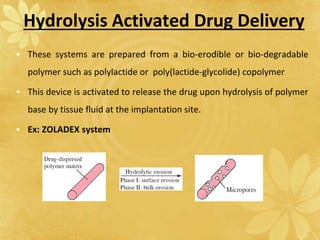
Hydrolysis Activated Drug Delivery
• These systems are prepared from a bio-erodible or bio-degradable
polymer such as polylactide or poly(lactide-glycolide) copolymer
• This device is activated to release the drug upon hydrolysis of polymer
base by tissue fluid at the implantation site.
• Ex: ZOLADEX system
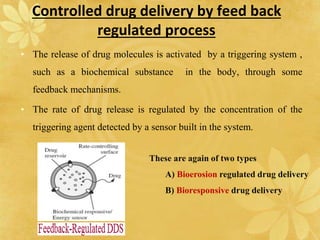
Controlled drug delivery by feed back
regulated process
• The release of drug molecules is activated by a triggering system ,
such as a biochemical substance in the body, through some
feedback mechanisms.
• The rate of drug release is regulated by the concentration of the
triggering agent detected by a sensor built in the system.
These are again of two types
A) Bioerosion regulated drug delivery
B) Bioresponsive drug delivery
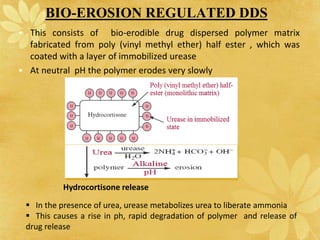
BIO-EROSION REGULATED DDS
• This consists of bio-erodible drug dispersed polymer matrix
fabricated from poly (vinyl methyl ether) half ester , which was
coated with a layer of immobilized urease
• At neutral pH the polymer erodes very slowly
Hydrocortisone release
 In the presence of urea, urease metabolizes urea to liberate ammonia
 This causes a rise in ph, rapid degradation of polymer and release of
drug release
Bioresponsive Drug Delivery
The drug reservoir is contained in a device enclosed by a bioresponsive
polymer membrane whose permeability to drug molecules is controlled
by concentration of biochemical agent in the tissue
Ex: Glucose Triggered Insulin Delivery System
• Insulin reservoir is enclosed within a hydrogel membrane containing pendant
NR2 groups
• In an alkaline solution the pendant NR2 groups exist at neutral state and the
membrane is unswollen and thus impermeable to insulin
• As glucose penetrates the membrane it is oxidized by glucose oxidase
enrapped in the membrane to gluconic acid
• This causes protonation of NR2 groups to NR2 H+
• This causes the membrane to swell and release of insulin
Application
A. Cancer Treatment
Gliadel Wafer: Delivers carmustine for the treatment of brain tumours
directly at the site of tumour to prevent reccurrence of tumours.
Depocyte: cytarabine releasing implantable DDS used to treat acute
leukemia.
Duros osmotic pump: Non-biodegradable implantable DDS used to
deliver Leoprolide acetate in the treatment of prostate cancer.
B. Osteoporosis
Micro chips: This device made by ELI Lilly & coworkers used to
deliver Forteo drug used to increase bone density in patients suffering
from severe osteoporosis.
D. Contraceptives
Norplant: delivers Norgestrol to achive contraception.
Reactions of host to implant:
Changes in permeability of polymer to body fluids.
Environmental stress cracking.
Chemical breakdown of polymeric material.
Loss of tensile strength in case of hydrophobic polymers.
C. Ocular Diseases
Lacrimedics: these are collagen implants used to treat dry eye syndrome
by partially blocking tear removing canals and they dissolve within 7-10
days.
Vitrasert: delivers ganicyclovir used to treat AIDS related retinitis.
Implant : Challenging Drug Delivery System

Implant : Challenging Drug Delivery System

  • 1.
  • 2.
    Definition Implants are smallsterile solid masses consisting of a highly purified drug (with or without occupants) made by compression or molding or extrusion. Implants are drug delivery systems which provide controlled delivery of drug over a period of time at the site of implantation
  • 3.
    Introduction Implants are intendedfor implantation in the body (usually subcutaneously) for the purpose of providing continuous release of the drug over long periods of time. Implants are administered by means of a suitable special injector or surgical incision. These are developed with a view to transmit drugs and fluids into the blood stream without the repeated insertion of needles These systems are particularly suited for delivery requirements of drugs such as insulin, steroids, antibiotics, analgesics,
  • 4.
  • 5.
    Advantages Unattended continuous deliverywithin the therapeutic window Avoids the highly variable peak and trough concentrations Enhanced drug efficacy Minimized side effects Termination of therapy as and when required Patient compliance is also a benefit of continuous dosing with these implants as they operate for a long period of time once implanted
  • 6.
    Disadvantages The reaction betweenhost and implant. Implantation procedure is difficult in the case of larger implants. Inadequate release. Requires small surgery for large implantation & painful.
  • 7.
    Preparation of implants Methodof preparation Compression Molding Extrusion
  • 8.
    Classification A. Rate preprogrammeddrug delivery system Membrane permeation controlled drug delivery. Matrix diffusion controlled drug delivery. Membrane matrix hybrid-type drug delivery. B. Activation modulated drug delivery system 1. Physical activation Osmotic pressure activated drug delivery Vapor pressure activated drug delivery Magnetically activated drug delivery Phonophoresis activated drug delivery Hydration activated drug delivery 2. Chemical activation Hydrolysis activated drug delivery C. Controlled drug delivery by feed back regulated process Bioerosion regulated drug delivery Bioresponsive drug delivery
  • 9.
    Polymer membrane permeation controlleddrug delivery Drug reservoir is encapsulated within a spherical compartment that is enclosed by a rate controlling polymeric membrane. Drug reservoir : solid particle/dispersion of solid particles in a liquid or solid dispersion medium Polymer membrane: nonporous/microporous/semipermeable Example NORPLANT subdermal implant Progestasert IUD Ocusert system
  • 10.
    Polymer matrix diffusioncontrolled drug delivery systems Drug reservoir is prepared by homogeneously dispersing drug particles at a rate controlling polymeric matrix fabricated from either a lipophilic or hydrophilic polymer A. NON SWELLABLE POLYMER MATRIX B. SWELLABLE POLYMER MATRIX Ex: Compudose subdermal implant
  • 11.
    Membrane Matrix HybridType Drug Delivery System It is a hybrid of Membrane permeation controlled DDS and Matrix diffusion controlled DDS. Advantage: It achieves controlled release kinetics maintained by matrix controlled DDS. It minimizes the risk of dose dumping associated with membrane permeation controlled DDS Example: NORPLANT 2 Subdermal Implant (Levonorgestrol releasing implant)
  • 12.
    Activation modulated DDS Therelease of drug molecules from the delivery system is activated by some physical, chemical or biochemical process facilitated by an external energy supplier In this type of DDS, the drug in solution is released through a specialized laser drilled delivery orifice at a constant rate under a controlled gradient of osmotic pressure External component: Rigid semipermeable housing made up of substituted cellulosic polymers containing an osmotically active salt. Internal compartment: Drug reservoir enclosed by a flexible partition layer and osmotic agent impermeable polyester bag. Osmotic Pressure Activated Drug Delivery Device
  • 13.
  • 14.
    Vapor Pressure ActivatedDrug In this system, the drug reservoir in a solution formulation, is contained inside an infusate chamber. It is physically separated from the vapor pressure chamber by a freely movable bellows The vapor chamber contains a vaporizable fluid, which vaporizes at body temp. & creates a vapor pressure. Under the vapor pressure created, the bellows move upward & forces the drug solution in the infusate chamber to release, through a series of flow regulators & the delivery cannula into the blood circulation at a constant flow rate.
  • 15.
    Vapor Pressure ActivatedDrug Ex: Infusaid , implantable infusion pump for - Constant infusion of heparin in anticoagulation treatment
  • 16.
    Hydration Activated DrugDelivery System Drug reservoir is homogeneously dispersed in a swellable hydrophilic polymeric matrix. After hydration drug molecules are released by diffusing through the microscopic water saturated pore channels in the swollen polymeric matrix. • Ex: Norgestomet releasing HYDRON implant
  • 17.
    Hydrolysis Activated DrugDelivery • These systems are prepared from a bio-erodible or bio-degradable polymer such as polylactide or poly(lactide-glycolide) copolymer • This device is activated to release the drug upon hydrolysis of polymer base by tissue fluid at the implantation site. • Ex: ZOLADEX system
  • 18.
    Controlled drug deliveryby feed back regulated process • The release of drug molecules is activated by a triggering system , such as a biochemical substance in the body, through some feedback mechanisms. • The rate of drug release is regulated by the concentration of the triggering agent detected by a sensor built in the system. These are again of two types A) Bioerosion regulated drug delivery B) Bioresponsive drug delivery
  • 19.
    BIO-EROSION REGULATED DDS •This consists of bio-erodible drug dispersed polymer matrix fabricated from poly (vinyl methyl ether) half ester , which was coated with a layer of immobilized urease • At neutral pH the polymer erodes very slowly Hydrocortisone release  In the presence of urea, urease metabolizes urea to liberate ammonia  This causes a rise in ph, rapid degradation of polymer and release of drug release
  • 20.
    Bioresponsive Drug Delivery Thedrug reservoir is contained in a device enclosed by a bioresponsive polymer membrane whose permeability to drug molecules is controlled by concentration of biochemical agent in the tissue Ex: Glucose Triggered Insulin Delivery System • Insulin reservoir is enclosed within a hydrogel membrane containing pendant NR2 groups • In an alkaline solution the pendant NR2 groups exist at neutral state and the membrane is unswollen and thus impermeable to insulin • As glucose penetrates the membrane it is oxidized by glucose oxidase enrapped in the membrane to gluconic acid • This causes protonation of NR2 groups to NR2 H+ • This causes the membrane to swell and release of insulin
  • 21.
    Application A. Cancer Treatment GliadelWafer: Delivers carmustine for the treatment of brain tumours directly at the site of tumour to prevent reccurrence of tumours. Depocyte: cytarabine releasing implantable DDS used to treat acute leukemia. Duros osmotic pump: Non-biodegradable implantable DDS used to deliver Leoprolide acetate in the treatment of prostate cancer. B. Osteoporosis Micro chips: This device made by ELI Lilly & coworkers used to deliver Forteo drug used to increase bone density in patients suffering from severe osteoporosis.
  • 22.
    D. Contraceptives Norplant: deliversNorgestrol to achive contraception. Reactions of host to implant: Changes in permeability of polymer to body fluids. Environmental stress cracking. Chemical breakdown of polymeric material. Loss of tensile strength in case of hydrophobic polymers. C. Ocular Diseases Lacrimedics: these are collagen implants used to treat dry eye syndrome by partially blocking tear removing canals and they dissolve within 7-10 days. Vitrasert: delivers ganicyclovir used to treat AIDS related retinitis.