INTRODUCTION
    Niosomes are non-ionic surfactant
 vesicles obtained on hydration of synthetic
 nonionic surfactants, with or without
 incorporation of cholesterol or other lipids.
 They are vesicular systems similar to
 liposomes that can be used as carriers of
 hydrophilic and lipophilic drugs
It is less toxic and improves the
 therapeutic index of drug by restricting its
 action to target cells
Niosomes are a novel drug delivery system, in which the
 medication is encapsulated in a vesicle.

The niosomes are very small, and microscopic in size. Their size
 lies in the nanometric scale.

Niosomes are unilamellar or multilamellar vesicles.The vesicle
 is composed of a bilayer of non-ionic surface active agents and
 hence the name niosomes.

A diverse range of materials have been used to form niosomes
 such as sucrose ester surfactants and polyoxyethylene alkyl
 ether surfactants, alkyl ester, alkyl amides, fatty acids and amino
 acid compound.
Structure of Niosomes
Niosomes are microscopic lamellar structures which are formed
 on the admixture of non-ionic surfactant of the alkyl or dialkyl
 polyglycerol ether class and cholesterol with subsequent
 hydration in aqueous media.

The bilayer in the case of niosomes is made up of non-ionic
 surface active agents rather than phospholipids as seen in the
 case of liposomes.

Most surface active agents when immersed in water yield
 micellar structures, however some surfactants can yield bilayer
 vesicles which are niosomes.

Niosomes may be unilamellar or multilamellar depending on the
 method used to prepare them.
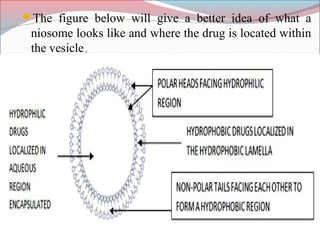
The niosome is made of a surfactant bilayer with its
 hydrophilic ends exposed on the outside and inside of the
 vesicle, while the hydrophobic chains face each other within
 the bilayer.
Hence, the vesicle holds hydrophilic drugs within the space
 enclosed in the vesicle, while hydrophobic drugs are
 embedded within the bilayer itself.
The figure below will give a better idea of what a
 niosome looks like and where the drug is located within
 the vesicle ,
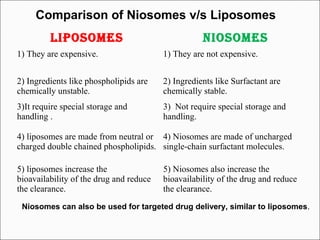
Comparison of Niosomes v/s Liposomes
         Liposomes                                  Niosomes
1) They are expensive.                   1) They are not expensive.


2) Ingredients like phospholipids are    2) Ingredients like Surfactant are
chemically unstable.                     chemically stable.
3)It require special storage and         3) Not require special storage and
handling .                               handling.

4) liposomes are made from neutral or 4) Niosomes are made of uncharged
charged double chained phospholipids. single-chain surfactant molecules.

5) liposomes increase the                5) Niosomes also increase the
bioavailability of the drug and reduce   bioavailability of the drug and reduce
the clearance.                           the clearance.
 Niosomes can also be used for targeted drug delivery, similar to liposomes.
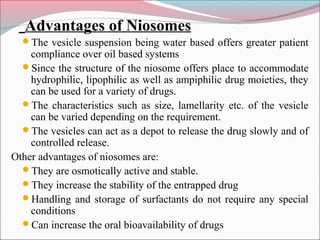
Advantages of Niosomes
  The vesicle suspension being water based offers greater patient
    compliance over oil based systems
  Since the structure of the niosome offers place to accommodate
    hydrophilic, lipophilic as well as ampiphilic drug moieties, they
    can be used for a variety of drugs.
  The characteristics such as size, lamellarity etc. of the vesicle
    can be varied depending on the requirement.
  The vesicles can act as a depot to release the drug slowly and of
    controlled release.
Other advantages of niosomes are:
  They are osmotically active and stable.
  They increase the stability of the entrapped drug
  Handling and storage of surfactants do not require any special
    conditions
  Can increase the oral bioavailability of drugs
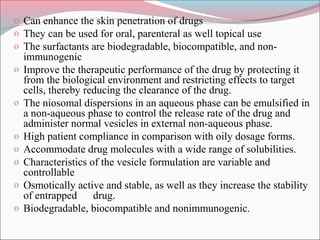
o Can enhance the skin penetration of drugs
o They can be used for oral, parenteral as well topical use
o The surfactants are biodegradable, biocompatible, and non-
    immunogenic
o   Improve the therapeutic performance of the drug by protecting it
    from the biological environment and restricting effects to target
    cells, thereby reducing the clearance of the drug.
o   The niosomal dispersions in an aqueous phase can be emulsified in
    a non-aqueous phase to control the release rate of the drug and
    administer normal vesicles in external non-aqueous phase.
o   High patient compliance in comparison with oily dosage forms.
o   Accommodate drug molecules with a wide range of solubilities.
o   Characteristics of the vesicle formulation are variable and
    controllable
o   Osmotically active and stable, as well as they increase the stability
    of entrapped     drug.
o   Biodegradable, biocompatible and nonimmunogenic.
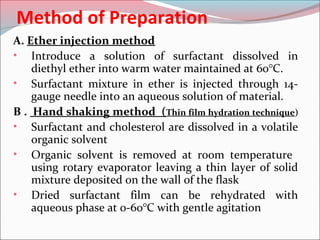
Method of Preparation
A. Ether injection method
• Introduce a solution of surfactant dissolved in
    diethyl ether into warm water maintained at 60°C.
• Surfactant mixture in ether is injected through 14-
    gauge needle into an aqueous solution of material.
B . Hand shaking method (Thin film hydration technique)
• Surfactant and cholesterol are dissolved in a volatile
    organic solvent
• Organic solvent is removed at room temperature
    using rotary evaporator leaving a thin layer of solid
    mixture deposited on the wall of the flask
• Dried surfactant film can be rehydrated with
    aqueous phase at 0-60°C with gentle agitation
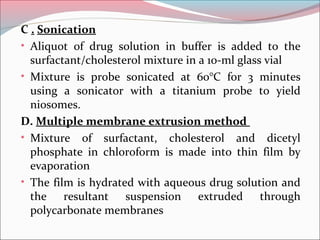
C . Sonication
• Aliquot of drug solution in buffer is added to the
  surfactant/cholesterol mixture in a 10-ml glass vial
• Mixture is probe sonicated at 60°C for 3 minutes
  using a sonicator with a titanium probe to yield
  niosomes.
D. Multiple membrane extrusion method
• Mixture of surfactant, cholesterol and dicetyl
  phosphate in chloroform is made into thin film by
  evaporation
• The film is hydrated with aqueous drug solution and
  the resultant suspension extruded through
  polycarbonate membranes
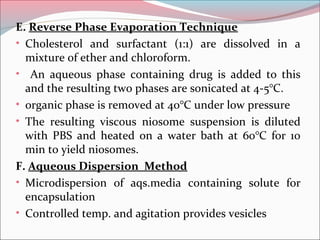
E. Reverse Phase Evaporation Technique
• Cholesterol and surfactant (1:1) are dissolved in a
  mixture of ether and chloroform.
• An aqueous phase containing drug is added to this
  and the resulting two phases are sonicated at 4-5°C.
• organic phase is removed at 40°C under low pressure
• The resulting viscous niosome suspension is diluted
  with PBS and heated on a water bath at 60°C for 10
  min to yield niosomes.
F. Aqueous Dispersion Method
• Microdispersion of aqs.media containing solute for
  encapsulation
• Controlled temp. and agitation provides vesicles
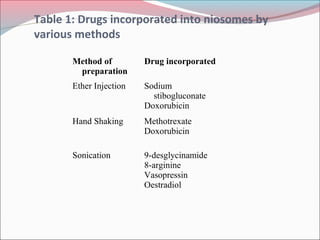
Table 1: Drugs incorporated into niosomes by
various methods

       Method of         Drug incorporated
        preparation
       Ether Injection   Sodium
                           stibogluconate
                         Doxorubicin
       Hand Shaking      Methotrexate
                         Doxorubicin

       Sonication        9-desglycinamide
                         8-arginine
                         Vasopressin
                         Oestradiol
Separation of Unentrapped Drug
1. Dialysis
   The aqueous niosomal dispersion is dialyzed in a
   dialysis tubing against phosphate buffer or normal
   saline or glucose solution.
2. Gel Filtration
   The unentrapped drug is removed by gel filtration of
   niosomal dispersion through a Sephadex-G-50 column
   and elution with phosphate buffered saline or normal
   saline.
3. Centrifugation
   The niosomal suspension is centrifuged and the
   supernatant is separated. The pellet is washed and
   then resuspended to obtain a niosomal suspension free
Characterization of Niosomes
A. Entrapment Efficiency
• Entrapment efficiency = (Amount entrapped total
    amount) x 100

B. Vesicle Morphology
• Light Microscopy
• Photon Correlation Microscopy
• Freeze Fracture Electron Microscopy
• Confocal laser scanning Microscopy
• SEM
• TEM

C. In-vitro release
Factors affecting vesicles size, entrapment
efficiency and release characteristics

Drug
Amount and type of surfactant
Cholesterol content
Methods of preparation
Marketed Products

Lancome has come out with a variety of anti-ageing
 products which are based on niosome formulations.
 L’Oreal is also conducting research on anti-ageing
 cosmetic products.
Applications
1) Targeting of bioactive agents
a) To reticulo-endothelial system
b) To organs other than RES
2) Neoplasia
     Doxorubicin Niosomal delivery of Doxorubicin to
    mice bearing S-180 tumor increased their life span
    and decreased the rate of proliferation of sarcoma
3) Leishmaniasis
4) Delivery of peptide drugs
       Oral delivery of 9-desglycinamide, 8-arginine
    vasopressin entrapped in niosomes increase
    stability of peptide significantly.
5) Immunological application of niosomes
     enhance the antibody production in response to
  bovine serum albumin
6) Niosomes as carriers for Hemoglobin
7) Transdermal delivery of drugs by niosomes
  e.g. erythromycin
Conclusion
The concept of incorporating the drug into niosomes
 for a better targeting of the drug at appropriate tissue
 destination .
They presents a structure similar to liposome and
 hence they can represent alternative vesicular
 systems with respect to liposomes
Niosomes are thoughts to be better candidates drug
 delivery as compared to liposomes due to various
 factors like cost, stability etc. Various type of drug
 deliveries can be possible using niosomes like
 targeting, ophthalmic, topical, parentral, etc.
REFERENCES
Vyas S.P. , Khar R.K. ,Targeted & Controlled Drug
 Delivery, Novel Carrier Systems, CBS Publication ,
 2002 ,Page No.249-279
Malhotra M. and Jain N.K. Niosomes as Drug
 Carriers. Indian Drugs 1994, Page No: 81-86.
Chandraprakash K.S., Udupa N., Umadevi P. and
 Pillai G.K. Pharmacokinetic evaluation of surfactant
 vesicles containing methotrexate in tumor bearing
 mice. Int. J. Pharma. 1990; R1-R3: 61.
www.pharmainfo.net
www.sciencedirect.com
Niosome

Niosome

  • 2.
    INTRODUCTION  Niosomes are non-ionic surfactant vesicles obtained on hydration of synthetic nonionic surfactants, with or without incorporation of cholesterol or other lipids.  They are vesicular systems similar to liposomes that can be used as carriers of hydrophilic and lipophilic drugs It is less toxic and improves the therapeutic index of drug by restricting its action to target cells
  • 3.
    Niosomes are anovel drug delivery system, in which the medication is encapsulated in a vesicle. The niosomes are very small, and microscopic in size. Their size lies in the nanometric scale. Niosomes are unilamellar or multilamellar vesicles.The vesicle is composed of a bilayer of non-ionic surface active agents and hence the name niosomes. A diverse range of materials have been used to form niosomes such as sucrose ester surfactants and polyoxyethylene alkyl ether surfactants, alkyl ester, alkyl amides, fatty acids and amino acid compound.
  • 4.
    Structure of Niosomes Niosomesare microscopic lamellar structures which are formed on the admixture of non-ionic surfactant of the alkyl or dialkyl polyglycerol ether class and cholesterol with subsequent hydration in aqueous media. The bilayer in the case of niosomes is made up of non-ionic surface active agents rather than phospholipids as seen in the case of liposomes. Most surface active agents when immersed in water yield micellar structures, however some surfactants can yield bilayer vesicles which are niosomes. Niosomes may be unilamellar or multilamellar depending on the method used to prepare them.
  • 5.
    The niosome ismade of a surfactant bilayer with its hydrophilic ends exposed on the outside and inside of the vesicle, while the hydrophobic chains face each other within the bilayer. Hence, the vesicle holds hydrophilic drugs within the space enclosed in the vesicle, while hydrophobic drugs are embedded within the bilayer itself.
  • 6.
    The figure belowwill give a better idea of what a niosome looks like and where the drug is located within the vesicle ,
  • 7.
    Comparison of Niosomesv/s Liposomes Liposomes Niosomes 1) They are expensive. 1) They are not expensive. 2) Ingredients like phospholipids are 2) Ingredients like Surfactant are chemically unstable. chemically stable. 3)It require special storage and 3) Not require special storage and handling . handling. 4) liposomes are made from neutral or 4) Niosomes are made of uncharged charged double chained phospholipids. single-chain surfactant molecules. 5) liposomes increase the 5) Niosomes also increase the bioavailability of the drug and reduce bioavailability of the drug and reduce the clearance. the clearance. Niosomes can also be used for targeted drug delivery, similar to liposomes.
  • 8.
    Advantages of Niosomes The vesicle suspension being water based offers greater patient compliance over oil based systems Since the structure of the niosome offers place to accommodate hydrophilic, lipophilic as well as ampiphilic drug moieties, they can be used for a variety of drugs. The characteristics such as size, lamellarity etc. of the vesicle can be varied depending on the requirement. The vesicles can act as a depot to release the drug slowly and of controlled release. Other advantages of niosomes are: They are osmotically active and stable. They increase the stability of the entrapped drug Handling and storage of surfactants do not require any special conditions Can increase the oral bioavailability of drugs
  • 9.
    o Can enhancethe skin penetration of drugs o They can be used for oral, parenteral as well topical use o The surfactants are biodegradable, biocompatible, and non- immunogenic o Improve the therapeutic performance of the drug by protecting it from the biological environment and restricting effects to target cells, thereby reducing the clearance of the drug. o The niosomal dispersions in an aqueous phase can be emulsified in a non-aqueous phase to control the release rate of the drug and administer normal vesicles in external non-aqueous phase. o High patient compliance in comparison with oily dosage forms. o Accommodate drug molecules with a wide range of solubilities. o Characteristics of the vesicle formulation are variable and controllable o Osmotically active and stable, as well as they increase the stability of entrapped drug. o Biodegradable, biocompatible and nonimmunogenic.
  • 10.
    Method of Preparation A.Ether injection method • Introduce a solution of surfactant dissolved in diethyl ether into warm water maintained at 60°C. • Surfactant mixture in ether is injected through 14- gauge needle into an aqueous solution of material. B . Hand shaking method (Thin film hydration technique) • Surfactant and cholesterol are dissolved in a volatile organic solvent • Organic solvent is removed at room temperature using rotary evaporator leaving a thin layer of solid mixture deposited on the wall of the flask • Dried surfactant film can be rehydrated with aqueous phase at 0-60°C with gentle agitation
  • 11.
    C . Sonication •Aliquot of drug solution in buffer is added to the surfactant/cholesterol mixture in a 10-ml glass vial • Mixture is probe sonicated at 60°C for 3 minutes using a sonicator with a titanium probe to yield niosomes. D. Multiple membrane extrusion method • Mixture of surfactant, cholesterol and dicetyl phosphate in chloroform is made into thin film by evaporation • The film is hydrated with aqueous drug solution and the resultant suspension extruded through polycarbonate membranes
  • 12.
    E. Reverse PhaseEvaporation Technique • Cholesterol and surfactant (1:1) are dissolved in a mixture of ether and chloroform. • An aqueous phase containing drug is added to this and the resulting two phases are sonicated at 4-5°C. • organic phase is removed at 40°C under low pressure • The resulting viscous niosome suspension is diluted with PBS and heated on a water bath at 60°C for 10 min to yield niosomes. F. Aqueous Dispersion Method • Microdispersion of aqs.media containing solute for encapsulation • Controlled temp. and agitation provides vesicles
  • 13.
    Table 1: Drugsincorporated into niosomes by various methods Method of Drug incorporated preparation Ether Injection Sodium stibogluconate Doxorubicin Hand Shaking Methotrexate Doxorubicin Sonication 9-desglycinamide 8-arginine Vasopressin Oestradiol
  • 14.
    Separation of UnentrappedDrug 1. Dialysis The aqueous niosomal dispersion is dialyzed in a dialysis tubing against phosphate buffer or normal saline or glucose solution. 2. Gel Filtration The unentrapped drug is removed by gel filtration of niosomal dispersion through a Sephadex-G-50 column and elution with phosphate buffered saline or normal saline. 3. Centrifugation The niosomal suspension is centrifuged and the supernatant is separated. The pellet is washed and then resuspended to obtain a niosomal suspension free
  • 15.
    Characterization of Niosomes A.Entrapment Efficiency • Entrapment efficiency = (Amount entrapped total amount) x 100 B. Vesicle Morphology • Light Microscopy • Photon Correlation Microscopy • Freeze Fracture Electron Microscopy • Confocal laser scanning Microscopy • SEM • TEM C. In-vitro release
  • 16.
    Factors affecting vesiclessize, entrapment efficiency and release characteristics Drug Amount and type of surfactant Cholesterol content Methods of preparation
  • 17.
    Marketed Products Lancome hascome out with a variety of anti-ageing products which are based on niosome formulations. L’Oreal is also conducting research on anti-ageing cosmetic products.
  • 18.
    Applications 1) Targeting ofbioactive agents a) To reticulo-endothelial system b) To organs other than RES 2) Neoplasia Doxorubicin Niosomal delivery of Doxorubicin to mice bearing S-180 tumor increased their life span and decreased the rate of proliferation of sarcoma 3) Leishmaniasis 4) Delivery of peptide drugs Oral delivery of 9-desglycinamide, 8-arginine vasopressin entrapped in niosomes increase stability of peptide significantly.
  • 19.
    5) Immunological applicationof niosomes enhance the antibody production in response to bovine serum albumin 6) Niosomes as carriers for Hemoglobin 7) Transdermal delivery of drugs by niosomes e.g. erythromycin
  • 20.
    Conclusion The concept ofincorporating the drug into niosomes for a better targeting of the drug at appropriate tissue destination . They presents a structure similar to liposome and hence they can represent alternative vesicular systems with respect to liposomes Niosomes are thoughts to be better candidates drug delivery as compared to liposomes due to various factors like cost, stability etc. Various type of drug deliveries can be possible using niosomes like targeting, ophthalmic, topical, parentral, etc.
  • 21.
    REFERENCES Vyas S.P. ,Khar R.K. ,Targeted & Controlled Drug Delivery, Novel Carrier Systems, CBS Publication , 2002 ,Page No.249-279 Malhotra M. and Jain N.K. Niosomes as Drug Carriers. Indian Drugs 1994, Page No: 81-86. Chandraprakash K.S., Udupa N., Umadevi P. and Pillai G.K. Pharmacokinetic evaluation of surfactant vesicles containing methotrexate in tumor bearing mice. Int. J. Pharma. 1990; R1-R3: 61. www.pharmainfo.net www.sciencedirect.com