
Presented by
P.Pavazhaviji
M.Pharm I Year (II Sem)
Dept. of Pharmaceutics
MTPG & RIHS
Puducherry 1
MICROSPHERES
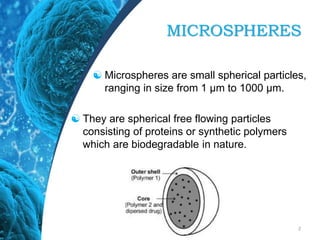
 Microspheres are small spherical particles,
ranging in size from 1 μm to 1000 μm.
 They are spherical free flowing particles
consisting of proteins or synthetic polymers
which are biodegradable in nature.
2
CLASSIFICATION
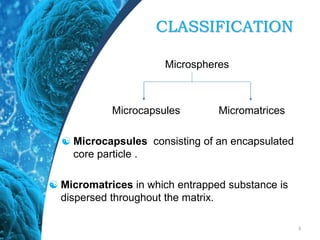
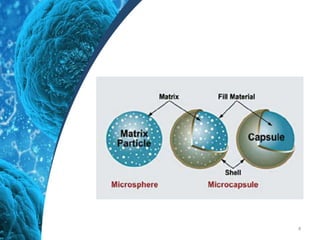
Microspheres
Microcapsules Micromatrices
 Microcapsules consisting of an encapsulated
core particle .
 Micromatrices in which entrapped substance is
dispersed throughout the matrix.
3
4
ADVANTAGES
 Improve bioavailability
 Provide prolonged therapeutic effect.
 Provide constant drug concentration in
blood .
 Decrease toxicity.
 Protect the drug from enzymatic and
photolytic cleavage
 Reduce the dosing frequency and thereby
improve the patient compliance
5
DISADVANTAGES
 The cost is more.
 Process conditions like change in
temperature, pH, solvent addition, and
evaporation/agitation may influence the
stability of core particles.
 Degradation of product due to heat,
hydrolysis, oxidation, solar radiation or
biological agents.
6
TYPES OF MICROSPHERES
 Bioadhesive microspheres
 Floating microspheres
 Radioactive microspheres
 Magnetic microspheres
 Polymeric microspheres
a) Biodegradable polymeric
microspheres
b) Synthetic polymeric
microspheres 7
Bio-adhesive microspheres:
 Adhesion of drug delivery device to the
mucosal membrane such as buccal, ocular,
rectal, nasal etc can be termed as
Bioadhesive microspheres .
8
TYPES OF MICROSPHERES
Magnetic microspheres:
 This kind of delivery system is very
much important which localises the drug
to the disease site.
 Magnetic carriers receive magnetic
responses to a magnetic field from
incorporated materials that are used for
magnetic microspheres.
9
TYPES OF MICROSPHERES
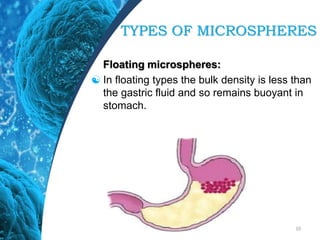
Floating microspheres:
 In floating types the bulk density is less than
the gastric fluid and so remains buoyant in
stomach.
10
TYPES OF MICROSPHERES
Radioactive microspheres:
 radioactive microspheres deliver high
radiation dose to the targeted areas without
damaging the normal surrounding tissues.
11
TYPES OF MICROSPHERES
Polymeric microspheres:
 The different types of polymeric
microspheres can be classified as follows:
a) Biodegradable polymeric microspheres
b) Synthetic polymeric microspheres
12
TYPES OF MICROSPHERES
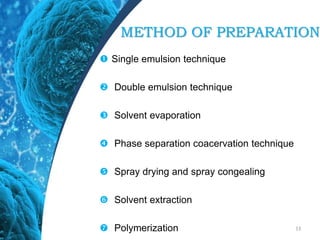
METHOD OF PREPARATION
 Single emulsion technique
 Double emulsion technique
 Solvent evaporation
 Phase separation coacervation technique
 Spray drying and spray congealing
 Solvent extraction
 Polymerization 13
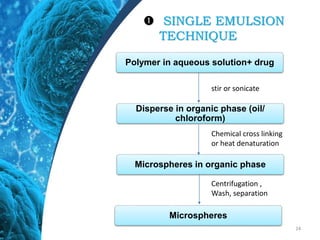
 SINGLE EMULSION
TECHNIQUE
14
Polymer in aqueous solution+ drug
Disperse in organic phase (oil/
chloroform)
Microspheres
Microspheres in organic phase
stir or sonicate
Chemical cross linking
or heat denaturation
Centrifugation ,
Wash, separation
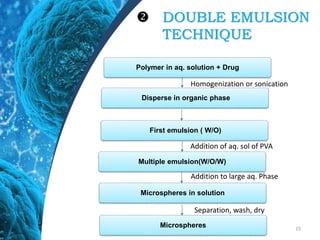
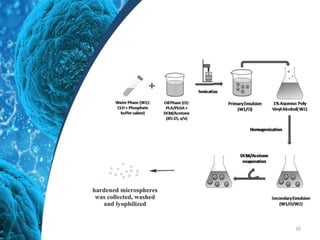
 DOUBLE EMULSION
TECHNIQUE
15
Polymer in aq. solution + Drug
Disperse in organic phase
First emulsion ( W/O)
Multiple emulsion(W/O/W)
Microspheres in solution
Microspheres
Homogenization or sonication
Addition of aq. sol of PVA
Addition to large aq. Phase
Separation, wash, dry
16
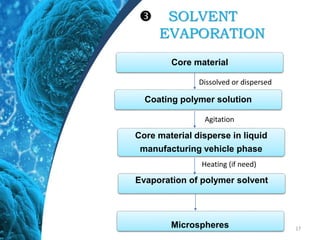
 SOLVENT
EVAPORATION
17
Coating polymer solution
Core material disperse in liquid
manufacturing vehicle phase
Evaporation of polymer solvent
Microspheres
Core material
Dissolved or dispersed
Agitation
Heating (if need)
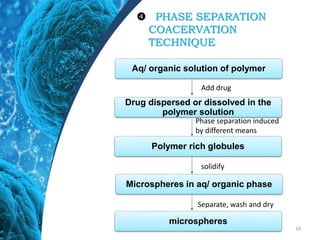
 PHASE SEPARATION
COACERVATION
TECHNIQUE
18
Aq/ organic solution of polymer
Drug dispersed or dissolved in the
polymer solution
Polymer rich globules
Microspheres in aq/ organic phase
microspheres
Add drug
Phase separation induced
by different means
solidify
Separate, wash and dry
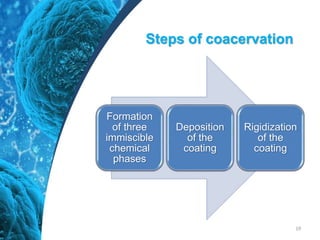
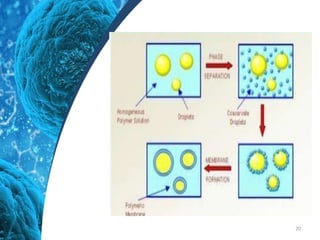
Steps of coacervation
Formation
of three
immiscible
chemical
phases
Deposition
of the
coating
Rigidization
of the
coating
19
20
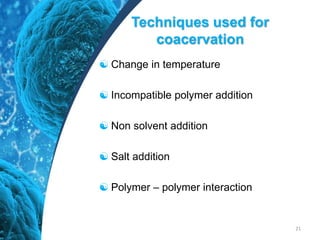
Techniques used for
coacervation
 Change in temperature
 Incompatible polymer addition
 Non solvent addition
 Salt addition
 Polymer – polymer interaction
21
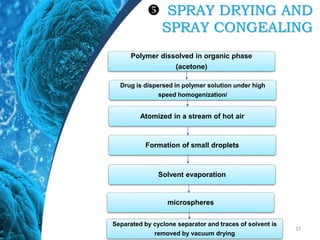
 SPRAY DRYING AND
SPRAY CONGEALING
22
Polymer dissolved in organic phase
(acetone)
Drug is dispersed in polymer solution under high
speed homogenization/
Atomized in a stream of hot air
Separated by cyclone separator and traces of solvent is
removed by vacuum drying
microspheres
Solvent evaporation
Formation of small droplets
23
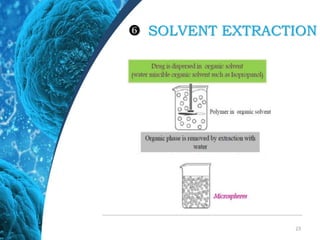
 SOLVENT EXTRACTION
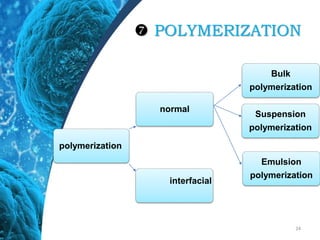
 POLYMERIZATION
24
polymerization
normal
interfacial
Emulsion
polymerization
Suspension
polymerization
Bulk
polymerization
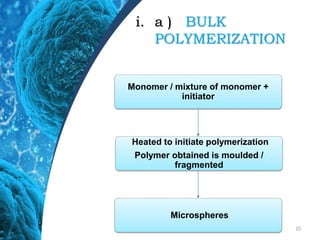
i. a ) BULK
POLYMERIZATION
25
Monomer / mixture of monomer +
initiator
Microspheres
Heated to initiate polymerization
Polymer obtained is moulded /
fragmented
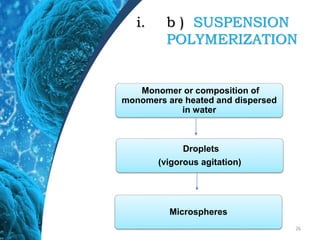
i. b ) SUSPENSION
POLYMERIZATION
26
Monomer or composition of
monomers are heated and dispersed
in water
Microspheres
Droplets
(vigorous agitation)
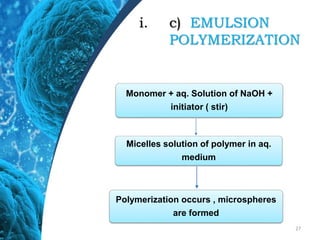
i. c) EMULSION
POLYMERIZATION
27
Monomer + aq. Solution of NaOH +
initiator ( stir)
Polymerization occurs , microspheres
are formed
Micelles solution of polymer in aq.
medium
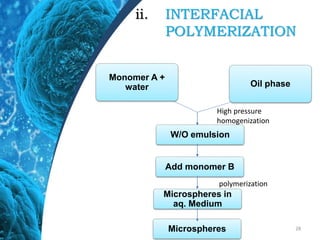
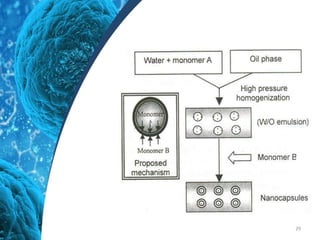
ii. INTERFACIAL
POLYMERIZATION
28
Monomer A +
water Oil phase
W/O emulsion
Add monomer B
Microspheres in
aq. Medium
Microspheres
High pressure
homogenization
polymerization
29
EVALUATION OF
MICROSPHERES
1 .Particle size and shape:
 The most widely used procedures to
visualize microparticles are conventional
light microscopy (LM) and scanning
electron microscopy (SEM).
2. surface chemistry :
 The surface chemistry of the microspheres
can be determined using the electron
spectroscopy for chemical analysis(ESCA).
30
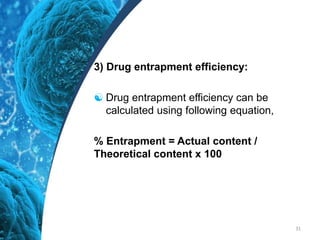
3) Drug entrapment efficiency:
 Drug entrapment efficiency can be
calculated using following equation,
% Entrapment = Actual content /
Theoretical content x 100
31
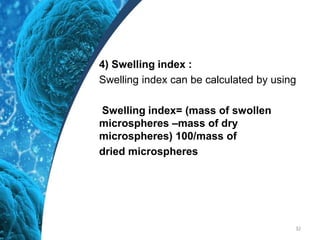
4) Swelling index :
Swelling index can be calculated by using
Swelling index= (mass of swollen
microspheres –mass of dry
microspheres) 100/mass of
dried microspheres
32
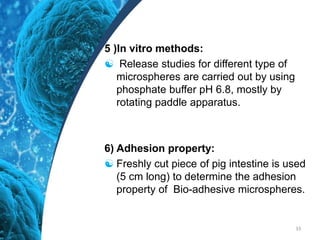
5 )In vitro methods:
 Release studies for different type of
microspheres are carried out by using
phosphate buffer pH 6.8, mostly by
rotating paddle apparatus.
6) Adhesion property:
 Freshly cut piece of pig intestine is used
(5 cm long) to determine the adhesion
property of Bio-adhesive microspheres.
33
34
APPLICATIONS
Ophthalmic Drug Delivery
Oral drug delivery
 Gene delivery
Nasal drug delivery
 Buccal drug delivery
 Gastrointestinal drug delivery
 Transdermal drug delivery
Colonic drug delivery
35
MICROCAPSULES
Microcapsules :
Microcapsules consisting of an
encapsulated core particle .
Entrapped substance completely
surrounded by a capsule distance
wall.
36
MICROENCAPSULATION
 “Microencapsulation may be defined as
the process of surrounding or
enveloping one substance within
another substance on a very small
scale, yielding capsules ranging from
less than one micron to several hundred
microns in size.”
 It is mean of applying thin coating to
small particle of solid or droplet of liquid
& dispersion.
 Particle size: 50-5000 micron.
2 phases:
 a) Core material
 b) Coating material
37
TECHNIQUES TO
MANUFACTURE
Physical methods
 Air-suspension coating
 Multiorifice centrifugal process
 Pan coating
 Coacervation Process
 Spray–drying
Chemical process
 Solvent Evaporation
 Polymerization
38
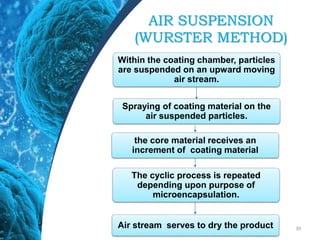
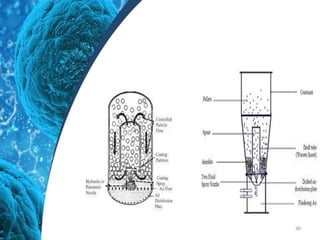
AIR SUSPENSION
(WURSTER METHOD)
39
Within the coating chamber, particles
are suspended on an upward moving
air stream.
Spraying of coating material on the
air suspended particles.
The cyclic process is repeated
depending upon purpose of
microencapsulation.
Air stream serves to dry the product
the core material receives an
increment of coating material
40
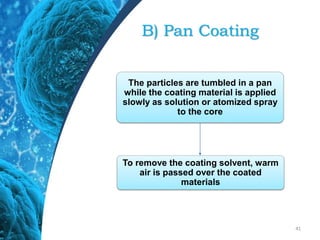
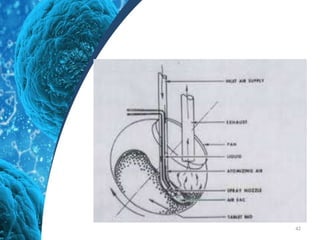
B) Pan Coating
41
The particles are tumbled in a pan
while the coating material is applied
slowly as solution or atomized spray
to the core
To remove the coating solvent, warm
air is passed over the coated
materials
42
43
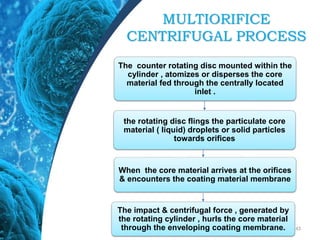
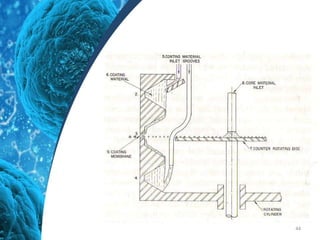
the rotating disc flings the particulate core
material ( liquid) droplets or solid particles
towards orifices
The counter rotating disc mounted within the
cylinder , atomizes or disperses the core
material fed through the centrally located
inlet .
When the core material arrives at the orifices
& encounters the coating material membrane
The impact & centrifugal force , generated by
the rotating cylinder , hurls the core material
through the enveloping coating membrane.
MULTIORIFICE
CENTRIFUGAL PROCESS
44
APPLICATION
 For sustained or prolonged drug release.
 For masking taste and odor of many drugs
to improve patient compliance.
 For converting liquid drugs in a free
flowing powder.
 To reduce toxicity and GI irritation
 Incompatibility among the drugs can be
prevented by microencapsulation.
 The drugs, which are sensitive to oxygen,
moisture or light, can be stabilized by
microencapsulation
45
REFERENCE
 Theory and practice in novel drug delivery
system by S.P. VYAS.
 MICROSPHERES: A BRIEF REVIEW
Kadam N. R. and Suvarna V Department of
Quality Assurance, SVKM’s Dr. Bhanuben
Nanavati College of Pharmacy,Vile Parle,
Maharashtra.
 Leon, Lachman, Herbert A. L., Joseph, L.
K; “ The Theory And Practice Of Industrial
Pharmacy”, 3rd edition, 1990, Varghese
Publishing House,412, 428.
46
47

Micro capsules or microspheres

  • 1.
    Presented by P.Pavazhaviji M.Pharm IYear (II Sem) Dept. of Pharmaceutics MTPG & RIHS Puducherry 1
  • 2.
    MICROSPHERES  Microspheres aresmall spherical particles, ranging in size from 1 μm to 1000 μm.  They are spherical free flowing particles consisting of proteins or synthetic polymers which are biodegradable in nature. 2
  • 3.
    CLASSIFICATION Microspheres Microcapsules Micromatrices  Microcapsulesconsisting of an encapsulated core particle .  Micromatrices in which entrapped substance is dispersed throughout the matrix. 3
  • 4.
  • 5.
    ADVANTAGES  Improve bioavailability Provide prolonged therapeutic effect.  Provide constant drug concentration in blood .  Decrease toxicity.  Protect the drug from enzymatic and photolytic cleavage  Reduce the dosing frequency and thereby improve the patient compliance 5
  • 6.
    DISADVANTAGES  The costis more.  Process conditions like change in temperature, pH, solvent addition, and evaporation/agitation may influence the stability of core particles.  Degradation of product due to heat, hydrolysis, oxidation, solar radiation or biological agents. 6
  • 7.
    TYPES OF MICROSPHERES Bioadhesive microspheres  Floating microspheres  Radioactive microspheres  Magnetic microspheres  Polymeric microspheres a) Biodegradable polymeric microspheres b) Synthetic polymeric microspheres 7
  • 8.
    Bio-adhesive microspheres:  Adhesionof drug delivery device to the mucosal membrane such as buccal, ocular, rectal, nasal etc can be termed as Bioadhesive microspheres . 8 TYPES OF MICROSPHERES
  • 9.
    Magnetic microspheres:  Thiskind of delivery system is very much important which localises the drug to the disease site.  Magnetic carriers receive magnetic responses to a magnetic field from incorporated materials that are used for magnetic microspheres. 9 TYPES OF MICROSPHERES
  • 10.
    Floating microspheres:  Infloating types the bulk density is less than the gastric fluid and so remains buoyant in stomach. 10 TYPES OF MICROSPHERES
  • 11.
    Radioactive microspheres:  radioactivemicrospheres deliver high radiation dose to the targeted areas without damaging the normal surrounding tissues. 11 TYPES OF MICROSPHERES
  • 12.
    Polymeric microspheres:  Thedifferent types of polymeric microspheres can be classified as follows: a) Biodegradable polymeric microspheres b) Synthetic polymeric microspheres 12 TYPES OF MICROSPHERES
  • 13.
    METHOD OF PREPARATION Single emulsion technique  Double emulsion technique  Solvent evaporation  Phase separation coacervation technique  Spray drying and spray congealing  Solvent extraction  Polymerization 13
  • 14.
     SINGLE EMULSION TECHNIQUE 14 Polymerin aqueous solution+ drug Disperse in organic phase (oil/ chloroform) Microspheres Microspheres in organic phase stir or sonicate Chemical cross linking or heat denaturation Centrifugation , Wash, separation
  • 15.
     DOUBLE EMULSION TECHNIQUE 15 Polymerin aq. solution + Drug Disperse in organic phase First emulsion ( W/O) Multiple emulsion(W/O/W) Microspheres in solution Microspheres Homogenization or sonication Addition of aq. sol of PVA Addition to large aq. Phase Separation, wash, dry
  • 16.
  • 17.
     SOLVENT EVAPORATION 17 Coating polymersolution Core material disperse in liquid manufacturing vehicle phase Evaporation of polymer solvent Microspheres Core material Dissolved or dispersed Agitation Heating (if need)
  • 18.
     PHASE SEPARATION COACERVATION TECHNIQUE 18 Aq/organic solution of polymer Drug dispersed or dissolved in the polymer solution Polymer rich globules Microspheres in aq/ organic phase microspheres Add drug Phase separation induced by different means solidify Separate, wash and dry
  • 19.
    Steps of coacervation Formation ofthree immiscible chemical phases Deposition of the coating Rigidization of the coating 19
  • 20.
  • 21.
    Techniques used for coacervation Change in temperature  Incompatible polymer addition  Non solvent addition  Salt addition  Polymer – polymer interaction 21
  • 22.
     SPRAY DRYINGAND SPRAY CONGEALING 22 Polymer dissolved in organic phase (acetone) Drug is dispersed in polymer solution under high speed homogenization/ Atomized in a stream of hot air Separated by cyclone separator and traces of solvent is removed by vacuum drying microspheres Solvent evaporation Formation of small droplets
  • 23.
  • 24.
  • 25.
    i. a )BULK POLYMERIZATION 25 Monomer / mixture of monomer + initiator Microspheres Heated to initiate polymerization Polymer obtained is moulded / fragmented
  • 26.
    i. b )SUSPENSION POLYMERIZATION 26 Monomer or composition of monomers are heated and dispersed in water Microspheres Droplets (vigorous agitation)
  • 27.
    i. c) EMULSION POLYMERIZATION 27 Monomer+ aq. Solution of NaOH + initiator ( stir) Polymerization occurs , microspheres are formed Micelles solution of polymer in aq. medium
  • 28.
    ii. INTERFACIAL POLYMERIZATION 28 Monomer A+ water Oil phase W/O emulsion Add monomer B Microspheres in aq. Medium Microspheres High pressure homogenization polymerization
  • 29.
  • 30.
    EVALUATION OF MICROSPHERES 1 .Particlesize and shape:  The most widely used procedures to visualize microparticles are conventional light microscopy (LM) and scanning electron microscopy (SEM). 2. surface chemistry :  The surface chemistry of the microspheres can be determined using the electron spectroscopy for chemical analysis(ESCA). 30
  • 31.
    3) Drug entrapmentefficiency:  Drug entrapment efficiency can be calculated using following equation, % Entrapment = Actual content / Theoretical content x 100 31
  • 32.
    4) Swelling index: Swelling index can be calculated by using Swelling index= (mass of swollen microspheres –mass of dry microspheres) 100/mass of dried microspheres 32
  • 33.
    5 )In vitromethods:  Release studies for different type of microspheres are carried out by using phosphate buffer pH 6.8, mostly by rotating paddle apparatus. 6) Adhesion property:  Freshly cut piece of pig intestine is used (5 cm long) to determine the adhesion property of Bio-adhesive microspheres. 33
  • 34.
  • 35.
    APPLICATIONS Ophthalmic Drug Delivery Oraldrug delivery  Gene delivery Nasal drug delivery  Buccal drug delivery  Gastrointestinal drug delivery  Transdermal drug delivery Colonic drug delivery 35
  • 36.
    MICROCAPSULES Microcapsules : Microcapsules consistingof an encapsulated core particle . Entrapped substance completely surrounded by a capsule distance wall. 36
  • 37.
    MICROENCAPSULATION  “Microencapsulation maybe defined as the process of surrounding or enveloping one substance within another substance on a very small scale, yielding capsules ranging from less than one micron to several hundred microns in size.”  It is mean of applying thin coating to small particle of solid or droplet of liquid & dispersion.  Particle size: 50-5000 micron. 2 phases:  a) Core material  b) Coating material 37
  • 38.
    TECHNIQUES TO MANUFACTURE Physical methods Air-suspension coating  Multiorifice centrifugal process  Pan coating  Coacervation Process  Spray–drying Chemical process  Solvent Evaporation  Polymerization 38
  • 39.
    AIR SUSPENSION (WURSTER METHOD) 39 Withinthe coating chamber, particles are suspended on an upward moving air stream. Spraying of coating material on the air suspended particles. The cyclic process is repeated depending upon purpose of microencapsulation. Air stream serves to dry the product the core material receives an increment of coating material
  • 40.
  • 41.
    B) Pan Coating 41 Theparticles are tumbled in a pan while the coating material is applied slowly as solution or atomized spray to the core To remove the coating solvent, warm air is passed over the coated materials
  • 42.
  • 43.
    43 the rotating discflings the particulate core material ( liquid) droplets or solid particles towards orifices The counter rotating disc mounted within the cylinder , atomizes or disperses the core material fed through the centrally located inlet . When the core material arrives at the orifices & encounters the coating material membrane The impact & centrifugal force , generated by the rotating cylinder , hurls the core material through the enveloping coating membrane. MULTIORIFICE CENTRIFUGAL PROCESS
  • 44.
  • 45.
    APPLICATION  For sustainedor prolonged drug release.  For masking taste and odor of many drugs to improve patient compliance.  For converting liquid drugs in a free flowing powder.  To reduce toxicity and GI irritation  Incompatibility among the drugs can be prevented by microencapsulation.  The drugs, which are sensitive to oxygen, moisture or light, can be stabilized by microencapsulation 45
  • 46.
    REFERENCE  Theory andpractice in novel drug delivery system by S.P. VYAS.  MICROSPHERES: A BRIEF REVIEW Kadam N. R. and Suvarna V Department of Quality Assurance, SVKM’s Dr. Bhanuben Nanavati College of Pharmacy,Vile Parle, Maharashtra.  Leon, Lachman, Herbert A. L., Joseph, L. K; “ The Theory And Practice Of Industrial Pharmacy”, 3rd edition, 1990, Varghese Publishing House,412, 428. 46
  • 47.