Electrosomes
Mr. Dighe Ajinkya D
M- Pharm 1st year, Sem II (Pharmaceutics)
Guided By - Ms. Bidkar Mam
Presented At- Sharadchandra Pawar Collage Of Pharmacy Otur
Contents
1. Introduction
2. Method of preparation
3. Advantages Electrosomes
4. Disadvantages Electrosomes
5. Application
6. Reference
INTRODUCTION
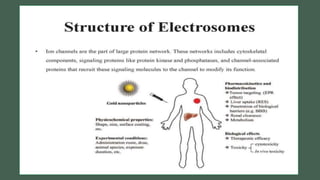
• These are the transmembrane protein generate and propagate the electrical signals that
allow us to sense our surroundings, process, information, make decisions, and move.
• Ion channel proteins act as gates that span the lipid bilayer that surrounds all
electrochemical gradients.
• The ion flux through a channel pore can be extremely high.
• They are high resolution in function and 3D structure to description of their molecules.
• The high resolution structure of ion channel and ion channel associated protein are
providing the substrates for sophisticated tests of the mechanisms of channel gating and
permeation.
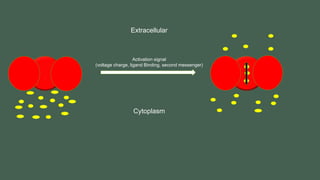
• Ion perform two basic function open and close to control the passage of ion across the cell
membrane.
Extracellular
Activation signal
(voltage charge, ligand Binding, second messenger)
Cytoplasm
• The electrosomes, a novel surface-display system based on the specific interaction
between the cellulosomal scaffoldin protein and a cascade of redox enzymes that
allows multiple electron-release by fuel oxidation.
• The electrosomes is composed of two compartment:
(i) a hybrid anode, which consists of dockerin-containing enzymes
attached specifically to cohesin sites in the scaffoldin to assemble an ethanol
oxidation cascade, and
(ii) a hybrid cathode, which consists of a dockerin-containing oxygen-
reducing enzyme attached in multiple copies to the cohesin-bearing scaffoldin.
• The electrosomes was designed for use both in an anode and a cathode compartment; in
each compartment, the unique attributes of the cellulosome scaffoldin give a different
advantage
• In the anode, the ethanol oxidation cascade consists of two enzymes, ADH and
formaldehyde dehydrogenase (FormDH), both containing a different dockerin module of
Acetivibrio cellulolyticus and of Clostridium thermocellum, C. thermocellum (zADH-Ac and
pFormDH-Ct), respectively, assembled on a ‘designer’-scaffoldin chimera displayed on
the surface of S. cerevisiae.
• At the cathode, copper oxidase (CueO) was selected for surface-display. CueO is a multi-
copper oxidase enzyme expressed by E. coli that catalyzes the oxidation of Cu(I) ions
coupled to oxygen reduction to water.
• The different constructs used for assembly are depicted. We report the characterization of
the dockerin-containing enzymes and their electrochemical activity using a diffusing redox
mediator.
Method of Preparation
1. Strains and Constructs method.
2. Enzyme Binding to Scaffoldin.
3. Biofuel-Cell Assembly and Characterization.
4. Protein Expression.
5. Enzyme Activity Assays.
6. Construction of YSD of Chimeric Scaffoldins.
7. Cyclic Voltammetry (CV) and Chronoamperometry (CA).
Strains and Constructs method
• The genes encoding dockerins of Acetivibrio cellulolyticus and Clostridium thermocellum
were cloned and ligated to the C-terminus of Zymomonas mobilis alcohol dehydrogenase
and to Pseudomonasputida formaldehyde dehydrogenase by standard methods.
• The dockerin module of C.thermocellum was also ligated to the C-terminus of CueO (CueO-
Ct) of E.coli.
• All the dockerin-containing enzymes encoding genes have been cloned into the pET15b
vector for expression in E. coli, yielding the pET15b-zADH-Ac, pET15b- pFormDH-Ct, and
pET15b-CueO-Ct vectors.
• For controls, the genes encoding the native enzymes without an appended dockerin module
were also cloned in the same vector, yielding plasmids pET15b- zADH, pET15b-pFormDH,
and pET15b-CueO.
Enzyme Binding to Scaffoldin
• 2.0 mL of yeast cells displaying scaffoldin, for which absorbance at a wavelength of 600 nm
was 1.0 , were incubated with bacterial lysates containing the expressed enzymes at room
temperature for 1 h. 1.0 mL of the bacterial lysates were used for the binding, which was
performed in a final volume of 15 ml.
• As a binding buffer, 50 mM Tris buffer at pH 8.0 with 1 mM CaCl2 was used. Upon binding,
the yeast cells were precipitated, and binding was repeated using fresh lysate.
• After the second binding cycle, the yeast cells were washed four times in the buffer to
remove non-specifically bound enzymes.
• For the CueO-Ct binding, the yeast cells were suspended in 0.1m acetate buffer pH 5.0
containing 1 mm CaCl2 after the last wash.
• Following binding, the yeast cells were resuspended in 2.0 ml of buffer
Biofuel-Cell Assembly and Characterization
• Air was continuously purged to the fuel-cells. A potentiostatically controlled anode set to
−0.2 V versus Ag/AgCl was used.
• In all experiments, the cells were left to stabilize overnight, following fuel cell assembly,
before characterization was performed.
• The characterization of fuel cell performance was done by measuring the voltage of the cells
under variable external loads.
• A background current cell was used as a negative control for all fuel cell experiments and
did not contain any yeast. Graphite rods of 5 mm diameter served as both anodes and
cathodes.
• The counter electrode that served for the potentiostatically controlled electrode was of a
larger surface area, as described for the CV and CA measurements
Advantages
• It perpetuates the endurance of active drug molecule in the systemic circulation. Deferment
the elimination reactions of promptly metabolize drugs and contributes to controlled release.
• Incorporates both hydrophilic and lipophilic drugs.
• Intensifies the stability of medicament.
• Cost of therapy is minimized by reducing the dose per unit formulation
• Elevate bioavailability especially in water disfavouring drugs.
• Selective uptake by tissues due to direct drug delivery.
Disadvantages
• The production cost of electrosomes are generally high since these come under the
class of nanotherapeutics.
• The constituent phospholipids present in lipid vesicular structures may undergo
oxidation or hydrolysis.
Application
• They use enzymatic reactions to catalyze the conversion of chemical energy to electricity in
a fuel cell.
• The use of enzymatic cascades in enzymatic fuel cell anodes resulted in very high power
outputs, as the electron density achieved was much higher when the fuel was fully oxidized.
• Its used as a carrier in drug targeting.
• Used in the treatment of cancer.
• Used in studying immune response.
• Ear targeting
• Muscle targeting
Reference
1. SHEFRIN S, SREELAXMI C. S, VISHNU VIJAYAN, SREEJA C. NAIR.ENZYMOSOMES:
A RISING EFFECTUAL TOOL FOR TARGETED DRUG DELIVERY SYSTEM.INT J APP
PHARM. 2017;9(6);1-9
2. 2. SZCZUPAK A, AIZIK D, MORAÏS S, VAZANA Y, BARAK Y, BAYER A E, ALFONTA L.
THE ELECTROSOME: A SURFACE-DISPLAYED ENZYMATIC CASCADE IN A BIOFUEL
CELL’S ANODE AND A HIGH-DENSITY SURFACE-DISPLAYED BIOCATHODIC
ENZYME.NANO- MATERIAL.2017
3. 3. WWW.SCIENCE DIRECT.COM
Electrosome