2
Flow of Presentation
 Introduction
 Drug Delivery Routes Across Human Skin
 Properties For Ideal Penetration Enhancers
 Uses of Penetration Enhancers
 Merits And Demerits of Penetration Enhancers
 Classification of Penetration Enhancers
 Physical Enhancers
 References
VNS Group of Institutes
INTRODUCTION
3
Penetration enhancers:
Substances used to increase permeation of skin mucosa.
Increases the absorption of penetrant through the skin.
Synonyms: absorption promoter and sorption accelerants.
VNS Group of Institutes
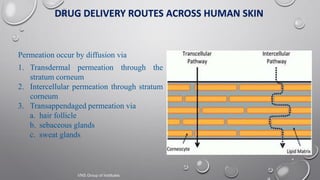
Permeation occur by diffusion via
1. Transdermal permeation through the
stratum corneum
2. Intercellular permeation through stratum
corneum
3. Transappendaged permeation via
a. hair follicle
b. sebaceous glands
c. sweat glands
DRUG DELIVERY ROUTES ACROSS HUMAN SKIN
4
VNS Group of Institutes
5
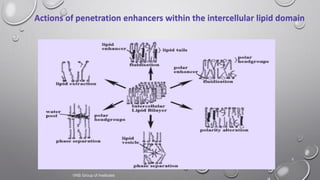
Actions of penetration enhancers within the intercellular lipid domain
VNS Group of Institutes
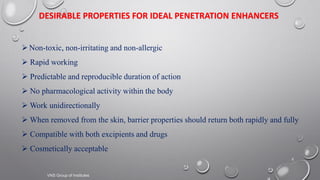
DESIRABLE PROPERTIES FOR IDEAL PENETRATION ENHANCERS
 Non-toxic, non-irritating and non-allergic
 Rapid working
 Predictable and reproducible duration of action
 No pharmacological activity within the body
 Work unidirectionally
 When removed from the skin, barrier properties should return both rapidly and fully
 Compatible with both excipients and drugs
 Cosmetically acceptable
6
VNS Group of Institutes
1. To increase the delivery of ionisable drugs. Example: timolol maleate etc
2. To deliver the impermeable drugs. Example: heparin etc
3. To maintain level of drug into blood stream
4. To improve the efficacy of less potent drugs with higher dose. Example:
oxymorphane
5. To deliver the drugs having high molecular weight like peptide and hormones
6. To decrease lag time of transdermal drug delivery system
7
USES OF PENETRATION ENHANCERS
VNS Group of Institutes
8
Merits of Penetration Enhancers
1) Most drugs penetrate at rates sufficiently high for therapeutic efficiency by
using penetration enhancers
2) It is useful for unabsorbable drugs to facilitate their absorption through skin
3) It can improve transdermal absorption of topical preparation
4) No adverse effect on skin
5) Do not affect zero order skin permeation profile of skin
6) The terpenes like limonene in propylene glycol solution are effective
penetration enhancer for cytotoxic drugs
VNS Group of Institutes
9
1. The effective concentration varies from drug to drug
2. The uses of different penetration enhancer with various concentrations are
restricted completely
3. Physicochemical properties of enhancers are also affecting the side effects in
the body
Demerits of Penetration Enhancers
VNS Group of Institutes
10
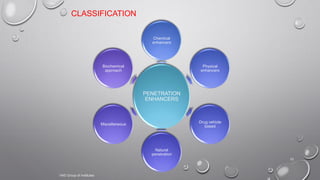
PENETRATION
ENHANCERS
Chemical
enhancers
Physical
enhancers
Drug vehicle
based
Natural
penetration
Miscellaneous
Biochemical
approach
CLASSIFICATION
11
Mechanism of action:
1. By distruption of highly ordered structure of stratum corneum lipid
2. By interaction with intercellular protein
3. By improved partition of the drug or solvent into stratum corneum
Examples:
Sulfoxide- DMSO, DMF, DMAC
Azones
Surface active agents- SLS, BKC
Amines & amides- urea
Fatty acids etc
VNS Group of Institutes
12
Mechanism of action :
Interaction of enhancers with stratum corneum and development of SAR for
enhances with optimal characteristics and minimal toxicity.
Examples Ion pairs and complex Coacervates chemical potential adjustment.
Drug selection.
VNS Group of Institutes
13
1. Terpenes-
Menthol, Linalool,
Limonene, Carvacrol
2. Essential oil-
Basil oil, Neem oil,
Eucalyptus oil
Mechanism of action :
It may increase one or more of following effects
1. Partition coefficient
2. Diffusion coefficient
3. Lipid Extraction
4. Drug Solubility
5. Macroscopic Barrier Perturbation
6. Molecular Orientation of Terpenes Molecule
with Lipid Bilayer
Examples
VNS Group of Institutes
14VNS Group of Institutes
VNS Group of Institutes 15
16
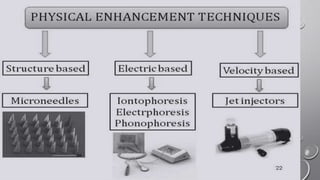
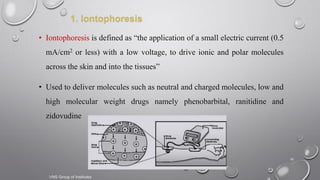
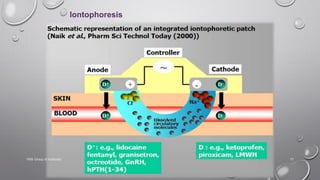
1. Iontophoresis
• Iontophoresis is defined as “the application of a small electric current (0.5
mA/cm2 or less) with a low voltage, to drive ionic and polar molecules
across the skin and into the tissues”
• Used to deliver molecules such as neutral and charged molecules, low and
high molecular weight drugs namely phenobarbital, ranitidine and
zidovudine
VNS Group of Institutes
17
Iontophoresis
VNS Group of Institutes
18
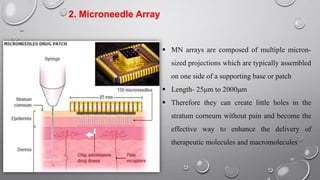
2. Microneedle Array
 MN arrays are composed of multiple micron-
sized projections which are typically assembled
on one side of a supporting base or patch
 Length- 25μm to 2000μm
 Therefore they can create little holes in the
stratum corneum without pain and become the
effective way to enhance the delivery of
therapeutic molecules and macromolecules
VNS Group of Institutes
19
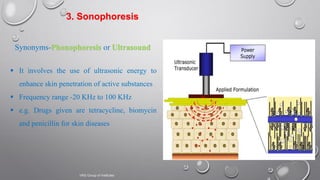
3. Sonophoresis
Synonyms-Phonophoresis or Ultrasound
 It involves the use of ultrasonic energy to
enhance skin penetration of active substances
 Frequency range -20 KHz to 100 KHz
 e.g. Drugs given are tetracycline, biomycin
and penicillin for skin diseases
VNS Group of Institutes
20
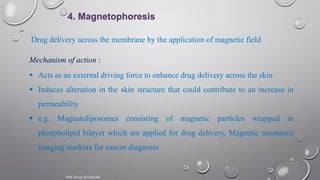
4. Magnetophoresis
 Acts as an external driving force to enhance drug delivery across the skin
 Induces alteration in the skin structure that could contribute to an increase in
permeability
 e.g. Magnatoliposomes consisting of magnetic particles wrapped in
phospholipid bilayer which are applied for drug delivery, Magnetic resonance
imaging markers for cancer diagnosis
Mechanism of action :
Drug delivery across the membrane by the application of magnetic field
VNS Group of Institutes
21
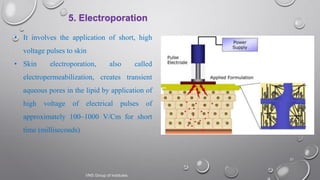
5. Electroporation
• It involves the application of short, high
voltage pulses to skin
• Skin electroporation, also called
electropermeabilization, creates transient
aqueous pores in the lipid by application of
high voltage of electrical pulses of
approximately 100–1000 V/Cm for short
time (milliseconds)
VNS Group of Institutes
22
6. Thermophoresis
 Thermal energy when applied to skin, cause increased skin
permeability
 Heating during topical application of a drug dilates penetration
pathway in the skin and increase kinetic energy and movement of
particles in the treated area which facilitates drug absorption
VNS Group of Institutes
23
7. Radiofrequency
 It involves exposure of the skin to a high frequency alternating current of 100
KHz that result in the formation of heat-induced microchannels in the cell
membrane.
 Rate of drug delivery is controlled by number and depth of microchannels
formed which depends on the properties of microelectrodes in contact with the
skin during treatment.
 e.g. Skin delivery of testosterone and growth hormones.
VNS Group of Institutes
24
• Permeability varies according to skin condition
• Hydrated skin is more permeable than dry skin
• Hydration of skin reduces resistance by loosening the
packaging of layers of stratum corneum
8. Hydration of stratum corneum
VNS Group of Institutes
25
 Chemical peels- for superficial or light (epidermal), medium (epidermal–dermal
junction) or deep (deep papillary or papillary reticular dermis) treatments
 Microdermabrasion which uses a stream of aluminium oxide crystals
 Dermabrasion which employs a motor-driven abrasive fraise or cylinder
 Laser ablation applies high- powered pulses to vapourise a section of the horny layer
 Adhesive tape- To remove stratum corneum prior to drug application
 A microinfusor device- To deliver peptides, proteins and other macromolecules
9. Stripping of stratum corneum
As the horny layer usually provides the permeation barrier, for
efficient drug delivery it can be removed by following techniques:
VNS Group of Institutes
1) Maghrabya, G. M. M. E., Michael, C., Barrie, C. F., 2005. International Journal of
Pharmaceutics 305, 90–104
2) Barry, B. W., 2001. European Journal of Pharmaceutical Sciences 14, 101 –114
3) Karande, P., Jain A., Ergun, K., Kispersky, V., Mitragotri, S., 2005. PNAS 102(13), 4688–
4693
4) Williams, A. C., Barry, B. W., 2012. Advanced Drug Delivery Reviews 64, 128–137
5) Gill, H.S., Prausnitz, M. R., 2007. Journal of Control Drug Release 117, 227–37
6) Henry, S., McAllister, D.V., Allen, M.G., Prausnitz, M. R., 1998. Journal of
Pharmaceutical Sciences 87, 922–925
7) Saini, S., Baghel, S., Agrawal, S. S., 2014. Journal of Advanced Pharmacy Education &
Research 4(1), 31-40
26
References
VNS Group of Institutes
VNS Group of Institutes 27

Penetration enhancer with their examples

  • 2.
    2 Flow of Presentation Introduction  Drug Delivery Routes Across Human Skin  Properties For Ideal Penetration Enhancers  Uses of Penetration Enhancers  Merits And Demerits of Penetration Enhancers  Classification of Penetration Enhancers  Physical Enhancers  References VNS Group of Institutes
  • 3.
    INTRODUCTION 3 Penetration enhancers: Substances usedto increase permeation of skin mucosa. Increases the absorption of penetrant through the skin. Synonyms: absorption promoter and sorption accelerants. VNS Group of Institutes
  • 4.
    Permeation occur bydiffusion via 1. Transdermal permeation through the stratum corneum 2. Intercellular permeation through stratum corneum 3. Transappendaged permeation via a. hair follicle b. sebaceous glands c. sweat glands DRUG DELIVERY ROUTES ACROSS HUMAN SKIN 4 VNS Group of Institutes
  • 5.
    5 Actions of penetrationenhancers within the intercellular lipid domain VNS Group of Institutes
  • 6.
    DESIRABLE PROPERTIES FORIDEAL PENETRATION ENHANCERS  Non-toxic, non-irritating and non-allergic  Rapid working  Predictable and reproducible duration of action  No pharmacological activity within the body  Work unidirectionally  When removed from the skin, barrier properties should return both rapidly and fully  Compatible with both excipients and drugs  Cosmetically acceptable 6 VNS Group of Institutes
  • 7.
    1. To increasethe delivery of ionisable drugs. Example: timolol maleate etc 2. To deliver the impermeable drugs. Example: heparin etc 3. To maintain level of drug into blood stream 4. To improve the efficacy of less potent drugs with higher dose. Example: oxymorphane 5. To deliver the drugs having high molecular weight like peptide and hormones 6. To decrease lag time of transdermal drug delivery system 7 USES OF PENETRATION ENHANCERS VNS Group of Institutes
  • 8.
    8 Merits of PenetrationEnhancers 1) Most drugs penetrate at rates sufficiently high for therapeutic efficiency by using penetration enhancers 2) It is useful for unabsorbable drugs to facilitate their absorption through skin 3) It can improve transdermal absorption of topical preparation 4) No adverse effect on skin 5) Do not affect zero order skin permeation profile of skin 6) The terpenes like limonene in propylene glycol solution are effective penetration enhancer for cytotoxic drugs VNS Group of Institutes
  • 9.
    9 1. The effectiveconcentration varies from drug to drug 2. The uses of different penetration enhancer with various concentrations are restricted completely 3. Physicochemical properties of enhancers are also affecting the side effects in the body Demerits of Penetration Enhancers VNS Group of Institutes
  • 10.
    VNS Group ofInstitutes 10 PENETRATION ENHANCERS Chemical enhancers Physical enhancers Drug vehicle based Natural penetration Miscellaneous Biochemical approach CLASSIFICATION
  • 11.
    11 Mechanism of action: 1.By distruption of highly ordered structure of stratum corneum lipid 2. By interaction with intercellular protein 3. By improved partition of the drug or solvent into stratum corneum Examples: Sulfoxide- DMSO, DMF, DMAC Azones Surface active agents- SLS, BKC Amines & amides- urea Fatty acids etc VNS Group of Institutes
  • 12.
    12 Mechanism of action: Interaction of enhancers with stratum corneum and development of SAR for enhances with optimal characteristics and minimal toxicity. Examples Ion pairs and complex Coacervates chemical potential adjustment. Drug selection. VNS Group of Institutes
  • 13.
    13 1. Terpenes- Menthol, Linalool, Limonene,Carvacrol 2. Essential oil- Basil oil, Neem oil, Eucalyptus oil Mechanism of action : It may increase one or more of following effects 1. Partition coefficient 2. Diffusion coefficient 3. Lipid Extraction 4. Drug Solubility 5. Macroscopic Barrier Perturbation 6. Molecular Orientation of Terpenes Molecule with Lipid Bilayer Examples VNS Group of Institutes
  • 14.
    14VNS Group ofInstitutes
  • 15.
    VNS Group ofInstitutes 15
  • 16.
    16 1. Iontophoresis • Iontophoresisis defined as “the application of a small electric current (0.5 mA/cm2 or less) with a low voltage, to drive ionic and polar molecules across the skin and into the tissues” • Used to deliver molecules such as neutral and charged molecules, low and high molecular weight drugs namely phenobarbital, ranitidine and zidovudine VNS Group of Institutes
  • 17.
  • 18.
    18 2. Microneedle Array MN arrays are composed of multiple micron- sized projections which are typically assembled on one side of a supporting base or patch  Length- 25μm to 2000μm  Therefore they can create little holes in the stratum corneum without pain and become the effective way to enhance the delivery of therapeutic molecules and macromolecules VNS Group of Institutes
  • 19.
    19 3. Sonophoresis Synonyms-Phonophoresis orUltrasound  It involves the use of ultrasonic energy to enhance skin penetration of active substances  Frequency range -20 KHz to 100 KHz  e.g. Drugs given are tetracycline, biomycin and penicillin for skin diseases VNS Group of Institutes
  • 20.
    20 4. Magnetophoresis  Actsas an external driving force to enhance drug delivery across the skin  Induces alteration in the skin structure that could contribute to an increase in permeability  e.g. Magnatoliposomes consisting of magnetic particles wrapped in phospholipid bilayer which are applied for drug delivery, Magnetic resonance imaging markers for cancer diagnosis Mechanism of action : Drug delivery across the membrane by the application of magnetic field VNS Group of Institutes
  • 21.
    21 5. Electroporation • Itinvolves the application of short, high voltage pulses to skin • Skin electroporation, also called electropermeabilization, creates transient aqueous pores in the lipid by application of high voltage of electrical pulses of approximately 100–1000 V/Cm for short time (milliseconds) VNS Group of Institutes
  • 22.
    22 6. Thermophoresis  Thermalenergy when applied to skin, cause increased skin permeability  Heating during topical application of a drug dilates penetration pathway in the skin and increase kinetic energy and movement of particles in the treated area which facilitates drug absorption VNS Group of Institutes
  • 23.
    23 7. Radiofrequency  Itinvolves exposure of the skin to a high frequency alternating current of 100 KHz that result in the formation of heat-induced microchannels in the cell membrane.  Rate of drug delivery is controlled by number and depth of microchannels formed which depends on the properties of microelectrodes in contact with the skin during treatment.  e.g. Skin delivery of testosterone and growth hormones. VNS Group of Institutes
  • 24.
    24 • Permeability variesaccording to skin condition • Hydrated skin is more permeable than dry skin • Hydration of skin reduces resistance by loosening the packaging of layers of stratum corneum 8. Hydration of stratum corneum VNS Group of Institutes
  • 25.
    25  Chemical peels-for superficial or light (epidermal), medium (epidermal–dermal junction) or deep (deep papillary or papillary reticular dermis) treatments  Microdermabrasion which uses a stream of aluminium oxide crystals  Dermabrasion which employs a motor-driven abrasive fraise or cylinder  Laser ablation applies high- powered pulses to vapourise a section of the horny layer  Adhesive tape- To remove stratum corneum prior to drug application  A microinfusor device- To deliver peptides, proteins and other macromolecules 9. Stripping of stratum corneum As the horny layer usually provides the permeation barrier, for efficient drug delivery it can be removed by following techniques: VNS Group of Institutes
  • 26.
    1) Maghrabya, G.M. M. E., Michael, C., Barrie, C. F., 2005. International Journal of Pharmaceutics 305, 90–104 2) Barry, B. W., 2001. European Journal of Pharmaceutical Sciences 14, 101 –114 3) Karande, P., Jain A., Ergun, K., Kispersky, V., Mitragotri, S., 2005. PNAS 102(13), 4688– 4693 4) Williams, A. C., Barry, B. W., 2012. Advanced Drug Delivery Reviews 64, 128–137 5) Gill, H.S., Prausnitz, M. R., 2007. Journal of Control Drug Release 117, 227–37 6) Henry, S., McAllister, D.V., Allen, M.G., Prausnitz, M. R., 1998. Journal of Pharmaceutical Sciences 87, 922–925 7) Saini, S., Baghel, S., Agrawal, S. S., 2014. Journal of Advanced Pharmacy Education & Research 4(1), 31-40 26 References VNS Group of Institutes
  • 27.
    VNS Group ofInstitutes 27