Presented By:
Mr. Vishal Patange
M. Pharm (QAT)
CONTENTS
 Introduction
 Structure of niosome
 Advantages of niosomes
 Compositions of niosomes
 Method of preparation niosomes
 Characterization and factors affecting
formation of niosomes
 Conclusion 2
INTRODUCTION
 Defination
A niosome are synthetic microscopic vesicles consisting of an aqueous
core enclosed in a bilayer consisting of cholesterol and one or more
nonionic surfactants .
A niosome is a non-ionic surfactant-based liposome.
Niosome are non-ionic surfactant vesicles obtained on hydration of
synthetic nonionic surfactants,with or without incorporation of
cholesterol or their lipids.
They are vesicular systems similar to liposomes that can be used as
carriers of amphiphilic and lipophilic drugs.
3
Niosomes are promising vehicle for drug delivery and being non-ionic, it
is less toxic and improves the therapeutic index of drug by restricting its
action to target cells.
They are structurally similar to liposomes in having a bilayer, however,
the materials used to prepare niosomes make them more stable and thus
niosomes offer many more advantages over liposome
In niosomes, the vesicles forming amphiphile is a non-ionic surfactant such
as Span – 60 which is usually stabilized by addition of cholesterol and
small amount of anionic surfactant such as dicetyl phosphate.
4
STRUCTURE OF NIOSOME
A typical niosome vesicle would consist of a vesicle forming amphiphile i.e. a
non-ionic surfactant such as Span-60, which is usually stabilized by the addition
of cholesterol and a small amount of anionic surfactant such as dicetyl
phosphate,which also helps in stabilizing the vesicle.
5
ADVANTAGES OF NIOSOMES
-They possess an structure consisting of hydrophilic, amphiphilic and
lipophilic moieties together and as a result can accommodate drug
molecules with a wide range of solubilities.
-The characteristics of the vesicle formulation are variable and
controllable. Altering vesicle composition, size, lamellarity,surface charge
and concentration can control the vesicle characteristics.
-The vesicles may act as a depot, releasing the drug in a controlled manner.
-They are osmotically active and stable, as well as they increase the stability
of entrapped drug.
6
-Handling and storage of surfactants requires no special conditions.
-They can be made to reach the site of action by oral, parenteral as well as
topical routes so they improve oral bioavailability of poorly absorbed drugs
and enhance skin penetration of drugs.
-The surfactants are biodegradable, biocompatible and non-immunogenic.
- They improve the therapeutic performance of the drug molecules by
delayed clearance from the circulation, protecting the drug from biological
environment and restricting effects to target cells.
7
Comparison of Niosomes Vs Liposome’s
-Liposomes they are expensive, their ingredients like phospholipids are
chemically unstable because of their predisposition to oxidative
degradation, they require special storage and handling and purity of
natural phospholipids is variable.
-Differences in characteristics exist between liposomes and niosomes,
especially since niosomes are prepared from uncharged single-chain
surfactant and cholesterol whereas liposomes are prepared from
double-chain phospholipids (neutral or charged).
8
 -The properties of niosomes and liposomes depends both on the
composition of the bilayer and on method of their production. The
intercalation of cholesterol in the bilayers decreases the entrapment volume
during formulation and thus entrapment efficiency. As the concentration of
cholesterol increases, entrapment efficiency decreases.
-The entrapment efficiency increases with increase in the concentration
and lipophilicity of surfactant. It was also observed that as HLB value of
surfactant decreased, the mean size was reduced.
9
COMPOSITIONS OF NIOSOMES:
The two major components used for the preparation of niosomes are,
1. Cholesterol
2. Nonionic surfactants
1. Cholesterol
Cholesterol is used to provide rigidity and proper shape,conformation to
the niosomes preparations.
2. Nonionic surfactants
The role surfactants play a major role in the formation of niosomes. The
following non-ionic surfactants are generally used for the preparation of
niosomes.
E.g. Spans (span 60, 40, 20, 85, 80)
Tweens (tween 20, 40, 60, 80) and
The non ionic surfactants possess a hydrophilic head and a
hydrophobic tail.
10
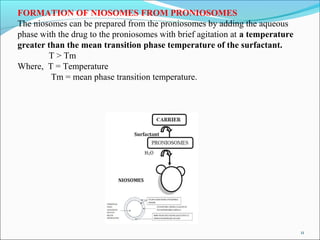
FORMATION OF NIOSOMES FROM PRONIOSOMES
The niosomes can be prepared from the proniosomes by adding the aqueous
phase with the drug to the proniosomes with brief agitation at a temperature
greater than the mean transition phase temperature of the surfactant.
T > Tm
Where, T = Temperature
Tm = mean phase transition temperature.
11
METHOD OF PREPARATION OF NIOSOMES
1.Sonication:Preparation steps
aq. Phase drug + mix. Of surfactant & cholesterol
↓ in scitillation vials
Mixture sonicated at 60 c for 3min to form small and uniform size niosomes.
2. Hand shaking method (Thin film hydration technique):
Surfactant & cholesterol dissolved in volatile org. Solvent(diethyl
ether,methanol or chloroform) in RBF
↓
Remove org. Solvent at 20 c (thin layer)
Again hydrate with containing drug at 50-60 c with gentale agitation to forms
vesicles.
12
3. Ether injection method:
Slowely intoducing Surfactant is dissolved in diethyl ether
↓
Then injected in warm water maintained at 60 C injected through a 14
gauze needle
↓
Ether is vaporized to form single layered niosomes.
13
4.Reverse Phase Evaporation Technique (REV)
Preparation steps
Cholesterol + surfactant(1:1) dissolved in ether + chloroform
↓
Sonicated at 5c and again sonicated after by adding phosphate buffered saline
(PBS).
↓
Drug in aqueous phase is added to above mixture
↓
Organic phase is removed at 40C at low pressure
↓
Heated on a water bath for 60 C for 10 mints to yield niosomes.
14
5.Multiple membrane extrusion method:
A mixture of surfactant, cholesterol, and diacetyl phosphate in
chloroform is made into thin film by evaporation.
The film is hydrated with aqueous drug solution
The resultant suspension extruded through polycarbonate membranes,
which are placed in a series for up to eight passages.
This is a good method for controlling niosome size14.
6.Emulsion method: The oil in water (o/w) emulsion is prepared from
an organic solution of surfactant,cholesterol, and an aqueous
solution of the drug.
The organic solvent is then evaporated, leaving niosomes
dispersed in the aqueous phase.
15
CHARACTERIZATION AND FACTORS AFFECTING FORMATION
OF NIOSOMES
(i) Size: diameter niosomal vesicles can be determined by using electron
microscopy, molecular sieve chromatography, ultracentrifugation, photon
correlation microscopy, optical microscopy and freeze fracture electron
microscopy.
(ii) Bilayer Formation: It is determine by bilayer vesicles light
polarization microscopy
(iii) Number of Lamellae : It is determine by X-ray scattering and
electron microscopy.
16
(iv) Entrapment Efficiency:
the drug remained entrapped in Niosomes is determined by complete
vesicle disruption using 50% n-propanol solution and analyzing the
resultant solution by appropriate assay method for the drug.
Entrapment efficiency = (Amount entrapped / total amount) x 100
17
Entrapment efficiency it is affected by following factors
A.surfactant
B.cholesterol content
A.surfactant :
HLB value of surfactant
HLB value of 14 to 17 is not suitable for niosomes
Highest entrapment efficincy for 8.6 and as
Entrapment efficiency decreses in HLB value from 8.6 to 1.7
 B.cholesterol content : The incorporation of cholesterol into bilayer
composition of niosome increses membrane stabilizing activity and
decreases the leakiness of membrane.
so cholesterol into bilayer increases entrapment efficiency.
18
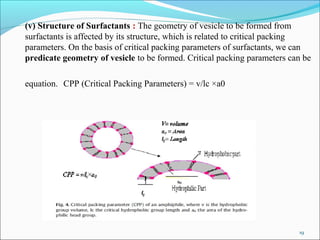
(v) Structure of Surfactants : The geometry of vesicle to be formed from
surfactants is affected by its structure, which is related to critical packing
parameters. On the basis of critical packing parameters of surfactants, we can
predicate geometry of vesicle to be formed. Critical packing parameters can be
equation. CPP (Critical Packing Parameters) = v/lc ×a0
19
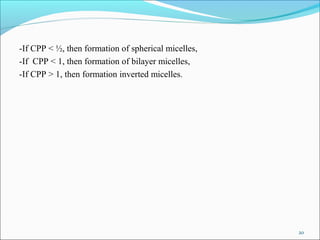
-If CPP < ½, then formation of spherical micelles,
-If CPP < 1, then formation of bilayer micelles,
-If CPP > 1, then formation inverted micelles.
20
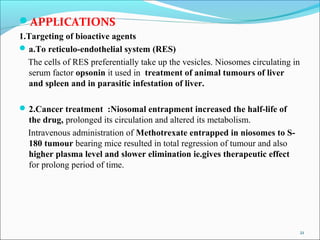
APPLICATIONS
1.Targeting of bioactive agents
a.To reticulo-endothelial system (RES)
The cells of RES preferentially take up the vesicles. Niosomes circulating in
serum factor opsonin it used in treatment of animal tumours of liver
and spleen and in parasitic infestation of liver.
2.Cancer treatment :Niosomal entrapment increased the half-life of
the drug, prolonged its circulation and altered its metabolism.
Intravenous administration of Methotrexate entrapped in niosomes to S-
180 tumour bearing mice resulted in total regression of tumour and also
higher plasma level and slower elimination ie.gives therapeutic effect
for prolong period of time.
21
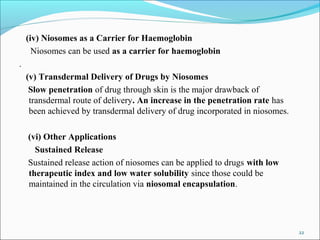
(iv) Niosomes as a Carrier for Haemoglobin
Niosomes can be used as a carrier for haemoglobin
.
(v) Transdermal Delivery of Drugs by Niosomes
Slow penetration of drug through skin is the major drawback of
transdermal route of delivery. An increase in the penetration rate has
been achieved by transdermal delivery of drug incorporated in niosomes.
(vi) Other Applications
Sustained Release
Sustained release action of niosomes can be applied to drugs with low
therapeutic index and low water solubility since those could be
maintained in the circulation via niosomal encapsulation.
22
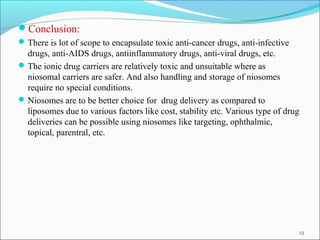
Conclusion:
There is lot of scope to encapsulate toxic anti-cancer drugs, anti-infective
drugs, anti-AIDS drugs, antiinflammatory drugs, anti-viral drugs, etc.
The ionic drug carriers are relatively toxic and unsuitable where as
niosomal carriers are safer. And also handling and storage of niosomes
require no special conditions.
Niosomes are to be better choice for drug delivery as compared to
liposomes due to various factors like cost, stability etc. Various type of drug
deliveries can be possible using niosomes like targeting, ophthalmic,
topical, parentral, etc.
23
References
Biswal S, Murthy PN, Sahu J, Sahoo P, Amir F. Vesicles of Non-ionic
Surfactants (Niosomes) and Drug Delivery Potential. International Journal
of Pharmaceutical Sciences and Nanotechnology. 2008; 1(1).
Review article on Niosomes: a novel drug delivery system Harsimran
Kaur
Bhaskaran S, Panigrahi L. Formulation and evaluation of niosomes
using different nonionic surfactant. Ind. J. Pharm Sci. 2002; 63.
24
25

Niosome seminar

  • 1.
    Presented By: Mr. VishalPatange M. Pharm (QAT)
  • 2.
    CONTENTS  Introduction  Structureof niosome  Advantages of niosomes  Compositions of niosomes  Method of preparation niosomes  Characterization and factors affecting formation of niosomes  Conclusion 2
  • 3.
    INTRODUCTION  Defination A niosomeare synthetic microscopic vesicles consisting of an aqueous core enclosed in a bilayer consisting of cholesterol and one or more nonionic surfactants . A niosome is a non-ionic surfactant-based liposome. Niosome are non-ionic surfactant vesicles obtained on hydration of synthetic nonionic surfactants,with or without incorporation of cholesterol or their lipids. They are vesicular systems similar to liposomes that can be used as carriers of amphiphilic and lipophilic drugs. 3
  • 4.
    Niosomes are promisingvehicle for drug delivery and being non-ionic, it is less toxic and improves the therapeutic index of drug by restricting its action to target cells. They are structurally similar to liposomes in having a bilayer, however, the materials used to prepare niosomes make them more stable and thus niosomes offer many more advantages over liposome In niosomes, the vesicles forming amphiphile is a non-ionic surfactant such as Span – 60 which is usually stabilized by addition of cholesterol and small amount of anionic surfactant such as dicetyl phosphate. 4
  • 5.
    STRUCTURE OF NIOSOME Atypical niosome vesicle would consist of a vesicle forming amphiphile i.e. a non-ionic surfactant such as Span-60, which is usually stabilized by the addition of cholesterol and a small amount of anionic surfactant such as dicetyl phosphate,which also helps in stabilizing the vesicle. 5
  • 6.
    ADVANTAGES OF NIOSOMES -Theypossess an structure consisting of hydrophilic, amphiphilic and lipophilic moieties together and as a result can accommodate drug molecules with a wide range of solubilities. -The characteristics of the vesicle formulation are variable and controllable. Altering vesicle composition, size, lamellarity,surface charge and concentration can control the vesicle characteristics. -The vesicles may act as a depot, releasing the drug in a controlled manner. -They are osmotically active and stable, as well as they increase the stability of entrapped drug. 6
  • 7.
    -Handling and storageof surfactants requires no special conditions. -They can be made to reach the site of action by oral, parenteral as well as topical routes so they improve oral bioavailability of poorly absorbed drugs and enhance skin penetration of drugs. -The surfactants are biodegradable, biocompatible and non-immunogenic. - They improve the therapeutic performance of the drug molecules by delayed clearance from the circulation, protecting the drug from biological environment and restricting effects to target cells. 7
  • 8.
    Comparison of NiosomesVs Liposome’s -Liposomes they are expensive, their ingredients like phospholipids are chemically unstable because of their predisposition to oxidative degradation, they require special storage and handling and purity of natural phospholipids is variable. -Differences in characteristics exist between liposomes and niosomes, especially since niosomes are prepared from uncharged single-chain surfactant and cholesterol whereas liposomes are prepared from double-chain phospholipids (neutral or charged). 8
  • 9.
     -The propertiesof niosomes and liposomes depends both on the composition of the bilayer and on method of their production. The intercalation of cholesterol in the bilayers decreases the entrapment volume during formulation and thus entrapment efficiency. As the concentration of cholesterol increases, entrapment efficiency decreases. -The entrapment efficiency increases with increase in the concentration and lipophilicity of surfactant. It was also observed that as HLB value of surfactant decreased, the mean size was reduced. 9
  • 10.
    COMPOSITIONS OF NIOSOMES: Thetwo major components used for the preparation of niosomes are, 1. Cholesterol 2. Nonionic surfactants 1. Cholesterol Cholesterol is used to provide rigidity and proper shape,conformation to the niosomes preparations. 2. Nonionic surfactants The role surfactants play a major role in the formation of niosomes. The following non-ionic surfactants are generally used for the preparation of niosomes. E.g. Spans (span 60, 40, 20, 85, 80) Tweens (tween 20, 40, 60, 80) and The non ionic surfactants possess a hydrophilic head and a hydrophobic tail. 10
  • 11.
    FORMATION OF NIOSOMESFROM PRONIOSOMES The niosomes can be prepared from the proniosomes by adding the aqueous phase with the drug to the proniosomes with brief agitation at a temperature greater than the mean transition phase temperature of the surfactant. T > Tm Where, T = Temperature Tm = mean phase transition temperature. 11
  • 12.
    METHOD OF PREPARATIONOF NIOSOMES 1.Sonication:Preparation steps aq. Phase drug + mix. Of surfactant & cholesterol ↓ in scitillation vials Mixture sonicated at 60 c for 3min to form small and uniform size niosomes. 2. Hand shaking method (Thin film hydration technique): Surfactant & cholesterol dissolved in volatile org. Solvent(diethyl ether,methanol or chloroform) in RBF ↓ Remove org. Solvent at 20 c (thin layer) Again hydrate with containing drug at 50-60 c with gentale agitation to forms vesicles. 12
  • 13.
    3. Ether injectionmethod: Slowely intoducing Surfactant is dissolved in diethyl ether ↓ Then injected in warm water maintained at 60 C injected through a 14 gauze needle ↓ Ether is vaporized to form single layered niosomes. 13
  • 14.
    4.Reverse Phase EvaporationTechnique (REV) Preparation steps Cholesterol + surfactant(1:1) dissolved in ether + chloroform ↓ Sonicated at 5c and again sonicated after by adding phosphate buffered saline (PBS). ↓ Drug in aqueous phase is added to above mixture ↓ Organic phase is removed at 40C at low pressure ↓ Heated on a water bath for 60 C for 10 mints to yield niosomes. 14
  • 15.
    5.Multiple membrane extrusionmethod: A mixture of surfactant, cholesterol, and diacetyl phosphate in chloroform is made into thin film by evaporation. The film is hydrated with aqueous drug solution The resultant suspension extruded through polycarbonate membranes, which are placed in a series for up to eight passages. This is a good method for controlling niosome size14. 6.Emulsion method: The oil in water (o/w) emulsion is prepared from an organic solution of surfactant,cholesterol, and an aqueous solution of the drug. The organic solvent is then evaporated, leaving niosomes dispersed in the aqueous phase. 15
  • 16.
    CHARACTERIZATION AND FACTORSAFFECTING FORMATION OF NIOSOMES (i) Size: diameter niosomal vesicles can be determined by using electron microscopy, molecular sieve chromatography, ultracentrifugation, photon correlation microscopy, optical microscopy and freeze fracture electron microscopy. (ii) Bilayer Formation: It is determine by bilayer vesicles light polarization microscopy (iii) Number of Lamellae : It is determine by X-ray scattering and electron microscopy. 16
  • 17.
    (iv) Entrapment Efficiency: thedrug remained entrapped in Niosomes is determined by complete vesicle disruption using 50% n-propanol solution and analyzing the resultant solution by appropriate assay method for the drug. Entrapment efficiency = (Amount entrapped / total amount) x 100 17
  • 18.
    Entrapment efficiency itis affected by following factors A.surfactant B.cholesterol content A.surfactant : HLB value of surfactant HLB value of 14 to 17 is not suitable for niosomes Highest entrapment efficincy for 8.6 and as Entrapment efficiency decreses in HLB value from 8.6 to 1.7  B.cholesterol content : The incorporation of cholesterol into bilayer composition of niosome increses membrane stabilizing activity and decreases the leakiness of membrane. so cholesterol into bilayer increases entrapment efficiency. 18
  • 19.
    (v) Structure ofSurfactants : The geometry of vesicle to be formed from surfactants is affected by its structure, which is related to critical packing parameters. On the basis of critical packing parameters of surfactants, we can predicate geometry of vesicle to be formed. Critical packing parameters can be equation. CPP (Critical Packing Parameters) = v/lc ×a0 19
  • 20.
    -If CPP <½, then formation of spherical micelles, -If CPP < 1, then formation of bilayer micelles, -If CPP > 1, then formation inverted micelles. 20
  • 21.
    APPLICATIONS 1.Targeting of bioactiveagents a.To reticulo-endothelial system (RES) The cells of RES preferentially take up the vesicles. Niosomes circulating in serum factor opsonin it used in treatment of animal tumours of liver and spleen and in parasitic infestation of liver. 2.Cancer treatment :Niosomal entrapment increased the half-life of the drug, prolonged its circulation and altered its metabolism. Intravenous administration of Methotrexate entrapped in niosomes to S- 180 tumour bearing mice resulted in total regression of tumour and also higher plasma level and slower elimination ie.gives therapeutic effect for prolong period of time. 21
  • 22.
    (iv) Niosomes asa Carrier for Haemoglobin Niosomes can be used as a carrier for haemoglobin . (v) Transdermal Delivery of Drugs by Niosomes Slow penetration of drug through skin is the major drawback of transdermal route of delivery. An increase in the penetration rate has been achieved by transdermal delivery of drug incorporated in niosomes. (vi) Other Applications Sustained Release Sustained release action of niosomes can be applied to drugs with low therapeutic index and low water solubility since those could be maintained in the circulation via niosomal encapsulation. 22
  • 23.
    Conclusion: There is lotof scope to encapsulate toxic anti-cancer drugs, anti-infective drugs, anti-AIDS drugs, antiinflammatory drugs, anti-viral drugs, etc. The ionic drug carriers are relatively toxic and unsuitable where as niosomal carriers are safer. And also handling and storage of niosomes require no special conditions. Niosomes are to be better choice for drug delivery as compared to liposomes due to various factors like cost, stability etc. Various type of drug deliveries can be possible using niosomes like targeting, ophthalmic, topical, parentral, etc. 23
  • 24.
    References Biswal S, MurthyPN, Sahu J, Sahoo P, Amir F. Vesicles of Non-ionic Surfactants (Niosomes) and Drug Delivery Potential. International Journal of Pharmaceutical Sciences and Nanotechnology. 2008; 1(1). Review article on Niosomes: a novel drug delivery system Harsimran Kaur Bhaskaran S, Panigrahi L. Formulation and evaluation of niosomes using different nonionic surfactant. Ind. J. Pharm Sci. 2002; 63. 24
  • 25.