THE NICUPROTOCOLFOR
NEONATAL SEIZURES
Dr. C. Kannan
Postgraduate
Pediatrics
MGMCRI
EPIDEMIOLOGY
• Incidence
• 10.3/1000 (Term neonates)
• 20.8/1000 (Preterm neonates)
• 36.1/1000 (VLBW neonates
• From NNPD; 2002-03
DEFINITIONS
• Seizures
• Paroxysmal alteration in neurological function
• Motor/behavior/autonomic function
• Epileptic seizures
• Clinical seizures corresponding EEG seizure activity
• Eg. Clonic seizures
• Non epileptic seizures
• Clinical seizures without EEG seizure activity
• Eg. Subtle and generalised tonic seizures
• EEG seizures
• Abnormal EEG activity with no clinical correlation
ETIOLOGY
Hypoxic-ischemic injury
• Perinatal asphyxia
Focal infarction
• Arterial
• Venous
CNS infection
• Escherichia coli/GBS/Listeria
monocytogenes/HSV
Intracranial hemorrhage
• Intraventricular
• Parenchymal
• Subdural
• Subarachnoid
Contd.,
Inborn errors of metabolism
• Aminoacidopathies
• Organic acidurias
• Peroxisomal diseases
• Mitochondrial disorders
• Disorder of glucose transport
(GLUT-1 deficiency)
• Pyridoxine-dependent seizures
• Folinic acid responsive seizures
Acute metabolic disorders
• Hypoglycemia
• Hypocalcemia
• Hypomagnesemia
Contd.,
Malformations and other structural lesions
• Neuronal migration disorders
• Cerebral dysgenesis
• Neurocutaneous disorders,
• E.g., Sturge-Weber syndrome, tuberous sclerosis
Epilepsy syndromes
• Benign familial syndromes
• Severe neonatal epileptic encephalopathies
• E.g., EIEE, Ohtahara syndrome, EME
NEUROTRANSMITTERS/RECEPTORS
• GABA is a Inhibitory neurotransmitter
• Glutamate is a excitatory neurotransmitter
• GABA receptors
• GABA-A/GABA-B(G-Protein coupled receptor)/GABA-C(Retina)
• GABA-A is a part of GABA-A-BDZ-Cl channel complex
• GABA binds to GABA-A receptors in brain
• Increases duration of Cl channel opening
• Causes CNS depression
PATHOPHYSIOLOGY
• Excitatory and inhibitory processes in immature brain are
• Unbalanced towards excitatory side
• Glutaminergic synapses > GABA ergic synapses
• GABA may temporarily act as an
• Excitatory neurotransmitter via an
• Alteration in chloride gradient and transportation
• These developmental features are etiology for
• High tendency of seizures in neonates
• Reduced efficacy of GABA ergic drugs
TYPES OF SEIZURES
• Subtle
• Clonic
• Tonic
• myoclonic
SUBTLE SEIZURES
Commonest type (50% of all seizures)
Mild & often are missed
Examples
• Ocular
• Tonic horizontal deviation of eyes
• Sustained eye opening
• Ocular fixation
• Cycled fluttering
• Oral-facial-lingual movements
• Chewing/tongue-thrusting/lip smacking/etc.,
Contd.,
• Limb movements
• Cycling/paddling/boxing-jabs/etc.,
• Autonomic phenomena – Tachycardia/bradycardia
• Apnea
• Rare manifestation of seizures
• Apnea due to seizures may have normal or increased HR
CLONIC SEIZURES
• Rhythmic movements of muscle groups
• Both slow and fast components
• 1-3 jerks/second
• Associated with EEG changes
• Best prognosis
TONIC SEIZURES
• Sustained flexion /extension of
• Axial or appendicular muscles
• Focal or generalised
• May resemble
• Decerebrate (tonic extension of all limbs)
• Decorticate posturing (flexion of UL/extension of LL)
• No EEG changes
MYOCLONIC SEIZURES
• Single/multiple lightening fast jerks of UL/LL
• How to differentiate from clonic seizures
• More rapid speed
• Absence of slow return
• Predilection for flexor groups
• EEG changes
• Burst suppression pattern
• Focal sharp waves
• Hypsarrhythmia
• Worst prognosis (Neurodevelopmental outcome )
APPROACH TO SEIZURES
• History
• Examination
• Investigations
HISTORY
Seizure history
• Complete description of seizures from parents
• Eye/limb movements/skin colour change
• Autonomic phenomena/consciousness
• Day of life
Antenatal history
• Intrauterine infection/maternal diabetes/narcotic addiction
• Sudden increase in fetal movements
Perinatal history
• Perinatal asphyxia
• Fetal distress/reduced fetal movements/instrumental delivery
• Need for resuscitation/Apgar/cord pH (<7), base deficit (>10)
• Pudental block for mid cavity forceps
Feeding history
• Lethargy/poor activity/drowsiness/vomiting
• After initiation of DBF
• Indicates IEM
• Late onset hypocalcaemia
• Due to top feeding with cow’s milk
Family history of
• Consanguinity /seizures / mental retardation
• Fetal/neonatal deaths – IEM
• Seizures of either parent or sibling indicates
• Benign familial neonatal convulsions
EXAMINATION
Vital signs
General examination
• Gestation / birth weight / weight for age
• Eg., seizure in a term well baby – SAH
• Eg., seizure in a LGA baby – Hypoglycemia
• Malformations / dysmorphic features
CNS examination
• Consciousness – Alert / drowsy / comatose
• Tone – hypo/hypertonia
• Bulging anterior fontanel – S/O meningitis / ICH
Systemic examination
• Hepatosplenomegaly / abnormal urine odour S/O IEM
• Neurocutaneous markers
INVESTIGATIONS
Essential investigations
• Blood sugar / sodium / Ca / CSF / Cranial USG / EEG
• CSF
• Must in all cases (seizure – may be first sign of meningitis)
• Even though other etiology is present ( eg., Hypoglycemia)
• Can withhold
• Severe cardiovascular compromise
• Severe birth asphyxia
• Do all other investigations
• Even 1 or 2 were positive - Multiple etiologies may coexist
Additional investigations
• Who do not respond to Phenobarbitone + phenytoin (or)
• Earlier in neonates with specific features
• Neuroimaging
• Screen for congenital infections (TORCH)
• Screen for IEM (ABG if strongly suspected)
Imaging
• Cranial USG
• Detects - IVH / Parenchymal bleed
• Unable to detect SAH / SDH
• CT scan
• Where etiology is not available
• After first line of investigations
• Diagnostic in SAH / Developmental malformations
• MRI
• Seizures resistant to usual AEDs
• Diagnostic in
• Cerebral dysgenesis / lissencephaly / neuronal migration defects
EEG
• Has both diagnostic and prognostic role
• For all neonates requiring AED therapy
• Preferably done within first week of seizure
• Atleast for one hour
• Ictal EEG – suspected seizures / SZ in mu. relaxed neonates
• Inter - Ictal EEG - For long term prognosis
• Background abnormalities
• Burst suppression pattern Indicates for high risk for
• Low voltage invariant pattern Neurological sequelae
• Electro- cerebral inactivity
aEEG
• New method provides continuous monitoring of
• Cerebral electrical activity at bedside
• In critically sick NB
Screen for Congenital infections
• TORCH / VDRL
• HSM / thrombocytopenia / IUGR / SGA / chorioretinitis
Metabolic screen
• Blood & urine ketones / urine reducing substances / sr. NH3
• Anion gap / urine & plasma AAs /
• Sr & CSF lactate pyruvate ratio
MANAGEMENT OF SEIZURES
Initial medical management
• Nurse the baby in thermoneutral environment
• Ensure TABC
• Oxygen support / IV access / sampling within 2-5 mins
• Brief relevant history
• Quick clinical examination
Contd.,
Correction of hypoglycemia / hypocalcaemia
• If you suspect hypoglycemia & unable to investigate
• Give 2 ml/kg of 10% D as bolus F/B 6-8 mg/kg/min as infusion
• If hypoglycemia is excluded
• NB should receive 2ml/kg of 10 % Ca IV over 10 mins
• If hypocalcemia +
• 8 ml/kg/d for 3 days
• If SZ persists despite hypocalcemia correction
• 0.25 ml/kg of 50% MgSO4 IM
AED Therapy
• Even with single clinical seizure
• SZ after the correction of Ca & sugar
• Phenobarbitone
• DOC in NS - Max. dose – 40 mg/kg
• Loading - 20 mg/kg IV over 20mins (not faster than 1 mg/kg/min)
• Half loading – 10mg/kg IV over 10 mins
• If SZ reoccur after completion of loading
• 2nd Half loading – 10 mg/kg IV over 10 mins
• If SZ reoccur after completion of 1st half loading
• Maintenance:
• 3-5mg/kg/day – 2divided doses – 12 hrs after Ld dose
MOA of Phenobarbitone
• Acts by 2 ways
• Directly binds and activates GABA-A receptors
• GABA Mimetic
• Increases binding of GABA to GABA-A receptors
• GABA Facilitatory
• Increases duration of Cl ion channels
• Causes CNS depression
Phenytoin
• SZ after maximum dose of Phenobarbitone is used
• Due to adverse effects of Phenobarbitone
• Loading - 20 mg/kg IV over 20 mins
• Dilute with normal saline (incompatible with dextrose)
• Not faster than 1 mg/kg/min
• Under cardiac monitoring
• Half loading – 10mg/kg IV over 10 mins
• If SZ reoccur after completion of loading
• Maintenance:
• 3-5mg/kg/day – 2-4 divided doses – 12 hrs after Ld dose
MOA of phenytoin
• Inhibit the sodium channels when they are open
• Prolong the inactivated stage of sodium channels
• Na channels are refractory to stimulation
• Until they reach closed/resting phase
• Similar action is seen in
• Carbamazepine
• Valproate
• Topiamate
• Lamotrigine
• Lacosamide
Benzodiazepines
• Lorazepam & midazolam
• Diazepam is avoided in neonates
• Short antiepileptic effect/prolonged sedation
• Narrow therapeutic index/Na benzoate as preservative
• Lorazepam (0.05 mg/kg IV bolus over 2-5 mins)
• longer duration/less adverse effects
• Midazolam (0.15 mg/kg – bolus F/B infusion 0.1- 0.4 mg/kg/hr)
• Faster acting than lorazepam
• More sedation & resp. depression
• Needs continuous monitoring
MOA of benzodiazepine
• Acts by
• Binding to BZD receptor (GABA-A-BDZ-Cl channel complex)
• Increases binding of GABA to GABA-A receptors
• GABA Facilitatory
• Increases frequency of Cl ion channels
• Causes CNS depression
Other AEDs (very rare)
• Lidocaine
• Paraldehyde
• Sodium valproate
• Vigabatrin
• Topiramate
Other therapies
• Pyridoxine/Folinic acid
• Exchange transfusion
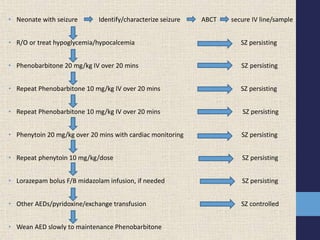
• Neonate with seizure Identify/characterize seizure ABCT secure IV line/sample
• R/O or treat hypoglycemia/hypocalcemia SZ persisting
• Phenobarbitone 20 mg/kg IV over 20 mins SZ persisting
• Repeat Phenobarbitone 10 mg/kg IV over 20 mins SZ persisting
• Phenytoin 20 mg/kg over 20 mins with cardiac monitoring SZ persisting
• Repeat phenytoin 10 mg/kg/dose SZ persisting
• Lorazepam bolus F/B midazolam infusion, if needed SZ persisting
• Other AEDs/pyridoxine/exchange transfusion SZ controlled
• Wean AED slowly to maintenance Phenobarbitone
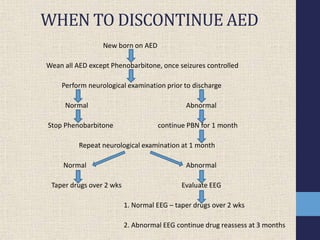
WHEN TO DISCONTINUE AED
New born on AED
Wean all AED except Phenobarbitone, once seizures controlled
Perform neurological examination prior to discharge
Normal Abnormal
Stop Phenobarbitone continue PBN for 1 month
Repeat neurological examination at 1 month
Normal Abnormal
Taper drugs over 2 wks Evaluate EEG
1. Normal EEG – taper drugs over 2 wks
2. Abnormal EEG continue drug reassess at 3 months
THANK YOU

Neonatal seizures

  • 1.
    THE NICUPROTOCOLFOR NEONATAL SEIZURES Dr.C. Kannan Postgraduate Pediatrics MGMCRI
  • 2.
    EPIDEMIOLOGY • Incidence • 10.3/1000(Term neonates) • 20.8/1000 (Preterm neonates) • 36.1/1000 (VLBW neonates • From NNPD; 2002-03
  • 3.
    DEFINITIONS • Seizures • Paroxysmalalteration in neurological function • Motor/behavior/autonomic function • Epileptic seizures • Clinical seizures corresponding EEG seizure activity • Eg. Clonic seizures • Non epileptic seizures • Clinical seizures without EEG seizure activity • Eg. Subtle and generalised tonic seizures • EEG seizures • Abnormal EEG activity with no clinical correlation
  • 4.
    ETIOLOGY Hypoxic-ischemic injury • Perinatalasphyxia Focal infarction • Arterial • Venous CNS infection • Escherichia coli/GBS/Listeria monocytogenes/HSV Intracranial hemorrhage • Intraventricular • Parenchymal • Subdural • Subarachnoid
  • 5.
    Contd., Inborn errors ofmetabolism • Aminoacidopathies • Organic acidurias • Peroxisomal diseases • Mitochondrial disorders • Disorder of glucose transport (GLUT-1 deficiency) • Pyridoxine-dependent seizures • Folinic acid responsive seizures Acute metabolic disorders • Hypoglycemia • Hypocalcemia • Hypomagnesemia
  • 6.
    Contd., Malformations and otherstructural lesions • Neuronal migration disorders • Cerebral dysgenesis • Neurocutaneous disorders, • E.g., Sturge-Weber syndrome, tuberous sclerosis Epilepsy syndromes • Benign familial syndromes • Severe neonatal epileptic encephalopathies • E.g., EIEE, Ohtahara syndrome, EME
  • 7.
    NEUROTRANSMITTERS/RECEPTORS • GABA isa Inhibitory neurotransmitter • Glutamate is a excitatory neurotransmitter • GABA receptors • GABA-A/GABA-B(G-Protein coupled receptor)/GABA-C(Retina) • GABA-A is a part of GABA-A-BDZ-Cl channel complex • GABA binds to GABA-A receptors in brain • Increases duration of Cl channel opening • Causes CNS depression
  • 8.
    PATHOPHYSIOLOGY • Excitatory andinhibitory processes in immature brain are • Unbalanced towards excitatory side • Glutaminergic synapses > GABA ergic synapses • GABA may temporarily act as an • Excitatory neurotransmitter via an • Alteration in chloride gradient and transportation • These developmental features are etiology for • High tendency of seizures in neonates • Reduced efficacy of GABA ergic drugs
  • 9.
    TYPES OF SEIZURES •Subtle • Clonic • Tonic • myoclonic
  • 10.
    SUBTLE SEIZURES Commonest type(50% of all seizures) Mild & often are missed Examples • Ocular • Tonic horizontal deviation of eyes • Sustained eye opening • Ocular fixation • Cycled fluttering • Oral-facial-lingual movements • Chewing/tongue-thrusting/lip smacking/etc.,
  • 11.
    Contd., • Limb movements •Cycling/paddling/boxing-jabs/etc., • Autonomic phenomena – Tachycardia/bradycardia • Apnea • Rare manifestation of seizures • Apnea due to seizures may have normal or increased HR
  • 12.
    CLONIC SEIZURES • Rhythmicmovements of muscle groups • Both slow and fast components • 1-3 jerks/second • Associated with EEG changes • Best prognosis
  • 13.
    TONIC SEIZURES • Sustainedflexion /extension of • Axial or appendicular muscles • Focal or generalised • May resemble • Decerebrate (tonic extension of all limbs) • Decorticate posturing (flexion of UL/extension of LL) • No EEG changes
  • 14.
    MYOCLONIC SEIZURES • Single/multiplelightening fast jerks of UL/LL • How to differentiate from clonic seizures • More rapid speed • Absence of slow return • Predilection for flexor groups • EEG changes • Burst suppression pattern • Focal sharp waves • Hypsarrhythmia • Worst prognosis (Neurodevelopmental outcome )
  • 15.
    APPROACH TO SEIZURES •History • Examination • Investigations
  • 16.
    HISTORY Seizure history • Completedescription of seizures from parents • Eye/limb movements/skin colour change • Autonomic phenomena/consciousness • Day of life Antenatal history • Intrauterine infection/maternal diabetes/narcotic addiction • Sudden increase in fetal movements
  • 17.
    Perinatal history • Perinatalasphyxia • Fetal distress/reduced fetal movements/instrumental delivery • Need for resuscitation/Apgar/cord pH (<7), base deficit (>10) • Pudental block for mid cavity forceps Feeding history • Lethargy/poor activity/drowsiness/vomiting • After initiation of DBF • Indicates IEM • Late onset hypocalcaemia • Due to top feeding with cow’s milk
  • 18.
    Family history of •Consanguinity /seizures / mental retardation • Fetal/neonatal deaths – IEM • Seizures of either parent or sibling indicates • Benign familial neonatal convulsions
  • 19.
    EXAMINATION Vital signs General examination •Gestation / birth weight / weight for age • Eg., seizure in a term well baby – SAH • Eg., seizure in a LGA baby – Hypoglycemia • Malformations / dysmorphic features
  • 20.
    CNS examination • Consciousness– Alert / drowsy / comatose • Tone – hypo/hypertonia • Bulging anterior fontanel – S/O meningitis / ICH Systemic examination • Hepatosplenomegaly / abnormal urine odour S/O IEM • Neurocutaneous markers
  • 21.
    INVESTIGATIONS Essential investigations • Bloodsugar / sodium / Ca / CSF / Cranial USG / EEG • CSF • Must in all cases (seizure – may be first sign of meningitis) • Even though other etiology is present ( eg., Hypoglycemia) • Can withhold • Severe cardiovascular compromise • Severe birth asphyxia • Do all other investigations • Even 1 or 2 were positive - Multiple etiologies may coexist
  • 22.
    Additional investigations • Whodo not respond to Phenobarbitone + phenytoin (or) • Earlier in neonates with specific features • Neuroimaging • Screen for congenital infections (TORCH) • Screen for IEM (ABG if strongly suspected) Imaging • Cranial USG • Detects - IVH / Parenchymal bleed • Unable to detect SAH / SDH
  • 23.
    • CT scan •Where etiology is not available • After first line of investigations • Diagnostic in SAH / Developmental malformations • MRI • Seizures resistant to usual AEDs • Diagnostic in • Cerebral dysgenesis / lissencephaly / neuronal migration defects
  • 24.
    EEG • Has bothdiagnostic and prognostic role • For all neonates requiring AED therapy • Preferably done within first week of seizure • Atleast for one hour • Ictal EEG – suspected seizures / SZ in mu. relaxed neonates • Inter - Ictal EEG - For long term prognosis
  • 25.
    • Background abnormalities •Burst suppression pattern Indicates for high risk for • Low voltage invariant pattern Neurological sequelae • Electro- cerebral inactivity aEEG • New method provides continuous monitoring of • Cerebral electrical activity at bedside • In critically sick NB
  • 26.
    Screen for Congenitalinfections • TORCH / VDRL • HSM / thrombocytopenia / IUGR / SGA / chorioretinitis Metabolic screen • Blood & urine ketones / urine reducing substances / sr. NH3 • Anion gap / urine & plasma AAs / • Sr & CSF lactate pyruvate ratio
  • 27.
    MANAGEMENT OF SEIZURES Initialmedical management • Nurse the baby in thermoneutral environment • Ensure TABC • Oxygen support / IV access / sampling within 2-5 mins • Brief relevant history • Quick clinical examination
  • 28.
    Contd., Correction of hypoglycemia/ hypocalcaemia • If you suspect hypoglycemia & unable to investigate • Give 2 ml/kg of 10% D as bolus F/B 6-8 mg/kg/min as infusion • If hypoglycemia is excluded • NB should receive 2ml/kg of 10 % Ca IV over 10 mins • If hypocalcemia + • 8 ml/kg/d for 3 days • If SZ persists despite hypocalcemia correction • 0.25 ml/kg of 50% MgSO4 IM
  • 29.
    AED Therapy • Evenwith single clinical seizure • SZ after the correction of Ca & sugar • Phenobarbitone • DOC in NS - Max. dose – 40 mg/kg • Loading - 20 mg/kg IV over 20mins (not faster than 1 mg/kg/min) • Half loading – 10mg/kg IV over 10 mins • If SZ reoccur after completion of loading • 2nd Half loading – 10 mg/kg IV over 10 mins • If SZ reoccur after completion of 1st half loading
  • 30.
    • Maintenance: • 3-5mg/kg/day– 2divided doses – 12 hrs after Ld dose MOA of Phenobarbitone • Acts by 2 ways • Directly binds and activates GABA-A receptors • GABA Mimetic • Increases binding of GABA to GABA-A receptors • GABA Facilitatory • Increases duration of Cl ion channels • Causes CNS depression
  • 31.
    Phenytoin • SZ aftermaximum dose of Phenobarbitone is used • Due to adverse effects of Phenobarbitone • Loading - 20 mg/kg IV over 20 mins • Dilute with normal saline (incompatible with dextrose) • Not faster than 1 mg/kg/min • Under cardiac monitoring • Half loading – 10mg/kg IV over 10 mins • If SZ reoccur after completion of loading • Maintenance: • 3-5mg/kg/day – 2-4 divided doses – 12 hrs after Ld dose
  • 32.
    MOA of phenytoin •Inhibit the sodium channels when they are open • Prolong the inactivated stage of sodium channels • Na channels are refractory to stimulation • Until they reach closed/resting phase • Similar action is seen in • Carbamazepine • Valproate • Topiamate • Lamotrigine • Lacosamide
  • 33.
    Benzodiazepines • Lorazepam &midazolam • Diazepam is avoided in neonates • Short antiepileptic effect/prolonged sedation • Narrow therapeutic index/Na benzoate as preservative • Lorazepam (0.05 mg/kg IV bolus over 2-5 mins) • longer duration/less adverse effects • Midazolam (0.15 mg/kg – bolus F/B infusion 0.1- 0.4 mg/kg/hr) • Faster acting than lorazepam • More sedation & resp. depression • Needs continuous monitoring
  • 34.
    MOA of benzodiazepine •Acts by • Binding to BZD receptor (GABA-A-BDZ-Cl channel complex) • Increases binding of GABA to GABA-A receptors • GABA Facilitatory • Increases frequency of Cl ion channels • Causes CNS depression
  • 35.
    Other AEDs (veryrare) • Lidocaine • Paraldehyde • Sodium valproate • Vigabatrin • Topiramate Other therapies • Pyridoxine/Folinic acid • Exchange transfusion
  • 36.
    • Neonate withseizure Identify/characterize seizure ABCT secure IV line/sample • R/O or treat hypoglycemia/hypocalcemia SZ persisting • Phenobarbitone 20 mg/kg IV over 20 mins SZ persisting • Repeat Phenobarbitone 10 mg/kg IV over 20 mins SZ persisting • Repeat Phenobarbitone 10 mg/kg IV over 20 mins SZ persisting • Phenytoin 20 mg/kg over 20 mins with cardiac monitoring SZ persisting • Repeat phenytoin 10 mg/kg/dose SZ persisting • Lorazepam bolus F/B midazolam infusion, if needed SZ persisting • Other AEDs/pyridoxine/exchange transfusion SZ controlled • Wean AED slowly to maintenance Phenobarbitone
  • 37.
    WHEN TO DISCONTINUEAED New born on AED Wean all AED except Phenobarbitone, once seizures controlled Perform neurological examination prior to discharge Normal Abnormal Stop Phenobarbitone continue PBN for 1 month Repeat neurological examination at 1 month Normal Abnormal Taper drugs over 2 wks Evaluate EEG 1. Normal EEG – taper drugs over 2 wks 2. Abnormal EEG continue drug reassess at 3 months
  • 38.