Protocols of Neonatal
seizure
Neonatal seizures (NS) are the most frequent and
distinctive clinical manifestation of neurological
dysfunction in the newborn infant.
Definition:-
A seizure is defined clinically as a paroxysmal
alteration in neurologic function, i.e. motor, behavior
and/or autonomic function.
1. Epileptic seizures: phenomena associated with
corresponding EEG seizure activity e.g. clonic
seizures
2. Non-epileptic seizures: clinical seizures without
corresponding EEG correlate e.g. subtle and
generalized tonic seizures
3. EEG seizures: abnormal EEG activity with no clinical
correlation.
Classification:-
Subtle seizures:
They are the commonest type
1. Ocular - Tonic horizontal deviation of eyes or
sustained eye opening with ocular fixation or
cycled fluttering
2. Oral–facial–lingual movements -
Chewing, tongue- thrusting, lip-smacking, etc.
3. Limb movements - Cycling, paddling, boxing-
jabs, etc
4. Autonomic phenomena - Tachycardia or bradycardia
5. Apnea may be a rare manifestation of seizures. Apnea
due to seizure activity has an accelerated or a
normal heart rate when evaluated 20 seconds
after onset.
Clonic seizures:
They are rhythmic movements of muscle groups. They
have both fast and slow components, occur with a
frequency of 1-3 jerks per second
Tonic seizures:
refers to a sustained flexion or extension of axial
or
appendicular muscle group
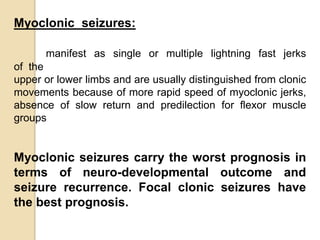
Myoclonic seizures:
manifest as single or multiple lightning fast jerks
of the
upper or lower limbs and are usually distinguished from clonic
movements because of more rapid speed of myoclonic jerks,
absence of slow return and predilection for flexor muscle
groups
Myoclonic seizures carry the worst prognosis in
terms of neuro-developmental outcome and
seizure recurrence. Focal clonic seizures have
the best prognosis.
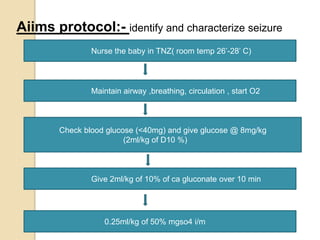
Aiims protocol:- identify and characterize seizure
Nurse the baby in TNZ( room temp 26’-28’ C)
Maintain airway ,breathing, circulation , start O2
Check blood glucose (<40mg) and give glucose @ 8mg/kg
(2ml/kg of D10 %)
Give 2ml/kg of 10% of ca gluconate over 10 min
0.25ml/kg of 50% mgso4 i/m
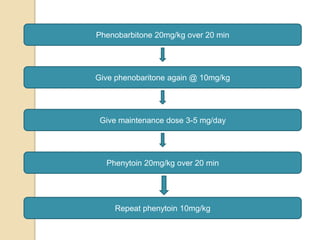
Phenobarbitone 20mg/kg over 20 min
Give phenobaritone again @ 10mg/kg
Give maintenance dose 3-5 mg/day
Phenytoin 20mg/kg over 20 min
Repeat phenytoin 10mg/kg
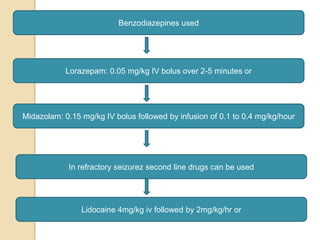
Benzodiazepines used
Lorazepam: 0.05 mg/kg IV bolus over 2-5 minutes or
Midazolam: 0.15 mg/kg IV bolus followed by infusion of 0.1 to 0.4 mg/kg/hour
In refractory seizurez second line drugs can be used
Lidocaine 4mg/kg iv followed by 2mg/kg/hr or
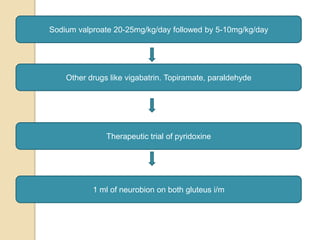
Sodium valproate 20-25mg/kg/day followed by 5-10mg/kg/day
Other drugs like vigabatrin. Topiramate, paraldehyde
Therapeutic trial of pyridoxine
1 ml of neurobion on both gluteus i/m
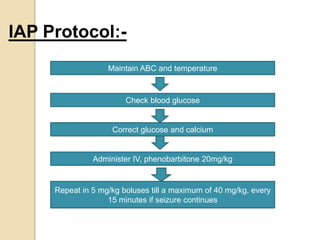
IAP Protocol:-
Maintain ABC and temperature
Check blood glucose
Correct glucose and calcium
Administer IV, phenobarbitone 20mg/kg
Repeat in 5 mg/kg boluses till a maximum of 40 mg/kg, every
15 minutes if seizure continues
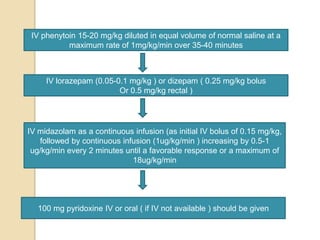
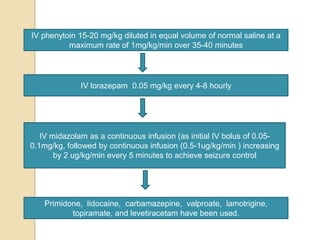
IV phenytoin 15-20 mg/kg diluted in equal volume of normal saline at a
maximum rate of 1mg/kg/min over 35-40 minutes
IV lorazepam (0.05-0.1 mg/kg ) or dizepam ( 0.25 mg/kg bolus
Or 0.5 mg/kg rectal )
IV midazolam as a continuous infusion (as initial IV bolus of 0.15 mg/kg,
followed by continuous infusion (1ug/kg/min ) increasing by 0.5-1
ug/kg/min every 2 minutes until a favorable response or a maximum of
18ug/kg/min
100 mg pyridoxine IV or oral ( if IV not available ) should be given
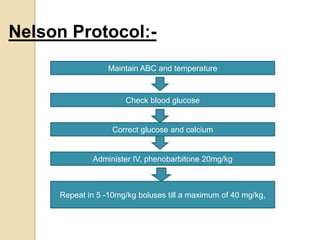
Nelson Protocol:-
Maintain ABC and temperature
Check blood glucose
Correct glucose and calcium
Administer IV, phenobarbitone 20mg/kg
Repeat in 5 -10mg/kg boluses till a maximum of 40 mg/kg,
IV phenytoin 15-20 mg/kg diluted in equal volume of normal saline at a
maximum rate of 1mg/kg/min over 35-40 minutes
IV lorazepam 0.05 mg/kg every 4-8 hourly
IV midazolam as a continuous infusion (as initial IV bolus of 0.05-
0.1mg/kg, followed by continuous infusion (0.5-1ug/kg/min ) increasing
by 2 ug/kg/min every 5 minutes to achieve seizure control
Primidone, lidocaine, carbamazepine, valproate, lamotrigine,
topiramate, and levetiracetam have been used.
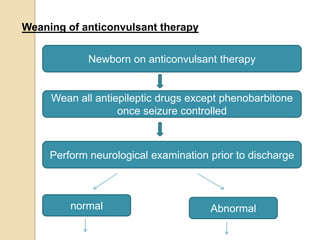
Weaning of anticonvulsant therapy
Newborn on anticonvulsant therapy
Wean all antiepileptic drugs except phenobarbitone
once seizure controlled
Perform neurological examination prior to discharge
normal Abnormal
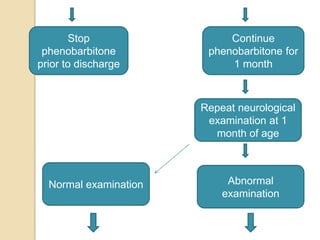
Stop
phenobarbitone
prior to discharge
Continue
phenobarbitone for
1 month
Repeat neurological
examination at 1
month of age
Abnormal
examination
Normal examination
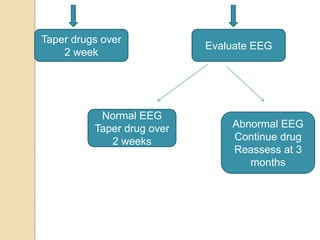
Taper drugs over
2 week
Evaluate EEG
Normal EEG
Taper drug over
2 weeks
Abnormal EEG
Continue drug
Reassess at 3
months
Dr.Priyank
Patel

Neonatal seizures

  • 1.
  • 2.
    Neonatal seizures (NS)are the most frequent and distinctive clinical manifestation of neurological dysfunction in the newborn infant. Definition:- A seizure is defined clinically as a paroxysmal alteration in neurologic function, i.e. motor, behavior and/or autonomic function. 1. Epileptic seizures: phenomena associated with corresponding EEG seizure activity e.g. clonic seizures 2. Non-epileptic seizures: clinical seizures without corresponding EEG correlate e.g. subtle and generalized tonic seizures
  • 3.
    3. EEG seizures:abnormal EEG activity with no clinical correlation. Classification:- Subtle seizures: They are the commonest type 1. Ocular - Tonic horizontal deviation of eyes or sustained eye opening with ocular fixation or cycled fluttering 2. Oral–facial–lingual movements - Chewing, tongue- thrusting, lip-smacking, etc. 3. Limb movements - Cycling, paddling, boxing- jabs, etc
  • 4.
    4. Autonomic phenomena- Tachycardia or bradycardia 5. Apnea may be a rare manifestation of seizures. Apnea due to seizure activity has an accelerated or a normal heart rate when evaluated 20 seconds after onset. Clonic seizures: They are rhythmic movements of muscle groups. They have both fast and slow components, occur with a frequency of 1-3 jerks per second Tonic seizures: refers to a sustained flexion or extension of axial or appendicular muscle group
  • 5.
    Myoclonic seizures: manifest assingle or multiple lightning fast jerks of the upper or lower limbs and are usually distinguished from clonic movements because of more rapid speed of myoclonic jerks, absence of slow return and predilection for flexor muscle groups Myoclonic seizures carry the worst prognosis in terms of neuro-developmental outcome and seizure recurrence. Focal clonic seizures have the best prognosis.
  • 6.
    Aiims protocol:- identifyand characterize seizure Nurse the baby in TNZ( room temp 26’-28’ C) Maintain airway ,breathing, circulation , start O2 Check blood glucose (<40mg) and give glucose @ 8mg/kg (2ml/kg of D10 %) Give 2ml/kg of 10% of ca gluconate over 10 min 0.25ml/kg of 50% mgso4 i/m
  • 7.
    Phenobarbitone 20mg/kg over20 min Give phenobaritone again @ 10mg/kg Give maintenance dose 3-5 mg/day Phenytoin 20mg/kg over 20 min Repeat phenytoin 10mg/kg
  • 8.
    Benzodiazepines used Lorazepam: 0.05mg/kg IV bolus over 2-5 minutes or Midazolam: 0.15 mg/kg IV bolus followed by infusion of 0.1 to 0.4 mg/kg/hour In refractory seizurez second line drugs can be used Lidocaine 4mg/kg iv followed by 2mg/kg/hr or
  • 9.
    Sodium valproate 20-25mg/kg/dayfollowed by 5-10mg/kg/day Other drugs like vigabatrin. Topiramate, paraldehyde Therapeutic trial of pyridoxine 1 ml of neurobion on both gluteus i/m
  • 10.
    IAP Protocol:- Maintain ABCand temperature Check blood glucose Correct glucose and calcium Administer IV, phenobarbitone 20mg/kg Repeat in 5 mg/kg boluses till a maximum of 40 mg/kg, every 15 minutes if seizure continues
  • 11.
    IV phenytoin 15-20mg/kg diluted in equal volume of normal saline at a maximum rate of 1mg/kg/min over 35-40 minutes IV lorazepam (0.05-0.1 mg/kg ) or dizepam ( 0.25 mg/kg bolus Or 0.5 mg/kg rectal ) IV midazolam as a continuous infusion (as initial IV bolus of 0.15 mg/kg, followed by continuous infusion (1ug/kg/min ) increasing by 0.5-1 ug/kg/min every 2 minutes until a favorable response or a maximum of 18ug/kg/min 100 mg pyridoxine IV or oral ( if IV not available ) should be given
  • 12.
    Nelson Protocol:- Maintain ABCand temperature Check blood glucose Correct glucose and calcium Administer IV, phenobarbitone 20mg/kg Repeat in 5 -10mg/kg boluses till a maximum of 40 mg/kg,
  • 13.
    IV phenytoin 15-20mg/kg diluted in equal volume of normal saline at a maximum rate of 1mg/kg/min over 35-40 minutes IV lorazepam 0.05 mg/kg every 4-8 hourly IV midazolam as a continuous infusion (as initial IV bolus of 0.05- 0.1mg/kg, followed by continuous infusion (0.5-1ug/kg/min ) increasing by 2 ug/kg/min every 5 minutes to achieve seizure control Primidone, lidocaine, carbamazepine, valproate, lamotrigine, topiramate, and levetiracetam have been used.
  • 14.
    Weaning of anticonvulsanttherapy Newborn on anticonvulsant therapy Wean all antiepileptic drugs except phenobarbitone once seizure controlled Perform neurological examination prior to discharge normal Abnormal
  • 15.
    Stop phenobarbitone prior to discharge Continue phenobarbitonefor 1 month Repeat neurological examination at 1 month of age Abnormal examination Normal examination
  • 16.
    Taper drugs over 2week Evaluate EEG Normal EEG Taper drug over 2 weeks Abnormal EEG Continue drug Reassess at 3 months
  • 17.