NEONATAL SEIZURE
Dr Chandan Barnwal MD (Pediatrics)
INTRODUCTION
 SEIZURE:- Paroxysmal alteration in neurological
function i.e. motor, sensory and autonomic
function
 Not uncommon
 Almost always due to some underlying cause
 Idiopathic
 Often first sign of neurological disorder
 Predicts long term cognitive and developmental
impairment
Dr Chandan Barnwal MD (Pediatrics)
EPIDEMIOLOGY
 A/c to NNPD (2002-03)
Incidence at India:-
 10.3 per 1000 live birth
 Higher in Pre-Term and VLBW BABY
 Term baby:- 8.4 per 1000 live birth
 Pre-Term baby:- 20.8 per 1000 live birth
 VLBW baby:- 36.1 per 1000 live birth
 No Racial but slightly Male predisposition
Dr Chandan Barnwal MD (Pediatrics)
DIAGNOSTIC DILEMNA
 Because
 Usually brief and subtle in clinical appearance
 Unusual behaviors i.e. difficult to differentiate from
seizure activity
 Differential ability of parents and even medical
personnel to recognize neonatal seizure
Dr Chandan Barnwal MD (Pediatrics)
OBJECTIVE
 To familiarize the various presentations of neonatal seizure
 To distinguish non-seizure state from seizure
 Early recognition of etiology
 To decide management specific to neonatal seizure
 To decide:- Duration of anti-epileptic therapy,
:- Duration of follow up
:- Prognosis
Dr Chandan Barnwal MD (Pediatrics)
PATHOPHYSIOLOGY
Immature Brain
More excitable
More liable to seizure
Dr Chandan Barnwal MD (Pediatrics)
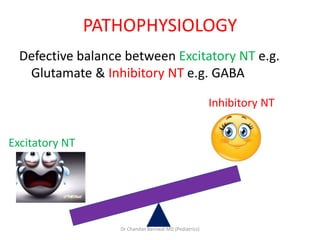
PATHOPHYSIOLOGY
Defective balance between Excitatory NT e.g.
Glutamate & Inhibitory NT e.g. GABA
Excitatory NT
Inhibitory NT
Dr Chandan Barnwal MD (Pediatrics)
Immaturity of Brain
1. Delay in maturation of Na+ - K+ ATPase
2. Increased density of NMDA & AMPA receptor
3. Increased GLUR2 AMPA receptor:-
Increases permeability of Ca++
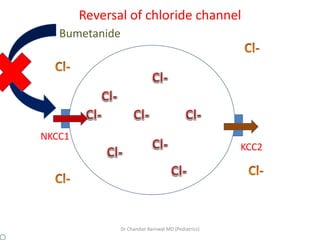
4. Delay in Inhibitory function of GABA:-
GABA receptor becomes excitatory instead of
inhibitory in immature brain d/t reversal of chloride
channel
Dr Chandan Barnwal MD (Pediatrics)
Reversal of chloride channel
.
NKCC1
KCC2
Bumetanide
Dr Chandan Barnwal MD (Pediatrics)
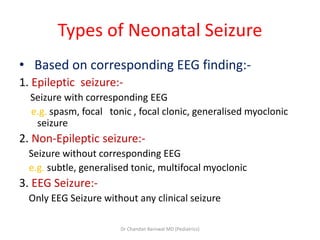
Types of Neonatal Seizure
• Based on corresponding EEG finding:-
1. Epileptic seizure:-
Seizure with corresponding EEG
e.g. spasm, focal tonic , focal clonic, generalised myoclonic
seizure
2. Non-Epileptic seizure:-
Seizure without corresponding EEG
e.g. subtle, generalised tonic, multifocal myoclonic
3. EEG Seizure:-
Only EEG Seizure without any clinical seizure
Dr Chandan Barnwal MD (Pediatrics)
Types of Neonatal Seizure
• Based on clinical features:-
1. Subtle seizure
2. Tonic seizure
3. Clonic seizure
4. Spasm
5. Myoclonic seizure
Dr Chandan Barnwal MD (Pediatrics)
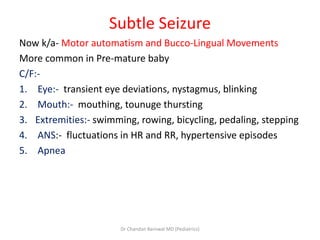
Subtle Seizure
Now k/a- Motor automatism and Bucco-Lingual Movements
More common in Pre-mature baby
C/F:-
1. Eye:- transient eye deviations, nystagmus, blinking
2. Mouth:- mouthing, tounuge thursting
3. Extremities:- swimming, rowing, bicycling, pedaling, stepping
4. ANS:- fluctuations in HR and RR, hypertensive episodes
5. Apnea
Dr Chandan Barnwal MD (Pediatrics)
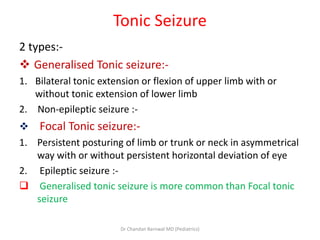
Tonic Seizure
2 types:-
 Generalised Tonic seizure:-
1. Bilateral tonic extension or flexion of upper limb with or
without tonic extension of lower limb
2. Non-epileptic seizure :-
 Focal Tonic seizure:-
1. Persistent posturing of limb or trunk or neck in asymmetrical
way with or without persistent horizontal deviation of eye
2. Epileptic seizure :-
 Generalised tonic seizure is more common than Focal tonic
seizure
Dr Chandan Barnwal MD (Pediatrics)
Clonic seizure
3 types:-
 Focal Clonic seizure:-
1. Repetitive and rhythmic contractions of group of muscles
2. Epileptic seizure-
 Multifocal Clonic seizure:-
1. k/a Fragmentary seizure
2. migratory in nature
3. migration follows Non- Jacksonian trend i.e. jerking of left
arm is a/w jerking of right leg
 Generalised clonic seizure:-
1. Very rare in neonate
Dr Chandan Barnwal MD (Pediatrics)
Spasm
1. Sudden generalised jerk that last for 1-2 seconds
2. Single jerk per episode
3. Epileptic seizure :-
Dr Chandan Barnwal MD (Pediatrics)
Myoclonic seizure
3 types:-
 Focal myoclonic seizure :-
It involves flexor group of muscles of upper extremities
 Multifocal myoclonic seizure :-
It involves synchronous twitching of several parts of body
 Generalised myoclonic seizure :-
There is bilateral jerking a/w flexon of upper limb and/or lower
limb
Dr Chandan Barnwal MD (Pediatrics)
ETIOLOGY
A/c to age of onset:-
1st day
1. Hypoxic Ischemic Encephalopathy
2. Cerebral Contusion
3. 1st day Hypocalcaemia
4. Accidental injection of local anesthetic into fetal scalp
5. Pyridoxine dependency
Dr Chandan Barnwal MD (Pediatrics)
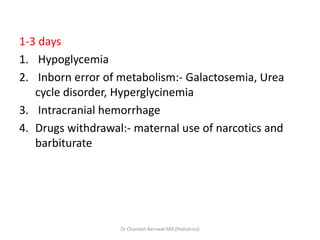
1-3 days
1. Hypoglycemia
2. Inborn error of metabolism:- Galactosemia, Urea
cycle disorder, Hyperglycinemia
3. Intracranial hemorrhage
4. Drugs withdrawal:- maternal use of narcotics and
barbiturate
Dr Chandan Barnwal MD (Pediatrics)
.
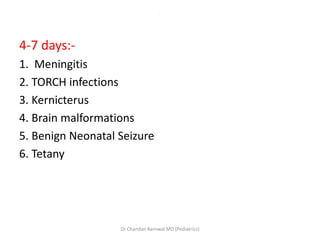
4-7 days:-
1. Meningitis
2. TORCH infections
3. Kernicterus
4. Brain malformations
5. Benign Neonatal Seizure
6. Tetany
Dr Chandan Barnwal MD (Pediatrics)
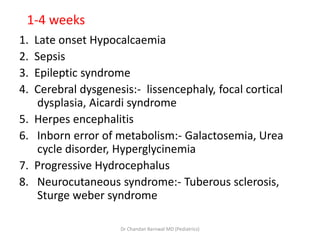
1-4 weeks
1. Late onset Hypocalcaemia
2. Sepsis
3. Epileptic syndrome
4. Cerebral dysgenesis:- lissencephaly, focal cortical
dysplasia, Aicardi syndrome
5. Herpes encephalitis
6. Inborn error of metabolism:- Galactosemia, Urea
cycle disorder, Hyperglycinemia
7. Progressive Hydrocephalus
8. Neurocutaneous syndrome:- Tuberous sclerosis,
Sturge weber syndrome
Dr Chandan Barnwal MD (Pediatrics)
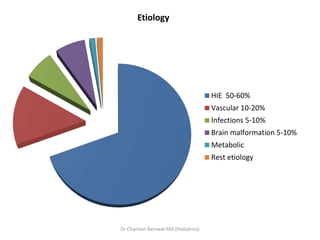
Etiology
HIE 50-60%
Vascular 10-20%
Infections 5-10%
Brain malformation 5-10%
Metabolic
Rest etiology
Dr Chandan Barnwal MD (Pediatrics)
.
Hypoxic ischemic encephalopathy
1. m/c etiology of neonatal seizure
2. onset within first 12-24 hr
3. types:- subtle(m/c), focal clonic, multifocal clonic
4. typically of short duration i.e. < 1 minutes, may be
very frequent but refractory to treatment specially
in first 24 hr
Dr Chandan Barnwal MD (Pediatrics)
.
Intracranial hemorrhage
1 . 10-15% of neonatal seizure
2. SDH, SAH, IVH, Germinal matrix, Parenchymal
hemorrhage
3. SAH:- Term baby, good prognosis, clinically normal
b/w seizure
4. IVH, Parenchymal, Germinal matrix hemorrhage:-
mainly in Pre-Term, poor prognosis
5. SDH:- d/t CPD, breech delivery, instrumentation
Dr Chandan Barnwal MD (Pediatrics)
.
CNS infections:-
1. 5-10% of neonatal seizure
2. Congenital infections:-
TORCH, seizure may onset within 2 days, a/w other features
e.g. microcephaly, IUGR, cerebral calcifications, cataract etc
3. Neonatal sepsis:-
Group B Streptococci, E. coli etc,
clinically well for couple of days, then clinical deterioration
with seizure after 48-72 hr
Dr Chandan Barnwal MD (Pediatrics)
.Acute metabolic disorder:-
1. Hypoglycemia:-
Definition is controversial- <20 mg/dl for Pre-Term and
<30 mg/dl for term
Threshold for treatment- <40mg/dl for first 24 hr and
<45mg/dl after 24 hr of age
2. Hypocalcaemia:-
<7.5mg/dl for Pre-Term and <8mg/dl for Term baby
ionized fraction <0.6 has more predictable a/w seizure
3. Hypomagnesaemia:-
mostly transient,
must be corrected before correction of Hypocalcaemia
4. Hyponatremia:-
<125meq/l
Dr Chandan Barnwal MD (Pediatrics)
.
Inborn error of metabolism:-
1. Initially normal then become encephalopathic
2. Seizure starts after 2-3 days
3. E.g.
 GLUT1 deficiency:- impair glucose transport across BBB
 Non-ketotic hyperglycemia i.e. Glycine encephalopathy
 Pyridoxine deficiency:-
d/t ALDH7A1/antiquitin gene,
l/t accumulation of alpha-AASA in blood, urine and CSF,
so act as biomarker,
diagnosed by a test dose of 100mg pyridoxine iv that l/t cessation
of seizure
 Folinic acid responsive seizure
Dr Chandan Barnwal MD (Pediatrics)
.
Epilepsy syndrome:-
Very rare:- e.g.
Benign or Malignant
 Benign Infantile Neonatal Convulsion:-
k/a 5th day fit ? Seizure b/w 4-6 day of life
initially focal clonic, often l/t status epilepticus
may be a/w apnea,
benign ? Cease within 2 weeks
 Benign Familial Neonatal Convulsion:-
family history present
seizure occur up to 6 month
d/t KCNQ2 channel abnormality
Dr Chandan Barnwal MD (Pediatrics)
.
 Early Myoclonic Epilepsy:-
presents in 1st few days of life
often with focal motor seizure and myoclonus
refractory to medications
EEG- burst suppression pattern
 Early Infantile Epileptic Encephalopathy:-
k/a- Ohtahara syndrome
early onset of tonic spasm with focal motor seizure
 Malignant Migrating Partial Seizure in Infancy:-
k/a- Coppola syndrome
may present from 1st month to 10th month of life
focal motor seizure and escalate aggressively
shift from side to side:- both clinically and Electrographically
Dr Chandan Barnwal MD (Pediatrics)
Investigations
Essential :
• Blood sugar
• Serum calcium and sodium
• CSF
• Cranial ultrasound
• EEG and /or aEEG
Dr Chandan Barnwal MD (Pediatrics)
.
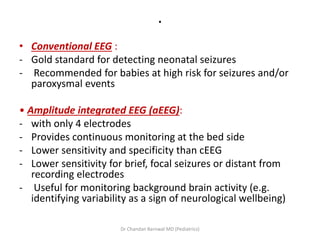
• Conventional EEG :
- Gold standard for detecting neonatal seizures
- Recommended for babies at high risk for seizures and/or
paroxysmal events
• Amplitude integrated EEG (aEEG):
- with only 4 electrodes
- Provides continuous monitoring at the bed side
- Lower sensitivity and specificity than cEEG
- Lower sensitivity for brief, focal seizures or distant from
recording electrodes
- Useful for monitoring background brain activity (e.g.
identifying variability as a sign of neurological wellbeing)
Dr Chandan Barnwal MD (Pediatrics)
.
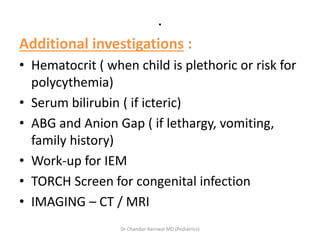
Additional investigations :
• Hematocrit ( when child is plethoric or risk for
polycythemia)
• Serum bilirubin ( if icteric)
• ABG and Anion Gap ( if lethargy, vomiting,
family history)
• Work-up for IEM
• TORCH Screen for congenital infection
• IMAGING – CT / MRI
Dr Chandan Barnwal MD (Pediatrics)
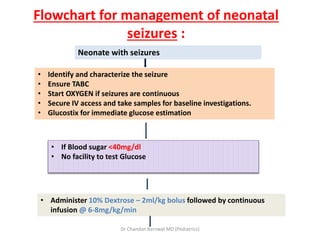
Flowchart for management of neonatal
seizures :
Neonate with seizures
• Identify and characterize the seizure
• Ensure TABC
• Start OXYGEN if seizures are continuous
• Secure IV access and take samples for baseline investigations.
• Glucostix for immediate glucose estimation
• If Blood sugar <40mg/dl
• No facility to test Glucose
• Administer 10% Dextrose – 2ml/kg bolus followed by continuous
infusion @ 6-8mg/kg/min
Dr Chandan Barnwal MD (Pediatrics)
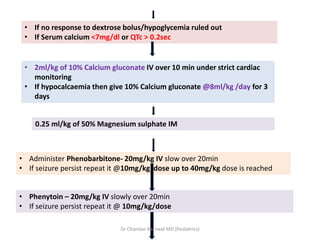
• If no response to dextrose bolus/hypoglycemia ruled out
• If Serum calcium <7mg/dl or QTc > 0.2sec
• 2ml/kg of 10% Calcium gluconate IV over 10 min under strict cardiac
monitoring
• If hypocalcaemia then give 10% Calcium gluconate @8ml/kg /day for 3
days
0.25 ml/kg of 50% Magnesium sulphate IM
• Administer Phenobarbitone- 20mg/kg IV slow over 20min
• If seizure persist repeat it @10mg/kg/dose up to 40mg/kg dose is reached
• Phenytoin – 20mg/kg IV slowly over 20min
• If seizure persist repeat it @ 10mg/kg/dose
Dr Chandan Barnwal MD (Pediatrics)
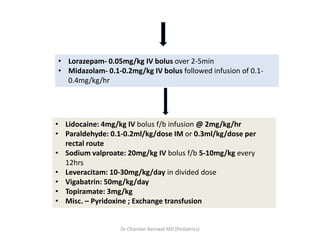
• Lorazepam- 0.05mg/kg IV bolus over 2-5min
• Midazolam- 0.1-0.2mg/kg IV bolus followed infusion of 0.1-
0.4mg/kg/hr
• Lidocaine: 4mg/kg IV bolus f/b infusion @ 2mg/kg/hr
• Paraldehyde: 0.1-0.2ml/kg/dose IM or 0.3ml/kg/dose per
rectal route
• Sodium valproate: 20mg/kg IV bolus f/b 5-10mg/kg every
12hrs
• Leveracitam: 10-30mg/kg/day in divided dose
• Vigabatrin: 50mg/kg/day
• Topiramate: 3mg/kg
• Misc. – Pyridoxine ; Exchange transfusion
Dr Chandan Barnwal MD (Pediatrics)
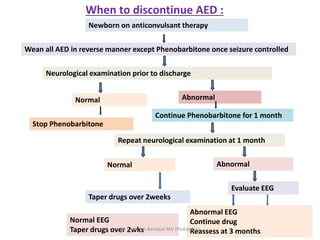
When to discontinue AED :
Newborn on anticonvulsant therapy
Wean all AED in reverse manner except Phenobarbitone once seizure controlled
Neurological examination prior to discharge
Normal Abnormal
Stop Phenobarbitone
Continue Phenobarbitone for 1 month
Repeat neurological examination at 1 month
Normal Abnormal
Evaluate EEG
Taper drugs over 2weeks
Normal EEG
Taper drugs over 2wks
Abnormal EEG
Continue drug
Reassess at 3 monthsDr Chandan Barnwal MD (Pediatrics)
Thank you
Dr Chandan Barnwal MD (Pediatrics)

Neonatal seizure

  • 1.
    NEONATAL SEIZURE Dr ChandanBarnwal MD (Pediatrics)
  • 2.
    INTRODUCTION  SEIZURE:- Paroxysmalalteration in neurological function i.e. motor, sensory and autonomic function  Not uncommon  Almost always due to some underlying cause  Idiopathic  Often first sign of neurological disorder  Predicts long term cognitive and developmental impairment Dr Chandan Barnwal MD (Pediatrics)
  • 3.
    EPIDEMIOLOGY  A/c toNNPD (2002-03) Incidence at India:-  10.3 per 1000 live birth  Higher in Pre-Term and VLBW BABY  Term baby:- 8.4 per 1000 live birth  Pre-Term baby:- 20.8 per 1000 live birth  VLBW baby:- 36.1 per 1000 live birth  No Racial but slightly Male predisposition Dr Chandan Barnwal MD (Pediatrics)
  • 4.
    DIAGNOSTIC DILEMNA  Because Usually brief and subtle in clinical appearance  Unusual behaviors i.e. difficult to differentiate from seizure activity  Differential ability of parents and even medical personnel to recognize neonatal seizure Dr Chandan Barnwal MD (Pediatrics)
  • 5.
    OBJECTIVE  To familiarizethe various presentations of neonatal seizure  To distinguish non-seizure state from seizure  Early recognition of etiology  To decide management specific to neonatal seizure  To decide:- Duration of anti-epileptic therapy, :- Duration of follow up :- Prognosis Dr Chandan Barnwal MD (Pediatrics)
  • 6.
    PATHOPHYSIOLOGY Immature Brain More excitable Moreliable to seizure Dr Chandan Barnwal MD (Pediatrics)
  • 7.
    PATHOPHYSIOLOGY Defective balance betweenExcitatory NT e.g. Glutamate & Inhibitory NT e.g. GABA Excitatory NT Inhibitory NT Dr Chandan Barnwal MD (Pediatrics)
  • 8.
    Immaturity of Brain 1.Delay in maturation of Na+ - K+ ATPase 2. Increased density of NMDA & AMPA receptor 3. Increased GLUR2 AMPA receptor:- Increases permeability of Ca++ 4. Delay in Inhibitory function of GABA:- GABA receptor becomes excitatory instead of inhibitory in immature brain d/t reversal of chloride channel Dr Chandan Barnwal MD (Pediatrics)
  • 9.
    Reversal of chloridechannel . NKCC1 KCC2 Bumetanide Dr Chandan Barnwal MD (Pediatrics)
  • 10.
    Types of NeonatalSeizure • Based on corresponding EEG finding:- 1. Epileptic seizure:- Seizure with corresponding EEG e.g. spasm, focal tonic , focal clonic, generalised myoclonic seizure 2. Non-Epileptic seizure:- Seizure without corresponding EEG e.g. subtle, generalised tonic, multifocal myoclonic 3. EEG Seizure:- Only EEG Seizure without any clinical seizure Dr Chandan Barnwal MD (Pediatrics)
  • 11.
    Types of NeonatalSeizure • Based on clinical features:- 1. Subtle seizure 2. Tonic seizure 3. Clonic seizure 4. Spasm 5. Myoclonic seizure Dr Chandan Barnwal MD (Pediatrics)
  • 12.
    Subtle Seizure Now k/a-Motor automatism and Bucco-Lingual Movements More common in Pre-mature baby C/F:- 1. Eye:- transient eye deviations, nystagmus, blinking 2. Mouth:- mouthing, tounuge thursting 3. Extremities:- swimming, rowing, bicycling, pedaling, stepping 4. ANS:- fluctuations in HR and RR, hypertensive episodes 5. Apnea Dr Chandan Barnwal MD (Pediatrics)
  • 13.
    Tonic Seizure 2 types:- Generalised Tonic seizure:- 1. Bilateral tonic extension or flexion of upper limb with or without tonic extension of lower limb 2. Non-epileptic seizure :-  Focal Tonic seizure:- 1. Persistent posturing of limb or trunk or neck in asymmetrical way with or without persistent horizontal deviation of eye 2. Epileptic seizure :-  Generalised tonic seizure is more common than Focal tonic seizure Dr Chandan Barnwal MD (Pediatrics)
  • 14.
    Clonic seizure 3 types:- Focal Clonic seizure:- 1. Repetitive and rhythmic contractions of group of muscles 2. Epileptic seizure-  Multifocal Clonic seizure:- 1. k/a Fragmentary seizure 2. migratory in nature 3. migration follows Non- Jacksonian trend i.e. jerking of left arm is a/w jerking of right leg  Generalised clonic seizure:- 1. Very rare in neonate Dr Chandan Barnwal MD (Pediatrics)
  • 15.
    Spasm 1. Sudden generalisedjerk that last for 1-2 seconds 2. Single jerk per episode 3. Epileptic seizure :- Dr Chandan Barnwal MD (Pediatrics)
  • 16.
    Myoclonic seizure 3 types:- Focal myoclonic seizure :- It involves flexor group of muscles of upper extremities  Multifocal myoclonic seizure :- It involves synchronous twitching of several parts of body  Generalised myoclonic seizure :- There is bilateral jerking a/w flexon of upper limb and/or lower limb Dr Chandan Barnwal MD (Pediatrics)
  • 17.
    ETIOLOGY A/c to ageof onset:- 1st day 1. Hypoxic Ischemic Encephalopathy 2. Cerebral Contusion 3. 1st day Hypocalcaemia 4. Accidental injection of local anesthetic into fetal scalp 5. Pyridoxine dependency Dr Chandan Barnwal MD (Pediatrics)
  • 18.
    1-3 days 1. Hypoglycemia 2.Inborn error of metabolism:- Galactosemia, Urea cycle disorder, Hyperglycinemia 3. Intracranial hemorrhage 4. Drugs withdrawal:- maternal use of narcotics and barbiturate Dr Chandan Barnwal MD (Pediatrics)
  • 19.
    . 4-7 days:- 1. Meningitis 2.TORCH infections 3. Kernicterus 4. Brain malformations 5. Benign Neonatal Seizure 6. Tetany Dr Chandan Barnwal MD (Pediatrics)
  • 20.
    1-4 weeks 1. Lateonset Hypocalcaemia 2. Sepsis 3. Epileptic syndrome 4. Cerebral dysgenesis:- lissencephaly, focal cortical dysplasia, Aicardi syndrome 5. Herpes encephalitis 6. Inborn error of metabolism:- Galactosemia, Urea cycle disorder, Hyperglycinemia 7. Progressive Hydrocephalus 8. Neurocutaneous syndrome:- Tuberous sclerosis, Sturge weber syndrome Dr Chandan Barnwal MD (Pediatrics)
  • 21.
    Etiology HIE 50-60% Vascular 10-20% Infections5-10% Brain malformation 5-10% Metabolic Rest etiology Dr Chandan Barnwal MD (Pediatrics)
  • 22.
    . Hypoxic ischemic encephalopathy 1.m/c etiology of neonatal seizure 2. onset within first 12-24 hr 3. types:- subtle(m/c), focal clonic, multifocal clonic 4. typically of short duration i.e. < 1 minutes, may be very frequent but refractory to treatment specially in first 24 hr Dr Chandan Barnwal MD (Pediatrics)
  • 23.
    . Intracranial hemorrhage 1 .10-15% of neonatal seizure 2. SDH, SAH, IVH, Germinal matrix, Parenchymal hemorrhage 3. SAH:- Term baby, good prognosis, clinically normal b/w seizure 4. IVH, Parenchymal, Germinal matrix hemorrhage:- mainly in Pre-Term, poor prognosis 5. SDH:- d/t CPD, breech delivery, instrumentation Dr Chandan Barnwal MD (Pediatrics)
  • 24.
    . CNS infections:- 1. 5-10%of neonatal seizure 2. Congenital infections:- TORCH, seizure may onset within 2 days, a/w other features e.g. microcephaly, IUGR, cerebral calcifications, cataract etc 3. Neonatal sepsis:- Group B Streptococci, E. coli etc, clinically well for couple of days, then clinical deterioration with seizure after 48-72 hr Dr Chandan Barnwal MD (Pediatrics)
  • 25.
    .Acute metabolic disorder:- 1.Hypoglycemia:- Definition is controversial- <20 mg/dl for Pre-Term and <30 mg/dl for term Threshold for treatment- <40mg/dl for first 24 hr and <45mg/dl after 24 hr of age 2. Hypocalcaemia:- <7.5mg/dl for Pre-Term and <8mg/dl for Term baby ionized fraction <0.6 has more predictable a/w seizure 3. Hypomagnesaemia:- mostly transient, must be corrected before correction of Hypocalcaemia 4. Hyponatremia:- <125meq/l Dr Chandan Barnwal MD (Pediatrics)
  • 26.
    . Inborn error ofmetabolism:- 1. Initially normal then become encephalopathic 2. Seizure starts after 2-3 days 3. E.g.  GLUT1 deficiency:- impair glucose transport across BBB  Non-ketotic hyperglycemia i.e. Glycine encephalopathy  Pyridoxine deficiency:- d/t ALDH7A1/antiquitin gene, l/t accumulation of alpha-AASA in blood, urine and CSF, so act as biomarker, diagnosed by a test dose of 100mg pyridoxine iv that l/t cessation of seizure  Folinic acid responsive seizure Dr Chandan Barnwal MD (Pediatrics)
  • 27.
    . Epilepsy syndrome:- Very rare:-e.g. Benign or Malignant  Benign Infantile Neonatal Convulsion:- k/a 5th day fit ? Seizure b/w 4-6 day of life initially focal clonic, often l/t status epilepticus may be a/w apnea, benign ? Cease within 2 weeks  Benign Familial Neonatal Convulsion:- family history present seizure occur up to 6 month d/t KCNQ2 channel abnormality Dr Chandan Barnwal MD (Pediatrics)
  • 28.
    .  Early MyoclonicEpilepsy:- presents in 1st few days of life often with focal motor seizure and myoclonus refractory to medications EEG- burst suppression pattern  Early Infantile Epileptic Encephalopathy:- k/a- Ohtahara syndrome early onset of tonic spasm with focal motor seizure  Malignant Migrating Partial Seizure in Infancy:- k/a- Coppola syndrome may present from 1st month to 10th month of life focal motor seizure and escalate aggressively shift from side to side:- both clinically and Electrographically Dr Chandan Barnwal MD (Pediatrics)
  • 29.
    Investigations Essential : • Bloodsugar • Serum calcium and sodium • CSF • Cranial ultrasound • EEG and /or aEEG Dr Chandan Barnwal MD (Pediatrics)
  • 30.
    . • Conventional EEG: - Gold standard for detecting neonatal seizures - Recommended for babies at high risk for seizures and/or paroxysmal events • Amplitude integrated EEG (aEEG): - with only 4 electrodes - Provides continuous monitoring at the bed side - Lower sensitivity and specificity than cEEG - Lower sensitivity for brief, focal seizures or distant from recording electrodes - Useful for monitoring background brain activity (e.g. identifying variability as a sign of neurological wellbeing) Dr Chandan Barnwal MD (Pediatrics)
  • 31.
    . Additional investigations : •Hematocrit ( when child is plethoric or risk for polycythemia) • Serum bilirubin ( if icteric) • ABG and Anion Gap ( if lethargy, vomiting, family history) • Work-up for IEM • TORCH Screen for congenital infection • IMAGING – CT / MRI Dr Chandan Barnwal MD (Pediatrics)
  • 32.
    Flowchart for managementof neonatal seizures : Neonate with seizures • Identify and characterize the seizure • Ensure TABC • Start OXYGEN if seizures are continuous • Secure IV access and take samples for baseline investigations. • Glucostix for immediate glucose estimation • If Blood sugar <40mg/dl • No facility to test Glucose • Administer 10% Dextrose – 2ml/kg bolus followed by continuous infusion @ 6-8mg/kg/min Dr Chandan Barnwal MD (Pediatrics)
  • 33.
    • If noresponse to dextrose bolus/hypoglycemia ruled out • If Serum calcium <7mg/dl or QTc > 0.2sec • 2ml/kg of 10% Calcium gluconate IV over 10 min under strict cardiac monitoring • If hypocalcaemia then give 10% Calcium gluconate @8ml/kg /day for 3 days 0.25 ml/kg of 50% Magnesium sulphate IM • Administer Phenobarbitone- 20mg/kg IV slow over 20min • If seizure persist repeat it @10mg/kg/dose up to 40mg/kg dose is reached • Phenytoin – 20mg/kg IV slowly over 20min • If seizure persist repeat it @ 10mg/kg/dose Dr Chandan Barnwal MD (Pediatrics)
  • 34.
    • Lorazepam- 0.05mg/kgIV bolus over 2-5min • Midazolam- 0.1-0.2mg/kg IV bolus followed infusion of 0.1- 0.4mg/kg/hr • Lidocaine: 4mg/kg IV bolus f/b infusion @ 2mg/kg/hr • Paraldehyde: 0.1-0.2ml/kg/dose IM or 0.3ml/kg/dose per rectal route • Sodium valproate: 20mg/kg IV bolus f/b 5-10mg/kg every 12hrs • Leveracitam: 10-30mg/kg/day in divided dose • Vigabatrin: 50mg/kg/day • Topiramate: 3mg/kg • Misc. – Pyridoxine ; Exchange transfusion Dr Chandan Barnwal MD (Pediatrics)
  • 35.
    When to discontinueAED : Newborn on anticonvulsant therapy Wean all AED in reverse manner except Phenobarbitone once seizure controlled Neurological examination prior to discharge Normal Abnormal Stop Phenobarbitone Continue Phenobarbitone for 1 month Repeat neurological examination at 1 month Normal Abnormal Evaluate EEG Taper drugs over 2weeks Normal EEG Taper drugs over 2wks Abnormal EEG Continue drug Reassess at 3 monthsDr Chandan Barnwal MD (Pediatrics)
  • 36.
    Thank you Dr ChandanBarnwal MD (Pediatrics)