WEST SYNDROME &
INFANTILE SPASMS
MITCHELL P. CREED, MD, MA
PEDIATRIC NEUROLOGY
STONY BROOK UNIVERSITY CHILDREN’S HOSPITAL
INFANTILE SPASMS
• Represents 2% of all epilepsies.
• 25 % of all that present in the first year of life
• 90% start before the age of 12 months.
• Peak at 4-6 months.
WEST SYNDROME
Triad of
• infantile spasms,
• an interictal EEG pattern termed
hypsarrhythmia,
• Development delay or regression
DO YOU KNOW WHO DESCRIBED FOR
THE FIRST TIME?
• West described the events in 1841as “bobbings” that
“cause a complete heaving of the head forward towards
his knees, and then immediately relaxing into the
upright position …
DO YOU KNOW WHO DESCRIBED FOR
THE FIRST TIME?
• … these bowings and relaxings would be repeated
alternately at intervals of a few seconds, and repeated
from 10 to 20 or more times at each attack, which attack
would not continue more than 2 or 3 minutes; he
sometimes has 2, 3 or more attacks in the day.”
INFANTILE SPASMS
• Spasms begin with a sudden, rapid, tonic
contraction of trunk and limb musculature that
gradually relaxes over 0.5-2 seconds.
• Contractions can last 5-10 seconds.
• The intensity may vary from a subtle head
nodding to a powerful contraction of the body.
• https://www.healthychildren.org/English/healt
h-issues/conditions/seizures/Pages/Infantile-
Spasms-What-Parents-Need-to-Know.aspx
INFANTILE SPASMS
• Infantile spasms usually occur in clusters,
often several dozens, separated by 5-30
seconds.
• Spasms frequently occur just before sleep or
upon awakening. They can be observed during
sleep, although this is rare.
INFANTILE SPASMS
• Spasms, the seizure type, may have
variable features
• Three subtypes (flexor, extensor, and
mixed flexor-extensor) based on postural
manifestations and patterns of muscle
involvement during the seizure.
• Flexor spasms involve flexion of the neck,
trunk, and extremities, resulting in jack-
knifing at the waist and a self-hugging
motion of the arms..
INFANTILE SPASMS
• Extensor spasms consist of extension of the
neck, trunk, and extremities. Mixed flexor-
extensor spasms involve combinations of the
above.
INTERICTAL MANIFESTATIONS
• Arrest or regression in psychomotor
development in 70-95% of patients.
FAMILY HISTORY
FAMILY HISTORY
• Only in 17 % of patients
• 10% have Hx of febrile Seizure
• Incidence 1.6-4.5/10,000 live births (2000-
2500 new cases/year in US)
PHYSICAL EXAMINATION
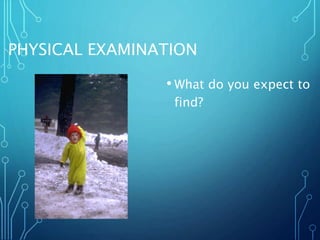
• What do you expect to
find?
PHYSICAL EXAMINATION
• Often Normal findings.
• Use a Wood lamp to examine the skin.
• Signs of growth delay.
NEUROLOGICAL EVALUATION
• Developmental Delay or regression
• No pathonomic findings
CLASSIFICATION
• How do you classify?
CLASSIFICATION
• Symptomatic
• Cryptogenic
• Idiopathic
ETIOLOGY
• Infantile spasms are a SYMPTOM, not an underlying
condition
• Any disorder that can produce brain damage can
be associated with infantile spasms.
• Prenatal
• Perinatal.
• Postnatal.
ETIOLOGY
• Genetic Syndromes: Tuberous sclerosis, Down’s
syndrome, Aicardi’s syndrome, Incontinentia
pigmenti, NF, Sturge Weber, GLUT-1 deficiency.
• Malformation syndromes: schizencephaly,
pachygyria, microgyria, etc.
ETIOLOGY
• Infectious: Congenital infections, meningitis,
encephalitis, brain abscess.
• Hypoxic-Ischemic or hemorrhagic insult
• Trauma
• Tumor
ETIOLOGY
Metabolic Disorders
Nonketotic hyperglycinemia, PKU, Maple Syrup
Urine Disease and other amino and organic
acidopathies,
Pyridoxine deficiency and dependency,
Mitochondrial encephalopathies,
Degenerative diseases.
INFANTILE SPASMS
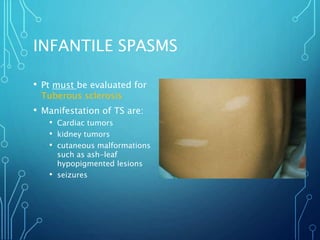
• Pt must be evaluated for
Tuberous sclerosis
• Manifestation of TS are:
• Cardiac tumors
• kidney tumors
• cutaneous malformations
such as ash-leaf
hypopigmented lesions
• seizures
INFANTILE SPASMS
Cryptogenic
• Patients have cryptogenic infantile spasms if
developmental delay and no cause is identified
but a cause is suspected and the epilepsy is
presumed to be symptomatic.
• Account for 8-42% of the cases (wide range)
CLASSIFICATION
Idiopathic
• Normal psychomotor development prior to the onset of
symptoms
• Does NOT meet West Syndrome criteria
• No underlying disorders or definite causes are present
• No neurological or neuroradiological abnormalities .
DIFFERENTIAL DIAGNOSIS
• Benign myoclonus in infancy,
which consists of clusters of nonepileptic spasms and a
normal EEG, occurs in infants with normal psychomotor
development.
• Hyperplexia,
a startle jerk, is triggered by touching the nose and eventually
the upper limbs.
• Tonic seizures
• Shuddering
• Sandifer syndrome,
due to GE reflux, may be difficult to detect and mimic
infantile spasms.
DIFFERENTIAL DIAGNOSIS
• Early breath-holding spells and aversive reactions
to stimuli can result in dystonic postures or jerks.
• Jactatio capitis,
or head banging, occurs in older infants on falling
asleep.
• Spasmus nutans associated with neck tilt and
nystagmus.
• Moro reflex must be distinguished from IS
LAB STUDIES
• CBC diff , LFTs , renal panel with electrolytes
and glucose, calcium, magnesium,
phosphorus, and urinalysis with microscopic
examination
• Metabolic workup including glucose, liver
panel, serum lactate and pyruvate, plasma
ammonia, serum and urine amino acids, urine
organic acids, and serum biotinidase
LAB STUDIES
• Blood, urine, and cerebrospinal fluid cultures if
an infection is suspected
• Cerebrospinal fluid analysis for cell count,
glucose, protein, bacterial and viral culture,
lactate, pyruvate, and amino acids
NEUROIMAGING
• 70-80% of patients have abnormal findings on
neuroimaging studies.
• MRI more sensitive than CT scan of the brain.
• Imaging studies should be obtained prior to
starting ACTH or steroid therapy, as these
therapies are associated with the appearance
of apparent brain atrophy as treatment
continues.
INFANTILE SPASMS
• EEG
• Video EEG
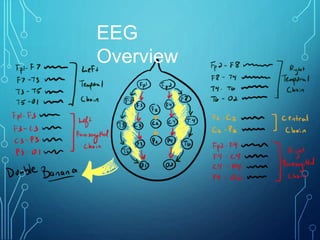
EEG
Overview
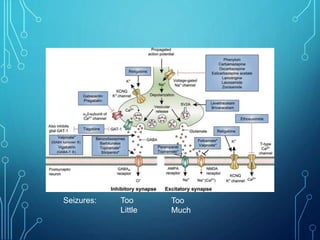
Too
Much
Too
Little
Seizures:
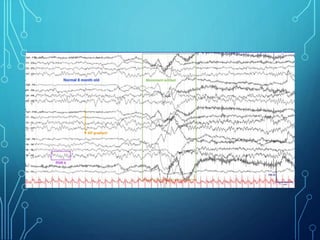
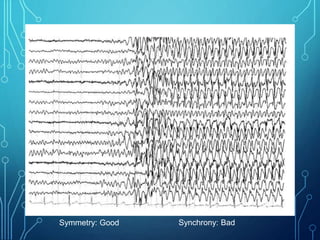
Symmetry: Good Synchrony: Bad
What about EEG findings of
Infantile Spasms?
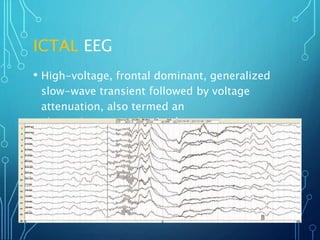
ICTAL EEG
• High-voltage, frontal dominant, generalized
slow-wave transient followed by voltage
attenuation, also termed an
electrodecremental episode
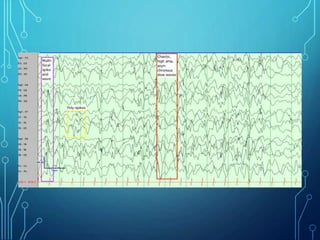
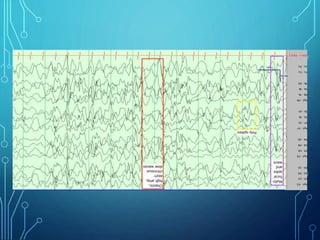
WHAT IS HYPSARRHYTMIA?
• Chaotic, high- to extremely high-voltage
polymorphic delta and theta rhythms with
• Superimposed multifocal spikes and wave
discharges
HYPSARRHYTHMIA
• At onset usually only during drowsiness and
light sleep.
• EEG may be normal (modified hypsarrhythmia).
TREATMENT
GOAL OF TREATMENT
• Cessation of spasms & resolution of
hypsarrhythmia in 2-4 weeks
• Quality of life with no seizures
• Fewest adverse effects from treatment
• The least number of medications.
TREATMENT
• First-line treatments (ie, ACTH, prednisone,
vigabatrin, pyridoxine [vitamin B-6])
• USA  natural, porcine ACTH (ACTHAR) -- $$$$$$
• Europe  tetracosactide, synthetic -- $
• Second-line treatments (ie, benzodiazepines,
valproic acid, lamotrigine, topiramate,
zonisamide)
• Combo?
TREATMENT
• Most of the patients achieve control within 2
weeks.
TREATMENT
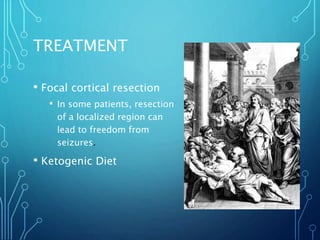
• Focal cortical resection
• In some patients, resection
of a localized region can
lead to freedom from
seizures.
• Ketogenic Diet
COMPLICATIONS OF TX
• Hypertension, metabolic abnormalities, severe
irritability, osteoporosis, sepsis, and
congestive heart failure
PROGNOSIS
• Only 14% have normal or borderline normal
cognitive development
• Drastically improves if*:
• Treatment started within 1 month
• Developmentally normal at onset (idiopathic)
• No cause found (cryptogenic/idiopathic)
• Some associations may have better outcome,
such as Down Syndrome, NF.
*Kivity S et al. Epilepsia 2004;
PROGNOSIS
• Poor prognosis
Persistently abnormal EEG
Poor response to ACTH
Delayed initiation of treatment.
• 20-25% evolves to LGS
THE END

Infantile Spasms.ppt

  • 1.
    WEST SYNDROME & INFANTILESPASMS MITCHELL P. CREED, MD, MA PEDIATRIC NEUROLOGY STONY BROOK UNIVERSITY CHILDREN’S HOSPITAL
  • 2.
    INFANTILE SPASMS • Represents2% of all epilepsies. • 25 % of all that present in the first year of life • 90% start before the age of 12 months. • Peak at 4-6 months.
  • 3.
    WEST SYNDROME Triad of •infantile spasms, • an interictal EEG pattern termed hypsarrhythmia, • Development delay or regression
  • 4.
    DO YOU KNOWWHO DESCRIBED FOR THE FIRST TIME? • West described the events in 1841as “bobbings” that “cause a complete heaving of the head forward towards his knees, and then immediately relaxing into the upright position …
  • 5.
    DO YOU KNOWWHO DESCRIBED FOR THE FIRST TIME? • … these bowings and relaxings would be repeated alternately at intervals of a few seconds, and repeated from 10 to 20 or more times at each attack, which attack would not continue more than 2 or 3 minutes; he sometimes has 2, 3 or more attacks in the day.”
  • 6.
    INFANTILE SPASMS • Spasmsbegin with a sudden, rapid, tonic contraction of trunk and limb musculature that gradually relaxes over 0.5-2 seconds. • Contractions can last 5-10 seconds. • The intensity may vary from a subtle head nodding to a powerful contraction of the body.
  • 7.
  • 8.
    INFANTILE SPASMS • Infantilespasms usually occur in clusters, often several dozens, separated by 5-30 seconds. • Spasms frequently occur just before sleep or upon awakening. They can be observed during sleep, although this is rare.
  • 9.
    INFANTILE SPASMS • Spasms,the seizure type, may have variable features • Three subtypes (flexor, extensor, and mixed flexor-extensor) based on postural manifestations and patterns of muscle involvement during the seizure. • Flexor spasms involve flexion of the neck, trunk, and extremities, resulting in jack- knifing at the waist and a self-hugging motion of the arms..
  • 10.
    INFANTILE SPASMS • Extensorspasms consist of extension of the neck, trunk, and extremities. Mixed flexor- extensor spasms involve combinations of the above.
  • 11.
    INTERICTAL MANIFESTATIONS • Arrestor regression in psychomotor development in 70-95% of patients.
  • 12.
  • 13.
    FAMILY HISTORY • Onlyin 17 % of patients • 10% have Hx of febrile Seizure • Incidence 1.6-4.5/10,000 live births (2000- 2500 new cases/year in US)
  • 14.
    PHYSICAL EXAMINATION • Whatdo you expect to find?
  • 15.
    PHYSICAL EXAMINATION • OftenNormal findings. • Use a Wood lamp to examine the skin. • Signs of growth delay.
  • 16.
    NEUROLOGICAL EVALUATION • DevelopmentalDelay or regression • No pathonomic findings
  • 17.
  • 18.
  • 19.
    ETIOLOGY • Infantile spasmsare a SYMPTOM, not an underlying condition • Any disorder that can produce brain damage can be associated with infantile spasms. • Prenatal • Perinatal. • Postnatal.
  • 20.
    ETIOLOGY • Genetic Syndromes:Tuberous sclerosis, Down’s syndrome, Aicardi’s syndrome, Incontinentia pigmenti, NF, Sturge Weber, GLUT-1 deficiency. • Malformation syndromes: schizencephaly, pachygyria, microgyria, etc.
  • 21.
    ETIOLOGY • Infectious: Congenitalinfections, meningitis, encephalitis, brain abscess. • Hypoxic-Ischemic or hemorrhagic insult • Trauma • Tumor
  • 22.
    ETIOLOGY Metabolic Disorders Nonketotic hyperglycinemia,PKU, Maple Syrup Urine Disease and other amino and organic acidopathies, Pyridoxine deficiency and dependency, Mitochondrial encephalopathies, Degenerative diseases.
  • 23.
    INFANTILE SPASMS • Ptmust be evaluated for Tuberous sclerosis • Manifestation of TS are: • Cardiac tumors • kidney tumors • cutaneous malformations such as ash-leaf hypopigmented lesions • seizures
  • 24.
    INFANTILE SPASMS Cryptogenic • Patientshave cryptogenic infantile spasms if developmental delay and no cause is identified but a cause is suspected and the epilepsy is presumed to be symptomatic. • Account for 8-42% of the cases (wide range)
  • 25.
    CLASSIFICATION Idiopathic • Normal psychomotordevelopment prior to the onset of symptoms • Does NOT meet West Syndrome criteria • No underlying disorders or definite causes are present • No neurological or neuroradiological abnormalities .
  • 26.
    DIFFERENTIAL DIAGNOSIS • Benignmyoclonus in infancy, which consists of clusters of nonepileptic spasms and a normal EEG, occurs in infants with normal psychomotor development. • Hyperplexia, a startle jerk, is triggered by touching the nose and eventually the upper limbs. • Tonic seizures • Shuddering • Sandifer syndrome, due to GE reflux, may be difficult to detect and mimic infantile spasms.
  • 27.
    DIFFERENTIAL DIAGNOSIS • Earlybreath-holding spells and aversive reactions to stimuli can result in dystonic postures or jerks. • Jactatio capitis, or head banging, occurs in older infants on falling asleep. • Spasmus nutans associated with neck tilt and nystagmus. • Moro reflex must be distinguished from IS
  • 28.
    LAB STUDIES • CBCdiff , LFTs , renal panel with electrolytes and glucose, calcium, magnesium, phosphorus, and urinalysis with microscopic examination • Metabolic workup including glucose, liver panel, serum lactate and pyruvate, plasma ammonia, serum and urine amino acids, urine organic acids, and serum biotinidase
  • 29.
    LAB STUDIES • Blood,urine, and cerebrospinal fluid cultures if an infection is suspected • Cerebrospinal fluid analysis for cell count, glucose, protein, bacterial and viral culture, lactate, pyruvate, and amino acids
  • 30.
    NEUROIMAGING • 70-80% ofpatients have abnormal findings on neuroimaging studies. • MRI more sensitive than CT scan of the brain. • Imaging studies should be obtained prior to starting ACTH or steroid therapy, as these therapies are associated with the appearance of apparent brain atrophy as treatment continues.
  • 31.
  • 32.
  • 34.
  • 35.
  • 36.
    What about EEGfindings of Infantile Spasms?
  • 37.
    ICTAL EEG • High-voltage,frontal dominant, generalized slow-wave transient followed by voltage attenuation, also termed an electrodecremental episode
  • 38.
    WHAT IS HYPSARRHYTMIA? •Chaotic, high- to extremely high-voltage polymorphic delta and theta rhythms with • Superimposed multifocal spikes and wave discharges
  • 41.
    HYPSARRHYTHMIA • At onsetusually only during drowsiness and light sleep. • EEG may be normal (modified hypsarrhythmia).
  • 42.
  • 43.
    GOAL OF TREATMENT •Cessation of spasms & resolution of hypsarrhythmia in 2-4 weeks • Quality of life with no seizures • Fewest adverse effects from treatment • The least number of medications.
  • 44.
    TREATMENT • First-line treatments(ie, ACTH, prednisone, vigabatrin, pyridoxine [vitamin B-6]) • USA  natural, porcine ACTH (ACTHAR) -- $$$$$$ • Europe  tetracosactide, synthetic -- $ • Second-line treatments (ie, benzodiazepines, valproic acid, lamotrigine, topiramate, zonisamide) • Combo?
  • 45.
    TREATMENT • Most ofthe patients achieve control within 2 weeks.
  • 46.
    TREATMENT • Focal corticalresection • In some patients, resection of a localized region can lead to freedom from seizures. • Ketogenic Diet
  • 47.
    COMPLICATIONS OF TX •Hypertension, metabolic abnormalities, severe irritability, osteoporosis, sepsis, and congestive heart failure
  • 48.
    PROGNOSIS • Only 14%have normal or borderline normal cognitive development • Drastically improves if*: • Treatment started within 1 month • Developmentally normal at onset (idiopathic) • No cause found (cryptogenic/idiopathic) • Some associations may have better outcome, such as Down Syndrome, NF. *Kivity S et al. Epilepsia 2004;
  • 49.
    PROGNOSIS • Poor prognosis Persistentlyabnormal EEG Poor response to ACTH Delayed initiation of treatment. • 20-25% evolves to LGS
  • 50.