Chapter 2
Network Design Essentials

Networking Concepts – Eric Vanderburg ©2005
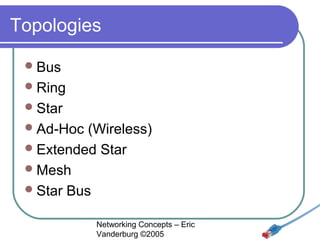
Topologies
 Bus
 Ring
 Star
 Ad-Hoc

(Wireless)
 Extended Star
 Mesh
 Star Bus
Networking Concepts – Eric
Vanderburg ©2005
Current Standard Layout
 Star

Topology
 Switches
 Twisted Pair wiring

Networking Concepts – Eric
Vanderburg ©2005
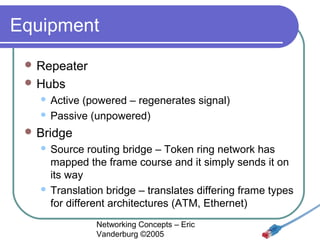
Equipment
 Repeater
 Hubs

Active (powered – regenerates signal)
 Passive (unpowered)


 Bridge

Source routing bridge – Token ring network has
mapped the frame course and it simply sends it on
its way
 Translation bridge – translates differing frame types
for different architectures (ATM, Ethernet)


Networking Concepts – Eric
Vanderburg ©2005
Equipment
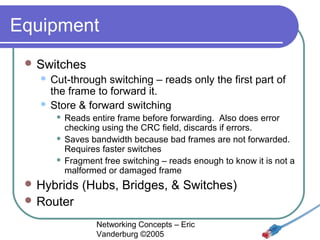
 Switches

Cut-through switching – reads only the first part of
the frame to forward it.
 Store & forward switching


Reads entire frame before forwarding. Also does error
checking using the CRC field, discards if errors.
 Saves bandwidth because bad frames are not forwarded.
Requires faster switches
 Fragment free switching – reads enough to know it is not a
malformed or damaged frame


 Hybrids

(Hubs, Bridges, & Switches)

 Router
Networking Concepts – Eric
Vanderburg ©2005
Tables
 Bridging

Table

 Layer

2 table created on Bridges and
Switches of MAC addresses on each port
 Created dynamically or statically
 Routing

table

 Each

router creates its own and can receive
information about other routing tables from
other routers. Information received
depends on the protocol used.
Networking Concepts – Eric
Vanderburg ©2005
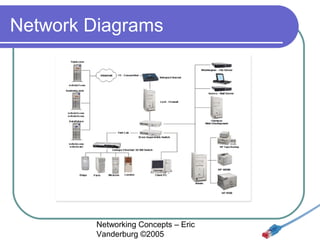
Network Diagrams

Networking Concepts – Eric
Vanderburg ©2005
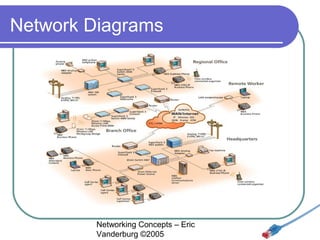
Network Diagrams

Networking Concepts – Eric
Vanderburg ©2005
Book Corrections
 Star

Ring is not a topology
(Physical Star, Logical Ring)

Networking Concepts – Eric
Vanderburg ©2005
Book Corrections
 Star

Ring is not a topology
(Physical Star, Logical Ring)

Networking Concepts – Eric
Vanderburg ©2005

Networking Concepts Lesson 02 - Network Design Essentials - Eric Vanderburg

  • 1.
    Chapter 2 Network DesignEssentials Networking Concepts – Eric Vanderburg ©2005
  • 2.
    Topologies  Bus  Ring Star  Ad-Hoc (Wireless)  Extended Star  Mesh  Star Bus Networking Concepts – Eric Vanderburg ©2005
  • 3.
    Current Standard Layout Star Topology  Switches  Twisted Pair wiring Networking Concepts – Eric Vanderburg ©2005
  • 4.
    Equipment  Repeater  Hubs Active(powered – regenerates signal)  Passive (unpowered)   Bridge Source routing bridge – Token ring network has mapped the frame course and it simply sends it on its way  Translation bridge – translates differing frame types for different architectures (ATM, Ethernet)  Networking Concepts – Eric Vanderburg ©2005
  • 5.
    Equipment  Switches Cut-through switching– reads only the first part of the frame to forward it.  Store & forward switching  Reads entire frame before forwarding. Also does error checking using the CRC field, discards if errors.  Saves bandwidth because bad frames are not forwarded. Requires faster switches  Fragment free switching – reads enough to know it is not a malformed or damaged frame   Hybrids (Hubs, Bridges, & Switches)  Router Networking Concepts – Eric Vanderburg ©2005
  • 6.
    Tables  Bridging Table  Layer 2table created on Bridges and Switches of MAC addresses on each port  Created dynamically or statically  Routing table  Each router creates its own and can receive information about other routing tables from other routers. Information received depends on the protocol used. Networking Concepts – Eric Vanderburg ©2005
  • 7.
    Network Diagrams Networking Concepts– Eric Vanderburg ©2005
  • 8.
    Network Diagrams Networking Concepts– Eric Vanderburg ©2005
  • 9.
    Book Corrections  Star Ringis not a topology (Physical Star, Logical Ring) Networking Concepts – Eric Vanderburg ©2005
  • 10.
    Book Corrections  Star Ringis not a topology (Physical Star, Logical Ring) Networking Concepts – Eric Vanderburg ©2005