Principles ofPrinciples of
Technology ManagementTechnology Management
Eric Vanderburg, MBA
September 6, 2004
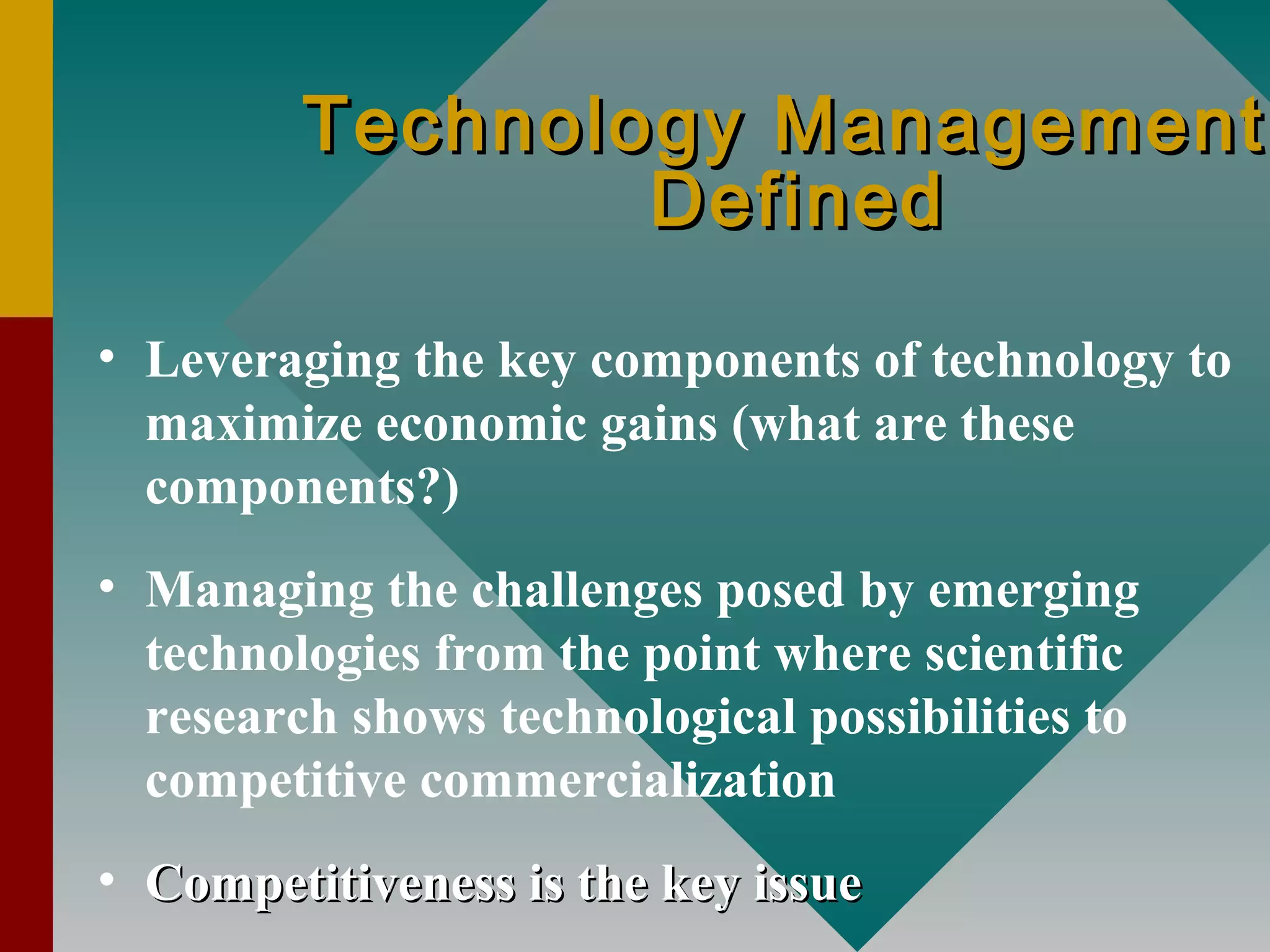
Technology ManagementTechnology Management
DefinedDefined
• Leveraging the key components of technology to
maximize economic gains (what are these
components?)
• Managing the challenges posed by emerging
technologies from the point where scientific
research shows technological possibilities to
competitive commercialization
• Competitiveness is the key issueCompetitiveness is the key issue
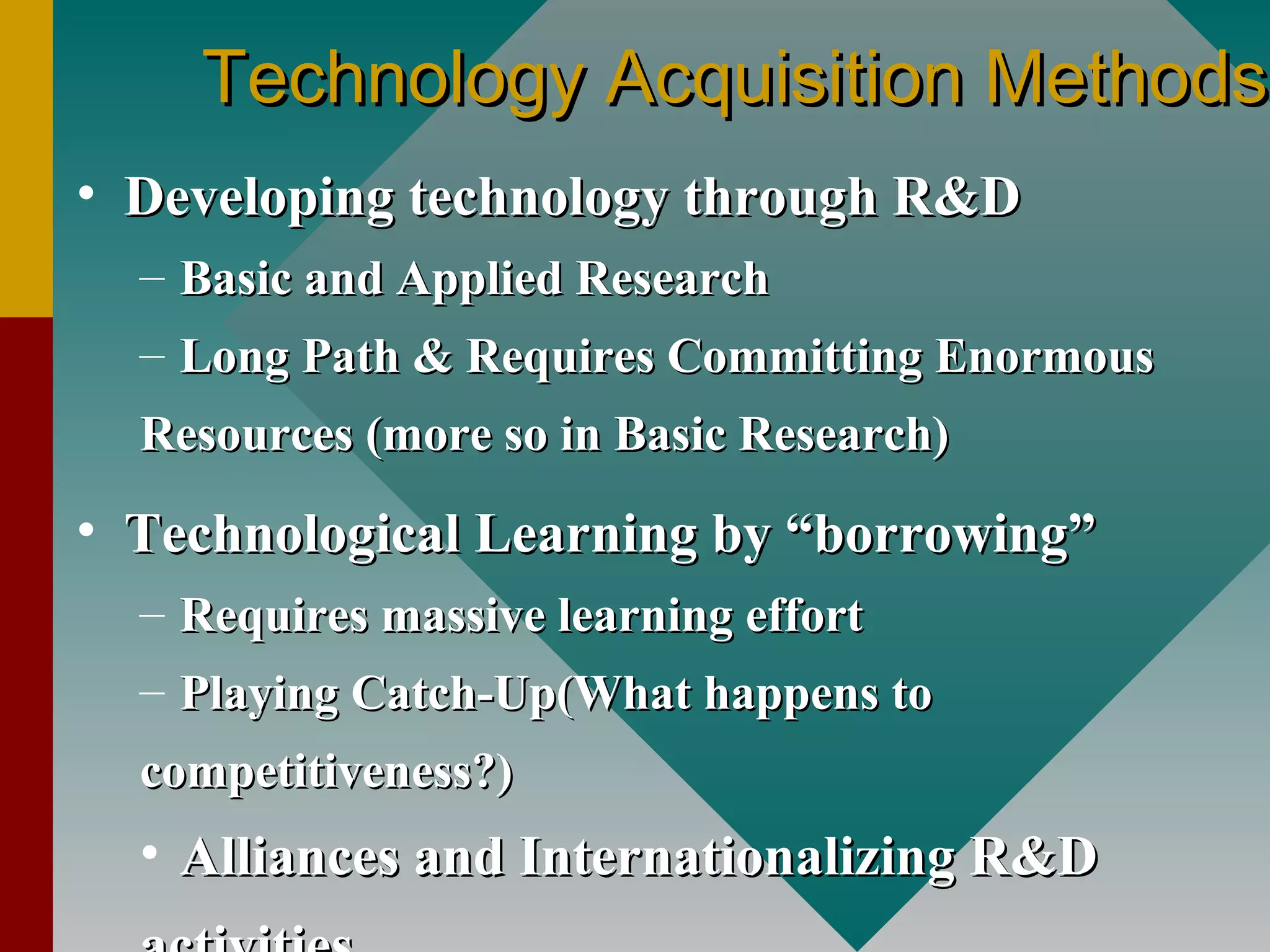
Technology Acquisition MethodsTechnology Acquisition Methods
• Developing technology through R&DDeveloping technology through R&D
– Basic and Applied ResearchBasic and Applied Research
– Long Path & Requires Committing EnormousLong Path & Requires Committing Enormous
Resources (more so in Basic Research)Resources (more so in Basic Research)
• Technological Learning by “borrowing”Technological Learning by “borrowing”
– Requires massive learning effortRequires massive learning effort
– Playing Catch-Up(What happens toPlaying Catch-Up(What happens to
competitiveness?)competitiveness?)
• Alliances and Internationalizing R&DAlliances and Internationalizing R&D
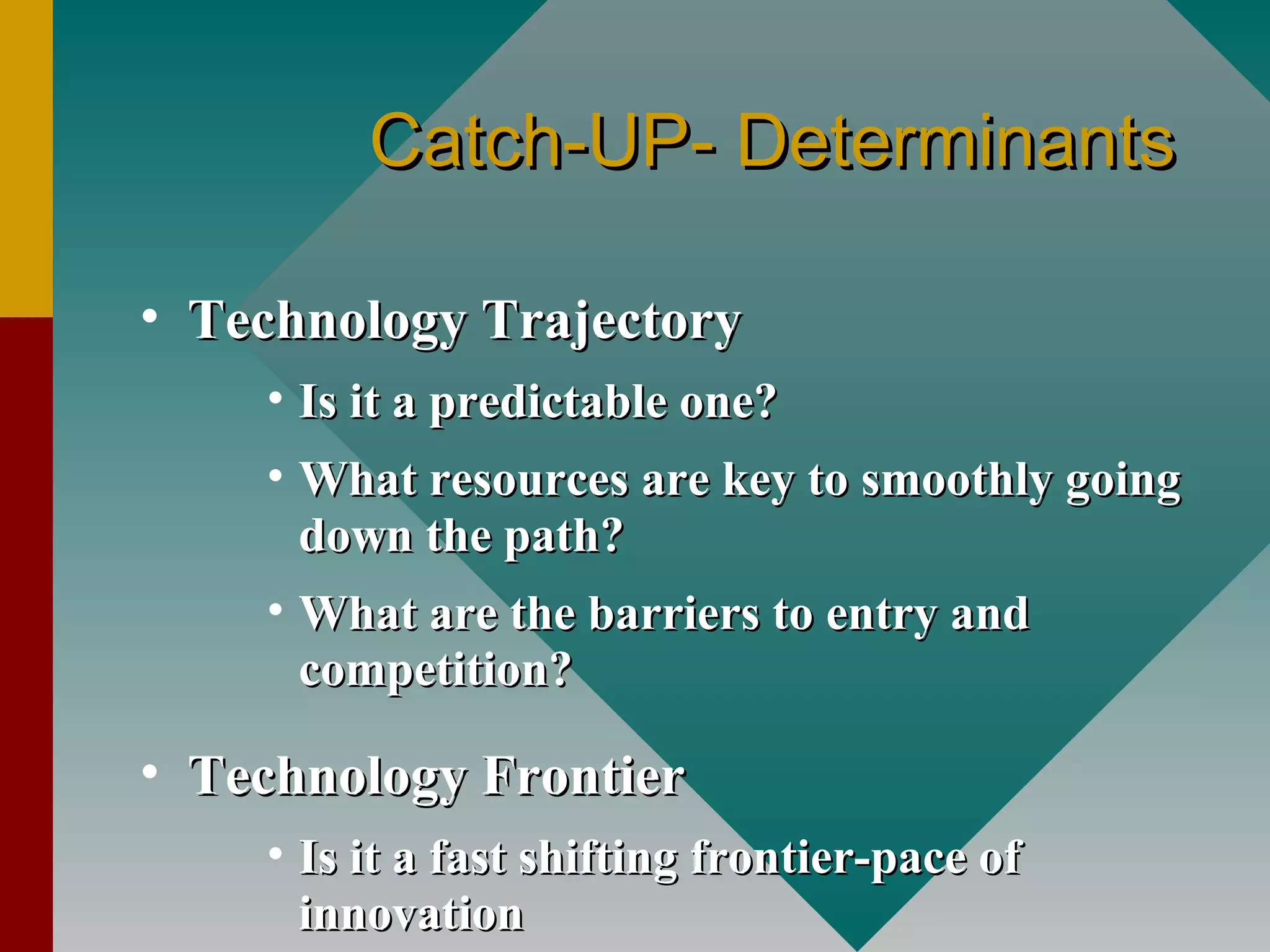
Catch-UP- DeterminantsCatch-UP- Determinants
• Technology TrajectoryTechnology Trajectory
• Is it a predictable one?Is it a predictable one?
• What resources are key to smoothly goingWhat resources are key to smoothly going
down the path?down the path?
• What are the barriers to entry andWhat are the barriers to entry and
competition?competition?
• Technology FrontierTechnology Frontier
• Is it a fast shifting frontier-pace ofIs it a fast shifting frontier-pace of
innovationinnovation
Macroeconomic EnvironmentMacroeconomic Environment
• A myriad of variablesA myriad of variables
• The Concept of National InnovationThe Concept of National Innovation
SystemSystem
Factors DeterminingFactors Determining
International CompetitivenessInternational Competitiveness
• Potter- Diamond ModelPotter- Diamond Model
• Firm Strategy, Structure,and Rivalry –many entrantsFirm Strategy, Structure,and Rivalry –many entrants
and innovationand innovation
• Demand Conditions- popularity of product,Demand Conditions- popularity of product,
sophistication of customers and saturation of domesticsophistication of customers and saturation of domestic
market leads to aggressive international activitymarket leads to aggressive international activity
• Related Supporting Industries- complementary activitiesRelated Supporting Industries- complementary activities
and intensive exchange of knowledgeand intensive exchange of knowledge
• Factor Conditions- skilled workers, infrastructureFactor Conditions- skilled workers, infrastructure
Factors DeterminingFactors Determining
International CompetitivenessInternational Competitiveness
• Potter- Diamond ModelPotter- Diamond Model
• Firm Strategy, Structure,and Rivalry –many entrantsFirm Strategy, Structure,and Rivalry –many entrants
and innovationand innovation
• Demand Conditions- popularity of product,Demand Conditions- popularity of product,
sophistication of customers and saturation of domesticsophistication of customers and saturation of domestic
market leads to aggressive international activitymarket leads to aggressive international activity
• Related Supporting Industries- complementary activitiesRelated Supporting Industries- complementary activities
and intensive exchange of knowledgeand intensive exchange of knowledge
• Factor Conditions- skilled workers, infrastructureFactor Conditions- skilled workers, infrastructure

Principles of technology management

  • 1.
    Principles ofPrinciples of TechnologyManagementTechnology Management Eric Vanderburg, MBA September 6, 2004
  • 2.
    Technology ManagementTechnology Management DefinedDefined •Leveraging the key components of technology to maximize economic gains (what are these components?) • Managing the challenges posed by emerging technologies from the point where scientific research shows technological possibilities to competitive commercialization • Competitiveness is the key issueCompetitiveness is the key issue
  • 3.
    Technology Acquisition MethodsTechnologyAcquisition Methods • Developing technology through R&DDeveloping technology through R&D – Basic and Applied ResearchBasic and Applied Research – Long Path & Requires Committing EnormousLong Path & Requires Committing Enormous Resources (more so in Basic Research)Resources (more so in Basic Research) • Technological Learning by “borrowing”Technological Learning by “borrowing” – Requires massive learning effortRequires massive learning effort – Playing Catch-Up(What happens toPlaying Catch-Up(What happens to competitiveness?)competitiveness?) • Alliances and Internationalizing R&DAlliances and Internationalizing R&D
  • 4.
    Catch-UP- DeterminantsCatch-UP- Determinants •Technology TrajectoryTechnology Trajectory • Is it a predictable one?Is it a predictable one? • What resources are key to smoothly goingWhat resources are key to smoothly going down the path?down the path? • What are the barriers to entry andWhat are the barriers to entry and competition?competition? • Technology FrontierTechnology Frontier • Is it a fast shifting frontier-pace ofIs it a fast shifting frontier-pace of innovationinnovation
  • 5.
    Macroeconomic EnvironmentMacroeconomic Environment •A myriad of variablesA myriad of variables • The Concept of National InnovationThe Concept of National Innovation SystemSystem
  • 6.
    Factors DeterminingFactors Determining InternationalCompetitivenessInternational Competitiveness • Potter- Diamond ModelPotter- Diamond Model • Firm Strategy, Structure,and Rivalry –many entrantsFirm Strategy, Structure,and Rivalry –many entrants and innovationand innovation • Demand Conditions- popularity of product,Demand Conditions- popularity of product, sophistication of customers and saturation of domesticsophistication of customers and saturation of domestic market leads to aggressive international activitymarket leads to aggressive international activity • Related Supporting Industries- complementary activitiesRelated Supporting Industries- complementary activities and intensive exchange of knowledgeand intensive exchange of knowledge • Factor Conditions- skilled workers, infrastructureFactor Conditions- skilled workers, infrastructure
  • 7.
    Factors DeterminingFactors Determining InternationalCompetitivenessInternational Competitiveness • Potter- Diamond ModelPotter- Diamond Model • Firm Strategy, Structure,and Rivalry –many entrantsFirm Strategy, Structure,and Rivalry –many entrants and innovationand innovation • Demand Conditions- popularity of product,Demand Conditions- popularity of product, sophistication of customers and saturation of domesticsophistication of customers and saturation of domestic market leads to aggressive international activitymarket leads to aggressive international activity • Related Supporting Industries- complementary activitiesRelated Supporting Industries- complementary activities and intensive exchange of knowledgeand intensive exchange of knowledge • Factor Conditions- skilled workers, infrastructureFactor Conditions- skilled workers, infrastructure