

Correct the most common
web development security mistakes
© 2015 Property of JurInnov Ltd. All Rights Reserved
Eric A. Vanderburg, MBA, CISSP
Director, Information Systems and Security
Computer Forensic and Investigation Services
© 2015 Property of JurInnov Ltd. All Rights Reserved© 2015 Property of JurInnov Ltd. All Rights Reserved
Security mistakes
• Current state
• Common web development mistakes
– Security misconfiguration
– URL access
– Redirects and forwards
– Direct object references
– Storage locations
– Transport layer
2
© 2015 Property of JurInnov Ltd. All Rights Reserved
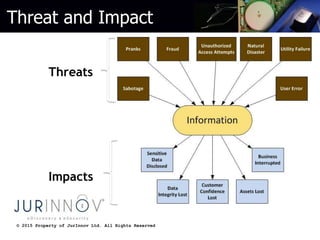
Threats
Impacts
Threat and Impact
© 2015 Property of JurInnov Ltd. All Rights Reserved© 2015 Property of JurInnov Ltd. All Rights Reserved
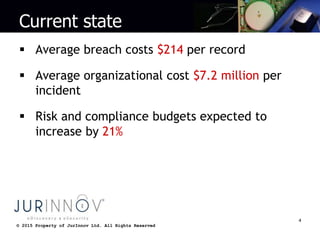
Current state
 Average breach costs $214 per record
 Average organizational cost $7.2 million per
incident
 Risk and compliance budgets expected to
increase by 21%
4
© 2015 Property of JurInnov Ltd. All Rights Reserved© 2015 Property of JurInnov Ltd. All Rights Reserved
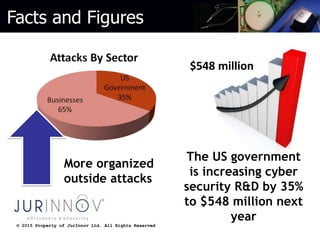
$548 million
The US government
is increasing cyber
security R&D by 35%
to $548 million next
year
More organized
outside attacks
Facts and Figures
© 2015 Property of JurInnov Ltd. All Rights Reserved© 2015 Property of JurInnov Ltd. All Rights Reserved
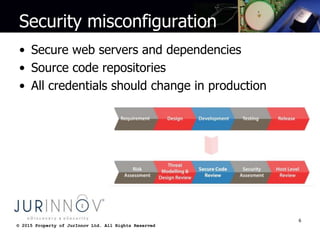
Security misconfiguration
• Secure web servers and dependencies
• Source code repositories
• All credentials should change in production
6
© 2015 Property of JurInnov Ltd. All Rights Reserved© 2015 Property of JurInnov Ltd. All Rights Reserved
Impact
• Install backdoor through missing network or
server patch
• XSS flaw exploits due to missing application
framework patches
• Unauthorized access to default accounts,
application functionality or data, or unused but
accessible functionality due to poor server
configuration
7
© 2015 Property of JurInnov Ltd. All Rights Reserved© 2015 Property of JurInnov Ltd. All Rights Reserved
Protection
• Verify your system’s configuration management
– Secure configuration “hardening”
– Must cover entire platform and application
– Keep up with patches for OS and components
– Analyze security effects of changes
• Can you export the application configuration
– Build reporting into your process
• Verify the implementation
– If you can’t verify it, it isn’t secure
– Scanning finds generic configuration and missing patch problems
8
© 2015 Property of JurInnov Ltd. All Rights Reserved© 2015 Property of JurInnov Ltd. All Rights Reserved
URL access
• Failure to restrict URL access
• How it happens:
– Displaying only authorized links and menu
choices
– This is called presentation layer access control,
and doesn’t work
– Attacker simply forges direct access to
‘unauthorized’ pages
9
© 2015 Property of JurInnov Ltd. All Rights Reserved© 2015 Property of JurInnov Ltd. All Rights Reserved
Example
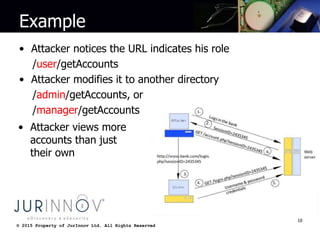
• Attacker notices the URL indicates his role
/user/getAccounts
• Attacker modifies it to another directory
/admin/getAccounts, or
/manager/getAccounts
10
• Attacker views more
accounts than just
their own
© 2015 Property of JurInnov Ltd. All Rights Reserved© 2015 Property of JurInnov Ltd. All Rights Reserved
Impact
• Attackers invoke functions and services they’re
not authorized for
• Access other user’s accounts and data
• Perform privileged actions
11
© 2015 Property of JurInnov Ltd. All Rights Reserved© 2015 Property of JurInnov Ltd. All Rights Reserved
Protection
• For each URL, a site needs to do 3 things
– Restrict access to authenticated users (if not public)
– Enforce any user or role based permissions (if
private)
– Completely disallow requests to unauthorized page
types (e.g., config files, log files, source files, etc.)
• Verify your architecture
– Use a simple, positive modeevery layer
– Be sure you actually have a mechanism at l at every
layer
12
© 2015 Property of JurInnov Ltd. All Rights Reserved© 2015 Property of JurInnov Ltd. All Rights Reserved
Verify the implementation
• Forget automated analysis approaches
• Verify that each URL in your application is protected by
either
– An external filter, like Java EE web.xml or a commercial product
– Or internal checks in YOUR code – Use ESAPI’s
isAuthorizedForURL() method
• Verify the server configuration disallows requests to
unauthorized file types
• Use WebScarab or your browser to forge unauthorized
requests
13
© 2015 Property of JurInnov Ltd. All Rights Reserved© 2015 Property of JurInnov Ltd. All Rights Reserved
Redirects and forwards
• Unvalidated redirects and forwards
• Web application redirects send victims to a site
of the attacker’s choice
• Forwards
– They internally send the request to a new page in
the same application
– Sometimes parameters define the target page
– Used to bypass authentication and authorization
checks
14
© 2015 Property of JurInnov Ltd. All Rights Reserved© 2015 Property of JurInnov Ltd. All Rights Reserved
Impact
• Redirect victim to phishing or malware site
• Attacker’s request is forwarded past security
checks, allowing unauthorized function or data
access
15
© 2015 Property of JurInnov Ltd. All Rights Reserved© 2015 Property of JurInnov Ltd. All Rights Reserved
Protecting redirects
• Avoid using redirects and forwards as much as you can
• If used, don’t involve user parameters in defining the
target URL
• If you ‘must’ involve user parameters, then either
– Validate each parameter to ensure its valid and
authorized for the current user, or
– (preferred) – Use server side mapping to translate
choice provided to user with actual target page
• Defense in depth: For redirects, validate the target URL
after it is calculated to make sure it goes to an
authorized external site
16
© 2015 Property of JurInnov Ltd. All Rights Reserved© 2015 Property of JurInnov Ltd. All Rights Reserved
Protecting forwards
• Ideally, you’d call the access controller to make
sure the user is authorized before you perform
the forward (with ESAPI, this is easy)
• With an external filter, like Siteminder, this is not
very practical
• Next best is to make sure that users who can
access the original page are ALL authorized to
access the target page.
17
© 2015 Property of JurInnov Ltd. All Rights Reserved© 2015 Property of JurInnov Ltd. All Rights Reserved
Direct object references
• Insecure direct object references
• Caused by failed access control at the
presentation layer allowing attackers to modify
parameter values.
– Only listing the ‘authorized’ objects for the
current user, or
– Hiding the object references in hidden fields and
then not enforcing these restrictions on the
server side
18
© 2015 Property of JurInnov Ltd. All Rights Reserved© 2015 Property of JurInnov Ltd. All Rights Reserved
Impact
• Impact
– Unauthorized access
– Data breach
– Data corruption
19
© 2015 Property of JurInnov Ltd. All Rights Reserved© 2015 Property of JurInnov Ltd. All Rights Reserved
Example
• www.banking.com/user?acct=10579
• Attacker notices his acct parameter is 10579
?acct=10579
• He modifies it to a nearby number
?acct=10580
• Attacker views the victim’s account information
20
© 2015 Property of JurInnov Ltd. All Rights Reserved© 2015 Property of JurInnov Ltd. All Rights Reserved
Protection techniques
• Eliminate the direct object reference
• Replace them with a temporary mapping value
• ESAPI provides support for numeric & random
mappings
» IntegerAccessReferenceMap
» RandomAccessReferenceMap
• Validate the direct object reference
• Verify the parameter value is properly formatted
• Verify the user is allowed to access the target object
• Verify the requested mode of access is allowed to the
target object (e.g., read, write, delete)
21
© 2015 Property of JurInnov Ltd. All Rights Reserved© 2015 Property of JurInnov Ltd. All Rights Reserved
Storage locations
• Insecure Cryptographic Storage
– Failure to identify all sensitive data
– Failure to identify all the places that this sensitive
data gets stored
– Databases, files, directories, log files, backups,
etc.
– Failure to properly protect this data in every
location
22
© 2015 Property of JurInnov Ltd. All Rights Reserved© 2015 Property of JurInnov Ltd. All Rights Reserved
Impact
• Attackers access or modify confidential or private
information
– e.g, credit cards, health care records, financial data
(yours or your customers)
• Attackers extract secrets to use in additional attacks
• Company embarrassment, customer dissatisfaction, and
loss of trust
• Expense of cleaning up the incident, such as forensics,
sending apology letters, reissuing thousands of credit
cards, providing identity theft insurance
• Business gets sued and/or fined
23
© 2015 Property of JurInnov Ltd. All Rights Reserved© 2015 Property of JurInnov Ltd. All Rights Reserved
Protection techniques
• Verify your architecture
– Identify all sensitive data
– Identify all the places that data is stored
– Ensure threat model accounts for possible attacks
– Use encryption to counter the threats, don’t just ‘encrypt’
the data
• Protect with appropriate mechanisms
– File encryption, database encryption, data element
encryption
24
© 2015 Property of JurInnov Ltd. All Rights Reserved© 2015 Property of JurInnov Ltd. All Rights Reserved
Protection techniques
• Use the mechanisms correctly
– Use standard strong algorithms
– Generate, distribute, and protect keys properly
– Be prepared for key change
• Verify the implementation
– A standard strong algorithm is used, and it’s the proper algorithm
for this situation
– All keys, certificates, and passwords are properly stored and
protected
– Safe key distribution and an effective plan for key change are in
place
– Analyze encryption code for common flaws
25
© 2015 Property of JurInnov Ltd. All Rights Reserved© 2015 Property of JurInnov Ltd. All Rights Reserved
Transport Layer
• Insufficient Transport Layer Protection
– Failure to identify all sensitive data
– Failure to identify all the places that this sensitive
data is sent
– On the web, to backend databases, to business
partners, internal communications
– Failure to properly protect this data in every
location
26
© 2015 Property of JurInnov Ltd. All Rights Reserved© 2015 Property of JurInnov Ltd. All Rights Reserved
Impact
• Attackers access or modify confidential or private
information
– e.g, credit cards, health care records, financial data
(yours or your customers)
• Attackers extract secrets to use in additional attacks
• Company embarrassment, customer dissatisfaction, and
loss of trust
• Expense of cleaning up the incident, such as forensics,
sending apology letters, reissuing thousands of credit
cards, providing identity theft insurance
• Business gets sued and/or fined
27
© 2015 Property of JurInnov Ltd. All Rights Reserved© 2015 Property of JurInnov Ltd. All Rights Reserved
Protection techniques
• Protect with appropriate mechanisms
– Use TLS on all connections with sensitive data
– Individually encrypt messages before transmission (XML-
Encryption)
– Sign messages before transmission (XML-Signature)
• Correct use
– Use standard strong algorithms (disable old SSL
algorithms)
– Manage keys/certificates properly
– Verify SSL certificates before using them
28
© 2015 Property of JurInnov Ltd. All Rights Reserved
Questions
© 2015 Property of JurInnov Ltd. All Rights Reserved© 2015 Property of JurInnov Ltd. All Rights Reserved
For assistance or additional information
• Phone: 216-664-1100
• Web: www.jurinnov.com
• Email: eric.vanderburg@jurinnov.com
• Twitter: @evanderburg
• Facebook: www.facebook.com/VanderburgE
• Linkedin: www.linkedin.com/in/evanderburg
• Youtube: www.youtube.com/user/evanderburg
JurInnov Ltd.
The Idea Center
1375 Euclid Avenue, Suite 400
Cleveland, Ohio 44115

Correct the most common web development security mistakes - Eric Vanderburg

  • 1.
    Correct the mostcommon web development security mistakes © 2015 Property of JurInnov Ltd. All Rights Reserved Eric A. Vanderburg, MBA, CISSP Director, Information Systems and Security Computer Forensic and Investigation Services
  • 2.
    © 2015 Propertyof JurInnov Ltd. All Rights Reserved© 2015 Property of JurInnov Ltd. All Rights Reserved Security mistakes • Current state • Common web development mistakes – Security misconfiguration – URL access – Redirects and forwards – Direct object references – Storage locations – Transport layer 2
  • 3.
    © 2015 Propertyof JurInnov Ltd. All Rights Reserved Threats Impacts Threat and Impact
  • 4.
    © 2015 Propertyof JurInnov Ltd. All Rights Reserved© 2015 Property of JurInnov Ltd. All Rights Reserved Current state  Average breach costs $214 per record  Average organizational cost $7.2 million per incident  Risk and compliance budgets expected to increase by 21% 4
  • 5.
    © 2015 Propertyof JurInnov Ltd. All Rights Reserved© 2015 Property of JurInnov Ltd. All Rights Reserved $548 million The US government is increasing cyber security R&D by 35% to $548 million next year More organized outside attacks Facts and Figures
  • 6.
    © 2015 Propertyof JurInnov Ltd. All Rights Reserved© 2015 Property of JurInnov Ltd. All Rights Reserved Security misconfiguration • Secure web servers and dependencies • Source code repositories • All credentials should change in production 6
  • 7.
    © 2015 Propertyof JurInnov Ltd. All Rights Reserved© 2015 Property of JurInnov Ltd. All Rights Reserved Impact • Install backdoor through missing network or server patch • XSS flaw exploits due to missing application framework patches • Unauthorized access to default accounts, application functionality or data, or unused but accessible functionality due to poor server configuration 7
  • 8.
    © 2015 Propertyof JurInnov Ltd. All Rights Reserved© 2015 Property of JurInnov Ltd. All Rights Reserved Protection • Verify your system’s configuration management – Secure configuration “hardening” – Must cover entire platform and application – Keep up with patches for OS and components – Analyze security effects of changes • Can you export the application configuration – Build reporting into your process • Verify the implementation – If you can’t verify it, it isn’t secure – Scanning finds generic configuration and missing patch problems 8
  • 9.
    © 2015 Propertyof JurInnov Ltd. All Rights Reserved© 2015 Property of JurInnov Ltd. All Rights Reserved URL access • Failure to restrict URL access • How it happens: – Displaying only authorized links and menu choices – This is called presentation layer access control, and doesn’t work – Attacker simply forges direct access to ‘unauthorized’ pages 9
  • 10.
    © 2015 Propertyof JurInnov Ltd. All Rights Reserved© 2015 Property of JurInnov Ltd. All Rights Reserved Example • Attacker notices the URL indicates his role /user/getAccounts • Attacker modifies it to another directory /admin/getAccounts, or /manager/getAccounts 10 • Attacker views more accounts than just their own
  • 11.
    © 2015 Propertyof JurInnov Ltd. All Rights Reserved© 2015 Property of JurInnov Ltd. All Rights Reserved Impact • Attackers invoke functions and services they’re not authorized for • Access other user’s accounts and data • Perform privileged actions 11
  • 12.
    © 2015 Propertyof JurInnov Ltd. All Rights Reserved© 2015 Property of JurInnov Ltd. All Rights Reserved Protection • For each URL, a site needs to do 3 things – Restrict access to authenticated users (if not public) – Enforce any user or role based permissions (if private) – Completely disallow requests to unauthorized page types (e.g., config files, log files, source files, etc.) • Verify your architecture – Use a simple, positive modeevery layer – Be sure you actually have a mechanism at l at every layer 12
  • 13.
    © 2015 Propertyof JurInnov Ltd. All Rights Reserved© 2015 Property of JurInnov Ltd. All Rights Reserved Verify the implementation • Forget automated analysis approaches • Verify that each URL in your application is protected by either – An external filter, like Java EE web.xml or a commercial product – Or internal checks in YOUR code – Use ESAPI’s isAuthorizedForURL() method • Verify the server configuration disallows requests to unauthorized file types • Use WebScarab or your browser to forge unauthorized requests 13
  • 14.
    © 2015 Propertyof JurInnov Ltd. All Rights Reserved© 2015 Property of JurInnov Ltd. All Rights Reserved Redirects and forwards • Unvalidated redirects and forwards • Web application redirects send victims to a site of the attacker’s choice • Forwards – They internally send the request to a new page in the same application – Sometimes parameters define the target page – Used to bypass authentication and authorization checks 14
  • 15.
    © 2015 Propertyof JurInnov Ltd. All Rights Reserved© 2015 Property of JurInnov Ltd. All Rights Reserved Impact • Redirect victim to phishing or malware site • Attacker’s request is forwarded past security checks, allowing unauthorized function or data access 15
  • 16.
    © 2015 Propertyof JurInnov Ltd. All Rights Reserved© 2015 Property of JurInnov Ltd. All Rights Reserved Protecting redirects • Avoid using redirects and forwards as much as you can • If used, don’t involve user parameters in defining the target URL • If you ‘must’ involve user parameters, then either – Validate each parameter to ensure its valid and authorized for the current user, or – (preferred) – Use server side mapping to translate choice provided to user with actual target page • Defense in depth: For redirects, validate the target URL after it is calculated to make sure it goes to an authorized external site 16
  • 17.
    © 2015 Propertyof JurInnov Ltd. All Rights Reserved© 2015 Property of JurInnov Ltd. All Rights Reserved Protecting forwards • Ideally, you’d call the access controller to make sure the user is authorized before you perform the forward (with ESAPI, this is easy) • With an external filter, like Siteminder, this is not very practical • Next best is to make sure that users who can access the original page are ALL authorized to access the target page. 17
  • 18.
    © 2015 Propertyof JurInnov Ltd. All Rights Reserved© 2015 Property of JurInnov Ltd. All Rights Reserved Direct object references • Insecure direct object references • Caused by failed access control at the presentation layer allowing attackers to modify parameter values. – Only listing the ‘authorized’ objects for the current user, or – Hiding the object references in hidden fields and then not enforcing these restrictions on the server side 18
  • 19.
    © 2015 Propertyof JurInnov Ltd. All Rights Reserved© 2015 Property of JurInnov Ltd. All Rights Reserved Impact • Impact – Unauthorized access – Data breach – Data corruption 19
  • 20.
    © 2015 Propertyof JurInnov Ltd. All Rights Reserved© 2015 Property of JurInnov Ltd. All Rights Reserved Example • www.banking.com/user?acct=10579 • Attacker notices his acct parameter is 10579 ?acct=10579 • He modifies it to a nearby number ?acct=10580 • Attacker views the victim’s account information 20
  • 21.
    © 2015 Propertyof JurInnov Ltd. All Rights Reserved© 2015 Property of JurInnov Ltd. All Rights Reserved Protection techniques • Eliminate the direct object reference • Replace them with a temporary mapping value • ESAPI provides support for numeric & random mappings » IntegerAccessReferenceMap » RandomAccessReferenceMap • Validate the direct object reference • Verify the parameter value is properly formatted • Verify the user is allowed to access the target object • Verify the requested mode of access is allowed to the target object (e.g., read, write, delete) 21
  • 22.
    © 2015 Propertyof JurInnov Ltd. All Rights Reserved© 2015 Property of JurInnov Ltd. All Rights Reserved Storage locations • Insecure Cryptographic Storage – Failure to identify all sensitive data – Failure to identify all the places that this sensitive data gets stored – Databases, files, directories, log files, backups, etc. – Failure to properly protect this data in every location 22
  • 23.
    © 2015 Propertyof JurInnov Ltd. All Rights Reserved© 2015 Property of JurInnov Ltd. All Rights Reserved Impact • Attackers access or modify confidential or private information – e.g, credit cards, health care records, financial data (yours or your customers) • Attackers extract secrets to use in additional attacks • Company embarrassment, customer dissatisfaction, and loss of trust • Expense of cleaning up the incident, such as forensics, sending apology letters, reissuing thousands of credit cards, providing identity theft insurance • Business gets sued and/or fined 23
  • 24.
    © 2015 Propertyof JurInnov Ltd. All Rights Reserved© 2015 Property of JurInnov Ltd. All Rights Reserved Protection techniques • Verify your architecture – Identify all sensitive data – Identify all the places that data is stored – Ensure threat model accounts for possible attacks – Use encryption to counter the threats, don’t just ‘encrypt’ the data • Protect with appropriate mechanisms – File encryption, database encryption, data element encryption 24
  • 25.
    © 2015 Propertyof JurInnov Ltd. All Rights Reserved© 2015 Property of JurInnov Ltd. All Rights Reserved Protection techniques • Use the mechanisms correctly – Use standard strong algorithms – Generate, distribute, and protect keys properly – Be prepared for key change • Verify the implementation – A standard strong algorithm is used, and it’s the proper algorithm for this situation – All keys, certificates, and passwords are properly stored and protected – Safe key distribution and an effective plan for key change are in place – Analyze encryption code for common flaws 25
  • 26.
    © 2015 Propertyof JurInnov Ltd. All Rights Reserved© 2015 Property of JurInnov Ltd. All Rights Reserved Transport Layer • Insufficient Transport Layer Protection – Failure to identify all sensitive data – Failure to identify all the places that this sensitive data is sent – On the web, to backend databases, to business partners, internal communications – Failure to properly protect this data in every location 26
  • 27.
    © 2015 Propertyof JurInnov Ltd. All Rights Reserved© 2015 Property of JurInnov Ltd. All Rights Reserved Impact • Attackers access or modify confidential or private information – e.g, credit cards, health care records, financial data (yours or your customers) • Attackers extract secrets to use in additional attacks • Company embarrassment, customer dissatisfaction, and loss of trust • Expense of cleaning up the incident, such as forensics, sending apology letters, reissuing thousands of credit cards, providing identity theft insurance • Business gets sued and/or fined 27
  • 28.
    © 2015 Propertyof JurInnov Ltd. All Rights Reserved© 2015 Property of JurInnov Ltd. All Rights Reserved Protection techniques • Protect with appropriate mechanisms – Use TLS on all connections with sensitive data – Individually encrypt messages before transmission (XML- Encryption) – Sign messages before transmission (XML-Signature) • Correct use – Use standard strong algorithms (disable old SSL algorithms) – Manage keys/certificates properly – Verify SSL certificates before using them 28
  • 29.
    © 2015 Propertyof JurInnov Ltd. All Rights Reserved Questions
  • 30.
    © 2015 Propertyof JurInnov Ltd. All Rights Reserved© 2015 Property of JurInnov Ltd. All Rights Reserved For assistance or additional information • Phone: 216-664-1100 • Web: www.jurinnov.com • Email: eric.vanderburg@jurinnov.com • Twitter: @evanderburg • Facebook: www.facebook.com/VanderburgE • Linkedin: www.linkedin.com/in/evanderburg • Youtube: www.youtube.com/user/evanderburg JurInnov Ltd. The Idea Center 1375 Euclid Avenue, Suite 400 Cleveland, Ohio 44115