NETWORK TOPOLOGIES
Dr. Kamal Gulati
Topology
The shape of a Local-Area
Network (LAN) or other
communications system.
Topologies are either Physical
or Logical.
Physical Topology
The physical layout of devices on a network. Every LAN
has a topology, or the way that the devices on a
network are arranged and how they communicate with
each other. The way that the workstations are
connected to the network through the actual cables that
transmit data -- the physical structure of the network --
is called the physical topology.
How the physical components on a network are connected.
(Design, Diagram & Map(
Logical Topology
The logical topology, also called signal topology in
contrast, is the way that the signals act on the
network media, or the way that the data passes
through the network from one device to the next
without regard to the physical interconnection of
the devices.
Logical topologies are bound to the network
protocols that direct how the data moves across a
network. The Ethernet protocol is a common
logical bus topology protocol.
Token Ring networks use a logical ring topology,
but physically they are cabled using a star
topology.
Six Basic Physical Topologies
 Bus
 Star
 Ring
 Tree
 Mesh
 Hybrid
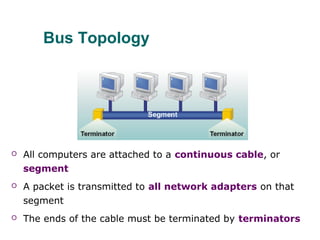
Bus Topology
 All computers are attached to a continuous cable, or
segment
 A packet is transmitted to all network adapters on that
segment
 The ends of the cable must be terminated by terminators
BUS
 When a device wants to transmit across the
bus, it has to determine whether the media is
in use.
 If no other device is transmitting, the signal is
sent.
 Each device receives the signal and then
determines whether its address matches that of
the recipient.
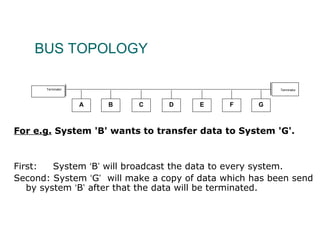
BUS TOPOLOGY
For e.g. System 'B' wants to transfer data to System 'G'.
First: System ‘B’ will broadcast the data to every system.
Second: System ‘G’ will make a copy of data which has been send
by system ‘B’ after that the data will be terminated.
A B C D E F G
TerminatorTerminator
There are three issues to consider with linear bus topology
 The number of computers connected to the cable: The
more computers on the network, the more traffic there will be
on the network. These computers will compete with each other
to send data because they can only do so one at a time.
 Signal bounce: signal bounce refers to an electrical property
of sending data through a cable. Without termination, an
electrical signal will bounce back and forth along the cable,
preventing all computers from sending data.
 Terminators: Each end of the trunk cable needs to be
properly terminated. A terminator prevents signal bounce.
 Bus topologies use coaxial cable. T connectors are often used
to connect the computer to the trunk cable.
BUS Topology Features
 Problem: If there is
1. A break anywhere in the cable OR
2. An end is not terminated
 Consequence: the signal will travel back and
forth across the network and ALL
COMMUNICATION WILL STOP.
BUS Topology Features
 The number of computers attached to a bus also
affects network performance.
 Because of the way computers communicate in a
bus topology, there may be a lot of collision or
noise.
BUS
 The advantages of using bus include
 Easy to install and configure
 Inexpensive
 Easily extended.
The disadvantages of using bus include
 Performance degrades.
 Barrel connectors used to extend the cable lengths can
weaken the signal.
 Troubleshooting a bus can be quite
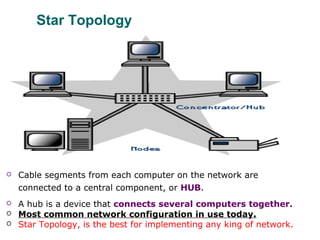
Star Topology
 Cable segments from each computer on the network are
connected to a central component, or HUB.
 A hub is a device that connects several computers together.
 Most common network configuration in use today.
 Star Topology, is the best for implementing any king of network.
Star Topology Features
ADVANTAGES:
 If one computer on the star topology fails, the remainder
of the network functions normally.
___________________________________________
DISADVANTAGES:
 Because each computer is connected to a hub, if the hub
fails, the entire network fails.
Types of Hub
 A passive hub: is used to connect computers in a
broadcast network. The signal sent to a passive hub is sent
to all workstations with no regeneration or amplification.
 An active hub: uses an external power source and
regenerates the signal before sending it out to all
workstations. Because the active hub regenerates the
signal, greater cable distances are allowed.
 A switched hub :directs the signal directly to the
recipient. Switched hubs can greatly reduce network traffic.
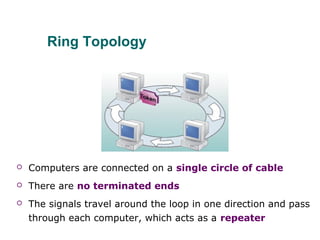
Ring Topology
 Computers are connected on a single circle of cable
 There are no terminated ends
 The signals travel around the loop in one direction and pass
through each computer, which acts as a repeater
Ring topology Feature
ADVANTAGE
 Each computer acts as a repeater, thereby preserving
signal strength.
 Handle high-traffic environments better than bus
networks.
 The impact of noise is reduced in the ring topology.
DISADVANTAGE
 only one computer at a time can send data on a single
token ring.
 Usually more expensive than bus technologies.
Token Passing
 The method of transmitting data around the ring
is called token passing.
 A token is a special series of bits that contains
control information.
 Possession of the token allows a network device to
transmit data to the network.
 Each network has ONLY ONE TOKEN.
Concept of Ring Topology
All computers are connected by a single
cable.
In Ring Topology the ends are not terminated
and the cable forms a full loop connecting
the last computer to the first computer.
Token Passing Ring Concept.
The Way of Transmitting Using Token Passing
 The sending computer removes the token from the ring
 It sends the message around the ring.
 Each computer passes along the message until the it finds
the computer that matches the address.
 The receiving computer then returns a confirmation
message to the sending computer.
 After verification, the sending computer creates a new
token and releases it to the network.
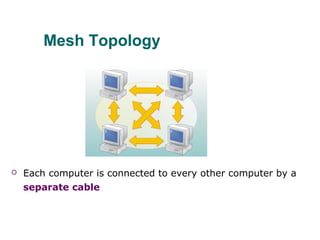
Mesh Topology
 Each computer is connected to every other computer by a
separate cable
Mesh Topology
ADVANTAGES
 If one cable fails, another carries the traffic and the
network continues to function.
 On a larger scale, multiple LANs can be connected to each
other by using leased telephone lines.
DISADVANTAGES
 Because redundant paths, a mesh topology can be
expensive
 The number of interconnections would be more.
 Difficult to implement with Big Network.
 Very Complicated.
 Multiple use of NIC Card in every system.
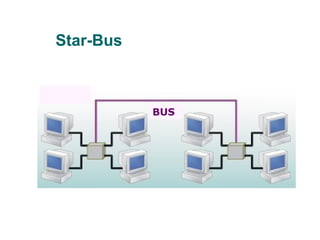
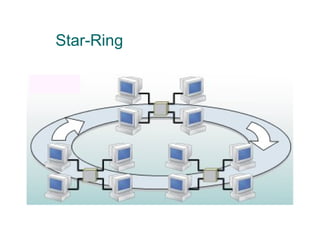
Hybrid Topologies
 Two or more topologies are combined to form a
complete network design.
 Star-bus topology.
 Star-ring topology.
Star-Bus
BUS
Star-Ring
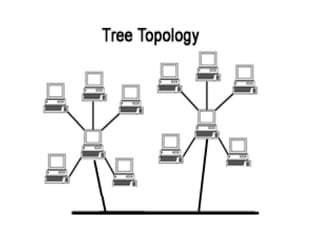
Tree Topology
Also known as a star bus topology,
tree topology is one of the most
common types of network setups
that is similar to a bus topology and
a star topology. A tree topology
connects multiple star networks to
other star networks. Below is a
visual example of a simple
computer setup on a network using
the star topology.
A network topology that, from a purely topologic
viewpoint, resembles an interconnection of star
networks in that individual peripheral nodes are
required to transmit to and receive from one other
node only, toward a central node, and are not
required to act as repeaters or regenerators.
Note 1: The function of the central node may be
distributed
Note 2: As in the conventional star network, individual
nodes may thus still be isolated from the network by a
single-point failure of a transmission path to the node.
Note 3: A single-point failure of a transmission path
within a distributed node will result in partitioning two
or more stations from the rest of the network.
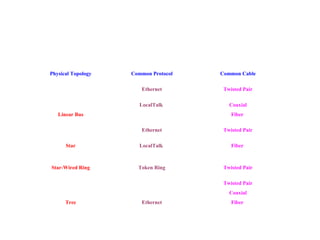
Physical Topology Common Protocol Common Cable
Linear Bus
Ethernet Twisted Pair
LocalTalk Coaxial
Fiber
Star
Ethernet Twisted Pair
LocalTalk Fiber
Star-Wired Ring Token Ring Twisted Pair
Tree Ethernet
Twisted Pair
Coaxial
Fiber
Dr. Kamal Gulati
Associate Professor |
University Quality Support Head |
Mentoring Programme Coordinator
]Ph. D., M.Sc. (Computer Science), M.C.A., M.B.A[
Professional Certifications:
Certified Microsoft Innovative Educator
Data Science 101 Certification from Big Data University
R Language 101 Certification from Big Data University
SQL Certification from SOLOLEARN.com
Certified IBM Big Data 101 from Big Data University
R Program & Python Certified from DataCamp
Wiley Certified Big Data Analyst [WCBDA[
Certification on DBMS from IIT Mumbai
Certified Cisco Certified Network Associate [CCNA[
Certified Microsoft Certified Professional [MCP[
Certified Brainbench in Computer Fundamentals, Microsoft Access, MySQL
5.7 Administration & Microsoft Project
•Worked as Visiting Professor with Stratford University, USA for six months
from Jan’2016 to June’2016.
•Also worked at Bahrain University in Kingdom of Bahrain Sr. I.T. Faculty
(Computer Science Department) for Period of 2 Years.
•Have rich experience in the field of teaching and research in Computer
Science and Information Technology for almost 15+ years in Academia.
•Having experience of working with both private and public institutions and
universities as the lecturer and self-instruction material writer for
Information Technology courses.
•Had number of research papers published in national and international
journals and conference proceedings in IEEE and Scopus Index.
•Also chaired various National and International Conferences of repute and
associated with various International Journals as Editorial Board Member
for International and National, Academic Adviser and Research Paper
Reviewer.
My current area of interest: Big Data Analytics, R Software, Management
Information System, IT Project Management, Decision Support System,
Business Analytics, Database Management System, Data Networking and
Advanced Excel with Visual Basic Macros.
Country Visited: USA, Canada, UK, UAE, Bahrain, Oman (Mostly for
Teaching and Research Purpose(
Profile of Dr. Kamal Gulati
Technical Program Committee for International Conference on Data, Engineering and
Applications 2017 (IDEA-2k17) which would be on October 28-29, 2017 at Bhopal.
http://www.ideaconference.in
Advisory Board Committee Member for International Conference on Energy,
Communication, Data Analytics and Soft Computing (ICECDS) which would be on 1-2
August 2017 at SKR Engineering College, Poonamallee, Tamil Nadu, India.http://ecds.org.in
Advisory Committee Member for International Conference on Innovative Research in
Engineering and Science which would be on 16-17 June 2017 at Asian Institute of
Technology Conference Center Thailand.http://www.iresconf.org
Advisory Committee Member for International Conference on Cloud Computing and Internet
of everything which held on 10-11 Feb’2016 at Delhi-NCR.http://www.ccioet.org
Technical Committee member for InCITe-2016 (International Conference on Information
Technology) Theme - Internet of Things: Connect Your Worlds, IT Summit, Amity
University 2016 which held on 06-07 Oct, 2016.http://www.amity.edu/incite2016
Technical Speaker for Global perspective on IT business “The Changing Scenario” – Big
Data on International Students Conference New Delhi (ISCND) which held on 14-15 Oct,
2016http://iscnd.com
Advisory Committee Member for International Conference on Sustainable Computing
Techniques in Engineering, Science and Management which has held on 09-10 Sep’2016 at
Delhi-NCR.http://www.scesm.org
Technical Program Committee Member for Program Committee Member for International
Conference on Recent Trends IN ICT, Jaipur, India, Aug 18-19, 2017 http://rtict.org
Program Committee Member for International Conference on Recent Advancement in
Computer and Communication Bhopal, India, (IC-RAC-2017) May 26-27, 2017
http://www.icrac.co.in
Profile Contd….
Editorial Board member for the following International
Journals:
International Journal of Computer Science and Innovation
http://www.infinitysciences.org
International Journal of Latest Research in Engineering and
Technology http://www.ijlret.com
International Journal of Latest Trends in Engineering and
Technology http://www.ijltet.org
InternationalJournalofApplicationorInnovationin
Engineering&Management http://www.ijaiem.org
International Journal for Management http://www.ijm-apm.com
ITM International Journal of Innovations in Science, Engineering
& Management www.iijisem.org
The International Journal of Emerging Engineering and
Embedded Systems http://www.ijeees.org
Conference Info http://conferenceinfo.org/tpc.php
International Journal of Computer Engineering in Research
Trends (IJCERT) http://www.ijcert.org
Expert Speaker for Program “Insurance Beyond Doubt”
Presented by Oriental Insurance Co Ltd.
https://www.youtube.com/watch?v=GrvJkN_Zn3Q
Profile Contd….
BOOK, CHAPTER, and CASE STUDY Published
Published Book on “A Study of Changing Trends in E-CRM
of Indian Insurance Industry” Published by LAP Lambert
Academic Publishing, one of the top researchers and
renowned scientists of Germany with ISBN: 3330009543,
9783330009547. The Book available at Amazon.com.
Published Real Case Study on “IoT Security
Considerations for Higher Education” published on
Business Cases - RENVOI 2017 BOOK (The Case Centre,
UK) with ISBN: 978-1-4828-8840-9, Page 63-70. The
Book available at the various online website: Amazon,
AbeBooks, Chegg, Barnes & Noble.
Published Chapter on "Role of eWorld in Insurance
Innovation" Published by Insurance Institute of India
(III), 60 Years Diamond Jubilee, Compendium, Nov 2016
– (Magazine) – One of the premium Insurance Institute
of India.
Contact Details
Email : drkamalgulati@gmail.com
Website : http://mybigdataanalytics.com
LinkedIn :
https://in.linkedin.com/in/drkamalgulati

Network Topologies in Simple (Logical, Physical and Types)

  • 1.
  • 2.
    Topology The shape ofa Local-Area Network (LAN) or other communications system. Topologies are either Physical or Logical.
  • 3.
    Physical Topology The physicallayout of devices on a network. Every LAN has a topology, or the way that the devices on a network are arranged and how they communicate with each other. The way that the workstations are connected to the network through the actual cables that transmit data -- the physical structure of the network -- is called the physical topology. How the physical components on a network are connected. (Design, Diagram & Map(
  • 4.
    Logical Topology The logicaltopology, also called signal topology in contrast, is the way that the signals act on the network media, or the way that the data passes through the network from one device to the next without regard to the physical interconnection of the devices. Logical topologies are bound to the network protocols that direct how the data moves across a network. The Ethernet protocol is a common logical bus topology protocol. Token Ring networks use a logical ring topology, but physically they are cabled using a star topology.
  • 5.
    Six Basic PhysicalTopologies  Bus  Star  Ring  Tree  Mesh  Hybrid
  • 6.
    Bus Topology  Allcomputers are attached to a continuous cable, or segment  A packet is transmitted to all network adapters on that segment  The ends of the cable must be terminated by terminators
  • 7.
    BUS  When adevice wants to transmit across the bus, it has to determine whether the media is in use.  If no other device is transmitting, the signal is sent.  Each device receives the signal and then determines whether its address matches that of the recipient.
  • 8.
    BUS TOPOLOGY For e.g.System 'B' wants to transfer data to System 'G'. First: System ‘B’ will broadcast the data to every system. Second: System ‘G’ will make a copy of data which has been send by system ‘B’ after that the data will be terminated. A B C D E F G TerminatorTerminator
  • 9.
    There are threeissues to consider with linear bus topology  The number of computers connected to the cable: The more computers on the network, the more traffic there will be on the network. These computers will compete with each other to send data because they can only do so one at a time.  Signal bounce: signal bounce refers to an electrical property of sending data through a cable. Without termination, an electrical signal will bounce back and forth along the cable, preventing all computers from sending data.  Terminators: Each end of the trunk cable needs to be properly terminated. A terminator prevents signal bounce.  Bus topologies use coaxial cable. T connectors are often used to connect the computer to the trunk cable.
  • 10.
    BUS Topology Features Problem: If there is 1. A break anywhere in the cable OR 2. An end is not terminated  Consequence: the signal will travel back and forth across the network and ALL COMMUNICATION WILL STOP.
  • 11.
    BUS Topology Features The number of computers attached to a bus also affects network performance.  Because of the way computers communicate in a bus topology, there may be a lot of collision or noise.
  • 12.
    BUS  The advantagesof using bus include  Easy to install and configure  Inexpensive  Easily extended. The disadvantages of using bus include  Performance degrades.  Barrel connectors used to extend the cable lengths can weaken the signal.  Troubleshooting a bus can be quite
  • 13.
    Star Topology  Cablesegments from each computer on the network are connected to a central component, or HUB.  A hub is a device that connects several computers together.  Most common network configuration in use today.  Star Topology, is the best for implementing any king of network.
  • 14.
    Star Topology Features ADVANTAGES: If one computer on the star topology fails, the remainder of the network functions normally. ___________________________________________ DISADVANTAGES:  Because each computer is connected to a hub, if the hub fails, the entire network fails.
  • 15.
    Types of Hub A passive hub: is used to connect computers in a broadcast network. The signal sent to a passive hub is sent to all workstations with no regeneration or amplification.  An active hub: uses an external power source and regenerates the signal before sending it out to all workstations. Because the active hub regenerates the signal, greater cable distances are allowed.  A switched hub :directs the signal directly to the recipient. Switched hubs can greatly reduce network traffic.
  • 16.
    Ring Topology  Computersare connected on a single circle of cable  There are no terminated ends  The signals travel around the loop in one direction and pass through each computer, which acts as a repeater
  • 17.
    Ring topology Feature ADVANTAGE Each computer acts as a repeater, thereby preserving signal strength.  Handle high-traffic environments better than bus networks.  The impact of noise is reduced in the ring topology. DISADVANTAGE  only one computer at a time can send data on a single token ring.  Usually more expensive than bus technologies.
  • 18.
    Token Passing  Themethod of transmitting data around the ring is called token passing.  A token is a special series of bits that contains control information.  Possession of the token allows a network device to transmit data to the network.  Each network has ONLY ONE TOKEN.
  • 19.
    Concept of RingTopology All computers are connected by a single cable. In Ring Topology the ends are not terminated and the cable forms a full loop connecting the last computer to the first computer. Token Passing Ring Concept.
  • 20.
    The Way ofTransmitting Using Token Passing  The sending computer removes the token from the ring  It sends the message around the ring.  Each computer passes along the message until the it finds the computer that matches the address.  The receiving computer then returns a confirmation message to the sending computer.  After verification, the sending computer creates a new token and releases it to the network.
  • 21.
    Mesh Topology  Eachcomputer is connected to every other computer by a separate cable
  • 22.
    Mesh Topology ADVANTAGES  Ifone cable fails, another carries the traffic and the network continues to function.  On a larger scale, multiple LANs can be connected to each other by using leased telephone lines. DISADVANTAGES  Because redundant paths, a mesh topology can be expensive  The number of interconnections would be more.  Difficult to implement with Big Network.  Very Complicated.  Multiple use of NIC Card in every system.
  • 23.
    Hybrid Topologies  Twoor more topologies are combined to form a complete network design.  Star-bus topology.  Star-ring topology.
  • 24.
  • 25.
  • 26.
    Tree Topology Also knownas a star bus topology, tree topology is one of the most common types of network setups that is similar to a bus topology and a star topology. A tree topology connects multiple star networks to other star networks. Below is a visual example of a simple computer setup on a network using the star topology.
  • 28.
    A network topologythat, from a purely topologic viewpoint, resembles an interconnection of star networks in that individual peripheral nodes are required to transmit to and receive from one other node only, toward a central node, and are not required to act as repeaters or regenerators. Note 1: The function of the central node may be distributed Note 2: As in the conventional star network, individual nodes may thus still be isolated from the network by a single-point failure of a transmission path to the node. Note 3: A single-point failure of a transmission path within a distributed node will result in partitioning two or more stations from the rest of the network.
  • 29.
    Physical Topology CommonProtocol Common Cable Linear Bus Ethernet Twisted Pair LocalTalk Coaxial Fiber Star Ethernet Twisted Pair LocalTalk Fiber Star-Wired Ring Token Ring Twisted Pair Tree Ethernet Twisted Pair Coaxial Fiber
  • 30.
    Dr. Kamal Gulati AssociateProfessor | University Quality Support Head | Mentoring Programme Coordinator ]Ph. D., M.Sc. (Computer Science), M.C.A., M.B.A[ Professional Certifications: Certified Microsoft Innovative Educator Data Science 101 Certification from Big Data University R Language 101 Certification from Big Data University SQL Certification from SOLOLEARN.com Certified IBM Big Data 101 from Big Data University R Program & Python Certified from DataCamp Wiley Certified Big Data Analyst [WCBDA[ Certification on DBMS from IIT Mumbai Certified Cisco Certified Network Associate [CCNA[ Certified Microsoft Certified Professional [MCP[ Certified Brainbench in Computer Fundamentals, Microsoft Access, MySQL 5.7 Administration & Microsoft Project
  • 31.
    •Worked as VisitingProfessor with Stratford University, USA for six months from Jan’2016 to June’2016. •Also worked at Bahrain University in Kingdom of Bahrain Sr. I.T. Faculty (Computer Science Department) for Period of 2 Years. •Have rich experience in the field of teaching and research in Computer Science and Information Technology for almost 15+ years in Academia. •Having experience of working with both private and public institutions and universities as the lecturer and self-instruction material writer for Information Technology courses. •Had number of research papers published in national and international journals and conference proceedings in IEEE and Scopus Index. •Also chaired various National and International Conferences of repute and associated with various International Journals as Editorial Board Member for International and National, Academic Adviser and Research Paper Reviewer. My current area of interest: Big Data Analytics, R Software, Management Information System, IT Project Management, Decision Support System, Business Analytics, Database Management System, Data Networking and Advanced Excel with Visual Basic Macros. Country Visited: USA, Canada, UK, UAE, Bahrain, Oman (Mostly for Teaching and Research Purpose( Profile of Dr. Kamal Gulati
  • 32.
    Technical Program Committeefor International Conference on Data, Engineering and Applications 2017 (IDEA-2k17) which would be on October 28-29, 2017 at Bhopal. http://www.ideaconference.in Advisory Board Committee Member for International Conference on Energy, Communication, Data Analytics and Soft Computing (ICECDS) which would be on 1-2 August 2017 at SKR Engineering College, Poonamallee, Tamil Nadu, India.http://ecds.org.in Advisory Committee Member for International Conference on Innovative Research in Engineering and Science which would be on 16-17 June 2017 at Asian Institute of Technology Conference Center Thailand.http://www.iresconf.org Advisory Committee Member for International Conference on Cloud Computing and Internet of everything which held on 10-11 Feb’2016 at Delhi-NCR.http://www.ccioet.org Technical Committee member for InCITe-2016 (International Conference on Information Technology) Theme - Internet of Things: Connect Your Worlds, IT Summit, Amity University 2016 which held on 06-07 Oct, 2016.http://www.amity.edu/incite2016 Technical Speaker for Global perspective on IT business “The Changing Scenario” – Big Data on International Students Conference New Delhi (ISCND) which held on 14-15 Oct, 2016http://iscnd.com Advisory Committee Member for International Conference on Sustainable Computing Techniques in Engineering, Science and Management which has held on 09-10 Sep’2016 at Delhi-NCR.http://www.scesm.org Technical Program Committee Member for Program Committee Member for International Conference on Recent Trends IN ICT, Jaipur, India, Aug 18-19, 2017 http://rtict.org Program Committee Member for International Conference on Recent Advancement in Computer and Communication Bhopal, India, (IC-RAC-2017) May 26-27, 2017 http://www.icrac.co.in Profile Contd….
  • 33.
    Editorial Board memberfor the following International Journals: International Journal of Computer Science and Innovation http://www.infinitysciences.org International Journal of Latest Research in Engineering and Technology http://www.ijlret.com International Journal of Latest Trends in Engineering and Technology http://www.ijltet.org InternationalJournalofApplicationorInnovationin Engineering&Management http://www.ijaiem.org International Journal for Management http://www.ijm-apm.com ITM International Journal of Innovations in Science, Engineering & Management www.iijisem.org The International Journal of Emerging Engineering and Embedded Systems http://www.ijeees.org Conference Info http://conferenceinfo.org/tpc.php International Journal of Computer Engineering in Research Trends (IJCERT) http://www.ijcert.org Expert Speaker for Program “Insurance Beyond Doubt” Presented by Oriental Insurance Co Ltd. https://www.youtube.com/watch?v=GrvJkN_Zn3Q Profile Contd….
  • 34.
    BOOK, CHAPTER, andCASE STUDY Published Published Book on “A Study of Changing Trends in E-CRM of Indian Insurance Industry” Published by LAP Lambert Academic Publishing, one of the top researchers and renowned scientists of Germany with ISBN: 3330009543, 9783330009547. The Book available at Amazon.com. Published Real Case Study on “IoT Security Considerations for Higher Education” published on Business Cases - RENVOI 2017 BOOK (The Case Centre, UK) with ISBN: 978-1-4828-8840-9, Page 63-70. The Book available at the various online website: Amazon, AbeBooks, Chegg, Barnes & Noble. Published Chapter on "Role of eWorld in Insurance Innovation" Published by Insurance Institute of India (III), 60 Years Diamond Jubilee, Compendium, Nov 2016 – (Magazine) – One of the premium Insurance Institute of India.
  • 35.
    Contact Details Email :drkamalgulati@gmail.com Website : http://mybigdataanalytics.com LinkedIn : https://in.linkedin.com/in/drkamalgulati