Japanese Current and
Future Technology
Management Challenges
Eric Vanderburg, MBA
October 7, 2004
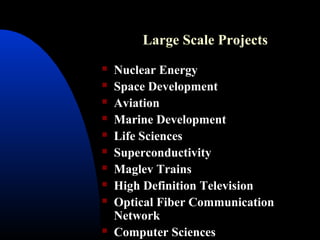
Large Scale Projects
 Nuclear Energy
 Space Development
 Aviation
 Marine Development
 Life Sciences
 Superconductivity
 Maglev Trains
 High Definition Television
 Optical Fiber Communication
Network
 Computer Sciences
Evaluation
 48 commercial nuclear electric power
reactors
 Concerns- safety and disaster-
prevention systems
 Japan has developed the use of
composite fuel (processing plant will
start operations in 2005(
 Doctoring of nuclear safety records of
five Tokyo Electric Co. reactors -
*Aug. 2002 undermined public
confidence in nuclear power industry
Evaluation
 Space development- Japan has launched
over 58 satellites for various uses- weather
observation, communications, broadcasting,
& earth observation- Japan has suffered
setbacks in its attempts at major launch. So
far its scientists have joined American
Shuttle Endeavor & Columbia
 Aviation- Japan participates in joint design
& development with Boeing- 767 , 777, &
V2500 civilian jet engine
 Japan is also working on feasibility of
studies for development of small passenger
planes *75 passengers- commercial &
supersonic transport aircraft
Evaluation
 can go up to a depth of 10,911 m
Marine Development- areas of
research are- marine biological
resources, seawater and sea bed
resources, marine energy, utilization
of space in the seas and marine
environment protection- using
Submarines Shinkai 2000 & Shinkai
6500, and latest is Kaiko
*unmanned submarine which
Evaluation
 Life Sciences- health care,
environmental protection, farming &
fishing, food processing, forestry, &
chemical manufacturing
 Japan has not made any distinguished
breakthroughs
 Maglev Trains- Japan is continuing
research on magnetic levitation
trains- promising results- test drives
have been successfully done at 400
km/hr. Cost and safety are still iisues
being worked on
Evaluation
 High-definition TV- been very
successful and so far has been used in
international sporting events- world
cup and Olympics
 Optical Fiber Communication
network- Currently Japan is working
on a high speed infrastructure that
would allow convergence of voice,
text, & image transmission – received
on all types of network terminals
Evaluation
 Computer Sciences- Currently Japan
is working on a four-dimensional
computer- with function closer to the
human brain- use will be automatic
driving systems for cars, and devices
capable of recognizing and identifying
people
 Research is still going on
Japan Incubators
 Japan has established incubators
in many parts of the country- both
private and public
 Results are not very encouraging
 There seems to be a problem of
supply push!
Japan Incubators
 Japan has established incubators
in many parts of the country- both
private and public
 Results are not very encouraging
 There seems to be a problem of
supply push!

Japanese current and future technology management challenges

  • 1.
    Japanese Current and FutureTechnology Management Challenges Eric Vanderburg, MBA October 7, 2004
  • 2.
    Large Scale Projects Nuclear Energy  Space Development  Aviation  Marine Development  Life Sciences  Superconductivity  Maglev Trains  High Definition Television  Optical Fiber Communication Network  Computer Sciences
  • 3.
    Evaluation  48 commercialnuclear electric power reactors  Concerns- safety and disaster- prevention systems  Japan has developed the use of composite fuel (processing plant will start operations in 2005(  Doctoring of nuclear safety records of five Tokyo Electric Co. reactors - *Aug. 2002 undermined public confidence in nuclear power industry
  • 4.
    Evaluation  Space development-Japan has launched over 58 satellites for various uses- weather observation, communications, broadcasting, & earth observation- Japan has suffered setbacks in its attempts at major launch. So far its scientists have joined American Shuttle Endeavor & Columbia  Aviation- Japan participates in joint design & development with Boeing- 767 , 777, & V2500 civilian jet engine  Japan is also working on feasibility of studies for development of small passenger planes *75 passengers- commercial & supersonic transport aircraft
  • 5.
    Evaluation  can goup to a depth of 10,911 m Marine Development- areas of research are- marine biological resources, seawater and sea bed resources, marine energy, utilization of space in the seas and marine environment protection- using Submarines Shinkai 2000 & Shinkai 6500, and latest is Kaiko *unmanned submarine which
  • 6.
    Evaluation  Life Sciences-health care, environmental protection, farming & fishing, food processing, forestry, & chemical manufacturing  Japan has not made any distinguished breakthroughs  Maglev Trains- Japan is continuing research on magnetic levitation trains- promising results- test drives have been successfully done at 400 km/hr. Cost and safety are still iisues being worked on
  • 7.
    Evaluation  High-definition TV-been very successful and so far has been used in international sporting events- world cup and Olympics  Optical Fiber Communication network- Currently Japan is working on a high speed infrastructure that would allow convergence of voice, text, & image transmission – received on all types of network terminals
  • 8.
    Evaluation  Computer Sciences-Currently Japan is working on a four-dimensional computer- with function closer to the human brain- use will be automatic driving systems for cars, and devices capable of recognizing and identifying people  Research is still going on
  • 9.
    Japan Incubators  Japanhas established incubators in many parts of the country- both private and public  Results are not very encouraging  There seems to be a problem of supply push!
  • 10.
    Japan Incubators  Japanhas established incubators in many parts of the country- both private and public  Results are not very encouraging  There seems to be a problem of supply push!