
Deconstructing website attacks
© 2015 Property of JurInnov Ltd. All Rights Reserved
Eric A. Vanderburg, MBA, CISSP
Director, Information Systems and Security
Computer Forensic and Investigation Services
© 2015 Property of JurInnov Ltd. All Rights Reserved© 2015 Property of JurInnov Ltd. All Rights Reserved
The nature of website attacks
• Current state
• Attacks
– Injection attacks
– Cross Site Scripting (XSS)
– Session Management attacks
– Object reference attacks
2
© 2015 Property of JurInnov Ltd. All Rights Reserved
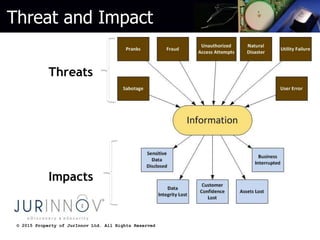
Threats
Impacts
Threat and Impact
© 2015 Property of JurInnov Ltd. All Rights Reserved© 2015 Property of JurInnov Ltd. All Rights Reserved
Current state
 Average breach costs $214 per record
 Average organizational cost $7.2 million per
incident
 Risk and compliance budgets expected to
increase by 21%
4
© 2015 Property of JurInnov Ltd. All Rights Reserved© 2015 Property of JurInnov Ltd. All Rights Reserved
$548 million
The US government
is increasing cyber
security R&D by 35%
to $548 million next
year
More organized
outside attacks
Facts and Figures
© 2015 Property of JurInnov Ltd. All Rights Reserved© 2015 Property of JurInnov Ltd. All Rights Reserved
Injection attacks
• Injection - Tricking an application into including
unintended commands in the data sent to an
interpreter
• Interpreter
– Take strings and interpret them as commands
– SQL, OS Shell, LDAP, XPath, Hibernate, etc…
• SQL injection
– Many applications still susceptible
– Even though it’s usually very simple to avoid
6
© 2015 Property of JurInnov Ltd. All Rights Reserved© 2015 Property of JurInnov Ltd. All Rights Reserved
Injection impact
• Usually severe.
• Entire database can usually
be read or modified
• May also allow full database
schema, or account access,
or even operating system
level access
7
© 2015 Property of JurInnov Ltd. All Rights Reserved© 2015 Property of JurInnov Ltd. All Rights Reserved
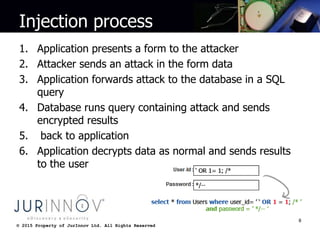
Injection process
1. Application presents a form to the attacker
2. Attacker sends an attack in the form data
3. Application forwards attack to the database in a SQL
query
4. Database runs query containing attack and sends
encrypted results
5. back to application
6. Application decrypts data as normal and sends results
to the user
8
© 2015 Property of JurInnov Ltd. All Rights Reserved© 2015 Property of JurInnov Ltd. All Rights Reserved
Injection Protection
• Avoid the interpreter entirely
• Use an interface that supports bind variables (e.g.,
prepared statements, or stored procedures),
– Bind variables allow the interpreter to distinguish between code
and data
• Encode all user input before passing it to the interpreter
• Always perform ‘white list’ input validation on all user
supplied input
• Always minimize database privileges to reduce the
impact of a flaw
9
© 2015 Property of JurInnov Ltd. All Rights Reserved© 2015 Property of JurInnov Ltd. All Rights Reserved
Cross-Site Scripting (XSS)
• Cross-Site Scripting (XSS) - Raw data from
attacker is sent to an innocent user’s browser
• Raw data
– Stored in database
– Reflected from web input (form field, hidden
field, URL, etc…)
– Sent directly into rich JavaScript client
10
© 2015 Property of JurInnov Ltd. All Rights Reserved© 2015 Property of JurInnov Ltd. All Rights Reserved
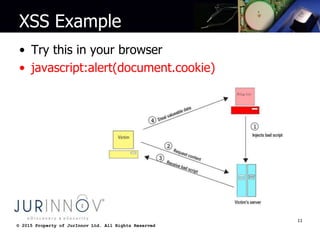
XSS Example
• Try this in your browser
• javascript:alert(document.cookie)
11
© 2015 Property of JurInnov Ltd. All Rights Reserved© 2015 Property of JurInnov Ltd. All Rights Reserved
XSS Impact
• Steal user’s session, steal sensitive data, rewrite
web page, redirect user to phishing or malware
site
• Most Severe: Install XSS proxy which allows
attacker to observe and direct all user’s behavior
on vulnerable site and force user to other sites
12
© 2015 Property of JurInnov Ltd. All Rights Reserved© 2015 Property of JurInnov Ltd. All Rights Reserved
XSS Protection
• Eliminate Flaw
– Don’t include user supplied input in the output page
• Defend Against the Flaw
– Primary Recommendation: Output encode all user
supplied input
– Perform ‘white list’ input validation on all user input to
be included in page
– For large chunks of user supplied HTML, use OWASP’s
AntiSamy to sanitize this HTML to make it safe
13
© 2015 Property of JurInnov Ltd. All Rights Reserved© 2015 Property of JurInnov Ltd. All Rights Reserved
Session Management
• HTTP as a stateless protocol
– Credentials have to go with every request
– SSL should be used for everything requiring
authentication
• Session management flaws
– SESSION ID used to track state since HTTP
doesn’t
– SESSION ID is typically exposed on the network,
in browser, in logs
14
© 2015 Property of JurInnov Ltd. All Rights Reserved© 2015 Property of JurInnov Ltd. All Rights Reserved
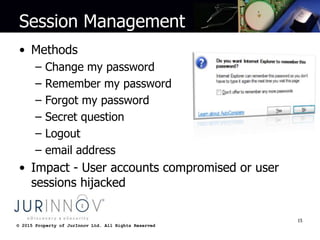
Session Management
• Methods
– Change my password
– Remember my password
– Forgot my password
– Secret question
– Logout
– email address
• Impact - User accounts compromised or user
sessions hijacked
15
© 2015 Property of JurInnov Ltd. All Rights Reserved© 2015 Property of JurInnov Ltd. All Rights Reserved
Protection techniques
• Verify your architecture
– Authentication should be simple, centralized, and standardized
– Use the standard session id provided by your container
– Be sure SSL protects both credentials and session id at all times
• Verify the implementation
– Forget automated analysis approaches
– Check your SSL certificate
– Examine all the authentication-related functions
– Verify that logoff actually destroys the session
– Use WebScarab to test the implementation
16
© 2015 Property of JurInnov Ltd. All Rights Reserved© 2015 Property of JurInnov Ltd. All Rights Reserved
Object references
• Caused by failed access control at the
presentation layer allowing attackers to modify
parameter values.
– Only listing the ‘authorized’ objects for the
current user, or
– Hiding the object references in hidden fields and
then not enforcing these restrictions on the
server side
• Impact - Users are able to access unauthorized
files or data
17
© 2015 Property of JurInnov Ltd. All Rights Reserved© 2015 Property of JurInnov Ltd. All Rights Reserved
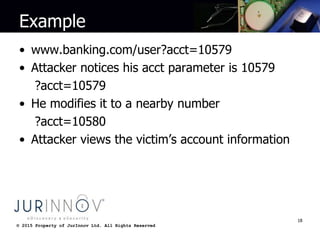
Example
• www.banking.com/user?acct=10579
• Attacker notices his acct parameter is 10579
?acct=10579
• He modifies it to a nearby number
?acct=10580
• Attacker views the victim’s account information
18
© 2015 Property of JurInnov Ltd. All Rights Reserved© 2015 Property of JurInnov Ltd. All Rights Reserved
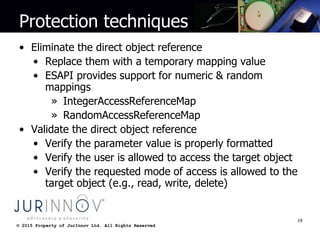
Protection techniques
• Eliminate the direct object reference
• Replace them with a temporary mapping value
• ESAPI provides support for numeric & random
mappings
» IntegerAccessReferenceMap
» RandomAccessReferenceMap
• Validate the direct object reference
• Verify the parameter value is properly formatted
• Verify the user is allowed to access the target object
• Verify the requested mode of access is allowed to the
target object (e.g., read, write, delete)
19
© 2015 Property of JurInnov Ltd. All Rights Reserved© 2015 Property of JurInnov Ltd. All Rights Reserved
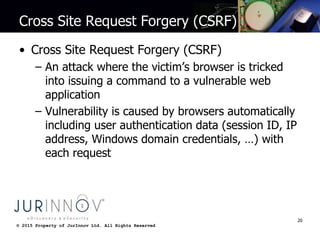
Cross Site Request Forgery (CSRF)
• Cross Site Request Forgery (CSRF)
– An attack where the victim’s browser is tricked
into issuing a command to a vulnerable web
application
– Vulnerability is caused by browsers automatically
including user authentication data (session ID, IP
address, Windows domain credentials, …) with
each request
20
© 2015 Property of JurInnov Ltd. All Rights Reserved© 2015 Property of JurInnov Ltd. All Rights Reserved
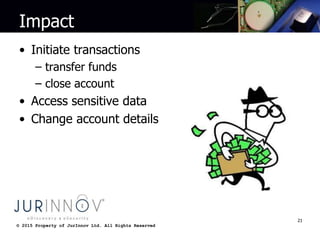
Impact
• Initiate transactions
– transfer funds
– close account
• Access sensitive data
• Change account details
21
© 2015 Property of JurInnov Ltd. All Rights Reserved© 2015 Property of JurInnov Ltd. All Rights Reserved
Protection techniques
• Add a secret, not automatically submitted, token to ALL
sensitive requests
– This makes it impossible for the attacker to spoof the
request
– Tokens should be cryptographically strong or random
• Don’t allow attackers to store attacks on your site
– Properly encode all input on the way out
– This renders all links/requests inert in most
interpreters
22
© 2015 Property of JurInnov Ltd. All Rights Reserved© 2015 Property of JurInnov Ltd. All Rights Reserved
Protection techniques
• Store a single token in the session and add it to
all forms and links
– Hidden Field: <input name="token"
value="687965fdfaew87agrde" type="hidden"/>
– Single use URL: /accounts/687965fdfaew87agrde
– Form Token: /accounts?auth=687965fdfaew87agrde …
• Use hidden fields so that the token in a referrer
header is not exposed
• Have a unique token for each function
• Require secondary authentication for functions
23
© 2015 Property of JurInnov Ltd. All Rights Reserved
Questions
© 2015 Property of JurInnov Ltd. All Rights Reserved© 2015 Property of JurInnov Ltd. All Rights Reserved
For assistance or additional information
• Phone: 216-664-1100
• Web: www.jurinnov.com
• Email: eric.vanderburg@jurinnov.com
• Twitter: @evanderburg
• Facebook: www.facebook.com/VanderburgE
• Linkedin: www.linkedin.com/in/evanderburg
• Youtube: www.youtube.com/user/evanderburg
JurInnov Ltd.
The Idea Center
1375 Euclid Avenue, Suite 400
Cleveland, Ohio 44115

Deconstructing website attacks - Eric Vanderburg

  • 1.
    Deconstructing website attacks ©2015 Property of JurInnov Ltd. All Rights Reserved Eric A. Vanderburg, MBA, CISSP Director, Information Systems and Security Computer Forensic and Investigation Services
  • 2.
    © 2015 Propertyof JurInnov Ltd. All Rights Reserved© 2015 Property of JurInnov Ltd. All Rights Reserved The nature of website attacks • Current state • Attacks – Injection attacks – Cross Site Scripting (XSS) – Session Management attacks – Object reference attacks 2
  • 3.
    © 2015 Propertyof JurInnov Ltd. All Rights Reserved Threats Impacts Threat and Impact
  • 4.
    © 2015 Propertyof JurInnov Ltd. All Rights Reserved© 2015 Property of JurInnov Ltd. All Rights Reserved Current state  Average breach costs $214 per record  Average organizational cost $7.2 million per incident  Risk and compliance budgets expected to increase by 21% 4
  • 5.
    © 2015 Propertyof JurInnov Ltd. All Rights Reserved© 2015 Property of JurInnov Ltd. All Rights Reserved $548 million The US government is increasing cyber security R&D by 35% to $548 million next year More organized outside attacks Facts and Figures
  • 6.
    © 2015 Propertyof JurInnov Ltd. All Rights Reserved© 2015 Property of JurInnov Ltd. All Rights Reserved Injection attacks • Injection - Tricking an application into including unintended commands in the data sent to an interpreter • Interpreter – Take strings and interpret them as commands – SQL, OS Shell, LDAP, XPath, Hibernate, etc… • SQL injection – Many applications still susceptible – Even though it’s usually very simple to avoid 6
  • 7.
    © 2015 Propertyof JurInnov Ltd. All Rights Reserved© 2015 Property of JurInnov Ltd. All Rights Reserved Injection impact • Usually severe. • Entire database can usually be read or modified • May also allow full database schema, or account access, or even operating system level access 7
  • 8.
    © 2015 Propertyof JurInnov Ltd. All Rights Reserved© 2015 Property of JurInnov Ltd. All Rights Reserved Injection process 1. Application presents a form to the attacker 2. Attacker sends an attack in the form data 3. Application forwards attack to the database in a SQL query 4. Database runs query containing attack and sends encrypted results 5. back to application 6. Application decrypts data as normal and sends results to the user 8
  • 9.
    © 2015 Propertyof JurInnov Ltd. All Rights Reserved© 2015 Property of JurInnov Ltd. All Rights Reserved Injection Protection • Avoid the interpreter entirely • Use an interface that supports bind variables (e.g., prepared statements, or stored procedures), – Bind variables allow the interpreter to distinguish between code and data • Encode all user input before passing it to the interpreter • Always perform ‘white list’ input validation on all user supplied input • Always minimize database privileges to reduce the impact of a flaw 9
  • 10.
    © 2015 Propertyof JurInnov Ltd. All Rights Reserved© 2015 Property of JurInnov Ltd. All Rights Reserved Cross-Site Scripting (XSS) • Cross-Site Scripting (XSS) - Raw data from attacker is sent to an innocent user’s browser • Raw data – Stored in database – Reflected from web input (form field, hidden field, URL, etc…) – Sent directly into rich JavaScript client 10
  • 11.
    © 2015 Propertyof JurInnov Ltd. All Rights Reserved© 2015 Property of JurInnov Ltd. All Rights Reserved XSS Example • Try this in your browser • javascript:alert(document.cookie) 11
  • 12.
    © 2015 Propertyof JurInnov Ltd. All Rights Reserved© 2015 Property of JurInnov Ltd. All Rights Reserved XSS Impact • Steal user’s session, steal sensitive data, rewrite web page, redirect user to phishing or malware site • Most Severe: Install XSS proxy which allows attacker to observe and direct all user’s behavior on vulnerable site and force user to other sites 12
  • 13.
    © 2015 Propertyof JurInnov Ltd. All Rights Reserved© 2015 Property of JurInnov Ltd. All Rights Reserved XSS Protection • Eliminate Flaw – Don’t include user supplied input in the output page • Defend Against the Flaw – Primary Recommendation: Output encode all user supplied input – Perform ‘white list’ input validation on all user input to be included in page – For large chunks of user supplied HTML, use OWASP’s AntiSamy to sanitize this HTML to make it safe 13
  • 14.
    © 2015 Propertyof JurInnov Ltd. All Rights Reserved© 2015 Property of JurInnov Ltd. All Rights Reserved Session Management • HTTP as a stateless protocol – Credentials have to go with every request – SSL should be used for everything requiring authentication • Session management flaws – SESSION ID used to track state since HTTP doesn’t – SESSION ID is typically exposed on the network, in browser, in logs 14
  • 15.
    © 2015 Propertyof JurInnov Ltd. All Rights Reserved© 2015 Property of JurInnov Ltd. All Rights Reserved Session Management • Methods – Change my password – Remember my password – Forgot my password – Secret question – Logout – email address • Impact - User accounts compromised or user sessions hijacked 15
  • 16.
    © 2015 Propertyof JurInnov Ltd. All Rights Reserved© 2015 Property of JurInnov Ltd. All Rights Reserved Protection techniques • Verify your architecture – Authentication should be simple, centralized, and standardized – Use the standard session id provided by your container – Be sure SSL protects both credentials and session id at all times • Verify the implementation – Forget automated analysis approaches – Check your SSL certificate – Examine all the authentication-related functions – Verify that logoff actually destroys the session – Use WebScarab to test the implementation 16
  • 17.
    © 2015 Propertyof JurInnov Ltd. All Rights Reserved© 2015 Property of JurInnov Ltd. All Rights Reserved Object references • Caused by failed access control at the presentation layer allowing attackers to modify parameter values. – Only listing the ‘authorized’ objects for the current user, or – Hiding the object references in hidden fields and then not enforcing these restrictions on the server side • Impact - Users are able to access unauthorized files or data 17
  • 18.
    © 2015 Propertyof JurInnov Ltd. All Rights Reserved© 2015 Property of JurInnov Ltd. All Rights Reserved Example • www.banking.com/user?acct=10579 • Attacker notices his acct parameter is 10579 ?acct=10579 • He modifies it to a nearby number ?acct=10580 • Attacker views the victim’s account information 18
  • 19.
    © 2015 Propertyof JurInnov Ltd. All Rights Reserved© 2015 Property of JurInnov Ltd. All Rights Reserved Protection techniques • Eliminate the direct object reference • Replace them with a temporary mapping value • ESAPI provides support for numeric & random mappings » IntegerAccessReferenceMap » RandomAccessReferenceMap • Validate the direct object reference • Verify the parameter value is properly formatted • Verify the user is allowed to access the target object • Verify the requested mode of access is allowed to the target object (e.g., read, write, delete) 19
  • 20.
    © 2015 Propertyof JurInnov Ltd. All Rights Reserved© 2015 Property of JurInnov Ltd. All Rights Reserved Cross Site Request Forgery (CSRF) • Cross Site Request Forgery (CSRF) – An attack where the victim’s browser is tricked into issuing a command to a vulnerable web application – Vulnerability is caused by browsers automatically including user authentication data (session ID, IP address, Windows domain credentials, …) with each request 20
  • 21.
    © 2015 Propertyof JurInnov Ltd. All Rights Reserved© 2015 Property of JurInnov Ltd. All Rights Reserved Impact • Initiate transactions – transfer funds – close account • Access sensitive data • Change account details 21
  • 22.
    © 2015 Propertyof JurInnov Ltd. All Rights Reserved© 2015 Property of JurInnov Ltd. All Rights Reserved Protection techniques • Add a secret, not automatically submitted, token to ALL sensitive requests – This makes it impossible for the attacker to spoof the request – Tokens should be cryptographically strong or random • Don’t allow attackers to store attacks on your site – Properly encode all input on the way out – This renders all links/requests inert in most interpreters 22
  • 23.
    © 2015 Propertyof JurInnov Ltd. All Rights Reserved© 2015 Property of JurInnov Ltd. All Rights Reserved Protection techniques • Store a single token in the session and add it to all forms and links – Hidden Field: <input name="token" value="687965fdfaew87agrde" type="hidden"/> – Single use URL: /accounts/687965fdfaew87agrde – Form Token: /accounts?auth=687965fdfaew87agrde … • Use hidden fields so that the token in a referrer header is not exposed • Have a unique token for each function • Require secondary authentication for functions 23
  • 24.
    © 2015 Propertyof JurInnov Ltd. All Rights Reserved Questions
  • 25.
    © 2015 Propertyof JurInnov Ltd. All Rights Reserved© 2015 Property of JurInnov Ltd. All Rights Reserved For assistance or additional information • Phone: 216-664-1100 • Web: www.jurinnov.com • Email: eric.vanderburg@jurinnov.com • Twitter: @evanderburg • Facebook: www.facebook.com/VanderburgE • Linkedin: www.linkedin.com/in/evanderburg • Youtube: www.youtube.com/user/evanderburg JurInnov Ltd. The Idea Center 1375 Euclid Avenue, Suite 400 Cleveland, Ohio 44115