Manoj Kumar
M.Sc.(Computer Science)
Saturday, January 24, 2015 1
 A network as a "group of computers and associated devices
that are connected by communications facilities.“
 A network provides two principle benefits: the ability to
communicate and the ability to share.
A network supports communication among users in ways that other media
cannot. E-mail, the most popular form of network communication,
provides low-cost, printable correspondence with the capability for
forwarding, acknowledgment, storage, retrieval, and attachments.
Sharing involves not only information (database records, e-mail, graphics,
etc.), but also resources (applications, printers, modems, disk space,
scanners, etc.) Through its ability to share, a network promotes
collaboration
Saturday, January 24, 2015 2
 A network can consist of two computers connected
together on a desk or it can consist of many Local
Area Networks (LANs) connected together to form a
Wide Area Network (WAN) across a continent.
Saturday, January 24, 2015 3
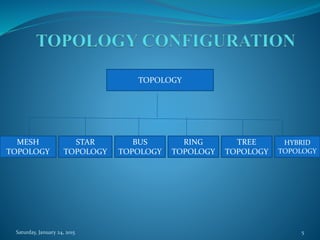
 A topology refers to the manner in which the cable is
run to individual workstations on the network.
 Two or more devices connect to a link; two or more
links are forms of topology.
 The topology of network is the geometrical
representation of the relationship of all the links and
linking devices (usually called nodes) one to another.
 A topology is concerned with the physical
arrangement of the network components
Saturday, January 24, 2015 4
TOPOLOGY
MESH
TOPOLOGY
STAR
TOPOLOGY
BUS
TOPOLOGY
RING
TOPOLOGY
TREE
TOPOLOGY
HYBRID
TOPOLOGY
Saturday, January 24, 2015 5
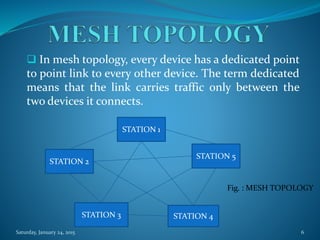
 In mesh topology, every device has a dedicated point
to point link to every other device. The term dedicated
means that the link carries traffic only between the
two devices it connects.
STATION 1
STATION 2
STATION 3 STATION 4
STATION 5
Fig. : MESH TOPOLOGY
Saturday, January 24, 2015 6
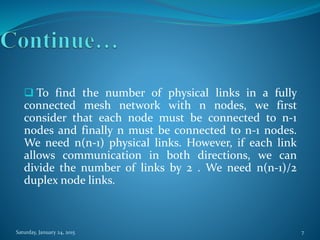
 To find the number of physical links in a fully
connected mesh network with n nodes, we first
consider that each node must be connected to n-1
nodes and finally n must be connected to n-1 nodes.
We need n(n-1) physical links. However, if each link
allows communication in both directions, we can
divide the number of links by 2 . We need n(n-1)/2
duplex node links.
Saturday, January 24, 2015 7
1. The use of dedicated links guarantees that each connection
can carry its own data load, thus eliminating the traffic
problems.
2. Mesh topology is robust ;if one link becomes unusable it
does not incapacitate the entire system.
3. There is advantage of privacy or security.
4. There is no need to provide any additional information , i.e.
;source address, along with the packet because each nodes
are connected to each other.
5. Point to point links make fault identification and fault
isolation easy.Saturday, January 24, 2015 8
1. Every device must be connected to every other device.
2. installation and reconnection are difficult.
3. The shear bulk of wiring can be greater than the
available space (in walls, ceilings or floors) can
accommodate.
4. Not flexible ;
5. Poor expandability ;i.e., to add a new node in network
is very cost effective.
Saturday, January 24, 2015 9
 A mesh topology is the connection of telephone
regional offices in which each regional office needs
to be connected to every other regional office.
Saturday, January 24, 2015 10
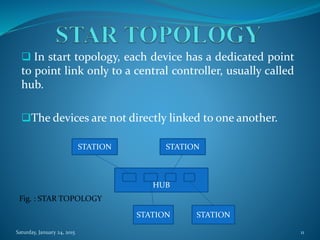
 In start topology, each device has a dedicated point
to point link only to a central controller, usually called
hub.
The devices are not directly linked to one another.
HUB
STATION
STATION
STATION
STATION
Fig. : STAR TOPOLOGY
Saturday, January 24, 2015 11
A star topology does not allow direct traffic between
devices.
The controller acts as an exchange : if one device
wants to send data to another, it sends the data to the
controller , which then relays the data to the other
connected device.
Saturday, January 24, 2015 12
1. Less expensive than mesh topology, due to less cabling
and ports.
2. It is easy to install and reconfigure because each device
needs only one link and one I/O port to connect it to
any number of other .
3. Provide high speed and great maintainability
4. Robustness: if one link fails, only that link is affected
other link remain active.
Saturday, January 24, 2015 13
1. One big disadvantage of star topology is the
dependency of whole topology on one single point,
the hub.
2. If the hub goes down, the whole system is dead.
3. Often more cabling is required in a star topology
than in some other topologies such as ring or bus
topology.
Saturday, January 24, 2015 14
Star topology is used in local-area networks
(LANs), high-speed LANs often use a star topology
with a central hub.
Saturday, January 24, 2015 15
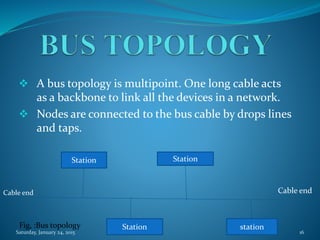
 A bus topology is multipoint. One long cable acts
as a backbone to link all the devices in a network.
 Nodes are connected to the bus cable by drops lines
and taps.
Station Station
Station station
Cable end Cable end
Fig, :Bus topology
Saturday, January 24, 2015 16
A drop line is a connection running between the device and the main
cable.
A tap is a connector that either splices into the main cable or
punctures the sheathing of a cable to create a contact with the metallic
core.
Full-duplex operation between the station and the tap allows data to
be transmitted onto the bus and received from the bus.
At each end of the bus there is a terminator, which absorbs any
signal, preventing reflection of signal from the endpoints. If the
terminator is not present, the endpoint acts like a mirror and reflects
the signal back causing interference and other problems.
Each station has a unique address in the network, a station copies a
packet only when the destination address of the packet matches with
the self-address.
Saturday, January 24, 2015 17
Ease of installation.
Bus uses less cabling than mesh or star topology.
In the bus, redundancy is eliminated.
A shared link is used, hence it is very cost effective.
Great expandability; One can easily add any new
node or delete any node without affecting other nodes.
Saturday, January 24, 2015 18
Difficult reconnection and fault isolation.
A fault or break in the bus cable stops all transmission.
Because of the shared medium, it is necessary to provide
some extra information about the desired destination, i.e.
to explicitly specify the destination in the packet.
One station is allowed to send data at a time and all other
stations listen to it, as it works in a broadcast mode. Hence,
only one station can transfer the data at any given time.
Saturday, January 24, 2015 19
Bus topology used in the design of early LANs,
Ethernet LANs.
Saturday, January 24, 2015 20
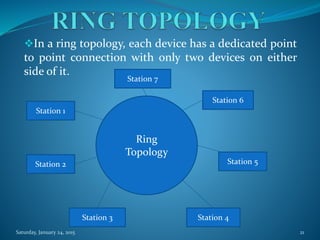
In a ring topology, each device has a dedicated point
to point connection with only two devices on either
side of it.
Ring
Topology
Station 1
Station 2
Station 3 Station 4
Station 5
Station 6
Station 7
Saturday, January 24, 2015 21
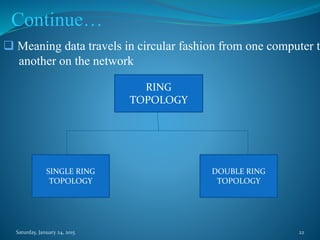
RING
TOPOLOGY
SINGLE RING
TOPOLOGY
DOUBLE RING
TOPOLOGY
 Meaning data travels in circular fashion from one computer t
another on the network
Continue…
Saturday, January 24, 2015 22
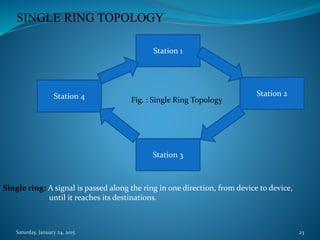
Station 1
Station 4
Station 3
Station 2
Fig. : Single Ring Topology
SINGLE RING TOPOLOGY
Single ring: A signal is passed along the ring in one direction, from device to device,
until it reaches its destinations.
Saturday, January 24, 2015 23
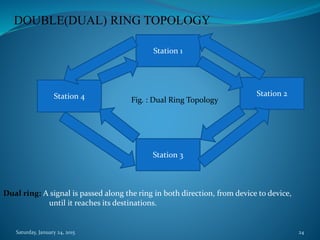
DOUBLE(DUAL) RING TOPOLOGY
Station 1
Station 4
Station 3
Station 2
Fig. : Dual Ring Topology
Dual ring: A signal is passed along the ring in both direction, from device to device,
until it reaches its destinations.
Saturday, January 24, 2015 24
Easy to install and reconfigure.
Fault isolation is simplified, generally in a ring topology, a signal is
circulating at all times.
Each computer has equal access to resources
 If one device does not receive a signal within a specified period , it can
issue an alarm. The alarm alerts the network operator to the problem
and its location.
Network is highly dependent on the wire which connects different
components.
Extension needs to affect only two neighbored stations, i.e.; good
expandability.
Saturday, January 24, 2015 25
Unidirectional traffic
A break in the ring can disable the entire network.
Each packet of data must pass through all the computers between source
and destination. This makes it slower than star topology.
If one workstation or port goes down, the entire network gets affected.
Network is highly dependent on the wire which connects different
components.
MAU’s and network cards are expensive as compared to Ethernet cards and
hubs.
Saturday, January 24, 2015 26
Ring topology was prevent when IBM introduce ,its
LAN token ring.
Saturday, January 24, 2015 27
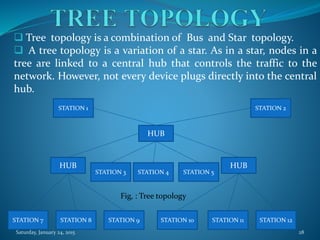
 Tree topology is a combination of Bus and Star topology.
 A tree topology is a variation of a star. As in a star, nodes in a
tree are linked to a central hub that controls the traffic to the
network. However, not every device plugs directly into the central
hub.
HUB
HUBHUB
STATION 1 STATION 2
STATION 9STATION 8STATION 7 STATION 12STATION 11STATION 10
STATION 5STATION 4STATION 3
Fig, : Tree topology
Saturday, January 24, 2015 28
Continue…
 The majority of devices connects to a secondary hub that in
turn is connected to the central hub.
 The central hub in the tree is an active hub.
 An active hub contains a repeater, which is a hardware
device that regenerates the received bit patterns before
sending them out.
 Repeating strengthens transmissions and increases the
distance a signal can travel.
 The secondary hubs may be active or passive hubs. A passive
hubs provides a simple physical connection between the
attached devices.
Saturday, January 24, 2015 29
It allow more device to be attached to a single central
hub and can therefore increase the distance a signal can
travel between devices.
 Point to point connection of devices.
It allows the network to isolate and prioritize
communications from different computers.
 Having different levels of the network makes it more
manageable hence easier fault identification and isolation
Saturday, January 24, 2015 30
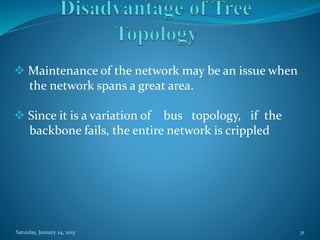
 Maintenance of the network may be an issue when
the network spans a great area.
 Since it is a variation of bus topology, if the
backbone fails, the entire network is crippled
Saturday, January 24, 2015 31
A good example of this network could be cable TV technology
where the main cable from the main office is divided into main
branches and each branch is divided into smaller branches and
so on. The hubs are used when a cable is divided.
Saturday, January 24, 2015 32
 Hybrid topology use a combination of any two or more topologies.

 In such a way that the resulting network does not exhibit one of the
standard topologies (e.g., bus, star, ring, etc.)
 For example a tree network connected to a tree network is still a tree
network topology.
 A hybrid topology is always produced when two different basic network
topologies are connected.
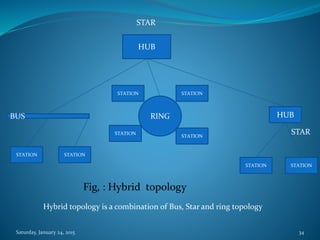
 Two common examples for Hybrid network are: star ring network and star
bus network.
Saturday, January 24, 2015 33
HUB
BUS HUB
STATION
STATION
STATION
STATION
RING
STATION
STATION
STATION
STATION
Fig, : Hybrid topology
STAR
STAR
Hybrid topology is a combination of Bus, Star and ring topology
Saturday, January 24, 2015 34
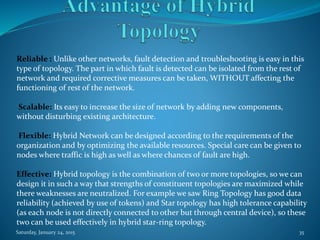
Reliable : Unlike other networks, fault detection and troubleshooting is easy in this
type of topology. The part in which fault is detected can be isolated from the rest of
network and required corrective measures can be taken, WITHOUT affecting the
functioning of rest of the network.
Scalable: Its easy to increase the size of network by adding new components,
without disturbing existing architecture.
Flexible: Hybrid Network can be designed according to the requirements of the
organization and by optimizing the available resources. Special care can be given to
nodes where traffic is high as well as where chances of fault are high.
Effective: Hybrid topology is the combination of two or more topologies, so we can
design it in such a way that strengths of constituent topologies are maximized while
there weaknesses are neutralized. For example we saw Ring Topology has good data
reliability (achieved by use of tokens) and Star topology has high tolerance capability
(as each node is not directly connected to other but through central device), so these
two can be used effectively in hybrid star-ring topology.
Saturday, January 24, 2015 35
Complexity of Design: One of the biggest drawback of hybrid
topology is its design. Its not easy to design this type of architecture
and its a tough job for designers. Configuration and installation
process needs to be very efficient.
Costly Hub: The hubs used to connect two distinct networks, are
very expensive. These hubs are different from usual hubs as they need
to be intelligent enough to work with different architectures and
should be function even if a part of network is down.
Costly Infrastructure: As hybrid architectures are usually larger in
scale, they require a lot of cables, cooling systems, sophisticate
network devices, etc.
Saturday, January 24, 2015 36
ANY
QUESTION?
Saturday, January 24, 2015 37
THANK
YOU!
Saturday, January 24, 2015 38

Computer Network - NetworkTopology

  • 1.
  • 2.
     A networkas a "group of computers and associated devices that are connected by communications facilities.“  A network provides two principle benefits: the ability to communicate and the ability to share. A network supports communication among users in ways that other media cannot. E-mail, the most popular form of network communication, provides low-cost, printable correspondence with the capability for forwarding, acknowledgment, storage, retrieval, and attachments. Sharing involves not only information (database records, e-mail, graphics, etc.), but also resources (applications, printers, modems, disk space, scanners, etc.) Through its ability to share, a network promotes collaboration Saturday, January 24, 2015 2
  • 3.
     A networkcan consist of two computers connected together on a desk or it can consist of many Local Area Networks (LANs) connected together to form a Wide Area Network (WAN) across a continent. Saturday, January 24, 2015 3
  • 4.
     A topologyrefers to the manner in which the cable is run to individual workstations on the network.  Two or more devices connect to a link; two or more links are forms of topology.  The topology of network is the geometrical representation of the relationship of all the links and linking devices (usually called nodes) one to another.  A topology is concerned with the physical arrangement of the network components Saturday, January 24, 2015 4
  • 5.
  • 6.
     In meshtopology, every device has a dedicated point to point link to every other device. The term dedicated means that the link carries traffic only between the two devices it connects. STATION 1 STATION 2 STATION 3 STATION 4 STATION 5 Fig. : MESH TOPOLOGY Saturday, January 24, 2015 6
  • 7.
     To findthe number of physical links in a fully connected mesh network with n nodes, we first consider that each node must be connected to n-1 nodes and finally n must be connected to n-1 nodes. We need n(n-1) physical links. However, if each link allows communication in both directions, we can divide the number of links by 2 . We need n(n-1)/2 duplex node links. Saturday, January 24, 2015 7
  • 8.
    1. The useof dedicated links guarantees that each connection can carry its own data load, thus eliminating the traffic problems. 2. Mesh topology is robust ;if one link becomes unusable it does not incapacitate the entire system. 3. There is advantage of privacy or security. 4. There is no need to provide any additional information , i.e. ;source address, along with the packet because each nodes are connected to each other. 5. Point to point links make fault identification and fault isolation easy.Saturday, January 24, 2015 8
  • 9.
    1. Every devicemust be connected to every other device. 2. installation and reconnection are difficult. 3. The shear bulk of wiring can be greater than the available space (in walls, ceilings or floors) can accommodate. 4. Not flexible ; 5. Poor expandability ;i.e., to add a new node in network is very cost effective. Saturday, January 24, 2015 9
  • 10.
     A meshtopology is the connection of telephone regional offices in which each regional office needs to be connected to every other regional office. Saturday, January 24, 2015 10
  • 11.
     In starttopology, each device has a dedicated point to point link only to a central controller, usually called hub. The devices are not directly linked to one another. HUB STATION STATION STATION STATION Fig. : STAR TOPOLOGY Saturday, January 24, 2015 11
  • 12.
    A star topologydoes not allow direct traffic between devices. The controller acts as an exchange : if one device wants to send data to another, it sends the data to the controller , which then relays the data to the other connected device. Saturday, January 24, 2015 12
  • 13.
    1. Less expensivethan mesh topology, due to less cabling and ports. 2. It is easy to install and reconfigure because each device needs only one link and one I/O port to connect it to any number of other . 3. Provide high speed and great maintainability 4. Robustness: if one link fails, only that link is affected other link remain active. Saturday, January 24, 2015 13
  • 14.
    1. One bigdisadvantage of star topology is the dependency of whole topology on one single point, the hub. 2. If the hub goes down, the whole system is dead. 3. Often more cabling is required in a star topology than in some other topologies such as ring or bus topology. Saturday, January 24, 2015 14
  • 15.
    Star topology isused in local-area networks (LANs), high-speed LANs often use a star topology with a central hub. Saturday, January 24, 2015 15
  • 16.
     A bustopology is multipoint. One long cable acts as a backbone to link all the devices in a network.  Nodes are connected to the bus cable by drops lines and taps. Station Station Station station Cable end Cable end Fig, :Bus topology Saturday, January 24, 2015 16
  • 17.
    A drop lineis a connection running between the device and the main cable. A tap is a connector that either splices into the main cable or punctures the sheathing of a cable to create a contact with the metallic core. Full-duplex operation between the station and the tap allows data to be transmitted onto the bus and received from the bus. At each end of the bus there is a terminator, which absorbs any signal, preventing reflection of signal from the endpoints. If the terminator is not present, the endpoint acts like a mirror and reflects the signal back causing interference and other problems. Each station has a unique address in the network, a station copies a packet only when the destination address of the packet matches with the self-address. Saturday, January 24, 2015 17
  • 18.
    Ease of installation. Bususes less cabling than mesh or star topology. In the bus, redundancy is eliminated. A shared link is used, hence it is very cost effective. Great expandability; One can easily add any new node or delete any node without affecting other nodes. Saturday, January 24, 2015 18
  • 19.
    Difficult reconnection andfault isolation. A fault or break in the bus cable stops all transmission. Because of the shared medium, it is necessary to provide some extra information about the desired destination, i.e. to explicitly specify the destination in the packet. One station is allowed to send data at a time and all other stations listen to it, as it works in a broadcast mode. Hence, only one station can transfer the data at any given time. Saturday, January 24, 2015 19
  • 20.
    Bus topology usedin the design of early LANs, Ethernet LANs. Saturday, January 24, 2015 20
  • 21.
    In a ringtopology, each device has a dedicated point to point connection with only two devices on either side of it. Ring Topology Station 1 Station 2 Station 3 Station 4 Station 5 Station 6 Station 7 Saturday, January 24, 2015 21
  • 22.
    RING TOPOLOGY SINGLE RING TOPOLOGY DOUBLE RING TOPOLOGY Meaning data travels in circular fashion from one computer t another on the network Continue… Saturday, January 24, 2015 22
  • 23.
    Station 1 Station 4 Station3 Station 2 Fig. : Single Ring Topology SINGLE RING TOPOLOGY Single ring: A signal is passed along the ring in one direction, from device to device, until it reaches its destinations. Saturday, January 24, 2015 23
  • 24.
    DOUBLE(DUAL) RING TOPOLOGY Station1 Station 4 Station 3 Station 2 Fig. : Dual Ring Topology Dual ring: A signal is passed along the ring in both direction, from device to device, until it reaches its destinations. Saturday, January 24, 2015 24
  • 25.
    Easy to installand reconfigure. Fault isolation is simplified, generally in a ring topology, a signal is circulating at all times. Each computer has equal access to resources  If one device does not receive a signal within a specified period , it can issue an alarm. The alarm alerts the network operator to the problem and its location. Network is highly dependent on the wire which connects different components. Extension needs to affect only two neighbored stations, i.e.; good expandability. Saturday, January 24, 2015 25
  • 26.
    Unidirectional traffic A breakin the ring can disable the entire network. Each packet of data must pass through all the computers between source and destination. This makes it slower than star topology. If one workstation or port goes down, the entire network gets affected. Network is highly dependent on the wire which connects different components. MAU’s and network cards are expensive as compared to Ethernet cards and hubs. Saturday, January 24, 2015 26
  • 27.
    Ring topology wasprevent when IBM introduce ,its LAN token ring. Saturday, January 24, 2015 27
  • 28.
     Tree topologyis a combination of Bus and Star topology.  A tree topology is a variation of a star. As in a star, nodes in a tree are linked to a central hub that controls the traffic to the network. However, not every device plugs directly into the central hub. HUB HUBHUB STATION 1 STATION 2 STATION 9STATION 8STATION 7 STATION 12STATION 11STATION 10 STATION 5STATION 4STATION 3 Fig, : Tree topology Saturday, January 24, 2015 28
  • 29.
    Continue…  The majorityof devices connects to a secondary hub that in turn is connected to the central hub.  The central hub in the tree is an active hub.  An active hub contains a repeater, which is a hardware device that regenerates the received bit patterns before sending them out.  Repeating strengthens transmissions and increases the distance a signal can travel.  The secondary hubs may be active or passive hubs. A passive hubs provides a simple physical connection between the attached devices. Saturday, January 24, 2015 29
  • 30.
    It allow moredevice to be attached to a single central hub and can therefore increase the distance a signal can travel between devices.  Point to point connection of devices. It allows the network to isolate and prioritize communications from different computers.  Having different levels of the network makes it more manageable hence easier fault identification and isolation Saturday, January 24, 2015 30
  • 31.
     Maintenance ofthe network may be an issue when the network spans a great area.  Since it is a variation of bus topology, if the backbone fails, the entire network is crippled Saturday, January 24, 2015 31
  • 32.
    A good exampleof this network could be cable TV technology where the main cable from the main office is divided into main branches and each branch is divided into smaller branches and so on. The hubs are used when a cable is divided. Saturday, January 24, 2015 32
  • 33.
     Hybrid topologyuse a combination of any two or more topologies.  In such a way that the resulting network does not exhibit one of the standard topologies (e.g., bus, star, ring, etc.)  For example a tree network connected to a tree network is still a tree network topology.  A hybrid topology is always produced when two different basic network topologies are connected.  Two common examples for Hybrid network are: star ring network and star bus network. Saturday, January 24, 2015 33
  • 34.
    HUB BUS HUB STATION STATION STATION STATION RING STATION STATION STATION STATION Fig, :Hybrid topology STAR STAR Hybrid topology is a combination of Bus, Star and ring topology Saturday, January 24, 2015 34
  • 35.
    Reliable : Unlikeother networks, fault detection and troubleshooting is easy in this type of topology. The part in which fault is detected can be isolated from the rest of network and required corrective measures can be taken, WITHOUT affecting the functioning of rest of the network. Scalable: Its easy to increase the size of network by adding new components, without disturbing existing architecture. Flexible: Hybrid Network can be designed according to the requirements of the organization and by optimizing the available resources. Special care can be given to nodes where traffic is high as well as where chances of fault are high. Effective: Hybrid topology is the combination of two or more topologies, so we can design it in such a way that strengths of constituent topologies are maximized while there weaknesses are neutralized. For example we saw Ring Topology has good data reliability (achieved by use of tokens) and Star topology has high tolerance capability (as each node is not directly connected to other but through central device), so these two can be used effectively in hybrid star-ring topology. Saturday, January 24, 2015 35
  • 36.
    Complexity of Design:One of the biggest drawback of hybrid topology is its design. Its not easy to design this type of architecture and its a tough job for designers. Configuration and installation process needs to be very efficient. Costly Hub: The hubs used to connect two distinct networks, are very expensive. These hubs are different from usual hubs as they need to be intelligent enough to work with different architectures and should be function even if a part of network is down. Costly Infrastructure: As hybrid architectures are usually larger in scale, they require a lot of cables, cooling systems, sophisticate network devices, etc. Saturday, January 24, 2015 36


  • 37.
  • 38.