Note 11: Network Security
The art of war teaches us to rely not on the likelihood of the enemy's not coming, but on our own readiness to receive him; not on the chance of his not attacking, but rather on the fact that we have made our position unassailable.    — The Art of War,  Sun Tzu
Network Security Threats Security and Cryptography Network Security Protocols Cryptographic Algorithms
What is information security? Keeping information secure against stealing & changing & destroying & forging Traditionally provided by physical (e.g., cabinets with locks) and administrative means (e.g., personal screening procedures) Information security requirements have dramatically changed in the last several decades Growing computer use requires  automated tools to protect files and other stored information Growing use of networks and communications links requires measures to protect data during transmission
Computer security the generic name for the collection of tools designed to protect data and to thwart hackers Network security measures to protect data during their transmission Internet security measures to protect data during their transmission over a collection of interconnected networks Note: boundaries among these definitions are blurred
Our focus is on  Network Security (Internet & Wireless Network Security) This consists of measures to deter, prevent, detect, and correct security violations that involve the transmission & storage of information
Network Security Threats Eavesdropping, man-in-the-middle, client and server imposters Denial of Service attacks Viruses, worms, and other malicious code Network Security Requirements Privacy, Integrity, Authentication, Non-Repudiation, Availability Countermeasures Communication channel security  Border security
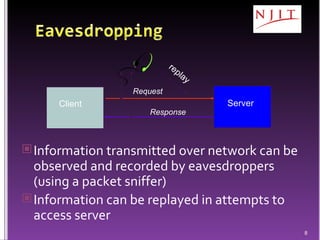
Information transmitted over network can be observed and recorded by eavesdroppers (using a packet sniffer)  Information can be replayed in attempts to access server Client Server Request Response replay
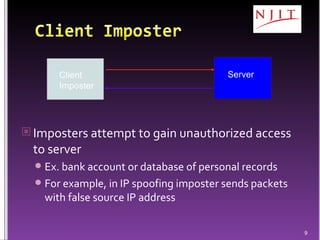
Imposters attempt to gain unauthorized access to server Ex. bank account or database of personal records For example, in IP spoofing imposter sends packets with false source IP address Client Imposter Server
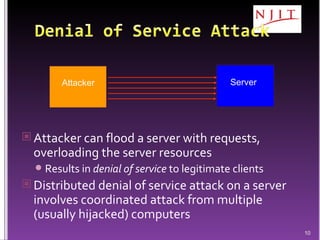
Attacker can flood a server with requests, overloading the server resources Results in  denial of service  to legitimate clients Distributed denial of service attack on a server involves coordinated attack from multiple (usually hijacked) computers Attacker Server
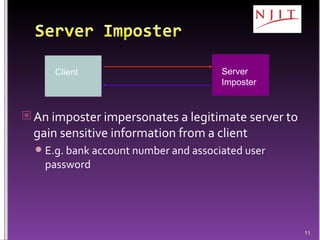
An imposter impersonates a legitimate server to gain sensitive information from a client E.g. bank account number and associated user password Client Server Imposter
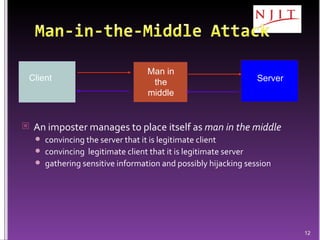
An imposter manages to place itself as  man in the middle convincing the server that it is legitimate client  convincing  legitimate client that it is legitimate server gathering sensitive information and possibly hijacking session Client Server Man in the middle
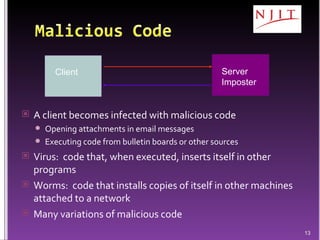
A client becomes infected with malicious code  Opening attachments in email messages Executing code from bulletin boards or other sources Virus:  code that, when executed, inserts itself in other programs Worms:  code that installs copies of itself in other machines attached to a network Many variations of malicious code Client Server Imposter
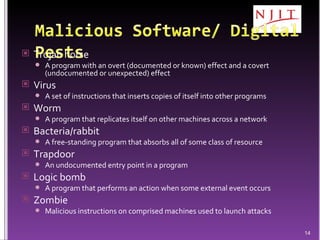
Trojan horse A program with an overt (documented or known) effect and a covert (undocumented or unexpected) effect  Virus A set of instructions that inserts copies of itself into other programs Worm A program that replicates itself on other machines across a network Bacteria/rabbit A free-standing program that absorbs all of some class of resource Trapdoor An undocumented entry point in a program Logic bomb A program that performs an action when some external event occurs Zombie Malicious instructions on comprised machines used to launch attacks
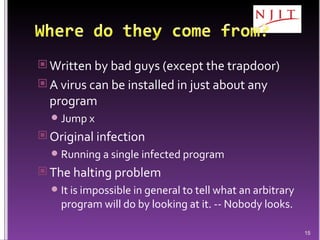
Written by bad guys (except the trapdoor) A virus can be installed in just about any program Jump x Original infection Running a single infected program The halting problem It is impossible in general to tell what an arbitrary program will do by looking at it. -- Nobody looks.
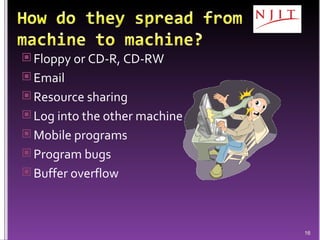
Floppy or CD-R, CD-RW Email  Resource sharing Log into the other machine Mobile programs Program bugs Buffer overflow
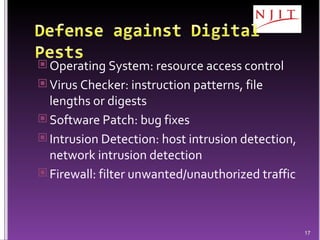
Operating System: resource access control Virus Checker: instruction patterns, file lengths or digests Software Patch: bug fixes Intrusion Detection: host intrusion detection, network intrusion detection Firewall: filter unwanted/unauthorized traffic
Don’t run software from suspicious sources Frequently run virus checkers Try to run programs in the most limited possible environments Do frequent backups, and save old backups for a long time Don’t boot off floppies
Security threats motivate the following requirements: Privacy : information should be readable only by intended recipient Integrity : recipient can confirm that a message has not been altered during transmission Authentication : it is possible to verify that sender or receiver is who he claims to be Non-repudiation : sender cannot deny having sent a given message. Availability : information and services should be available whenever needed
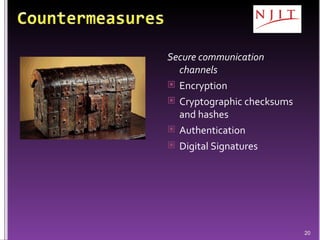
Secure communication channels Encryption Cryptographic checksums and hashes Authentication Digital Signatures
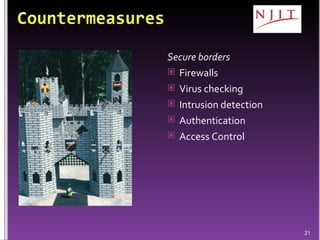
Secure borders Firewalls Virus checking Intrusion detection Authentication Access Control
Security and Cryptography
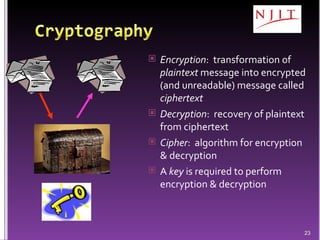
Encryption :  transformation of  plaintext  message into encrypted (and unreadable) message called  ciphertext Decryption :  recovery of plaintext from ciphertext Cipher :  algorithm for encryption & decryption A  key  is required to perform encryption & decryption
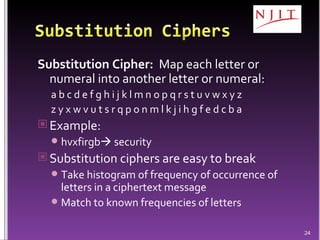
Substitution Cipher:  Map each letter or numeral into another letter or numeral: a b c d e f g h i j k l m n o p q r s t u v w x y z  z y x w v u t s r q p o n m l k j i h g f e d c b a Example: hvxfirgb   security Substitution ciphers are easy to break Take histogram of frequency of occurrence of letters in a ciphertext message  Match to known frequencies of letters
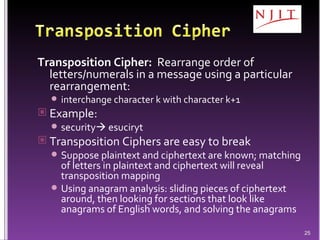
Transposition Cipher:  Rearrange order of letters/numerals in a message using a particular rearrangement: interchange character k with character k+1 Example: security   esuciryt Transposition Ciphers are easy to break Suppose plaintext and ciphertext are known; matching of letters in plaintext and ciphertext will reveal transposition mapping Using anagram analysis: sliding pieces of ciphertext around, then looking for sections that look like anagrams of English words, and solving the anagrams
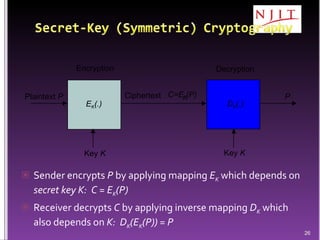
Sender encrypts  P  by applying mapping  E K  which depends on  secret key K:  C = E K (P) Receiver decrypts  C  by applying inverse mapping  D K  which also depends on  K:  D K (E K (P)) = P E K (.) Key  K Key  K Plaintext  P Ciphertext C=E K (P) P Encryption Decryption D K (.)
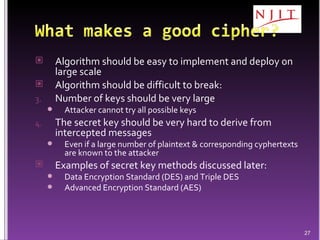
Algorithm should be easy to implement and deploy on large scale Algorithm should be difficult to break: Number of keys should be very large Attacker cannot try all possible keys The secret key should be very hard to derive from intercepted messages Even if a large number of plaintext & corresponding cyphertexts are known to the attacker Examples of secret key methods discussed later: Data Encryption Standard (DES) and Triple DES Advanced Encryption Standard (AES)
Privacy :  secret key renders messages confidential  Integrity :  alteration of the cyphertext will be detected, because the decrypted message will be gibberish  When privacy is not required, encryption of the entire message is overkill because much processing involved We will see that cryptographic checksums provide integrity and require less processing
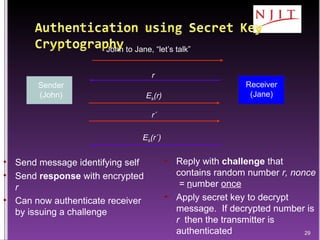
Sender (John) Receiver (Jane) E k (r) r E k (r´) r´ John to Jane, “let’s talk” Send message identifying self Send  response  with encrypted  r  Can now authenticate receiver by issuing a challenge  Reply with  challenge  that contains random number  r, nonce  =  n umber  once Apply secret key to decrypt message.  If decrypted number is  r   then the transmitter is authenticated
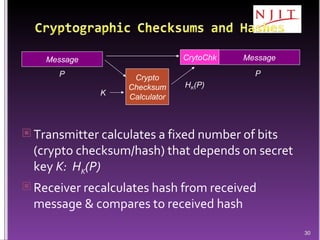
Transmitter calculates a fixed number of bits (crypto checksum/hash) that depends on secret key  K:  H K (P) Receiver recalculates hash from received message & compares to received hash Message Crypto Checksum Calculator CrytoChk Message K P P H K (P)
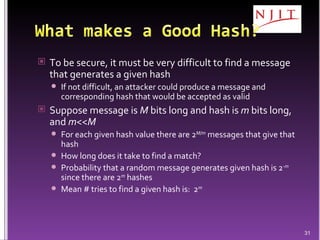
To be secure, it must be very difficult to find a message that generates a given hash If not difficult, an attacker could produce a message and corresponding hash that would be accepted as valid Suppose message is  M  bits long and hash is  m  bits long, and  m << M For each given hash value there are 2 M/m  messages that give that hash How long does it take to find a match? Probability that a random message generates given hash is 2 - m   since there are 2 m  hashes Mean # tries to find a given hash is:  2 m
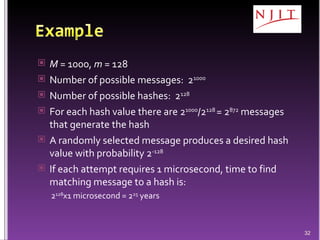
M  = 1000,  m  = 128 Number of possible messages:  2 1000 Number of possible hashes:  2 128 For each hash value there are 2 1000 /2 128  = 2 872  messages that generate the hash A randomly selected message produces a desired hash value with probability 2 -128 If each attempt requires 1 microsecond, time to find matching message to a hash is: 2 128 x1 microsecond = 2 25  years
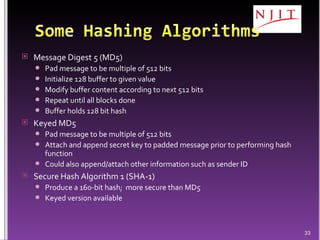
Message Digest 5 (MD5) Pad message to be multiple of 512 bits Initialize 128 buffer to given value Modify buffer content according to next 512 bits Repeat until all blocks done  Buffer holds 128 bit hash Keyed MD5 Pad message to be multiple of 512 bits Attach and append secret key to padded message prior to performing hash function Could also append/attach other information such as sender ID Secure Hash Algorithm 1 (SHA-1) Produce a 160-bit hash;  more secure than MD5 Keyed version available
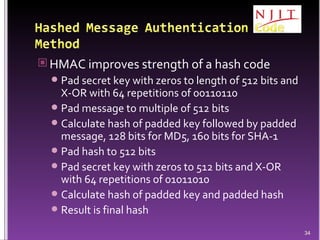
HMAC improves strength of a hash code Pad secret key with zeros to length of 512 bits and X-OR with 64 repetitions of 00110110  Pad message to multiple of 512 bits Calculate hash of padded key followed by padded message, 128 bits for MD5, 160 bits for SHA-1 Pad hash to 512 bits Pad secret key with zeros to 512 bits and X-OR with 64 repetitions of 01011010 Calculate hash of padded key and padded hash Result is final hash
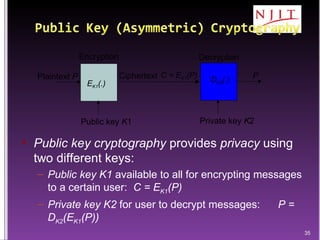
Public key cryptography  provides  privacy  using two different keys: Public key K1  available to all for encrypting messages to a certain user:  C = E K1 (P) Private key K2  for user to decrypt messages:  P = D K2 (E K1 (P))   E K1 (.)  Public key  K 1 Private key  K 2 Plaintext  P Ciphertext  C = E K1 (P) P Encryption Decryption D K2 (.)
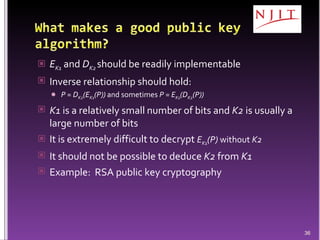
E K1  and  D K2   should be readily implementable Inverse relationship should hold: P = D K2 (E K1 (P))  and sometimes  P = E K1 (D K2 (P))   K1  is a relatively small number of bits and  K2  is usually a large number of bits It is extremely difficult to decrypt  E K1 (P)  without  K2 It should not be possible to deduce  K2  from  K1 Example:  RSA public key cryptography
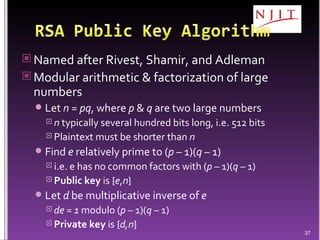
Named after Rivest, Shamir, and Adleman Modular arithmetic & factorization of large numbers Let  n = pq , where  p  &  q  are two large numbers n  typically several hundred bits long, i.e. 512 bits Plaintext must be shorter than  n Find  e  relatively prime to ( p –  1)( q –  1) i.e. e has no common factors with ( p –  1)( q –  1) Public key  is { e , n } Let  d  be multiplicative inverse of  e de = 1  modulo ( p –  1)( q –  1) Private key  is { d,n }
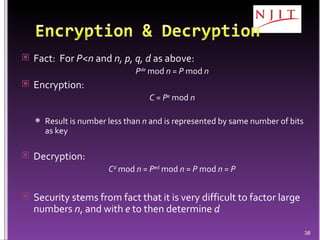
Fact:  For  P<n  and  n, p, q, d  as above: P de  mod  n  =  P  mod  n Encryption: C  =  P e   mod  n Result is number less than  n  and is represented by same number of bits as key Decryption: C d  mod  n  =  P ed   mod  n = P  mod  n = P Security stems from fact that it is very difficult to factor large numbers  n , and with  e  to then determine  d
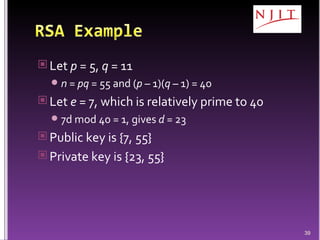
Let  p  = 5,  q  = 11 n  =  pq  = 55 and ( p  – 1)( q  – 1) = 40 Let  e  = 7, which is relatively prime to 40 7d mod 40 = 1, gives  d  = 23 Public key is {7, 55} Private key is {23, 55}
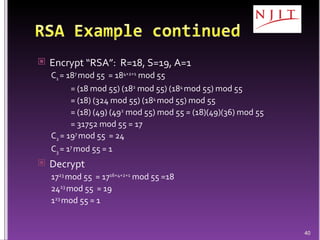
Encrypt “RSA”:  R=18, S=19, A=1 C 1  = 18 7  mod 55  = 18 4+2+1  mod 55    = (18 mod 55) (18 2  mod 55) (18 4  mod 55) mod 55   = (18) (324 mod 55) (18 4  mod 55) mod 55   = (18) (49) (49 2  mod 55) mod 55 = (18)(49)(36) mod 55   = 31752 mod 55 = 17 C 2  = 19 7  mod 55  = 24 C 3  = 1 7  mod 55 = 1 Decrypt  17 23  mod 55  = 17 16+4+2+1  mod 55 =18 24 23  mod 55  = 19 1 23  mod 55 = 1
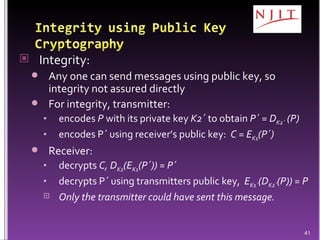
Integrity: Any one can send messages using public key, so integrity not assured directly For integrity, transmitter: encodes  P  with its private key  K2 ΄  to obtain  P ΄  = D K2 ΄  (P) encodes P ΄  using receiver’s public key:  C = E K1 (P ΄ )   Receiver:  decrypts  C, D K2 (E K1 (P ΄ )) = P ΄ decrypts P ΄  using transmitters public key,  E K1 ΄ (D K2΄ (P)) = P Only the transmitter could have sent this message.
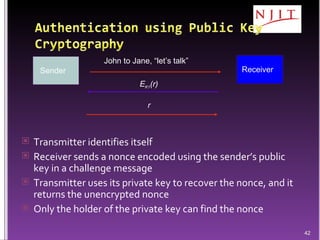
Transmitter identifies itself Receiver sends a nonce encoded using the sender’s public key in a challenge message Transmitter uses its private key to recover the nonce, and it returns the unencrypted nonce Only the holder of the private key can find the nonce E K1 (r) r John to Jane, “let’s talk” Sender Receiver
Digital signatures provide nonrepudiation User “signs” a message that cannot be repudiated Digital signature obtained as follows: Transmitter obtains a hash of the message Transmitter encrypts the hash using its private key;  result is the  digital signature Transmitter sends message and signature To check the signature: Receiver obtains hash of message Receiver decrypts signature using sender’s public key Receiver compares hash computed from message and hash obtained from signature Procedure also ensures message integrity
Public key systems have more capabilities Secret key:  privacy, integrity, authentication Public key:  all of above + digital signature Public key algorithms are more complex Require more processing and hence much slower than secret key Practice: Use public key method during session setup to establish a  session key Use secret key cryptography during session using the session key
PGP developed by Phillip Zimmerman to provide secure email http://www.philzimmermann.com/index.shtml http://www.pgpi.org Notorious for becoming publicly available for download over Internet in violation of US export restrictions Uses public key cryptography to provide Privacy, integrity, authentication, digital signature De facto standard for email security Also provides privacy and integrity for stored files
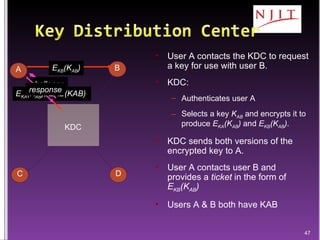
Every pair of users requires a separate shared secret key N ( N  – 1) keys for  N  users; Grows quickly with  N Similar to full-mesh connections for  N  users Solution:  Introduce Key Distribution Centers Each users has shared key with the KDC User A has shared key  K KA  with KDC User B has shared key  K KB  with KDC KDC provides shared key when A & B need to communicate
User A contacts the KDC to request a key for use with user B. KDC: Authenticates user A Selects a key  K AB  and encrypts it to produce  E KA (K AB )  and  E KB (K AB ) .  KDC sends both versions of the encrypted key to A. User A contacts user B and provides a  ticket  in the form of  E KB (K AB )   Users A & B both have KAB KDC A B C D request E KA (K AB ), EKB(KAB)  challenge response E KB (K AB )
Kerberos:  authentication service for users to access servers over network KDC has secret key with every user At login, user supplies ID and password KDC authenticates user & generates session key Session key & ticket-granting ticket (TGT) is sent to user encrypted using shared secret key To access a particular server, user sends request to KDC with server name and TGT KDC decrypts TGT to recover session key & then returns ticket to client for desired server
In public key only one pair of keys per user Key distribution problem:  How to determine whether an advertised public key is not from an imposter? Certification Authority (CA)   Issues  digitally signed  certificate that provides User’s name & public key Certificate serial #, expiration date Certificates can be stored in publicly accessible directories To communicate with B, a user contacts the CA to obtain the certificate for B Users are configured to have the CA’s public key, which they use to verify the digital signature
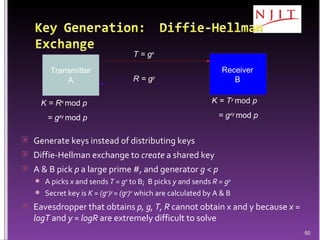
Generate keys instead of distributing keys Diffie-Hellman exchange to  create  a shared key A & B pick  p  a large prime #, and generator  g < p A picks  x  and sends  T = g x  to B;  B picks  y  and sends  R = g y   Secret key is  K = (g x ) y  = (g y ) x  which are calculated by A & B Eavesdropper that obtains  p, g, T, R  cannot obtain x and y because  x = logT  and  y = logR  are extremely difficult to solve Transmitter A Receiver B T = g x R = g y K = R x   mod  p = g xy   mod  p K = T y   mod  p = g xy   mod  p
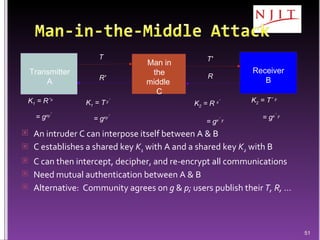
An intruder C can interpose itself between A & B C establishes a shared key  K 1  with A and a shared key  K 2  with B C can then intercept, decipher, and re-encrypt all communications Need mutual authentication between A & B Alternative:  Community agrees on  g  &  p;  users publish their  T, R,  … Transmitter A Man in the middle  C Receiver B T R' T' R K 1  = R´ x   = g xy ´   K 1  = T  y ´ = g xy ´   K 2  = R  x ´   K 2  = T´   y   = g x ´  y = g x ´  y
Diffie-Hellman exchange involves computation of powers of large numbers Large number of multiplications implies heavy computational burden Susceptible to denial-of-service attacks
Network Security Protocols
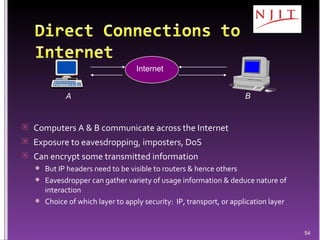
Computers A & B communicate across the Internet Exposure to eavesdropping, imposters, DoS Can encrypt some transmitted information But IP headers need to be visible to routers & hence others Eavesdropper can gather variety of usage information & deduce nature of interaction Choice of which layer to apply security:  IP, transport, or application layer A B Internet
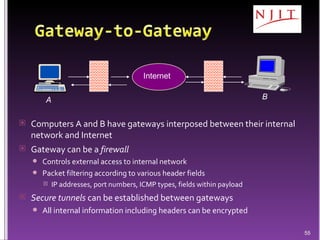
Computers A and B have gateways interposed between their internal network and Internet Gateway can be a  firewall Controls external access to internal network Packet filtering according to various header fields IP addresses, port numbers, ICMP types, fields within payload Secure tunnels  can be established between gateways All internal information including headers can be encrypted A B Internet
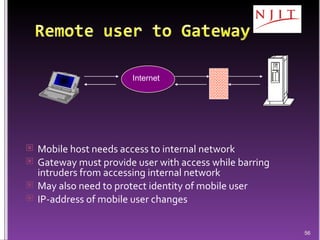
Mobile host needs access to internal network Gateway must provide user with access while barring intruders from accessing internal network May also need to protect identity of mobile user IP-address of mobile user changes Internet
Firewalls can operate at different layers IP-layer filtering cannot operate on payload contents Circuit-Level Gateways Direct client-to-server TCP connections not allowed Relays TCP segments between actual client & actual server Application-Level Gateways or Proxies Interposed between actual client and actual server Performs authentication and determines what features are available to client Monitors, filters & relays messages
Security Services can be provided at different layers of the protocol stack Data Link Layer security Point-to-point security between directly-connected devices, e.g. wireless LAN security IP-Layer security Security service between IP layers e.g. IPsec Transport Layer security  Security service between Transport Layers E.g.  Secure Sockets Layer & Transport Layer Security
. IPsec defined in RFCs 2401, 2402, 2406 Provides authentication, integrity, confidentiality, and access control at the IP layer Provides a key management protocol to provide automatic key distribution techniques. Security service can be provided between a pair of communication nodes, where the node can be a host or a gateway (router or firewall).  Two protocols & two modes to provide traffic security: Authentication Header and Encapsulating Security Payload Transport mode or tunnel mode
A  Security Association (SA)  is a logical simplex connection between two network-layer entities Two SA’s required for bidirectional secure communication SA is specified by A unique identifier Security services to be used Cryptographic algorithms to be used How shared keys will be established Other attributes such as lifetime SA negotiated before security service begins
Integrity can be ascertained by sending a  cryptographic checksum  or  hash  of message Authentication also provided if hash covers:  Shared secret key, sender’s identity & message Fields that are changed while packet traverses Internet are set to zero in calculation of hash To protect against replay attacks, message should carry a sequence number that is covered by the hash Receiver accepts a packet only once Receiver maintains a window of packets it accepts Receiver recalculates hash and compares to hash in received packet
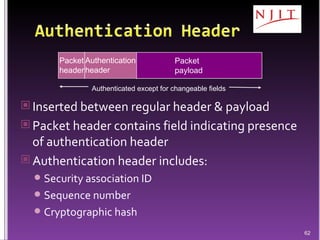
Inserted between regular header & payload Packet header contains field indicating presence of authentication header Authentication header includes: Security association ID Sequence number Cryptographic hash Packet header Authentication header Packet payload Authenticated except for changeable fields
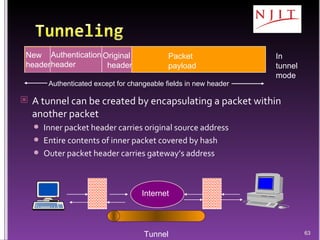
A tunnel can be created by encapsulating a packet within another packet Inner packet header carries original source address Entire contents of inner packet covered by hash Outer packet header carries gateway’s address New  header Authentication header Packet payload Authenticated except for changeable fields in new header Original  header In tunnel mode Internet Tunnel
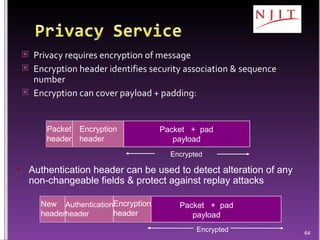
Privacy requires encryption of message Encryption header identifies security association & sequence number Encryption can cover payload + padding: Authentication header can be used to detect alteration of any non-changeable fields & protect against replay attacks Packet  +  pad payload Packet header Encryption header Encrypted Encrypted Packet  +  pad payload New  header Authentication header Encryption  header
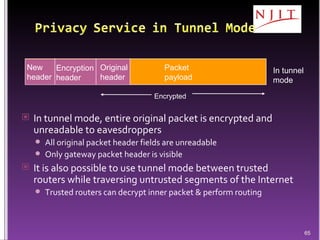
In tunnel mode, entire original packet is encrypted and unreadable to eavesdroppers All original packet header fields are unreadable Only gateway packet header is visible It is also possible to use tunnel mode between trusted routers while traversing untrusted segments of the Internet Trusted routers can decrypt inner packet & perform routing In tunnel mode New  header Encryption header Original  header Encrypted Packet  payload
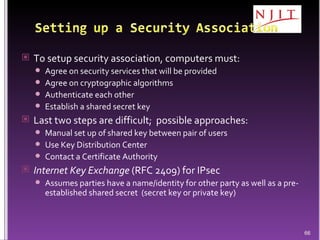
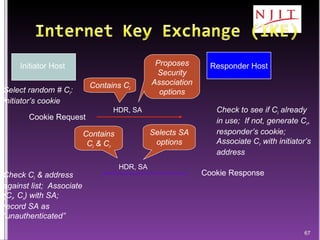
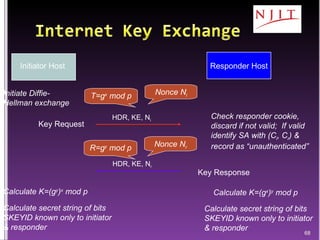
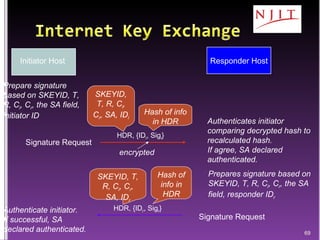
To setup security association, computers must: Agree on security services that will be provided Agree on cryptographic algorithms Authenticate each other Establish a shared secret key Last two steps are difficult;  possible approaches: Manual set up of shared key between pair of users Use Key Distribution Center Contact a Certificate Authority Internet Key Exchange  (RFC 2409) for IPsec Assumes parties have a name/identity for other party as well as a pre-established shared secret  (secret key or private key)
Initiator Host Contains C i Proposes Security Association options Contains C i  & C r Selects SA options Select random # C i : initiator’s cookie Check to see if C i  already in use;  If not, generate C r , responder’s cookie; Associate C r  with initiator’s address Check C i  & address against list;  Associate (C i , C r ) with SA;  record SA as “unauthenticated” Responder Host HDR, SA Cookie Request HDR, SA Cookie Response
Initiator Host T=g x  mod p Nonce N i Initiate Diffie-Hellman exchange Check responder cookie, discard if not valid;  If valid identify SA with (C i , C r ) & record as “unauthenticated” R=g y  mod p Nonce N r Calculate K=(g y ) x  mod p Calculate K=(g x ) y  mod p Calculate secret string of bits SKEYID known only to initiator & responder Calculate secret string of bits SKEYID known only to initiator & responder Responder Host HDR, KE, N i Key Request HDR, KE, N r Key Response
Initiator Host Prepare signature based on SKEYID, T, R, C i , C r , the SA field, initiator ID SKEYID, T, R, C i , C r , SA, ID i Hash of info in HDR encrypted Authenticates initiator comparing decrypted hash to recalculated hash. If agree, SA declared authenticated. Prepares signature based on SKEYID, T, R, C i , C r , the SA field, responder ID r SKEYID, T, R, C i , C r , SA, ID r Hash of info in HDR Authenticate initiator.  If successful, SA declared authenticated. Responder Host HDR, {ID i , Sig i } Signature Request HDR, {ID r , Sig r } Signature Request
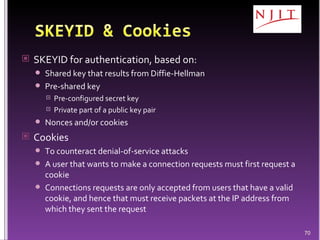
SKEYID for authentication, based on: Shared key that results from Diffie-Hellman  Pre-shared key  Pre-configured secret key Private part of a public key pair Nonces and/or cookies Cookies To counteract denial-of-service attacks A user that wants to make a connection requests must first request a cookie Connections requests are only accepted from users that have a valid cookie, and hence that must receive packets at the IP address from which they sent the request
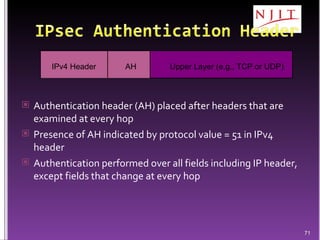
Authentication header (AH) placed after headers that are examined at every hop Presence of AH indicated by protocol value = 51 in IPv4 header Authentication performed over all fields including IP header, except fields that change at every hop IPv4 Header  AH  Upper Layer (e.g., TCP or UDP)
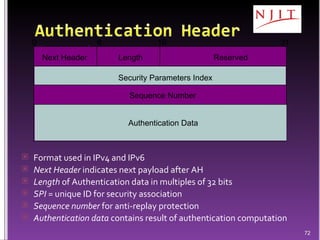
Format used in IPv4 and IPv6 Next Header  indicates next payload after AH Length  of Authentication data in multiples of 32 bits SPI  = unique ID for security association Sequence number  for anti-replay protection Authentication data  contains result of authentication computation Next Header  Length Reserved Security Parameters Index 0  8  16  31 Sequence Number Authentication Data
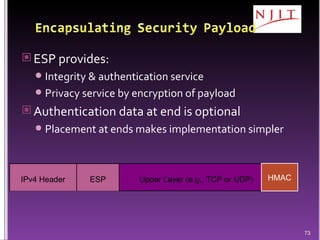
ESP provides: Integrity & authentication service Privacy service by encryption of payload Authentication data at end is optional Placement at ends makes implementation simpler IPv4 Header  ESP  Upper Layer (e.g., TCP or UDP) HMAC
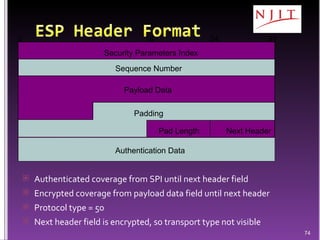
Authenticated coverage from SPI until next header field Encrypted coverage from payload data field until next header Protocol type = 50 Next header field is encrypted, so transport type not visible Security Parameters Index 0  16  24  31 Sequence Number Payload Data Padding Pad Length  Next Header Authentication Data
SSL developed by Netscape Communications Operates on top of TCP Provides secure connections HTTP, FTP, telnet, … Electronic ordering & payment; e-mail SSL 3.0 submitted to IETF for standardization TLS standardized by IETF (RFC 2246) Slight differences with SSL 3.0
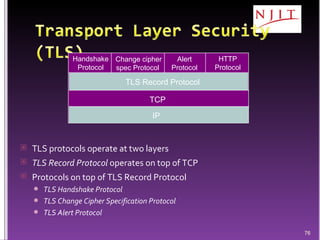
TLS protocols operate at two layers TLS Record Protocol  operates on top of TCP Protocols on top of TLS Record Protocol TLS Handshake Protocol TLS Change Cipher Specification Protocol TLS Alert Protocol TCP TLS Record Protocol Handshake Protocol Change cipher  spec Protocol  Alert Protocol HTTP Protocol IP
TLS Record protocol provides Privacy service through secret key encryption Encryption algorithm is negotiated at session setup Secret keys generated per connection using another protocol such as Handshake protocol Reliability service through  keyed message authentication code Hash algorithm negotiated at session setup Operates without hash only during session negotiation
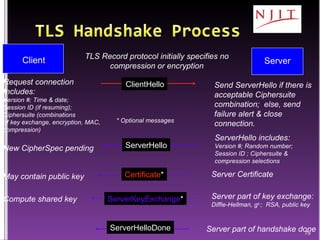
TLS Handshake protocol used by client & server Negotiate protocol version, encryption algorithm, key generation method Can authenticate each other using public key algorithm Client & server establish a shared secret Multiple secure connections can be set up after session setup Session specified by following parameters Session Identifier :  byte sequence selected by server Peer Certificate :  certificate of peer Compression method :  used prior to encryption Cipher spec :  encryption & message authentication code Master Secret : 48-byte secret shared by client & server Is resumable?:   flag indicating if new connections can be initiated
Request connection Includes: Version #; Time & date; Session ID (if resuming); Ciphersuite (combinations of key exchange, encryption, MAC, compression) Send ServerHello if there is acceptable Ciphersuite combination;  else, send failure alert & close connection. * Optional messages Server Certificate Server part of handshake done Server part of key exchange: Diffie-Hellman, g x; ;  RSA, public key ServerHello includes: Version #; Random number; Session ID ; Ciphersuite & compression selections Compute shared key May contain public key New CipherSpec pending TLS Record protocol initially specifies no compression or encryption Client Server ClientHello ServerHello Certificate * ServerKeyExchange * ServerHelloDone
Client’s part of key agreement: Diffie-Hellman g y ; RSA, random #s Change Cipher protocol message notifies server that subsequent records protected under new CipherSpec & keys Server changes CipherSpec Hash using new CipherSpec; allows server to verify change in Cipherspec Compute shared key Verify CipherSpec Client Server ClientKeyExchange [ChangeCipherSpec] Finished
Notify client that subsequent records protected under new CipherSpec & keys Client changes CipherSpec Hash using new CipherSpec;  Client verifies new CipherSpec TLS Record protocol encapsulates application-layer messages Privacy through secret key cryptography Reliability through MAC Fragmentation of application messages into blocks for compression/encryption Decompression/Decryption/Verification/Reassembly Client Server Application Data [ChangeCipherSpec] Finished
Server requests certificate if client needs to be authenticated Client sends suitable certificate  If server finds certificate unacceptable;  server can send fatal failure alert message & close connection  Client prepares digital signature based on messages sent using its private key Server verifies client has private key Client Server ClientHello ServerHello Certificate* ServerKeyExchange* CertificateRequest ServerHelloDone Certificate* ClientKeyExchange CertificateVerify* [ChangeCipherSpec] Finished Application Data [ChangeCipherSpec] Finished

Network Security

  • 1.
  • 2.
    The art ofwar teaches us to rely not on the likelihood of the enemy's not coming, but on our own readiness to receive him; not on the chance of his not attacking, but rather on the fact that we have made our position unassailable. — The Art of War, Sun Tzu
  • 3.
    Network Security ThreatsSecurity and Cryptography Network Security Protocols Cryptographic Algorithms
  • 4.
    What is informationsecurity? Keeping information secure against stealing & changing & destroying & forging Traditionally provided by physical (e.g., cabinets with locks) and administrative means (e.g., personal screening procedures) Information security requirements have dramatically changed in the last several decades Growing computer use requires automated tools to protect files and other stored information Growing use of networks and communications links requires measures to protect data during transmission
  • 5.
    Computer security thegeneric name for the collection of tools designed to protect data and to thwart hackers Network security measures to protect data during their transmission Internet security measures to protect data during their transmission over a collection of interconnected networks Note: boundaries among these definitions are blurred
  • 6.
    Our focus ison Network Security (Internet & Wireless Network Security) This consists of measures to deter, prevent, detect, and correct security violations that involve the transmission & storage of information
  • 7.
    Network Security ThreatsEavesdropping, man-in-the-middle, client and server imposters Denial of Service attacks Viruses, worms, and other malicious code Network Security Requirements Privacy, Integrity, Authentication, Non-Repudiation, Availability Countermeasures Communication channel security Border security
  • 8.
    Information transmitted overnetwork can be observed and recorded by eavesdroppers (using a packet sniffer) Information can be replayed in attempts to access server Client Server Request Response replay
  • 9.
    Imposters attempt togain unauthorized access to server Ex. bank account or database of personal records For example, in IP spoofing imposter sends packets with false source IP address Client Imposter Server
  • 10.
    Attacker can flooda server with requests, overloading the server resources Results in denial of service to legitimate clients Distributed denial of service attack on a server involves coordinated attack from multiple (usually hijacked) computers Attacker Server
  • 11.
    An imposter impersonatesa legitimate server to gain sensitive information from a client E.g. bank account number and associated user password Client Server Imposter
  • 12.
    An imposter managesto place itself as man in the middle convincing the server that it is legitimate client convincing legitimate client that it is legitimate server gathering sensitive information and possibly hijacking session Client Server Man in the middle
  • 13.
    A client becomesinfected with malicious code Opening attachments in email messages Executing code from bulletin boards or other sources Virus: code that, when executed, inserts itself in other programs Worms: code that installs copies of itself in other machines attached to a network Many variations of malicious code Client Server Imposter
  • 14.
    Trojan horse Aprogram with an overt (documented or known) effect and a covert (undocumented or unexpected) effect Virus A set of instructions that inserts copies of itself into other programs Worm A program that replicates itself on other machines across a network Bacteria/rabbit A free-standing program that absorbs all of some class of resource Trapdoor An undocumented entry point in a program Logic bomb A program that performs an action when some external event occurs Zombie Malicious instructions on comprised machines used to launch attacks
  • 15.
    Written by badguys (except the trapdoor) A virus can be installed in just about any program Jump x Original infection Running a single infected program The halting problem It is impossible in general to tell what an arbitrary program will do by looking at it. -- Nobody looks.
  • 16.
    Floppy or CD-R,CD-RW Email Resource sharing Log into the other machine Mobile programs Program bugs Buffer overflow
  • 17.
    Operating System: resourceaccess control Virus Checker: instruction patterns, file lengths or digests Software Patch: bug fixes Intrusion Detection: host intrusion detection, network intrusion detection Firewall: filter unwanted/unauthorized traffic
  • 18.
    Don’t run softwarefrom suspicious sources Frequently run virus checkers Try to run programs in the most limited possible environments Do frequent backups, and save old backups for a long time Don’t boot off floppies
  • 19.
    Security threats motivatethe following requirements: Privacy : information should be readable only by intended recipient Integrity : recipient can confirm that a message has not been altered during transmission Authentication : it is possible to verify that sender or receiver is who he claims to be Non-repudiation : sender cannot deny having sent a given message. Availability : information and services should be available whenever needed
  • 20.
    Secure communication channelsEncryption Cryptographic checksums and hashes Authentication Digital Signatures
  • 21.
    Secure borders FirewallsVirus checking Intrusion detection Authentication Access Control
  • 22.
  • 23.
    Encryption : transformation of plaintext message into encrypted (and unreadable) message called ciphertext Decryption : recovery of plaintext from ciphertext Cipher : algorithm for encryption & decryption A key is required to perform encryption & decryption
  • 24.
    Substitution Cipher: Map each letter or numeral into another letter or numeral: a b c d e f g h i j k l m n o p q r s t u v w x y z z y x w v u t s r q p o n m l k j i h g f e d c b a Example: hvxfirgb  security Substitution ciphers are easy to break Take histogram of frequency of occurrence of letters in a ciphertext message Match to known frequencies of letters
  • 25.
    Transposition Cipher: Rearrange order of letters/numerals in a message using a particular rearrangement: interchange character k with character k+1 Example: security  esuciryt Transposition Ciphers are easy to break Suppose plaintext and ciphertext are known; matching of letters in plaintext and ciphertext will reveal transposition mapping Using anagram analysis: sliding pieces of ciphertext around, then looking for sections that look like anagrams of English words, and solving the anagrams
  • 26.
    Sender encrypts P by applying mapping E K which depends on secret key K: C = E K (P) Receiver decrypts C by applying inverse mapping D K which also depends on K: D K (E K (P)) = P E K (.) Key K Key K Plaintext P Ciphertext C=E K (P) P Encryption Decryption D K (.)
  • 27.
    Algorithm should beeasy to implement and deploy on large scale Algorithm should be difficult to break: Number of keys should be very large Attacker cannot try all possible keys The secret key should be very hard to derive from intercepted messages Even if a large number of plaintext & corresponding cyphertexts are known to the attacker Examples of secret key methods discussed later: Data Encryption Standard (DES) and Triple DES Advanced Encryption Standard (AES)
  • 28.
    Privacy : secret key renders messages confidential Integrity : alteration of the cyphertext will be detected, because the decrypted message will be gibberish When privacy is not required, encryption of the entire message is overkill because much processing involved We will see that cryptographic checksums provide integrity and require less processing
  • 29.
    Sender (John) Receiver(Jane) E k (r) r E k (r´) r´ John to Jane, “let’s talk” Send message identifying self Send response with encrypted r Can now authenticate receiver by issuing a challenge Reply with challenge that contains random number r, nonce = n umber once Apply secret key to decrypt message. If decrypted number is r then the transmitter is authenticated
  • 30.
    Transmitter calculates afixed number of bits (crypto checksum/hash) that depends on secret key K: H K (P) Receiver recalculates hash from received message & compares to received hash Message Crypto Checksum Calculator CrytoChk Message K P P H K (P)
  • 31.
    To be secure,it must be very difficult to find a message that generates a given hash If not difficult, an attacker could produce a message and corresponding hash that would be accepted as valid Suppose message is M bits long and hash is m bits long, and m << M For each given hash value there are 2 M/m messages that give that hash How long does it take to find a match? Probability that a random message generates given hash is 2 - m since there are 2 m hashes Mean # tries to find a given hash is: 2 m
  • 32.
    M =1000, m = 128 Number of possible messages: 2 1000 Number of possible hashes: 2 128 For each hash value there are 2 1000 /2 128 = 2 872 messages that generate the hash A randomly selected message produces a desired hash value with probability 2 -128 If each attempt requires 1 microsecond, time to find matching message to a hash is: 2 128 x1 microsecond = 2 25 years
  • 33.
    Message Digest 5(MD5) Pad message to be multiple of 512 bits Initialize 128 buffer to given value Modify buffer content according to next 512 bits Repeat until all blocks done Buffer holds 128 bit hash Keyed MD5 Pad message to be multiple of 512 bits Attach and append secret key to padded message prior to performing hash function Could also append/attach other information such as sender ID Secure Hash Algorithm 1 (SHA-1) Produce a 160-bit hash; more secure than MD5 Keyed version available
  • 34.
    HMAC improves strengthof a hash code Pad secret key with zeros to length of 512 bits and X-OR with 64 repetitions of 00110110 Pad message to multiple of 512 bits Calculate hash of padded key followed by padded message, 128 bits for MD5, 160 bits for SHA-1 Pad hash to 512 bits Pad secret key with zeros to 512 bits and X-OR with 64 repetitions of 01011010 Calculate hash of padded key and padded hash Result is final hash
  • 35.
    Public key cryptography provides privacy using two different keys: Public key K1 available to all for encrypting messages to a certain user: C = E K1 (P) Private key K2 for user to decrypt messages: P = D K2 (E K1 (P)) E K1 (.) Public key K 1 Private key K 2 Plaintext P Ciphertext C = E K1 (P) P Encryption Decryption D K2 (.)
  • 36.
    E K1 and D K2 should be readily implementable Inverse relationship should hold: P = D K2 (E K1 (P)) and sometimes P = E K1 (D K2 (P)) K1 is a relatively small number of bits and K2 is usually a large number of bits It is extremely difficult to decrypt E K1 (P) without K2 It should not be possible to deduce K2 from K1 Example: RSA public key cryptography
  • 37.
    Named after Rivest,Shamir, and Adleman Modular arithmetic & factorization of large numbers Let n = pq , where p & q are two large numbers n typically several hundred bits long, i.e. 512 bits Plaintext must be shorter than n Find e relatively prime to ( p – 1)( q – 1) i.e. e has no common factors with ( p – 1)( q – 1) Public key is { e , n } Let d be multiplicative inverse of e de = 1 modulo ( p – 1)( q – 1) Private key is { d,n }
  • 38.
    Fact: For P<n and n, p, q, d as above: P de mod n = P mod n Encryption: C = P e mod n Result is number less than n and is represented by same number of bits as key Decryption: C d mod n = P ed mod n = P mod n = P Security stems from fact that it is very difficult to factor large numbers n , and with e to then determine d
  • 39.
    Let p = 5, q = 11 n = pq = 55 and ( p – 1)( q – 1) = 40 Let e = 7, which is relatively prime to 40 7d mod 40 = 1, gives d = 23 Public key is {7, 55} Private key is {23, 55}
  • 40.
    Encrypt “RSA”: R=18, S=19, A=1 C 1 = 18 7 mod 55 = 18 4+2+1 mod 55 = (18 mod 55) (18 2 mod 55) (18 4 mod 55) mod 55 = (18) (324 mod 55) (18 4 mod 55) mod 55 = (18) (49) (49 2 mod 55) mod 55 = (18)(49)(36) mod 55 = 31752 mod 55 = 17 C 2 = 19 7 mod 55 = 24 C 3 = 1 7 mod 55 = 1 Decrypt 17 23 mod 55 = 17 16+4+2+1 mod 55 =18 24 23 mod 55 = 19 1 23 mod 55 = 1
  • 41.
    Integrity: Any onecan send messages using public key, so integrity not assured directly For integrity, transmitter: encodes P with its private key K2 ΄ to obtain P ΄ = D K2 ΄ (P) encodes P ΄ using receiver’s public key: C = E K1 (P ΄ ) Receiver: decrypts C, D K2 (E K1 (P ΄ )) = P ΄ decrypts P ΄ using transmitters public key, E K1 ΄ (D K2΄ (P)) = P Only the transmitter could have sent this message.
  • 42.
    Transmitter identifies itselfReceiver sends a nonce encoded using the sender’s public key in a challenge message Transmitter uses its private key to recover the nonce, and it returns the unencrypted nonce Only the holder of the private key can find the nonce E K1 (r) r John to Jane, “let’s talk” Sender Receiver
  • 43.
    Digital signatures providenonrepudiation User “signs” a message that cannot be repudiated Digital signature obtained as follows: Transmitter obtains a hash of the message Transmitter encrypts the hash using its private key; result is the digital signature Transmitter sends message and signature To check the signature: Receiver obtains hash of message Receiver decrypts signature using sender’s public key Receiver compares hash computed from message and hash obtained from signature Procedure also ensures message integrity
  • 44.
    Public key systemshave more capabilities Secret key: privacy, integrity, authentication Public key: all of above + digital signature Public key algorithms are more complex Require more processing and hence much slower than secret key Practice: Use public key method during session setup to establish a session key Use secret key cryptography during session using the session key
  • 45.
    PGP developed byPhillip Zimmerman to provide secure email http://www.philzimmermann.com/index.shtml http://www.pgpi.org Notorious for becoming publicly available for download over Internet in violation of US export restrictions Uses public key cryptography to provide Privacy, integrity, authentication, digital signature De facto standard for email security Also provides privacy and integrity for stored files
  • 46.
    Every pair ofusers requires a separate shared secret key N ( N – 1) keys for N users; Grows quickly with N Similar to full-mesh connections for N users Solution: Introduce Key Distribution Centers Each users has shared key with the KDC User A has shared key K KA with KDC User B has shared key K KB with KDC KDC provides shared key when A & B need to communicate
  • 47.
    User A contactsthe KDC to request a key for use with user B. KDC: Authenticates user A Selects a key K AB and encrypts it to produce E KA (K AB ) and E KB (K AB ) . KDC sends both versions of the encrypted key to A. User A contacts user B and provides a ticket in the form of E KB (K AB ) Users A & B both have KAB KDC A B C D request E KA (K AB ), EKB(KAB) challenge response E KB (K AB )
  • 48.
    Kerberos: authenticationservice for users to access servers over network KDC has secret key with every user At login, user supplies ID and password KDC authenticates user & generates session key Session key & ticket-granting ticket (TGT) is sent to user encrypted using shared secret key To access a particular server, user sends request to KDC with server name and TGT KDC decrypts TGT to recover session key & then returns ticket to client for desired server
  • 49.
    In public keyonly one pair of keys per user Key distribution problem: How to determine whether an advertised public key is not from an imposter? Certification Authority (CA) Issues digitally signed certificate that provides User’s name & public key Certificate serial #, expiration date Certificates can be stored in publicly accessible directories To communicate with B, a user contacts the CA to obtain the certificate for B Users are configured to have the CA’s public key, which they use to verify the digital signature
  • 50.
    Generate keys insteadof distributing keys Diffie-Hellman exchange to create a shared key A & B pick p a large prime #, and generator g < p A picks x and sends T = g x to B; B picks y and sends R = g y Secret key is K = (g x ) y = (g y ) x which are calculated by A & B Eavesdropper that obtains p, g, T, R cannot obtain x and y because x = logT and y = logR are extremely difficult to solve Transmitter A Receiver B T = g x R = g y K = R x mod p = g xy mod p K = T y mod p = g xy mod p
  • 51.
    An intruder Ccan interpose itself between A & B C establishes a shared key K 1 with A and a shared key K 2 with B C can then intercept, decipher, and re-encrypt all communications Need mutual authentication between A & B Alternative: Community agrees on g & p; users publish their T, R, … Transmitter A Man in the middle C Receiver B T R' T' R K 1 = R´ x = g xy ´ K 1 = T y ´ = g xy ´ K 2 = R x ´ K 2 = T´ y = g x ´ y = g x ´ y
  • 52.
    Diffie-Hellman exchange involvescomputation of powers of large numbers Large number of multiplications implies heavy computational burden Susceptible to denial-of-service attacks
  • 53.
  • 54.
    Computers A &B communicate across the Internet Exposure to eavesdropping, imposters, DoS Can encrypt some transmitted information But IP headers need to be visible to routers & hence others Eavesdropper can gather variety of usage information & deduce nature of interaction Choice of which layer to apply security: IP, transport, or application layer A B Internet
  • 55.
    Computers A andB have gateways interposed between their internal network and Internet Gateway can be a firewall Controls external access to internal network Packet filtering according to various header fields IP addresses, port numbers, ICMP types, fields within payload Secure tunnels can be established between gateways All internal information including headers can be encrypted A B Internet
  • 56.
    Mobile host needsaccess to internal network Gateway must provide user with access while barring intruders from accessing internal network May also need to protect identity of mobile user IP-address of mobile user changes Internet
  • 57.
    Firewalls can operateat different layers IP-layer filtering cannot operate on payload contents Circuit-Level Gateways Direct client-to-server TCP connections not allowed Relays TCP segments between actual client & actual server Application-Level Gateways or Proxies Interposed between actual client and actual server Performs authentication and determines what features are available to client Monitors, filters & relays messages
  • 58.
    Security Services canbe provided at different layers of the protocol stack Data Link Layer security Point-to-point security between directly-connected devices, e.g. wireless LAN security IP-Layer security Security service between IP layers e.g. IPsec Transport Layer security Security service between Transport Layers E.g. Secure Sockets Layer & Transport Layer Security
  • 59.
    . IPsec definedin RFCs 2401, 2402, 2406 Provides authentication, integrity, confidentiality, and access control at the IP layer Provides a key management protocol to provide automatic key distribution techniques. Security service can be provided between a pair of communication nodes, where the node can be a host or a gateway (router or firewall). Two protocols & two modes to provide traffic security: Authentication Header and Encapsulating Security Payload Transport mode or tunnel mode
  • 60.
    A SecurityAssociation (SA) is a logical simplex connection between two network-layer entities Two SA’s required for bidirectional secure communication SA is specified by A unique identifier Security services to be used Cryptographic algorithms to be used How shared keys will be established Other attributes such as lifetime SA negotiated before security service begins
  • 61.
    Integrity can beascertained by sending a cryptographic checksum or hash of message Authentication also provided if hash covers: Shared secret key, sender’s identity & message Fields that are changed while packet traverses Internet are set to zero in calculation of hash To protect against replay attacks, message should carry a sequence number that is covered by the hash Receiver accepts a packet only once Receiver maintains a window of packets it accepts Receiver recalculates hash and compares to hash in received packet
  • 62.
    Inserted between regularheader & payload Packet header contains field indicating presence of authentication header Authentication header includes: Security association ID Sequence number Cryptographic hash Packet header Authentication header Packet payload Authenticated except for changeable fields
  • 63.
    A tunnel canbe created by encapsulating a packet within another packet Inner packet header carries original source address Entire contents of inner packet covered by hash Outer packet header carries gateway’s address New header Authentication header Packet payload Authenticated except for changeable fields in new header Original header In tunnel mode Internet Tunnel
  • 64.
    Privacy requires encryptionof message Encryption header identifies security association & sequence number Encryption can cover payload + padding: Authentication header can be used to detect alteration of any non-changeable fields & protect against replay attacks Packet + pad payload Packet header Encryption header Encrypted Encrypted Packet + pad payload New header Authentication header Encryption header
  • 65.
    In tunnel mode,entire original packet is encrypted and unreadable to eavesdroppers All original packet header fields are unreadable Only gateway packet header is visible It is also possible to use tunnel mode between trusted routers while traversing untrusted segments of the Internet Trusted routers can decrypt inner packet & perform routing In tunnel mode New header Encryption header Original header Encrypted Packet payload
  • 66.
    To setup securityassociation, computers must: Agree on security services that will be provided Agree on cryptographic algorithms Authenticate each other Establish a shared secret key Last two steps are difficult; possible approaches: Manual set up of shared key between pair of users Use Key Distribution Center Contact a Certificate Authority Internet Key Exchange (RFC 2409) for IPsec Assumes parties have a name/identity for other party as well as a pre-established shared secret (secret key or private key)
  • 67.
    Initiator Host ContainsC i Proposes Security Association options Contains C i & C r Selects SA options Select random # C i : initiator’s cookie Check to see if C i already in use; If not, generate C r , responder’s cookie; Associate C r with initiator’s address Check C i & address against list; Associate (C i , C r ) with SA; record SA as “unauthenticated” Responder Host HDR, SA Cookie Request HDR, SA Cookie Response
  • 68.
    Initiator Host T=gx mod p Nonce N i Initiate Diffie-Hellman exchange Check responder cookie, discard if not valid; If valid identify SA with (C i , C r ) & record as “unauthenticated” R=g y mod p Nonce N r Calculate K=(g y ) x mod p Calculate K=(g x ) y mod p Calculate secret string of bits SKEYID known only to initiator & responder Calculate secret string of bits SKEYID known only to initiator & responder Responder Host HDR, KE, N i Key Request HDR, KE, N r Key Response
  • 69.
    Initiator Host Preparesignature based on SKEYID, T, R, C i , C r , the SA field, initiator ID SKEYID, T, R, C i , C r , SA, ID i Hash of info in HDR encrypted Authenticates initiator comparing decrypted hash to recalculated hash. If agree, SA declared authenticated. Prepares signature based on SKEYID, T, R, C i , C r , the SA field, responder ID r SKEYID, T, R, C i , C r , SA, ID r Hash of info in HDR Authenticate initiator. If successful, SA declared authenticated. Responder Host HDR, {ID i , Sig i } Signature Request HDR, {ID r , Sig r } Signature Request
  • 70.
    SKEYID for authentication,based on: Shared key that results from Diffie-Hellman Pre-shared key Pre-configured secret key Private part of a public key pair Nonces and/or cookies Cookies To counteract denial-of-service attacks A user that wants to make a connection requests must first request a cookie Connections requests are only accepted from users that have a valid cookie, and hence that must receive packets at the IP address from which they sent the request
  • 71.
    Authentication header (AH)placed after headers that are examined at every hop Presence of AH indicated by protocol value = 51 in IPv4 header Authentication performed over all fields including IP header, except fields that change at every hop IPv4 Header AH Upper Layer (e.g., TCP or UDP)
  • 72.
    Format used inIPv4 and IPv6 Next Header indicates next payload after AH Length of Authentication data in multiples of 32 bits SPI = unique ID for security association Sequence number for anti-replay protection Authentication data contains result of authentication computation Next Header Length Reserved Security Parameters Index 0 8 16 31 Sequence Number Authentication Data
  • 73.
    ESP provides: Integrity& authentication service Privacy service by encryption of payload Authentication data at end is optional Placement at ends makes implementation simpler IPv4 Header ESP Upper Layer (e.g., TCP or UDP) HMAC
  • 74.
    Authenticated coverage fromSPI until next header field Encrypted coverage from payload data field until next header Protocol type = 50 Next header field is encrypted, so transport type not visible Security Parameters Index 0 16 24 31 Sequence Number Payload Data Padding Pad Length Next Header Authentication Data
  • 75.
    SSL developed byNetscape Communications Operates on top of TCP Provides secure connections HTTP, FTP, telnet, … Electronic ordering & payment; e-mail SSL 3.0 submitted to IETF for standardization TLS standardized by IETF (RFC 2246) Slight differences with SSL 3.0
  • 76.
    TLS protocols operateat two layers TLS Record Protocol operates on top of TCP Protocols on top of TLS Record Protocol TLS Handshake Protocol TLS Change Cipher Specification Protocol TLS Alert Protocol TCP TLS Record Protocol Handshake Protocol Change cipher spec Protocol Alert Protocol HTTP Protocol IP
  • 77.
    TLS Record protocolprovides Privacy service through secret key encryption Encryption algorithm is negotiated at session setup Secret keys generated per connection using another protocol such as Handshake protocol Reliability service through keyed message authentication code Hash algorithm negotiated at session setup Operates without hash only during session negotiation
  • 78.
    TLS Handshake protocolused by client & server Negotiate protocol version, encryption algorithm, key generation method Can authenticate each other using public key algorithm Client & server establish a shared secret Multiple secure connections can be set up after session setup Session specified by following parameters Session Identifier : byte sequence selected by server Peer Certificate : certificate of peer Compression method : used prior to encryption Cipher spec : encryption & message authentication code Master Secret : 48-byte secret shared by client & server Is resumable?: flag indicating if new connections can be initiated
  • 79.
    Request connection Includes:Version #; Time & date; Session ID (if resuming); Ciphersuite (combinations of key exchange, encryption, MAC, compression) Send ServerHello if there is acceptable Ciphersuite combination; else, send failure alert & close connection. * Optional messages Server Certificate Server part of handshake done Server part of key exchange: Diffie-Hellman, g x; ; RSA, public key ServerHello includes: Version #; Random number; Session ID ; Ciphersuite & compression selections Compute shared key May contain public key New CipherSpec pending TLS Record protocol initially specifies no compression or encryption Client Server ClientHello ServerHello Certificate * ServerKeyExchange * ServerHelloDone
  • 80.
    Client’s part ofkey agreement: Diffie-Hellman g y ; RSA, random #s Change Cipher protocol message notifies server that subsequent records protected under new CipherSpec & keys Server changes CipherSpec Hash using new CipherSpec; allows server to verify change in Cipherspec Compute shared key Verify CipherSpec Client Server ClientKeyExchange [ChangeCipherSpec] Finished
  • 81.
    Notify client thatsubsequent records protected under new CipherSpec & keys Client changes CipherSpec Hash using new CipherSpec; Client verifies new CipherSpec TLS Record protocol encapsulates application-layer messages Privacy through secret key cryptography Reliability through MAC Fragmentation of application messages into blocks for compression/encryption Decompression/Decryption/Verification/Reassembly Client Server Application Data [ChangeCipherSpec] Finished
  • 82.
    Server requests certificateif client needs to be authenticated Client sends suitable certificate If server finds certificate unacceptable; server can send fatal failure alert message & close connection Client prepares digital signature based on messages sent using its private key Server verifies client has private key Client Server ClientHello ServerHello Certificate* ServerKeyExchange* CertificateRequest ServerHelloDone Certificate* ClientKeyExchange CertificateVerify* [ChangeCipherSpec] Finished Application Data [ChangeCipherSpec] Finished