Radar Principles  &  Systems With your facilitator, LT Mazat
I. Learning Objectives A.  The student will comprehend the basic operation of a simple pulse radar system.   B.  The student will know the following terms:  pulse  width, pulse repetition frequency, carrier frequency, peak power, average power, and duty cycle. C.  The student will know the block diagram of a simple pulse radar system and will comprehend the major components of that system.
D.  The student will comprehend the basic operation of a simple continuous wave radar system. E.  The student will comprehend the concept of doppler frequency shift. F.  The student will know the block diagram of a simple continuous wave radar system and will comprehend the major components of that system, including amplifiers, power amplifiers, oscillators, and waveguides.
G.  The student will comprehend the use of filters in a continuous wave radar system. H.  The student will know the fundamental means of imparting information to radio waves and will comprehend the uses, advantages, and disadvantages of the various means. I. The student will comprehend the function and characteristics of radar/radio antennas and beam formation.
J. The student will comprehend the factors that affect radar performance. K. The student will comprehend frequency modulated CW as a means of range determination. L. The student will comprehend the basic principles of operation of pulse doppler radar and MTI systems.
 
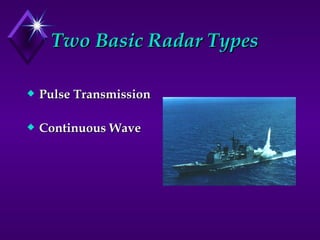
Two Basic Radar Types Pulse Transmission Continuous Wave
Pulse Transmission
Range vs. Power/PW/PRF Minimum Range:  If still transmitting when return received  RETURN NOT SEEN. Max Range:  As  min Rh max Rh PW PRF
2.  Pulse repetition frequency (PRF) a.  Pulses per second b.  Relation to pulse repetition time (PRT) c.  Effects of varying PRF  (1) Maximum range  (2) Accuracy 3.  Peak power a.  Maximum signal power of any pulse b.  Affects maximum range of radar
4.  Average power a.  Total power transmitted per unit of time b.  Relationship of average power to PW and PRT 5.  Duty cycle a.  Ratio PW (time transmitting) to PRT (time of entire cycle, time transmitting plus rest time) b.  Also equal to ratio of average power to peak power C. Discuss the determination of range with a pulse radar.
Determining Range With Pulse Radar c = 3 x 10 8  m/sec t is time to receive return divide by 2 because pulse traveled to object and back
Pulse Transmission Pulse Width (PW) Length or duration of a given pulse Pulse Repetition Time (PRT=1/PRF) PRT is time from beginning of one pulse to the beginning of the next PRF is frequency at which consecutive pulses are transmitted. PW can determine the radar’s minimum detection range; PW can determine the radar’s maximum detection range. PRF can determine the radar’s maximum detection range.
D. Describe the components of a pulse radar system. 1.  Synchronizer 2.  Transmitter  3.  Antenna  4.  Duplexer 5.  Receiver 6.  Display unit 7.  Power supply
Pulse Radar Block Diagram Power Supply Synchronizer Transmitter Display Duplexer (Switching Unit) Receiver Antenna Antenna Bearing or Elevation Video Echo ATR RF TR
Continuous Wave Radar Employs continual RADAR transmission Separate transmit and receive antennas Relies on the “DOPPLER SHIFT”
Doppler Frequency Shifts Motion Away:   Echo Frequency Decreases Motion Towards: Echo Frequency Increases
Continuous Wave Radar Components Discriminator AMP Mixer CW  RF Oscillator Indicator OUT IN Transmitter Antenna Antenna
Pulse Vs. Continuous Wave Pulse Echo Single Antenna Gives Range, usually Alt. as well Susceptible To Jamming Physical Range Determined By PW and PRF. Continuous Wave Requires 2 Antennae Range or Alt. Info High SNR More Difficult to Jam But Easily Deceived Amp can be tuned to look for expected frequencies
RADAR Wave Modulation Amplitude Modulation Vary the amplitude of the carrier sine wave Frequency Modulation Vary the frequency of the carrier sine wave Pulse-Amplitude Modulation Vary the amplitude of the pulses Pulse-Frequency Modulation Vary the Frequency at which the pulses occur
Modulation
Antennae Two Basic Purposes: Radiates RF Energy Provides Beam Forming and Focus Must Be 1/2 of the Wave Length for the maximum wave length employed Wide Beam pattern for Search, Narrow for Track
Beamwidth Vs. Accuracy
Azimuth Angular Measurement
Determining Altitude
Concentrating Radar Energy Through Beam Formation Linear Arrays Uses the Principle of wave summation (constructive interference) in a special direction and wave cancellation (destructive interference) in other directions. Made up of two or more simple half-wave antennas. Quasi-optical Uses reflectors and “lenses” to shape the beam.
Basic Dipole Antenna and Beam Forming H alf-Wave Dipole Antenna Basic Beam Formed
Wave Shaping Linear Array Beam Forming Side Bottom Types of Linear Arrays Broadside Endfire Array
Wave Shaping Linear Array Parasitic Element
Reflector Shape Paraboloid - Conical Scan used for fire control - can be CW or Pulse Orange Peel Paraboliod - Usually CW and primarily for fire control Parabolic Cylinder - Wide search beam - generally larger and used for long-range search applications - Pulse
Wave Shaping -Quasi-Optical Systems Reflectors Lenses
Wave Guides Used as a medium for high energy shielding. Uses A Magnetic Field to keep the energy centered in the wave guide. Filled with an inert gas to prevent arcing due to high voltages within the waveguide.
Questions? Please read Ch 9.
Radar Principles and Systems Part II
Factors That Affect Radar Performance Signal Reception Receiver Bandwidth Pulse Shape Power Relation Beam Width Pulse Repetition Frequency Antenna Gain Radar Cross Section of Target Signal-to-noise ratio Receiver Sensitivity Pulse Compression Scan Rate Mechanical Electronic Carrier Frequency Antenna aperture
Radar Receiver Performance Factors Signal Reception Signal-to-Noise Ratio Receiver Bandwidth Receiver Sensitivity
Signal Reception • Only a minute portion of the RF is reflected off the target. • Only a fraction of that returns to the antenna. • The  weaker the signal  that the receiver can process, the greater the effective range .
Signal-to-Noise Ratio Measured in dB!!!!! Ability to recognize target in random noise. Noise is always present. At some range, noise is greater that target’s return. Noise sets the absolute lower limit of the unit’s sensitivity. Threshold level  used to remove excess noise.
Receiver Bandwidth Is the frequency range the receiver can process. Receiver must process many frequencies Pulse are generated by summation of sine waves of various frequencies. Frequency shifts occur from Doppler Effects. Reducing the bandwidth Increases the signal-to-noise ratio(good) Distorts the transmitted pulse(bad)
Receiver Sensitivity Smallest return signal that is discernible against the noise background. Milliwatts range. An important factor in determining the unit’s maximum range.
Pulse Effects on Radar Performance Pulse Shape Pulse Width Pulse Compression Pulse Power
Pulse Shape Determines range accuracy and minimum and maximum range. Ideally we want a pulse with vertical leading and trailing edges.  Very clear signal – easily discerned when listening for the echo.
Pulse Width Determines the range resolution. Determines the minimum detection range. Can also determine the maximum range of radar. The narrower the pulse, the better the range resolution.
Pulse Compression Increases frequency of the wave within the pulse. Allows for good range resolution while packing enough power to provide a large maximum range.
Pulse Power The “Ummph” to get the signal out a long way. High peak power is desirable to achieve maximum ranges. Low power means smaller and more compact radar units and less power required to operate.
Other Factors Affecting Performance Scan Rate and Beam Width Narrow beam require slower antenna rotation rate. Pulse Repetition Frequency Determines radars maximum range(tactical factor). Carrier Frequency Determines antenna size, beam directivity and target size. Radar Cross Section  (What the radar can see(reflect)) Function of target size, shape, material, angle and carrier frequency.
 
 
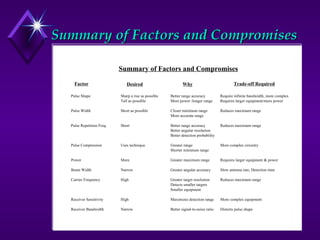
Summary of Factors and Compromises Summary of Factors and Compromises Pulse Shape Sharp a rise as possible  Better range accuracy Require infinite bandwidth, more complex  Tall as possible More power /longer range Requires larger equipment/more power Pulse Width Short as possible Closer minimum range Reduces maximum range More accurate range Pulse Repetition Freq. Short Better range accuracy Reduces maximum range Better angular resolution Better detection probability Pulse Compression Uses technique Greater range  More complex circuitry Shorter minimum range  Power More Greater maximum range Requires larger equipment & power Beam Width Narrow Greater angular accuracy Slow antenna rate, Detection time Carrier Frequency High Greater target resolution Reduces maximum range Detects smaller targets Smaller equipment Receiver Sensitivity High Maximizes detection range More complex equipment Receiver Bandwidth Narrow Better signal-to-noise ratio Distorts pulse shape Factor Desired Why Trade-off Required
Types of Radar Output Displays A Scan  Used for gunfire control Accurate Range information B Scan  Used for airborne fire control Range and Bearing, forward looking E Scan  Used for Altitude PPI  Used for surface search and navigation
Specific Types of Radar Frequency Modulated CW Radar  Use for radar altimeters and missile guidance. Pulse Doppler Carrier wave frequency within pulse is compared with a reference signal to detect moving targets. Moving Target Indicator (MTI) System Signals compared with previous return to enhance moving targets.  (search radars) Frequency Agile Systems Difficult to jam.
Specific Types of Radar SAR / ISAR Phased Array - Aegis Essentially 360° Coverage Phase shift and frequency shift allow the planar array to “steer” the beam.  Also allows for high / low power output depending on requirements.
Questions? Transmission Echo Wasted Echo

radar

  • 1.
    Radar Principles & Systems With your facilitator, LT Mazat
  • 2.
    I. Learning ObjectivesA. The student will comprehend the basic operation of a simple pulse radar system. B. The student will know the following terms: pulse width, pulse repetition frequency, carrier frequency, peak power, average power, and duty cycle. C. The student will know the block diagram of a simple pulse radar system and will comprehend the major components of that system.
  • 3.
    D. Thestudent will comprehend the basic operation of a simple continuous wave radar system. E. The student will comprehend the concept of doppler frequency shift. F. The student will know the block diagram of a simple continuous wave radar system and will comprehend the major components of that system, including amplifiers, power amplifiers, oscillators, and waveguides.
  • 4.
    G. Thestudent will comprehend the use of filters in a continuous wave radar system. H. The student will know the fundamental means of imparting information to radio waves and will comprehend the uses, advantages, and disadvantages of the various means. I. The student will comprehend the function and characteristics of radar/radio antennas and beam formation.
  • 5.
    J. The studentwill comprehend the factors that affect radar performance. K. The student will comprehend frequency modulated CW as a means of range determination. L. The student will comprehend the basic principles of operation of pulse doppler radar and MTI systems.
  • 6.
  • 7.
    Two Basic RadarTypes Pulse Transmission Continuous Wave
  • 8.
  • 9.
    Range vs. Power/PW/PRFMinimum Range: If still transmitting when return received RETURN NOT SEEN. Max Range: As min Rh max Rh PW PRF
  • 10.
    2. Pulserepetition frequency (PRF) a. Pulses per second b. Relation to pulse repetition time (PRT) c. Effects of varying PRF (1) Maximum range (2) Accuracy 3. Peak power a. Maximum signal power of any pulse b. Affects maximum range of radar
  • 11.
    4. Averagepower a. Total power transmitted per unit of time b. Relationship of average power to PW and PRT 5. Duty cycle a. Ratio PW (time transmitting) to PRT (time of entire cycle, time transmitting plus rest time) b. Also equal to ratio of average power to peak power C. Discuss the determination of range with a pulse radar.
  • 12.
    Determining Range WithPulse Radar c = 3 x 10 8 m/sec t is time to receive return divide by 2 because pulse traveled to object and back
  • 13.
    Pulse Transmission PulseWidth (PW) Length or duration of a given pulse Pulse Repetition Time (PRT=1/PRF) PRT is time from beginning of one pulse to the beginning of the next PRF is frequency at which consecutive pulses are transmitted. PW can determine the radar’s minimum detection range; PW can determine the radar’s maximum detection range. PRF can determine the radar’s maximum detection range.
  • 14.
    D. Describe thecomponents of a pulse radar system. 1. Synchronizer 2. Transmitter 3. Antenna 4. Duplexer 5. Receiver 6. Display unit 7. Power supply
  • 15.
    Pulse Radar BlockDiagram Power Supply Synchronizer Transmitter Display Duplexer (Switching Unit) Receiver Antenna Antenna Bearing or Elevation Video Echo ATR RF TR
  • 16.
    Continuous Wave RadarEmploys continual RADAR transmission Separate transmit and receive antennas Relies on the “DOPPLER SHIFT”
  • 17.
    Doppler Frequency ShiftsMotion Away: Echo Frequency Decreases Motion Towards: Echo Frequency Increases
  • 18.
    Continuous Wave RadarComponents Discriminator AMP Mixer CW RF Oscillator Indicator OUT IN Transmitter Antenna Antenna
  • 19.
    Pulse Vs. ContinuousWave Pulse Echo Single Antenna Gives Range, usually Alt. as well Susceptible To Jamming Physical Range Determined By PW and PRF. Continuous Wave Requires 2 Antennae Range or Alt. Info High SNR More Difficult to Jam But Easily Deceived Amp can be tuned to look for expected frequencies
  • 20.
    RADAR Wave ModulationAmplitude Modulation Vary the amplitude of the carrier sine wave Frequency Modulation Vary the frequency of the carrier sine wave Pulse-Amplitude Modulation Vary the amplitude of the pulses Pulse-Frequency Modulation Vary the Frequency at which the pulses occur
  • 21.
  • 22.
    Antennae Two BasicPurposes: Radiates RF Energy Provides Beam Forming and Focus Must Be 1/2 of the Wave Length for the maximum wave length employed Wide Beam pattern for Search, Narrow for Track
  • 23.
  • 24.
  • 25.
  • 26.
    Concentrating Radar EnergyThrough Beam Formation Linear Arrays Uses the Principle of wave summation (constructive interference) in a special direction and wave cancellation (destructive interference) in other directions. Made up of two or more simple half-wave antennas. Quasi-optical Uses reflectors and “lenses” to shape the beam.
  • 27.
    Basic Dipole Antennaand Beam Forming H alf-Wave Dipole Antenna Basic Beam Formed
  • 28.
    Wave Shaping LinearArray Beam Forming Side Bottom Types of Linear Arrays Broadside Endfire Array
  • 29.
    Wave Shaping LinearArray Parasitic Element
  • 30.
    Reflector Shape Paraboloid- Conical Scan used for fire control - can be CW or Pulse Orange Peel Paraboliod - Usually CW and primarily for fire control Parabolic Cylinder - Wide search beam - generally larger and used for long-range search applications - Pulse
  • 31.
    Wave Shaping -Quasi-OpticalSystems Reflectors Lenses
  • 32.
    Wave Guides Usedas a medium for high energy shielding. Uses A Magnetic Field to keep the energy centered in the wave guide. Filled with an inert gas to prevent arcing due to high voltages within the waveguide.
  • 33.
  • 34.
    Radar Principles andSystems Part II
  • 35.
    Factors That AffectRadar Performance Signal Reception Receiver Bandwidth Pulse Shape Power Relation Beam Width Pulse Repetition Frequency Antenna Gain Radar Cross Section of Target Signal-to-noise ratio Receiver Sensitivity Pulse Compression Scan Rate Mechanical Electronic Carrier Frequency Antenna aperture
  • 36.
    Radar Receiver PerformanceFactors Signal Reception Signal-to-Noise Ratio Receiver Bandwidth Receiver Sensitivity
  • 37.
    Signal Reception •Only a minute portion of the RF is reflected off the target. • Only a fraction of that returns to the antenna. • The weaker the signal that the receiver can process, the greater the effective range .
  • 38.
    Signal-to-Noise Ratio Measuredin dB!!!!! Ability to recognize target in random noise. Noise is always present. At some range, noise is greater that target’s return. Noise sets the absolute lower limit of the unit’s sensitivity. Threshold level used to remove excess noise.
  • 39.
    Receiver Bandwidth Isthe frequency range the receiver can process. Receiver must process many frequencies Pulse are generated by summation of sine waves of various frequencies. Frequency shifts occur from Doppler Effects. Reducing the bandwidth Increases the signal-to-noise ratio(good) Distorts the transmitted pulse(bad)
  • 40.
    Receiver Sensitivity Smallestreturn signal that is discernible against the noise background. Milliwatts range. An important factor in determining the unit’s maximum range.
  • 41.
    Pulse Effects onRadar Performance Pulse Shape Pulse Width Pulse Compression Pulse Power
  • 42.
    Pulse Shape Determinesrange accuracy and minimum and maximum range. Ideally we want a pulse with vertical leading and trailing edges. Very clear signal – easily discerned when listening for the echo.
  • 43.
    Pulse Width Determinesthe range resolution. Determines the minimum detection range. Can also determine the maximum range of radar. The narrower the pulse, the better the range resolution.
  • 44.
    Pulse Compression Increasesfrequency of the wave within the pulse. Allows for good range resolution while packing enough power to provide a large maximum range.
  • 45.
    Pulse Power The“Ummph” to get the signal out a long way. High peak power is desirable to achieve maximum ranges. Low power means smaller and more compact radar units and less power required to operate.
  • 46.
    Other Factors AffectingPerformance Scan Rate and Beam Width Narrow beam require slower antenna rotation rate. Pulse Repetition Frequency Determines radars maximum range(tactical factor). Carrier Frequency Determines antenna size, beam directivity and target size. Radar Cross Section (What the radar can see(reflect)) Function of target size, shape, material, angle and carrier frequency.
  • 47.
  • 48.
  • 49.
    Summary of Factorsand Compromises Summary of Factors and Compromises Pulse Shape Sharp a rise as possible Better range accuracy Require infinite bandwidth, more complex Tall as possible More power /longer range Requires larger equipment/more power Pulse Width Short as possible Closer minimum range Reduces maximum range More accurate range Pulse Repetition Freq. Short Better range accuracy Reduces maximum range Better angular resolution Better detection probability Pulse Compression Uses technique Greater range More complex circuitry Shorter minimum range Power More Greater maximum range Requires larger equipment & power Beam Width Narrow Greater angular accuracy Slow antenna rate, Detection time Carrier Frequency High Greater target resolution Reduces maximum range Detects smaller targets Smaller equipment Receiver Sensitivity High Maximizes detection range More complex equipment Receiver Bandwidth Narrow Better signal-to-noise ratio Distorts pulse shape Factor Desired Why Trade-off Required
  • 50.
    Types of RadarOutput Displays A Scan Used for gunfire control Accurate Range information B Scan Used for airborne fire control Range and Bearing, forward looking E Scan Used for Altitude PPI Used for surface search and navigation
  • 51.
    Specific Types ofRadar Frequency Modulated CW Radar Use for radar altimeters and missile guidance. Pulse Doppler Carrier wave frequency within pulse is compared with a reference signal to detect moving targets. Moving Target Indicator (MTI) System Signals compared with previous return to enhance moving targets. (search radars) Frequency Agile Systems Difficult to jam.
  • 52.
    Specific Types ofRadar SAR / ISAR Phased Array - Aegis Essentially 360° Coverage Phase shift and frequency shift allow the planar array to “steer” the beam. Also allows for high / low power output depending on requirements.
  • 53.

Editor's Notes

  • #2 What is RADAR an acronym for? Radio Detection and Ranging. Radio wave is generated, transmitted, reflected, and detected. RADAR unimpaired by night, fog, clouds, smoke. Not as detailed as actual sight. RADAR is good for isolated targets against a relatively featureless background.