Introduction to PKI Technology Sylvain Maret Février 2002 Version 2.01
Course Map Day One Introduction Key Terms Cryptosystems Services, Mechanisms, Algorithms Cryptography in History Cryptanalysis
Course Map Day One Secret-Key Cryptography AES Public-Key Cryptography RSA Diffie-Hellman Message Digests Random Numbers Key Length
Course Map Day One Message Authentication Code (MAC, HMAC) Digital Signature RSA, DSS / DSA, ElGamal Hybrid Cryptosystems RSA Key Wrapping Diffie-Hellman PKCS Standard Smart Card End of day one
Course Map Day Two Questions to day one ? Revision quiz ! PKI introduction Digital certificates X.509 certificates (Demo) Certificate Revocation (Demo) Certification Authorities RA, LRA Data Repositories (LDAP)
Course Map Day two S/MIME: How it works ? SSL: How it works ? IPSEC: How it works ? Open discussion Encryption references site s
Course Objectives Understand cryptographic fundamentals and how cryptographic technology is applied in a Public Key Infrastructure Know the elements of Public Key Infrastructure and how they interact with each other Understand and be able to describe some of the practical applications of PKI Understand why PKI is an attractive technology to enable e-commerce and enhance security
PKI, WHY? The rise of public data networks. Internet is a new platform for business relationships: E-business Business rules need to be “translated” into this new “language”. Hope behind PKI: to preserve classical business rules in this new virtual world.
Drawbacks for E- business Let’s say you have an electronic contract which you need to distribute to another party over the Internet… With existing Internet tools like www and e-mail you lose a lot compared to paper No assurance that the contract has been signed No guarantee that the contract is authentic No assurance of the contract’s source Basically, it is worth than the paper where everything is printed on!
About needs... You need to know who you are dealing with  (Authentication) You need to keep private things private  (Confidentiality) You need to make sure that people do not cheat  (Non-Repudiation) You need to be sure that information has not been altered  (Integrity)
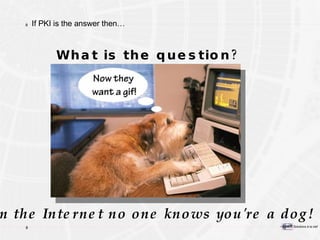
If PKI is the answer then… What is the question? On the Internet no one knows you're a dog!
Key Terms A message will be defined as plaintext or cleartext The process of disguising a message to hide its substance is encryption The encrypted message is referred to as ciphertext Decryption is the process turning ciphertext back into plaintext
Key Terms Cryptography is the science allowing messages to be kept secure Cryptoanalysis is the art and science of breaking ciphertext Cryptology is the mathematics field Cryptologist are theoretical mathematicians
Cryptosystems A cryptosystem is a collection of cryptographic algorithms, cryptographic keys, and all possible plaintexts and their corresponding ciphertexts.
Security Services Authentication :  Provides the assurance of someone’s identity Confidentiality :  Protects against disclosure to unauthorized identities Non-Repudiation :  Protects against communications originator to later deny it Integrity :  Protects from unauthorized data alteration
Security Mechanisms Three basic building blocks are used: Encryption is used to provide confidentiality and integrity protection Digital Signatures are used to provide authentication, integrity protection and non-repudiation Checksums / hash algorithms are used to provide integrity protection and can provide authentication
Cryptography Algorithms All Cryptosystems are based on only three algorithms: 1 - Secret-Key algorithms 2 - Public-Key algorithms 3 - Message-Digest algorithms
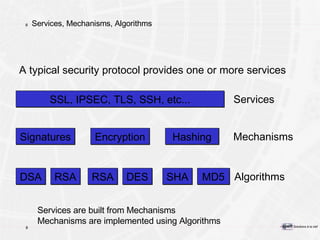
Services, Mechanisms, Algorithms A typical security protocol provides one or more services Services Mechanisms Algorithms Services are built from Mechanisms Mechanisms are implemented using Algorithms SSL, IPSEC, TLS, SSH, etc... Signatures Encryption Hashing DSA RSA RSA DES SHA MD5
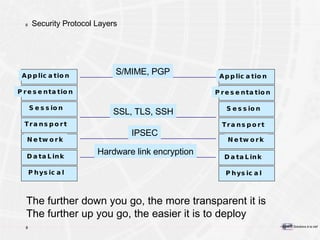
Security Protocol Layers The further down you go, the more transparent it is The further up you go, the easier it is to deploy Application Presentation Session Transport DataLink Physical Application Presentation Session Transport Network DataLink Physical Network S/MIME, PGP SSL, TLS, SSH IPSEC Hardware link encryption
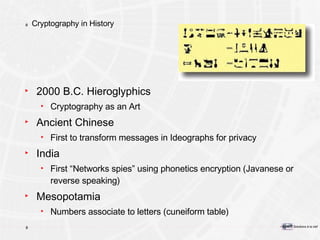
Cryptography in History 2000 B.C. Hieroglyphics Cryptography as an Art Ancient Chinese First to transform messages in Ideographs for privacy India First “Networks spies” using phonetics encryption (Javanese or reverse speaking) Mesopotamia Numbers associate to letters (cuneiform table)
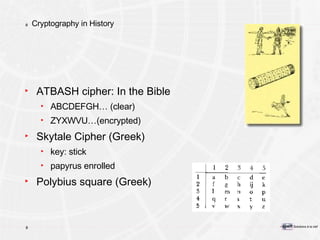
Cryptography in History ATBASH cipher: In the Bible  ABCDEFGH… (clear) ZYXWVU…(encrypted) Skytale Cipher (Greek) key: stick papyrus enrolled Polybius square (Greek)
Cryptography in History Runiques Stones by Vikings (Arts)
Cryptography in History World War II: Electromechanical cryptography Rotor based machine transforming plaintext into ciphertext, using electrical signals as encryption key Example: Enigma machine used by Germans Ciphers were not new, but their processing was… 1970-today: New ciphers: based on numbers properties issued from Mathematical theories RSA: Prime numbers factorization Diffie-Hellman: discrete logarithm ECDSA: Elliptic curve cryptography
Cryptanalysis Two categories of security levels Computationally secure: Question of time and money (Brute force attack) (Most of the cryptosystems: DES, 3DES, IDEA, RSA, DH etc.) Unconditionally secure: Can “never” be broken independently of the resources One-time pads
Several Cryptanalytic Attacks  Ciphertext only Brute force attack and dictionary attacks on keys Chosen ciphertext Start from a known ciphertext and try to appear as someone else to get information from others behavior Known Plain ciphertext Derive the key from knowledge of both plain and ciphertext
Secret-Key Cryptography
Secret-Key Cryptography Use a secret key to encrypt a message into a ciphertext Use the same key to decrypt the ciphertext into the original message Secret-key cryptography is referred also as symmetric cryptography or conventional cryptography The secret key is also known as session key or bulk encryption key
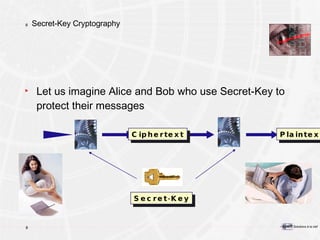
Secret-Key Cryptography Let us imagine Alice and Bob who use Secret-Key to protect their messages Plaintext Ciphertext Secret-Key
Secret-Key Cryptography How to share the Secret-Key ? Alice and Bob can use the phone, fax, a meeting point, etc. But!?: Could someone steal the key? How to proceed without partner knowledge?
Secret-Key Cryptography The Advantages Implementation is efficient to encrypt large volume of data (100 to 1’000 faster than Public-Key Cryptography) Simple to implement in either software or hardware Most of the algorithms are well know and secure Seem to be safe to brute force attack Widely used
Secret-Key Cryptography The Disadvantages Hard to share Secret-Keys Large number of keys No non-repudiation (Signature) Subject to interception (Secret-Key)
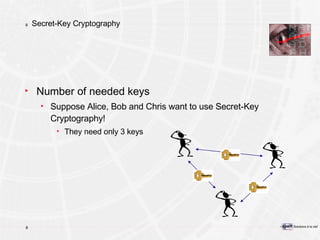
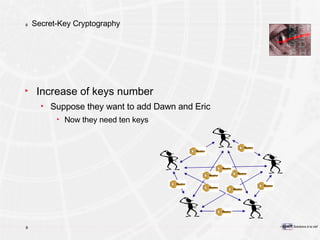
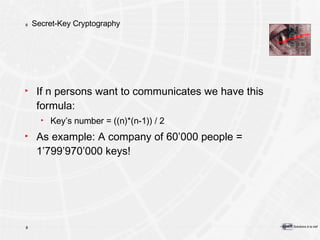
Secret-Key Cryptography Number of needed keys Suppose Alice, Bob and Chris want to use Secret-Key Cryptography! They need only 3 keys
Secret-Key Cryptography Increase of keys number Suppose they want to add Dawn and Eric Now they need ten keys
Secret-Key Cryptography If n persons want to communicates we have this formula: Key’s number = ((n)*(n-1)) / 2 As example: A company of 60’000 people = 1’799’970’000 keys!
Secret-Key Cryptography Block cipher: Encrypts data in predefined block size Most well-known ciphers are block ciphers Stream cipher: Encrypts data stream, one-bit at the time Only few algorithms use it
Secret-Key Cryptography Common Secret-Key Ciphers DES Triple DES (3DES) RC2 IDEA Blowfish CAST-128 Skipjack RC4 (Stream cipher) etc.
Secret-Key Cryptography DES Data Encryption Standard (1973) by IBM World  Standard for 20 years DES was broken in 22 hours (DES challenge III, January 18th, 1999) Key size = 56 bits Block cipher Recommendation: should be replaced by 3DES for high confidentiality requirements !
Secret-Key Cryptography Triple DES (3DES) Block cipher Encrypt + decrypt + encrypt with 2 (112 bits) or 3 (168 bits) DES keys DES’s replacement for Banking (1998) Recommendation: Use it for high confidentiality!
Secret-Key Cryptography RC2 Designed by Ron Rivest from RSA  Block cipher Key size = up to 2048 Encryption speed: independent from the key size Trade secret from RSA, posted on the net in 1996 Designed as a DES’ replacement Faster than DES Recommendation: like DES but faster!
Secret-Key Cryptography CAST-128 Designed by C.Adams and S. Tavares (1993) Block cipher Key size = 128 bits Used in PGP 5.x Recommendation: unknown
Secret-Key Cryptography IDEA International Data Encryption Algorithm  Designed by X.Lai and J. Massey (ETH Zurich) in 1990 Block cipher Key size = 128 bits More efficient than DES for software implementation Used in PGP Recommendation: Better than DES
Secret-Key Cryptography Blowfish Designed by B. Schneier in 1993 Optimized for high-speed execution on 32-bit processors Block cipher Key size = up to 448 bits key Recommendation: Use for fast performances and with a maximum key size
Secret-Key Cryptography Skipjack Designed by NSA (National Security Agency) Block cipher Key size = 80 bits Recommendation: Inadequate for long term security (key size too short)
Secret-Key Cryptography GOST Acronym for “GOsudarstvennyi STandard” Russian answer to DES Key size = 256 bits Recommendation: Incompletely specified to give an answer...
Secret-Key Cryptography RC4 Designed by Ron Rivest from RSA  Stream cipher Key size = up to 2048 bits Optimized for fast software implementation Trade secret from RSA, posted on the net in 1994 Very fast Used in SSL, Lotus Note, Windows password encryption, Oracle etc. Recommendation: Highly recommended for long keys (>40 bits)
Secret-Key Cryptography Many, many others There is no good reason not to use one of above proven algorithms!
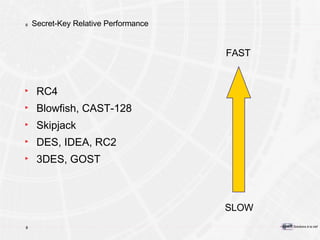
Secret-Key Relative Performance RC4 Blowfish, CAST-128 Skipjack DES, IDEA, RC2 3DES, GOST FAST SLOW
AES National Institute of Standard and Technology expressed a formal call for algorithm on 09.1997  The aim is to define the “next century’s” symmetric encryption standard or Advanced Encryption Standard AES1 conf. (08.98): 15 potential candidates  AES2 conf. (03.99): 5 retained candidates Final choice expected for summer 2001
AES candidates MARS (IBM) RC6 (RSA Laboratories) Rijndael (J. Daemen, V. Rijmen) Serpent (R. Anderson, E. Biham, L. Knudsen) Twofish (B. Schneier - Counterpane)
AES requirements Block cipher of minimum 128 bits Must implement symmetric keys of 128, 192, 256 bits  Must be efficient on software and hardware basis (high speed encryption)
Public Key  Cryptography
Public-Key Cryptography Use two distinct keys, one public and one private The private is kept secret The public can be freely shared Referred as asymmetric cryptography A public-key and its corresponding key are mathematically related A public-key and its associated private-key are called a key-pair
Public-Key Cryptography A message encrypted with a public-key can be only decrypted by the private-key A message encrypted with a private-key can be only decrypted by the public-key (Signature)
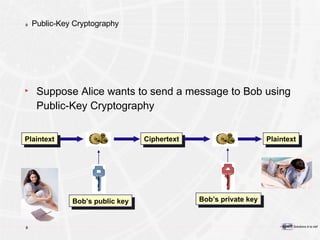
Public-Key Cryptography Suppose Alice wants to send a message to Bob using Public-Key Cryptography Plaintext Plaintext Ciphertext Bob’s public key Bob’s private key
Public-Key Cryptography How to obtain the public-key ? Any publishing way can be used to get the public-key (Directory servers, Phone, Web server, Newspapers etc.) No more confidentiality issues in key distribution
Public-Key Cryptography Advantages No secret sharing Fewer keys No prior relationship needed Easier to administrate Offers useful mechanisms like digital signature (offering non repudiation)
Public-Key Cryptography Disadvantages Not efficient (slow) to encrypt large volume of data  Keys need to be much longer than with secret-key encryption Impossible to encrypt a plaintext with size > key
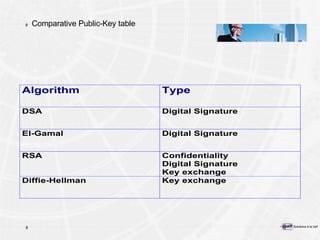
Types of public-key algorithm A public-key algorithm is reversible if encryption and decryption can be processed with either   a private or a public-key A public-key algorithm is irreversible if a private-key is mandatory for encryption Key exchange algorithm: neither used for encryption nor decryption (Diffie-Hellman)
RS A Inventors: Rivest, Shamir, Adleman in 1977 Most popular Provide confidentiality, digital signature and key exchange Key length up to 4096 Plaintext length < Key length Ciphertext size = Key size
RSA RSA is protected by a patent. Patent expires on 20th September 2000 Relies on irreversible mathematics functions (Prime numbers)
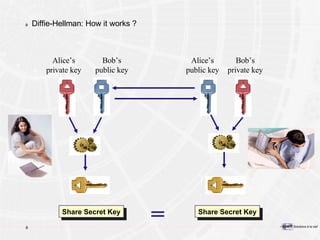
Diffie-Hellman Published in 1976 by W. Diffie and M. Hellman Oldest known public-key cryptosystem Key agreement algorithm Enables secret-key exchange without prior knowledge Agrees on shared secret used in conjunction with a secret-key Cryptosystem (DES, 3DES, IDEA, etc.)
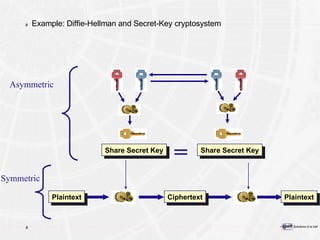
Diffie-Hellman: How it works ? Alice’s private key Bob’s private key Alice’s public key Bob’s public key = Share Secret Key Share Secret Key
DSA Compliant to  D igital  S ignature  S tandard (DSS) Published in 1994 Irreversible algorithm (encryption with private key only) Used in Digital signature only Performance tuned for smart cards
Comparative Public-Key table
Message-Digest Algorithms
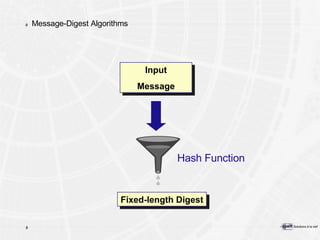
Message-Digest Algorithms Take a variable-length message and produce   a fixed-length digest as output The fixed-length output is called the message digest, a digest or a hash A message-digest algorithm is also called   a one-way hash algorithm or a hash algorithm
Message-Digest Algorithms Input Message Fixed-length Digest Hash Function
Message-Digest Algorithms Message-Digest Algorithms properties required to be cryptographically secure It must not be feasible to determine the input message based on its digest It must not be possible to find an arbitrary message that has a particular, desired digest It should be impossible to find two messages that have the same digest (collision) It should be very sensitive to input message changes
Message-Digest Algorithms Some Common Message-Digest Algorithms MD2: 128-bit-output, deprecated, by Ronald Rivest MD4: 128-bit-output, broken, by Ronald Rivest MD5: 128-bit-output, weaknesses, by Ronald Rivest SHA-1: 160-bit-output, NSA-Designed RIPEMD-160: 160-bit-output Haval: 128 to 256 bit-output (3 to 5 Passes) CRC-32: 32-bit-output Recommendation: Use SHA-1
Message-Digest Algorithms Message-Digest at work Creation of digital signatures Creation of MAC, HMAC Creation of secret-key with a passphrase File checksum (FTP server, Patches, etc.) FIA (File Integrity Assessment like Tripwire)
Random Numbers Random numbers are usually required to generate cryptographic keys or challenge. Two main categories (PRNG) Pseudo Random Number Generator uses a deterministic algorithm to generate a pseudo random number based on a seed (mouse, keyboard, etc..) A random number generator generates truly unpredictable numbers. Based generally on special hardware (white noise, radioactive-decay, etc…)
Random Numbers
Random Numbers A very secure cryptosystem can be broken if it relies on random numbers that can be guessed Netscape browser using SSL broken! Some PRNG Yarrow from B. Schneier CryptPack etc.
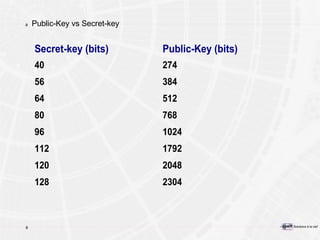
Keys Length To break a secret-key cryptosystem with “no weakness”, an attacker must try each possible key. This is called a brute force attack To break a public-key cryptosystem an attacker should use “smarter” brute force attack based on mathematics Key space dimension = 2n  (n:keylength)
Keys Length
What is the right key size ? The goals of cryptography are to make the value of encrypted information less than the money spent to decrypt it ! the value of information usually decreases over  tim e
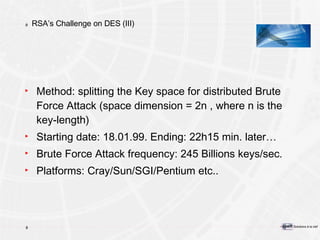
RSA’s Challenge on DES (III) Method: splitting the Key space for distributed Brute Force Attack (space dimension = 2n , where n is the key-length) Starting date: 18.01.99. Ending: 22h15 min. later… Brute Force Attack frequency: 245 Billions keys/sec. Platforms: Cray/Sun/SGI/Pentium etc..
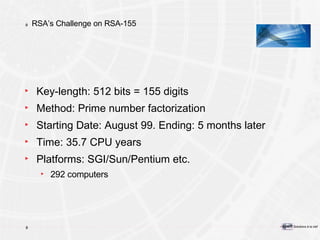
RSA’s Challenge on RSA-155 Key-length: 512 bits = 155 digits Method: Prime number factorization Starting Date: August 99. Ending: 5 months later Time: 35.7 CPU years Platforms: SGI/Sun/Pentium etc. 292 computers
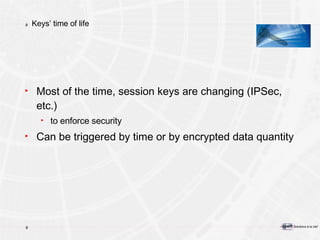
Keys’ time of life Most of the time, session keys are changing (IPSec, etc.) to enforce security Can be triggered by time or by encrypted data quantity
Public-Key vs Secret-key
Message Authentication Code
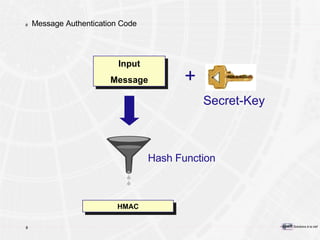
Message Authentication Code MAC is a fixed-length data item that is send together with a message to prove integrity and origin Provide authentication and integrity without confidentiality Also referred as message integrity code (MIC) Most common form is HMAC ( Hashed Mac) Example: HMAC-MD5
Message Authentication Code + Input Message HMAC Secret-Key Hash Function
Digital Signature
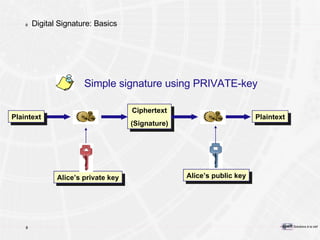
Digital Signature Digital signature  is a data item that guarantees the origin and integrity of a message The signer of the message uses a signing key The recipient uses a verification key to verify the origin and integrity Signing key = private-key Verification key = public-key
Digital Signature By using his own private key, the signer can not repudiate the fact he has signed the message This mechanism provide non-repudiation Think about the difference with MAC …
Digital Signature: Basics Plaintext Simple signature using PRIVATE-key Plaintext Ciphertext (Signature) Alice’s private key Alice’s public key
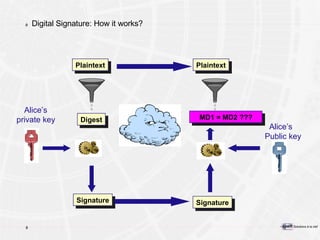
Digital Signature: How it works? Alice’s  private key Signature Alice’s  Public key Signature Plaintext MD1 = MD2 ??? Plaintext Digest
Digital Signature Why signing a message involves Hashing ? Signature (data item) is too big Performance (public-key is very slow) Possible attack (known plaintext attack)
Common Signature Algorithms RSA Well known Export limitation DSA Similar to RSA (algebraic properties of numbers) Non-reversible algorithm, suitable for digital signature only ElGamal Another cipher for digital signature only
Hybrid Cryptosystems
Hybrid Cryptosystems A Hybrid Cryptosystem combines the best features of both Secret-Key and Public-Key cryptography Used to exchange session key to initiate a symmetric encryption Example: PGP, SSL, IPSEC using Diffie-Hellman or RSA
Example: Diffie-Hellman and Secret-Key cryptosystem = Share Secret Key Share Secret Key Plaintext Plaintext Ciphertext Asymmetric Symmetric
RSA Key wrapping encryption Suppose Alice wants to send an encrypted text to Bob across the Internet , using RSA key wrapping
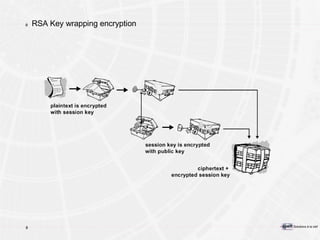
RSA Key wrapping encryption How it works ? Alice creates a session key, which is a one-time-only secret-key Alice encrypts the data with the session key Alice encrypts the session key with Bob’s public-key Alice sends the ciphertext + the encrypted session key to Bob
RSA Key wrapping encryption
RSA Key wrapping decryption How it works ? Bob receives the message from Alice  Bob uses his private-key to recover the temporary session key Bob uses the session key to decrypt the ciphertext
RSA Key wrapping decryption
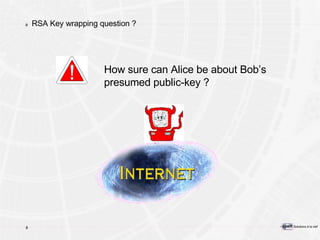
RSA Key wrapping question ? How sure can Alice be about Bob’s  presumed public-key ?
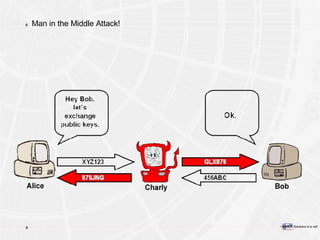
Man in the Middle Attack!
SSH: How it works ?
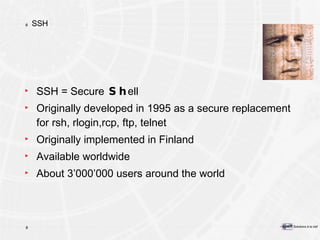
SSH SSH = Secure  Sh ell Originally developed in 1995 as a secure replacement for rsh, rlogin,rcp, ftp, telnet Originally implemented in Finland Available worldwide About 3’000’000 users around the world
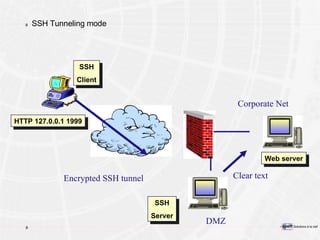
SSH Also allows port forwarding (tunneling over SSH) X11 connection forwarding SSH v2 submitted to IETF Can be run and used in a short space of time Many SSH clients available Secure CRT F-Secure Java Client etc.
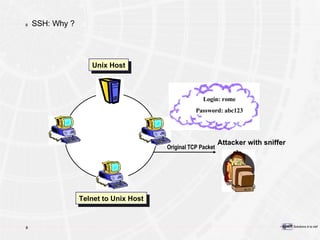
SSH: Why ? Attacker with sniffer Network Original TCP Packet Login: rome Password: abc123 Unix Host Telnet to Unix Host
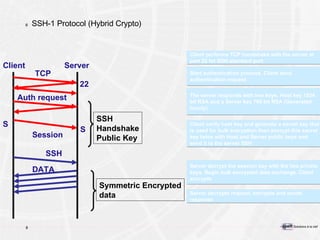
SSH-1 Protocol (Hybrid Crypto) TCP Auth request SSH Client Server DATA Client performs TCP handshake with the server at port 22 for SSH standard port Start authentication process. Client send authentication request Server decrypt the session key with the two private keys. Begin bulk encrypted data exchange. Client encrypts Server decrypts request, encrypts and sends response S S 22 Session The server responds with two keys. Host key 1024  bit RSA and a Server key 768 bit RSA (Generated hourly) Client verify host key and generate a secret key that is used for bulk encryption then encrypt this secret key twice with Host and Server public keys and send it to the server SSH Symmetric Encrypted data SSH Handshake Public Key
SSH Ciphers SSH v1 RSA DES, 3DES, Blowfish, IDEA SSH v2 Diffie-Hellman for key exchange algorithm DSA, RSA 3DES, Blowfish, IDEA, Twofish, Arcfour, Cast-128
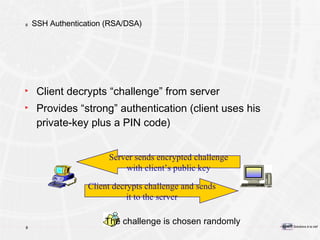
SSH Authentication Multiple Authentication mechanisms Static password (protected by SSH encryption) RSA or DSA authentication (client decrypts challenge from server) Plug-in authentication (Securid, Radius, ldap,  PAM *) “ .rhosts or /etc/hosts.equiv” (Based on IP address)
SSH Authentication (RSA/DSA) Client decrypts “challenge” from server Provides “strong” authentication (client uses his private-key plus a PIN code) Server sends encrypted challenge with client’s public key Client decrypts challenge and sends it to the server The challenge is chosen randomly
SSH Tunneling mode SSH Server HTTP 127.0.0.1 1999 Encrypted SSH tunnel  Clear text Web server DMZ Corporate Net SSH Client
PKCS
PKCS Public Key Cryptographic Standard (PKCS) Standardization of public-key algorithmic, in order to maintain interoperability Developed by RSA Laboratories,  a consortium of information technology vendors and academic institutions. Apple Microsoft Compaq Lotus Sun MIT etc.
PKCS list #1: Encrypting and signing using RSA public key cryptosystem #3: Key agreement with Diffie-Hellman key exchange #5: Encrypting with a secret key derived from a password #7: Syntax for message with digital signature #8: Format for private key information #9: Attribute type for use in other PKCS standard #10: Syntax for certification request #11: Define a  cryptoki  programming interface (API for smart cards) #12: Portable format for storing and transporting private keys #13: Encrypting and signing data using elliptic curves cryptography #14: Standard for pseudo number generation #15: Standard to store credentials on tokens
Smart Card
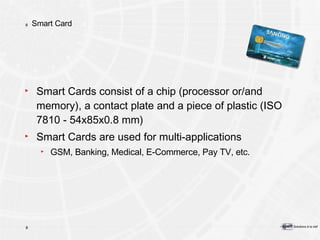
Smart Card Smart Cards consist of a chip (processor or/and memory), a contact plate and a piece of plastic (ISO 7810 - 54x85x0.8 mm) Smart Cards are used for multi-applications GSM, Banking, Medical, E-Commerce, Pay TV, etc .
Smart Card and PKI Storing the private-key and/or X.509 certificate  on the Smart Card Provide Strong Authentication Something you have, Something you know Access protected by a PIN (like credit card) Types of Smart Card Memory Cards PKI smart cards using Crypto-processor (RSA, etc.) Some Smart Card are “brute force” protected
Smart Card Standard (interface) PKCS #11 also call Cryptoki Interface for the communication to Smart Card Netscape, RSA PC/SC and their Crypto API http://www.pcscworkgroup.com/ Bull, Gemplus, HP, Intel, Microsoft, Schlumberger Siemens, SUN, Toshiba
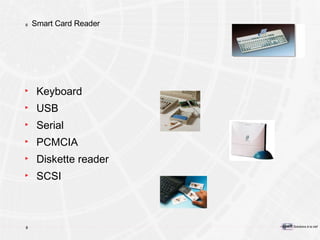
Smart Card Reader Keyboard USB Serial PCMCIA Diskette reader SCSI
Today’s Smart Card Drawbacks Hardware... Multi-Services rarely used Users leave Smart Card on the reader
Quiz !
Quiz! Describe Secret-Key ? Advantages / Disadvantages Describe Public-Key ? Advantages / Disadvantages Describe Messages Digest ? Describe Digital Signature and verification ? Differences between MAC and signature? Describe two Hybrid Cryptosystems ? Describe a challenge response based authentication?
PKI Introduction
PKI introduction The aim of PKI is to integrate all the previous mechanisms and algorithms into a coherent   and efficient structure.  It will answer the following fundamental security needs: Authentication Confidentiality Non-Repudiation Integrity The basis of PKI relies on the concept of certificates
PKI basis function PKI will include at least: One Certificate Authority who delivers certificates One Directory who stores active Certificates and/or Revoked Certificates One Registration Authority who allows certificates’ enrollment One centralized Management
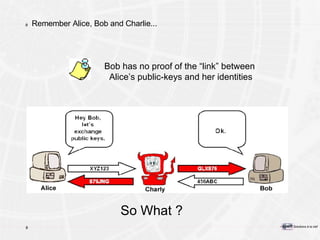
Remember Alice, Bob and Charlie... Bob has no proof of the “link” between  Alice’s public-keys and her identities So What   ?
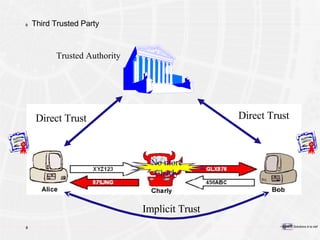
Third Trusted Party No more Charly Implicit Trust Trusted Authority Direct Trust Direct Trust
Digital Certificates A public-key certificate is a bond between n  an entity’s   public-key and one entity The entity can be: A person A role (Manager Director) An organization A piece of hardware (Router, Server, IPSEC, SSL, etc.) A software process (JAVA Applet) A file (Image, Databases, etc.) etc.
Digital Certificates A Public-key certificate provides assurance that the public-key belongs to the identified entity A Public-key certificate is also called a digital certificate, digital ID or certificate The entity identified is referred to as the certificate subject If the certificate subject is a person, it is referred to as a subscriber
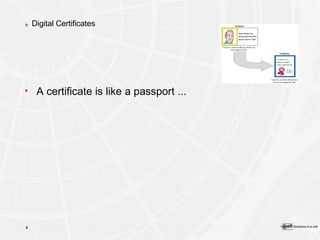
Digital Certificates A certificate is like a passport ...
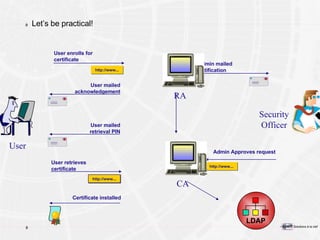
How to obtain a certificate As with passports, you give proof of your identity to an official (or trusted) authority. The authority checks this proof. The authority delivers a signed passport . This procedure is defined as an “enrollment” Instead of “enrolling” for a passport we’ll enroll for digital certificate.
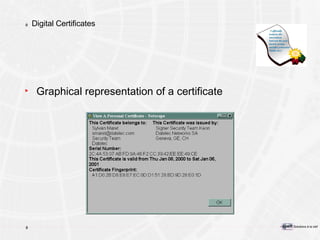
Digital Certificates Graphical representation of a certificate
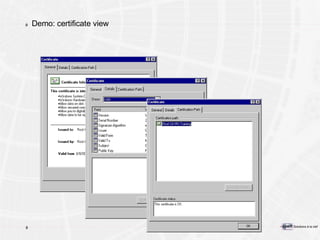
Demo: certificate view
X.509 Certificate Standard X.509 is a standard for digital certificate by International Telecommunications Union (ITU) First published in 1988 (V1.0) Version 2.0 (1993) adds two new fields Current version is v3.0 (1996) and allows additional extension fields
X.509 Basic Certificate Fields  Version: X509 version 1,2 and 3 Certificate serial number: Integer assigned by  the CA (unique) Signature algorithm identifier: RSA/MD5 etc. Issuer name: name of CA having signed and issued the certificate Validity period: time interval Subject name: the entity name (this name must be unique = distinguished name (DN) )
X.509 Basic Certificate Fields Subject public-key information: contains the public-key plus the parameters Issuer unique identifier: optional field Subject unique identifier: optional field Extensions: may provide additional data for specific applications.
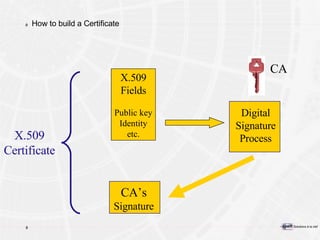
How to build a Certificate X.509 Certificate CA’s Signature X.509 Fields Public key Identity etc. Digital Signature Process CA
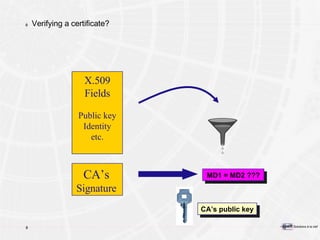
How to verify a certificate ? Obtain the Signer’s (CA) public-key Pass the X.509 fields into the message digest algorithm and keep the digest (= your digest 1) Decrypt the Certificate signature with the Signer’s (CA) public-key. The decrypting plaintext will be  the digest (= your digest 2) Compare the digest 1 with the digest 2 Does this match together?
Verifying a certificate? MD1 = MD2 ??? CA’s public key CA’s Signature X.509 Fields Public key Identity etc.
A few words about CAs Entities that issue and manage digital certificates including maintaining  revoking publishing status information CAs’ security policy defined in CPS (Certification Practice Statement) Security measures to guarantee CA’s integrity Security measures to check enrollment’s identity Trust level relies upon CPS and not technology
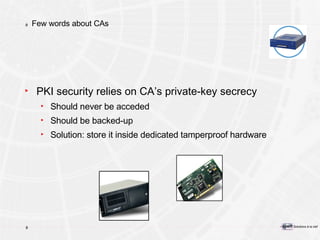
Few words about CAs PKI security relies on CA’s private-key secrecy Should never be acceded Should be backed-up Solution: store it inside dedicated tamperproof hardware
Type of CAs Private CAs: Hold by a private entity (Company, Administration, the Military) Public CAs: Verisign, Swisskey, GTE, Thawte, Global-sign, Certplus, etc.
Registration Authority (RA) A Registration Authority is the entity receiving  the certification requests and managing them before sending them to the CA. RA acts as a front end. As in hybrid CAs, the registration authority can be separate from the CA itself. In this case we talk about Local Registration Authority (LRA) Multiple sites for big companies Distributed environment
LDAP X.500 Directories required more effort and complexity than most companies were prepared  to invest L ightweight  D irectory  A ccess  P rotocol was proposed by the Internet community LDAP uses the X.500 naming conventions but simplifies the way you interact with a directory
LDAP LDAP is a “front end” that is used to implement simple directory services An LDAP Server may be implemented over: a full X.500 Directory a database a flat file Most of structured data set CA will use LDAP to publish certificates and CRLs
Certificate Revocation Certificate Revocation: Mechanism used by the CA to publish and disseminate revoked certificates Revocation is triggered in the following cases: Key compromise CA compromise Cessation of operation Affiliation change  etc...
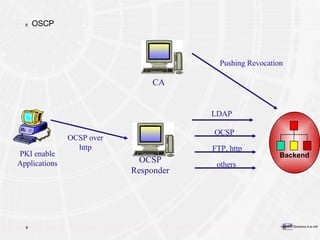
Certificate Revocation Several data structures exist to publish revocation CRL (Certificate Revocation List) ARL (Authority Revocation List) CRT (Certificate Revocation Trees) by Valicert Also Online query mechanisms OCSP (Online Certificate Status Protocol)
CRL’s publication and retrieval Certificate-using applications must be aware of revoked certificates Get CRL via ldap Get CRL via FTP, Http, Https, etc. Check certificate status via OCSP Etc. Problem to solve: Revocation delay ! Not yet fully standardized (Delta CRLs, OCSP etc.)
OSCP LDAP OCSP FTP, http others OCSP over http PKI enable Applications Pushing Revocation OCSP Responder CA Backend
Trust Because a CA has a certificate itself and represents the highest possible trust level,  the CA has its self-signed certificate A self-signed certificate is a Root Certificate or Meta-Introducer A certificate-using application (any X.509 holders) must trust the Root certificate Importing a Root certificate into such an application is called Bootstrapping a CA
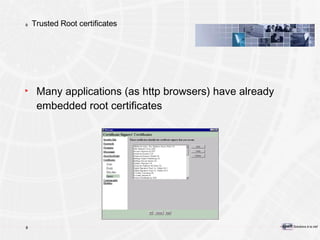
Trusted Root certificates Many applications (as http browsers) have already embedded root certificates
Let’s be practical! User enrolls for certificate http://www... User mailed retrieval PIN User retrieves certificate http://www... Admin Approves request  http://www... User mailed acknowledgement Admin mailed notification RA CA User Security Officer LDAP Certificate installed
PKI Standards Some standard organizations: IETF PKI Working Group (PKIX) ITU SPKI RSA with PKCS
PKI Summary Based on Certificates (X.509) Trusted third party (CA) (L)RA CRL Data repositories Mechanisms and protocols between all these elements
S/MIME
S/MIME S ecure  M ultipurpose  I nternet  M ail  E xchange Developed by RSA, Microsoft, Lotus, Banyan, and Connectsoft in 1995 Implemented at application layer Build on top of PKCS #7 and PKCS #10 Very strong commercial vendor acceptance Netscape, Microsoft, Lotus, etc. IETF developed S/MIME v3 (last version) Use X.509 certificates
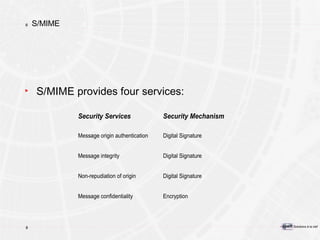
S/MIME S/MIME provides four services:
S/MIME Ciphers Symmetric encryption 3DES 168 bit DES 56 bit RC2 128, 64 and 40 bit Public-Key RSA 512 to 1024 bit
S/MIME dual Key ? Dual Key Pair One key pair for encryption One key pair for signature and non repudiation CA must support key backup and recovery Key pair for encryption generated on the CA itself ! Draw back: Not all Email client support Dual Key Pair
SSL / TLS
SSL S ecure  S ockets  L ayer TCP/IP socket encryption Provides end-to-end protection of communications sections Confidentiality protection via encryption Integrity protection with MAC’s Usually authenticates server using a digital signature (option) Can authenticate client (option)
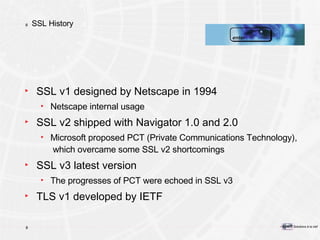
SSL History SSL v1 designed by Netscape in 1994 Netscape internal usage SSL v2 shipped with Navigator 1.0 and 2.0 Microsoft proposed PCT (Private Communications Technology),  which overcame some SSL v2 shortcomings SSL v3 latest version The progresses of PCT were echoed in SSL v3 TLS v1 developed by IETF
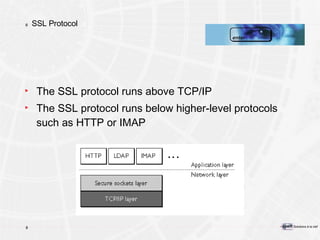
SSL Protocol The SSL protocol runs above TCP/IP The SSL protocol runs below higher-level protocols such as HTTP or IMAP
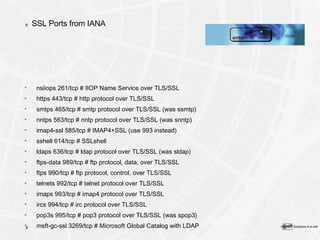
SSL Ports from IANA nsiiops 261/tcp # IIOP Name Service over TLS/SSL  https 443/tcp # http protocol over TLS/SSL  smtps 465/tcp # smtp protocol over TLS/SSL (was ssmtp)  nntps 563/tcp # nntp protocol over TLS/SSL (was snntp)  imap4-ssl 585/tcp # IMAP4+SSL (use 993 instead)  sshell 614/tcp # SSLshell  ldaps 636/tcp # ldap protocol over TLS/SSL (was sldap)  ftps-data 989/tcp # ftp protocol, data, over TLS/SSL  ftps 990/tcp # ftp protocol, control, over TLS/SSL  telnets 992/tcp # telnet protocol over TLS/SSL  imaps 993/tcp # imap4 protocol over TLS/SSL  ircs 994/tcp # irc protocol over TLS/SSL  pop3s 995/tcp # pop3 protocol over TLS/SSL (was spop3)  msft-gc-ssl 3269/tcp # Microsoft Global Catalog with LDAP
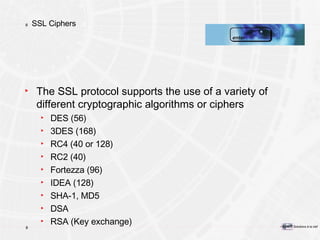
SSL Ciphers The SSL protocol supports the use of a variety of different cryptographic algorithms or ciphers DES (56) 3DES (168) RC4 (40 or 128) RC2 (40) Fortezza (96) IDEA (128) SHA-1, MD5 DSA RSA (Key exchange)
SSL Handshake Negotiate the cipher suite Establish a shared session key Authenticate the server (Optional) Authenticate the client (Optional)
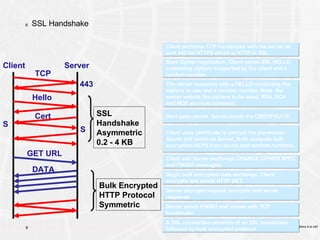
SSL Handshake TCP Hello GET URL Client Server DATA Client performs TCP handshake with the server at port 443 for HTTPS which is HTTP in SSL Start Cipher negotiation. Client sends SSL HELLO containing ciphers supported by the client and a random number. Start pass secret. Server sends it’s CERTIFICATE.  Client and Server exchange CHANGE CIPHER SPEC and FINISH messages. Begin bulk encrypted data exchange. Client encrypts and sends HTTP GET. Server decrypts request, encrypts and sends response Server sends FINISH and closes with TCP handshake S A SSL connection consists of an SSL handshake followed by bulk encrypted protocol S 443 Cert The server responds with a HELLO containing the ciphers to use and a random number. Note  the server selects the ciphers to be used. RSA, RC4 and MD5 are most common. Client uses certificate to encrypt the pre-master Secret and sends to Server. Both compute bulk encryption KEYS from secret and random numbers. Bulk Encrypted HTTP Protocol Symmetric SSL Handshake Asymmetric 0.2 - 4 KB
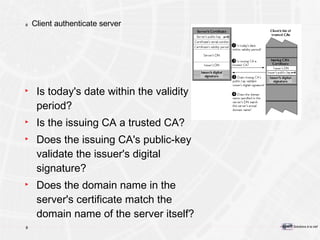
Client authenticate server Is today's date within the validity period? Is the issuing CA a trusted CA? Does the issuing CA's public-key validate the issuer's digital signature? Does the domain name in the server's certificate match the domain name of the server itself?
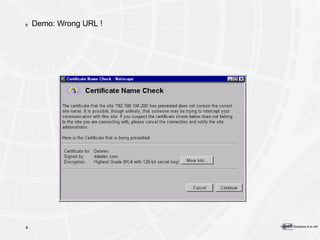
Demo: Wrong URL !
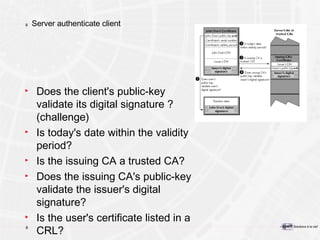
Server authenticate client Does the client's public-key validate its digital signature ? (challenge) Is today's date within the validity period? Is the issuing CA a trusted CA? Does the issuing CA's public-key validate the issuer's digital signature? Is the user's certificate listed in a CRL?
SSL Tunneling SSL can provide tunneling to transport TCP port over an encrypted channel Some tunneling software can use client and server authentication using Certificates X.509 Some tunneling programs Webtop (Sun/Netscape) Stunnel bjorb, Jonama SSLProxy Celo Communicationss (SSR)
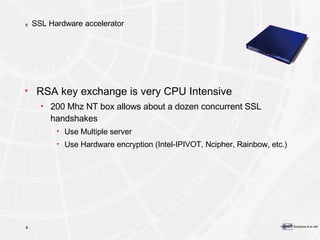
SSL Hardware accelerator RSA key exchange is very CPU Intensive 200 Mhz NT box allows about a dozen concurrent SSL handshakes Use Multiple server Use Hardware encryption (Intel-IPIVOT, Ncipher, Rainbow, etc.)
SGC Server Gated Cryptography Allows strong encryption on a server basis Originally available only to “qualified financial institutions” Requires a special SGC server certificate from:  Verisign Global-ID Thawte SuperCert GlobalSign HyperSign128 Etc.
SGC Enables strong encryption for export’s browser Procedure: Browser is export version: 40 bit cipher only ! Browser connect to SGC-enabled server with 40 bits cipher Server send his SGC-tagged certificate to browser Browser verifies server certificate and detect that is issued by a CA root certificate which is tagged to enable SGC Browser enabled 128 bit ciphers and force a SSL/TLS renegotiation with the stronger cipher suite.
TLS T ransport  L ayer  S ecurity IETF standardized evolution of SSL v3 Update Mac layer to HMAC Updated for newer algorithms Substantially similar to SSL v3 Cleanup of SSL v3 Aka SSL v3.1 Standardized by RFC 2246 (Jan 1999)
Installing a SSL Web Server Create the key-pair: Public and Private-Keys Each server includes programs to generate these Generate a CSR (Certificate Signing Request) This adds Information about your server and yourself Send the CSR to a CA (Certificate Authority) and wait for your Certificate For instance Verisign, or a internal CA Install the Certificate
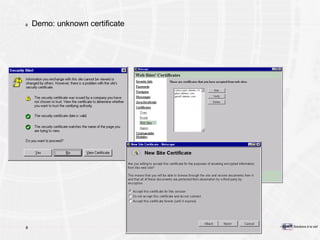
Demo: unknown certificate
IPSEC
IPSec introduction Stands for IP Security Provide site-to-site and/or host-to-site encryption and/or authentication Driven by the IETF Mandatory for IPv6, optional for IPv4
IPSec: two main ”Blocks”  IPSec deals with two main “blocks” IPSec - Encryption and Authentication ESP - Encapsulating Security Payload AH - Authentication Header Two modes: Tunnel and transport IPSec - Key management IKE, Skip, Manual IPSEC
IPSec: ESP and AH The  AH  (Authentication Header) is a protocol providing authentication only The  ESP  (Encapsulation Protocol) is an IPSEC protocol for packet encryption and encapsulation. Both protocols offer integrity check with authentication
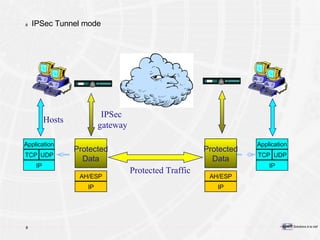
IPSec Tunnel mode Each datagram is captured by the security gateway, encapsulated inside an IPSEC packet and sent to a remote security gateway, which “decapsulates” it, and sends the original datagram to its original destination The two security gateways create a ‘tunnel’ through which data is passed The two hosts (and their applications) are unaware of the encapsulation process
IPSec Tunnel mode IP TCP Application UDP IP TCP Application UDP IP AH/ESP Protected Data IP AH/ESP Protected Data Protected Traffic Hosts IPSec  gateway
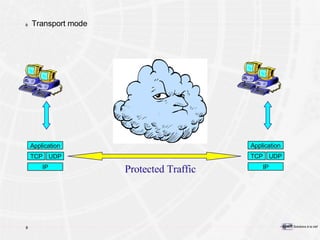
IPSec Transport mode In transport mode, the two hosts serve as a security gateway and encrypt their own data In this case, there is no need for a tunnel, nor for the double IP header The two hosts are aware of the encapsulation (since they perform it)
Transport mode Protected Traffic IP TCP Application UDP IP TCP Application UDP
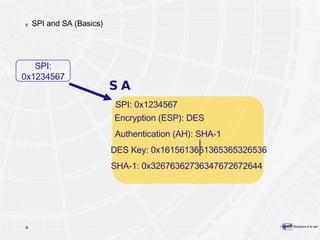
Security Associations (SA) The  SA  is shared by the two communicating  parties - it provides indications on the algorithms, the keys, the lifetimes and other algorithm dependant information The  SPI  (Security Parameter Index) is a number and serves as an index to the SA Each SA has two SPIs: incoming & outgoing
SPI and SA (Basics) SPI: 0x1234567 Encryption (ESP): DES Authentication (AH): SHA-1 DES Key: 0x1615613651365365326536 SHA-1: 0x32676362736347672672644 SPI: 0x1234567 SA
IPSec Key management In order to create the SA, the two parties need to exchange all the security parameters, as well as the keys. Several methods of key management: Manual keying or manual IPSec (statically defining SPI and SA).  SKIP (Simple Key Interchange Protocol by SUN Microsystems) ISAKMP/OAKLEY or IKE: automatic key management using DH Photuris alternative to IKE using DH
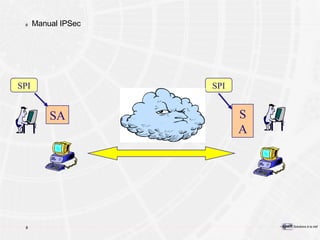
Manual IPSec On each gateway a specific SA is defined (according S/WAN) for each remote gateway  (SPI, Cipher, Keys, Hash etc.) Drawback: Very heavy management Static keys: less security Often used between different IPSec vendors Cisco to Check Point for instance
Manual IPSec SA SPI SA SPI
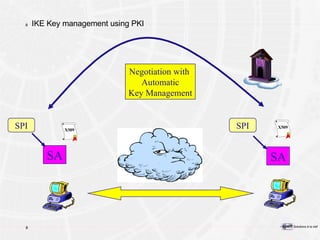
IKE Key management IKE is widely used (OSPF, IPSec etc..) SA proposal and negotiation is done using IKE Peers may be authenticated using X.509 certificate Each IPSec gateway holds a X.509 certificate SA negotiation starts after cross authentication Alternate method for authentication: Authentication is provided by pre-shared secrets Drawback: heavy key management etc.
IKE Key management using PKI SA SPI SA SPI Negotiation with  Automatic Key Management X509 X509
Questions?
Pour plus d’informations e-Xpert Solutions SA Sylvain Maret Route de Pré-Marais 29 CH-1233 Bernex / Genève +41 22 727 05 55 [email_address]

Introduction To PKI Technology

  • 1.
    Introduction to PKITechnology Sylvain Maret Février 2002 Version 2.01
  • 2.
    Course Map DayOne Introduction Key Terms Cryptosystems Services, Mechanisms, Algorithms Cryptography in History Cryptanalysis
  • 3.
    Course Map DayOne Secret-Key Cryptography AES Public-Key Cryptography RSA Diffie-Hellman Message Digests Random Numbers Key Length
  • 4.
    Course Map DayOne Message Authentication Code (MAC, HMAC) Digital Signature RSA, DSS / DSA, ElGamal Hybrid Cryptosystems RSA Key Wrapping Diffie-Hellman PKCS Standard Smart Card End of day one
  • 5.
    Course Map DayTwo Questions to day one ? Revision quiz ! PKI introduction Digital certificates X.509 certificates (Demo) Certificate Revocation (Demo) Certification Authorities RA, LRA Data Repositories (LDAP)
  • 6.
    Course Map Daytwo S/MIME: How it works ? SSL: How it works ? IPSEC: How it works ? Open discussion Encryption references site s
  • 7.
    Course Objectives Understandcryptographic fundamentals and how cryptographic technology is applied in a Public Key Infrastructure Know the elements of Public Key Infrastructure and how they interact with each other Understand and be able to describe some of the practical applications of PKI Understand why PKI is an attractive technology to enable e-commerce and enhance security
  • 8.
    PKI, WHY? Therise of public data networks. Internet is a new platform for business relationships: E-business Business rules need to be “translated” into this new “language”. Hope behind PKI: to preserve classical business rules in this new virtual world.
  • 9.
    Drawbacks for E-business Let’s say you have an electronic contract which you need to distribute to another party over the Internet… With existing Internet tools like www and e-mail you lose a lot compared to paper No assurance that the contract has been signed No guarantee that the contract is authentic No assurance of the contract’s source Basically, it is worth than the paper where everything is printed on!
  • 10.
    About needs... Youneed to know who you are dealing with (Authentication) You need to keep private things private (Confidentiality) You need to make sure that people do not cheat (Non-Repudiation) You need to be sure that information has not been altered (Integrity)
  • 11.
    If PKI isthe answer then… What is the question? On the Internet no one knows you're a dog!
  • 12.
    Key Terms Amessage will be defined as plaintext or cleartext The process of disguising a message to hide its substance is encryption The encrypted message is referred to as ciphertext Decryption is the process turning ciphertext back into plaintext
  • 13.
    Key Terms Cryptographyis the science allowing messages to be kept secure Cryptoanalysis is the art and science of breaking ciphertext Cryptology is the mathematics field Cryptologist are theoretical mathematicians
  • 14.
    Cryptosystems A cryptosystemis a collection of cryptographic algorithms, cryptographic keys, and all possible plaintexts and their corresponding ciphertexts.
  • 15.
    Security Services Authentication: Provides the assurance of someone’s identity Confidentiality : Protects against disclosure to unauthorized identities Non-Repudiation : Protects against communications originator to later deny it Integrity : Protects from unauthorized data alteration
  • 16.
    Security Mechanisms Threebasic building blocks are used: Encryption is used to provide confidentiality and integrity protection Digital Signatures are used to provide authentication, integrity protection and non-repudiation Checksums / hash algorithms are used to provide integrity protection and can provide authentication
  • 17.
    Cryptography Algorithms AllCryptosystems are based on only three algorithms: 1 - Secret-Key algorithms 2 - Public-Key algorithms 3 - Message-Digest algorithms
  • 18.
    Services, Mechanisms, AlgorithmsA typical security protocol provides one or more services Services Mechanisms Algorithms Services are built from Mechanisms Mechanisms are implemented using Algorithms SSL, IPSEC, TLS, SSH, etc... Signatures Encryption Hashing DSA RSA RSA DES SHA MD5
  • 19.
    Security Protocol LayersThe further down you go, the more transparent it is The further up you go, the easier it is to deploy Application Presentation Session Transport DataLink Physical Application Presentation Session Transport Network DataLink Physical Network S/MIME, PGP SSL, TLS, SSH IPSEC Hardware link encryption
  • 20.
    Cryptography in History2000 B.C. Hieroglyphics Cryptography as an Art Ancient Chinese First to transform messages in Ideographs for privacy India First “Networks spies” using phonetics encryption (Javanese or reverse speaking) Mesopotamia Numbers associate to letters (cuneiform table)
  • 21.
    Cryptography in HistoryATBASH cipher: In the Bible ABCDEFGH… (clear) ZYXWVU…(encrypted) Skytale Cipher (Greek) key: stick papyrus enrolled Polybius square (Greek)
  • 22.
    Cryptography in HistoryRuniques Stones by Vikings (Arts)
  • 23.
    Cryptography in HistoryWorld War II: Electromechanical cryptography Rotor based machine transforming plaintext into ciphertext, using electrical signals as encryption key Example: Enigma machine used by Germans Ciphers were not new, but their processing was… 1970-today: New ciphers: based on numbers properties issued from Mathematical theories RSA: Prime numbers factorization Diffie-Hellman: discrete logarithm ECDSA: Elliptic curve cryptography
  • 24.
    Cryptanalysis Two categoriesof security levels Computationally secure: Question of time and money (Brute force attack) (Most of the cryptosystems: DES, 3DES, IDEA, RSA, DH etc.) Unconditionally secure: Can “never” be broken independently of the resources One-time pads
  • 25.
    Several Cryptanalytic Attacks Ciphertext only Brute force attack and dictionary attacks on keys Chosen ciphertext Start from a known ciphertext and try to appear as someone else to get information from others behavior Known Plain ciphertext Derive the key from knowledge of both plain and ciphertext
  • 26.
  • 27.
    Secret-Key Cryptography Usea secret key to encrypt a message into a ciphertext Use the same key to decrypt the ciphertext into the original message Secret-key cryptography is referred also as symmetric cryptography or conventional cryptography The secret key is also known as session key or bulk encryption key
  • 28.
    Secret-Key Cryptography Letus imagine Alice and Bob who use Secret-Key to protect their messages Plaintext Ciphertext Secret-Key
  • 29.
    Secret-Key Cryptography Howto share the Secret-Key ? Alice and Bob can use the phone, fax, a meeting point, etc. But!?: Could someone steal the key? How to proceed without partner knowledge?
  • 30.
    Secret-Key Cryptography TheAdvantages Implementation is efficient to encrypt large volume of data (100 to 1’000 faster than Public-Key Cryptography) Simple to implement in either software or hardware Most of the algorithms are well know and secure Seem to be safe to brute force attack Widely used
  • 31.
    Secret-Key Cryptography TheDisadvantages Hard to share Secret-Keys Large number of keys No non-repudiation (Signature) Subject to interception (Secret-Key)
  • 32.
    Secret-Key Cryptography Numberof needed keys Suppose Alice, Bob and Chris want to use Secret-Key Cryptography! They need only 3 keys
  • 33.
    Secret-Key Cryptography Increaseof keys number Suppose they want to add Dawn and Eric Now they need ten keys
  • 34.
    Secret-Key Cryptography Ifn persons want to communicates we have this formula: Key’s number = ((n)*(n-1)) / 2 As example: A company of 60’000 people = 1’799’970’000 keys!
  • 35.
    Secret-Key Cryptography Blockcipher: Encrypts data in predefined block size Most well-known ciphers are block ciphers Stream cipher: Encrypts data stream, one-bit at the time Only few algorithms use it
  • 36.
    Secret-Key Cryptography CommonSecret-Key Ciphers DES Triple DES (3DES) RC2 IDEA Blowfish CAST-128 Skipjack RC4 (Stream cipher) etc.
  • 37.
    Secret-Key Cryptography DESData Encryption Standard (1973) by IBM World Standard for 20 years DES was broken in 22 hours (DES challenge III, January 18th, 1999) Key size = 56 bits Block cipher Recommendation: should be replaced by 3DES for high confidentiality requirements !
  • 38.
    Secret-Key Cryptography TripleDES (3DES) Block cipher Encrypt + decrypt + encrypt with 2 (112 bits) or 3 (168 bits) DES keys DES’s replacement for Banking (1998) Recommendation: Use it for high confidentiality!
  • 39.
    Secret-Key Cryptography RC2Designed by Ron Rivest from RSA Block cipher Key size = up to 2048 Encryption speed: independent from the key size Trade secret from RSA, posted on the net in 1996 Designed as a DES’ replacement Faster than DES Recommendation: like DES but faster!
  • 40.
    Secret-Key Cryptography CAST-128Designed by C.Adams and S. Tavares (1993) Block cipher Key size = 128 bits Used in PGP 5.x Recommendation: unknown
  • 41.
    Secret-Key Cryptography IDEAInternational Data Encryption Algorithm Designed by X.Lai and J. Massey (ETH Zurich) in 1990 Block cipher Key size = 128 bits More efficient than DES for software implementation Used in PGP Recommendation: Better than DES
  • 42.
    Secret-Key Cryptography BlowfishDesigned by B. Schneier in 1993 Optimized for high-speed execution on 32-bit processors Block cipher Key size = up to 448 bits key Recommendation: Use for fast performances and with a maximum key size
  • 43.
    Secret-Key Cryptography SkipjackDesigned by NSA (National Security Agency) Block cipher Key size = 80 bits Recommendation: Inadequate for long term security (key size too short)
  • 44.
    Secret-Key Cryptography GOSTAcronym for “GOsudarstvennyi STandard” Russian answer to DES Key size = 256 bits Recommendation: Incompletely specified to give an answer...
  • 45.
    Secret-Key Cryptography RC4Designed by Ron Rivest from RSA Stream cipher Key size = up to 2048 bits Optimized for fast software implementation Trade secret from RSA, posted on the net in 1994 Very fast Used in SSL, Lotus Note, Windows password encryption, Oracle etc. Recommendation: Highly recommended for long keys (>40 bits)
  • 46.
    Secret-Key Cryptography Many,many others There is no good reason not to use one of above proven algorithms!
  • 47.
    Secret-Key Relative PerformanceRC4 Blowfish, CAST-128 Skipjack DES, IDEA, RC2 3DES, GOST FAST SLOW
  • 48.
    AES National Instituteof Standard and Technology expressed a formal call for algorithm on 09.1997 The aim is to define the “next century’s” symmetric encryption standard or Advanced Encryption Standard AES1 conf. (08.98): 15 potential candidates AES2 conf. (03.99): 5 retained candidates Final choice expected for summer 2001
  • 49.
    AES candidates MARS(IBM) RC6 (RSA Laboratories) Rijndael (J. Daemen, V. Rijmen) Serpent (R. Anderson, E. Biham, L. Knudsen) Twofish (B. Schneier - Counterpane)
  • 50.
    AES requirements Blockcipher of minimum 128 bits Must implement symmetric keys of 128, 192, 256 bits Must be efficient on software and hardware basis (high speed encryption)
  • 51.
    Public Key Cryptography
  • 52.
    Public-Key Cryptography Usetwo distinct keys, one public and one private The private is kept secret The public can be freely shared Referred as asymmetric cryptography A public-key and its corresponding key are mathematically related A public-key and its associated private-key are called a key-pair
  • 53.
    Public-Key Cryptography Amessage encrypted with a public-key can be only decrypted by the private-key A message encrypted with a private-key can be only decrypted by the public-key (Signature)
  • 54.
    Public-Key Cryptography SupposeAlice wants to send a message to Bob using Public-Key Cryptography Plaintext Plaintext Ciphertext Bob’s public key Bob’s private key
  • 55.
    Public-Key Cryptography Howto obtain the public-key ? Any publishing way can be used to get the public-key (Directory servers, Phone, Web server, Newspapers etc.) No more confidentiality issues in key distribution
  • 56.
    Public-Key Cryptography AdvantagesNo secret sharing Fewer keys No prior relationship needed Easier to administrate Offers useful mechanisms like digital signature (offering non repudiation)
  • 57.
    Public-Key Cryptography DisadvantagesNot efficient (slow) to encrypt large volume of data Keys need to be much longer than with secret-key encryption Impossible to encrypt a plaintext with size > key
  • 58.
    Types of public-keyalgorithm A public-key algorithm is reversible if encryption and decryption can be processed with either a private or a public-key A public-key algorithm is irreversible if a private-key is mandatory for encryption Key exchange algorithm: neither used for encryption nor decryption (Diffie-Hellman)
  • 59.
    RS A Inventors:Rivest, Shamir, Adleman in 1977 Most popular Provide confidentiality, digital signature and key exchange Key length up to 4096 Plaintext length < Key length Ciphertext size = Key size
  • 60.
    RSA RSA isprotected by a patent. Patent expires on 20th September 2000 Relies on irreversible mathematics functions (Prime numbers)
  • 61.
    Diffie-Hellman Published in1976 by W. Diffie and M. Hellman Oldest known public-key cryptosystem Key agreement algorithm Enables secret-key exchange without prior knowledge Agrees on shared secret used in conjunction with a secret-key Cryptosystem (DES, 3DES, IDEA, etc.)
  • 62.
    Diffie-Hellman: How itworks ? Alice’s private key Bob’s private key Alice’s public key Bob’s public key = Share Secret Key Share Secret Key
  • 63.
    DSA Compliant to D igital S ignature S tandard (DSS) Published in 1994 Irreversible algorithm (encryption with private key only) Used in Digital signature only Performance tuned for smart cards
  • 64.
  • 65.
  • 66.
    Message-Digest Algorithms Takea variable-length message and produce a fixed-length digest as output The fixed-length output is called the message digest, a digest or a hash A message-digest algorithm is also called a one-way hash algorithm or a hash algorithm
  • 67.
    Message-Digest Algorithms InputMessage Fixed-length Digest Hash Function
  • 68.
    Message-Digest Algorithms Message-DigestAlgorithms properties required to be cryptographically secure It must not be feasible to determine the input message based on its digest It must not be possible to find an arbitrary message that has a particular, desired digest It should be impossible to find two messages that have the same digest (collision) It should be very sensitive to input message changes
  • 69.
    Message-Digest Algorithms SomeCommon Message-Digest Algorithms MD2: 128-bit-output, deprecated, by Ronald Rivest MD4: 128-bit-output, broken, by Ronald Rivest MD5: 128-bit-output, weaknesses, by Ronald Rivest SHA-1: 160-bit-output, NSA-Designed RIPEMD-160: 160-bit-output Haval: 128 to 256 bit-output (3 to 5 Passes) CRC-32: 32-bit-output Recommendation: Use SHA-1
  • 70.
    Message-Digest Algorithms Message-Digestat work Creation of digital signatures Creation of MAC, HMAC Creation of secret-key with a passphrase File checksum (FTP server, Patches, etc.) FIA (File Integrity Assessment like Tripwire)
  • 71.
    Random Numbers Randomnumbers are usually required to generate cryptographic keys or challenge. Two main categories (PRNG) Pseudo Random Number Generator uses a deterministic algorithm to generate a pseudo random number based on a seed (mouse, keyboard, etc..) A random number generator generates truly unpredictable numbers. Based generally on special hardware (white noise, radioactive-decay, etc…)
  • 72.
  • 73.
    Random Numbers Avery secure cryptosystem can be broken if it relies on random numbers that can be guessed Netscape browser using SSL broken! Some PRNG Yarrow from B. Schneier CryptPack etc.
  • 74.
    Keys Length Tobreak a secret-key cryptosystem with “no weakness”, an attacker must try each possible key. This is called a brute force attack To break a public-key cryptosystem an attacker should use “smarter” brute force attack based on mathematics Key space dimension = 2n (n:keylength)
  • 75.
  • 76.
    What is theright key size ? The goals of cryptography are to make the value of encrypted information less than the money spent to decrypt it ! the value of information usually decreases over tim e
  • 77.
    RSA’s Challenge onDES (III) Method: splitting the Key space for distributed Brute Force Attack (space dimension = 2n , where n is the key-length) Starting date: 18.01.99. Ending: 22h15 min. later… Brute Force Attack frequency: 245 Billions keys/sec. Platforms: Cray/Sun/SGI/Pentium etc..
  • 78.
    RSA’s Challenge onRSA-155 Key-length: 512 bits = 155 digits Method: Prime number factorization Starting Date: August 99. Ending: 5 months later Time: 35.7 CPU years Platforms: SGI/Sun/Pentium etc. 292 computers
  • 79.
    Keys’ time oflife Most of the time, session keys are changing (IPSec, etc.) to enforce security Can be triggered by time or by encrypted data quantity
  • 80.
  • 81.
  • 82.
    Message Authentication CodeMAC is a fixed-length data item that is send together with a message to prove integrity and origin Provide authentication and integrity without confidentiality Also referred as message integrity code (MIC) Most common form is HMAC ( Hashed Mac) Example: HMAC-MD5
  • 83.
    Message Authentication Code+ Input Message HMAC Secret-Key Hash Function
  • 84.
  • 85.
    Digital Signature Digitalsignature is a data item that guarantees the origin and integrity of a message The signer of the message uses a signing key The recipient uses a verification key to verify the origin and integrity Signing key = private-key Verification key = public-key
  • 86.
    Digital Signature Byusing his own private key, the signer can not repudiate the fact he has signed the message This mechanism provide non-repudiation Think about the difference with MAC …
  • 87.
    Digital Signature: BasicsPlaintext Simple signature using PRIVATE-key Plaintext Ciphertext (Signature) Alice’s private key Alice’s public key
  • 88.
    Digital Signature: Howit works? Alice’s private key Signature Alice’s Public key Signature Plaintext MD1 = MD2 ??? Plaintext Digest
  • 89.
    Digital Signature Whysigning a message involves Hashing ? Signature (data item) is too big Performance (public-key is very slow) Possible attack (known plaintext attack)
  • 90.
    Common Signature AlgorithmsRSA Well known Export limitation DSA Similar to RSA (algebraic properties of numbers) Non-reversible algorithm, suitable for digital signature only ElGamal Another cipher for digital signature only
  • 91.
  • 92.
    Hybrid Cryptosystems AHybrid Cryptosystem combines the best features of both Secret-Key and Public-Key cryptography Used to exchange session key to initiate a symmetric encryption Example: PGP, SSL, IPSEC using Diffie-Hellman or RSA
  • 93.
    Example: Diffie-Hellman andSecret-Key cryptosystem = Share Secret Key Share Secret Key Plaintext Plaintext Ciphertext Asymmetric Symmetric
  • 94.
    RSA Key wrappingencryption Suppose Alice wants to send an encrypted text to Bob across the Internet , using RSA key wrapping
  • 95.
    RSA Key wrappingencryption How it works ? Alice creates a session key, which is a one-time-only secret-key Alice encrypts the data with the session key Alice encrypts the session key with Bob’s public-key Alice sends the ciphertext + the encrypted session key to Bob
  • 96.
    RSA Key wrappingencryption
  • 97.
    RSA Key wrappingdecryption How it works ? Bob receives the message from Alice Bob uses his private-key to recover the temporary session key Bob uses the session key to decrypt the ciphertext
  • 98.
    RSA Key wrappingdecryption
  • 99.
    RSA Key wrappingquestion ? How sure can Alice be about Bob’s presumed public-key ?
  • 100.
    Man in theMiddle Attack!
  • 101.
    SSH: How itworks ?
  • 102.
    SSH SSH =Secure Sh ell Originally developed in 1995 as a secure replacement for rsh, rlogin,rcp, ftp, telnet Originally implemented in Finland Available worldwide About 3’000’000 users around the world
  • 103.
    SSH Also allowsport forwarding (tunneling over SSH) X11 connection forwarding SSH v2 submitted to IETF Can be run and used in a short space of time Many SSH clients available Secure CRT F-Secure Java Client etc.
  • 104.
    SSH: Why ?Attacker with sniffer Network Original TCP Packet Login: rome Password: abc123 Unix Host Telnet to Unix Host
  • 105.
    SSH-1 Protocol (HybridCrypto) TCP Auth request SSH Client Server DATA Client performs TCP handshake with the server at port 22 for SSH standard port Start authentication process. Client send authentication request Server decrypt the session key with the two private keys. Begin bulk encrypted data exchange. Client encrypts Server decrypts request, encrypts and sends response S S 22 Session The server responds with two keys. Host key 1024 bit RSA and a Server key 768 bit RSA (Generated hourly) Client verify host key and generate a secret key that is used for bulk encryption then encrypt this secret key twice with Host and Server public keys and send it to the server SSH Symmetric Encrypted data SSH Handshake Public Key
  • 106.
    SSH Ciphers SSHv1 RSA DES, 3DES, Blowfish, IDEA SSH v2 Diffie-Hellman for key exchange algorithm DSA, RSA 3DES, Blowfish, IDEA, Twofish, Arcfour, Cast-128
  • 107.
    SSH Authentication MultipleAuthentication mechanisms Static password (protected by SSH encryption) RSA or DSA authentication (client decrypts challenge from server) Plug-in authentication (Securid, Radius, ldap, PAM *) “ .rhosts or /etc/hosts.equiv” (Based on IP address)
  • 108.
    SSH Authentication (RSA/DSA)Client decrypts “challenge” from server Provides “strong” authentication (client uses his private-key plus a PIN code) Server sends encrypted challenge with client’s public key Client decrypts challenge and sends it to the server The challenge is chosen randomly
  • 109.
    SSH Tunneling modeSSH Server HTTP 127.0.0.1 1999 Encrypted SSH tunnel Clear text Web server DMZ Corporate Net SSH Client
  • 110.
  • 111.
    PKCS Public KeyCryptographic Standard (PKCS) Standardization of public-key algorithmic, in order to maintain interoperability Developed by RSA Laboratories, a consortium of information technology vendors and academic institutions. Apple Microsoft Compaq Lotus Sun MIT etc.
  • 112.
    PKCS list #1:Encrypting and signing using RSA public key cryptosystem #3: Key agreement with Diffie-Hellman key exchange #5: Encrypting with a secret key derived from a password #7: Syntax for message with digital signature #8: Format for private key information #9: Attribute type for use in other PKCS standard #10: Syntax for certification request #11: Define a cryptoki programming interface (API for smart cards) #12: Portable format for storing and transporting private keys #13: Encrypting and signing data using elliptic curves cryptography #14: Standard for pseudo number generation #15: Standard to store credentials on tokens
  • 113.
  • 114.
    Smart Card SmartCards consist of a chip (processor or/and memory), a contact plate and a piece of plastic (ISO 7810 - 54x85x0.8 mm) Smart Cards are used for multi-applications GSM, Banking, Medical, E-Commerce, Pay TV, etc .
  • 115.
    Smart Card andPKI Storing the private-key and/or X.509 certificate on the Smart Card Provide Strong Authentication Something you have, Something you know Access protected by a PIN (like credit card) Types of Smart Card Memory Cards PKI smart cards using Crypto-processor (RSA, etc.) Some Smart Card are “brute force” protected
  • 116.
    Smart Card Standard(interface) PKCS #11 also call Cryptoki Interface for the communication to Smart Card Netscape, RSA PC/SC and their Crypto API http://www.pcscworkgroup.com/ Bull, Gemplus, HP, Intel, Microsoft, Schlumberger Siemens, SUN, Toshiba
  • 117.
    Smart Card ReaderKeyboard USB Serial PCMCIA Diskette reader SCSI
  • 118.
    Today’s Smart CardDrawbacks Hardware... Multi-Services rarely used Users leave Smart Card on the reader
  • 119.
  • 120.
    Quiz! Describe Secret-Key? Advantages / Disadvantages Describe Public-Key ? Advantages / Disadvantages Describe Messages Digest ? Describe Digital Signature and verification ? Differences between MAC and signature? Describe two Hybrid Cryptosystems ? Describe a challenge response based authentication?
  • 121.
  • 122.
    PKI introduction Theaim of PKI is to integrate all the previous mechanisms and algorithms into a coherent and efficient structure. It will answer the following fundamental security needs: Authentication Confidentiality Non-Repudiation Integrity The basis of PKI relies on the concept of certificates
  • 123.
    PKI basis functionPKI will include at least: One Certificate Authority who delivers certificates One Directory who stores active Certificates and/or Revoked Certificates One Registration Authority who allows certificates’ enrollment One centralized Management
  • 124.
    Remember Alice, Boband Charlie... Bob has no proof of the “link” between Alice’s public-keys and her identities So What ?
  • 125.
    Third Trusted PartyNo more Charly Implicit Trust Trusted Authority Direct Trust Direct Trust
  • 126.
    Digital Certificates Apublic-key certificate is a bond between n an entity’s public-key and one entity The entity can be: A person A role (Manager Director) An organization A piece of hardware (Router, Server, IPSEC, SSL, etc.) A software process (JAVA Applet) A file (Image, Databases, etc.) etc.
  • 127.
    Digital Certificates APublic-key certificate provides assurance that the public-key belongs to the identified entity A Public-key certificate is also called a digital certificate, digital ID or certificate The entity identified is referred to as the certificate subject If the certificate subject is a person, it is referred to as a subscriber
  • 128.
    Digital Certificates Acertificate is like a passport ...
  • 129.
    How to obtaina certificate As with passports, you give proof of your identity to an official (or trusted) authority. The authority checks this proof. The authority delivers a signed passport . This procedure is defined as an “enrollment” Instead of “enrolling” for a passport we’ll enroll for digital certificate.
  • 130.
    Digital Certificates Graphicalrepresentation of a certificate
  • 131.
  • 132.
    X.509 Certificate StandardX.509 is a standard for digital certificate by International Telecommunications Union (ITU) First published in 1988 (V1.0) Version 2.0 (1993) adds two new fields Current version is v3.0 (1996) and allows additional extension fields
  • 133.
    X.509 Basic CertificateFields Version: X509 version 1,2 and 3 Certificate serial number: Integer assigned by the CA (unique) Signature algorithm identifier: RSA/MD5 etc. Issuer name: name of CA having signed and issued the certificate Validity period: time interval Subject name: the entity name (this name must be unique = distinguished name (DN) )
  • 134.
    X.509 Basic CertificateFields Subject public-key information: contains the public-key plus the parameters Issuer unique identifier: optional field Subject unique identifier: optional field Extensions: may provide additional data for specific applications.
  • 135.
    How to builda Certificate X.509 Certificate CA’s Signature X.509 Fields Public key Identity etc. Digital Signature Process CA
  • 136.
    How to verifya certificate ? Obtain the Signer’s (CA) public-key Pass the X.509 fields into the message digest algorithm and keep the digest (= your digest 1) Decrypt the Certificate signature with the Signer’s (CA) public-key. The decrypting plaintext will be the digest (= your digest 2) Compare the digest 1 with the digest 2 Does this match together?
  • 137.
    Verifying a certificate?MD1 = MD2 ??? CA’s public key CA’s Signature X.509 Fields Public key Identity etc.
  • 138.
    A few wordsabout CAs Entities that issue and manage digital certificates including maintaining revoking publishing status information CAs’ security policy defined in CPS (Certification Practice Statement) Security measures to guarantee CA’s integrity Security measures to check enrollment’s identity Trust level relies upon CPS and not technology
  • 139.
    Few words aboutCAs PKI security relies on CA’s private-key secrecy Should never be acceded Should be backed-up Solution: store it inside dedicated tamperproof hardware
  • 140.
    Type of CAsPrivate CAs: Hold by a private entity (Company, Administration, the Military) Public CAs: Verisign, Swisskey, GTE, Thawte, Global-sign, Certplus, etc.
  • 141.
    Registration Authority (RA)A Registration Authority is the entity receiving the certification requests and managing them before sending them to the CA. RA acts as a front end. As in hybrid CAs, the registration authority can be separate from the CA itself. In this case we talk about Local Registration Authority (LRA) Multiple sites for big companies Distributed environment
  • 142.
    LDAP X.500 Directoriesrequired more effort and complexity than most companies were prepared to invest L ightweight D irectory A ccess P rotocol was proposed by the Internet community LDAP uses the X.500 naming conventions but simplifies the way you interact with a directory
  • 143.
    LDAP LDAP isa “front end” that is used to implement simple directory services An LDAP Server may be implemented over: a full X.500 Directory a database a flat file Most of structured data set CA will use LDAP to publish certificates and CRLs
  • 144.
    Certificate Revocation CertificateRevocation: Mechanism used by the CA to publish and disseminate revoked certificates Revocation is triggered in the following cases: Key compromise CA compromise Cessation of operation Affiliation change etc...
  • 145.
    Certificate Revocation Severaldata structures exist to publish revocation CRL (Certificate Revocation List) ARL (Authority Revocation List) CRT (Certificate Revocation Trees) by Valicert Also Online query mechanisms OCSP (Online Certificate Status Protocol)
  • 146.
    CRL’s publication andretrieval Certificate-using applications must be aware of revoked certificates Get CRL via ldap Get CRL via FTP, Http, Https, etc. Check certificate status via OCSP Etc. Problem to solve: Revocation delay ! Not yet fully standardized (Delta CRLs, OCSP etc.)
  • 147.
    OSCP LDAP OCSPFTP, http others OCSP over http PKI enable Applications Pushing Revocation OCSP Responder CA Backend
  • 148.
    Trust Because aCA has a certificate itself and represents the highest possible trust level, the CA has its self-signed certificate A self-signed certificate is a Root Certificate or Meta-Introducer A certificate-using application (any X.509 holders) must trust the Root certificate Importing a Root certificate into such an application is called Bootstrapping a CA
  • 149.
    Trusted Root certificatesMany applications (as http browsers) have already embedded root certificates
  • 150.
    Let’s be practical!User enrolls for certificate http://www... User mailed retrieval PIN User retrieves certificate http://www... Admin Approves request http://www... User mailed acknowledgement Admin mailed notification RA CA User Security Officer LDAP Certificate installed
  • 151.
    PKI Standards Somestandard organizations: IETF PKI Working Group (PKIX) ITU SPKI RSA with PKCS
  • 152.
    PKI Summary Basedon Certificates (X.509) Trusted third party (CA) (L)RA CRL Data repositories Mechanisms and protocols between all these elements
  • 153.
  • 154.
    S/MIME S ecure M ultipurpose I nternet M ail E xchange Developed by RSA, Microsoft, Lotus, Banyan, and Connectsoft in 1995 Implemented at application layer Build on top of PKCS #7 and PKCS #10 Very strong commercial vendor acceptance Netscape, Microsoft, Lotus, etc. IETF developed S/MIME v3 (last version) Use X.509 certificates
  • 155.
    S/MIME S/MIME providesfour services:
  • 156.
    S/MIME Ciphers Symmetricencryption 3DES 168 bit DES 56 bit RC2 128, 64 and 40 bit Public-Key RSA 512 to 1024 bit
  • 157.
    S/MIME dual Key? Dual Key Pair One key pair for encryption One key pair for signature and non repudiation CA must support key backup and recovery Key pair for encryption generated on the CA itself ! Draw back: Not all Email client support Dual Key Pair
  • 158.
  • 159.
    SSL S ecure S ockets L ayer TCP/IP socket encryption Provides end-to-end protection of communications sections Confidentiality protection via encryption Integrity protection with MAC’s Usually authenticates server using a digital signature (option) Can authenticate client (option)
  • 160.
    SSL History SSLv1 designed by Netscape in 1994 Netscape internal usage SSL v2 shipped with Navigator 1.0 and 2.0 Microsoft proposed PCT (Private Communications Technology), which overcame some SSL v2 shortcomings SSL v3 latest version The progresses of PCT were echoed in SSL v3 TLS v1 developed by IETF
  • 161.
    SSL Protocol TheSSL protocol runs above TCP/IP The SSL protocol runs below higher-level protocols such as HTTP or IMAP
  • 162.
    SSL Ports fromIANA nsiiops 261/tcp # IIOP Name Service over TLS/SSL https 443/tcp # http protocol over TLS/SSL smtps 465/tcp # smtp protocol over TLS/SSL (was ssmtp) nntps 563/tcp # nntp protocol over TLS/SSL (was snntp) imap4-ssl 585/tcp # IMAP4+SSL (use 993 instead) sshell 614/tcp # SSLshell ldaps 636/tcp # ldap protocol over TLS/SSL (was sldap) ftps-data 989/tcp # ftp protocol, data, over TLS/SSL ftps 990/tcp # ftp protocol, control, over TLS/SSL telnets 992/tcp # telnet protocol over TLS/SSL imaps 993/tcp # imap4 protocol over TLS/SSL ircs 994/tcp # irc protocol over TLS/SSL pop3s 995/tcp # pop3 protocol over TLS/SSL (was spop3) msft-gc-ssl 3269/tcp # Microsoft Global Catalog with LDAP
  • 163.
    SSL Ciphers TheSSL protocol supports the use of a variety of different cryptographic algorithms or ciphers DES (56) 3DES (168) RC4 (40 or 128) RC2 (40) Fortezza (96) IDEA (128) SHA-1, MD5 DSA RSA (Key exchange)
  • 164.
    SSL Handshake Negotiatethe cipher suite Establish a shared session key Authenticate the server (Optional) Authenticate the client (Optional)
  • 165.
    SSL Handshake TCPHello GET URL Client Server DATA Client performs TCP handshake with the server at port 443 for HTTPS which is HTTP in SSL Start Cipher negotiation. Client sends SSL HELLO containing ciphers supported by the client and a random number. Start pass secret. Server sends it’s CERTIFICATE. Client and Server exchange CHANGE CIPHER SPEC and FINISH messages. Begin bulk encrypted data exchange. Client encrypts and sends HTTP GET. Server decrypts request, encrypts and sends response Server sends FINISH and closes with TCP handshake S A SSL connection consists of an SSL handshake followed by bulk encrypted protocol S 443 Cert The server responds with a HELLO containing the ciphers to use and a random number. Note the server selects the ciphers to be used. RSA, RC4 and MD5 are most common. Client uses certificate to encrypt the pre-master Secret and sends to Server. Both compute bulk encryption KEYS from secret and random numbers. Bulk Encrypted HTTP Protocol Symmetric SSL Handshake Asymmetric 0.2 - 4 KB
  • 166.
    Client authenticate serverIs today's date within the validity period? Is the issuing CA a trusted CA? Does the issuing CA's public-key validate the issuer's digital signature? Does the domain name in the server's certificate match the domain name of the server itself?
  • 167.
  • 168.
    Server authenticate clientDoes the client's public-key validate its digital signature ? (challenge) Is today's date within the validity period? Is the issuing CA a trusted CA? Does the issuing CA's public-key validate the issuer's digital signature? Is the user's certificate listed in a CRL?
  • 169.
    SSL Tunneling SSLcan provide tunneling to transport TCP port over an encrypted channel Some tunneling software can use client and server authentication using Certificates X.509 Some tunneling programs Webtop (Sun/Netscape) Stunnel bjorb, Jonama SSLProxy Celo Communicationss (SSR)
  • 170.
    SSL Hardware acceleratorRSA key exchange is very CPU Intensive 200 Mhz NT box allows about a dozen concurrent SSL handshakes Use Multiple server Use Hardware encryption (Intel-IPIVOT, Ncipher, Rainbow, etc.)
  • 171.
    SGC Server GatedCryptography Allows strong encryption on a server basis Originally available only to “qualified financial institutions” Requires a special SGC server certificate from: Verisign Global-ID Thawte SuperCert GlobalSign HyperSign128 Etc.
  • 172.
    SGC Enables strongencryption for export’s browser Procedure: Browser is export version: 40 bit cipher only ! Browser connect to SGC-enabled server with 40 bits cipher Server send his SGC-tagged certificate to browser Browser verifies server certificate and detect that is issued by a CA root certificate which is tagged to enable SGC Browser enabled 128 bit ciphers and force a SSL/TLS renegotiation with the stronger cipher suite.
  • 173.
    TLS T ransport L ayer S ecurity IETF standardized evolution of SSL v3 Update Mac layer to HMAC Updated for newer algorithms Substantially similar to SSL v3 Cleanup of SSL v3 Aka SSL v3.1 Standardized by RFC 2246 (Jan 1999)
  • 174.
    Installing a SSLWeb Server Create the key-pair: Public and Private-Keys Each server includes programs to generate these Generate a CSR (Certificate Signing Request) This adds Information about your server and yourself Send the CSR to a CA (Certificate Authority) and wait for your Certificate For instance Verisign, or a internal CA Install the Certificate
  • 175.
  • 176.
  • 177.
    IPSec introduction Standsfor IP Security Provide site-to-site and/or host-to-site encryption and/or authentication Driven by the IETF Mandatory for IPv6, optional for IPv4
  • 178.
    IPSec: two main”Blocks” IPSec deals with two main “blocks” IPSec - Encryption and Authentication ESP - Encapsulating Security Payload AH - Authentication Header Two modes: Tunnel and transport IPSec - Key management IKE, Skip, Manual IPSEC
  • 179.
    IPSec: ESP andAH The AH (Authentication Header) is a protocol providing authentication only The ESP (Encapsulation Protocol) is an IPSEC protocol for packet encryption and encapsulation. Both protocols offer integrity check with authentication
  • 180.
    IPSec Tunnel modeEach datagram is captured by the security gateway, encapsulated inside an IPSEC packet and sent to a remote security gateway, which “decapsulates” it, and sends the original datagram to its original destination The two security gateways create a ‘tunnel’ through which data is passed The two hosts (and their applications) are unaware of the encapsulation process
  • 181.
    IPSec Tunnel modeIP TCP Application UDP IP TCP Application UDP IP AH/ESP Protected Data IP AH/ESP Protected Data Protected Traffic Hosts IPSec gateway
  • 182.
    IPSec Transport modeIn transport mode, the two hosts serve as a security gateway and encrypt their own data In this case, there is no need for a tunnel, nor for the double IP header The two hosts are aware of the encapsulation (since they perform it)
  • 183.
    Transport mode ProtectedTraffic IP TCP Application UDP IP TCP Application UDP
  • 184.
    Security Associations (SA)The SA is shared by the two communicating parties - it provides indications on the algorithms, the keys, the lifetimes and other algorithm dependant information The SPI (Security Parameter Index) is a number and serves as an index to the SA Each SA has two SPIs: incoming & outgoing
  • 185.
    SPI and SA(Basics) SPI: 0x1234567 Encryption (ESP): DES Authentication (AH): SHA-1 DES Key: 0x1615613651365365326536 SHA-1: 0x32676362736347672672644 SPI: 0x1234567 SA
  • 186.
    IPSec Key managementIn order to create the SA, the two parties need to exchange all the security parameters, as well as the keys. Several methods of key management: Manual keying or manual IPSec (statically defining SPI and SA). SKIP (Simple Key Interchange Protocol by SUN Microsystems) ISAKMP/OAKLEY or IKE: automatic key management using DH Photuris alternative to IKE using DH
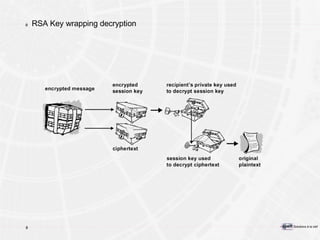
  • 187.
    Manual IPSec Oneach gateway a specific SA is defined (according S/WAN) for each remote gateway (SPI, Cipher, Keys, Hash etc.) Drawback: Very heavy management Static keys: less security Often used between different IPSec vendors Cisco to Check Point for instance
  • 188.
    Manual IPSec SASPI SA SPI
  • 189.
    IKE Key managementIKE is widely used (OSPF, IPSec etc..) SA proposal and negotiation is done using IKE Peers may be authenticated using X.509 certificate Each IPSec gateway holds a X.509 certificate SA negotiation starts after cross authentication Alternate method for authentication: Authentication is provided by pre-shared secrets Drawback: heavy key management etc.
  • 190.
    IKE Key managementusing PKI SA SPI SA SPI Negotiation with Automatic Key Management X509 X509
  • 191.
  • 192.
    Pour plus d’informationse-Xpert Solutions SA Sylvain Maret Route de Pré-Marais 29 CH-1233 Bernex / Genève +41 22 727 05 55 [email_address]